A minimal, developer-friendly pretty-printer and debug dumper for Go structs, inspired by Laravel’s dump() and Symfony’s VarDumper.
Go
1,768
95 commits
updated Oct 2, 2026



godump is a developer-friendly, zero-dependency debug dumper for Go. It provides pretty, colorized terminal output of your structs, slices, maps, and more - complete with cyclic reference detection and control character escaping.
Inspired by Symfony's VarDumper which is used in Laravel's tools like dump() and dd().
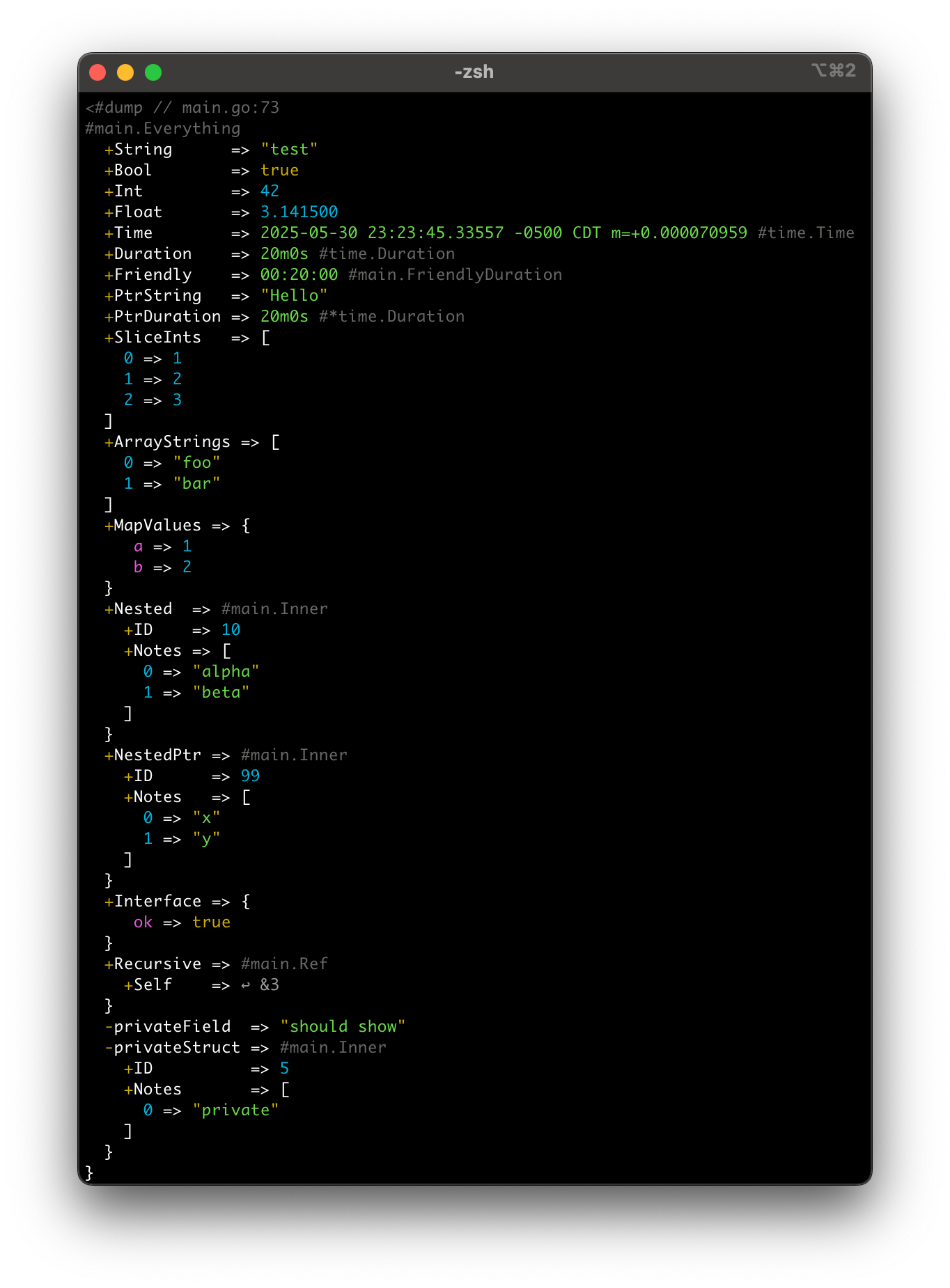
Terminal Output Example (Kitchen Sink)
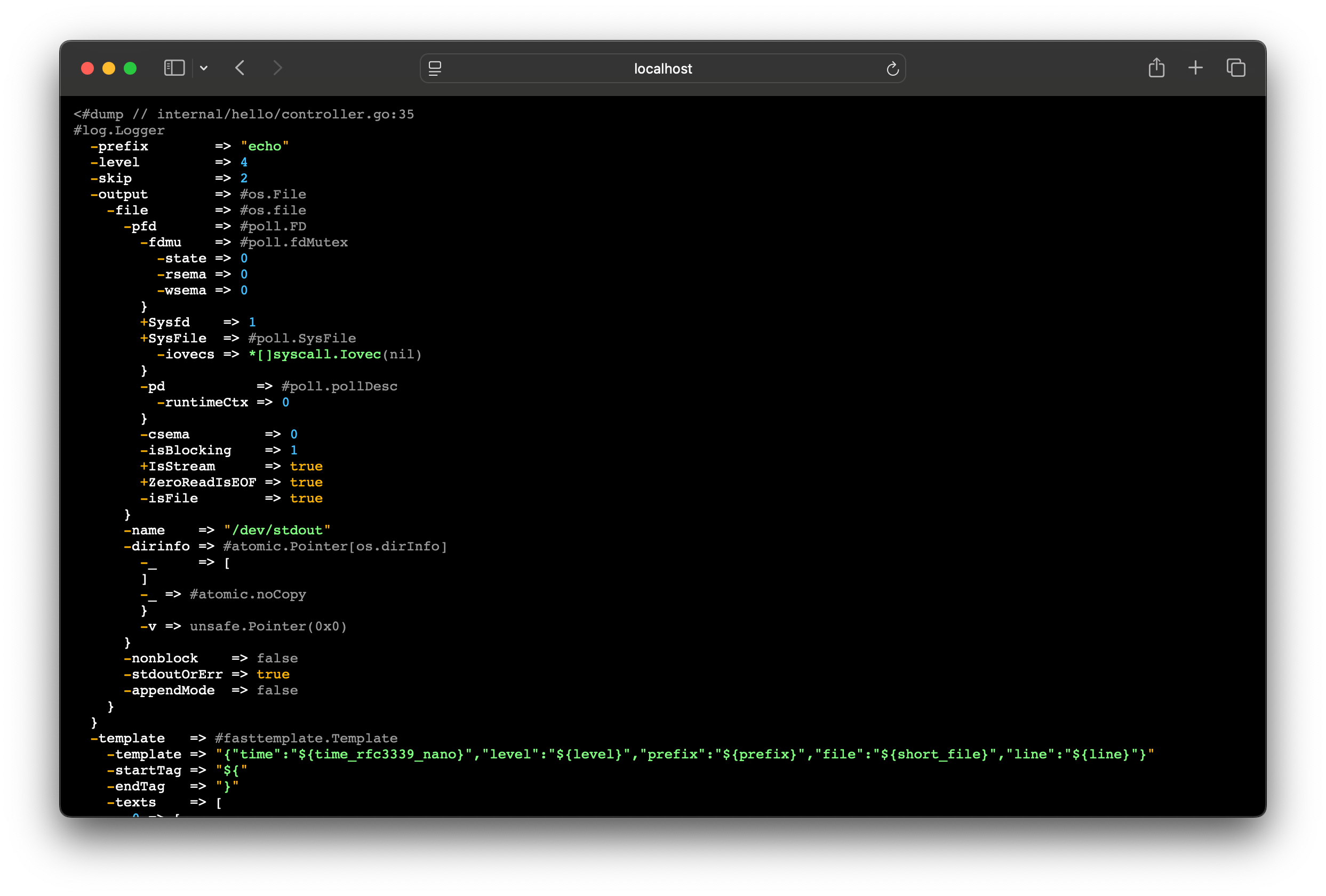
HTML Output Example
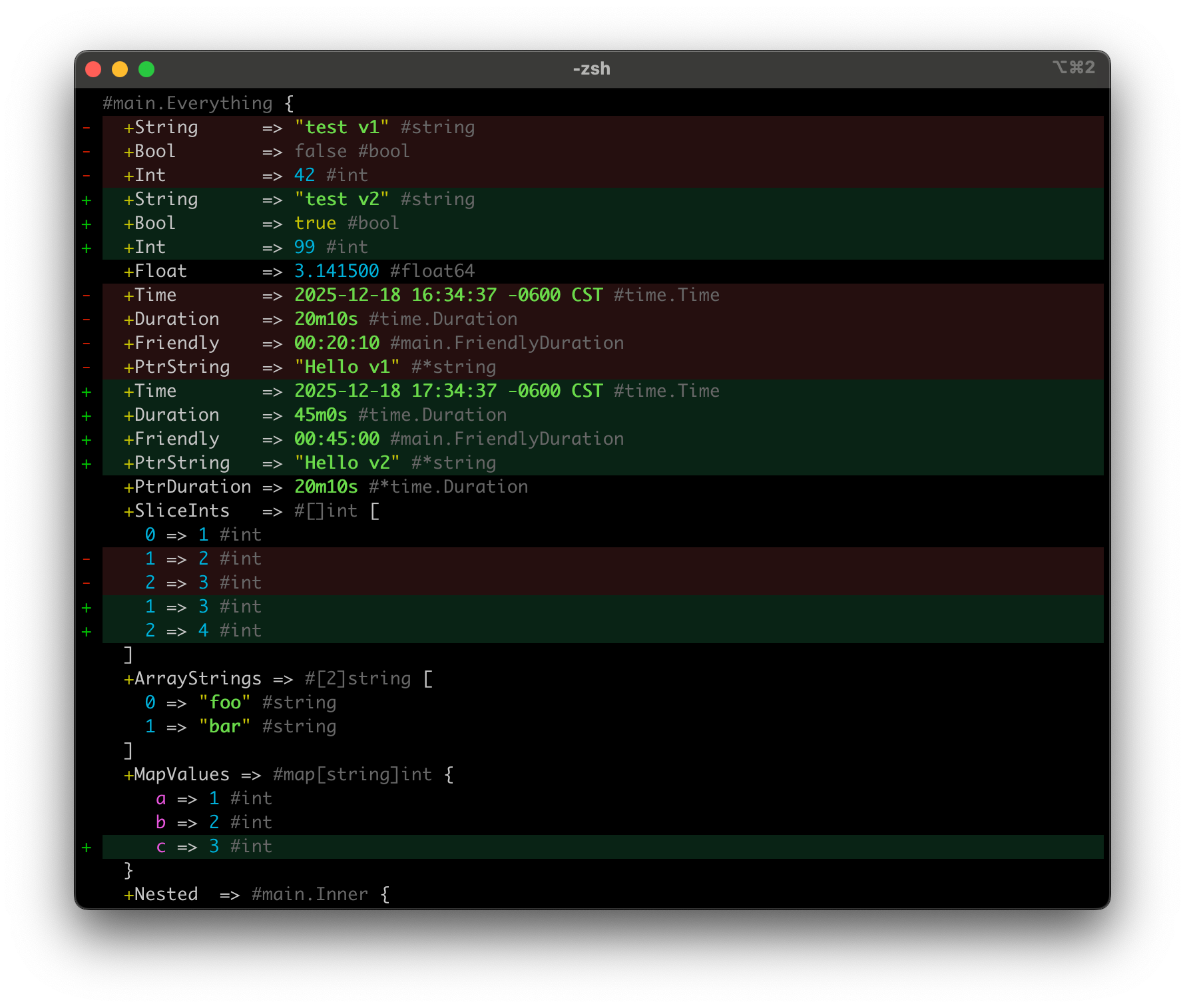
godump.Diff(a,b) Output Example
godump vs go-spew vs pp| Feature | godump | go-spew | pp |
|---|---|---|---|
| Zero dependencies | ✓ | - | - |
| Colorized terminal output | ✓ | ✓ | ✓ |
| HTML output | ✓ | - | - |
JSON output helpers (DumpJSON, DumpJSONStr) | ✓ | - | - |
Diff output helpers (Diff, DiffStr) | ✓ | - | - |
Diff HTML output (DiffHTML) | ✓ | - | - |
Dump to io.Writer | ✓ | ✓ | ✓ |
| Shows file + line number of dump call | ✓ | - | - |
| Cyclic reference detection | ✓ | ~ | - |
| Handles unexported struct fields | ✓ | ✓ | ✓ |
Visibility markers (+ / -) | ✓ | - | - |
| Max depth control | ✓ | - | - |
| Max items (slice/map truncation) | ✓ | - | - |
| Max string length truncation | ✓ | - | - |
Dump & Die (dd() equivalent) | ✓ | - | - |
| Control character escaping | ✓ | ~ | ~ |
| Supports structs, maps, slices, pointers, interfaces | ✓ | ✓ | ✓ |
Pretty type name rendering (#package.Type) | ✓ | - | - |
| Builder-style configuration API | ✓ | - | - |
Test-friendly string output (DumpStr, DiffStr, DumpJSONStr) | ✓ | ✓ | ✓ |
| HTML / Web UI debugging support | ✓ | - | - |
If you'd like to suggest improvements or additional comparisons, feel free to open an issue or PR.
go get github.com/goforj/godump
type User struct { Name string }
godump.Dump(User{Name: "Alice"})
// #main.User {
//    +Name => "Alice" #string
// }
godump.DumpStr(v)     // return as string
godump.DumpHTML(v)    // return HTML output
godump.DumpJSON(v)    // print JSON directly
godump.Fdump(w, v)    // write to io.Writer
godump.Dd(v)          // dump + exit
godump.Diff(a, b)     // diff two values
godump.DiffStr(a, b)  // diff two values as string
godump.DiffHTML(a, b) // diff two values as HTML
type User struct {
    Name string
}
before := User{Name: "Alice"}
after := User{Name: "Bob"}
godump.Diff(before, after)
//   #main.User {
// -   +Name => "Alice" #string
// +   +Name => "Bob" #string
//   }
godump aims for simple usage with sensible defaults out of the box, but also provides a flexible builder-style API for customization.
If you want to heavily customize the dumper behavior, you can create a Dumper instance with specific options:
godump.NewDumper(
    godump.WithMaxDepth(15),           // default: 15
    godump.WithMaxItems(100),          // default: 100
    godump.WithMaxStringLen(100000),   // default: 100000
    godump.WithWriter(os.Stdout),      // default: os.Stdout
    godump.WithSkipStackFrames(10),    // default: 10
    godump.WithDisableStringer(false), // default: false
    godump.WithoutColor(),             // default: false
).Dump(v)
Ensure that all tests pass, and you run ./docs/generate.sh to update the API index in the README before submitting a PR.
Ensure all public functions have documentation blocks with examples, as these are used to generate runnable examples and the API index.
Every function has a corresponding runnable example under ./examples.
These examples are generated directly from the documentation blocks of each function, ensuring the docs and code never drift. These are the same examples you see here in the README and GoDoc.
An automated test executes every example to verify it builds and runs successfully.
This guarantees all examples are valid, up-to-date, and remain functional as the API evolves.
godump output is designed for clarity and traceability. Here's how to interpret its structure:
<#dump // main.go:26
godump.Dump() was invoked.#main.User
  +Name => "Alice"
  -secret  => "..."
+ → Exported (public) field- → Unexported (private) field (accessed reflectively)If a pointer has already been printed:
↩︎ &1
  0 => "value"
  a => 1
=> formatting and indentationmaxItems is exceeded"Line1\nLine2\tDone"
\n, \t, \r, etc. are safely escapedmaxStringLen runes| Group | Functions |
|---|---|
| Builder | NewDumper |
| Diff | Diff · DiffHTML · DiffStr |
| Dump | Dd · Dump · DumpStr · Fdump |
| HTML | DumpHTML |
| JSON | DumpJSON · DumpJSONStr |
| Options | WithDisableStringer · WithExcludeFields · WithFieldMatchMode · WithMaxDepth · WithMaxItems · WithMaxStringLen · WithOnlyFields · WithRedactFields · WithRedactMatchMode · WithRedactSensitive · WithSkipStackFrames · WithWriter · WithoutColor · WithoutHeader |
NewDumper creates a new Dumper with the given options applied. Defaults are used for any setting not overridden.
v := map[string]int{"a": 1}
d := godump.NewDumper(
	godump.WithMaxDepth(10),
	godump.WithWriter(os.Stdout),
)
d.Dump(v)
// #map[string]int {
//   a => 1 #int
// }
Diff prints a diff between two values to stdout.
Example: print diff
a := map[string]int{"a": 1}
b := map[string]int{"a": 2}
godump.Diff(a, b)
// <#diff // path:line
// - #map[string]int {
// -   a => 1 #int
// - }
// + #map[string]int {
// +   a => 2 #int
// + }
Example: print diff with a custom dumper
d := godump.NewDumper()
a := map[string]int{"a": 1}
b := map[string]int{"a": 2}
d.Diff(a, b)
// <#diff // path:line
// - #map[string]int {
// -   a => 1 #int
// - }
// + #map[string]int {
// +   a => 2 #int
// + }
DiffHTML returns an HTML diff between two values.
Example: HTML diff
a := map[string]int{"a": 1}
b := map[string]int{"a": 2}
html := godump.DiffHTML(a, b)
_ = html
// (html diff)
Example: HTML diff with a custom dumper
d := godump.NewDumper()
a := map[string]int{"a": 1}
b := map[string]int{"a": 2}
html := d.DiffHTML(a, b)
_ = html
// (html diff)
DiffStr returns a string diff between two values.
Example: diff string
a := map[string]int{"a": 1}
b := map[string]int{"a": 2}
out := godump.DiffStr(a, b)
_ = out
// <#diff // path:line
// - #map[string]int {
// -   a => 1 #int
// - }
// + #map[string]int {
// +   a => 2 #int
// + }
Example: diff string with a custom dumper
d := godump.NewDumper()
a := map[string]int{"a": 1}
b := map[string]int{"a": 2}
out := d.DiffStr(a, b)
_ = out
// <#diff // path:line
// - #map[string]int {
// -   a => 1 #int
// - }
// + #map[string]int {
// +   a => 2 #int
// + }
Dd is a debug function that prints the values and exits the program.
Example: dump and exit
v := map[string]int{"a": 1}
godump.Dd(v)
// #map[string]int {
//   a => 1 #int
// }
Example: dump and exit with a custom dumper
d := godump.NewDumper()
v := map[string]int{"a": 1}
d.Dd(v)
// #map[string]int {
//   a => 1 #int
// }
Dump prints the values to stdout with colorized output.
Example: print to stdout
v := map[string]int{"a": 1}
godump.Dump(v)
// #map[string]int {
//   a => 1 #int
// }
Example: print with a custom dumper
d := godump.NewDumper()
v := map[string]int{"a": 1}
d.Dump(v)
// #map[string]int {
//   a => 1 #int
// }
DumpStr returns a string representation of the values with colorized output.
Example: get a string dump
v := map[string]int{"a": 1}
out := godump.DumpStr(v)
godump.Dump(out)
// "#map[string]int {\n  a => 1 #int\n}" #string
Example: get a string dump with a custom dumper
d := godump.NewDumper()
v := map[string]int{"a": 1}
out := d.DumpStr(v)
_ = out
// "#map[string]int {\n  a => 1 #int\n}" #string
Fdump writes the formatted dump of values to the given io.Writer.
var b strings.Builder
v := map[string]int{"a": 1}
godump.Fdump(&b, v)
// outputs to strings builder
DumpHTML dumps the values as HTML with colorized output.
Example: dump HTML
v := map[string]int{"a": 1}
html := godump.DumpHTML(v)
_ = html
// (html output)
Example: dump HTML with a custom dumper
d := godump.NewDumper()
v := map[string]int{"a": 1}
html := d.DumpHTML(v)
_ = html
fmt.Println(html)
// (html output)
DumpJSON prints a pretty-printed JSON string to the configured writer.
Example: print JSON
v := map[string]int{"a": 1}
d := godump.NewDumper()
d.DumpJSON(v)
// {
//   "a": 1
// }
Example: print JSON
v := map[string]int{"a": 1}
godump.DumpJSON(v)
// {
//   "a": 1
// }
DumpJSONStr pretty-prints values as JSON and returns it as a string.
Example: dump JSON string
v := map[string]int{"a": 1}
d := godump.NewDumper()
out := d.DumpJSONStr(v)
_ = out
// {"a":1}
Example: JSON string
v := map[string]int{"a": 1}
out := godump.DumpJSONStr(v)
_ = out
// {"a":1}
WithDisableStringer disables using the fmt.Stringer output. When enabled, the underlying type is rendered instead of String().
// Default: false
v := time.Duration(3)
d := godump.NewDumper(godump.WithDisableStringer(true))
d.Dump(v)
// 3 #time.Duration
WithExcludeFields omits struct fields that match the provided names.
// Default: none
type User struct {
	ID       int
	Email    string
	Password string
}
d := godump.NewDumper(
	godump.WithExcludeFields("Password"),
)
d.Dump(User{ID: 1, Email: "user@example.com", Password: "secret"})
// #godump.User {
//   +ID    => 1 #int
//   +Email => "user@example.com" #string
// }
WithFieldMatchMode sets how field names are matched for WithExcludeFields.
// Default: FieldMatchExact
type User struct {
	UserID int
}
d := godump.NewDumper(
	godump.WithExcludeFields("id"),
	godump.WithFieldMatchMode(godump.FieldMatchContains),
)
d.Dump(User{UserID: 10})
// #godump.User {
// }
WithMaxDepth limits how deep the structure will be dumped. Param n must be 0 or greater or this will be ignored, and default MaxDepth will be 15.
// Default: 15
v := map[string]map[string]int{"a": {"b": 1}}
d := godump.NewDumper(godump.WithMaxDepth(1))
d.Dump(v)
// #map[string]map[string]int {
//   a => #map[string]int {
//     b => 1 #int
//   }
// }
WithMaxItems limits how many items from an array, slice, or map can be printed. Param n must be 0 or greater or this will be ignored, and default MaxItems will be 100.
// Default: 100
v := []int{1, 2, 3}
d := godump.NewDumper(godump.WithMaxItems(2))
d.Dump(v)
// #[]int [
//   0 => 1 #int
//   1 => 2 #int
//   ... (truncated)
// ]
WithMaxStringLen limits how long printed strings can be. Param n must be 0 or greater or this will be ignored, and default MaxStringLen will be 100000.
// Default: 100000
v := "hello world"
d := godump.NewDumper(godump.WithMaxStringLen(5))
d.Dump(v)
// "hello…" #string
WithOnlyFields limits struct output to fields that match the provided names.
// Default: none
type User struct {
	ID       int
	Email    string
	Password string
}
d := godump.NewDumper(
	godump.WithOnlyFields("ID", "Email"),
)
d.Dump(User{ID: 1, Email: "user@example.com", Password: "secret"})
// #godump.User {
//   +ID    => 1 #int
//   +Email => "user@example.com" #string
// }
WithRedactFields replaces matching struct fields with a redacted placeholder.
// Default: none
type User struct {
	ID       int
	Password string
}
d := godump.NewDumper(
	godump.WithRedactFields("Password"),
)
d.Dump(User{ID: 1, Password: "secret"})
// #godump.User {
//   +ID       => 1 #int
//   +Password => <redacted> #string
// }
WithRedactMatchMode sets how field names are matched for WithRedactFields.
// Default: FieldMatchExact
type User struct {
	APIKey string
}
d := godump.NewDumper(
	godump.WithRedactFields("key"),
	godump.WithRedactMatchMode(godump.FieldMatchContains),
)
d.Dump(User{APIKey: "abc"})
// #godump.User {
//   +APIKey => <redacted> #string
// }
WithRedactSensitive enables default redaction for common sensitive fields.
// Default: disabled
type User struct {
	Password string
	Token    string
}
d := godump.NewDumper(
	godump.WithRedactSensitive(),
)
d.Dump(User{Password: "secret", Token: "abc"})
// #godump.User {
//   +Password => <redacted> #string
//   +Token    => <redacted> #string
// }
WithSkipStackFrames skips additional stack frames for header reporting. This is useful when godump is wrapped and the actual call site is deeper.
// Default: 0
v := map[string]int{"a": 1}
d := godump.NewDumper(godump.WithSkipStackFrames(2))
d.Dump(v)
// <#dump // ../../../../usr/local/go/src/runtime/asm_arm64.s:1223
// #map[string]int {
//   a => 1 #int
// }
WithWriter routes output to the provided writer.
// Default: stdout
var b strings.Builder
v := map[string]int{"a": 1}
d := godump.NewDumper(godump.WithWriter(&b))
d.Dump(v)
// #map[string]int {
//   a => 1 #int
// }
WithoutColor disables colorized output for the dumper.
// Default: false
v := map[string]int{"a": 1}
d := godump.NewDumper(godump.WithoutColor())
d.Dump(v)
// (prints without color)
// #map[string]int {
//   a => 1 #int
// }
WithoutHeader disables printing the source location header.
// Default: false
d := godump.NewDumper(godump.WithoutHeader())
d.Dump("hello")
// "hello" #string
Use make test for the root module, make vet for static checks, and make modernize-check to check for supported modernization opportunities. The examples directory is a separate Go module and can be tested from that directory when changed.
(top 24 of 44)
3,232 followers · starred Jun 2025
150 followers · starred Mar 2026
208 followers · starred May 2025
392 followers · starred May 2025
A minimal, developer-friendly pretty-printer and debug dumper for Go structs, inspired by Laravel’s dump() and Symfony’s VarDumper.
Go
1,768
95 commits
updated Oct 2, 2026
godump is a developer-friendly, zero-dependency debug dumper for Go. It provides pretty, colorized terminal output of your structs, slices, maps, and more - complete with cyclic reference detection and control character escaping.
Inspired by Symfony's VarDumper which is used in Laravel's tools like dump() and dd().
Terminal Output Example (Kitchen Sink)
HTML Output Example
godump.Diff(a,b) Output Example
godump vs go-spew vs pp| Feature | godump | go-spew | pp |
|---|---|---|---|
| Zero dependencies | ✓ | - | - |
| Colorized terminal output | ✓ | ✓ | ✓ |
| HTML output | ✓ | - | - |
JSON output helpers (DumpJSON, DumpJSONStr) | ✓ | - | - |
Diff output helpers (Diff, DiffStr) | ✓ | - | - |
Diff HTML output (DiffHTML) | ✓ | - | - |
Dump to io.Writer | ✓ | ✓ | ✓ |
| Shows file + line number of dump call | ✓ | - | - |
| Cyclic reference detection | ✓ | ~ | - |
| Handles unexported struct fields | ✓ | ✓ | ✓ |
Visibility markers (+ / -) | ✓ | - | - |
| Max depth control | ✓ | - | - |
| Max items (slice/map truncation) | ✓ | - | - |
| Max string length truncation | ✓ | - | - |
Dump & Die (dd() equivalent) | ✓ | - | - |
| Control character escaping | ✓ | ~ | ~ |
| Supports structs, maps, slices, pointers, interfaces | ✓ | ✓ | ✓ |
Pretty type name rendering (#package.Type) | ✓ | - | - |
| Builder-style configuration API | ✓ | - | - |
Test-friendly string output (DumpStr, DiffStr, DumpJSONStr) | ✓ | ✓ | ✓ |
| HTML / Web UI debugging support | ✓ | - | - |
If you'd like to suggest improvements or additional comparisons, feel free to open an issue or PR.
go get github.com/goforj/godump
type User struct { Name string }
godump.Dump(User{Name: "Alice"})
// #main.User {
//    +Name => "Alice" #string
// }
godump.DumpStr(v)     // return as string
godump.DumpHTML(v)    // return HTML output
godump.DumpJSON(v)    // print JSON directly
godump.Fdump(w, v)    // write to io.Writer
godump.Dd(v)          // dump + exit
godump.Diff(a, b)     // diff two values
godump.DiffStr(a, b)  // diff two values as string
godump.DiffHTML(a, b) // diff two values as HTML
type User struct {
    Name string
}
before := User{Name: "Alice"}
after := User{Name: "Bob"}
godump.Diff(before, after)
//   #main.User {
// -   +Name => "Alice" #string
// +   +Name => "Bob" #string
//   }
godump aims for simple usage with sensible defaults out of the box, but also provides a flexible builder-style API for customization.
If you want to heavily customize the dumper behavior, you can create a Dumper instance with specific options:
godump.NewDumper(
    godump.WithMaxDepth(15),           // default: 15
    godump.WithMaxItems(100),          // default: 100
    godump.WithMaxStringLen(100000),   // default: 100000
    godump.WithWriter(os.Stdout),      // default: os.Stdout
    godump.WithSkipStackFrames(10),    // default: 10
    godump.WithDisableStringer(false), // default: false
    godump.WithoutColor(),             // default: false
).Dump(v)
Ensure that all tests pass, and you run ./docs/generate.sh to update the API index in the README before submitting a PR.
Ensure all public functions have documentation blocks with examples, as these are used to generate runnable examples and the API index.
Every function has a corresponding runnable example under ./examples.
These examples are generated directly from the documentation blocks of each function, ensuring the docs and code never drift. These are the same examples you see here in the README and GoDoc.
An automated test executes every example to verify it builds and runs successfully.
This guarantees all examples are valid, up-to-date, and remain functional as the API evolves.
godump output is designed for clarity and traceability. Here's how to interpret its structure:
<#dump // main.go:26
godump.Dump() was invoked.#main.User
  +Name => "Alice"
  -secret  => "..."
+ → Exported (public) field- → Unexported (private) field (accessed reflectively)If a pointer has already been printed:
↩︎ &1
  0 => "value"
  a => 1
=> formatting and indentationmaxItems is exceeded"Line1\nLine2\tDone"
\n, \t, \r, etc. are safely escapedmaxStringLen runes| Group | Functions |
|---|---|
| Builder | NewDumper |
| Diff | Diff · DiffHTML · DiffStr |
| Dump | Dd · Dump · DumpStr · Fdump |
| HTML | DumpHTML |
| JSON | DumpJSON · DumpJSONStr |
| Options | WithDisableStringer · WithExcludeFields · WithFieldMatchMode · WithMaxDepth · WithMaxItems · WithMaxStringLen · WithOnlyFields · WithRedactFields · WithRedactMatchMode · WithRedactSensitive · WithSkipStackFrames · WithWriter · WithoutColor · WithoutHeader |
NewDumper creates a new Dumper with the given options applied. Defaults are used for any setting not overridden.
v := map[string]int{"a": 1}
d := godump.NewDumper(
	godump.WithMaxDepth(10),
	godump.WithWriter(os.Stdout),
)
d.Dump(v)
// #map[string]int {
//   a => 1 #int
// }
Diff prints a diff between two values to stdout.
Example: print diff
a := map[string]int{"a": 1}
b := map[string]int{"a": 2}
godump.Diff(a, b)
// <#diff // path:line
// - #map[string]int {
// -   a => 1 #int
// - }
// + #map[string]int {
// +   a => 2 #int
// + }
Example: print diff with a custom dumper
d := godump.NewDumper()
a := map[string]int{"a": 1}
b := map[string]int{"a": 2}
d.Diff(a, b)
// <#diff // path:line
// - #map[string]int {
// -   a => 1 #int
// - }
// + #map[string]int {
// +   a => 2 #int
// + }
DiffHTML returns an HTML diff between two values.
Example: HTML diff
a := map[string]int{"a": 1}
b := map[string]int{"a": 2}
html := godump.DiffHTML(a, b)
_ = html
// (html diff)
Example: HTML diff with a custom dumper
d := godump.NewDumper()
a := map[string]int{"a": 1}
b := map[string]int{"a": 2}
html := d.DiffHTML(a, b)
_ = html
// (html diff)
DiffStr returns a string diff between two values.
Example: diff string
a := map[string]int{"a": 1}
b := map[string]int{"a": 2}
out := godump.DiffStr(a, b)
_ = out
// <#diff // path:line
// - #map[string]int {
// -   a => 1 #int
// - }
// + #map[string]int {
// +   a => 2 #int
// + }
Example: diff string with a custom dumper
d := godump.NewDumper()
a := map[string]int{"a": 1}
b := map[string]int{"a": 2}
out := d.DiffStr(a, b)
_ = out
// <#diff // path:line
// - #map[string]int {
// -   a => 1 #int
// - }
// + #map[string]int {
// +   a => 2 #int
// + }
Dd is a debug function that prints the values and exits the program.
Example: dump and exit
v := map[string]int{"a": 1}
godump.Dd(v)
// #map[string]int {
//   a => 1 #int
// }
Example: dump and exit with a custom dumper
d := godump.NewDumper()
v := map[string]int{"a": 1}
d.Dd(v)
// #map[string]int {
//   a => 1 #int
// }
Dump prints the values to stdout with colorized output.
Example: print to stdout
v := map[string]int{"a": 1}
godump.Dump(v)
// #map[string]int {
//   a => 1 #int
// }
Example: print with a custom dumper
d := godump.NewDumper()
v := map[string]int{"a": 1}
d.Dump(v)
// #map[string]int {
//   a => 1 #int
// }
DumpStr returns a string representation of the values with colorized output.
Example: get a string dump
v := map[string]int{"a": 1}
out := godump.DumpStr(v)
godump.Dump(out)
// "#map[string]int {\n  a => 1 #int\n}" #string
Example: get a string dump with a custom dumper
d := godump.NewDumper()
v := map[string]int{"a": 1}
out := d.DumpStr(v)
_ = out
// "#map[string]int {\n  a => 1 #int\n}" #string
Fdump writes the formatted dump of values to the given io.Writer.
var b strings.Builder
v := map[string]int{"a": 1}
godump.Fdump(&b, v)
// outputs to strings builder
DumpHTML dumps the values as HTML with colorized output.
Example: dump HTML
v := map[string]int{"a": 1}
html := godump.DumpHTML(v)
_ = html
// (html output)
Example: dump HTML with a custom dumper
d := godump.NewDumper()
v := map[string]int{"a": 1}
html := d.DumpHTML(v)
_ = html
fmt.Println(html)
// (html output)
DumpJSON prints a pretty-printed JSON string to the configured writer.
Example: print JSON
v := map[string]int{"a": 1}
d := godump.NewDumper()
d.DumpJSON(v)
// {
//   "a": 1
// }
Example: print JSON
v := map[string]int{"a": 1}
godump.DumpJSON(v)
// {
//   "a": 1
// }
DumpJSONStr pretty-prints values as JSON and returns it as a string.
Example: dump JSON string
v := map[string]int{"a": 1}
d := godump.NewDumper()
out := d.DumpJSONStr(v)
_ = out
// {"a":1}
Example: JSON string
v := map[string]int{"a": 1}
out := godump.DumpJSONStr(v)
_ = out
// {"a":1}
WithDisableStringer disables using the fmt.Stringer output. When enabled, the underlying type is rendered instead of String().
// Default: false
v := time.Duration(3)
d := godump.NewDumper(godump.WithDisableStringer(true))
d.Dump(v)
// 3 #time.Duration
WithExcludeFields omits struct fields that match the provided names.
// Default: none
type User struct {
	ID       int
	Email    string
	Password string
}
d := godump.NewDumper(
	godump.WithExcludeFields("Password"),
)
d.Dump(User{ID: 1, Email: "user@example.com", Password: "secret"})
// #godump.User {
//   +ID    => 1 #int
//   +Email => "user@example.com" #string
// }
WithFieldMatchMode sets how field names are matched for WithExcludeFields.
// Default: FieldMatchExact
type User struct {
	UserID int
}
d := godump.NewDumper(
	godump.WithExcludeFields("id"),
	godump.WithFieldMatchMode(godump.FieldMatchContains),
)
d.Dump(User{UserID: 10})
// #godump.User {
// }
WithMaxDepth limits how deep the structure will be dumped. Param n must be 0 or greater or this will be ignored, and default MaxDepth will be 15.
// Default: 15
v := map[string]map[string]int{"a": {"b": 1}}
d := godump.NewDumper(godump.WithMaxDepth(1))
d.Dump(v)
// #map[string]map[string]int {
//   a => #map[string]int {
//     b => 1 #int
//   }
// }
WithMaxItems limits how many items from an array, slice, or map can be printed. Param n must be 0 or greater or this will be ignored, and default MaxItems will be 100.
// Default: 100
v := []int{1, 2, 3}
d := godump.NewDumper(godump.WithMaxItems(2))
d.Dump(v)
// #[]int [
//   0 => 1 #int
//   1 => 2 #int
//   ... (truncated)
// ]
WithMaxStringLen limits how long printed strings can be. Param n must be 0 or greater or this will be ignored, and default MaxStringLen will be 100000.
// Default: 100000
v := "hello world"
d := godump.NewDumper(godump.WithMaxStringLen(5))
d.Dump(v)
// "hello…" #string
WithOnlyFields limits struct output to fields that match the provided names.
// Default: none
type User struct {
	ID       int
	Email    string
	Password string
}
d := godump.NewDumper(
	godump.WithOnlyFields("ID", "Email"),
)
d.Dump(User{ID: 1, Email: "user@example.com", Password: "secret"})
// #godump.User {
//   +ID    => 1 #int
//   +Email => "user@example.com" #string
// }
WithRedactFields replaces matching struct fields with a redacted placeholder.
// Default: none
type User struct {
	ID       int
	Password string
}
d := godump.NewDumper(
	godump.WithRedactFields("Password"),
)
d.Dump(User{ID: 1, Password: "secret"})
// #godump.User {
//   +ID       => 1 #int
//   +Password => <redacted> #string
// }
WithRedactMatchMode sets how field names are matched for WithRedactFields.
// Default: FieldMatchExact
type User struct {
	APIKey string
}
d := godump.NewDumper(
	godump.WithRedactFields("key"),
	godump.WithRedactMatchMode(godump.FieldMatchContains),
)
d.Dump(User{APIKey: "abc"})
// #godump.User {
//   +APIKey => <redacted> #string
// }
WithRedactSensitive enables default redaction for common sensitive fields.
// Default: disabled
type User struct {
	Password string
	Token    string
}
d := godump.NewDumper(
	godump.WithRedactSensitive(),
)
d.Dump(User{Password: "secret", Token: "abc"})
// #godump.User {
//   +Password => <redacted> #string
//   +Token    => <redacted> #string
// }
WithSkipStackFrames skips additional stack frames for header reporting. This is useful when godump is wrapped and the actual call site is deeper.
// Default: 0
v := map[string]int{"a": 1}
d := godump.NewDumper(godump.WithSkipStackFrames(2))
d.Dump(v)
// <#dump // ../../../../usr/local/go/src/runtime/asm_arm64.s:1223
// #map[string]int {
//   a => 1 #int
// }
WithWriter routes output to the provided writer.
// Default: stdout
var b strings.Builder
v := map[string]int{"a": 1}
d := godump.NewDumper(godump.WithWriter(&b))
d.Dump(v)
// #map[string]int {
//   a => 1 #int
// }
WithoutColor disables colorized output for the dumper.
// Default: false
v := map[string]int{"a": 1}
d := godump.NewDumper(godump.WithoutColor())
d.Dump(v)
// (prints without color)
// #map[string]int {
//   a => 1 #int
// }
WithoutHeader disables printing the source location header.
// Default: false
d := godump.NewDumper(godump.WithoutHeader())
d.Dump("hello")
// "hello" #string
Use make test for the root module, make vet for static checks, and make modernize-check to check for supported modernization opportunities. The examples directory is a separate Go module and can be tested from that directory when changed.
(top 24 of 44)
3,232 followers · starred Jun 2025
150 followers · starred Mar 2026
208 followers · starred May 2025
392 followers · starred May 2025



