
Import this repo for a toolchain and methodology to generate your own complex music videos with Claude Opus 5.5 or whatever comes next.
TypeScript
0
1 commits
updated Oct 3, 2026
See what people are saying
README
drawn in code
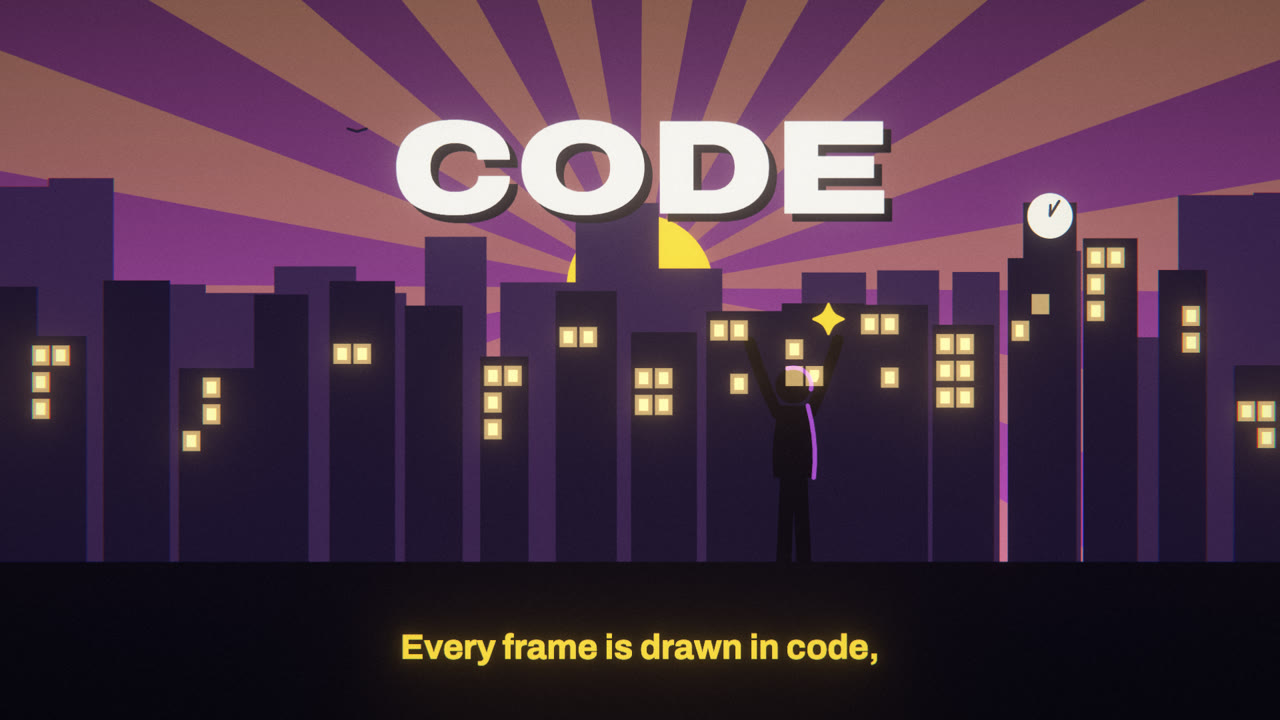
A toolchain and a method for making music videos in which every frame is drawn in code. The song comes from an AI music generator; the words, timing analysis, design and code are written with Claude; a human directs.
The output is a 3840×2160, 60 fps film with motion blur, where:
- every sung word is on screen at the moment it is sung;
- every cut lands on the beat;
- a character with a face acts every line.
It was built for one brief and is written down here so the next film starts further on.
What is here
| Path | What it is |
|---|---|
METHOD.md | The method end to end: from a brief to words, takes, timing, treatment, a shared kit, parallel plates, gates, checks and the final render |
DIRECTION.md | How to set and hold an artistic direction: palettes, type, the readable lyric, environments with clues, a character who acts (anime faces, chibi pops, lines of force), silhouettes that emote, motifs, camera grammar, the compositor's restraint, variants |
MUSIC.md | The link between the lyric (Claude), the song (Suno, or another generator) and the timing |
LESSONS.md | What broke, how it was found and the fix, with numbers |
PRIOR-ART.md | Whose work this stands on, the nearest prior art to each part, the licences that matter, and what is not new; the verified surveys are in research/ |
memory/ | The working rules in Claude Code memory format, to copy into a project's memory |
templates/ | A treatment, a variants plan, a scene guide, a brief for a plate author, and plates.json |
engine/ | The renderer: TypeScript scenes on Canvas2D and three.js, rendered offline in headless Chromium and encoded in the page with WebCodecs. It includes the shared kit (src/scenes/_motifs.ts, _manga.ts, _post.ts) and a demo scene. |
analysis/ | The timing pipeline: Demucs stems, CTC forced alignment, a whisper cross-check, the beat grid, bars and sections |
tools/ | Measuring tools (palette.py, song-analyze.py, dynamics.py, srt-lines.py, srt-check.py), soundtrack.py, make-demo-take.py, the final render (render-final.sh) and its memory guard (memwatch.py) |
takes/ | One folder per take: the master WAV and its analysis. takes/demo/ is made by tools/make-demo-take.py. |
examples/stone/ | The worked example: one brief, three films, every treatment, guide, timeline and scene file |
Try it
You need bun and FFmpeg. The renderer drives Playwright's Chromium:
python3 tools/make-demo-take.py
cd engine
bun install
bunx playwright-core install chromium chromium-headless-shell
bun scripts/render.ts stills --take demo --t 3.6,10.1 --out ../out/demo
bun scripts/render.ts video --take demo --out ../out/demo.mp4
cd ..
TAKE=demo tools/render-final.sh
The last command writes out/final/demo-4k60.mp4.
To preview in a browser, run bunx vite in engine/ and open http://localhost:5173/?take=demo.
Making a film
Read METHOD.md, then DIRECTION.md, then examples/stone/README.md. The short version:
- Write. Write the lyric for the generator (
MUSIC.md). Generate takes, and choose by ear. - Time. Decode the take to
takes/<take>/audio.wav, write the sung lines tolyrics.src.json, then runTAKE=<take> analysis/run-take.shandanalysis/analyze.py. - Script. Write the treatment and its shot-by-shot script, and commit them (
templates/TREATMENT.md). - Build the shared kit. Build the character, sets, cast and lyric presenter, look-test them, then freeze the kit.
- Plates. List the plates in
takes/<take>/plates.json(or a TypeScript timeline). Build them in parallel from a scene guide (templates/SCENE-GUIDE.md). - Gates. Storyboard gate, then a 1080p preview, then
TAKE=<take> tools/render-final.sh. Verify the result before you deliver.
Requirements and platform
- Engine: bun, Playwright's Chromium (WebCodecs H.264 with hardware encoding) and FFmpeg.
- Analysis: Python 3.12+ with uv, and a GPU for Demucs and the acoustic models.
- The alignment fuses two acoustic models. MMS_FA's weights are licensed CC-BY-NC 4.0 (non-commercial);
wav2vec2 LV60K is MIT. For commercial work, set
ALIGN_MODELS=lv60kto use the MIT model alone. On one take this put 560 of 571 words within 0.1 s of the two-model result; the worst word was off by 0.74 s. whisper_run.pyuses mlx-whisper, which runs on Apple silicon; swap in another whisper elsewhere.run-take.shasks Demucs for-d mps; change it tocudaorcpuas needed.
- The alignment fuses two acoustic models. MMS_FA's weights are licensed CC-BY-NC 4.0 (non-commercial);
wav2vec2 LV60K is MIT. For commercial work, set
- Platform: developed and measured on a 16 GB Apple-silicon laptop running macOS.
tools/memwatch.pyreads macOS memory statistics (vm_stat,sysctl,top).
Credits
- The engine and analysis are forked from pdoom-video by Giacomo
Magnanini (MIT;
engine/LICENSE-pdoom-video.txt,analysis/LICENSE-pdoom-video.txt). That repository had already solved the hard parts: offline rendering with motion blur, word-level forced alignment for sung vocals, and a scene API built for music. - Fonts: Archivo, Cormorant Garamond and IBM Plex Mono, under the SIL Open Font License (
engine/public/fonts/FONTS.md). - Made by Knight Commander Gareth (direction) and Claude (Anthropic): words, analysis, design and code.
Similar repos


Languages
TypeScript
66.6%
Python
31.4%
Shell
1.4%
Import this repo for a toolchain and methodology to generate your own complex music videos with Claude Opus 5.5 or whatever comes next.
TypeScript
0
1 commits
updated Oct 3, 2026
See what people are saying
README
drawn in code
A toolchain and a method for making music videos in which every frame is drawn in code. The song comes from an AI music generator; the words, timing analysis, design and code are written with Claude; a human directs.
The output is a 3840×2160, 60 fps film with motion blur, where:
- every sung word is on screen at the moment it is sung;
- every cut lands on the beat;
- a character with a face acts every line.
It was built for one brief and is written down here so the next film starts further on.
What is here
| Path | What it is |
|---|---|
METHOD.md | The method end to end: from a brief to words, takes, timing, treatment, a shared kit, parallel plates, gates, checks and the final render |
DIRECTION.md | How to set and hold an artistic direction: palettes, type, the readable lyric, environments with clues, a character who acts (anime faces, chibi pops, lines of force), silhouettes that emote, motifs, camera grammar, the compositor's restraint, variants |
MUSIC.md | The link between the lyric (Claude), the song (Suno, or another generator) and the timing |
LESSONS.md | What broke, how it was found and the fix, with numbers |
PRIOR-ART.md | Whose work this stands on, the nearest prior art to each part, the licences that matter, and what is not new; the verified surveys are in research/ |
memory/ | The working rules in Claude Code memory format, to copy into a project's memory |
templates/ | A treatment, a variants plan, a scene guide, a brief for a plate author, and plates.json |
engine/ | The renderer: TypeScript scenes on Canvas2D and three.js, rendered offline in headless Chromium and encoded in the page with WebCodecs. It includes the shared kit (src/scenes/_motifs.ts, _manga.ts, _post.ts) and a demo scene. |
analysis/ | The timing pipeline: Demucs stems, CTC forced alignment, a whisper cross-check, the beat grid, bars and sections |
tools/ | Measuring tools (palette.py, song-analyze.py, dynamics.py, srt-lines.py, srt-check.py), soundtrack.py, make-demo-take.py, the final render (render-final.sh) and its memory guard (memwatch.py) |
takes/ | One folder per take: the master WAV and its analysis. takes/demo/ is made by tools/make-demo-take.py. |
examples/stone/ | The worked example: one brief, three films, every treatment, guide, timeline and scene file |
Try it
You need bun and FFmpeg. The renderer drives Playwright's Chromium:
python3 tools/make-demo-take.py
cd engine
bun install
bunx playwright-core install chromium chromium-headless-shell
bun scripts/render.ts stills --take demo --t 3.6,10.1 --out ../out/demo
bun scripts/render.ts video --take demo --out ../out/demo.mp4
cd ..
TAKE=demo tools/render-final.sh
The last command writes out/final/demo-4k60.mp4.
To preview in a browser, run bunx vite in engine/ and open http://localhost:5173/?take=demo.
Making a film
Read METHOD.md, then DIRECTION.md, then examples/stone/README.md. The short version:
- Write. Write the lyric for the generator (
MUSIC.md). Generate takes, and choose by ear. - Time. Decode the take to
takes/<take>/audio.wav, write the sung lines tolyrics.src.json, then runTAKE=<take> analysis/run-take.shandanalysis/analyze.py. - Script. Write the treatment and its shot-by-shot script, and commit them (
templates/TREATMENT.md). - Build the shared kit. Build the character, sets, cast and lyric presenter, look-test them, then freeze the kit.
- Plates. List the plates in
takes/<take>/plates.json(or a TypeScript timeline). Build them in parallel from a scene guide (templates/SCENE-GUIDE.md). - Gates. Storyboard gate, then a 1080p preview, then
TAKE=<take> tools/render-final.sh. Verify the result before you deliver.
Requirements and platform
- Engine: bun, Playwright's Chromium (WebCodecs H.264 with hardware encoding) and FFmpeg.
- Analysis: Python 3.12+ with uv, and a GPU for Demucs and the acoustic models.
- The alignment fuses two acoustic models. MMS_FA's weights are licensed CC-BY-NC 4.0 (non-commercial);
wav2vec2 LV60K is MIT. For commercial work, set
ALIGN_MODELS=lv60kto use the MIT model alone. On one take this put 560 of 571 words within 0.1 s of the two-model result; the worst word was off by 0.74 s. whisper_run.pyuses mlx-whisper, which runs on Apple silicon; swap in another whisper elsewhere.run-take.shasks Demucs for-d mps; change it tocudaorcpuas needed.
- The alignment fuses two acoustic models. MMS_FA's weights are licensed CC-BY-NC 4.0 (non-commercial);
wav2vec2 LV60K is MIT. For commercial work, set
- Platform: developed and measured on a 16 GB Apple-silicon laptop running macOS.
tools/memwatch.pyreads macOS memory statistics (vm_stat,sysctl,top).
Credits
- The engine and analysis are forked from pdoom-video by Giacomo
Magnanini (MIT;
engine/LICENSE-pdoom-video.txt,analysis/LICENSE-pdoom-video.txt). That repository had already solved the hard parts: offline rendering with motion blur, word-level forced alignment for sung vocals, and a scene API built for music. - Fonts: Archivo, Cormorant Garamond and IBM Plex Mono, under the SIL Open Font License (
engine/public/fonts/FONTS.md). - Made by Knight Commander Gareth (direction) and Claude (Anthropic): words, analysis, design and code.
Similar repos
Languages
TypeScript
66.6%
Python
31.4%
Shell
1.4%