What Claude Code sends on every turn before you type a word: what it costs, which of it you never used, and which of your skills never reached the agent.
See the codeWhat Claude Code sends on every turn before you type a word: what it costs, which of it you never used, and which of it never reached your agent at all.





npx context-tax
For Claude Code.
Every article about MCP context bloat ends with the same advice: audit which tools your agent actually calls, and prune the rest. None of them automate that sentence. They tell you to do it by hand.
This does it for you. Your session transcripts already record what Claude Code sent to the model, so it reads that instead of guessing: the skill listing as it went out, the tool names, your instruction files, the client's own tools. It reads the same transcripts for what you actually called, and multiplies.
No install, no account, no sign-up, no telemetry, no LLM call, and no context-tax server for
anything to be sent to.
| Read, not modelled | Rows come from what a recent session sent, measured on the text itself. The per-turn total comes from the usage your API calls were billed on |
| What your agent never received | Past its budget, Claude Code sends a skill as a bare name with no description. This counts them, says whose they are, and prices sending them all |
| Cost per use, not per turn | A 400-token server used once in 96 sessions cost you 17M tokens, and that is the number that changes minds |
| It writes the fix | context-tax fix routes each finding to the lever that actually turns that thing off |
| Two screens made to be shared | A receipt and a picture of one session, with no server name, skill name or path on either |
| Zero runtime dependencies | Not "few". None. Asserted by a test against the import graph |
context-tax fix[!NOTE] Every number and name below is fabricated for illustration, on an invented config. The screens are real renderer output, generated from a fixture, so the docs cannot drift from the code. Run
npx context-taxto see your own.
  context-tax  ~/projects/storefront
  on this machine: 96 sessions, 42,900 turns, 1.7B tokens of context carried.
  You typed /clear 118, /compact 31.

  40,000 tokens on every turn, 20% of a window of about 200,000, before you type
  a word. 1,900 of them are recoverable from the 8 findings below.

  ┌───────────────────────┬──────────┬───────────┬────────┬────────┬───────────┐
  │ MCP SERVERS           │   tokens │  deferred │  share │  calls │  per call │
  ├───────────────────────┼──────────┼───────────┼────────┼────────┼───────────┤
  │ figma                 │      300 │    +1,110 │     1% │      0 │         - │
  │ github                │      700 │    +3,680 │     2% │    214 │      140K │
  │ linear                │      300 │    +2,540 │     1% │      3 │      4.3M │
  │ postgres              │        - │         - │      - │      0 │         - │
  │ sentry                │      400 │    +6,300 │     1% │      1 │       17M │
  │ claude_ai_Notion      │      900 │         - │     2% │      2 │       19M │
  ├───────────────────────┼──────────┼───────────┼────────┼────────┼───────────┤
  │ 31 skills             │    2,000 │         - │     5% │      1 │         - │
  │ 11 agents             │    2,400 │         - │     6% │      - │         - │
  │ 2 memory files        │    1,600 │         - │     4% │      - │         - │
  │ your hooks            │      400 │         - │     1% │      - │         - │
  ├───────────────────────┼──────────┼───────────┼────────┼────────┼───────────┤
  │ CLAUDE CODE ITSELF    │          │           │        │        │           │
  │ its 14 tools          │   22,000 │         - │    55% │      - │         - │
  │ its system prompt     │    3,200 │         - │     8% │      - │         - │
  │ its tool name list    │      400 │         - │     1% │      - │         - │
  │ its session details   │      600 │         - │     2% │      - │         - │
  ├───────────────────────┼──────────┼───────────┼────────┼────────┼───────────┤
  │ unattributed          │    4,800 │           │    12% │        │           │
  │ EVERY TURN            │   40,000 │           │   100% │        │           │
  └───────────────────────┴──────────┴───────────┴────────┴────────┴───────────┘
    postgres: configured but off, so nothing was started to measure
    31 skills: as sent in your session of 2026-09-01: 9 skills went as a name
      with no description, because Claude Code caps this listing at about 8,000
      characters, its share of a window of about 200,000 tokens
    11 agents: agent listings are not separable from the prompt
    2 memory files: the model reads these, it does not call them, so no log
      can say which lines were used
    your hooks: what your hooks put in front of the first turn. A hook that
      adds context on every prompt adds this much again each time
    its 14 tools: sent by Claude Code itself on every turn. A permissions.deny
      rule takes one out of what is sent
    its system prompt, its tool name list, its session details: sent by Claude
      Code itself on every turn, so there is nothing here to switch off
    EVERY TURN is exact, from usage. Median first request across your 10 most
    recent sessions, 2026-08-24 to 2026-09-01.
    Rows are what your session of 2026-09-01 sent, read from its transcript. A
    row that says otherwise was weighed from your config.
    token counts are chars/4, measured within 4%; a server's schemas are counted
    whole, which is what you pay only if your client does not defer them.
    tokens: what every turn carries. deferred: the schemas behind it, paid when
    something loads them.

  FINDINGS
    1. 9 of your 31 skills reach the model as a name with no description
       design-kit 7 of 12, your own 2 of 14 (release-notes, db-migrate). A bare
       name gives the model nothing to choose a skill by. The cap is about 8,000
       characters and yours needs about 11,640. From your session of 2026-09-01;
       who loses out shifts with recent use.
       fix: set skillListingBudgetFraction to 0.015 and every description is
       sent, for about 910 more tokens on every turn (context-tax fix
       --restore-descriptions writes it). Or make room: each skill switched off
       below hands its space to another description
    2. figma costs 300 tokens every turn and has never been called
       0 calls in 96 sessions since it was configured. Loading its schemas costs
       1,110 tokens more, every time something does.
       fix: add "figma" to disabledMcpjsonServers in
       ~/projects/storefront/.claude/settings.local.json
    3. github: 9 of its 26 tools have never been called
       create_gist, delete_file, fork_repo, list_gists, ... Their names and
       descriptions cost 415 tokens on every turn, and 1,102 tokens of schema
       you have never used waits behind them.
       fix: MCP has no per-tool switch. Ask the server for a narrower tool set,
       or drop the server.
    4. linear is loaded on every turn and used in 3 of 96 sessions on this
       machine
       300 tokens re-sent across 42,900 turns for 3 calls: 4,290,000 tokens of
       standing cost per use, counted over every session on record because
       nothing says when this was added, so read it as an upper bound. Loading
       its schemas costs 2,540 tokens more, every time something does.
       fix: claude mcp remove linear -s user
    5. sentry is loaded on every turn and used in 1 of 96 sessions
       400 tokens re-sent across 42,900 turns for 1 call: 17,160,000 tokens of
       standing cost per use. Loading its schemas costs 6,300 tokens more, every
       time something does.
       fix: add "sentry" to disabledMcpjsonServers in
       ~/projects/storefront/.claude/settings.local.json
    6. claude_ai_Notion is sent on every turn and used in 2 of 96 sessions on
       this machine
       900 tokens of tool names and instructions across 42,900 turns for 2
       calls. No file on this machine declares it, so its age is unknown and the
       per-call figure is an upper bound.
       fix: no file here declares it, so there is nothing for this tool to edit.
       /mcp in a session shows where it is connected from, and a claude.ai
       connector is switched off in your claude.ai settings
    7. 13 skills never invoked, either way
       The listing is over its budget, so most of what this frees goes to
       another description rather than out of the prompt. changelog-writer,
       commit-helper, db-migrate, ...
       fix: set each to off in skillOverrides, or delete the ones you do not
       recognise
    8. 2 of Claude Code's own tools are 4,300 tokens and used in under 1 session
       in 20
       Workflow 2,300, 2 of 96 (multi-agent workflows); ScheduleWakeup 2,000, 1
       of 96 (/loop without an interval)
       fix: context-tax fix --level lean denies them, for 4,300 fewer tokens on
       every turn. Each stops working until you take its rule out of
       permissions.deny

  NOT MEASURABLE HERE
    Your memory and instruction files are 1,600 tokens of every turn. This tool
    can tell you what they cost. It cannot tell you which of the instructions
    inside them your agent actually used. Nothing in a log can: that needs the
    model's attention, not your history.

    MCP connectors attached to your claude.ai account appear in no file on this
    machine. The ones your session connected are rows above, read from what it
    sent.

  1,900 tokens per turn recoverable from the findings above.
  context-tax measure   what each line weighs, and how
  context-tax config    what is loaded, and from where
The first line is the whole report in one sentence. How much is sent before you type, what share of your window that is, and how much of it you can get back. The share is only printed when a session proves the window it is a share of. Without one there is no percentage at all, because a percentage of an assumed window is a guess wearing a decimal point.
per call is the column that changes behaviour.
A total makes people shrug, because every total looks like the cost of doing business. Cost per use
reads as a bill. The sentry row is not expensive because 400 tokens is a lot. It is expensive
because those 400 tokens were re-sent on every one of 42,900 turns, to be used once.
The rows are read from what a session sent. A recent Claude Code writes what it sent into the session transcript: the skill listing, the tool names, each instruction file, its own tools and system prompt. The line under the table names the session the rows came from. With no such session on the machine, the rows are weighed from your config instead, and the same line says that.
deferred is the column nothing else knows to print.
Current Claude Code does not put an MCP server's tool schemas in the prompt. It sends the tool
names and the server's instructions, and loads a schema when something reaches for it. So a server
has two costs, paid at different times, and one number would have to pick a lie.
claude_ai_Notion appears in no file on the machine.
A connector attached to a claude.ai account is real context, and no config file declares it. It is a
row here because the session sent it. There is nothing for fix to edit, so the finding says where
it is switched off instead.
CLAUDE CODE ITSELF is mostly the part you cannot switch off.
The client's own tools and system prompt are usually the largest lines on the screen. They are
itemised so the rows above them read in proportion: on the invented machine above, every MCP server
together is about an eighth of what the built-in tools weigh. The tools are the exception: a
permissions.deny rule naming one takes it out of what is sent, and some of them are large. On one
real machine a single tool was 11,402 tokens of a 47,700-token first request, measured by running an
interactive session with and without the rule. Finding 8 above prices each one you rarely use.
unattributed is the honest remainder.
The total is exact, from usage. The rows are measured on text, and tokens are estimated from
characters. The difference gets its own row instead of being smeared across the numbers above it.
A - is not a 0, and a 0 is not a guess.
postgres is configured but switched off, so it was never started to find out what it weighs.
Reporting 0 there would under-report your tax and quietly recommend keeping something you pay for.
A server that does show 0 is one the session tried and could not connect to: it sent nothing, and
the row says so, because a server that fails to load fails silently everywhere else.
Claude Code gives the skill listing a budget: 1% of the context window, in characters. Every skill keeps its name. Descriptions compete for what is left, and the ones that lose are sent as a bare name. A bare name gives the model nothing to choose a skill by, so a skill you installed last week can be invisible in every session since, and nothing on screen says so.
It is the first finding when it happens (finding 1 in the report above), because it is the only one about what your agent is missing rather than what you are overpaying.
It is read from the listing a session sent, entry by entry, so it is a count and not an estimate. It
is grouped by who owns the skills, because the usual cause is one large plugin crowding out your own.
And it prices the two ways out: raise skillListingBudgetFraction and pay for every description, or
switch skills off below and hand their room to the ones you want.
context-tax fix --restore-descriptions writes the first one. It is never part of a plain fix,
because it is the one change in this tool that makes every turn cost more, and that should be
something you asked for by name.
npx context-tax receipt
                   CONTEXT TAX
       sent on every turn, before you type
  ----------------------------------------------
  Claude Code's own tools (14)            22,000
  Claude Code's system prompt              3,200
  MCP servers (5)                          2,600
  Agent listing (11)                       2,400
  Skill listing (31)                       2,000
    9 sent as a name, no description
  Instruction files (2)                    1,600
  Tool names, session details              1,000
  Your hooks                                 400
  Not itemised                             4,800
  ----------------------------------------------
  TOTAL PER TURN                          40,000
  20% of a window of about 200,000 tokens
  ----------------------------------------------
  SO FAR                            42,900 turns
                             1.7B tokens carried
  RECOVERABLE PER TURN                     1,900
  ----------------------------------------------
  npx context-tax                     2026-09-02
  read from what a session sent · chars/4
npx context-tax session                  # your longest session here, in the terminal
npx context-tax session --svg tax.svg    # the same picture as an image
npx context-tax session 4f2a             # a session by the start of its id
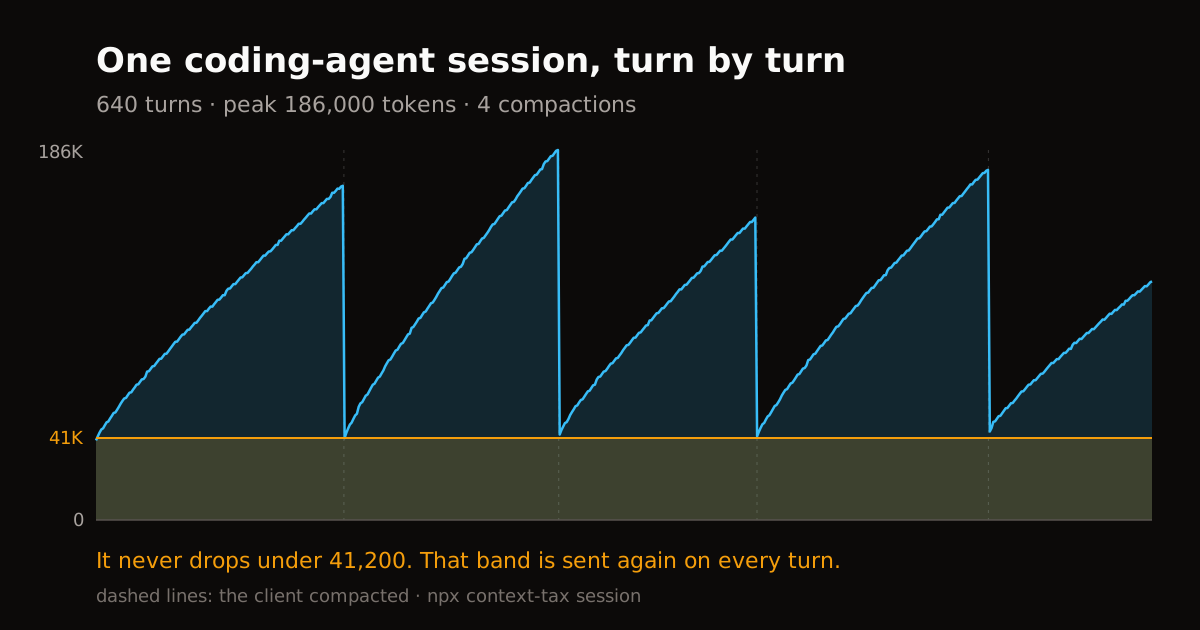
A long session is a sawtooth. Context climbs, the client compacts, it drops, it climbs again. The drop never reaches the bottom of the chart. The band it lands on is the fixed prefix: the same tokens the main screen itemises, sent again on the turn after every compaction and on every turn between.
  context-tax session  2026-09-01

   186K │                            ▂▇█                          ▂▃
        │              ▃▆▇         ▁▆███                        ▂▆██
        │            ▃▇███        ▅█████          ▂▆▆         ▂▆████
        │          ▅██████      ▂███████        ▃▆███       ▁▆██████
        │       ▁▅████████     ▆████████      ▃▇█████     ▁▆████████        ▃▆
        │     ▁▄██████████   ▃██████████    ▂▇███████    ▄██████████     ▁▄███
        │   ▁▅████████████  ▆███████████  ▂▆█████████  ▃████████████   ▂▆█████
        │  ▄██████████████▁█████████████ ▅███████████▁▆█████████████ ▃▇███████
        │▂██████████████████████████████████████████████████████████▇█████████
    41K │█████████████████████████████████████████████████████████████████████
        │█████████████████████████████████████████████████████████████████████
      0 │█████████████████████████████████████████████████████████████████████
        └────────────────▴─────────────▴────────────▴──────────────▴──────────

  640 turns, peak 186,000 tokens, compacted 4 times, and never under 41,200.
  ▴ marks a compaction. The band at the bottom is what a compaction cannot
  remove: 41,200 tokens. The session opened at 40,000, before a word of work,
  and that is the part the main screen itemises.

  context-tax session --svg <file>   the same picture, to post
Every value is exact, from the usage on each reply. The image carries numbers and nothing else: no
path, no session id, no project name.
context-tax fixThe report is the easy half. This is the half that changes something.
npx context-tax fix --dry-run                  # show every line that would change, then stop
npx context-tax fix                            # show it, ask, then write
npx context-tax fix --rare                     # also switch off tools and plugins you rarely use
npx context-tax fix --restore-descriptions     # also raise the skill listing budget
Not a summary of the change. A summary is a second description that can drift from the thing it describes, so what you confirm is the diff itself.
  WILL CHANGE

    ~/projects/storefront/.claude/settings.local.json
      disable the figma MCP server
        figma costs 300 tokens every turn and has never been called in 96
        sessions since it was configured.
      disable the sentry MCP server
        sentry costs 400 tokens every turn for 1 call in 96 sessions: 17,160,000
        tokens of standing cost per use.
      set the changelog-writer skill to off
        changelog-writer has not been invoked in 96 sessions here, by you or by
        the model.
      set the design-review skill to user-invocable-only
        design-review has only ever been typed as /design-review, never chosen
        by the model. This keeps the slash command and drops the description
        from the prompt.

      @@ -1,6 +1,17 @@
        {
          "permissions": {
      -     "allow": ["Bash(npm run test:*)", "Read(./src/**)"],
      +     "allow": [
      +       "Bash(npm run test:*)",
      +       "Read(./src/**)"
      +     ],
            "deny": []
      +   },
      +   "disabledMcpjsonServers": [
      +     "figma",
      +     "sentry"
      +   ],
      +   "skillOverrides": {
      +     "changelog-writer": "off",
      +     "design-review": "user-invocable-only"
          }
        }

  HANDED BACK TO YOU
    These do not live in a settings file this tool will write. Servers declared
    in ~/.claude.json sit beside live API keys, so context-tax neither edits
    that file nor backs it up: a backup would be a second copy of every
    credential.

    linear costs 300 tokens every turn for 3 calls, counted over every session
    on record because nothing says when it was added. It is declared in
    ~/.claude.json, which this tool does not write.
      claude mcp remove linear -s user

  700 tokens per turn recovered by the changes above.
Notice the fourth action. design-review is not switched off, it is demoted to
user-invocable-only: typing /design-review keeps working, and only the description leaves the
model's prompt. That costs you zero function, and a blunt on/off tool cannot express it, so it
tells you to delete something you use.
Notice the last line too. The two servers are the whole 700. The two skills add nothing to it here, because this listing is over its budget: the room a skill gives up goes to a description that was being dropped, not out of the prompt. That is the better outcome and a smaller number, and the number printed is the one the change delivers.
And notice the allow array. Nothing asked for it to change, and the diff shows it anyway: fix
rewrites the whole file with two-space indentation, so an array you wrote on one line comes back
one element per line. It is the one change in the diff you did not ask for, and it is in the diff
so you see it before you say yes. The file is written with mode 0600.
Write this file? [y/N]
  Written.
    ~/projects/storefront/.claude/settings.local.json
      previous contents: ~/.cache/context-tax/b…ront-.claude-settings.local.json

  Restore any of them by copying the backup back over the file.
The lever is not the same for every row, and advice that names the wrong lever does nothing at all while looking like it worked.
| Where the item came from | What fix does |
|---|---|
<repo>/.mcp.json | adds it to disabledMcpjsonServers in .claude/settings.local.json |
~/.claude.json | prints claude mcp remove <name> -s <scope> for you to run |
| a plugin | sets enabledPlugins["<plugin>@<marketplace>"]: false, scoped to this project |
| a skill | writes off, or user-invocable-only when you type it and the model never picks it |
| one of Claude Code's own tools you have never used | adds it to permissions.deny in .claude/settings.local.json |
| an agent that has never been called | adds Agent(<name>) to permissions.deny. The agent listing has no cap, so this saving is real |
| a tool or a plugin used in under 1 session in 20 | denies the tool or switches the plugin off at the lean level, and only if you pick it |
| a tool or a plugin used in under 1 session in 5 | the same at the max level |
| a claude.ai connector, or anything else no file declares | says where it is switched off, because there is no file here to edit |
| skills sent with no description | --restore-descriptions sets skillListingBudgetFraction, and only when you pass it |
fix is a subcommand rather than a flag, on purpose. It is the only command that writes to your
settings, and it should not be reachable by adding one word to a command you ran for a report. (Two
other things write, and neither is a setting: session --svg writes the image file you name, and
every measuring command caches what your servers answered under ~/.cache/context-tax/.)
--dry-run worth trusting. It still
starts your servers to measure them, the same as the report does--yes. A CLI that writes to a
config file because it could not find anyone to ask is a CLI that writes to config files in CI~/.cache/context-tax/backups/, directory 0700, files 0600rename, so an interrupted run leaves your old settings file intactNOT TOUCHED instead--restore-descriptions is the one change that adds
tokens, so it is off unless you name it, it prints what it adds, and it never lowers a budget you
have already set higherfix
shows each level with what it recovers and asks; anything else gets safe unless --level says
otherwise. Each line says what stops working~/.claude.json. That file sits beside your API keys and bearer tokens. It is
not rewritten and not backed up either, because a backup would be a second copy of every
credential on your machinecontext-tax what your context costs and whether you used it (default)
context-tax fix execute the findings, after showing every changed line
context-tax receipt the same totals with no names on them, to share
context-tax session one session turn by turn: the climb, the compactions, the floor
context-tax config what is loaded here, and where each piece came from
context-tax measure what each line item weighs, and how it was measured
context-tax evidence what your sessions actually used
| Flag | |
|---|---|
--help, -h | print the command and flag list, and exit |
--version, -v | print the version, and exit |
--cwd <path> | resolve for another directory |
--json | machine-readable output |
--top <n> | projects to list in the evidence view (default 12) |
--window <n> | recent sessions the exact total is taken from (default 10) |
--no-spawn | measure from cache and the bundled table; start nothing |
--refresh | ignore cached schemas and measure again |
--timeout <s> | per server, default 10 |
--dry-run | fix: show the diff and stop |
--yes, -y | fix: skip the confirmation |
--restore-descriptions | fix: also raise the skill listing budget so every description is sent |
--level <safe|lean|max> | fix: how much to switch off. safe (the default) is what you do not use; lean adds Claude Code's own tools and the plugins you use in under 1 session in 20; max adds the ones under 1 in 5. A terminal is asked when this is left out |
--svg <file> | session: write the picture as an SVG |
--no-color | plain text (NO_COLOR is honoured too) |
Four passes and one join, kept apart because they fail differently.
  resolve  ─┐
  measure  ─┼─►  ledger  ─►  findings  ─►  fix
  evidence ─┘
| Pass | What it knows | Confidence |
|---|---|---|
resolve/ | What is loaded here: the settings chain, .mcp.json, ~/.claude.json, plugins, skills, agents, memory | Exact, but incomplete |
measure/ | What it weighs. Performs the same initialize then tools/list handshake your agent performs at session start, against the servers already in your config, over stdio, streamable HTTP or legacy SSE | Estimated |
evidence/ | What you called, and what was sent. Parses every local transcript for tool_use blocks and usage, machine-wide, so a directory with no history of its own still has a denominator. Reads the record a recent client keeps of what it put in the prompt, and keeps sizes and names, never the text | Exact, it is what you were billed and what was sent |
ledger/ | The multiplication, and a verdict per row | The join |
The rows come from the record when a session kept one. measure still runs, for two things the
record cannot say: the deferred column, which is the schemas a session never loaded, and any server
or machine with no recorded session to read.
To measure a server you have to start it. So every command that measures says what it started and
which hosts it contacted: measure in its report, and the report, receipt and fix on stderr as
they run. Schemas are cached for a week keyed on the names of your environment variables and
never their values, ${VAR} and ${VAR:-default} in a server definition are filled in the way
Claude Code fills them, and no project server is started from a directory you are not standing
in, since running one executes code from a repo you only pointed at. --no-spawn starts no
server at all; it still runs git log to date your config.
Starting them is also where the ten seconds goes, so a run tells you which server it is waiting on
while it waits. That line is written to stderr and only when stderr is a terminal, so --json,
> file and | less carry the report and nothing else.
The failure that kills a tool like this is telling somebody that a server they added on Tuesday is dead weight. So it holds itself to a set of rules, and they are worth reading before you trust a verdict.
Every verdict carries the window it was reached over, and prints it: 0 calls in 96 sessions since
it was configured, never a bare "unused". neverCalled is unreachable in the type system without
one.
claude mcp remove <name> -s user takes a server out of every project on the machine, so it is
never recommended on one project's silence: a server idle in this repo and busy in the one next door
is not dead, and that command would break work you are still doing. Machine-wide levers are judged
on machine-wide evidence, and project-scoped levers on this project's.
The rule has a ceiling as well as a floor: a denominator must not count sessions the thing could
never have been loaded in. A .mcp.json server exists in one project, so the machine's history is
not a wider window on the same question. A directory with too little history of its own therefore
borrows the machine's for what the machine loads everywhere, and says no sessions yet, so there is
nothing to judge it on for what it does not.
Whenever a count came from more than this directory, the row says on this machine. Silence means the project, which is what every number here has always meant.
git checkout rewrites mtimes, so on a fresh clone an mtime-based tool thinks every server was
added today and goes quiet exactly when it should speak. Project servers are dated from git log,
plugin servers from your install record, and ~/.claude.json servers are reported as unknown
age, out loud, which downgrades a finding to an upper bound rather than dressing a guess up as a
fact.
If every tool a server declares looks unused while the server itself shows calls, its tools were renamed and the evidence can no longer be attributed. Printing "26 of its 26 tools have never been called" beside a row reading 214 calls is a contradiction a reader resolves by disbelieving both numbers, so it is not printed.
If the rows ever sum to more than the billed total, the estimator is wrong. The run says so and exits non-zero instead of printing a negative remainder.
Claude Code caps the skill listing at 1% of the context window, in characters: 8,000 on a 200,000-token window, 40,000 on a million. Past that every skill keeps its name and descriptions compete for what is left, so sixty skills of 1,000 characters each cost the budget that is sent, not the 60,000 on disk. One large plugin is enough to be over.
The row is read from the listing your session sent, so it includes the client's own bundled skills, which appear in no file. The window is not assumed either. It is worked back from that listing: the budget has to sit between the size of what was sent and what the smallest dropped description would have needed, and the window is that budget divided by your fraction. That is why the screen says about. A listing that fits proves nothing about the window, so then no window is claimed and no percentage is printed.
With no recorded session the row is modelled from the files on disk, and it says so: modelled, because no session here recorded its listing, with the window it guessed and why.
Two things follow either way. Past the budget, switching a few skills off recovers close to nothing,
because the room goes to another description, so a saving here is always the listing before minus the
listing after. And only a skill with a lever counts as recoverable: a plugin skill in a plugin you
use has no switch, and a number promised for it is a number fix can never deliver. For skills, the
headline and the fix plan are the same figure for that reason.
Claude Code writes a single API reply as several transcript lines, one per content block, and each
line repeats the reply's usage. Counting lines counts a reply about twice. Every turn count, every
"tokens of context carried" and every per-call figure is taken once per reply id. Versions before
0.4.0 counted lines, so their turn and per-call figures ran at about twice the truth.
A server in your config that the session could not reach sent nothing, so its row is 0 and says
could not connect, with what it weighs when it does start. It gets no finding: there is nothing to
recover from a server that costs nothing, and the useful news is that it is broken. A server added
after the recorded session began is weighed instead, because that session could not have sent it.
--cwd is an error, not a reportNothing project-scoped resolves under a path that is not there, so a typo would otherwise buy a confident page of findings about a directory that does not exist.
Token counts are chars / 4, measured within 4%. The ratio was pre-registered and then checked by
execution: adding one MCP server to a real Claude Code prompt cost 912 tokens where chars/4
predicted 948.
That same measurement found something bigger. Current Claude Code defers tool schemas, loading them on demand rather than carrying them in every prompt, so a server's schema bytes are what you would pay if they were loaded, not what you pay per turn under a client that defers. A server's names, descriptions and its (truncated) instructions blob are resident either way. That is why there are two columns.
No dollar figure is printed at all, because a wrong dollar figure is more convincing than a wrong token count.
And what it cannot answer at all, said in the output rather than in the small print: it can tell you
what your CLAUDE.md costs, but not which instructions inside it your agent used. Nothing in a log
can. That needs the model's attention, not your history.
This tool reads local files and starts the MCP servers you have already configured. That is the whole of its network activity, and all of it is to hosts you chose.
~/.claude/projects, and none of it leaves. The whole corpus
is read so a project with no history of its own can still be given a denominator. It is a local
read of files you already have: nothing is uploaded, cached off-machine or written back.--json,
or the library API. A test asserts that. (The descriptions of the skills and agents on your disk
are read as files, and config --json carries those.)env, headers and
arguments are handed to that server to start it, never printed, and never cached: schema caching
is keyed on the names of environment variables, a URL is printed as its scheme and host, and a
failing server's output is scrubbed of every value it was given. ~/.claude.json is never
written or backed up.fetch appears in exactly one file, which is the file that documents why.Not "few". None. The suite asserts it against the import graph, because an empty dependencies
block proves nothing on its own: a package can declare nothing, still import something that only
resolves because a sibling installed it, work perfectly on the author's machine, and break the
moment anybody runs npx.
Each pass is exported on its own, because each is useful without the terminal rendering.
import { resolveConfig, scanEvidence, measureContext, buildLedger } from 'context-tax';

const cwd = process.cwd();

const resolved = await resolveConfig({ cwd });
const evidence = await scanEvidence({ cwd });
// Starts the servers in the config, the same handshake your agent performs. The CLI refuses to
// start a project's servers from a directory you are not standing in; the library leaves that to
// you, so pass `trustProjectServers: false` when `cwd` is somewhere you only pointed at.
const measured = await measureContext(resolved);

const ledger = buildLedger(resolved, measured, evidence);

for (const finding of ledger.findings) {
  console.log(finding.headline, '→', finding.saves ?? 'unknown', 'tokens/turn');
}
planFixes and applyFixes are exported too, so the write path is available without the CLI. So
are the two shareable screens and the series behind the picture:
import { readSessionSeries, renderSessionSvg, renderReceipt, palette } from 'context-tax';

const series = await readSessionSeries(pathToOneTranscript);
const svg = renderSessionSvg({ series, openedAt: null });
const receipt = renderReceipt(ledger, palette(false), '2026-09-02');
evidence.sessions[n].record is what that session sent, as sizes, counts and names. The text it was
measured on is never on it.
[!WARNING]
resolveConfigreturns{ config, launch }. Onlyconfigis safe to serialize.launchholds the command lines, environment values and bearer tokens a spawn needs, and it is aMapprecisely so thatJSON.stringifyon the whole result emits{}for it.
No. The resolve and evidence passes read Claude Code's config chain and transcript format. The
measure pass is plain MCP and client-agnostic, so a reader for another client is mostly a second
resolve and evidence pass. If you use one, open an issue with its config and log layout.
Only fix writes to your settings, only after showing you the diff and asking, and it copies every
file it replaces to ~/.cache/context-tax/backups/ first. Restoring is a cp. It will not touch
~/.claude.json at all.
A server's tool list is not in your config, it is in the server. The only way to know what a server
weighs is to ask it the same question your agent asks at session start. Results are cached for a
week, and --no-spawn skips it entirely and works from cache plus a bundled table for well-known
servers.
It means every measured item cleared the bar, or that there is not yet enough history to say
anything defensible. The table still prints, so you can see the cost even where there is no verdict.
context-tax config will show you what was resolved and from where.
unattributed so large?With a recent Claude Code it should not be. The client's own tools and system prompt used to live in
this row, and they are now itemised under CLAUDE CODE ITSELF, read from what the session sent. What
is left is the gap between text measured in characters and tokens billed, plus anything the client
sends without recording it.
On a machine whose sessions predate that record it is still large, because it still holds the system prompt and the built-in tool schemas. Those are real tokens you pay, and it would be easy to hide them by only totalling the rows. They are shown so the percentages mean something.
npm install
npm run typecheck    # tsc --noEmit, strict
npm run lint         # eslint, no-explicit-any is an error
npm test             # vitest
npm run build
Every guard in this package has been mutation-checked: the bug is put back and the test has to fail. A test that has never been seen to fail is not evidence of anything.
Three of the bugs found that way were confident zeroes that looked entirely plausible on screen, and each was found by running the tool against real projects rather than by reading it. One is worth repeating as a rule, because it is the trap this whole category of tool falls into: a finding the tool cannot defend line by line is a bug in the tool.
Contributions are welcome. See CONTRIBUTING.md.
MIT · Report an issue · Changelog
Built by the team behind Harbor, a shared brain for your team's agents.
What Claude Code sends on every turn before you type a word: what it costs, which of it you never used, and which of your skills never reached the agent.
See the codeWhat Claude Code sends on every turn before you type a word: what it costs, which of it you never used, and which of it never reached your agent at all.
npx context-tax
For Claude Code.
Every article about MCP context bloat ends with the same advice: audit which tools your agent actually calls, and prune the rest. None of them automate that sentence. They tell you to do it by hand.
This does it for you. Your session transcripts already record what Claude Code sent to the model, so it reads that instead of guessing: the skill listing as it went out, the tool names, your instruction files, the client's own tools. It reads the same transcripts for what you actually called, and multiplies.
No install, no account, no sign-up, no telemetry, no LLM call, and no context-tax server for
anything to be sent to.
| Read, not modelled | Rows come from what a recent session sent, measured on the text itself. The per-turn total comes from the usage your API calls were billed on |
| What your agent never received | Past its budget, Claude Code sends a skill as a bare name with no description. This counts them, says whose they are, and prices sending them all |
| Cost per use, not per turn | A 400-token server used once in 96 sessions cost you 17M tokens, and that is the number that changes minds |
| It writes the fix | context-tax fix routes each finding to the lever that actually turns that thing off |
| Two screens made to be shared | A receipt and a picture of one session, with no server name, skill name or path on either |
| Zero runtime dependencies | Not "few". None. Asserted by a test against the import graph |
context-tax fix[!NOTE] Every number and name below is fabricated for illustration, on an invented config. The screens are real renderer output, generated from a fixture, so the docs cannot drift from the code. Run
npx context-taxto see your own.
  context-tax  ~/projects/storefront
  on this machine: 96 sessions, 42,900 turns, 1.7B tokens of context carried.
  You typed /clear 118, /compact 31.

  40,000 tokens on every turn, 20% of a window of about 200,000, before you type
  a word. 1,900 of them are recoverable from the 8 findings below.

  ┌───────────────────────┬──────────┬───────────┬────────┬────────┬───────────┐
  │ MCP SERVERS           │   tokens │  deferred │  share │  calls │  per call │
  ├───────────────────────┼──────────┼───────────┼────────┼────────┼───────────┤
  │ figma                 │      300 │    +1,110 │     1% │      0 │         - │
  │ github                │      700 │    +3,680 │     2% │    214 │      140K │
  │ linear                │      300 │    +2,540 │     1% │      3 │      4.3M │
  │ postgres              │        - │         - │      - │      0 │         - │
  │ sentry                │      400 │    +6,300 │     1% │      1 │       17M │
  │ claude_ai_Notion      │      900 │         - │     2% │      2 │       19M │
  ├───────────────────────┼──────────┼───────────┼────────┼────────┼───────────┤
  │ 31 skills             │    2,000 │         - │     5% │      1 │         - │
  │ 11 agents             │    2,400 │         - │     6% │      - │         - │
  │ 2 memory files        │    1,600 │         - │     4% │      - │         - │
  │ your hooks            │      400 │         - │     1% │      - │         - │
  ├───────────────────────┼──────────┼───────────┼────────┼────────┼───────────┤
  │ CLAUDE CODE ITSELF    │          │           │        │        │           │
  │ its 14 tools          │   22,000 │         - │    55% │      - │         - │
  │ its system prompt     │    3,200 │         - │     8% │      - │         - │
  │ its tool name list    │      400 │         - │     1% │      - │         - │
  │ its session details   │      600 │         - │     2% │      - │         - │
  ├───────────────────────┼──────────┼───────────┼────────┼────────┼───────────┤
  │ unattributed          │    4,800 │           │    12% │        │           │
  │ EVERY TURN            │   40,000 │           │   100% │        │           │
  └───────────────────────┴──────────┴───────────┴────────┴────────┴───────────┘
    postgres: configured but off, so nothing was started to measure
    31 skills: as sent in your session of 2026-09-01: 9 skills went as a name
      with no description, because Claude Code caps this listing at about 8,000
      characters, its share of a window of about 200,000 tokens
    11 agents: agent listings are not separable from the prompt
    2 memory files: the model reads these, it does not call them, so no log
      can say which lines were used
    your hooks: what your hooks put in front of the first turn. A hook that
      adds context on every prompt adds this much again each time
    its 14 tools: sent by Claude Code itself on every turn. A permissions.deny
      rule takes one out of what is sent
    its system prompt, its tool name list, its session details: sent by Claude
      Code itself on every turn, so there is nothing here to switch off
    EVERY TURN is exact, from usage. Median first request across your 10 most
    recent sessions, 2026-08-24 to 2026-09-01.
    Rows are what your session of 2026-09-01 sent, read from its transcript. A
    row that says otherwise was weighed from your config.
    token counts are chars/4, measured within 4%; a server's schemas are counted
    whole, which is what you pay only if your client does not defer them.
    tokens: what every turn carries. deferred: the schemas behind it, paid when
    something loads them.

  FINDINGS
    1. 9 of your 31 skills reach the model as a name with no description
       design-kit 7 of 12, your own 2 of 14 (release-notes, db-migrate). A bare
       name gives the model nothing to choose a skill by. The cap is about 8,000
       characters and yours needs about 11,640. From your session of 2026-09-01;
       who loses out shifts with recent use.
       fix: set skillListingBudgetFraction to 0.015 and every description is
       sent, for about 910 more tokens on every turn (context-tax fix
       --restore-descriptions writes it). Or make room: each skill switched off
       below hands its space to another description
    2. figma costs 300 tokens every turn and has never been called
       0 calls in 96 sessions since it was configured. Loading its schemas costs
       1,110 tokens more, every time something does.
       fix: add "figma" to disabledMcpjsonServers in
       ~/projects/storefront/.claude/settings.local.json
    3. github: 9 of its 26 tools have never been called
       create_gist, delete_file, fork_repo, list_gists, ... Their names and
       descriptions cost 415 tokens on every turn, and 1,102 tokens of schema
       you have never used waits behind them.
       fix: MCP has no per-tool switch. Ask the server for a narrower tool set,
       or drop the server.
    4. linear is loaded on every turn and used in 3 of 96 sessions on this
       machine
       300 tokens re-sent across 42,900 turns for 3 calls: 4,290,000 tokens of
       standing cost per use, counted over every session on record because
       nothing says when this was added, so read it as an upper bound. Loading
       its schemas costs 2,540 tokens more, every time something does.
       fix: claude mcp remove linear -s user
    5. sentry is loaded on every turn and used in 1 of 96 sessions
       400 tokens re-sent across 42,900 turns for 1 call: 17,160,000 tokens of
       standing cost per use. Loading its schemas costs 6,300 tokens more, every
       time something does.
       fix: add "sentry" to disabledMcpjsonServers in
       ~/projects/storefront/.claude/settings.local.json
    6. claude_ai_Notion is sent on every turn and used in 2 of 96 sessions on
       this machine
       900 tokens of tool names and instructions across 42,900 turns for 2
       calls. No file on this machine declares it, so its age is unknown and the
       per-call figure is an upper bound.
       fix: no file here declares it, so there is nothing for this tool to edit.
       /mcp in a session shows where it is connected from, and a claude.ai
       connector is switched off in your claude.ai settings
    7. 13 skills never invoked, either way
       The listing is over its budget, so most of what this frees goes to
       another description rather than out of the prompt. changelog-writer,
       commit-helper, db-migrate, ...
       fix: set each to off in skillOverrides, or delete the ones you do not
       recognise
    8. 2 of Claude Code's own tools are 4,300 tokens and used in under 1 session
       in 20
       Workflow 2,300, 2 of 96 (multi-agent workflows); ScheduleWakeup 2,000, 1
       of 96 (/loop without an interval)
       fix: context-tax fix --level lean denies them, for 4,300 fewer tokens on
       every turn. Each stops working until you take its rule out of
       permissions.deny

  NOT MEASURABLE HERE
    Your memory and instruction files are 1,600 tokens of every turn. This tool
    can tell you what they cost. It cannot tell you which of the instructions
    inside them your agent actually used. Nothing in a log can: that needs the
    model's attention, not your history.

    MCP connectors attached to your claude.ai account appear in no file on this
    machine. The ones your session connected are rows above, read from what it
    sent.

  1,900 tokens per turn recoverable from the findings above.
  context-tax measure   what each line weighs, and how
  context-tax config    what is loaded, and from where
The first line is the whole report in one sentence. How much is sent before you type, what share of your window that is, and how much of it you can get back. The share is only printed when a session proves the window it is a share of. Without one there is no percentage at all, because a percentage of an assumed window is a guess wearing a decimal point.
per call is the column that changes behaviour.
A total makes people shrug, because every total looks like the cost of doing business. Cost per use
reads as a bill. The sentry row is not expensive because 400 tokens is a lot. It is expensive
because those 400 tokens were re-sent on every one of 42,900 turns, to be used once.
The rows are read from what a session sent. A recent Claude Code writes what it sent into the session transcript: the skill listing, the tool names, each instruction file, its own tools and system prompt. The line under the table names the session the rows came from. With no such session on the machine, the rows are weighed from your config instead, and the same line says that.
deferred is the column nothing else knows to print.
Current Claude Code does not put an MCP server's tool schemas in the prompt. It sends the tool
names and the server's instructions, and loads a schema when something reaches for it. So a server
has two costs, paid at different times, and one number would have to pick a lie.
claude_ai_Notion appears in no file on the machine.
A connector attached to a claude.ai account is real context, and no config file declares it. It is a
row here because the session sent it. There is nothing for fix to edit, so the finding says where
it is switched off instead.
CLAUDE CODE ITSELF is mostly the part you cannot switch off.
The client's own tools and system prompt are usually the largest lines on the screen. They are
itemised so the rows above them read in proportion: on the invented machine above, every MCP server
together is about an eighth of what the built-in tools weigh. The tools are the exception: a
permissions.deny rule naming one takes it out of what is sent, and some of them are large. On one
real machine a single tool was 11,402 tokens of a 47,700-token first request, measured by running an
interactive session with and without the rule. Finding 8 above prices each one you rarely use.
unattributed is the honest remainder.
The total is exact, from usage. The rows are measured on text, and tokens are estimated from
characters. The difference gets its own row instead of being smeared across the numbers above it.
A - is not a 0, and a 0 is not a guess.
postgres is configured but switched off, so it was never started to find out what it weighs.
Reporting 0 there would under-report your tax and quietly recommend keeping something you pay for.
A server that does show 0 is one the session tried and could not connect to: it sent nothing, and
the row says so, because a server that fails to load fails silently everywhere else.
Claude Code gives the skill listing a budget: 1% of the context window, in characters. Every skill keeps its name. Descriptions compete for what is left, and the ones that lose are sent as a bare name. A bare name gives the model nothing to choose a skill by, so a skill you installed last week can be invisible in every session since, and nothing on screen says so.
It is the first finding when it happens (finding 1 in the report above), because it is the only one about what your agent is missing rather than what you are overpaying.
It is read from the listing a session sent, entry by entry, so it is a count and not an estimate. It
is grouped by who owns the skills, because the usual cause is one large plugin crowding out your own.
And it prices the two ways out: raise skillListingBudgetFraction and pay for every description, or
switch skills off below and hand their room to the ones you want.
context-tax fix --restore-descriptions writes the first one. It is never part of a plain fix,
because it is the one change in this tool that makes every turn cost more, and that should be
something you asked for by name.
npx context-tax receipt
                   CONTEXT TAX
       sent on every turn, before you type
  ----------------------------------------------
  Claude Code's own tools (14)            22,000
  Claude Code's system prompt              3,200
  MCP servers (5)                          2,600
  Agent listing (11)                       2,400
  Skill listing (31)                       2,000
    9 sent as a name, no description
  Instruction files (2)                    1,600
  Tool names, session details              1,000
  Your hooks                                 400
  Not itemised                             4,800
  ----------------------------------------------
  TOTAL PER TURN                          40,000
  20% of a window of about 200,000 tokens
  ----------------------------------------------
  SO FAR                            42,900 turns
                             1.7B tokens carried
  RECOVERABLE PER TURN                     1,900
  ----------------------------------------------
  npx context-tax                     2026-09-02
  read from what a session sent · chars/4
npx context-tax session                  # your longest session here, in the terminal
npx context-tax session --svg tax.svg    # the same picture as an image
npx context-tax session 4f2a             # a session by the start of its id
A long session is a sawtooth. Context climbs, the client compacts, it drops, it climbs again. The drop never reaches the bottom of the chart. The band it lands on is the fixed prefix: the same tokens the main screen itemises, sent again on the turn after every compaction and on every turn between.
  context-tax session  2026-09-01

   186K │                            ▂▇█                          ▂▃
        │              ▃▆▇         ▁▆███                        ▂▆██
        │            ▃▇███        ▅█████          ▂▆▆         ▂▆████
        │          ▅██████      ▂███████        ▃▆███       ▁▆██████
        │       ▁▅████████     ▆████████      ▃▇█████     ▁▆████████        ▃▆
        │     ▁▄██████████   ▃██████████    ▂▇███████    ▄██████████     ▁▄███
        │   ▁▅████████████  ▆███████████  ▂▆█████████  ▃████████████   ▂▆█████
        │  ▄██████████████▁█████████████ ▅███████████▁▆█████████████ ▃▇███████
        │▂██████████████████████████████████████████████████████████▇█████████
    41K │█████████████████████████████████████████████████████████████████████
        │█████████████████████████████████████████████████████████████████████
      0 │█████████████████████████████████████████████████████████████████████
        └────────────────▴─────────────▴────────────▴──────────────▴──────────

  640 turns, peak 186,000 tokens, compacted 4 times, and never under 41,200.
  ▴ marks a compaction. The band at the bottom is what a compaction cannot
  remove: 41,200 tokens. The session opened at 40,000, before a word of work,
  and that is the part the main screen itemises.

  context-tax session --svg <file>   the same picture, to post
Every value is exact, from the usage on each reply. The image carries numbers and nothing else: no
path, no session id, no project name.
context-tax fixThe report is the easy half. This is the half that changes something.
npx context-tax fix --dry-run                  # show every line that would change, then stop
npx context-tax fix                            # show it, ask, then write
npx context-tax fix --rare                     # also switch off tools and plugins you rarely use
npx context-tax fix --restore-descriptions     # also raise the skill listing budget
Not a summary of the change. A summary is a second description that can drift from the thing it describes, so what you confirm is the diff itself.
  WILL CHANGE

    ~/projects/storefront/.claude/settings.local.json
      disable the figma MCP server
        figma costs 300 tokens every turn and has never been called in 96
        sessions since it was configured.
      disable the sentry MCP server
        sentry costs 400 tokens every turn for 1 call in 96 sessions: 17,160,000
        tokens of standing cost per use.
      set the changelog-writer skill to off
        changelog-writer has not been invoked in 96 sessions here, by you or by
        the model.
      set the design-review skill to user-invocable-only
        design-review has only ever been typed as /design-review, never chosen
        by the model. This keeps the slash command and drops the description
        from the prompt.

      @@ -1,6 +1,17 @@
        {
          "permissions": {
      -     "allow": ["Bash(npm run test:*)", "Read(./src/**)"],
      +     "allow": [
      +       "Bash(npm run test:*)",
      +       "Read(./src/**)"
      +     ],
            "deny": []
      +   },
      +   "disabledMcpjsonServers": [
      +     "figma",
      +     "sentry"
      +   ],
      +   "skillOverrides": {
      +     "changelog-writer": "off",
      +     "design-review": "user-invocable-only"
          }
        }

  HANDED BACK TO YOU
    These do not live in a settings file this tool will write. Servers declared
    in ~/.claude.json sit beside live API keys, so context-tax neither edits
    that file nor backs it up: a backup would be a second copy of every
    credential.

    linear costs 300 tokens every turn for 3 calls, counted over every session
    on record because nothing says when it was added. It is declared in
    ~/.claude.json, which this tool does not write.
      claude mcp remove linear -s user

  700 tokens per turn recovered by the changes above.
Notice the fourth action. design-review is not switched off, it is demoted to
user-invocable-only: typing /design-review keeps working, and only the description leaves the
model's prompt. That costs you zero function, and a blunt on/off tool cannot express it, so it
tells you to delete something you use.
Notice the last line too. The two servers are the whole 700. The two skills add nothing to it here, because this listing is over its budget: the room a skill gives up goes to a description that was being dropped, not out of the prompt. That is the better outcome and a smaller number, and the number printed is the one the change delivers.
And notice the allow array. Nothing asked for it to change, and the diff shows it anyway: fix
rewrites the whole file with two-space indentation, so an array you wrote on one line comes back
one element per line. It is the one change in the diff you did not ask for, and it is in the diff
so you see it before you say yes. The file is written with mode 0600.
Write this file? [y/N]
  Written.
    ~/projects/storefront/.claude/settings.local.json
      previous contents: ~/.cache/context-tax/b…ront-.claude-settings.local.json

  Restore any of them by copying the backup back over the file.
The lever is not the same for every row, and advice that names the wrong lever does nothing at all while looking like it worked.
| Where the item came from | What fix does |
|---|---|
<repo>/.mcp.json | adds it to disabledMcpjsonServers in .claude/settings.local.json |
~/.claude.json | prints claude mcp remove <name> -s <scope> for you to run |
| a plugin | sets enabledPlugins["<plugin>@<marketplace>"]: false, scoped to this project |
| a skill | writes off, or user-invocable-only when you type it and the model never picks it |
| one of Claude Code's own tools you have never used | adds it to permissions.deny in .claude/settings.local.json |
| an agent that has never been called | adds Agent(<name>) to permissions.deny. The agent listing has no cap, so this saving is real |
| a tool or a plugin used in under 1 session in 20 | denies the tool or switches the plugin off at the lean level, and only if you pick it |
| a tool or a plugin used in under 1 session in 5 | the same at the max level |
| a claude.ai connector, or anything else no file declares | says where it is switched off, because there is no file here to edit |
| skills sent with no description | --restore-descriptions sets skillListingBudgetFraction, and only when you pass it |
fix is a subcommand rather than a flag, on purpose. It is the only command that writes to your
settings, and it should not be reachable by adding one word to a command you ran for a report. (Two
other things write, and neither is a setting: session --svg writes the image file you name, and
every measuring command caches what your servers answered under ~/.cache/context-tax/.)
--dry-run worth trusting. It still
starts your servers to measure them, the same as the report does--yes. A CLI that writes to a
config file because it could not find anyone to ask is a CLI that writes to config files in CI~/.cache/context-tax/backups/, directory 0700, files 0600rename, so an interrupted run leaves your old settings file intactNOT TOUCHED instead--restore-descriptions is the one change that adds
tokens, so it is off unless you name it, it prints what it adds, and it never lowers a budget you
have already set higherfix
shows each level with what it recovers and asks; anything else gets safe unless --level says
otherwise. Each line says what stops working~/.claude.json. That file sits beside your API keys and bearer tokens. It is
not rewritten and not backed up either, because a backup would be a second copy of every
credential on your machinecontext-tax what your context costs and whether you used it (default)
context-tax fix execute the findings, after showing every changed line
context-tax receipt the same totals with no names on them, to share
context-tax session one session turn by turn: the climb, the compactions, the floor
context-tax config what is loaded here, and where each piece came from
context-tax measure what each line item weighs, and how it was measured
context-tax evidence what your sessions actually used
| Flag | |
|---|---|
--help, -h | print the command and flag list, and exit |
--version, -v | print the version, and exit |
--cwd <path> | resolve for another directory |
--json | machine-readable output |
--top <n> | projects to list in the evidence view (default 12) |
--window <n> | recent sessions the exact total is taken from (default 10) |
--no-spawn | measure from cache and the bundled table; start nothing |
--refresh | ignore cached schemas and measure again |
--timeout <s> | per server, default 10 |
--dry-run | fix: show the diff and stop |
--yes, -y | fix: skip the confirmation |
--restore-descriptions | fix: also raise the skill listing budget so every description is sent |
--level <safe|lean|max> | fix: how much to switch off. safe (the default) is what you do not use; lean adds Claude Code's own tools and the plugins you use in under 1 session in 20; max adds the ones under 1 in 5. A terminal is asked when this is left out |
--svg <file> | session: write the picture as an SVG |
--no-color | plain text (NO_COLOR is honoured too) |
Four passes and one join, kept apart because they fail differently.
  resolve  ─┐
  measure  ─┼─►  ledger  ─►  findings  ─►  fix
  evidence ─┘
| Pass | What it knows | Confidence |
|---|---|---|
resolve/ | What is loaded here: the settings chain, .mcp.json, ~/.claude.json, plugins, skills, agents, memory | Exact, but incomplete |
measure/ | What it weighs. Performs the same initialize then tools/list handshake your agent performs at session start, against the servers already in your config, over stdio, streamable HTTP or legacy SSE | Estimated |
evidence/ | What you called, and what was sent. Parses every local transcript for tool_use blocks and usage, machine-wide, so a directory with no history of its own still has a denominator. Reads the record a recent client keeps of what it put in the prompt, and keeps sizes and names, never the text | Exact, it is what you were billed and what was sent |
ledger/ | The multiplication, and a verdict per row | The join |
The rows come from the record when a session kept one. measure still runs, for two things the
record cannot say: the deferred column, which is the schemas a session never loaded, and any server
or machine with no recorded session to read.
To measure a server you have to start it. So every command that measures says what it started and
which hosts it contacted: measure in its report, and the report, receipt and fix on stderr as
they run. Schemas are cached for a week keyed on the names of your environment variables and
never their values, ${VAR} and ${VAR:-default} in a server definition are filled in the way
Claude Code fills them, and no project server is started from a directory you are not standing
in, since running one executes code from a repo you only pointed at. --no-spawn starts no
server at all; it still runs git log to date your config.
Starting them is also where the ten seconds goes, so a run tells you which server it is waiting on
while it waits. That line is written to stderr and only when stderr is a terminal, so --json,
> file and | less carry the report and nothing else.
The failure that kills a tool like this is telling somebody that a server they added on Tuesday is dead weight. So it holds itself to a set of rules, and they are worth reading before you trust a verdict.
Every verdict carries the window it was reached over, and prints it: 0 calls in 96 sessions since
it was configured, never a bare "unused". neverCalled is unreachable in the type system without
one.
claude mcp remove <name> -s user takes a server out of every project on the machine, so it is
never recommended on one project's silence: a server idle in this repo and busy in the one next door
is not dead, and that command would break work you are still doing. Machine-wide levers are judged
on machine-wide evidence, and project-scoped levers on this project's.
The rule has a ceiling as well as a floor: a denominator must not count sessions the thing could
never have been loaded in. A .mcp.json server exists in one project, so the machine's history is
not a wider window on the same question. A directory with too little history of its own therefore
borrows the machine's for what the machine loads everywhere, and says no sessions yet, so there is
nothing to judge it on for what it does not.
Whenever a count came from more than this directory, the row says on this machine. Silence means the project, which is what every number here has always meant.
git checkout rewrites mtimes, so on a fresh clone an mtime-based tool thinks every server was
added today and goes quiet exactly when it should speak. Project servers are dated from git log,
plugin servers from your install record, and ~/.claude.json servers are reported as unknown
age, out loud, which downgrades a finding to an upper bound rather than dressing a guess up as a
fact.
If every tool a server declares looks unused while the server itself shows calls, its tools were renamed and the evidence can no longer be attributed. Printing "26 of its 26 tools have never been called" beside a row reading 214 calls is a contradiction a reader resolves by disbelieving both numbers, so it is not printed.
If the rows ever sum to more than the billed total, the estimator is wrong. The run says so and exits non-zero instead of printing a negative remainder.
Claude Code caps the skill listing at 1% of the context window, in characters: 8,000 on a 200,000-token window, 40,000 on a million. Past that every skill keeps its name and descriptions compete for what is left, so sixty skills of 1,000 characters each cost the budget that is sent, not the 60,000 on disk. One large plugin is enough to be over.
The row is read from the listing your session sent, so it includes the client's own bundled skills, which appear in no file. The window is not assumed either. It is worked back from that listing: the budget has to sit between the size of what was sent and what the smallest dropped description would have needed, and the window is that budget divided by your fraction. That is why the screen says about. A listing that fits proves nothing about the window, so then no window is claimed and no percentage is printed.
With no recorded session the row is modelled from the files on disk, and it says so: modelled, because no session here recorded its listing, with the window it guessed and why.
Two things follow either way. Past the budget, switching a few skills off recovers close to nothing,
because the room goes to another description, so a saving here is always the listing before minus the
listing after. And only a skill with a lever counts as recoverable: a plugin skill in a plugin you
use has no switch, and a number promised for it is a number fix can never deliver. For skills, the
headline and the fix plan are the same figure for that reason.
Claude Code writes a single API reply as several transcript lines, one per content block, and each
line repeats the reply's usage. Counting lines counts a reply about twice. Every turn count, every
"tokens of context carried" and every per-call figure is taken once per reply id. Versions before
0.4.0 counted lines, so their turn and per-call figures ran at about twice the truth.
A server in your config that the session could not reach sent nothing, so its row is 0 and says
could not connect, with what it weighs when it does start. It gets no finding: there is nothing to
recover from a server that costs nothing, and the useful news is that it is broken. A server added
after the recorded session began is weighed instead, because that session could not have sent it.
--cwd is an error, not a reportNothing project-scoped resolves under a path that is not there, so a typo would otherwise buy a confident page of findings about a directory that does not exist.
Token counts are chars / 4, measured within 4%. The ratio was pre-registered and then checked by
execution: adding one MCP server to a real Claude Code prompt cost 912 tokens where chars/4
predicted 948.
That same measurement found something bigger. Current Claude Code defers tool schemas, loading them on demand rather than carrying them in every prompt, so a server's schema bytes are what you would pay if they were loaded, not what you pay per turn under a client that defers. A server's names, descriptions and its (truncated) instructions blob are resident either way. That is why there are two columns.
No dollar figure is printed at all, because a wrong dollar figure is more convincing than a wrong token count.
And what it cannot answer at all, said in the output rather than in the small print: it can tell you
what your CLAUDE.md costs, but not which instructions inside it your agent used. Nothing in a log
can. That needs the model's attention, not your history.
This tool reads local files and starts the MCP servers you have already configured. That is the whole of its network activity, and all of it is to hosts you chose.
~/.claude/projects, and none of it leaves. The whole corpus
is read so a project with no history of its own can still be given a denominator. It is a local
read of files you already have: nothing is uploaded, cached off-machine or written back.--json,
or the library API. A test asserts that. (The descriptions of the skills and agents on your disk
are read as files, and config --json carries those.)env, headers and
arguments are handed to that server to start it, never printed, and never cached: schema caching
is keyed on the names of environment variables, a URL is printed as its scheme and host, and a
failing server's output is scrubbed of every value it was given. ~/.claude.json is never
written or backed up.fetch appears in exactly one file, which is the file that documents why.Not "few". None. The suite asserts it against the import graph, because an empty dependencies
block proves nothing on its own: a package can declare nothing, still import something that only
resolves because a sibling installed it, work perfectly on the author's machine, and break the
moment anybody runs npx.
Each pass is exported on its own, because each is useful without the terminal rendering.
import { resolveConfig, scanEvidence, measureContext, buildLedger } from 'context-tax';

const cwd = process.cwd();

const resolved = await resolveConfig({ cwd });
const evidence = await scanEvidence({ cwd });
// Starts the servers in the config, the same handshake your agent performs. The CLI refuses to
// start a project's servers from a directory you are not standing in; the library leaves that to
// you, so pass `trustProjectServers: false` when `cwd` is somewhere you only pointed at.
const measured = await measureContext(resolved);

const ledger = buildLedger(resolved, measured, evidence);

for (const finding of ledger.findings) {
  console.log(finding.headline, '→', finding.saves ?? 'unknown', 'tokens/turn');
}
planFixes and applyFixes are exported too, so the write path is available without the CLI. So
are the two shareable screens and the series behind the picture:
import { readSessionSeries, renderSessionSvg, renderReceipt, palette } from 'context-tax';

const series = await readSessionSeries(pathToOneTranscript);
const svg = renderSessionSvg({ series, openedAt: null });
const receipt = renderReceipt(ledger, palette(false), '2026-09-02');
evidence.sessions[n].record is what that session sent, as sizes, counts and names. The text it was
measured on is never on it.
[!WARNING]
resolveConfigreturns{ config, launch }. Onlyconfigis safe to serialize.launchholds the command lines, environment values and bearer tokens a spawn needs, and it is aMapprecisely so thatJSON.stringifyon the whole result emits{}for it.
No. The resolve and evidence passes read Claude Code's config chain and transcript format. The
measure pass is plain MCP and client-agnostic, so a reader for another client is mostly a second
resolve and evidence pass. If you use one, open an issue with its config and log layout.
Only fix writes to your settings, only after showing you the diff and asking, and it copies every
file it replaces to ~/.cache/context-tax/backups/ first. Restoring is a cp. It will not touch
~/.claude.json at all.
A server's tool list is not in your config, it is in the server. The only way to know what a server
weighs is to ask it the same question your agent asks at session start. Results are cached for a
week, and --no-spawn skips it entirely and works from cache plus a bundled table for well-known
servers.
It means every measured item cleared the bar, or that there is not yet enough history to say
anything defensible. The table still prints, so you can see the cost even where there is no verdict.
context-tax config will show you what was resolved and from where.
unattributed so large?With a recent Claude Code it should not be. The client's own tools and system prompt used to live in
this row, and they are now itemised under CLAUDE CODE ITSELF, read from what the session sent. What
is left is the gap between text measured in characters and tokens billed, plus anything the client
sends without recording it.
On a machine whose sessions predate that record it is still large, because it still holds the system prompt and the built-in tool schemas. Those are real tokens you pay, and it would be easy to hide them by only totalling the rows. They are shown so the percentages mean something.
npm install
npm run typecheck    # tsc --noEmit, strict
npm run lint         # eslint, no-explicit-any is an error
npm test             # vitest
npm run build
Every guard in this package has been mutation-checked: the bug is put back and the test has to fail. A test that has never been seen to fail is not evidence of anything.
Three of the bugs found that way were confident zeroes that looked entirely plausible on screen, and each was found by running the tool against real projects rather than by reading it. One is worth repeating as a rule, because it is the trap this whole category of tool falls into: a finding the tool cannot defend line by line is a bug in the tool.
Contributions are welcome. See CONTRIBUTING.md.
MIT · Report an issue · Changelog
Built by the team behind Harbor, a shared brain for your team's agents.





