[TPAMI 2026 & NeurIPS 2025] Pixel-Perfect Depth
See the codeGangwei Xu1,2,* · Haotong Lin3,* · Hongcheng Luo2 · Xianqi Wang1 · Jingfeng Yao1
Lianghui Zhu1 · Yuechuan Pu2 · Cheng Chi2 · Haiyang Sun2,† · Bing Wang2
Guang Chen2 · Hangjun Ye2 · Sida Peng3 · Xin Yang1,†,✉️
1HUST 2Xiaomi EV 3Zhejiang University
*co-first author †project leader ✉️ corresponding author


This work presents Pixel-Perfect Depth, a monocular depth estimation model with pixel-space diffusion transformers. Compared to existing discriminative and generative models, its estimated depth maps can produce high-quality, flying-pixel-free point clouds.
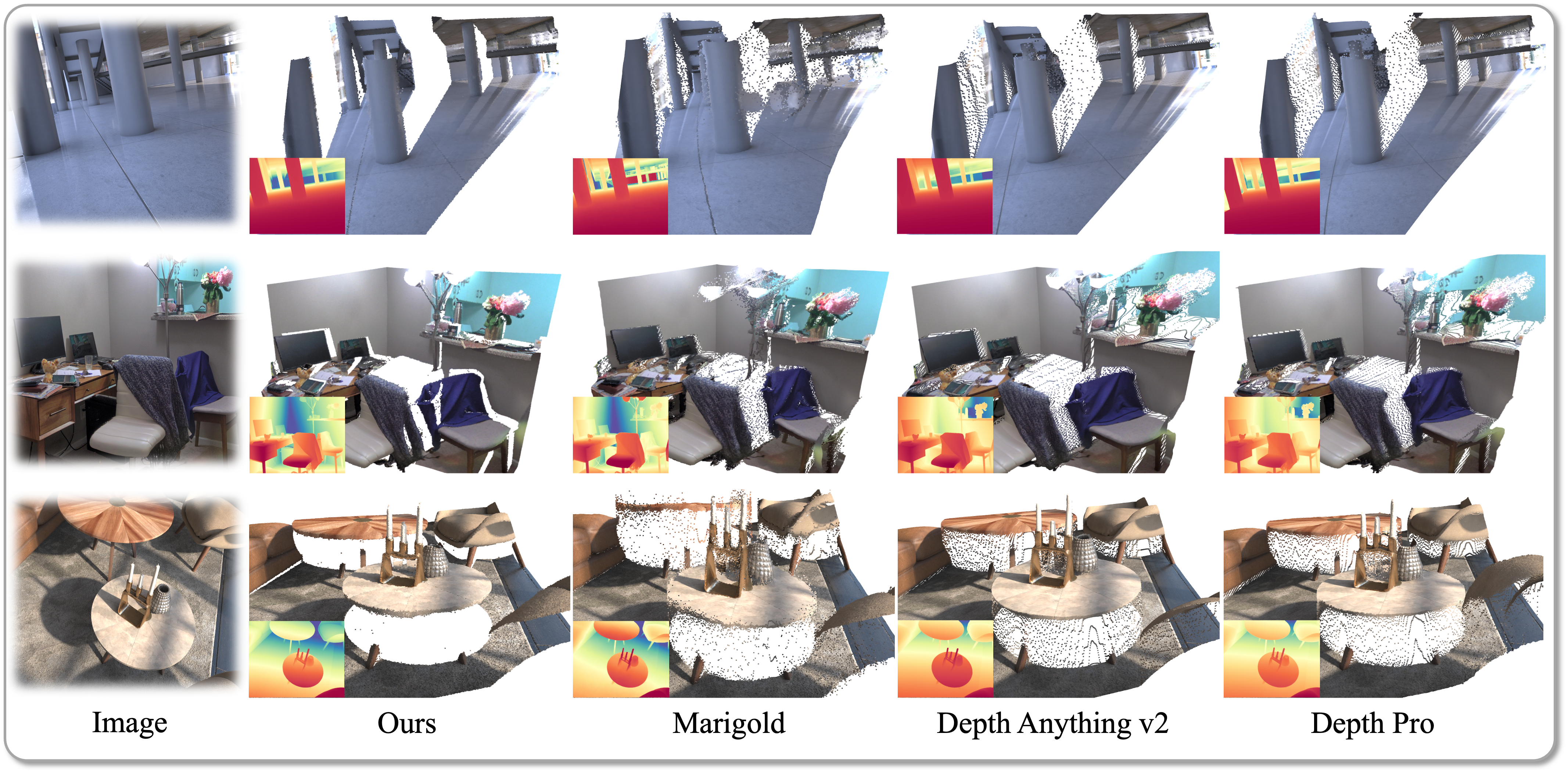
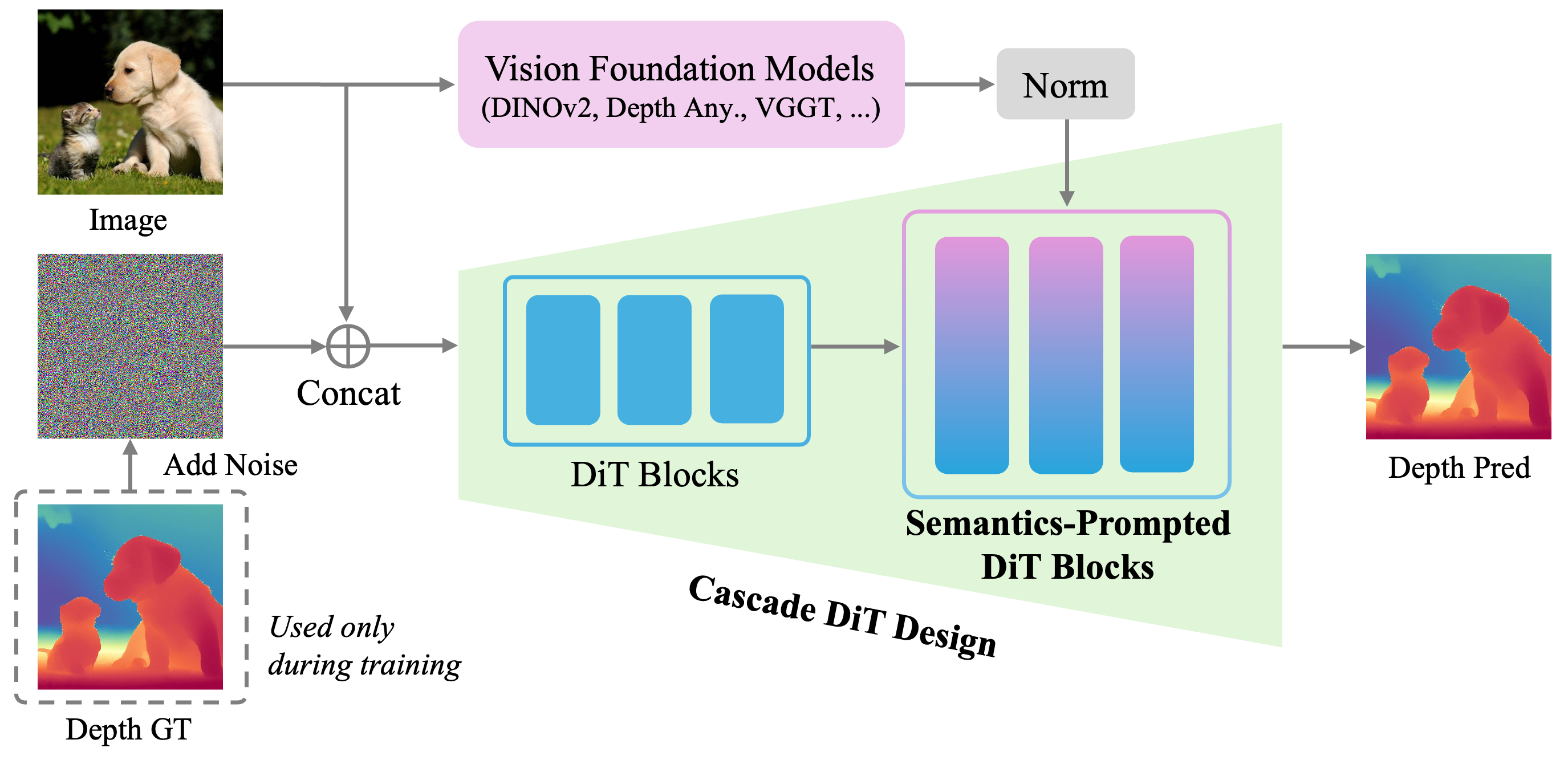
Overview of Pixel-Perfect Depth. We perform diffusion generation directly in pixel space without using any VAE.

Our pretrained models are available on the huggingface hub:
| Model | Semantics | Params | Checkpoint | Training Resolution |
|---|---|---|---|---|
| PPD | DA2 | 500M | Download | 1024×768 |
| PPD | MoGe2 | 500M | Download | 1024×768 |
git clone https://github.com/gangweix/pixel-perfect-depth
cd pixel-perfect-depth
pip install -r requirements.txt
Download our pretrained model ppd.pth and put it under the checkpoints/ directory.
In addition, you also need to download the pretrained model depth_anything_v2_vitl.pth (or moge2.pt) and put it under the checkpoints/ directory.
python run.py
Generating point clouds requires metric depth and camera intrinsics from MoGe.
Please download the pretrained model moge2.pt and place it under the checkpoints/ folder.
python run_point_cloud.py --save_pcd
Download our pretrained model ppvd.pth and put it under the checkpoints/ directory. In addition, you also need to download the pretrained model pi3.safetensors
python run_video.py
Our training strategy follows a two-stage curriculum:
python main.py --cfg_file ppd/configs/train_pretrain.yaml pl_trainer.devices=8
python main.py --cfg_file ppd/configs/train_finetune.yaml pl_trainer.devices=8
Before running the evaluation, please first modify the data_root field in ppd/configs/eval.yaml to point to your local evaluation dataset path.
bash eval.sh
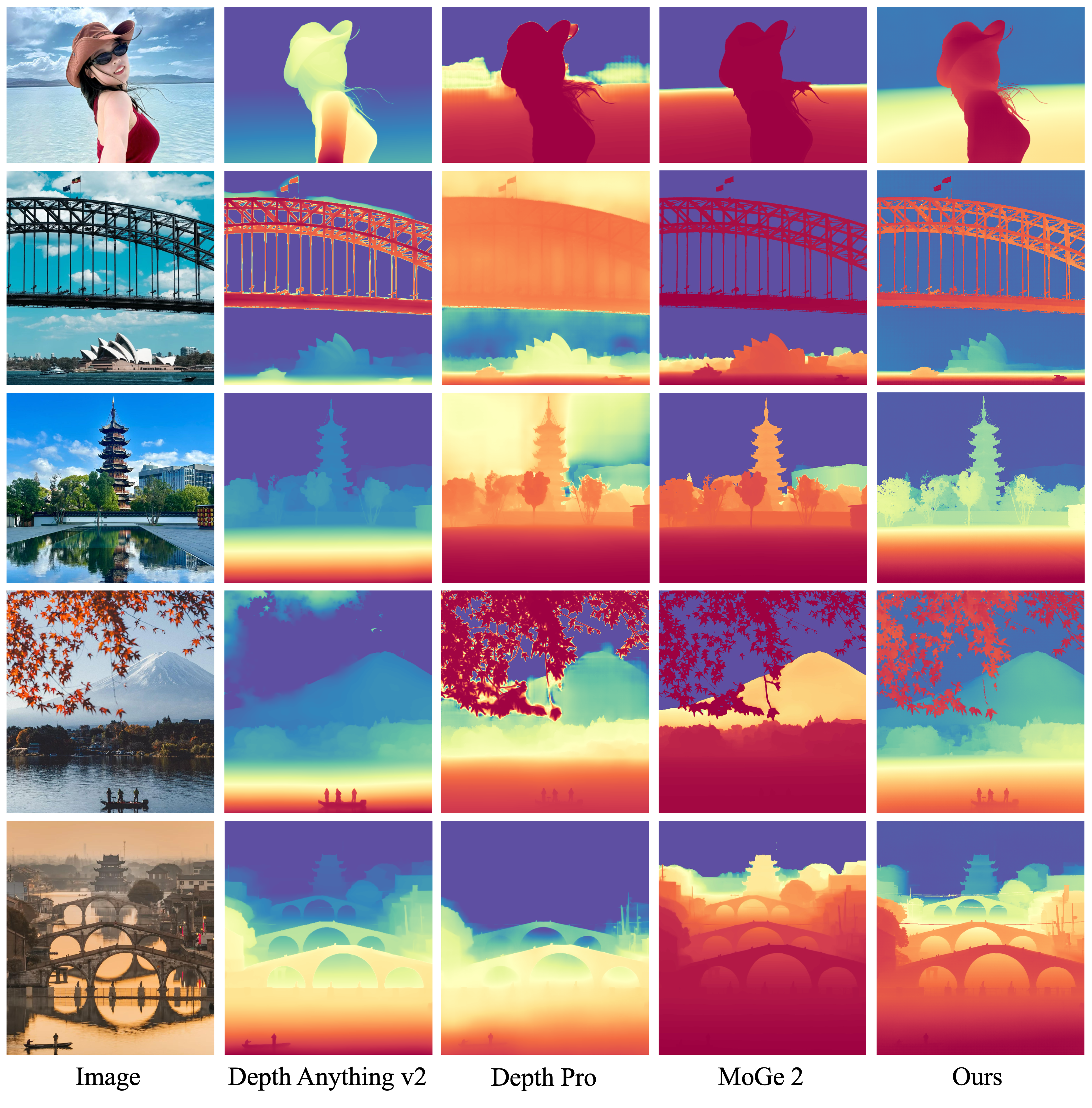
Our model preserves more fine-grained details than Depth Anything v2 and MoGe 2, while demonstrating significantly higher robustness compared to Depth Pro.
We are grateful to the Depth Anything V2, MoGe and DiT teams for their code and model release. We would also like to sincerely thank the NeurIPS reviewers for their appreciation of this work (ratings: 5, 5, 5, 5).
If you find this project useful, please consider citing:
@article{xu2025pixel,
  title={Pixel-perfect depth with semantics-prompted diffusion transformers},
  author={Xu, Gangwei and Lin, Haotong and Luo, Hongcheng and Wang, Xianqi and Yao, Jingfeng and Zhu, Lianghui and Pu, Yuechuan and Chi, Cheng and Sun, Haiyang and Wang, Bing and others},
  journal={arXiv preprint arXiv:2510.07316},
  year={2025}
}
1,949 followers · starred Oct 2025
499 followers · starred Oct 2025
72 followers · starred Oct 2025
31 followers · starred Nov 2025
[TPAMI 2026 & NeurIPS 2025] Pixel-Perfect Depth
See the codeGangwei Xu1,2,* · Haotong Lin3,* · Hongcheng Luo2 · Xianqi Wang1 · Jingfeng Yao1
Lianghui Zhu1 · Yuechuan Pu2 · Cheng Chi2 · Haiyang Sun2,† · Bing Wang2
Guang Chen2 · Hangjun Ye2 · Sida Peng3 · Xin Yang1,†,✉️
1HUST 2Xiaomi EV 3Zhejiang University
*co-first author †project leader ✉️ corresponding author
This work presents Pixel-Perfect Depth, a monocular depth estimation model with pixel-space diffusion transformers. Compared to existing discriminative and generative models, its estimated depth maps can produce high-quality, flying-pixel-free point clouds.
Overview of Pixel-Perfect Depth. We perform diffusion generation directly in pixel space without using any VAE.
Our pretrained models are available on the huggingface hub:
| Model | Semantics | Params | Checkpoint | Training Resolution |
|---|---|---|---|---|
| PPD | DA2 | 500M | Download | 1024×768 |
| PPD | MoGe2 | 500M | Download | 1024×768 |
git clone https://github.com/gangweix/pixel-perfect-depth
cd pixel-perfect-depth
pip install -r requirements.txt
Download our pretrained model ppd.pth and put it under the checkpoints/ directory.
In addition, you also need to download the pretrained model depth_anything_v2_vitl.pth (or moge2.pt) and put it under the checkpoints/ directory.
python run.py
Generating point clouds requires metric depth and camera intrinsics from MoGe.
Please download the pretrained model moge2.pt and place it under the checkpoints/ folder.
python run_point_cloud.py --save_pcd
Download our pretrained model ppvd.pth and put it under the checkpoints/ directory. In addition, you also need to download the pretrained model pi3.safetensors
python run_video.py
Our training strategy follows a two-stage curriculum:
python main.py --cfg_file ppd/configs/train_pretrain.yaml pl_trainer.devices=8
python main.py --cfg_file ppd/configs/train_finetune.yaml pl_trainer.devices=8
Before running the evaluation, please first modify the data_root field in ppd/configs/eval.yaml to point to your local evaluation dataset path.
bash eval.sh
Our model preserves more fine-grained details than Depth Anything v2 and MoGe 2, while demonstrating significantly higher robustness compared to Depth Pro.
We are grateful to the Depth Anything V2, MoGe and DiT teams for their code and model release. We would also like to sincerely thank the NeurIPS reviewers for their appreciation of this work (ratings: 5, 5, 5, 5).
If you find this project useful, please consider citing:
@article{xu2025pixel,
  title={Pixel-perfect depth with semantics-prompted diffusion transformers},
  author={Xu, Gangwei and Lin, Haotong and Luo, Hongcheng and Wang, Xianqi and Yao, Jingfeng and Zhu, Lianghui and Pu, Yuechuan and Chi, Cheng and Sun, Haiyang and Wang, Bing and others},
  journal={arXiv preprint arXiv:2510.07316},
  year={2025}
}
1,949 followers · starred Oct 2025
499 followers · starred Oct 2025
72 followers · starred Oct 2025
31 followers · starred Nov 2025