
Human in the loop for agentic workflows
See the codeSee what people are saying
README
Pinrail
Website · Download · Documentation · Plugins
Pinrail is a desktop app where your coding agents ask you before they act. You review what an agent proposes in a view made for it, and the agent carries on with your decision.
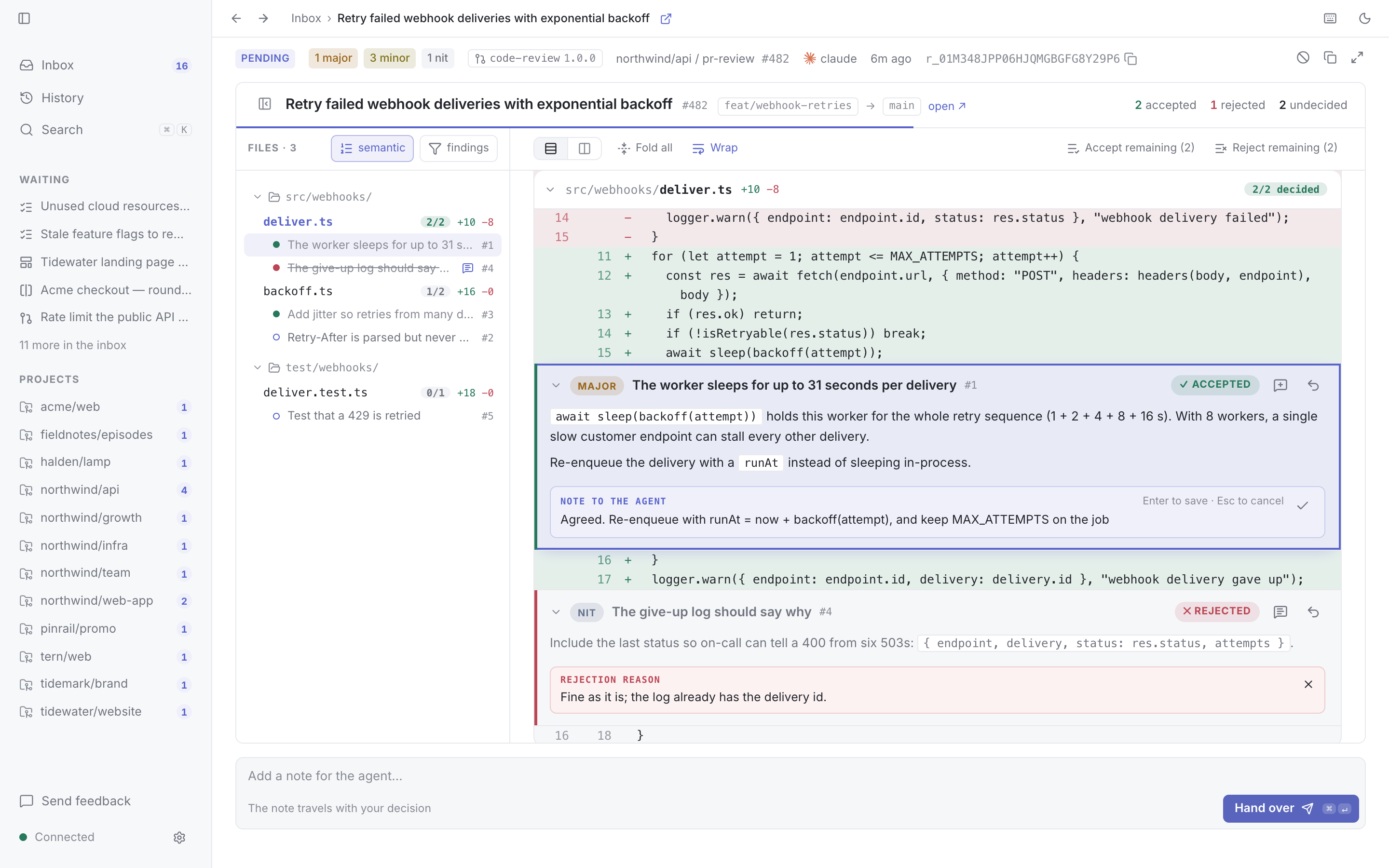
Pinrail works with any agent that can run a command, such as Claude Code, Codex, Cursor or OpenCode. It runs on macOS and Linux, and Windows support is coming. Pinrail is in early development, so expect rough edges and changes between releases.
Why
Agents are good at doing the work, but some steps need a person: a comment posted under your name, an email to a customer, a change to production. Approving those steps in a chat means reading a wall of text and typing your answer back. Pinrail gives each of these moments a proper review:
- The agent decides when to ask. Its instructions name the steps that need you, so it asks at those steps and nowhere else.
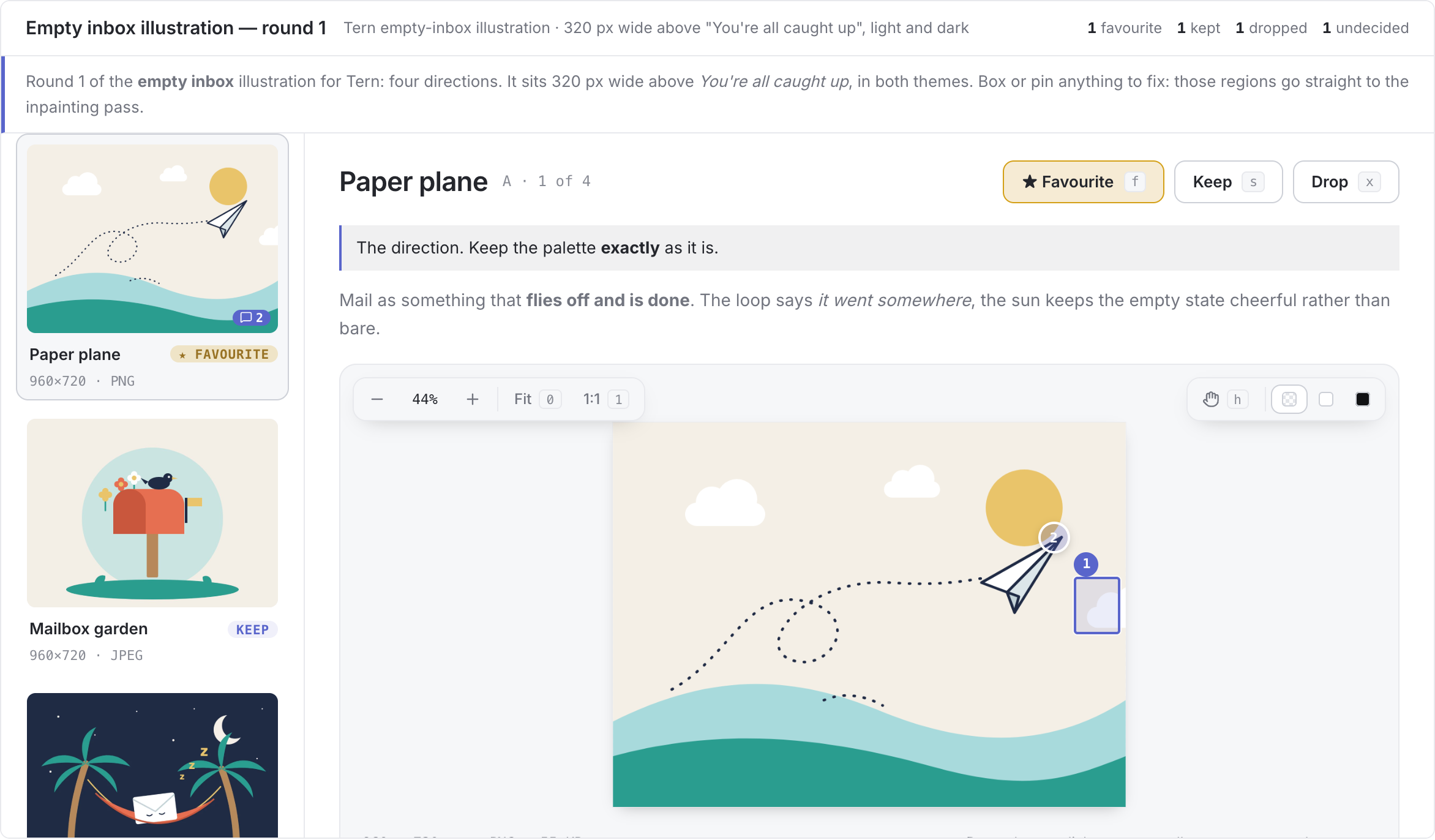
- Each review has a view made for its content. A code review shows the diff with the agent's findings on it. A set of generated images shows the images, and you draw a box on the part that should change.
- Your decision is structured. The agent gets back what you accepted, what you rejected and your notes, as Markdown it can act on or JSON for a script.
- Everything stays on your machine. The app serves its API on loopback only, and keeps your reviews and decisions locally.
How it works
sequenceDiagram
  participant A as Your agent
  participant P as Pinrail
  A->>P: pinrail submit code-review --data review.json --wait
  Note over A: waits
  Note over P: you review and decide
  P->>A: your decision
  Note over A: carries on with it
When the agent reaches a step that needs you, it runs the pinrail command
with a review: the plugin to show it with, a title and a JSON payload.
pinrail submit code-review --title "Retry failed webhook deliveries" \
  --data findings.json --wait
Pinrail notifies you, and the review waits in your inbox, grouped by project.
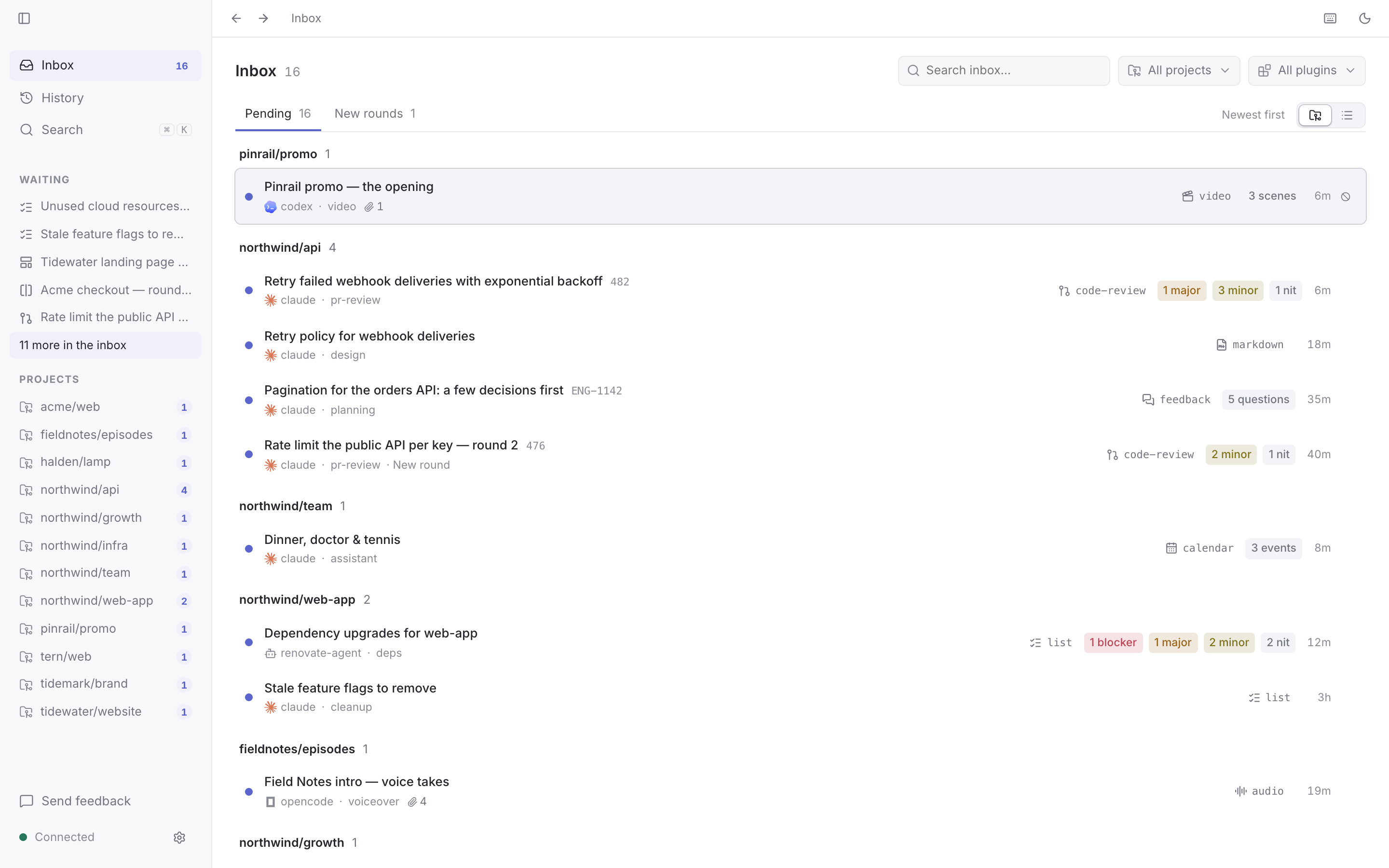
You open it, and decide in the plugin's view. In the code review at the top of this page, you accept or reject each of the agent's findings, and write a note to the agent.
When you hand the review over, the command prints your decision and exits, and the agent carries on:
r_01K5R2 · decided · Retry failed webhook deliveries
code-review · decided by maya at 2026-09-23 10:14

- **#1 accepted** `src/deliver.ts:42` — The worker sleeps for up to 31 seconds per delivery (major)
  > Agreed. Re-enqueue with runAt = now + backoff(attempt)
- **#4 rejected** `src/log.ts:18` — The give-up log should say why (nit)
  > Fine as it is; the log already has the delivery id.

Undecided: #2, #3, #5
The command's exit code says how the review ended: decided, discarded with an instruction to stop, withdrawn or expired. When you ask for changes, the agent submits a new round, and the app shows your earlier verdicts beside it.
Getting started
-
Install the app from the download page or the latest release. On macOS, it is signed and notarized.
-
Follow the setup that opens the first time. It installs the
pinrailcommand, adds Pinrail's skill to the agents it finds on your computer, and installs the recommended plugins. -
Ask your agent for something, in your own words:
Ask me through Pinrail which TODOs in this repository to tackle first.Or ask it where Pinrail would help in your project:
Look at this project and suggest where you should ask me through Pinrail before you act.
Your first review walks through this, and Instructing an agent shows how to make an agent ask at the steps you choose, every time.
Plugins
Each kind of review is a plugin: the payload an agent sends, the decision you give back, and the view you decide in. Five core plugins come with the app:
| Plugin | Review |
|---|---|
code-review | A diff with the agent's proposed review comments, each accepted, rejected or edited. |
list | Items grouped under headings, each accepted or rejected with a note. |
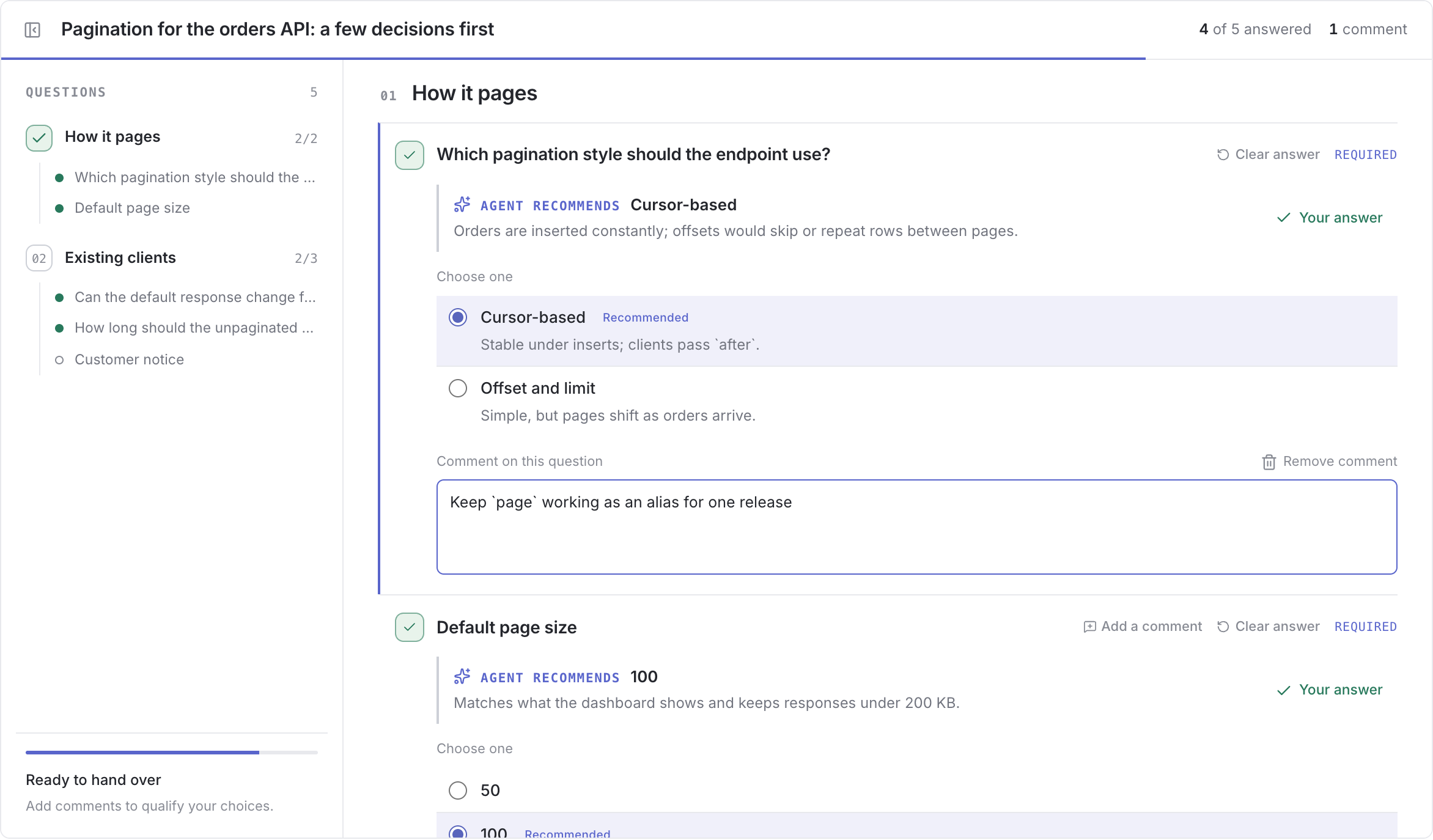
feedback | Questions answered in one pass: choices, yes or no, and free text. |
markdown | A document, such as a plan or a spec, read and commented on section by section. |
image | Generated images to choose between, with boxes and pins on what to change. |
 |  |
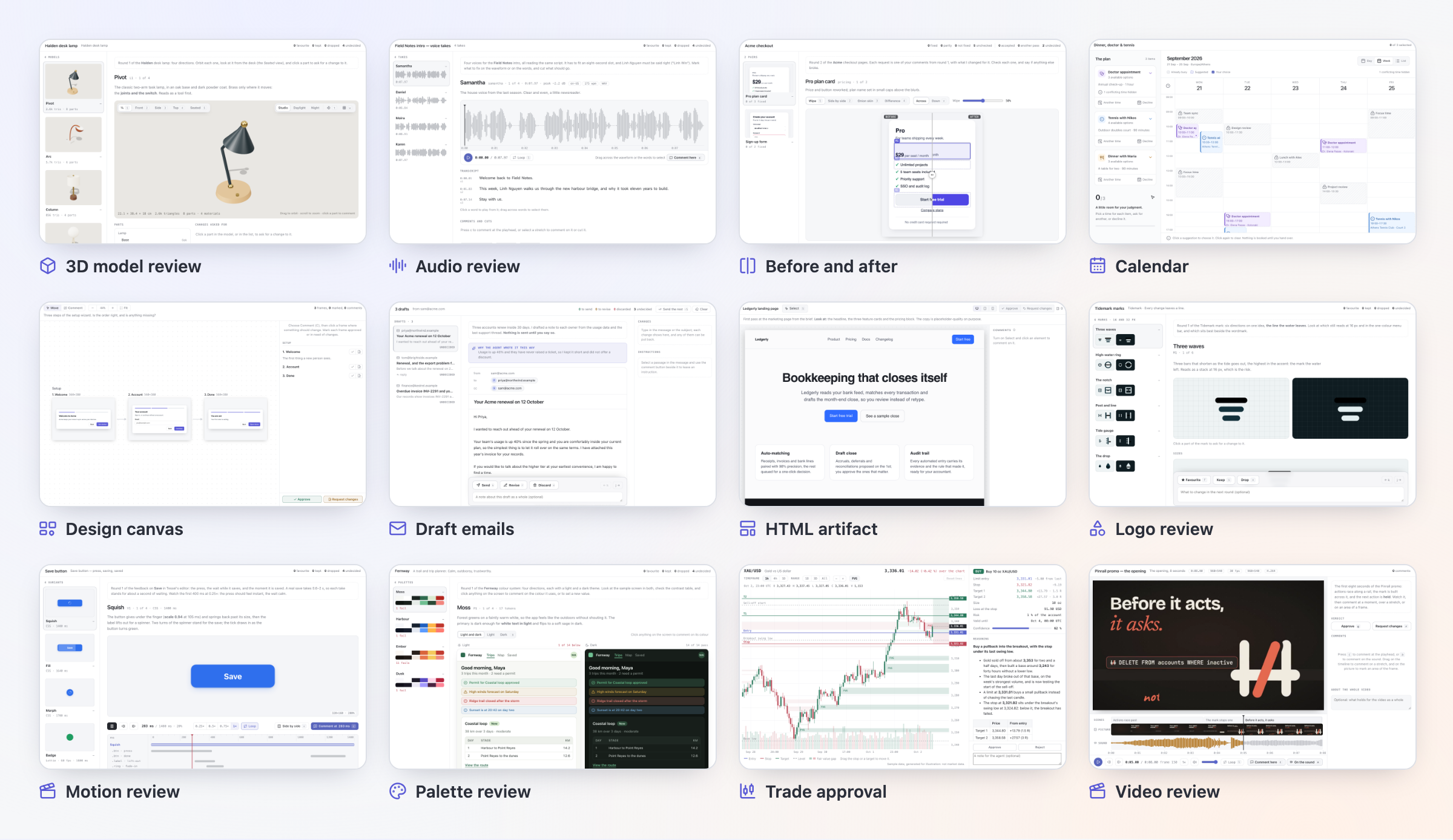
Sample plugins in forgeplane/pinrail-plugins show what else a plugin can do. They cover HTML pages, emails, calendars, logos, colour palettes, 3D models, animations, audio, video, design canvases, before-and-after comparisons and trades. Each one is released as a zip, which you install in the app's Settings › Plugins.
Writing a plugin
A plugin is a manifest, two JSON schemas and an HTML view, with no build step
needed. pinrail plugins new <name> creates one, and the plugin SDK,
pinrail-sdk, runs its view in a
browser without the app and tests it with Playwright. Views can also be
built with React, Vue, Svelte or any other framework. See
Writing a plugin.
Repository
| Directory | Contents |
|---|---|
desktop/ | The app: a Rust core (API, storage, plugins), a Tauri shell and a React UI. |
cli/ | The pinrail command that agents run. |
plugins/ | The core plugins. |
sdk/ | The plugin SDK, its development shell and its test harness. |
skill/ | The skill that teaches an agent to use Pinrail. |
e2e/ | End-to-end tests of the CLI and the app's UI against the headless core. |
docs/ | The documentation, published on the website. |
website/ | The website. |
Development
Node is pinned in mise.toml, which mise install sets up, and Rust in
rust-toolchain.toml, which rustup reads on its own.
mise run dev:desktop        # the app with live reload
mise run test               # every test suite
mise run lint               # rustfmt, clippy, the type check and the licences, as CI runs them
CONTRIBUTING.md describes each test suite and how to run it. Read it before you open a pull request. To report a vulnerability, follow SECURITY.md.
License
Pinrail is licensed under the Apache License 2.0. See
NOTICE for the copyright and the third-party notices.
Similar repos


Human in the loop for agentic workflows
See the codeSee what people are saying
README
Pinrail
Website · Download · Documentation · Plugins
Pinrail is a desktop app where your coding agents ask you before they act. You review what an agent proposes in a view made for it, and the agent carries on with your decision.
Pinrail works with any agent that can run a command, such as Claude Code, Codex, Cursor or OpenCode. It runs on macOS and Linux, and Windows support is coming. Pinrail is in early development, so expect rough edges and changes between releases.
Why
Agents are good at doing the work, but some steps need a person: a comment posted under your name, an email to a customer, a change to production. Approving those steps in a chat means reading a wall of text and typing your answer back. Pinrail gives each of these moments a proper review:
- The agent decides when to ask. Its instructions name the steps that need you, so it asks at those steps and nowhere else.
- Each review has a view made for its content. A code review shows the diff with the agent's findings on it. A set of generated images shows the images, and you draw a box on the part that should change.
- Your decision is structured. The agent gets back what you accepted, what you rejected and your notes, as Markdown it can act on or JSON for a script.
- Everything stays on your machine. The app serves its API on loopback only, and keeps your reviews and decisions locally.
How it works
sequenceDiagram
  participant A as Your agent
  participant P as Pinrail
  A->>P: pinrail submit code-review --data review.json --wait
  Note over A: waits
  Note over P: you review and decide
  P->>A: your decision
  Note over A: carries on with it
When the agent reaches a step that needs you, it runs the pinrail command
with a review: the plugin to show it with, a title and a JSON payload.
pinrail submit code-review --title "Retry failed webhook deliveries" \
  --data findings.json --wait
Pinrail notifies you, and the review waits in your inbox, grouped by project.
You open it, and decide in the plugin's view. In the code review at the top of this page, you accept or reject each of the agent's findings, and write a note to the agent.
When you hand the review over, the command prints your decision and exits, and the agent carries on:
r_01K5R2 · decided · Retry failed webhook deliveries
code-review · decided by maya at 2026-09-23 10:14

- **#1 accepted** `src/deliver.ts:42` — The worker sleeps for up to 31 seconds per delivery (major)
  > Agreed. Re-enqueue with runAt = now + backoff(attempt)
- **#4 rejected** `src/log.ts:18` — The give-up log should say why (nit)
  > Fine as it is; the log already has the delivery id.

Undecided: #2, #3, #5
The command's exit code says how the review ended: decided, discarded with an instruction to stop, withdrawn or expired. When you ask for changes, the agent submits a new round, and the app shows your earlier verdicts beside it.
Getting started
-
Install the app from the download page or the latest release. On macOS, it is signed and notarized.
-
Follow the setup that opens the first time. It installs the
pinrailcommand, adds Pinrail's skill to the agents it finds on your computer, and installs the recommended plugins. -
Ask your agent for something, in your own words:
Ask me through Pinrail which TODOs in this repository to tackle first.Or ask it where Pinrail would help in your project:
Look at this project and suggest where you should ask me through Pinrail before you act.
Your first review walks through this, and Instructing an agent shows how to make an agent ask at the steps you choose, every time.
Plugins
Each kind of review is a plugin: the payload an agent sends, the decision you give back, and the view you decide in. Five core plugins come with the app:
| Plugin | Review |
|---|---|
code-review | A diff with the agent's proposed review comments, each accepted, rejected or edited. |
list | Items grouped under headings, each accepted or rejected with a note. |
feedback | Questions answered in one pass: choices, yes or no, and free text. |
markdown | A document, such as a plan or a spec, read and commented on section by section. |
image | Generated images to choose between, with boxes and pins on what to change. |
| |
Sample plugins in forgeplane/pinrail-plugins show what else a plugin can do. They cover HTML pages, emails, calendars, logos, colour palettes, 3D models, animations, audio, video, design canvases, before-and-after comparisons and trades. Each one is released as a zip, which you install in the app's Settings › Plugins.
Writing a plugin
A plugin is a manifest, two JSON schemas and an HTML view, with no build step
needed. pinrail plugins new <name> creates one, and the plugin SDK,
pinrail-sdk, runs its view in a
browser without the app and tests it with Playwright. Views can also be
built with React, Vue, Svelte or any other framework. See
Writing a plugin.
Repository
| Directory | Contents |
|---|---|
desktop/ | The app: a Rust core (API, storage, plugins), a Tauri shell and a React UI. |
cli/ | The pinrail command that agents run. |
plugins/ | The core plugins. |
sdk/ | The plugin SDK, its development shell and its test harness. |
skill/ | The skill that teaches an agent to use Pinrail. |
e2e/ | End-to-end tests of the CLI and the app's UI against the headless core. |
docs/ | The documentation, published on the website. |
website/ | The website. |
Development
Node is pinned in mise.toml, which mise install sets up, and Rust in
rust-toolchain.toml, which rustup reads on its own.
mise run dev:desktop        # the app with live reload
mise run test               # every test suite
mise run lint               # rustfmt, clippy, the type check and the licences, as CI runs them
CONTRIBUTING.md describes each test suite and how to run it. Read it before you open a pull request. To report a vulnerability, follow SECURITY.md.
License
Pinrail is licensed under the Apache License 2.0. See
NOTICE for the copyright and the third-party notices.