
✨ The open-source multi-agent platform. Every agent gets its own computer, desktop, network, and long-term memory. You can bring your own key, or host your coding agent like Claude Code, Codex and so on.
See the codeREADME

Memoh
Give every AI agent its own cloud computer. Open source.
Desktop, browser, network, and long-term memory — always on, even when your laptop is closed.





Login · Self-hosted · Docs · Website · X
What is Memoh?
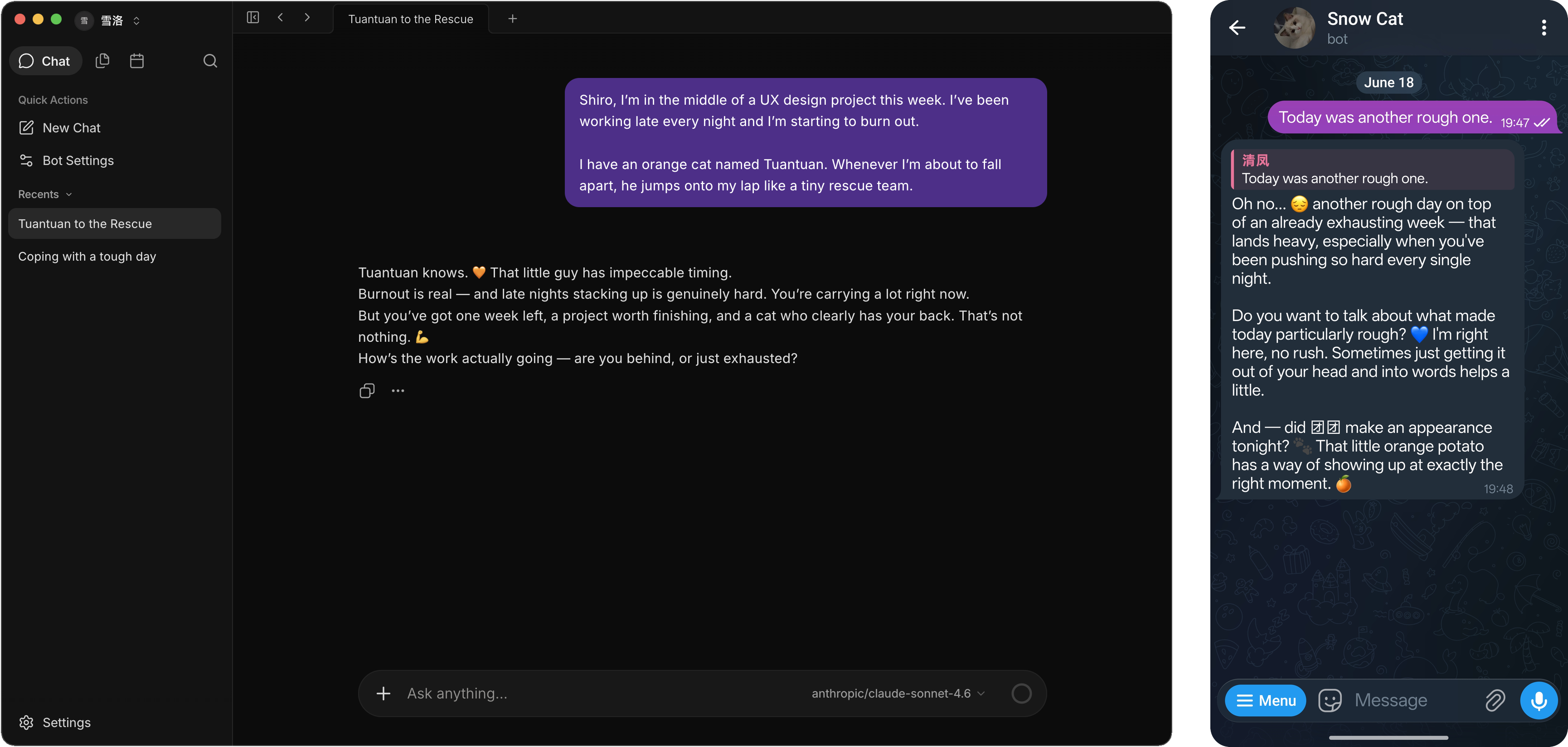
Memoh is an open-source multi-agent platform. Each agent gets its own cloud computer — a dedicated workspace with a filesystem, desktop, browser, network, and long-term memory. Your agents stay online 24/7, even when your laptop is closed.
Use your own API keys to run Memoh's built-in agent, or host your existing Claude Code and Codex agents inside Memoh workspaces.
Talk to them through Telegram, Discord, Lark, WeChat, Web UI, and more. They remember context across sessions and platforms, drive a browser, call MCP tools, and run scheduled tasks. Run one for yourself, assign one to each team member, or spin up a fleet.
Get Started
Memoh Cloud
You can now sign up or log in directly at app.memoh.net.
Self-hosted
Self-host the full stack on your own infrastructure.
curl -fsSL https://memoh.sh | sh
More deployment options
Manual deployment:
git clone --depth 1 --recurse-submodules --shallow-submodules https://github.com/felinics/Memoh.git
cd Memoh
cp conf/app.docker.toml config.toml
# Edit config.toml
export MEMOH_INTERNAL_RPC_SHARED_SECRET="$(openssl rand -hex 32)"
docker compose up -d
The Compose stack runs Server and Channel as separate services. Keep the internal RPC secret private and use the same value whenever the stack is recreated.
Running without Docker (or upgrading an existing bare-metal install)? Leave internal_rpc.shared_secret empty in config.toml: the server then embeds the channel runtime and keeps running as a single all-in-one process — external channels, email, and webhook endpoints included — with no memoh-channel process required. Setting the secret opts into the split two-process deployment.
Existing setup checkouts can keep using git pull: the post-merge hook initializes the new
submodule, and setup enables recursive updates for future pulls. If that hook was never installed,
run mise run submodule-init once after upgrading.
GitHub's automatic “Source code” archives omit submodule contents. For a buildable release archive,
use the attached Memoh-<version>-source.zip or .tar.gz asset instead.
Use CN mirror for slow image pulls:
curl -fsSL https://memoh.sh | USE_CN_MIRROR=true shDo not run the whole installer with
sudo. The installer will usesudo dockerinternally if Docker requires it.
See DEPLOYMENT.md for custom configuration and production setup.
Why Memoh?
- Every agent gets its own computer: An isolated workspace with its own filesystem, network, desktop, and browser.
- Multi-user, multi-bot: Run one for yourself, deploy one for each family member, run a fleet on a single machine.
- Lightweight: Self-host the server on your own infrastructure, or connect through Memoh Cloud.
Sub-projects
- Twilight AI — A lightweight, idiomatic AI SDK for Go, inspired by Vercel AI SDK. Provider-agnostic (OpenAI, Anthropic, Google), with first-class streaming, tool calling, MCP, and embeddings.
- Connect It — A self-hosted connector gateway that securely stores SaaS credentials and gives agents access to integrations through a single MCP endpoint.
- UI — A Vue 3 design system for AI agent management interfaces, including a component library, design tokens, and skills that teach agents how to use them.
Project Status





Star History
Contributors
Community
LICENSE: AGPLv3
Made with ❤️ by MemohAI Team,
Copyright (C) 2026 MemohAI (memoh.ai). All rights reserved.
Contributors
(top 30 of 58)


Similar repos


Languages
Go
70.0%
TypeScript
15.9%
Vue
11.0%
PLpgSQL
1.4%
✨ The open-source multi-agent platform. Every agent gets its own computer, desktop, network, and long-term memory. You can bring your own key, or host your coding agent like Claude Code, Codex and so on.
See the codeREADME
Memoh
Give every AI agent its own cloud computer. Open source.
Desktop, browser, network, and long-term memory — always on, even when your laptop is closed.
Login · Self-hosted · Docs · Website · X
What is Memoh?
Memoh is an open-source multi-agent platform. Each agent gets its own cloud computer — a dedicated workspace with a filesystem, desktop, browser, network, and long-term memory. Your agents stay online 24/7, even when your laptop is closed.
Use your own API keys to run Memoh's built-in agent, or host your existing Claude Code and Codex agents inside Memoh workspaces.
Talk to them through Telegram, Discord, Lark, WeChat, Web UI, and more. They remember context across sessions and platforms, drive a browser, call MCP tools, and run scheduled tasks. Run one for yourself, assign one to each team member, or spin up a fleet.
Get Started
Memoh Cloud
You can now sign up or log in directly at app.memoh.net.
Self-hosted
Self-host the full stack on your own infrastructure.
curl -fsSL https://memoh.sh | sh
More deployment options
Manual deployment:
git clone --depth 1 --recurse-submodules --shallow-submodules https://github.com/felinics/Memoh.git
cd Memoh
cp conf/app.docker.toml config.toml
# Edit config.toml
export MEMOH_INTERNAL_RPC_SHARED_SECRET="$(openssl rand -hex 32)"
docker compose up -d
The Compose stack runs Server and Channel as separate services. Keep the internal RPC secret private and use the same value whenever the stack is recreated.
Running without Docker (or upgrading an existing bare-metal install)? Leave internal_rpc.shared_secret empty in config.toml: the server then embeds the channel runtime and keeps running as a single all-in-one process — external channels, email, and webhook endpoints included — with no memoh-channel process required. Setting the secret opts into the split two-process deployment.
Existing setup checkouts can keep using git pull: the post-merge hook initializes the new
submodule, and setup enables recursive updates for future pulls. If that hook was never installed,
run mise run submodule-init once after upgrading.
GitHub's automatic “Source code” archives omit submodule contents. For a buildable release archive,
use the attached Memoh-<version>-source.zip or .tar.gz asset instead.
Use CN mirror for slow image pulls:
curl -fsSL https://memoh.sh | USE_CN_MIRROR=true shDo not run the whole installer with
sudo. The installer will usesudo dockerinternally if Docker requires it.
See DEPLOYMENT.md for custom configuration and production setup.
Why Memoh?
- Every agent gets its own computer: An isolated workspace with its own filesystem, network, desktop, and browser.
- Multi-user, multi-bot: Run one for yourself, deploy one for each family member, run a fleet on a single machine.
- Lightweight: Self-host the server on your own infrastructure, or connect through Memoh Cloud.
Sub-projects
- Twilight AI — A lightweight, idiomatic AI SDK for Go, inspired by Vercel AI SDK. Provider-agnostic (OpenAI, Anthropic, Google), with first-class streaming, tool calling, MCP, and embeddings.
- Connect It — A self-hosted connector gateway that securely stores SaaS credentials and gives agents access to integrations through a single MCP endpoint.
- UI — A Vue 3 design system for AI agent management interfaces, including a component library, design tokens, and skills that teach agents how to use them.
Project Status
Star History
Contributors
Community
LICENSE: AGPLv3
Made with ❤️ by MemohAI Team,
Copyright (C) 2026 MemohAI (memoh.ai). All rights reserved.
Similar repos
Contributors
(top 30 of 58)
Languages
Go
70.0%
TypeScript
15.9%
Vue
11.0%
PLpgSQL
1.4%