
MIRA (which stands for Multi-tasking Intelligent Responsive Assistant) is a self-hosted, personal AI agent designed to run on your own hardware.
Rust
8
83 commits
updated Sep 9, 2026
README

MIRA
Multi-tasking Intelligent Responsive Assistant
"Your life's loyal partner. Always ready to assist."
A self-hosted personal AI agent that runs on your hardware and reaches you on the apps you already use — Signal, Telegram, Discord, the web, and more. A project of Vexillon.





Documentation · Install · Releases · Issues
📸 Screenshots
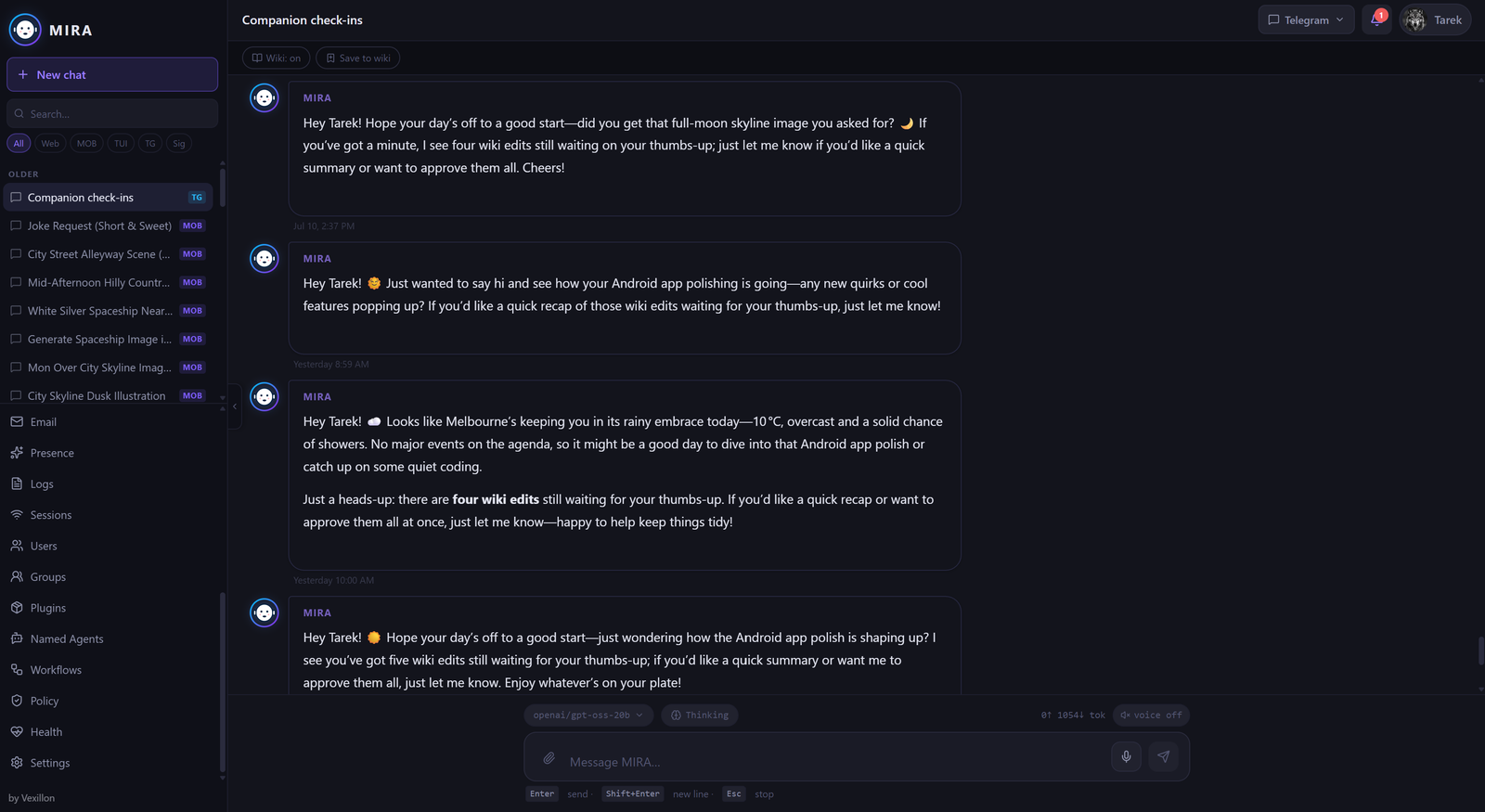 Proactive check-ins — MIRA reaches out first | 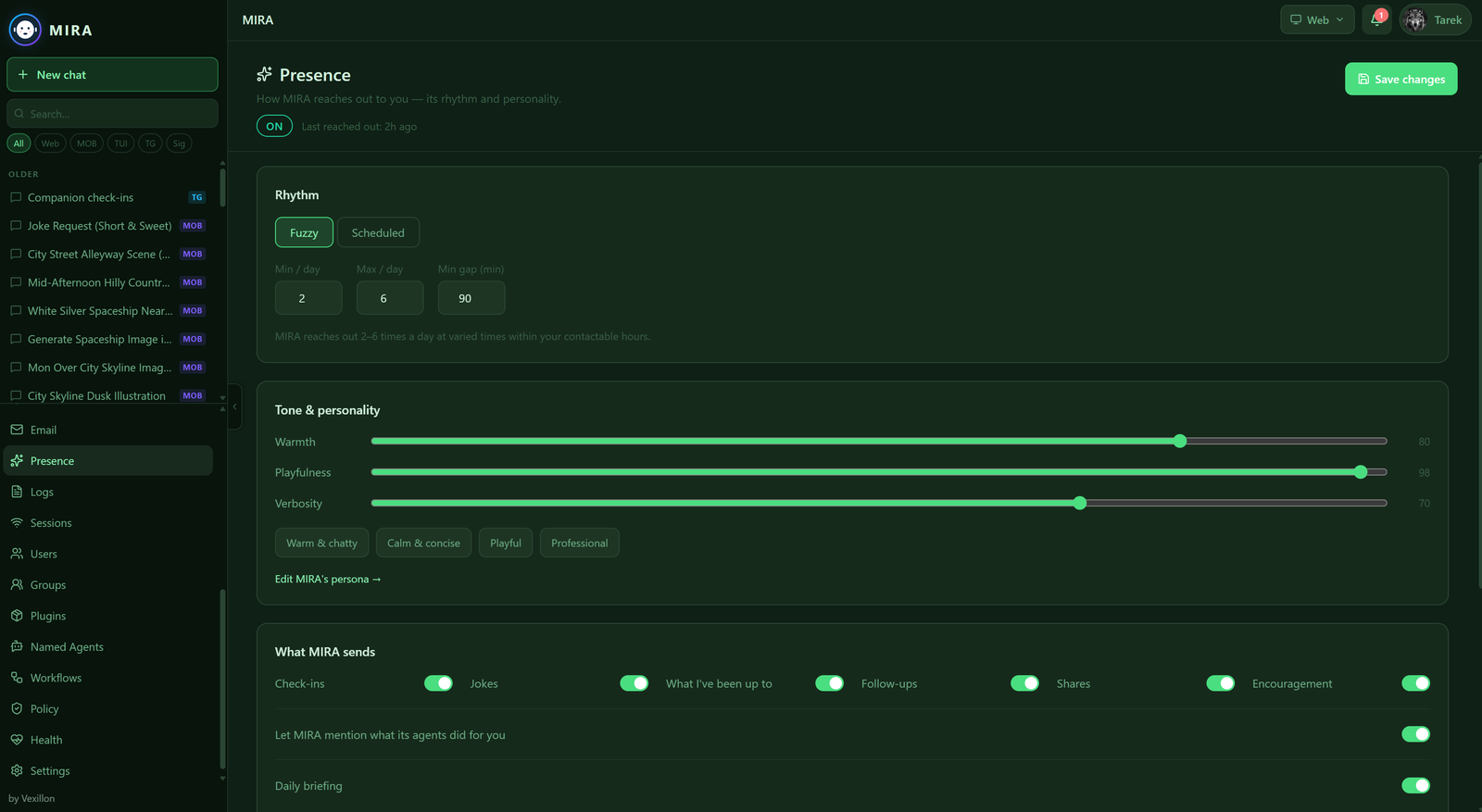 Presence — tune its rhythm & personality |
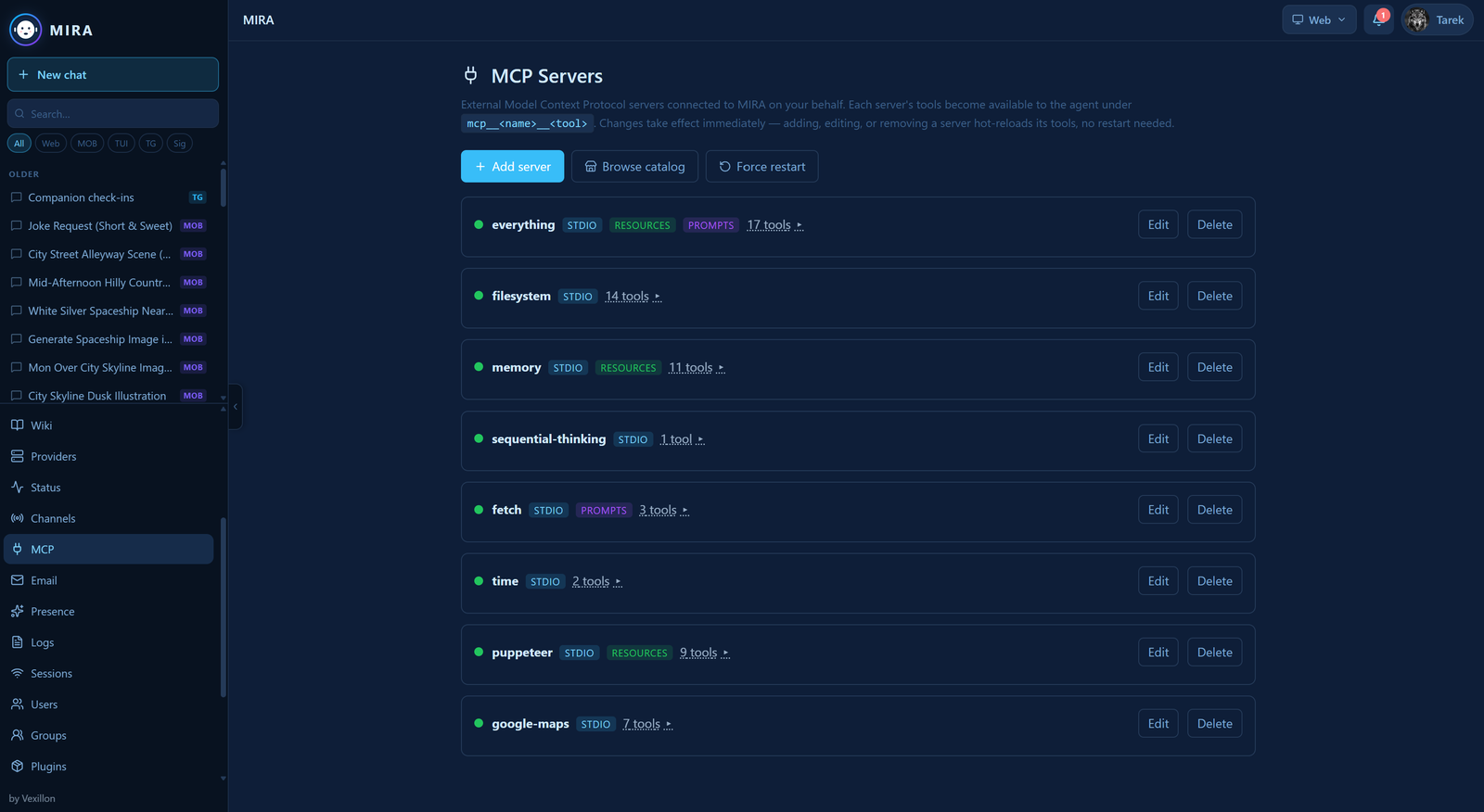 MCP — extend it with external tool servers | 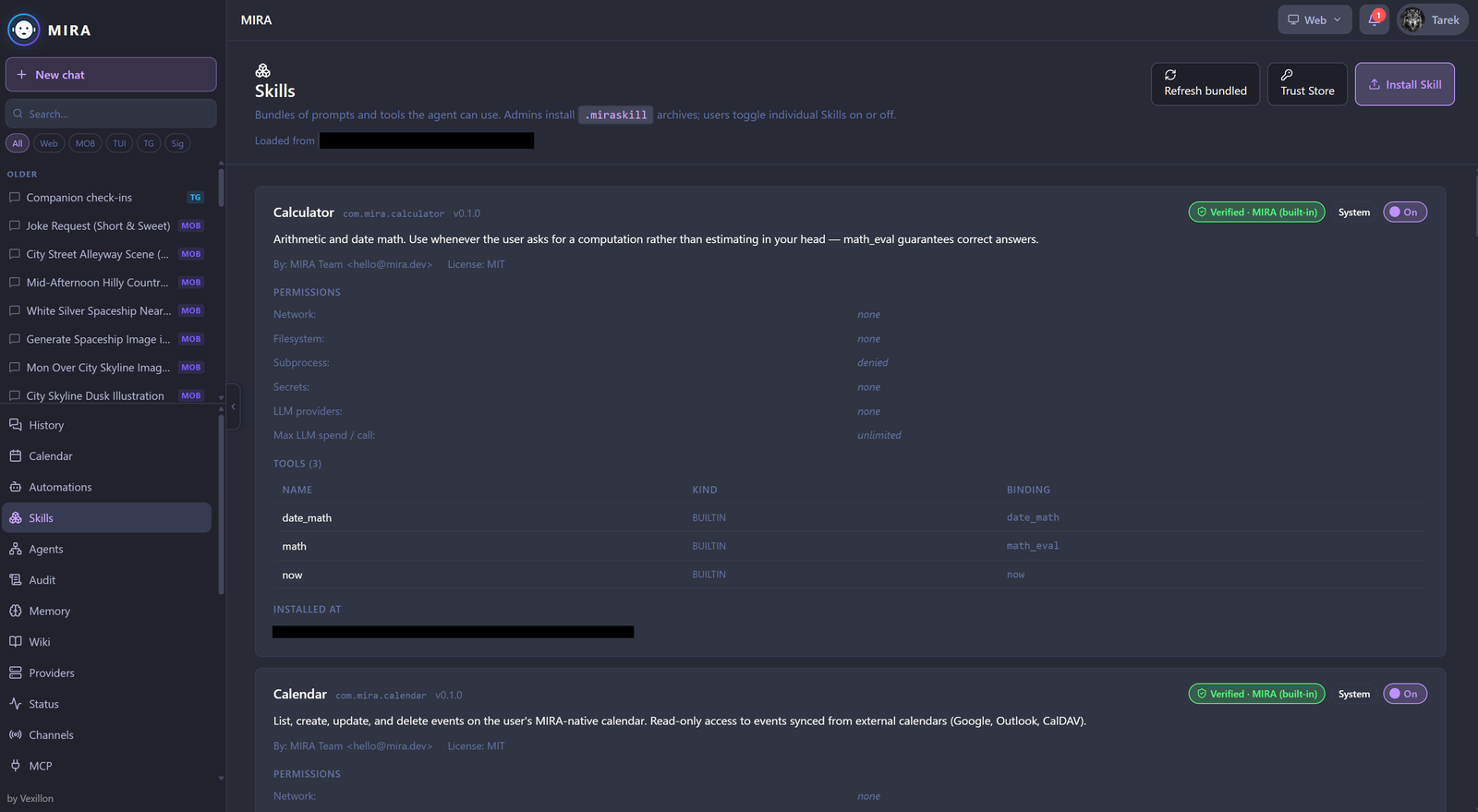 Skills — bundled tools, scoped permissions |
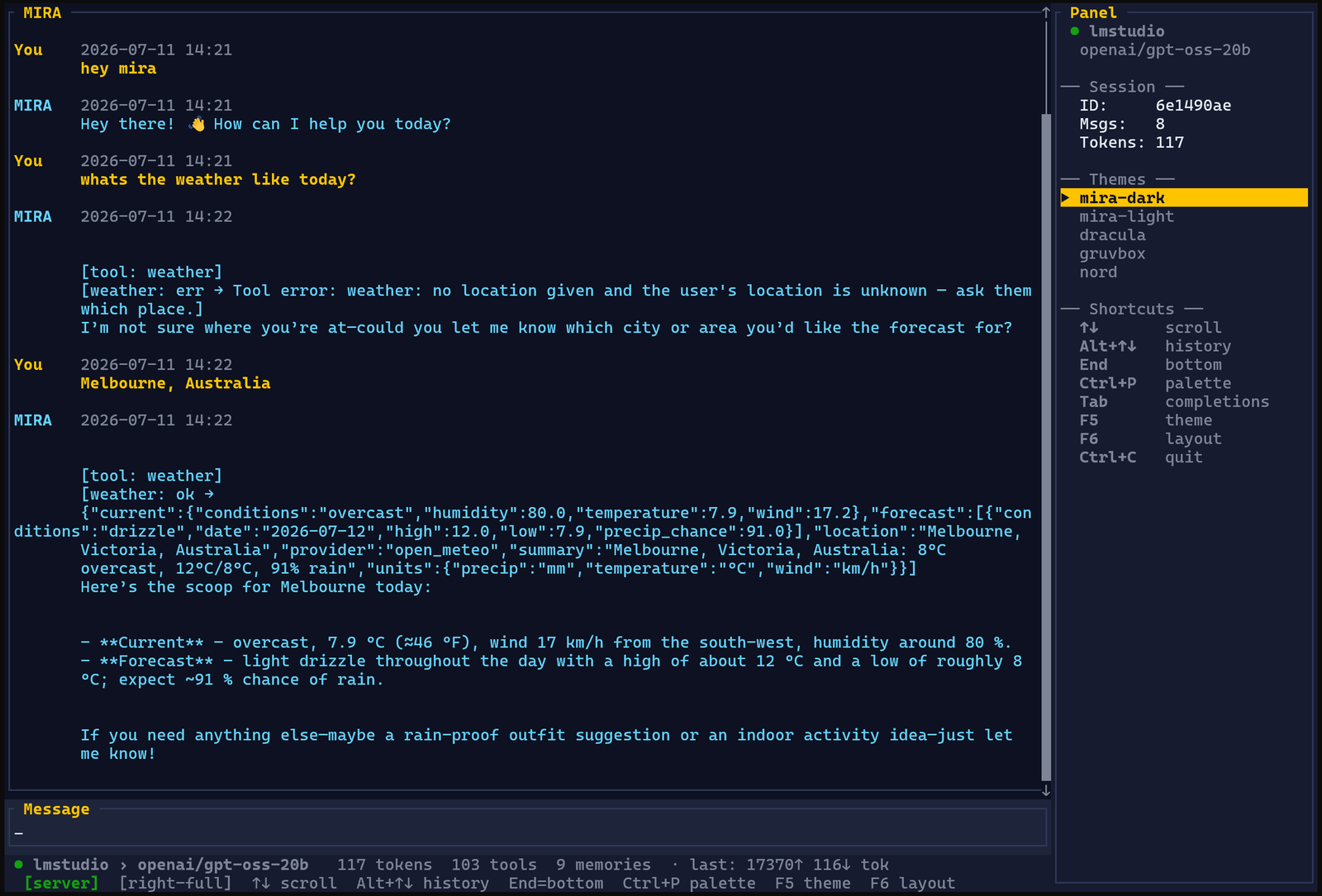 Terminal UI — the full agent in your shell | 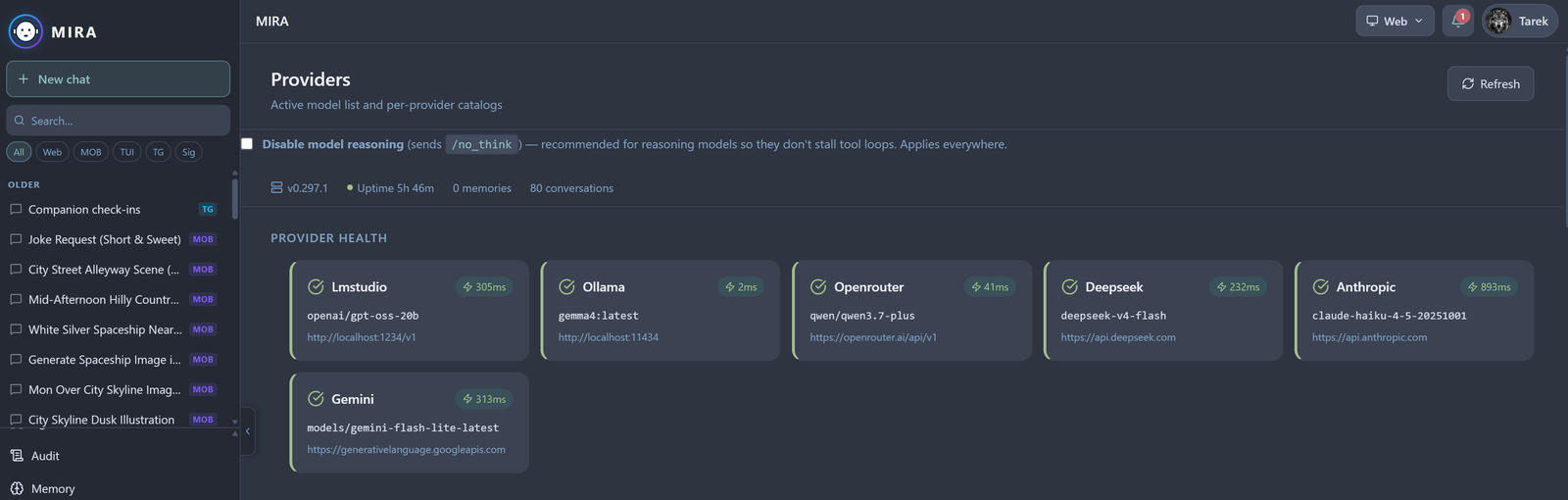 Providers — multi-provider health at a glance |
Why MIRA
Most AI assistants live in one app, on someone else's cloud, with a memory that resets every conversation. MIRA inverts all three:
- 🏠 Yours. One Rust binary on hardware you control. Conversations, memory, and provider keys never leave the box.
- 📩 Reaches you where you are. Not a feed to open — a contact that texts you on Signal, Telegram, Discord, Matrix, WhatsApp, Slack, email, or the web. It can start the conversation, too.
- 🧠 Remembers you. A growing store of facts about you plus a hand-editable wiki — the same context across channels and across months.
- 🛡️ Built safe. Memory-safe Rust core, opt-in sandboxing for code execution, least-privilege elevation, per-user accounts, and an audit trail.
✨ Features
| 💬 Channels | Web, Telegram, Signal, Discord, Matrix, WhatsApp, Slack, Email (IMAP/SMTP + OAuth), Web Push — plus external channels over the Channel Provider Protocol ("MCP for channels"). |
| 🔔 Proactive / companion | Quiet-hours-aware check-ins and a daily briefing built from your calendar, wiki, and automations — per-user, opt-in, as text or voice. |
| 🎙️ Voice | Built-in TTS (Kokoro, Piper, eSpeak, OpenAI-compatible) and STT (Whisper), with per-channel routing and per-user policy. |
| 🧠 Memory & knowledge | Auto-extracted atomic facts with semantic recall, optional experimental knowledge-graph memory, and a per-user + system wiki. |
| 🛠️ Tools | Web search/fetch, URL preview, sandboxed code execution, opt-in shell, calendar, PDF extraction, summarisation, history recall, background sub-agents. |
| 🔌 MCP host mode | Connect external MCP servers (stdio or Streamable-HTTP); tools hot-reload and surface as mcp__<server>__<tool>. |
| ⏰ Automations | Cron-scheduled and event-triggered actions, plus internal heartbeats (watchdog, memory janitor, rollups). |
| 🧩 Skills & agents | Signed, packaged units of capability, and spawnable background sub-agents. |
| 🔐 Security & multi-user | Per-user JWT accounts, admin/user roles, a tool-policy layer, a per-skill secrets vault (AES-256-GCM), secret redaction, optional nginx reverse proxy. |
| ♻️ Backup & restore | One-click or scheduled encrypted backup of the whole data directory, with a safe two-phase restore. |
More detail on each area
- Channels — Web chat, Telegram, Signal, Email (IMAP/SMTP + OAuth + webhooks), Discord, Matrix, WhatsApp, Slack, external plugin channels (Channel Provider Protocol), shared bots with identity linking, and Web Push.
- Proactive / companion — scheduled check-ins (quiet-hours aware) and a daily briefing built from your calendar, wiki, and automation runs; per-user, opt-in, deliverable as text or voice.
- Voice — TTS backends (Kokoro, Piper, eSpeak, OpenAI-compatible) and STT (whisper), with per-channel routing and per-user voice policy.
- Memory & knowledge — auto-extracted atomic facts with topic-grouped semantic recall, an optional experimental knowledge-graph memory, and a per-user + system wiki.
- Tools — web search, web fetch / URL preview, sandboxed code execution, opt-in shell, calendar, PDF extraction, date/time, summarisation, history recall, and background sub-agents.
- MCP host mode — connect external MCP servers (stdio or Streamable-HTTP) with a built-in admin-managed catalog; tools hot-reload and surface as
mcp__<server>__<tool>. - Automations — cron-scheduled and event-triggered actions, plus internal heartbeats (watchdog, memory janitor, rollups).
- Skills & agents — signed, packaged units of capability, and spawnable background sub-agents.
- Security & multi-user — per-user JWT accounts, admin/user roles, a tool policy layer, a per-skill secrets vault (AES-256-GCM), redaction of secrets on read, and an optional nginx reverse proxy.
- Reasoning auto-routing — optionally detect "hard" turns and route them to a stronger reasoning model automatically.
- Backup & restore — one-click (or scheduled) encrypted backup of the entire data directory, with a safe two-phase restore.
MIRA also ships this documentation built in — ask it "what can you do?" See mira-docs/features.md for the full tour.
Overview
MIRA is a self-hosted personal AI agent. You run it on your own hardware; it talks to whichever LLM provider you configure (Anthropic, OpenAI, OpenRouter, DeepSeek, Gemini, or a local / OpenAI-compatible server). Your conversations, memory, and data stay on your machine.
The core is Rust (~156k LOC) for a small, memory-safe, edge-deployable footprint, with a React web UI and a terminal UI.
Design principles
- Self-hosted & private — your data lives in your data directory, on your hardware.
- Safety first — Rust core; opt-in Linux sandbox and container/native runtime confinement for code execution; a least-privilege privileged helper for the few elevated operations.
- Extensible via traits — pluggable channels, tools, providers, and skills.
- Proactive — background memory, companion check-ins, scheduled automations.
- Transparent — tool/thinking traces in the UI, comprehensive logging, an audit trail.
Install
Public beta. Every release archive ships with a
SHA256SUMSand a minisign.minisigsignature — see verifying a download below.
Quick install — Linux / macOS:
curl -fsSL https://get.vexillon.ai/install.sh | sh
Quick install — Windows (PowerShell):
irm https://get.vexillon.ai/install.ps1 | iex
The installer detects your platform, downloads and verifies the signed build, places mira on your PATH, and runs the guided mira setup. Pin a version with … | sh -s -- --version 0.272.0 (or -Version 0.272.0 on Windows).
Or download manually — grab the archive for your platform from Releases, extract the mira binary onto your PATH, then run the guided setup:
mira setup        # admin account, LLM provider, security
mira install      # register the OS service (systemd / launchd / Windows SCM)
# then finish onboarding in the web UI
Docker — the repo ships a multi-stage Dockerfile (web build → rust build → slim Debian runtime with JRE + signal-cli) and a docker-compose.yml:
docker compose up -d
# open http://localhost:8080   (MIRA_PORT=9090 to change the host port)
The compose file mounts ./data into the container at /data (config, history DB, signal-cli keystores, logs) — back up that directory to back up your install. Inside the container the Docker daemon is the supervisor: restart: unless-stopped honours the web UI's Restart button.
See the installation guide for the full deployment matrix.
Verify a download
sha256sum -c SHA256SUMS
minisign -Vm mira-<version>-<target>.tar.gz \
  -P RWQX8PcjZB3S8i1V9AkZgUKoIy+eZWRzaEHKvBW9U/mkMP9Vp0B8xOaO
# trusted comment must read: signed by vexillon.ai — MIRA <version>
Architecture
System overview
┌──────────────────────────────────────────────────────────────┐
│  CHANNELS                                                      │
│  Web · Telegram · Signal · Discord · Matrix · WhatsApp ·      │
│  Slack · Email · Web Push · External providers (CPP)          │
└───────────────────────────┬──────────────────────────────────┘
                            ▼
┌──────────────────────────────────────────────────────────────┐
│  GATEWAY  (single process: HTTP/web API · channel pollers ·   │
│            schedulers · auth)                                  │
│                                                              │
│   Agent core ── Model router (multi-LLM)                      │
│      │          Memory + Wiki                                 │
│      │          Tool registry · MCP host                     │
│      │          Skills · Sub-agents                          │
│      │          Automations / scheduler                      │
└──────┼───────────────────────────────────────────────────────┘
       ▼
   Data directory (~/.mira/data): auth/user DB, memory DB, wiki,
   companion DB, automations, channel accounts, artifacts, TTS models
A single gateway process hosts the agent, the HTTP/web API, the channel pollers, and the schedulers. Global/operator settings live in mira_config.json (admin-managed); per-user settings (voice, companion, channel accounts, connected MCP servers) live per account.
Repository structure
mira/
├── src/                 # Rust core (~156k LOC)
│   ├── gateway/         # HTTP/web API, routing, control plane
│   ├── agent/           # agent loop, tool orchestration
│   ├── providers/       # LLM provider adapters (Anthropic, OpenAI, …)
│   ├── channel*/        # channel framework + per-channel impls
│   ├── discord, matrix, slack, whatsapp, email   # built-in channels
│   ├── memory/, wiki/   # memory + knowledge
│   ├── tools/           # built-in tools
│   ├── mcp/             # MCP host mode
│   ├── automations/, companion/   # scheduling + proactive
│   ├── skills/          # skills system
│   ├── tts/, stt/, voice/         # speech
│   ├── sandbox/, packages/, privhelper/   # execution confinement + elevation
│   ├── security/, policy/, auth/  # multi-user security
│   └── tui/, server/    # terminal UI + server mode
├── web/                 # React web UI + landing page
├── docs/                # public user documentation (guides, how-tos, reference)
├── mira-docs/           # built-in self-knowledge docs (compiled into the binary)
├── config/              # config schema
├── bundled-skills/      # skills shipped with MIRA
├── Dockerfile, docker-compose.yml
├── LICENSE              # GNU AGPL-3.0
└── NOTICE               # copyright + license summary
License
Copyright (C) 2026 Tarek El Diab — a project of Vexillon.
This program is free software: you can redistribute it and/or modify it under the terms of the GNU Affero General Public License, version 3 (or, at your option, any later version) as published by the Free Software Foundation. See the LICENSE file for the full text.
It is distributed WITHOUT ANY WARRANTY; without even the implied warranty of MERCHANTABILITY or FITNESS FOR A PARTICULAR PURPOSE. Because MIRA can be operated over a network, the AGPL's §13 applies: if you run a modified version as a network service, you must offer its users the corresponding source.
Acknowledgments
MIRA's design drew on a comparative study of existing agent frameworks — OpenClaw, ZeroClaw, IronClaw, memU, SuperAGI, Hermes Agent, nanobot, and Agent Zero. All are open-source projects with their own licenses; see their respective repositories.
Contact
- Issues: GitHub Issues
Contributors

83 commits
Similar repos


Languages
Rust
83.3%
TypeScript
13.3%
CSS
2.7%
MIRA (which stands for Multi-tasking Intelligent Responsive Assistant) is a self-hosted, personal AI agent designed to run on your own hardware.
Rust
8
83 commits
updated Sep 9, 2026
README
MIRA
Multi-tasking Intelligent Responsive Assistant
"Your life's loyal partner. Always ready to assist."
A self-hosted personal AI agent that runs on your hardware and reaches you on the apps you already use — Signal, Telegram, Discord, the web, and more. A project of Vexillon.
Documentation · Install · Releases · Issues
📸 Screenshots
Proactive check-ins — MIRA reaches out first | Presence — tune its rhythm & personality |
MCP — extend it with external tool servers | Skills — bundled tools, scoped permissions |
Terminal UI — the full agent in your shell | Providers — multi-provider health at a glance |
Why MIRA
Most AI assistants live in one app, on someone else's cloud, with a memory that resets every conversation. MIRA inverts all three:
- 🏠 Yours. One Rust binary on hardware you control. Conversations, memory, and provider keys never leave the box.
- 📩 Reaches you where you are. Not a feed to open — a contact that texts you on Signal, Telegram, Discord, Matrix, WhatsApp, Slack, email, or the web. It can start the conversation, too.
- 🧠 Remembers you. A growing store of facts about you plus a hand-editable wiki — the same context across channels and across months.
- 🛡️ Built safe. Memory-safe Rust core, opt-in sandboxing for code execution, least-privilege elevation, per-user accounts, and an audit trail.
✨ Features
| 💬 Channels | Web, Telegram, Signal, Discord, Matrix, WhatsApp, Slack, Email (IMAP/SMTP + OAuth), Web Push — plus external channels over the Channel Provider Protocol ("MCP for channels"). |
| 🔔 Proactive / companion | Quiet-hours-aware check-ins and a daily briefing built from your calendar, wiki, and automations — per-user, opt-in, as text or voice. |
| 🎙️ Voice | Built-in TTS (Kokoro, Piper, eSpeak, OpenAI-compatible) and STT (Whisper), with per-channel routing and per-user policy. |
| 🧠 Memory & knowledge | Auto-extracted atomic facts with semantic recall, optional experimental knowledge-graph memory, and a per-user + system wiki. |
| 🛠️ Tools | Web search/fetch, URL preview, sandboxed code execution, opt-in shell, calendar, PDF extraction, summarisation, history recall, background sub-agents. |
| 🔌 MCP host mode | Connect external MCP servers (stdio or Streamable-HTTP); tools hot-reload and surface as mcp__<server>__<tool>. |
| ⏰ Automations | Cron-scheduled and event-triggered actions, plus internal heartbeats (watchdog, memory janitor, rollups). |
| 🧩 Skills & agents | Signed, packaged units of capability, and spawnable background sub-agents. |
| 🔐 Security & multi-user | Per-user JWT accounts, admin/user roles, a tool-policy layer, a per-skill secrets vault (AES-256-GCM), secret redaction, optional nginx reverse proxy. |
| ♻️ Backup & restore | One-click or scheduled encrypted backup of the whole data directory, with a safe two-phase restore. |
More detail on each area
- Channels — Web chat, Telegram, Signal, Email (IMAP/SMTP + OAuth + webhooks), Discord, Matrix, WhatsApp, Slack, external plugin channels (Channel Provider Protocol), shared bots with identity linking, and Web Push.
- Proactive / companion — scheduled check-ins (quiet-hours aware) and a daily briefing built from your calendar, wiki, and automation runs; per-user, opt-in, deliverable as text or voice.
- Voice — TTS backends (Kokoro, Piper, eSpeak, OpenAI-compatible) and STT (whisper), with per-channel routing and per-user voice policy.
- Memory & knowledge — auto-extracted atomic facts with topic-grouped semantic recall, an optional experimental knowledge-graph memory, and a per-user + system wiki.
- Tools — web search, web fetch / URL preview, sandboxed code execution, opt-in shell, calendar, PDF extraction, date/time, summarisation, history recall, and background sub-agents.
- MCP host mode — connect external MCP servers (stdio or Streamable-HTTP) with a built-in admin-managed catalog; tools hot-reload and surface as
mcp__<server>__<tool>. - Automations — cron-scheduled and event-triggered actions, plus internal heartbeats (watchdog, memory janitor, rollups).
- Skills & agents — signed, packaged units of capability, and spawnable background sub-agents.
- Security & multi-user — per-user JWT accounts, admin/user roles, a tool policy layer, a per-skill secrets vault (AES-256-GCM), redaction of secrets on read, and an optional nginx reverse proxy.
- Reasoning auto-routing — optionally detect "hard" turns and route them to a stronger reasoning model automatically.
- Backup & restore — one-click (or scheduled) encrypted backup of the entire data directory, with a safe two-phase restore.
MIRA also ships this documentation built in — ask it "what can you do?" See mira-docs/features.md for the full tour.
Overview
MIRA is a self-hosted personal AI agent. You run it on your own hardware; it talks to whichever LLM provider you configure (Anthropic, OpenAI, OpenRouter, DeepSeek, Gemini, or a local / OpenAI-compatible server). Your conversations, memory, and data stay on your machine.
The core is Rust (~156k LOC) for a small, memory-safe, edge-deployable footprint, with a React web UI and a terminal UI.
Design principles
- Self-hosted & private — your data lives in your data directory, on your hardware.
- Safety first — Rust core; opt-in Linux sandbox and container/native runtime confinement for code execution; a least-privilege privileged helper for the few elevated operations.
- Extensible via traits — pluggable channels, tools, providers, and skills.
- Proactive — background memory, companion check-ins, scheduled automations.
- Transparent — tool/thinking traces in the UI, comprehensive logging, an audit trail.
Install
Public beta. Every release archive ships with a
SHA256SUMSand a minisign.minisigsignature — see verifying a download below.
Quick install — Linux / macOS:
curl -fsSL https://get.vexillon.ai/install.sh | sh
Quick install — Windows (PowerShell):
irm https://get.vexillon.ai/install.ps1 | iex
The installer detects your platform, downloads and verifies the signed build, places mira on your PATH, and runs the guided mira setup. Pin a version with … | sh -s -- --version 0.272.0 (or -Version 0.272.0 on Windows).
Or download manually — grab the archive for your platform from Releases, extract the mira binary onto your PATH, then run the guided setup:
mira setup        # admin account, LLM provider, security
mira install      # register the OS service (systemd / launchd / Windows SCM)
# then finish onboarding in the web UI
Docker — the repo ships a multi-stage Dockerfile (web build → rust build → slim Debian runtime with JRE + signal-cli) and a docker-compose.yml:
docker compose up -d
# open http://localhost:8080   (MIRA_PORT=9090 to change the host port)
The compose file mounts ./data into the container at /data (config, history DB, signal-cli keystores, logs) — back up that directory to back up your install. Inside the container the Docker daemon is the supervisor: restart: unless-stopped honours the web UI's Restart button.
See the installation guide for the full deployment matrix.
Verify a download
sha256sum -c SHA256SUMS
minisign -Vm mira-<version>-<target>.tar.gz \
  -P RWQX8PcjZB3S8i1V9AkZgUKoIy+eZWRzaEHKvBW9U/mkMP9Vp0B8xOaO
# trusted comment must read: signed by vexillon.ai — MIRA <version>
Architecture
System overview
┌──────────────────────────────────────────────────────────────┐
│  CHANNELS                                                      │
│  Web · Telegram · Signal · Discord · Matrix · WhatsApp ·      │
│  Slack · Email · Web Push · External providers (CPP)          │
└───────────────────────────┬──────────────────────────────────┘
                            ▼
┌──────────────────────────────────────────────────────────────┐
│  GATEWAY  (single process: HTTP/web API · channel pollers ·   │
│            schedulers · auth)                                  │
│                                                              │
│   Agent core ── Model router (multi-LLM)                      │
│      │          Memory + Wiki                                 │
│      │          Tool registry · MCP host                     │
│      │          Skills · Sub-agents                          │
│      │          Automations / scheduler                      │
└──────┼───────────────────────────────────────────────────────┘
       ▼
   Data directory (~/.mira/data): auth/user DB, memory DB, wiki,
   companion DB, automations, channel accounts, artifacts, TTS models
A single gateway process hosts the agent, the HTTP/web API, the channel pollers, and the schedulers. Global/operator settings live in mira_config.json (admin-managed); per-user settings (voice, companion, channel accounts, connected MCP servers) live per account.
Repository structure
mira/
├── src/                 # Rust core (~156k LOC)
│   ├── gateway/         # HTTP/web API, routing, control plane
│   ├── agent/           # agent loop, tool orchestration
│   ├── providers/       # LLM provider adapters (Anthropic, OpenAI, …)
│   ├── channel*/        # channel framework + per-channel impls
│   ├── discord, matrix, slack, whatsapp, email   # built-in channels
│   ├── memory/, wiki/   # memory + knowledge
│   ├── tools/           # built-in tools
│   ├── mcp/             # MCP host mode
│   ├── automations/, companion/   # scheduling + proactive
│   ├── skills/          # skills system
│   ├── tts/, stt/, voice/         # speech
│   ├── sandbox/, packages/, privhelper/   # execution confinement + elevation
│   ├── security/, policy/, auth/  # multi-user security
│   └── tui/, server/    # terminal UI + server mode
├── web/                 # React web UI + landing page
├── docs/                # public user documentation (guides, how-tos, reference)
├── mira-docs/           # built-in self-knowledge docs (compiled into the binary)
├── config/              # config schema
├── bundled-skills/      # skills shipped with MIRA
├── Dockerfile, docker-compose.yml
├── LICENSE              # GNU AGPL-3.0
└── NOTICE               # copyright + license summary
License
Copyright (C) 2026 Tarek El Diab — a project of Vexillon.
This program is free software: you can redistribute it and/or modify it under the terms of the GNU Affero General Public License, version 3 (or, at your option, any later version) as published by the Free Software Foundation. See the LICENSE file for the full text.
It is distributed WITHOUT ANY WARRANTY; without even the implied warranty of MERCHANTABILITY or FITNESS FOR A PARTICULAR PURPOSE. Because MIRA can be operated over a network, the AGPL's §13 applies: if you run a modified version as a network service, you must offer its users the corresponding source.
Acknowledgments
MIRA's design drew on a comparative study of existing agent frameworks — OpenClaw, ZeroClaw, IronClaw, memU, SuperAGI, Hermes Agent, nanobot, and Agent Zero. All are open-source projects with their own licenses; see their respective repositories.
Contact
- Issues: GitHub Issues
Similar repos
Contributors
83 commits
Languages
Rust
83.3%
TypeScript
13.3%
CSS
2.7%