
GAN-based colorization of SAR (radar) satellite imagery into optical-style RGB, using an Attention U-Net generator and multi-scale PatchGAN discriminator
Jupyter Notebook
12
5 commits
updated Sep 13, 2026
See what people are saying
README
SAR Image Colorization — Attention GAN
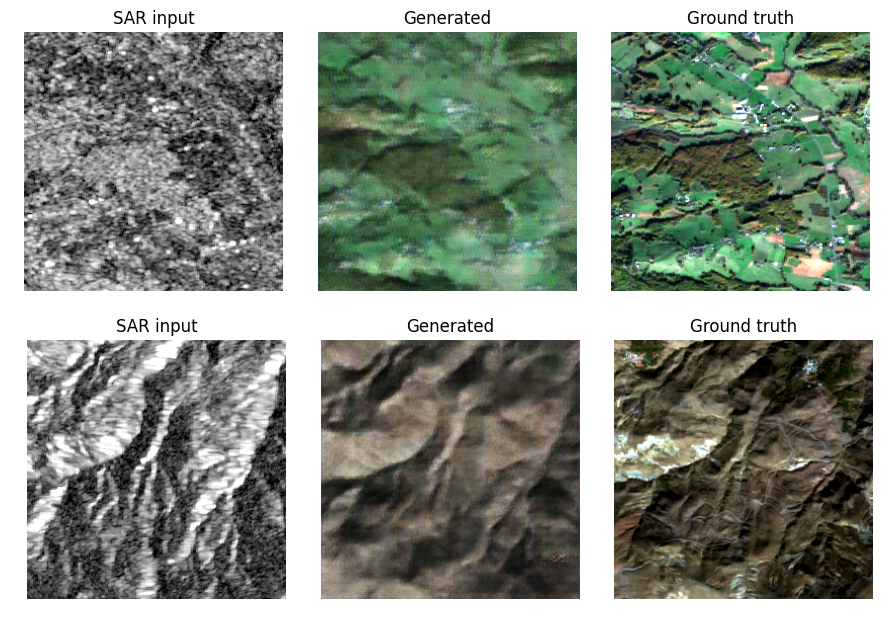
Translating grayscale Synthetic Aperture Radar (SAR) imagery into realistic optical (RGB) imagery using a conditional GAN with attention.
Overview
SAR sensors image the ground regardless of cloud cover or daylight, but the resulting grayscale imagery is hard to interpret visually. This project trains a conditional GAN to translate SAR imagery into optical-style RGB imagery, so the output is easier to read while keeping the availability advantages of radar.
Architecture
- Generator: U-Net with a self-attention block at the 16×16 bottleneck (SAGAN-style) and attention gates on every skip connection (Attention U-Net style, Oktay et al.)
- Discriminator: Multi-scale PatchGAN — three discriminators at full, half, and quarter resolution (Pix2PixHD style)
- Losses: LSGAN adversarial + feature matching + L1 + VGG19 perceptual + differentiable SSIM
Training details
- 256×256 paired SAR/optical images, deterministic train/val split (fixed seed) for reproducible evaluation
- Mixed-precision (AMP) training with automatic checkpoint resume, built for Kaggle's session time limits
- Evaluated with PSNR and SSIM on a held-out test split
Dataset
Paired SAR-Optical Dataset (16K Images) on Kaggle. Each image is a single PNG with the SAR tile on the left half and the paired optical tile on the right half.
Repository structure
Getting started
- Open
notebooks/sar_colorization_attention_gan.ipynbon a GPU environment (developed for Kaggle P100/T4; a local CUDA GPU works too). - Download the dataset above and point
CFG["DATA_DIR"]at it. - Run the notebook top to bottom. Training checkpoints and sample grids are written to
checkpoints/andsamples/; re-running the notebook resumes automatically from the last checkpoint. - The evaluation section at the bottom loads a checkpoint and reports PSNR/SSIM on the held-out split, plus saves comparison grids (SAR | Generated | Ground Truth) to
test_results/.
Local setup
python -m venv venv
source venv/bin/activate        # Windows: venv\Scripts\activate
pip install -r requirements.txt
jupyter notebook notebooks/sar_colorization_attention_gan.ipynb
Results
| Metric | Value |
|---|---|
| PSNR | 17.669 ± 2.929 dB |
| SSIM | 0.3393 ± 0.1155 |
| Test set size | 319 images |
License
MIT — see LICENSE.
Acknowledgments
- Attention U-Net: Oktay et al., Attention U-Net: Learning Where to Look for the Pancreas
- Multi-scale PatchGAN + feature matching: Wang et al., High-Resolution Image Synthesis and Semantic Manipulation with Conditional GANs (Pix2PixHD)
- Self-attention block: Zhang et al., Self-Attention Generative Adversarial Networks (SAGAN)
Contributors

5 commits
Similar repos


Languages
Jupyter Notebook
99.8%
GAN-based colorization of SAR (radar) satellite imagery into optical-style RGB, using an Attention U-Net generator and multi-scale PatchGAN discriminator
Jupyter Notebook
12
5 commits
updated Sep 13, 2026
See what people are saying
README
SAR Image Colorization — Attention GAN
Translating grayscale Synthetic Aperture Radar (SAR) imagery into realistic optical (RGB) imagery using a conditional GAN with attention.
Overview
SAR sensors image the ground regardless of cloud cover or daylight, but the resulting grayscale imagery is hard to interpret visually. This project trains a conditional GAN to translate SAR imagery into optical-style RGB imagery, so the output is easier to read while keeping the availability advantages of radar.
Architecture
- Generator: U-Net with a self-attention block at the 16×16 bottleneck (SAGAN-style) and attention gates on every skip connection (Attention U-Net style, Oktay et al.)
- Discriminator: Multi-scale PatchGAN — three discriminators at full, half, and quarter resolution (Pix2PixHD style)
- Losses: LSGAN adversarial + feature matching + L1 + VGG19 perceptual + differentiable SSIM
Training details
- 256×256 paired SAR/optical images, deterministic train/val split (fixed seed) for reproducible evaluation
- Mixed-precision (AMP) training with automatic checkpoint resume, built for Kaggle's session time limits
- Evaluated with PSNR and SSIM on a held-out test split
Dataset
Paired SAR-Optical Dataset (16K Images) on Kaggle. Each image is a single PNG with the SAR tile on the left half and the paired optical tile on the right half.
Repository structure
Getting started
- Open
notebooks/sar_colorization_attention_gan.ipynbon a GPU environment (developed for Kaggle P100/T4; a local CUDA GPU works too). - Download the dataset above and point
CFG["DATA_DIR"]at it. - Run the notebook top to bottom. Training checkpoints and sample grids are written to
checkpoints/andsamples/; re-running the notebook resumes automatically from the last checkpoint. - The evaluation section at the bottom loads a checkpoint and reports PSNR/SSIM on the held-out split, plus saves comparison grids (SAR | Generated | Ground Truth) to
test_results/.
Local setup
python -m venv venv
source venv/bin/activate        # Windows: venv\Scripts\activate
pip install -r requirements.txt
jupyter notebook notebooks/sar_colorization_attention_gan.ipynb
Results
| Metric | Value |
|---|---|
| PSNR | 17.669 ± 2.929 dB |
| SSIM | 0.3393 ± 0.1155 |
| Test set size | 319 images |
License
MIT — see LICENSE.
Acknowledgments
- Attention U-Net: Oktay et al., Attention U-Net: Learning Where to Look for the Pancreas
- Multi-scale PatchGAN + feature matching: Wang et al., High-Resolution Image Synthesis and Semantic Manipulation with Conditional GANs (Pix2PixHD)
- Self-attention block: Zhang et al., Self-Attention Generative Adversarial Networks (SAGAN)
Similar repos
Contributors
5 commits
Languages
Jupyter Notebook
99.8%