
A list of awesome mechatronics books, courses and software.
See the codeREADME
Awesome Mechatronics 

Books, courses, tools, papers and hardware for mechatronic engineering —
from the classical V-model to vision-language-action models.
Definitions · Learning paths · VLAs & diffusion policies · Agentic AI · Projects · Trends radar
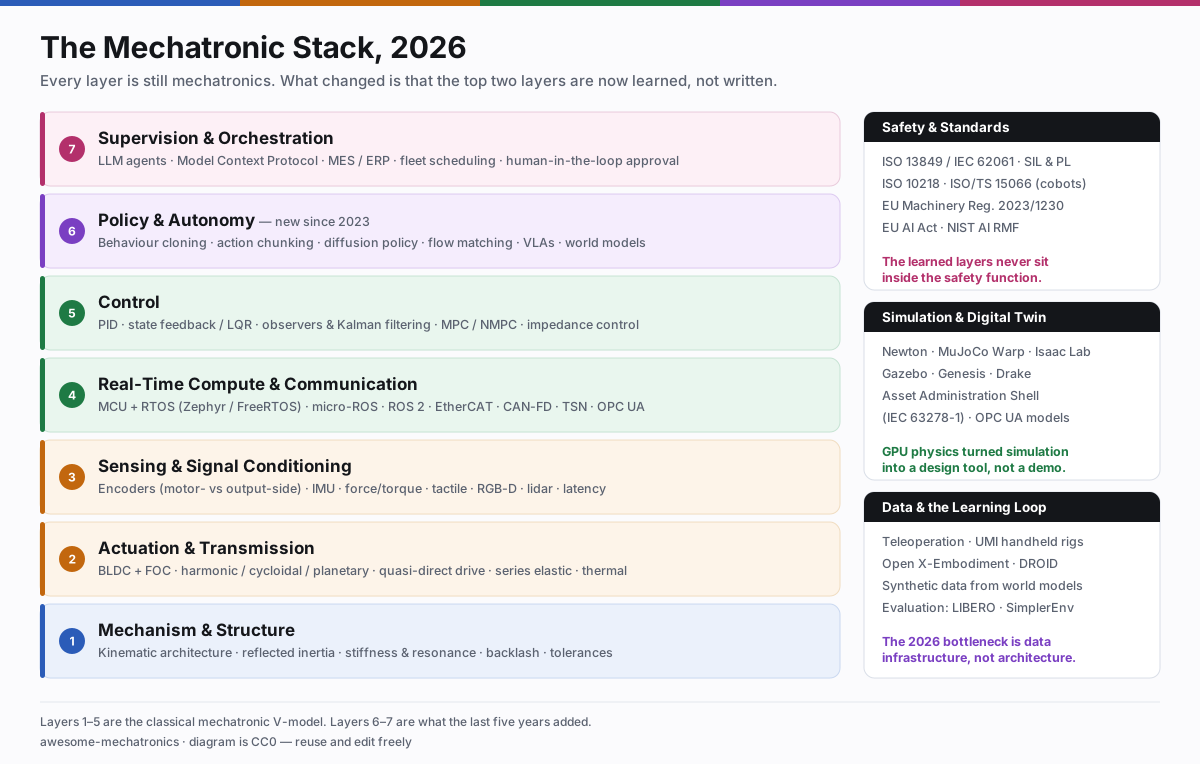
Mechatronics is the synergistic integration of mechanical engineering, electronics, control theory and computing in the design of products and processes. The 1969 Yaskawa coinage described machines with electronics inside. The discipline has since absorbed cyber-physical systems, digital twins, and — since roughly 2023 — learned, language-conditioned policies that replace hand-written control laws. See §0 for how the definition has moved.
What's in here. This list keeps the classical mechatronics canon (it still matters — nothing about foundation models repeals the Nyquist criterion) and adds the parts of the field that appeared in the last five years: learned visuomotor control, VLAs, diffusion and flow-matching policies, GPU physics, agentic industrial software, and the mechanical-design ideas that came back into fashion because learning made compliant hardware tractable.
Legend — 📖 book · 📄 paper · 🎓 course · 🔧 tool · 📝 write-up · 🧪 hands-on · 🆓 free / open source · 💵 paid · ⭐ start here if you're new · 🔬 research-level
Table of contents
- 0. What Mechatronics Means Now
- 1. Start Here: Learning Paths
- 2. Foundations: Books & Courses
- 3. The Mechanical Side, Seen From Mechatronics
- 4. Electronics, Embedded & Edge
- 5. Industrial Automation, Industry 4.0 / 5.0
- 6. The Robotics Software Stack
- 7. Learning-Based Control: The New Core
- 8. Agentic AI in Automation and Robotics
- 9. Hands-On Projects
- 10. Hardware You Can Actually Buy or Build
- 11. Classic Mechatronic Systems
- 12. Trends Radar 2026
- 13. Journals, Conferences, Communities
- 14. Related Awesome Lists
- Contributing
- Licence
0. What Mechatronics Means Now
The definition has moved four times
Mechatronics has been redefined roughly once per industrial revolution, and the current redefinition is the sharpest since the 1990s.
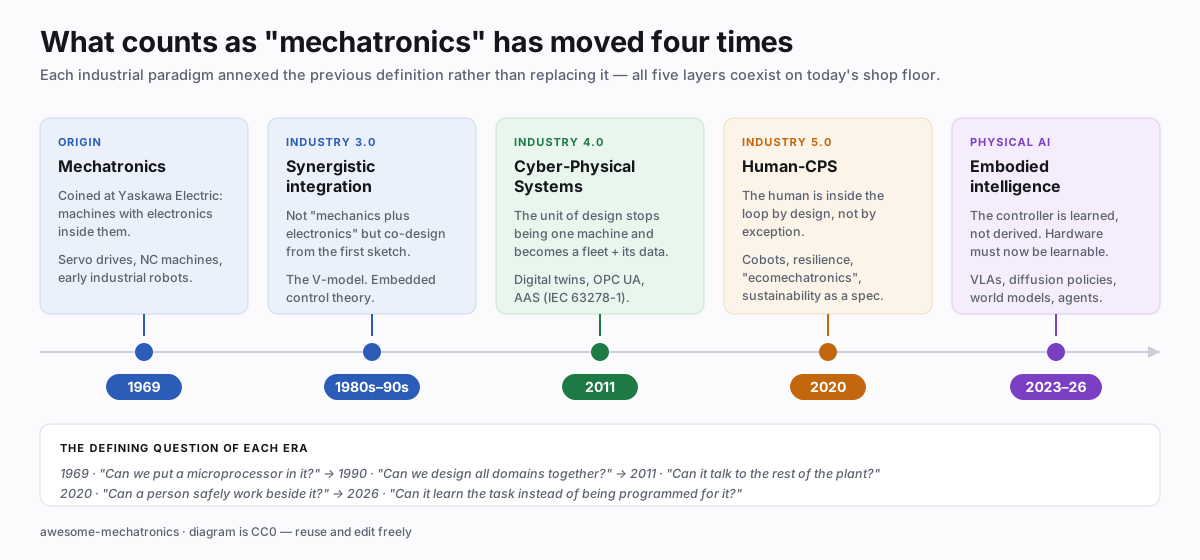
1. Mechanics + electronics → synergistic integration. The 1980s–90s reframing was that mechatronics is not a sum of parts bolted together but a co-design discipline: the mechanism, the sensor choice and the control law are decided together, from the first sketch. This is where the V-model and concurrent engineering come from, and it remains the core professional skill.
2. Mechatronics → Cyber-Physical Systems. With Industry 4.0 (2011), production systems became networked CPS built on digital twins and standardised information models. Mechatronics stopped being about one machine and started being about fleets of machines with an information layer. The Asset Administration Shell (IEC 63278-1:2023) is the concrete artefact of this shift.
3. CPS → Human-CPS (Industry 5.0). From around 2020, the framing added human-centricity, resilience and sustainability, giving rise to Human Cyber-Physical Systems and cobots. A useful consequence: three industrial paradigms now coexist on the same shop floor, and a mechatronics engineer is expected to work across all three.
4. Everything → Physical AI / Embodied AI. The 2024–2026 shift is the largest. Perception-to-action neural policies increasingly replace the hand-designed controller, not just augment it. Terminology is genuinely contested here:
| Term | Rough meaning | Who pushes it |
|---|---|---|
| Embodied AI | AI that perceives, decides and acts through a body (physical or simulated). The older, academic term. | Academia; ITU-T Rec. F.748.66 (Dec 2025) gives it a formal framework |
| Physical AI | The broader commercial umbrella: models + simulation + compute sold as one stack for real-world machines | NVIDIA, BCG, investors |
| Mechatronics | The engineering discipline that actually builds the body the AI acts through | Everyone, once the demo has to ship |
The honest reading: Physical AI is a market category; mechatronics is the engineering discipline it depends on. Nothing in a VLA solves backlash, thermal derating, or the fact that a harmonic drive has a torque ripple signature. What has changed is where the difficulty sits — less in writing the controller, more in hardware that is learnable: backdrivable, well-instrumented, repeatable, and cheap enough to collect thousands of demonstrations on.
A working definition for 2026
Mechatronics is the design of systems whose behaviour emerges from the co-design of mechanism, actuation, sensing, computation and learned or programmed policy — where the policy may now be a neural network trained on data rather than a control law derived from a model.
Read the definition debate yourself 📄
- The Evolution of Mechatronics Engineering and Its Relationship with Industry 3.0, 4.0, and 5.0 — Technologies, 2026. 🆓 The single best recent paper on this question; proposes a generational classification of machines. Start here. ⭐
- Mechatronics in Industry 4.0 and 5.0: advancing synergy, innovations, sustainability, and challenges — Maki K. Habib, 2025.
- Skills for Physical Artificial Intelligence — Miriyev & Kovač, Nature Machine Intelligence, 2020. 📄 The paper that named the skills gap between materials, mechanics and AI.
- Intelligence as Computation — Oliver Brock, 2024. 🔬 Argues digital, analog, mechanical and morphological computation are one continuum — the philosophical backbone for "mechanical intelligence."
- ITU-T F.748.66 — Requirements and framework for embodied artificial intelligence systems, approved Dec 2025. The first ITU-level attempt to standardise what "embodied AI system" means.
- Evolution from mechatronics to cyber-physical systems: an educational point of view — still the clearest statement of the CPS transition for curricula.
1. Start Here: Learning Paths
Mechatronics is wide enough that "where do I start" is the most common question. Three paths, depending on where you want to end up.
flowchart TD
    A["Absolute beginner<br/>Arduino / ESP32 blink → sensors → PWM motor"] --> B["Circuits + C/C++ + Python"]
    B --> C["Classical control<br/>PID, Laplace, Bode, state space"]
    C --> D{"Pick a direction"}

    D --> E["<b>Industrial automation</b><br/>PLC · IEC 61131-3 · HMI/SCADA<br/>OPC UA · digital twin"]
    D --> F["<b>Robotics</b><br/>ROS 2 · kinematics · SLAM<br/>MoveIt · Nav2"]
    D --> G["<b>Machine / product design</b><br/>CAD · FEA · actuator sizing<br/>tolerances · DfM"]

    E --> H["Agentic industrial AI<br/>MCP · anomaly agents · predictive maintenance"]
    F --> I["Robot learning<br/>imitation → ACT → diffusion policy → VLA"]
    G --> J["Co-design<br/>compliant actuators · topology opt · morphological computation"]

    H --> K["<b>Physical AI engineer</b>"]
    I --> K
    J --> K
Path A — Beginner, hands-on first (0–6 months) ⭐
You want to build something that moves before you learn Laplace transforms. This is a legitimate order.
- Get a board and a motor. Arduino Uno/ESP32 + L298N or a TB6612 + a cheap DC gearmotor with an encoder. Total cost under €40.
- 🎓 Paul McWhorter — Arduino for Beginners 🆓 — the most patient beginner series that exists.
- 🎓 ControlSystemsAcademy / Brian Douglas — Control System Lectures 🆓 — intuition before mathematics. Watch "PID Control — A brief introduction" and the root locus series.
- 🧪 Build a closed-loop position controller for one motor. Tune a PID by hand. This single project teaches sampling, quantisation, saturation, integral windup and derivative noise — the four things that actually bite in practice.
- 🎓 MATLAB Tech Talks — Understanding PID Control 🆓 (free videos even without a MATLAB licence)
- Move to ESP32 + micro-ROS or Raspberry Pi + ROS 2 and you're in the robotics world proper.
- 🧪 Then: LeRobot + an SO-101 arm — collect 50 demonstrations, train a policy, watch it work. Two hours, and it will reframe everything you thought robot programming was.
Path B — Undergraduate / career-switcher (6–18 months)
- Control: 🎓 Steve Brunton — Control Bootcamp 🆓 + 📖 Feedback Systems (Åström & Murray) 🆓
- Robotics: 📖 Modern Robotics (Lynch & Park) 🆓 + the Coursera specialisation
- Embedded: build one project in bare-metal C on an STM32, then one on Zephyr RTOS. The contrast teaches you what an RTOS buys you.
- Industrial: one PLC project in Structured Text on OpenPLC 🆓 or a real S7-1200, plus one OPC UA client.
- Learning: 📖 Robot Learning: A Tutorial 🆓 — the single best on-ramp from classical control to learned policies, with runnable
lerobotexamples.
Path C — Graduate / research 🔬
- 📖 Underactuated Robotics and Robotic Manipulation — Russ Tedrake, MIT. 🆓 Free, interactive, with Drake notebooks. The best treatment anywhere of why contact-rich control is hard.
- 📄 Towards a Unified Understanding of Robot Manipulation: A Comprehensive Survey — 2025. The map of the whole manipulation literature.
- 📄 Vision-Language-Action Models for Robotics: A Review Towards Real-World Applications — Kawaharazuka et al., IEEE Access 2025. Has a searchable database of every VLA.
- Pick a benchmark (LIBERO, SimplerEnv, RoboCasa) and reproduce one result before you propose anything.
2. Foundations: Books & Courses
Core mechatronics textbooks 📖
The classics, kept because they are still the right first books:
- Mechatronics: Electronic Control Systems in Mechanical and Electrical Engineering — W. Bolton, 7th ed. 💵 The standard undergraduate entry point.
- Introduction to Mechatronics and Measurement Systems — Alciatore & Histand, 5th ed. 💵 Stronger on instrumentation and signal conditioning than Bolton.
- The Mechatronics Handbook — Robert H. Bishop (ed.). 🆓 first-edition PDF. Reference work, not a textbook.
- Mechatronic Systems: Modelling and Simulation with HDLs — Pelz. 💵 Underrated: HDL-based modelling of mixed-domain systems.
- Control of Mechatronic Systems — Patrick O. J. Kaltjob, 2021. 💵 One of the few recent books that treats digital control implementation seriously.
- Machine Vision and Mechatronics in Practice — Billingsley & Brett. 💵
- Automotive Mechatronics — Bosch Professional Automotive Information. 💵 The reference for automotive networking, ESP/ABS, and drivetrain electronics.
Control & dynamics (free where possible) 📖
- Feedback Systems: An Introduction for Scientists and Engineers — Åström & Murray, 2nd ed. 🆓 Free PDF. The best free control textbook.
- Data-Driven Science and Engineering — Brunton & Kutz, 2nd ed. 🆓 Free PDF + code. SVD, DMD, SINDy, MPC, RL, all with runnable examples.
- Applied Nonlinear Control — Slotine & Li. 💵 Still the reference for Lyapunov design and sliding mode.
- Predictive Control for Linear and Hybrid Systems — Borrelli, Bemporad, Morari, Cambridge 2017. 💵
- Rigid Body Dynamics Algorithms — Roy Featherstone. 💵 If you ever need to know why your dynamics library is fast.
Robotics 📖
- Modern Robotics: Mechanics, Planning, and Control — Lynch & Park. 🆓 Free PDF, free videos, free software library, matching Coursera specialisation. ⭐ The best value in robotics education.
- Robotics: Modelling, Planning and Control — Siciliano, Sciavicco, Villani, Oriolo. 💵 The European standard text.
- Springer Handbook of Robotics — Siciliano & Khatib (eds.), 2nd ed. 💵 2,300 pages; the field's encyclopedia.
- Probabilistic Robotics — Thrun, Burgard, Fox. 💵 Still the reference for state estimation and SLAM.
- Underactuated Robotics — Russ Tedrake, MIT 6.832. 🆓 Free, interactive, updated every year. 🔬
- Robotic Manipulation — Russ Tedrake, MIT 6.4210. 🆓 Perception, planning and control for manipulation, with Drake.
- Introduction to Autonomous Mobile Robots — Siegwart, Nourbakhsh, Scaramuzza. 💵
Machine learning for engineers 📖
- Deep Learning — Goodfellow, Bengio, Courville. 🆓 Now historical, but the maths chapters age well.
- Dive into Deep Learning — Zhang et al. 🆓 Interactive, PyTorch/JAX, actually current.
- Reinforcement Learning: An Introduction — Sutton & Barto, 2nd ed. 🆓
- Spinning Up in Deep RL — OpenAI. 🆓 The clearest practical RL introduction; algorithms implemented readably.
- Probabilistic Machine Learning — Kevin Murphy. 🆓 Two volumes, free PDFs.
- Computer Vision: Algorithms and Applications — Szeliski, 2nd ed. 🆓
Courses worth your time 🎓
| Course | Who | Cost | Why |
|---|---|---|---|
| Control Bootcamp | Steve Brunton, UW | 🆓 | Best state-space introduction on YouTube |
| Modern Robotics Specialization | Northwestern | 🆓 audit | Screw theory done properly, with CoppeliaSim labs |
| Underactuated Robotics | MIT | 🆓 | Trajectory optimisation, LQR trees, contact 🔬 |
| Robotic Manipulation | MIT | 🆓 | The manipulation course, with Drake notebooks 🔬 |
| SLAM lectures | Cyrill Stachniss, Bonn | 🆓 | The reference SLAM lecture series |
| Sim-to-Real with the SO-101 | NVIDIA | 🆓 | Full pipeline: Isaac Sim → Isaac Lab → GR00T → real arm 🧪 |
| LeRobot docs & tutorials | Hugging Face | 🆓 | Imitation learning and VLAs, hands-on, end to end ⭐ |
| Introduction to Robotics CS223A | Khatib, Stanford | 🆓 | Classic; operational space control from the source |
| Learn 5 PLCs in a Day | Udemy | 💵 | Practical multi-vendor PLC exposure |
| From Wire to PLC | Udemy | 💵 | Panel wiring → ladder → commissioning |
| Wearable Robotics — Exoskeletons | Udemy | 💵 | Niche but well-made |
3. The Mechanical Side, Seen From Mechatronics
The most common failure mode in modern mechatronics projects is a good policy on bad hardware. This section is the mechanical engineering that a mechatronic engineer specifically needs — not general machine design, but the subset where mechanics and control interact.
The central idea: your mechanism is part of your controller
flowchart LR
    subgraph Physical["Mechanical domain"]
        M["Mechanism<br/>kinematics, inertia"]
        T["Transmission<br/>ratio, backlash, friction"]
        C["Compliance<br/>stiffness, damping"]
    end
    subgraph Electrical["Electrical domain"]
        A["Actuator<br/>torque density, thermal"]
        S["Sensing<br/>resolution, bandwidth, latency"]
    end
    subgraph Compute["Computation"]
        P["Policy<br/>PID / MPC / learned"]
    end

    M --> T --> A --> P
    S --> P --> A
    C -.->|"sets achievable<br/>control bandwidth"| P
    P -.->|"required bandwidth<br/>constrains design"| C

    style Physical fill:#e8f0fe
    style Electrical fill:#fef3e8
    style Compute fill:#e8fae8
Three rules that follow, and that no amount of learning removes:
- Structural resonance caps your bandwidth. A closed loop cannot be much faster than the first flexible mode of the structure it drives. Stiffness is a control-design parameter.
- Backlash is not a disturbance, it is a discontinuity. It breaks gradient-based tuning, breaks learned policies trained in simulation, and shows up as limit cycles.
- Reflected inertia scales with gear ratio squared. This is why quasi-direct-drive exists, and why highly geared arms cannot do impedance control well.
3.1 Actuation & transmission
- 📄 Compact Gearboxes for Modern Robotics: A Review — García et al., Frontiers in Robotics and AI, 2020. 🆓 The best free survey of harmonic, cycloidal, planetary and novel drives, with efficiency and backdrivability compared. ⭐
- 📄 Quasi-Direct Drive Actuation for a Lightweight Hip Exoskeleton with High Backdrivability and High Bandwidth — Yu et al. 🆓 The clearest worked example of QDD design trade-offs.
- 📄 Cycloidal Quasi-Direct Drive Actuators with Learning-Based Torque Estimation — 2024. 🆓 Where mechanical design and learning meet directly: use a network to recover torque a cheap transmission can't sense.
- 📄 Variable Impedance Actuators: A Review — Vanderborght et al. The taxonomy paper for SEA / VSA / PEA.
- 🔧 SimpleFOC 🆓 — Field-oriented control on Arduino-class hardware. The fastest way to understand BLDC control by doing.
- 🔧 ODrive 💵 / 🔧 moteus 💵 — Open(ish) high-performance BLDC controllers used across the hobby-to-research spectrum.
- 🔧 TMotor / CubeMars AK-series 💵 — the de-facto QDD actuators for legged robot builds.
Selection cheat-sheet:
| Need | Architecture | Typical ratio | Trade-off |
|---|---|---|---|
| Precise position, high stiffness | Harmonic / strain wave | 50:1–160:1 | Non-backdrivable, expensive, torque ripple |
| High dynamics, force control, impact | Quasi-direct drive (QDD) | 6:1–10:1 | Large motor, high current, heat |
| Safe human contact, energy storage | Series elastic (SEA) | any + spring | Bandwidth limited by spring, extra sensing |
| Cheap, high ratio, tolerant | Cycloidal | 20:1–100:1 | Vibration, harder to manufacture well |
| Lightweight distal mass | Cable / tendon drive | varies | Friction, stretch, routing complexity |
3.2 Compliance, contact and impedance
Learning-based manipulation made compliance fashionable again: policies that touch things need hardware that can survive touching things.
- 📄 Series Elastic Actuators — Pratt & Williamson, IROS 1995. The origin paper; still worth reading.
- 📄 Backdrivable actuators in robotics — a good living survey of the design space.
- 📄 Mechatronic whole-body co-design of a quadruped robot integrating local compliance — INRIA, 2026. States the current frontier plainly: rigid QDD quadrupeds have plateaued far below biological performance, and distributed compliance is the next lever.
- 🔧 Drake 🆓 — hydroelastic contact modelling; the reference implementation for contact-rich simulation you can trust.
3.3 Mechanical intelligence & morphological computation 🔬
The idea that the body itself performs computation — that a well-designed gripper needs less control than a badly-designed one. This has moved from curiosity to an active research programme.
- 📄 Intelligence as Computation — Oliver Brock, 2024. Unifies digital, analog, mechanical and morphological computation.
- 📄 Perspectives on Intelligence in Soft Robotics — Kortman et al., Advanced Intelligent Systems, 2025. 🆓 Classifies embodied intelligence into adaptive shape, adaptive functionality and adaptive mechanics.
- 📄 Reprogrammable metamaterial robot with embodied versatile computation and mechanical intelligence — Nature Communications, 2026. 🆓 Elastic-wave metamaterials performing analog and logic operations inside a crawling robot.
- 📄 The 2024 Active Metamaterials Roadmap — 🆓 Shape-morphing metamaterials as embodied intelligence.
- 📄 Exploring Embodied Intelligence in Soft Robotics: A Review — Biomimetics, 2024. 🆓
- 📄 Morphological design methodologies of soft robots — 2025. 🆓 Forward biomimetic vs. inverse morphological design.
3.4 Design, simulation and manufacturing tools
| Tool | Type | Cost | Note |
|---|---|---|---|
| FreeCAD | Parametric CAD | 🆓 | v1.x finally fixed the topological naming problem; genuinely usable now |
| Onshape | Cloud CAD | 🆓 free tier | Free for public documents; excellent for open-source hardware |
| SolidWorks | CAD + CAE | 💵 | Industry default; motion + FEA add-ins |
| Fusion | CAD/CAM/CAE | 💵 (free personal) | Integrated generative design and CAM |
| nTop | Implicit modelling | 💵 | Lattices, topology optimisation, field-driven design |
| Ansys / COMSOL | Multiphysics FEA | 💵 | Thermal + structural + electromagnetic coupling |
| CalculiX / Code_Aster | FEA solver | 🆓 | Free FEA; usable via FreeCAD FEM workbench |
| ToOptix / ToPy | Topology optimisation | 🆓 | Learn the method before paying for a suite |
| OpenModelica | Acausal multi-domain sim | 🆓 | The right tool for mechanical+hydraulic+electrical system models |
| Simscape | Multi-domain sim | 💵 | The commercial equivalent, tightly coupled to Simulink |
| Blender | 3D modelling | 🆓 | Not CAD, but the standard for robot visual meshes and rendering |
| PrusaSlicer / OrcaSlicer | Slicers | 🆓 | Printed robot parts: print orientation determines layer-direction strength |
3.5 Practical mechanical checklist for mechatronic builds 🧪
Expand — the things that actually go wrong
- Actuator sizing: size on RMS torque over the duty cycle, not peak. Check thermal, then check peak, then check backdrive torque.
- Reflected inertia ratio: aim for load-to-motor inertia below ~10:1 for good servo response; below 3:1 for high dynamics.
- First resonance: measure it (tap test + accelerometer, or a swept-sine on the actuator). Target closed-loop bandwidth ≤ 1/3 of it.
- Backlash budget: total it across every joint in the chain. Preload, use anti-backlash gears, or move the encoder to the output.
- Encoder placement: motor-side encoders lie about the load. Output-side encoders (dual encoding) cost more and solve most repeatability complaints.
- Cable management: the leading cause of field failures in articulated robots. Design the cable path before the last link.
- Thermal path: motors derate. Where does the heat go? Aluminium bracket, not printed PLA.
- Tolerance stack-up: run it for the gripper-to-camera chain specifically — that's what a learned policy actually sees.
- Learnability: if you plan to collect demonstrations, the robot must be backdrivable enough to hand-guide, repeatable enough that yesterday's data still applies, and mechanically identical to any other unit you deploy on.
4. Electronics, Embedded & Edge
Microcontrollers & compute
| Platform | Role | Note |
|---|---|---|
| Arduino 🆓 | Learning, prototyping | The Uno R4 / Nano ESP32 generation is far more capable than the AVR days |
| ESP32 family 🆓 | Wireless mechatronics | Wi-Fi/BLE + dual core + enough RAM for micro-ROS |
| Raspberry Pi Pico / RP2350 🆓 | Real-time IO | PIO state machines are excellent for encoder decoding and step generation |
| STM32 💵 | Production motor control | The industry default for motor drives; G4/H7 for FOC |
| Teensy 4.x 💵 | High-rate control loops | 600 MHz Cortex-M7; underrated for 10 kHz+ loops |
| Raspberry Pi 5 💵 | Linux + ROS 2 | Enough for perception at modest rates; add a Hailo or Coral for NN inference |
| NVIDIA Jetson Orin / Thor 💵 | On-robot policy inference | Thor / T4000 (Blackwell, 2026) is what current VLAs are deployed on |
Firmware & RTOS
- 🔧 Zephyr RTOS 🆓 — the RTOS to learn now: vendor-neutral, device-tree based, Linux-Foundation governed, huge board support.
- 🔧 FreeRTOS 🆓 — still ubiquitous, simpler mental model.
- 🔧 micro-ROS 🆓 — ROS 2 on microcontrollers. Runs on Zephyr, FreeRTOS, Mbed, Arduino. The correct way to bridge MCU sensors/actuators into a ROS 2 system. ⭐
- 🔧 PlatformIO 🆓 — sane multi-board build system; escape from the Arduino IDE.
- 🔧 Embassy /
embedded-hal🆓 — async embedded Rust. Increasingly serious for safety-relevant firmware; memory safety without a GC. - 🔧 Renode 🆓 — emulate the whole board in CI. Test firmware without hardware.
Edge AI / TinyML
Running inference on the machine rather than in the cloud is now a normal part of a mechatronic design, especially for condition monitoring and anomaly detection.
- 🔧 Edge Impulse 💵/free tier — end-to-end TinyML: data capture → training → C++ export.
- 🔧 TensorFlow Lite for Microcontrollers / LiteRT 🆓
- 🔧 microTVM 🆓 — compiler-based deployment, better control over memory.
- 🔧 MicroFlow 🆓 — Rust TinyML inference engine; runs NNs on 8-bit MCUs with 2 kB RAM. 📄 paper
- 📄 State of Edge AI on Microcontrollers in 2026 — Shawn Hymel. A clear-eyed, hype-free assessment; note the trend of silicon vendors absorbing the tooling layer.
- 📖 TinyML — Warden & Situnayake 💵, and TinyML Cookbook 💵
Electronics design
- 🔧 KiCad 🆓 — v8/v9 is fully production-capable. No reason to pay for hobby or small-team PCB work.
- 🔧 Fritzing 💵 (small fee) — still the best for teaching wiring diagrams.
- 🔧 Proteus 💵 — schematic capture with MCU co-simulation.
- 🔧 Falstad Circuit Simulator 🆓 — instant intuition for analog circuits, in the browser.
- 🔧 LTspice 🆓 — free, accurate SPICE; use it before you build the motor driver.
- 🔧 LabVIEW 💵 — still dominant in test & measurement rigs.
- 📖 The Art of Electronics — Horowitz & Hill, 3rd ed. 💵 The reference.
- 📖 Practical Electronics for Inventors — Scherz & Monk. 💵 More approachable starting point.
5. Industrial Automation, Industry 4.0 / 5.0
Controllers & languages
- IEC 61131-3 — the PLC languages standard (LD, FBD, ST, IL, SFC). Learn Structured Text first; ladder second.
- IEC 61499 — distributed, event-driven automation. The intended successor for distributed control; slow adoption but conceptually important. 🔧 Eclipse 4diac 🆓 is the open reference implementation.
- 🔧 OpenPLC 🆓 — open-source IEC 61131-3 runtime + editor. The cheapest possible way to learn real PLC programming. ⭐ 🧪
- 🔧 Beremiz 🆓 — open IDE for IEC 61131-3.
- 🔧 CODESYS 💵 — the vendor-neutral runtime behind many PLC brands.
- 🔧 TwinCAT 💵 — Beckhoff's PC-based control platform; increasingly the platform where AI-in-automation experiments happen first.
- 🔧 Siemens TIA Portal / STEP 7 💵
- 📖 Programmable Logic Controllers — Petruzella. 💵 The standard PLC textbook.
Simulation & commissioning
- 🔧 Factory I/O 💵 — 3D factory simulation you can drive from a real PLC. Best-in-class for learning. 🧪
- 🔧 NVIDIA Isaac Sim / Omniverse 🆓 — OpenUSD-based digital twins of full production cells.
- 🔧 Visual Components 💵 / Process Simulate 💵 — commercial virtual commissioning.
- 🔧 Ignition 💵 — SCADA/MES platform with a very good free trial mode for learning.
Connectivity, information models and digital twins
This is the part of Industry 4.0 that actually matters and that most curricula skip.
- 🔧 OPC UA — the industrial information-model standard. Not just a protocol: it's a type system for machines. 🆓 open62541 is the reference open-source stack.
- 🔧 Asset Administration Shell (AAS) — IEC 63278-1:2023. The standardised digital twin. 🆓 Eclipse BaSyx and AASX Package Explorer are the tools to start with.
- 🔧 MQTT + Sparkplug B 🆓 — the pragmatic OT→IT data path; Sparkplug adds state and payload conventions MQTT lacks.
- 🔧 AutomationML (IEC 62714) 🆓 — engineering data exchange between CAD/PLC/robot tools.
- RAMI 4.0 — the reference architecture model that ties the above together.
- Digital Product Passport — the AAS + OPC UA convergence now driving EU regulatory work; open-source reference tooling exists.
- 📄 Asset Administration Shell in Manufacturing: Applications and Relationship with Digital Twin 🆓
Industry 5.0 concepts
- Human Cyber-Physical Systems (HCPS) — the human is inside the control loop by design, not by exception.
- Cobots — ISO/TS 15066 defines the power-and-force-limiting regime; read it before designing any human-adjacent machine.
- Ecomechatronics — energy- and material-efficiency as first-class design objectives, driven by EU sustainability regulation.
- 📄 The Evolution of Mechatronics Engineering and Its Relationship with Industry 3.0, 4.0, and 5.0 — 2026. 🆓
6. The Robotics Software Stack
ROS 2 — current state (as of mid-2026)
| Distro | Released | Ubuntu | Support until | Use it? |
|---|---|---|---|---|
| Lyrical Luth | May 2026 | 26.04 | May 2031 | ✅ New production projects (LTS) |
| Kilted Kaiju | May 2025 | 24.04 | Nov 2026 | ⚠️ Migrate off |
| Jazzy Jalisco | May 2024 | 24.04 | May 2029 | ✅ Safe, widest package support today |
| Humble Hawksbill | May 2022 | 22.04 | May 2027 | ⚠️ Plan migration |
ROS 1 reached end of life in May 2025. New projects should not use it.
- 🎓 ROS 2 official tutorials 🆓 ⭐
- 🎓 ROS 2 for Beginners — Edouard Renard 💵 / lots of free material
- 🔧 MoveIt 2 🆓 — motion planning for manipulators
- 🔧 Nav2 🆓 — the navigation stack for mobile robots
- 🔧 ros2_control 🆓 — hardware abstraction + controller lifecycle. Learn this before writing a custom driver.
- 🔧 Zenoh 🆓 — increasingly used as an alternative RMW / bridge, especially over lossy links.
Kinematics, dynamics & optimisation libraries
- 🔧 Pinocchio 🆓 — fast rigid-body dynamics with analytical derivatives. The backbone of most modern whole-body controllers.
- 🔧 Drake 🆓 — MIT's toolbox: modelling, contact, trajectory optimisation, convex programs. 🔬
- 🔧 CasADi 🆓 — symbolic framework for nonlinear optimisation and optimal control.
- 🔧 acados 🆓 — embedded NMPC that actually runs at kHz rates on real hardware.
- 🔧 Crocoddyl 🆓 — DDP-family optimal control for legged/multi-contact robots. 🔬
- 🔧 OMPL 🆓 — sampling-based motion planning.
- 🔧 Python Robotics 🆓 — readable implementations of dozens of algorithms. Excellent for learning. ⭐
Simulation — this changed completely in 2025–2026
The physics-engine landscape has been rewritten by GPU acceleration.
| Simulator | Cost | Best for |
|---|---|---|
| Newton | 🆓 | The new centre of gravity. Open-source, GPU-accelerated, differentiable; built on NVIDIA Warp + OpenUSD; developed by NVIDIA + Google DeepMind + Disney Research under the Linux Foundation. v1.0 GA at GTC 2026. Bundles MuJoCo-Warp and Disney's Kamino (closed-loop mechanisms) solvers, SDF collision, hydroelastic contact, and deformables. |
| MuJoCo | 🆓 | Contact-rich control research; CPU version remains the easiest to debug |
| MuJoCo Playground | 🆓 | Ready-made GPU RL environments |
| Isaac Lab | 🆓 | Large-scale robot learning; v3.0 builds on Newton + PhysX |
| Isaac Sim | 🆓 | Photorealistic digital twins, synthetic data, sensor simulation |
| Genesis | 🆓 | Fast multi-platform GPU physics; strong on generative scene creation |
| Gazebo | 🆓 | ROS-native system-level simulation; still the right tool for full-robot integration testing |
| Webots | 🆓 | Education; batteries included, low setup cost ⭐ |
| CoppeliaSim | 🆓 edu | Teaching kinematics; used by the Modern Robotics course |
| SAPIEN | 🆓 | Articulated-object manipulation research |
Practical guidance: for learning a policy, use Newton/MuJoCo-Warp or Isaac Lab. For validating a system, use Gazebo or Isaac Sim. For understanding what your controller does, use MuJoCo on CPU with the viewer open.
Perception
- 🔧 OpenCV 🆓 — v5 launched at CVPR 2026.
- 🔧 Open3D 🆓 — point clouds and 3D processing.
- 🔧 SAM 2 🆓 — promptable segmentation for images and video; now a standard preprocessing block in robot perception.
- 🔧 FoundationPose 🆓 — 6-DoF pose estimation for novel objects.
- 🔧 ORB-SLAM3 🆓 / RTAB-Map 🆓 — visual and RGB-D SLAM.
- 🔧 Nerfstudio 🆓 / gsplat 🆓 — NeRF and 3D Gaussian splatting; now used for real-to-sim asset capture.
Tooling & visualisation
- 🔧 Foxglove 🆓 free tier — the modern replacement for RViz+rqt for log inspection.
- 🔧 Rerun 🆓 — multimodal time-series visualisation. Excellent for debugging learned policies (log observations, actions and predictions together).
- 🔧 PlotJuggler 🆓 — the fastest way to look at time-series from a robot or PLC.
- 🔧 MCAP 🆓 — the modern robotics log format.
7. Learning-Based Control: The New Core
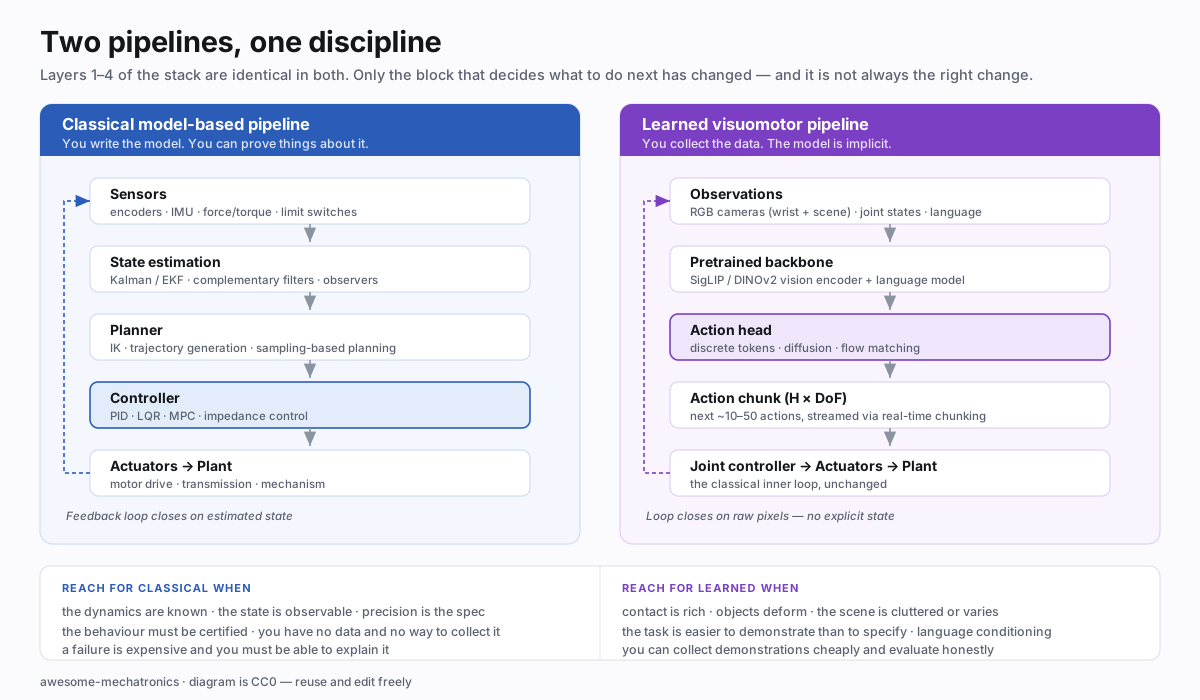
This is the section that did not exist when this list was first written. In five years, robot manipulation moved from "write an inverse-kinematics solver and a state machine" to "collect demonstrations and train a policy." Both approaches are alive; a mechatronic engineer in 2026 needs to know when to reach for which.
7.0 The mental model
flowchart LR
    subgraph Classical["Classical mechatronic pipeline"]
        direction TB
        C1["Sensors"] --> C2["State estimation"] --> C3["Planner"] --> C4["Controller<br/>PID / MPC"] --> C5["Actuators"]
    end

    subgraph Learned["Learned visuomotor pipeline"]
        direction TB
        L1["Cameras +<br/>proprioception"] --> L2["Neural policy<br/>ACT · Diffusion · VLA"] --> L3["Action chunk<br/>(next N actions)"] --> L4["Low-level<br/>joint controller"] --> L5["Actuators"]
    end

    Choose{"Which one?"}
    Classical -.->|"models known,<br/>state observable,<br/>safety certifiable"| Choose
    Learned -.->|"contact-rich,<br/>deformable, cluttered,<br/>hard to model"| Choose

    style Classical fill:#e8f0fe
    style Learned fill:#e8fae8
Three ideas do most of the work in modern policies:
- Action chunking — predict a sequence of future actions instead of one. Cuts compounding error and makes the policy robust to slow inference.
- Generative action heads — model the distribution over action sequences (diffusion, flow matching) rather than regressing a mean. Critical when demonstrations are multimodal (two valid ways to grasp a mug, and averaging them drops the mug).
- Pretrained vision-language backbones — inherit semantic and spatial priors from internet-scale data so the robot generalises to objects and instructions it never saw.
7.1 Imitation learning & action chunking
- 📄 Learning Fine-Grained Bimanual Manipulation with Low-Cost Hardware (ACT / ALOHA) — Zhao, Kumar, Levine, Finn, RSS 2023. 🆓 The paper that made cheap bimanual imitation learning work. Start here. ⭐ code · project
- 📄 Universal Manipulation Interface (UMI) — Chi et al., RSS 2024. 🆓 Collect demonstrations with a handheld gripper and a GoPro, no robot required. A genuinely important idea for anyone without a robot budget. 🧪
- 📄 Action chunking and exploratory data collection yield exponential improvements in behavior cloning — 2025. 🔬 The theory behind why chunking works.
- 📄 Bidirectional Decoding — ICLR 2025. Closed-loop resampling to fix chunk-boundary artefacts.
7.2 Diffusion policies
A diffusion policy generates robot actions by iteratively denoising, exactly as image diffusion models generate pixels. It handles multimodal demonstrations naturally and has become the default strong baseline.
- 📄 Diffusion Policy: Visuomotor Policy Learning via Action Diffusion — Chi et al., RSS 2023 / IJRR 2025. 🆓 The foundational paper. ⭐ code · arXiv
- 📄 3D Diffusion Policy (DP3) — point-cloud conditioning; large sample-efficiency gains.
- 📄 Consistency Policy / ManiCM — distil the multi-step denoiser into few-step inference for real-time control.
- 📄 NoMaD: Goal-Masked Diffusion Policies for Navigation and Exploration — ICRA 2024. Diffusion for mobile robots, not just arms.
- 📄 Steering Your Diffusion Policy with Latent-Space RL — CoRL 2025. 🔬 Improve a cloned policy with RL without retraining it end to end.
- 📄 Much Ado About Noising: Dispelling the Myths of Generative Robotic Control — 2025. 🔬 A useful sceptical counterweight: read it before assuming diffusion is always the answer.
7.3 Flow matching & real-time chunking
Flow matching learns a deterministic transport from noise to data instead of an iterative denoising chain. In practice: faster inference, smoother trajectories, better stability — which is why the newest VLAs use it.
- 📄 Flow Matching for Generative Modeling — Lipman et al., ICLR 2023. 🆓 The source.
- 📄 Real-Time Execution of Action Chunking Flow Policies (RTC) — Black, Galliker, Levine, NeurIPS 2025. 🆓 "Action inpainting": compute the next chunk while executing the current one. This is the paper that made big VLAs usable at real robot rates. ⭐
- 📄 Training-Time Action Conditioning for Efficient Real-Time Chunking — 2025.
- 📄 Streaming Flow Policy — treat the action trajectory itself as the flow trajectory; stream actions out continuously.
- 📄 FlowPolicy — consistency flow matching for fast 3D policies.
- 📄 FAST: Efficient Action Tokenization for VLAs — Pertsch et al., RSS 2025. 🆓 DCT-based action tokenisation; makes autoregressive VLAs 5× faster to train.
7.4 Vision-Language-Action models (VLAs)
A VLA takes camera images plus a natural-language instruction and outputs robot actions, end to end. This is the fastest-moving area in robotics.
flowchart LR
    IMG["Camera(s)"] --> VE["Vision encoder<br/>SigLIP / DINOv2"]
    TXT["Instruction:<br/>'put the mug in the sink'"] --> LM
    VE --> LM["Language model backbone<br/>Llama / PaliGemma / Cosmos"]
    STATE["Proprioception"] --> AH
    LM --> AH["Action head"]
    AH --> A1["Discrete action tokens<br/>(autoregressive)"]
    AH --> A2["Diffusion / flow<br/>action expert"]
    A1 --> CH["Action chunk<br/>H × DoF"]
    A2 --> CH
    CH --> RTC["Real-time chunking<br/>+ low-level controller"]
    RTC --> ROBOT["Robot"]
    ROBOT -->|"new observation"| IMG

    style LM fill:#fef3e8
    style AH fill:#e8fae8
Open models you can actually run:
| Model | Params | Licence | Notes |
|---|---|---|---|
| SmolVLA | 450M | 🆓 Apache | Hugging Face, June 2025. Trained purely on community datasets; runs on consumer hardware. Best starting point. ⭐ 📄 |
| OpenVLA | 7B | 🆓 | Stanford/Berkeley, 2024. ~970k Open X-Embodiment episodes; DINOv2 + SigLIP + Llama 2. The reference open VLA. 📄 code |
| OpenVLA-OFT | 7B | 🆓 | Optimised fine-tuning recipe; large speed/success gains over base OpenVLA |
| π₀ / openpi | ~3B | 🆓 weights | Physical Intelligence. Flow-matching action expert on a VLM backbone; pretrained on 10,000+ hours. Smoothest trajectories in contact-rich tasks. 📄 |
| Isaac GR00T N | ~2–3B | 🆓 | NVIDIA. Dual-system: slow VLM planner (System 2) + fast diffusion transformer controller (System 1). N1 (Mar 2025) → N1.5 → N1.6 (Dec 2025, Cosmos-2B backbone). Built for humanoids. 📄 |
| Octo | 27M–93M | 🆓 | Generalist transformer policy; small and easy to fine-tune |
| SpatialVLA | 4B | 🆓 | Explicit 3D spatial representations |
| MolmoAct | — | 🆓 | "Action reasoning model" — reasons in space before acting |
| BitVLA | 3B | 🆓 | 1-bit weights; VLA inference on constrained hardware 🔬 |
| Gemini Robotics On-Device | — | 💵 restricted | Google DeepMind; on-robot inference without cloud |
Surveys — read one of these before the papers:
- 📄 Vision-Language-Action Models for Robotics: A Review Towards Real-World Applications — Kawaharazuka et al., IEEE Access 13:162467–162504, 2025. 🆓 Best practical survey; includes a filterable database of every VLA. ⭐
- 📄 A Survey on Vision-Language-Action Models for Embodied AI — Ma et al., continuously updated through 2026.
- 📄 Vision-Language-Action Models: Concepts, Progress, Applications and Challenges — Sapkota et al., 2025. 🆓 Good on architectural taxonomy.
- 📄 Vision-Language-Action in Robotics: A Survey of Datasets, Benchmarks, and Data Engines — TMLR 2026. 🆓 Argues the bottleneck is now data infrastructure, not architecture — the most important strategic claim in the field right now.
- 📄 A Survey on Efficient Vision-Language-Action Models — 2025. Quantisation, token pruning, caching, distillation. Read this if you have to deploy on a Jetson.
- 📄 Vision-Language-Action Safety: Threats, Challenges, Evaluations, and Mechanisms — 2026. 🔬
7.5 World models 🔬
Learned simulators that predict how the world evolves given actions — used for synthetic data generation, planning in imagination, and safe evaluation.
- 🔧 NVIDIA Cosmos 🆓 open weights — world foundation models for physical AI; Cosmos 3 (GTC 2026) unifies world generation, vision reasoning and action simulation.
- 📄 Genie 3 — Google DeepMind. Real-time interactive world generation.
- 📄 DayDreamer / Dreamer V3 — model-based RL that learns a world model and plans inside it.
- 📄 Real2Render2Real / GigaBrain-0 — scaling robot data without scaling robot hardware.
- Why it matters for mechatronics: synthetic data augmentation lets a team turn ~200 real demonstrations into thousands of variants, which is often cheaper than buying more robots.
7.6 Reinforcement learning on real hardware
- 📄 HIL-SERL: Human-in-the-Loop Sample-Efficient RL — Luo et al. 🆓 Trains real-robot manipulation policies to near-perfect success in 1–2 hours of real interaction. The most practically important real-robot RL result of recent years. ⭐
- 📄 Learning Quadrupedal Locomotion over Challenging Terrain — Lee et al., Science Robotics 2020. The sim-to-real result that started the legged-robot RL era.
- 📄 Rapid Motor Adaptation — online adaptation to changing dynamics.
- 🔧 Stable-Baselines3 🆓 / CleanRL 🆓 — CleanRL's single-file implementations are the best way to actually understand the algorithms.
- 🔧 rsl_rl 🆓 — the PPO implementation behind most legged-robot papers.
7.7 Datasets & benchmarks
| Resource | What |
|---|---|
| Open X-Embodiment 🆓 | 1M+ trajectories, 22 embodiments, 30+ labs. The ImageNet moment for robot data. |
| DROID 🆓 | 76k in-the-wild manipulation trajectories, 564 scenes |
| BridgeData V2 🆓 | 60k trajectories, widely used for VLA pretraining |
| LeRobot datasets on the HF Hub 🆓 | Thousands of community datasets in a standard format |
| LIBERO 🆓 | The standard lifelong-manipulation benchmark |
| SimplerEnv 🆓 | Reproducible simulated evaluation of real-robot VLAs |
| RoboCasa 🆓 | Large-scale simulated kitchen environments |
| RoboTwin 2.0 🆓 | Bimanual manipulation data generator + benchmark |
| Isaac Lab-Arena 🆓 | NVIDIA's robot evaluation framework (2026) |
7.8 Hands-on: train your own policy 🧪
The single highest-value practical exercise in modern mechatronics. Under €500 of hardware and one afternoon.
- 🔧 LeRobot 🆓 — Hugging Face's end-to-end robot learning library.
pip install, no ROS required. Includes ACT, Diffusion Policy, VQ-BeT, π₀, SmolVLA, HIL-SERL, TD-MPC. ⭐ 📄 ICLR 2026 - 📖 Robot Learning: A Tutorial — Capuano, Pascal, Zouitine, Aractingi, Wolf. 🆓 RL → behavioural cloning → generalist policies, with runnable
lerobotcode. Read this cover to cover. ⭐ - 🎓 SO-101 assembly guide 🆓 — 3D-printable leader/follower arm pair, ~€120–250 depending on servos.
- 🎓 NVIDIA SO-101 sim-to-real course 🆓 — the same arm, through Isaac Sim → Isaac Lab → GR00T → hardware.
- 📝 How I trained ACT on SO-101: journey, gotchas and lessons 🆓 — honest write-up of the failure modes (no eval split, accidentally cheating by watching the arm instead of the camera feed). Read it before you start.
Realistic expectations: ~50 demonstrations and ~30 minutes on an RTX 3060 gets a working single-task ACT policy. Language conditioning and generalisation need far more. For a single fixed task, ACT or Diffusion Policy usually beats a general VLA — reach for a VLA when you need language conditioning or cross-task transfer.
8. Agentic AI in Automation and Robotics
"Agentic" is the most abused word in industrial marketing right now, so start with the distinction that actually matters:
A copilot answers when asked. An agent acts on a trigger, plans a sequence, calls tools, and escalates only when confidence is low or a threshold is crossed.
flowchart TD
    G["Goal<br/>'keep OEE above 85% this shift'"] --> P["Planner<br/>LLM reasoning"]
    P --> T{"Tool selection"}
    T --> T1["MES / ERP API"]
    T --> T2["Historian / time-series DB"]
    T --> T3["OPC UA client<br/>read tags"]
    T --> T4["CMMS<br/>create work order"]
    T1 & T2 & T3 & T4 --> O["Observation"]
    O --> P
    P --> G2{"Confidence and<br/>authority check"}
    G2 -->|"within limits"| ACT["Bounded actuation<br/>small setpoint change"]
    G2 -->|"outside limits"| HUM["Human-in-the-loop<br/>approval"]
    ACT --> SAFETY["Deterministic safety layer<br/>PLC interlocks · ISO 13849 · SIL"]
    HUM --> SAFETY
    SAFETY --> MACHINE["Machine"]

    style SAFETY fill:#fde8e8
    style HUM fill:#fef3e8
The non-negotiable design rule: the LLM never sits inside the safety function. Interlocks, e-stops and safety-rated logic remain deterministic, certified and independent. An agent may adjust a setpoint inside a human-defined envelope; it may not define the envelope.
8.1 Where this actually is, in production
- Beckhoff TwinCAT CoAgent (Hannover Messe 2026) — LLMs connected over the Model Context Protocol driving real machine motion sequences inside the TwinCAT platform. Engineers describe a motion in natural language; the platform generates and runs it.
- Dell / XMPro / NVIDIA Omniverse — live PLC data from a brewery centrifuge digital twin feeding an LLM that detects boundary violations and makes small supervised SCADA-level adjustments. Deployed, not a proof of concept.
- Siemens Industrial Copilot — code generation and diagnostics inside TIA Portal.
- Adoption reality check: surveys through 2026 put most manufacturers at pilot stage, a minority at line-level deployment, and only a few percent letting agents make consequential decisions unsupervised. Multi-agent orchestration is still rare. Human-in-the-loop remains a hard requirement in regulated and high-precision environments, because non-deterministic behaviour is a validation problem, not just a quality problem.
8.2 Protocols and building blocks
- 🔧 Model Context Protocol (MCP) 🆓 — the open standard for connecting models to tools and data sources. Rapidly becoming the way agents reach OPC UA servers, historians and MES.
- 🔧 Agent2Agent (A2A) 🆓 — inter-agent interoperability across vendors.
- 🔧 LangGraph 🆓 / CrewAI 🆓 / AutoGen 🆓 — agent orchestration frameworks.
- 🔧 Node-RED 🆓 — unglamorous, but still the most practical glue between OT protocols and everything else.
8.3 Agents in robotics (as opposed to plant floors)
- 📄 Code as Policies — LLMs writing robot control code. The paper that opened this line.
- 📄 SayCan — grounding language plans in what a robot can actually do.
- 📄 Embodied Chain-of-Thought Reasoning — CoRL 2024. Reasoning traces improve VLA action quality.
- 📄 OpenHelix — open dual-system (planner + controller) VLA; a good template for the architecture. 🆓
- The dual-system pattern (slow LLM planner + fast reactive controller) is now the dominant architecture — GR00T N1's System 1 / System 2 split is the clearest published example.
8.4 Safety, assurance and governance
- 📄 Agentic AI in Engineering and Manufacturing — MIT DeCoDE Lab, 2026. 🆓 Sober analysis of bounded autonomy: agents inside tightly scoped workflows, subject to human validation, not assuming engineering accountability. ⭐
- EU AI Act — machinery and safety components fall under high-risk obligations. If your agent touches a machine sold in the EU, this applies to you.
- EU Machinery Regulation 2023/1230 — replaces the Machinery Directive from January 2027 and explicitly addresses self-evolving behaviour and AI-enabled safety components. This is the regulation mechatronic engineers should be reading now.
- NIST AI Risk Management Framework 🆓
- OWASP Top 10 for LLM Applications 🆓 — prompt injection into an agent with OPC UA write access is not a theoretical risk.
- ISO 10218-1/-2:2025 (industrial robot safety, revised) and ISO/TS 15066 (collaborative operation).
9. Hands-On Projects
Ordered by difficulty. Each one teaches something the previous one couldn't.
| # | Project | Level | Rough cost | What it actually teaches |
|---|---|---|---|---|
| 1 | Closed-loop DC motor position control with encoder | Beginner | €30 | Sampling, quantisation, integral windup, derivative noise |
| 2 | Line follower with PID on IR array | Beginner | €40 | Sensor calibration, loop rate vs. speed, saturation |
| 3 | Reaction wheel / inverted pendulum | Beginner+ | €60 | Unstable plants, state feedback, why LQR exists 🧪 |
| 4 | BLDC field-oriented control with SimpleFOC | Intermediate | €80 | Commutation, current control, why FOC beats trapezoidal |
| 5 | PLC-controlled sorting line in Factory I/O | Intermediate | €30 (licence) | Ladder/ST, sequence control, HMI, industrial thinking |
| 6 | ESP32 + micro-ROS sensor node into a ROS 2 graph | Intermediate | €20 | Distributed robotics, QoS, real-time boundaries |
| 7 | Differential-drive robot: SLAM + Nav2 | Intermediate+ | €200 | TF trees, odometry drift, costmaps, localisation |
| 8 | 3D-print an SO-101 arm, teleoperate it | Intermediate+ | €150–250 | Servo calibration, leader-follower, mechanical repeatability |
| 9 | Collect 50 demos, train ACT, run it on the SO-101 | Intermediate+ | +GPU access | Data quality, overfitting, the whole modern paradigm ⭐ |
| 10 | Fine-tune SmolVLA on your own task | Advanced | +GPU | Language conditioning, LoRA, evaluation protocol |
| 11 | RL locomotion in Isaac Lab → real quadruped | Advanced | €1500+ | Domain randomisation, sim-to-real, reward shaping |
| 12 | Digital twin: AAS + OPC UA of a real machine | Advanced | €0 | Information modelling — the Industry 4.0 skill that gets hired |
| 13 | Design + build a QDD actuator, characterise it | Advanced | €300 | Torque density, backdrivability, thermal, transparency 🔬 |
| 14 | UMI-style handheld data collection rig | Advanced | €200 | Robot-free data collection at scale 🔬 |
Project-based learning resources:
- 🧪 Modern Robotics course projects — mobile manipulation capstone in CoppeliaSim
- 🧪 Articulated Robotics 🆓 — the best step-by-step ROS 2 mobile robot build series on the internet ⭐
- 🧪 Robotics Backend 🆓/💵 — practical ROS 2 tutorials
- 🧪 James Bruton 🆓 — mechanical-first robot builds; excellent for design intuition
- 🧪 Skyentific 🆓 — actuator and mechanism design deep-dives
10. Hardware You Can Actually Buy or Build
Open-source and low-cost platforms, roughly by price.
| Platform | ~Cost | Type | Notes |
|---|---|---|---|
| SO-101 / SO-ARM101 | €120–350 | 6-DoF arm pair | 🆓 open hardware. Leader/follower teleoperation; the LeRobot reference platform. Kits from Hiwonder, Seeed, WowRobo. ⭐ |
| LeKiwi | €400 | Mobile manipulator | SO-101 on a holonomic base; open source |
| Koch v1.1 | €250 | 5-DoF arm | The predecessor design; still a good build |
| ALOHA / ALOHA 2 | €5k–20k | Bimanual | The reference bimanual teleoperation setup |
| Open Duck Mini | €400 | Bipedal | Approachable legged-robot learning platform |
| Reachy 2 / Reachy Mini | €300–70k | Humanoid | Pollen Robotics (Hugging Face); open source |
| Unitree Go2 / G1 | €1.6k–16k | Quadruped / humanoid | The default research legged platforms; SDK is usable |
| Franka Research 3 | €25k+ | 7-DoF arm | The academic manipulation standard; excellent torque control |
| UR cobots | €20k+ | Cobot | The industrial collaborative standard; good ROS 2 driver |
| TurtleBot 4 | €1.5k | Mobile | The canonical ROS 2 teaching robot |
| Duckietown | €300+ | Mobile / education | Complete autonomy curriculum in a box 🎓 |
| Open Dynamic Robot Initiative | €3k+ | Legged actuators | 🆓 Open QDD actuator + leg designs from MPI/NYU |
11. Classic Mechatronic Systems
Worked examples worth studying, because each one is a complete mechatronic argument:
- ABS — wheel-slip estimation from noisy sensors under hard real-time constraints. The canonical automotive mechatronic system.
- 3D printers — motion control, thermal control, and (in Klipper) input shaping and pressure advance. An accessible, complete control-systems case study. 🧪
- GNSS/INS — sensor fusion; the practical home of the Kalman filter.
- PLCs — deterministic scan-cycle computation; a genuinely different computational model worth understanding.
- Hybrid & electric drivetrains — power-split control, energy management, thermal.
- Hard disk drives — the highest-precision mass-produced servo system ever built; nanometre positioning at kHz bandwidth.
- Washing machines — unbalance detection, drum resonance avoidance, cost-driven sensor minimisation. Deceptively deep.
- Surgical robots — teleoperation, force reflection, safety architecture.
- Wafer steppers — the extreme end: sub-nanometre stages, feed-forward everything, the field's hardest control problems.
12. Trends Radar 2026
Where things stand, honestly assessed.
| Trend | Maturity | Why a mechatronic engineer should care |
|---|---|---|
| VLAs / generalist robot policies | Early production | Changes what "programming a robot" means. Hardware must now be learnable, not just controllable |
| Diffusion & flow-matching policies | Production-ready | The strong default for contact-rich manipulation; robust to multimodal demonstrations |
| Real-time action chunking | Production-ready | Made large policies runnable at real robot rates — the practical unlock of 2025 |
| GPU physics (Newton, MuJoCo-Warp) | Rapidly maturing | Two orders of magnitude more simulation throughput; sim-first design becomes viable for small teams |
| World models (Cosmos, Genie) | Research → early product | Synthetic data instead of more robots; expect commercial integration around 2027 |
| Agentic AI in plant operations | Pilots, few deployments | Real value in exception handling and supervised execution; the safety architecture is the engineering problem |
| MCP as industrial glue | Early, fast-moving | Becoming the standard way models reach OPC UA / MES / historians |
| Humanoids | Overhyped, genuinely improving | Massive investment; the hard problems remain actuation, energy, hands and reliability — mechanical problems |
| Compliant & backdrivable actuation | Mature, resurging | Learned policies need hardware that survives contact; QDD, SEA and VSA are back in demand |
| Morphological computation / metamaterials | Research | Offload control effort into the structure; watch this over the next five years 🔬 |
| Digital twin standardisation (AAS) | Mature standard, slow adoption | The Industry 4.0 skill with the best employability-to-effort ratio |
| Edge AI / TinyML on MCUs | Mature | Condition monitoring and anomaly detection without cloud dependency |
| Digital Product Passport / ecomechatronics | Regulatory-driven | EU rules will make this mandatory work, not optional differentiation |
| Embedded Rust | Growing | Memory safety in firmware; adoption rising in safety-relevant contexts |
| Robot data scarcity | The bottleneck | The 2026 consensus: progress is limited by data infrastructure, not model architecture |
13. Journals, Conferences, Communities
Journals
- IEEE/ASME Transactions on Mechatronics — the flagship
- Mechatronics (Elsevier)
- IEEE Transactions on Robotics (T-RO)
- International Journal of Robotics Research (IJRR)
- Science Robotics
- IEEE Robotics and Automation Letters (RA-L)
- IEEE Transactions on Industrial Electronics / Informatics
- Mechanism and Machine Theory
- Frontiers in Robotics and AI 🆓 open access
Conferences
- ICRA · IROS — the two big robotics conferences
- RSS — smaller, higher signal-to-noise; where Diffusion Policy and ACT appeared
- CoRL — the robot learning conference
- AIM — IEEE/ASME Advanced Intelligent Mechatronics
- Hannover Messe · SPS Nuremberg · automatica — where industrial reality shows up
- NVIDIA GTC — increasingly where robotics platform announcements land
Communities
- ROS Discourse · Robotics Stack Exchange
- LeRobot — very active Discord; the current invite is linked from the repo README
- r/robotics · r/PLC (the best industrial-automation community online) · r/ControlTheory
- Hugging Face Robotics
14. Related Awesome Lists
Robotics & learning
- Awesome Robotics · Awesome Robotics Libraries
- Awesome ROS2
- Awesome VLA — actively maintained VLA paper tracker
- Awesome Physical AI — VLA, world models, embodied AI, robot foundation models
- Awesome LLM Robotics
- Awesome Embodied AI
- robotics-coursework — where to learn robotics online
- PythonRobotics — algorithms with readable code
Engineering & embedded
- Awesome Embedded · Awesome Embedded Rust
- Awesome Embedded and IoT Security
- Awesome Electronics
- Awesome Mechanical Engineering
- Awesome TinyML
- Awesome C++ · Awesome Python
AI
Contributing
Contributions are welcome — additions, corrections and dead-link reports alike.
The rules in short: prefer free and primary sources, mark paid ones with 💵, include the year for anything in the fast-moving sections, and give one line on why a resource is worth someone's time. Keep the mechatronic point of view — this is not a general AI, ME or EE list.
Read CONTRIBUTING.md for the full guidelines, entry format and marker conventions.
Licence

To the extent possible under law, the contributors have waived all copyright and related rights to this work.
Contributors


Similar repos


A list of awesome mechatronics books, courses and software.
See the codeREADME
Awesome Mechatronics
Books, courses, tools, papers and hardware for mechatronic engineering —
from the classical V-model to vision-language-action models.
Definitions · Learning paths · VLAs & diffusion policies · Agentic AI · Projects · Trends radar
Mechatronics is the synergistic integration of mechanical engineering, electronics, control theory and computing in the design of products and processes. The 1969 Yaskawa coinage described machines with electronics inside. The discipline has since absorbed cyber-physical systems, digital twins, and — since roughly 2023 — learned, language-conditioned policies that replace hand-written control laws. See §0 for how the definition has moved.
What's in here. This list keeps the classical mechatronics canon (it still matters — nothing about foundation models repeals the Nyquist criterion) and adds the parts of the field that appeared in the last five years: learned visuomotor control, VLAs, diffusion and flow-matching policies, GPU physics, agentic industrial software, and the mechanical-design ideas that came back into fashion because learning made compliant hardware tractable.
Legend — 📖 book · 📄 paper · 🎓 course · 🔧 tool · 📝 write-up · 🧪 hands-on · 🆓 free / open source · 💵 paid · ⭐ start here if you're new · 🔬 research-level
Table of contents
- 0. What Mechatronics Means Now
- 1. Start Here: Learning Paths
- 2. Foundations: Books & Courses
- 3. The Mechanical Side, Seen From Mechatronics
- 4. Electronics, Embedded & Edge
- 5. Industrial Automation, Industry 4.0 / 5.0
- 6. The Robotics Software Stack
- 7. Learning-Based Control: The New Core
- 8. Agentic AI in Automation and Robotics
- 9. Hands-On Projects
- 10. Hardware You Can Actually Buy or Build
- 11. Classic Mechatronic Systems
- 12. Trends Radar 2026
- 13. Journals, Conferences, Communities
- 14. Related Awesome Lists
- Contributing
- Licence
0. What Mechatronics Means Now
The definition has moved four times
Mechatronics has been redefined roughly once per industrial revolution, and the current redefinition is the sharpest since the 1990s.
1. Mechanics + electronics → synergistic integration. The 1980s–90s reframing was that mechatronics is not a sum of parts bolted together but a co-design discipline: the mechanism, the sensor choice and the control law are decided together, from the first sketch. This is where the V-model and concurrent engineering come from, and it remains the core professional skill.
2. Mechatronics → Cyber-Physical Systems. With Industry 4.0 (2011), production systems became networked CPS built on digital twins and standardised information models. Mechatronics stopped being about one machine and started being about fleets of machines with an information layer. The Asset Administration Shell (IEC 63278-1:2023) is the concrete artefact of this shift.
3. CPS → Human-CPS (Industry 5.0). From around 2020, the framing added human-centricity, resilience and sustainability, giving rise to Human Cyber-Physical Systems and cobots. A useful consequence: three industrial paradigms now coexist on the same shop floor, and a mechatronics engineer is expected to work across all three.
4. Everything → Physical AI / Embodied AI. The 2024–2026 shift is the largest. Perception-to-action neural policies increasingly replace the hand-designed controller, not just augment it. Terminology is genuinely contested here:
| Term | Rough meaning | Who pushes it |
|---|---|---|
| Embodied AI | AI that perceives, decides and acts through a body (physical or simulated). The older, academic term. | Academia; ITU-T Rec. F.748.66 (Dec 2025) gives it a formal framework |
| Physical AI | The broader commercial umbrella: models + simulation + compute sold as one stack for real-world machines | NVIDIA, BCG, investors |
| Mechatronics | The engineering discipline that actually builds the body the AI acts through | Everyone, once the demo has to ship |
The honest reading: Physical AI is a market category; mechatronics is the engineering discipline it depends on. Nothing in a VLA solves backlash, thermal derating, or the fact that a harmonic drive has a torque ripple signature. What has changed is where the difficulty sits — less in writing the controller, more in hardware that is learnable: backdrivable, well-instrumented, repeatable, and cheap enough to collect thousands of demonstrations on.
A working definition for 2026
Mechatronics is the design of systems whose behaviour emerges from the co-design of mechanism, actuation, sensing, computation and learned or programmed policy — where the policy may now be a neural network trained on data rather than a control law derived from a model.
Read the definition debate yourself 📄
- The Evolution of Mechatronics Engineering and Its Relationship with Industry 3.0, 4.0, and 5.0 — Technologies, 2026. 🆓 The single best recent paper on this question; proposes a generational classification of machines. Start here. ⭐
- Mechatronics in Industry 4.0 and 5.0: advancing synergy, innovations, sustainability, and challenges — Maki K. Habib, 2025.
- Skills for Physical Artificial Intelligence — Miriyev & Kovač, Nature Machine Intelligence, 2020. 📄 The paper that named the skills gap between materials, mechanics and AI.
- Intelligence as Computation — Oliver Brock, 2024. 🔬 Argues digital, analog, mechanical and morphological computation are one continuum — the philosophical backbone for "mechanical intelligence."
- ITU-T F.748.66 — Requirements and framework for embodied artificial intelligence systems, approved Dec 2025. The first ITU-level attempt to standardise what "embodied AI system" means.
- Evolution from mechatronics to cyber-physical systems: an educational point of view — still the clearest statement of the CPS transition for curricula.
1. Start Here: Learning Paths
Mechatronics is wide enough that "where do I start" is the most common question. Three paths, depending on where you want to end up.
flowchart TD
    A["Absolute beginner<br/>Arduino / ESP32 blink → sensors → PWM motor"] --> B["Circuits + C/C++ + Python"]
    B --> C["Classical control<br/>PID, Laplace, Bode, state space"]
    C --> D{"Pick a direction"}

    D --> E["<b>Industrial automation</b><br/>PLC · IEC 61131-3 · HMI/SCADA<br/>OPC UA · digital twin"]
    D --> F["<b>Robotics</b><br/>ROS 2 · kinematics · SLAM<br/>MoveIt · Nav2"]
    D --> G["<b>Machine / product design</b><br/>CAD · FEA · actuator sizing<br/>tolerances · DfM"]

    E --> H["Agentic industrial AI<br/>MCP · anomaly agents · predictive maintenance"]
    F --> I["Robot learning<br/>imitation → ACT → diffusion policy → VLA"]
    G --> J["Co-design<br/>compliant actuators · topology opt · morphological computation"]

    H --> K["<b>Physical AI engineer</b>"]
    I --> K
    J --> K
Path A — Beginner, hands-on first (0–6 months) ⭐
You want to build something that moves before you learn Laplace transforms. This is a legitimate order.
- Get a board and a motor. Arduino Uno/ESP32 + L298N or a TB6612 + a cheap DC gearmotor with an encoder. Total cost under €40.
- 🎓 Paul McWhorter — Arduino for Beginners 🆓 — the most patient beginner series that exists.
- 🎓 ControlSystemsAcademy / Brian Douglas — Control System Lectures 🆓 — intuition before mathematics. Watch "PID Control — A brief introduction" and the root locus series.
- 🧪 Build a closed-loop position controller for one motor. Tune a PID by hand. This single project teaches sampling, quantisation, saturation, integral windup and derivative noise — the four things that actually bite in practice.
- 🎓 MATLAB Tech Talks — Understanding PID Control 🆓 (free videos even without a MATLAB licence)
- Move to ESP32 + micro-ROS or Raspberry Pi + ROS 2 and you're in the robotics world proper.
- 🧪 Then: LeRobot + an SO-101 arm — collect 50 demonstrations, train a policy, watch it work. Two hours, and it will reframe everything you thought robot programming was.
Path B — Undergraduate / career-switcher (6–18 months)
- Control: 🎓 Steve Brunton — Control Bootcamp 🆓 + 📖 Feedback Systems (Åström & Murray) 🆓
- Robotics: 📖 Modern Robotics (Lynch & Park) 🆓 + the Coursera specialisation
- Embedded: build one project in bare-metal C on an STM32, then one on Zephyr RTOS. The contrast teaches you what an RTOS buys you.
- Industrial: one PLC project in Structured Text on OpenPLC 🆓 or a real S7-1200, plus one OPC UA client.
- Learning: 📖 Robot Learning: A Tutorial 🆓 — the single best on-ramp from classical control to learned policies, with runnable
lerobotexamples.
Path C — Graduate / research 🔬
- 📖 Underactuated Robotics and Robotic Manipulation — Russ Tedrake, MIT. 🆓 Free, interactive, with Drake notebooks. The best treatment anywhere of why contact-rich control is hard.
- 📄 Towards a Unified Understanding of Robot Manipulation: A Comprehensive Survey — 2025. The map of the whole manipulation literature.
- 📄 Vision-Language-Action Models for Robotics: A Review Towards Real-World Applications — Kawaharazuka et al., IEEE Access 2025. Has a searchable database of every VLA.
- Pick a benchmark (LIBERO, SimplerEnv, RoboCasa) and reproduce one result before you propose anything.
2. Foundations: Books & Courses
Core mechatronics textbooks 📖
The classics, kept because they are still the right first books:
- Mechatronics: Electronic Control Systems in Mechanical and Electrical Engineering — W. Bolton, 7th ed. 💵 The standard undergraduate entry point.
- Introduction to Mechatronics and Measurement Systems — Alciatore & Histand, 5th ed. 💵 Stronger on instrumentation and signal conditioning than Bolton.
- The Mechatronics Handbook — Robert H. Bishop (ed.). 🆓 first-edition PDF. Reference work, not a textbook.
- Mechatronic Systems: Modelling and Simulation with HDLs — Pelz. 💵 Underrated: HDL-based modelling of mixed-domain systems.
- Control of Mechatronic Systems — Patrick O. J. Kaltjob, 2021. 💵 One of the few recent books that treats digital control implementation seriously.
- Machine Vision and Mechatronics in Practice — Billingsley & Brett. 💵
- Automotive Mechatronics — Bosch Professional Automotive Information. 💵 The reference for automotive networking, ESP/ABS, and drivetrain electronics.
Control & dynamics (free where possible) 📖
- Feedback Systems: An Introduction for Scientists and Engineers — Åström & Murray, 2nd ed. 🆓 Free PDF. The best free control textbook.
- Data-Driven Science and Engineering — Brunton & Kutz, 2nd ed. 🆓 Free PDF + code. SVD, DMD, SINDy, MPC, RL, all with runnable examples.
- Applied Nonlinear Control — Slotine & Li. 💵 Still the reference for Lyapunov design and sliding mode.
- Predictive Control for Linear and Hybrid Systems — Borrelli, Bemporad, Morari, Cambridge 2017. 💵
- Rigid Body Dynamics Algorithms — Roy Featherstone. 💵 If you ever need to know why your dynamics library is fast.
Robotics 📖
- Modern Robotics: Mechanics, Planning, and Control — Lynch & Park. 🆓 Free PDF, free videos, free software library, matching Coursera specialisation. ⭐ The best value in robotics education.
- Robotics: Modelling, Planning and Control — Siciliano, Sciavicco, Villani, Oriolo. 💵 The European standard text.
- Springer Handbook of Robotics — Siciliano & Khatib (eds.), 2nd ed. 💵 2,300 pages; the field's encyclopedia.
- Probabilistic Robotics — Thrun, Burgard, Fox. 💵 Still the reference for state estimation and SLAM.
- Underactuated Robotics — Russ Tedrake, MIT 6.832. 🆓 Free, interactive, updated every year. 🔬
- Robotic Manipulation — Russ Tedrake, MIT 6.4210. 🆓 Perception, planning and control for manipulation, with Drake.
- Introduction to Autonomous Mobile Robots — Siegwart, Nourbakhsh, Scaramuzza. 💵
Machine learning for engineers 📖
- Deep Learning — Goodfellow, Bengio, Courville. 🆓 Now historical, but the maths chapters age well.
- Dive into Deep Learning — Zhang et al. 🆓 Interactive, PyTorch/JAX, actually current.
- Reinforcement Learning: An Introduction — Sutton & Barto, 2nd ed. 🆓
- Spinning Up in Deep RL — OpenAI. 🆓 The clearest practical RL introduction; algorithms implemented readably.
- Probabilistic Machine Learning — Kevin Murphy. 🆓 Two volumes, free PDFs.
- Computer Vision: Algorithms and Applications — Szeliski, 2nd ed. 🆓
Courses worth your time 🎓
| Course | Who | Cost | Why |
|---|---|---|---|
| Control Bootcamp | Steve Brunton, UW | 🆓 | Best state-space introduction on YouTube |
| Modern Robotics Specialization | Northwestern | 🆓 audit | Screw theory done properly, with CoppeliaSim labs |
| Underactuated Robotics | MIT | 🆓 | Trajectory optimisation, LQR trees, contact 🔬 |
| Robotic Manipulation | MIT | 🆓 | The manipulation course, with Drake notebooks 🔬 |
| SLAM lectures | Cyrill Stachniss, Bonn | 🆓 | The reference SLAM lecture series |
| Sim-to-Real with the SO-101 | NVIDIA | 🆓 | Full pipeline: Isaac Sim → Isaac Lab → GR00T → real arm 🧪 |
| LeRobot docs & tutorials | Hugging Face | 🆓 | Imitation learning and VLAs, hands-on, end to end ⭐ |
| Introduction to Robotics CS223A | Khatib, Stanford | 🆓 | Classic; operational space control from the source |
| Learn 5 PLCs in a Day | Udemy | 💵 | Practical multi-vendor PLC exposure |
| From Wire to PLC | Udemy | 💵 | Panel wiring → ladder → commissioning |
| Wearable Robotics — Exoskeletons | Udemy | 💵 | Niche but well-made |
3. The Mechanical Side, Seen From Mechatronics
The most common failure mode in modern mechatronics projects is a good policy on bad hardware. This section is the mechanical engineering that a mechatronic engineer specifically needs — not general machine design, but the subset where mechanics and control interact.
The central idea: your mechanism is part of your controller
flowchart LR
    subgraph Physical["Mechanical domain"]
        M["Mechanism<br/>kinematics, inertia"]
        T["Transmission<br/>ratio, backlash, friction"]
        C["Compliance<br/>stiffness, damping"]
    end
    subgraph Electrical["Electrical domain"]
        A["Actuator<br/>torque density, thermal"]
        S["Sensing<br/>resolution, bandwidth, latency"]
    end
    subgraph Compute["Computation"]
        P["Policy<br/>PID / MPC / learned"]
    end

    M --> T --> A --> P
    S --> P --> A
    C -.->|"sets achievable<br/>control bandwidth"| P
    P -.->|"required bandwidth<br/>constrains design"| C

    style Physical fill:#e8f0fe
    style Electrical fill:#fef3e8
    style Compute fill:#e8fae8
Three rules that follow, and that no amount of learning removes:
- Structural resonance caps your bandwidth. A closed loop cannot be much faster than the first flexible mode of the structure it drives. Stiffness is a control-design parameter.
- Backlash is not a disturbance, it is a discontinuity. It breaks gradient-based tuning, breaks learned policies trained in simulation, and shows up as limit cycles.
- Reflected inertia scales with gear ratio squared. This is why quasi-direct-drive exists, and why highly geared arms cannot do impedance control well.
3.1 Actuation & transmission
- 📄 Compact Gearboxes for Modern Robotics: A Review — García et al., Frontiers in Robotics and AI, 2020. 🆓 The best free survey of harmonic, cycloidal, planetary and novel drives, with efficiency and backdrivability compared. ⭐
- 📄 Quasi-Direct Drive Actuation for a Lightweight Hip Exoskeleton with High Backdrivability and High Bandwidth — Yu et al. 🆓 The clearest worked example of QDD design trade-offs.
- 📄 Cycloidal Quasi-Direct Drive Actuators with Learning-Based Torque Estimation — 2024. 🆓 Where mechanical design and learning meet directly: use a network to recover torque a cheap transmission can't sense.
- 📄 Variable Impedance Actuators: A Review — Vanderborght et al. The taxonomy paper for SEA / VSA / PEA.
- 🔧 SimpleFOC 🆓 — Field-oriented control on Arduino-class hardware. The fastest way to understand BLDC control by doing.
- 🔧 ODrive 💵 / 🔧 moteus 💵 — Open(ish) high-performance BLDC controllers used across the hobby-to-research spectrum.
- 🔧 TMotor / CubeMars AK-series 💵 — the de-facto QDD actuators for legged robot builds.
Selection cheat-sheet:
| Need | Architecture | Typical ratio | Trade-off |
|---|---|---|---|
| Precise position, high stiffness | Harmonic / strain wave | 50:1–160:1 | Non-backdrivable, expensive, torque ripple |
| High dynamics, force control, impact | Quasi-direct drive (QDD) | 6:1–10:1 | Large motor, high current, heat |
| Safe human contact, energy storage | Series elastic (SEA) | any + spring | Bandwidth limited by spring, extra sensing |
| Cheap, high ratio, tolerant | Cycloidal | 20:1–100:1 | Vibration, harder to manufacture well |
| Lightweight distal mass | Cable / tendon drive | varies | Friction, stretch, routing complexity |
3.2 Compliance, contact and impedance
Learning-based manipulation made compliance fashionable again: policies that touch things need hardware that can survive touching things.
- 📄 Series Elastic Actuators — Pratt & Williamson, IROS 1995. The origin paper; still worth reading.
- 📄 Backdrivable actuators in robotics — a good living survey of the design space.
- 📄 Mechatronic whole-body co-design of a quadruped robot integrating local compliance — INRIA, 2026. States the current frontier plainly: rigid QDD quadrupeds have plateaued far below biological performance, and distributed compliance is the next lever.
- 🔧 Drake 🆓 — hydroelastic contact modelling; the reference implementation for contact-rich simulation you can trust.
3.3 Mechanical intelligence & morphological computation 🔬
The idea that the body itself performs computation — that a well-designed gripper needs less control than a badly-designed one. This has moved from curiosity to an active research programme.
- 📄 Intelligence as Computation — Oliver Brock, 2024. Unifies digital, analog, mechanical and morphological computation.
- 📄 Perspectives on Intelligence in Soft Robotics — Kortman et al., Advanced Intelligent Systems, 2025. 🆓 Classifies embodied intelligence into adaptive shape, adaptive functionality and adaptive mechanics.
- 📄 Reprogrammable metamaterial robot with embodied versatile computation and mechanical intelligence — Nature Communications, 2026. 🆓 Elastic-wave metamaterials performing analog and logic operations inside a crawling robot.
- 📄 The 2024 Active Metamaterials Roadmap — 🆓 Shape-morphing metamaterials as embodied intelligence.
- 📄 Exploring Embodied Intelligence in Soft Robotics: A Review — Biomimetics, 2024. 🆓
- 📄 Morphological design methodologies of soft robots — 2025. 🆓 Forward biomimetic vs. inverse morphological design.
3.4 Design, simulation and manufacturing tools
| Tool | Type | Cost | Note |
|---|---|---|---|
| FreeCAD | Parametric CAD | 🆓 | v1.x finally fixed the topological naming problem; genuinely usable now |
| Onshape | Cloud CAD | 🆓 free tier | Free for public documents; excellent for open-source hardware |
| SolidWorks | CAD + CAE | 💵 | Industry default; motion + FEA add-ins |
| Fusion | CAD/CAM/CAE | 💵 (free personal) | Integrated generative design and CAM |
| nTop | Implicit modelling | 💵 | Lattices, topology optimisation, field-driven design |
| Ansys / COMSOL | Multiphysics FEA | 💵 | Thermal + structural + electromagnetic coupling |
| CalculiX / Code_Aster | FEA solver | 🆓 | Free FEA; usable via FreeCAD FEM workbench |
| ToOptix / ToPy | Topology optimisation | 🆓 | Learn the method before paying for a suite |
| OpenModelica | Acausal multi-domain sim | 🆓 | The right tool for mechanical+hydraulic+electrical system models |
| Simscape | Multi-domain sim | 💵 | The commercial equivalent, tightly coupled to Simulink |
| Blender | 3D modelling | 🆓 | Not CAD, but the standard for robot visual meshes and rendering |
| PrusaSlicer / OrcaSlicer | Slicers | 🆓 | Printed robot parts: print orientation determines layer-direction strength |
3.5 Practical mechanical checklist for mechatronic builds 🧪
Expand — the things that actually go wrong
- Actuator sizing: size on RMS torque over the duty cycle, not peak. Check thermal, then check peak, then check backdrive torque.
- Reflected inertia ratio: aim for load-to-motor inertia below ~10:1 for good servo response; below 3:1 for high dynamics.
- First resonance: measure it (tap test + accelerometer, or a swept-sine on the actuator). Target closed-loop bandwidth ≤ 1/3 of it.
- Backlash budget: total it across every joint in the chain. Preload, use anti-backlash gears, or move the encoder to the output.
- Encoder placement: motor-side encoders lie about the load. Output-side encoders (dual encoding) cost more and solve most repeatability complaints.
- Cable management: the leading cause of field failures in articulated robots. Design the cable path before the last link.
- Thermal path: motors derate. Where does the heat go? Aluminium bracket, not printed PLA.
- Tolerance stack-up: run it for the gripper-to-camera chain specifically — that's what a learned policy actually sees.
- Learnability: if you plan to collect demonstrations, the robot must be backdrivable enough to hand-guide, repeatable enough that yesterday's data still applies, and mechanically identical to any other unit you deploy on.
4. Electronics, Embedded & Edge
Microcontrollers & compute
| Platform | Role | Note |
|---|---|---|
| Arduino 🆓 | Learning, prototyping | The Uno R4 / Nano ESP32 generation is far more capable than the AVR days |
| ESP32 family 🆓 | Wireless mechatronics | Wi-Fi/BLE + dual core + enough RAM for micro-ROS |
| Raspberry Pi Pico / RP2350 🆓 | Real-time IO | PIO state machines are excellent for encoder decoding and step generation |
| STM32 💵 | Production motor control | The industry default for motor drives; G4/H7 for FOC |
| Teensy 4.x 💵 | High-rate control loops | 600 MHz Cortex-M7; underrated for 10 kHz+ loops |
| Raspberry Pi 5 💵 | Linux + ROS 2 | Enough for perception at modest rates; add a Hailo or Coral for NN inference |
| NVIDIA Jetson Orin / Thor 💵 | On-robot policy inference | Thor / T4000 (Blackwell, 2026) is what current VLAs are deployed on |
Firmware & RTOS
- 🔧 Zephyr RTOS 🆓 — the RTOS to learn now: vendor-neutral, device-tree based, Linux-Foundation governed, huge board support.
- 🔧 FreeRTOS 🆓 — still ubiquitous, simpler mental model.
- 🔧 micro-ROS 🆓 — ROS 2 on microcontrollers. Runs on Zephyr, FreeRTOS, Mbed, Arduino. The correct way to bridge MCU sensors/actuators into a ROS 2 system. ⭐
- 🔧 PlatformIO 🆓 — sane multi-board build system; escape from the Arduino IDE.
- 🔧 Embassy /
embedded-hal🆓 — async embedded Rust. Increasingly serious for safety-relevant firmware; memory safety without a GC. - 🔧 Renode 🆓 — emulate the whole board in CI. Test firmware without hardware.
Edge AI / TinyML
Running inference on the machine rather than in the cloud is now a normal part of a mechatronic design, especially for condition monitoring and anomaly detection.
- 🔧 Edge Impulse 💵/free tier — end-to-end TinyML: data capture → training → C++ export.
- 🔧 TensorFlow Lite for Microcontrollers / LiteRT 🆓
- 🔧 microTVM 🆓 — compiler-based deployment, better control over memory.
- 🔧 MicroFlow 🆓 — Rust TinyML inference engine; runs NNs on 8-bit MCUs with 2 kB RAM. 📄 paper
- 📄 State of Edge AI on Microcontrollers in 2026 — Shawn Hymel. A clear-eyed, hype-free assessment; note the trend of silicon vendors absorbing the tooling layer.
- 📖 TinyML — Warden & Situnayake 💵, and TinyML Cookbook 💵
Electronics design
- 🔧 KiCad 🆓 — v8/v9 is fully production-capable. No reason to pay for hobby or small-team PCB work.
- 🔧 Fritzing 💵 (small fee) — still the best for teaching wiring diagrams.
- 🔧 Proteus 💵 — schematic capture with MCU co-simulation.
- 🔧 Falstad Circuit Simulator 🆓 — instant intuition for analog circuits, in the browser.
- 🔧 LTspice 🆓 — free, accurate SPICE; use it before you build the motor driver.
- 🔧 LabVIEW 💵 — still dominant in test & measurement rigs.
- 📖 The Art of Electronics — Horowitz & Hill, 3rd ed. 💵 The reference.
- 📖 Practical Electronics for Inventors — Scherz & Monk. 💵 More approachable starting point.
5. Industrial Automation, Industry 4.0 / 5.0
Controllers & languages
- IEC 61131-3 — the PLC languages standard (LD, FBD, ST, IL, SFC). Learn Structured Text first; ladder second.
- IEC 61499 — distributed, event-driven automation. The intended successor for distributed control; slow adoption but conceptually important. 🔧 Eclipse 4diac 🆓 is the open reference implementation.
- 🔧 OpenPLC 🆓 — open-source IEC 61131-3 runtime + editor. The cheapest possible way to learn real PLC programming. ⭐ 🧪
- 🔧 Beremiz 🆓 — open IDE for IEC 61131-3.
- 🔧 CODESYS 💵 — the vendor-neutral runtime behind many PLC brands.
- 🔧 TwinCAT 💵 — Beckhoff's PC-based control platform; increasingly the platform where AI-in-automation experiments happen first.
- 🔧 Siemens TIA Portal / STEP 7 💵
- 📖 Programmable Logic Controllers — Petruzella. 💵 The standard PLC textbook.
Simulation & commissioning
- 🔧 Factory I/O 💵 — 3D factory simulation you can drive from a real PLC. Best-in-class for learning. 🧪
- 🔧 NVIDIA Isaac Sim / Omniverse 🆓 — OpenUSD-based digital twins of full production cells.
- 🔧 Visual Components 💵 / Process Simulate 💵 — commercial virtual commissioning.
- 🔧 Ignition 💵 — SCADA/MES platform with a very good free trial mode for learning.
Connectivity, information models and digital twins
This is the part of Industry 4.0 that actually matters and that most curricula skip.
- 🔧 OPC UA — the industrial information-model standard. Not just a protocol: it's a type system for machines. 🆓 open62541 is the reference open-source stack.
- 🔧 Asset Administration Shell (AAS) — IEC 63278-1:2023. The standardised digital twin. 🆓 Eclipse BaSyx and AASX Package Explorer are the tools to start with.
- 🔧 MQTT + Sparkplug B 🆓 — the pragmatic OT→IT data path; Sparkplug adds state and payload conventions MQTT lacks.
- 🔧 AutomationML (IEC 62714) 🆓 — engineering data exchange between CAD/PLC/robot tools.
- RAMI 4.0 — the reference architecture model that ties the above together.
- Digital Product Passport — the AAS + OPC UA convergence now driving EU regulatory work; open-source reference tooling exists.
- 📄 Asset Administration Shell in Manufacturing: Applications and Relationship with Digital Twin 🆓
Industry 5.0 concepts
- Human Cyber-Physical Systems (HCPS) — the human is inside the control loop by design, not by exception.
- Cobots — ISO/TS 15066 defines the power-and-force-limiting regime; read it before designing any human-adjacent machine.
- Ecomechatronics — energy- and material-efficiency as first-class design objectives, driven by EU sustainability regulation.
- 📄 The Evolution of Mechatronics Engineering and Its Relationship with Industry 3.0, 4.0, and 5.0 — 2026. 🆓
6. The Robotics Software Stack
ROS 2 — current state (as of mid-2026)
| Distro | Released | Ubuntu | Support until | Use it? |
|---|---|---|---|---|
| Lyrical Luth | May 2026 | 26.04 | May 2031 | ✅ New production projects (LTS) |
| Kilted Kaiju | May 2025 | 24.04 | Nov 2026 | ⚠️ Migrate off |
| Jazzy Jalisco | May 2024 | 24.04 | May 2029 | ✅ Safe, widest package support today |
| Humble Hawksbill | May 2022 | 22.04 | May 2027 | ⚠️ Plan migration |
ROS 1 reached end of life in May 2025. New projects should not use it.
- 🎓 ROS 2 official tutorials 🆓 ⭐
- 🎓 ROS 2 for Beginners — Edouard Renard 💵 / lots of free material
- 🔧 MoveIt 2 🆓 — motion planning for manipulators
- 🔧 Nav2 🆓 — the navigation stack for mobile robots
- 🔧 ros2_control 🆓 — hardware abstraction + controller lifecycle. Learn this before writing a custom driver.
- 🔧 Zenoh 🆓 — increasingly used as an alternative RMW / bridge, especially over lossy links.
Kinematics, dynamics & optimisation libraries
- 🔧 Pinocchio 🆓 — fast rigid-body dynamics with analytical derivatives. The backbone of most modern whole-body controllers.
- 🔧 Drake 🆓 — MIT's toolbox: modelling, contact, trajectory optimisation, convex programs. 🔬
- 🔧 CasADi 🆓 — symbolic framework for nonlinear optimisation and optimal control.
- 🔧 acados 🆓 — embedded NMPC that actually runs at kHz rates on real hardware.
- 🔧 Crocoddyl 🆓 — DDP-family optimal control for legged/multi-contact robots. 🔬
- 🔧 OMPL 🆓 — sampling-based motion planning.
- 🔧 Python Robotics 🆓 — readable implementations of dozens of algorithms. Excellent for learning. ⭐
Simulation — this changed completely in 2025–2026
The physics-engine landscape has been rewritten by GPU acceleration.
| Simulator | Cost | Best for |
|---|---|---|
| Newton | 🆓 | The new centre of gravity. Open-source, GPU-accelerated, differentiable; built on NVIDIA Warp + OpenUSD; developed by NVIDIA + Google DeepMind + Disney Research under the Linux Foundation. v1.0 GA at GTC 2026. Bundles MuJoCo-Warp and Disney's Kamino (closed-loop mechanisms) solvers, SDF collision, hydroelastic contact, and deformables. |
| MuJoCo | 🆓 | Contact-rich control research; CPU version remains the easiest to debug |
| MuJoCo Playground | 🆓 | Ready-made GPU RL environments |
| Isaac Lab | 🆓 | Large-scale robot learning; v3.0 builds on Newton + PhysX |
| Isaac Sim | 🆓 | Photorealistic digital twins, synthetic data, sensor simulation |
| Genesis | 🆓 | Fast multi-platform GPU physics; strong on generative scene creation |
| Gazebo | 🆓 | ROS-native system-level simulation; still the right tool for full-robot integration testing |
| Webots | 🆓 | Education; batteries included, low setup cost ⭐ |
| CoppeliaSim | 🆓 edu | Teaching kinematics; used by the Modern Robotics course |
| SAPIEN | 🆓 | Articulated-object manipulation research |
Practical guidance: for learning a policy, use Newton/MuJoCo-Warp or Isaac Lab. For validating a system, use Gazebo or Isaac Sim. For understanding what your controller does, use MuJoCo on CPU with the viewer open.
Perception
- 🔧 OpenCV 🆓 — v5 launched at CVPR 2026.
- 🔧 Open3D 🆓 — point clouds and 3D processing.
- 🔧 SAM 2 🆓 — promptable segmentation for images and video; now a standard preprocessing block in robot perception.
- 🔧 FoundationPose 🆓 — 6-DoF pose estimation for novel objects.
- 🔧 ORB-SLAM3 🆓 / RTAB-Map 🆓 — visual and RGB-D SLAM.
- 🔧 Nerfstudio 🆓 / gsplat 🆓 — NeRF and 3D Gaussian splatting; now used for real-to-sim asset capture.
Tooling & visualisation
- 🔧 Foxglove 🆓 free tier — the modern replacement for RViz+rqt for log inspection.
- 🔧 Rerun 🆓 — multimodal time-series visualisation. Excellent for debugging learned policies (log observations, actions and predictions together).
- 🔧 PlotJuggler 🆓 — the fastest way to look at time-series from a robot or PLC.
- 🔧 MCAP 🆓 — the modern robotics log format.
7. Learning-Based Control: The New Core
This is the section that did not exist when this list was first written. In five years, robot manipulation moved from "write an inverse-kinematics solver and a state machine" to "collect demonstrations and train a policy." Both approaches are alive; a mechatronic engineer in 2026 needs to know when to reach for which.
7.0 The mental model
flowchart LR
    subgraph Classical["Classical mechatronic pipeline"]
        direction TB
        C1["Sensors"] --> C2["State estimation"] --> C3["Planner"] --> C4["Controller<br/>PID / MPC"] --> C5["Actuators"]
    end

    subgraph Learned["Learned visuomotor pipeline"]
        direction TB
        L1["Cameras +<br/>proprioception"] --> L2["Neural policy<br/>ACT · Diffusion · VLA"] --> L3["Action chunk<br/>(next N actions)"] --> L4["Low-level<br/>joint controller"] --> L5["Actuators"]
    end

    Choose{"Which one?"}
    Classical -.->|"models known,<br/>state observable,<br/>safety certifiable"| Choose
    Learned -.->|"contact-rich,<br/>deformable, cluttered,<br/>hard to model"| Choose

    style Classical fill:#e8f0fe
    style Learned fill:#e8fae8
Three ideas do most of the work in modern policies:
- Action chunking — predict a sequence of future actions instead of one. Cuts compounding error and makes the policy robust to slow inference.
- Generative action heads — model the distribution over action sequences (diffusion, flow matching) rather than regressing a mean. Critical when demonstrations are multimodal (two valid ways to grasp a mug, and averaging them drops the mug).
- Pretrained vision-language backbones — inherit semantic and spatial priors from internet-scale data so the robot generalises to objects and instructions it never saw.
7.1 Imitation learning & action chunking
- 📄 Learning Fine-Grained Bimanual Manipulation with Low-Cost Hardware (ACT / ALOHA) — Zhao, Kumar, Levine, Finn, RSS 2023. 🆓 The paper that made cheap bimanual imitation learning work. Start here. ⭐ code · project
- 📄 Universal Manipulation Interface (UMI) — Chi et al., RSS 2024. 🆓 Collect demonstrations with a handheld gripper and a GoPro, no robot required. A genuinely important idea for anyone without a robot budget. 🧪
- 📄 Action chunking and exploratory data collection yield exponential improvements in behavior cloning — 2025. 🔬 The theory behind why chunking works.
- 📄 Bidirectional Decoding — ICLR 2025. Closed-loop resampling to fix chunk-boundary artefacts.
7.2 Diffusion policies
A diffusion policy generates robot actions by iteratively denoising, exactly as image diffusion models generate pixels. It handles multimodal demonstrations naturally and has become the default strong baseline.
- 📄 Diffusion Policy: Visuomotor Policy Learning via Action Diffusion — Chi et al., RSS 2023 / IJRR 2025. 🆓 The foundational paper. ⭐ code · arXiv
- 📄 3D Diffusion Policy (DP3) — point-cloud conditioning; large sample-efficiency gains.
- 📄 Consistency Policy / ManiCM — distil the multi-step denoiser into few-step inference for real-time control.
- 📄 NoMaD: Goal-Masked Diffusion Policies for Navigation and Exploration — ICRA 2024. Diffusion for mobile robots, not just arms.
- 📄 Steering Your Diffusion Policy with Latent-Space RL — CoRL 2025. 🔬 Improve a cloned policy with RL without retraining it end to end.
- 📄 Much Ado About Noising: Dispelling the Myths of Generative Robotic Control — 2025. 🔬 A useful sceptical counterweight: read it before assuming diffusion is always the answer.
7.3 Flow matching & real-time chunking
Flow matching learns a deterministic transport from noise to data instead of an iterative denoising chain. In practice: faster inference, smoother trajectories, better stability — which is why the newest VLAs use it.
- 📄 Flow Matching for Generative Modeling — Lipman et al., ICLR 2023. 🆓 The source.
- 📄 Real-Time Execution of Action Chunking Flow Policies (RTC) — Black, Galliker, Levine, NeurIPS 2025. 🆓 "Action inpainting": compute the next chunk while executing the current one. This is the paper that made big VLAs usable at real robot rates. ⭐
- 📄 Training-Time Action Conditioning for Efficient Real-Time Chunking — 2025.
- 📄 Streaming Flow Policy — treat the action trajectory itself as the flow trajectory; stream actions out continuously.
- 📄 FlowPolicy — consistency flow matching for fast 3D policies.
- 📄 FAST: Efficient Action Tokenization for VLAs — Pertsch et al., RSS 2025. 🆓 DCT-based action tokenisation; makes autoregressive VLAs 5× faster to train.
7.4 Vision-Language-Action models (VLAs)
A VLA takes camera images plus a natural-language instruction and outputs robot actions, end to end. This is the fastest-moving area in robotics.
flowchart LR
    IMG["Camera(s)"] --> VE["Vision encoder<br/>SigLIP / DINOv2"]
    TXT["Instruction:<br/>'put the mug in the sink'"] --> LM
    VE --> LM["Language model backbone<br/>Llama / PaliGemma / Cosmos"]
    STATE["Proprioception"] --> AH
    LM --> AH["Action head"]
    AH --> A1["Discrete action tokens<br/>(autoregressive)"]
    AH --> A2["Diffusion / flow<br/>action expert"]
    A1 --> CH["Action chunk<br/>H × DoF"]
    A2 --> CH
    CH --> RTC["Real-time chunking<br/>+ low-level controller"]
    RTC --> ROBOT["Robot"]
    ROBOT -->|"new observation"| IMG

    style LM fill:#fef3e8
    style AH fill:#e8fae8
Open models you can actually run:
| Model | Params | Licence | Notes |
|---|---|---|---|
| SmolVLA | 450M | 🆓 Apache | Hugging Face, June 2025. Trained purely on community datasets; runs on consumer hardware. Best starting point. ⭐ 📄 |
| OpenVLA | 7B | 🆓 | Stanford/Berkeley, 2024. ~970k Open X-Embodiment episodes; DINOv2 + SigLIP + Llama 2. The reference open VLA. 📄 code |
| OpenVLA-OFT | 7B | 🆓 | Optimised fine-tuning recipe; large speed/success gains over base OpenVLA |
| π₀ / openpi | ~3B | 🆓 weights | Physical Intelligence. Flow-matching action expert on a VLM backbone; pretrained on 10,000+ hours. Smoothest trajectories in contact-rich tasks. 📄 |
| Isaac GR00T N | ~2–3B | 🆓 | NVIDIA. Dual-system: slow VLM planner (System 2) + fast diffusion transformer controller (System 1). N1 (Mar 2025) → N1.5 → N1.6 (Dec 2025, Cosmos-2B backbone). Built for humanoids. 📄 |
| Octo | 27M–93M | 🆓 | Generalist transformer policy; small and easy to fine-tune |
| SpatialVLA | 4B | 🆓 | Explicit 3D spatial representations |
| MolmoAct | — | 🆓 | "Action reasoning model" — reasons in space before acting |
| BitVLA | 3B | 🆓 | 1-bit weights; VLA inference on constrained hardware 🔬 |
| Gemini Robotics On-Device | — | 💵 restricted | Google DeepMind; on-robot inference without cloud |
Surveys — read one of these before the papers:
- 📄 Vision-Language-Action Models for Robotics: A Review Towards Real-World Applications — Kawaharazuka et al., IEEE Access 13:162467–162504, 2025. 🆓 Best practical survey; includes a filterable database of every VLA. ⭐
- 📄 A Survey on Vision-Language-Action Models for Embodied AI — Ma et al., continuously updated through 2026.
- 📄 Vision-Language-Action Models: Concepts, Progress, Applications and Challenges — Sapkota et al., 2025. 🆓 Good on architectural taxonomy.
- 📄 Vision-Language-Action in Robotics: A Survey of Datasets, Benchmarks, and Data Engines — TMLR 2026. 🆓 Argues the bottleneck is now data infrastructure, not architecture — the most important strategic claim in the field right now.
- 📄 A Survey on Efficient Vision-Language-Action Models — 2025. Quantisation, token pruning, caching, distillation. Read this if you have to deploy on a Jetson.
- 📄 Vision-Language-Action Safety: Threats, Challenges, Evaluations, and Mechanisms — 2026. 🔬
7.5 World models 🔬
Learned simulators that predict how the world evolves given actions — used for synthetic data generation, planning in imagination, and safe evaluation.
- 🔧 NVIDIA Cosmos 🆓 open weights — world foundation models for physical AI; Cosmos 3 (GTC 2026) unifies world generation, vision reasoning and action simulation.
- 📄 Genie 3 — Google DeepMind. Real-time interactive world generation.
- 📄 DayDreamer / Dreamer V3 — model-based RL that learns a world model and plans inside it.
- 📄 Real2Render2Real / GigaBrain-0 — scaling robot data without scaling robot hardware.
- Why it matters for mechatronics: synthetic data augmentation lets a team turn ~200 real demonstrations into thousands of variants, which is often cheaper than buying more robots.
7.6 Reinforcement learning on real hardware
- 📄 HIL-SERL: Human-in-the-Loop Sample-Efficient RL — Luo et al. 🆓 Trains real-robot manipulation policies to near-perfect success in 1–2 hours of real interaction. The most practically important real-robot RL result of recent years. ⭐
- 📄 Learning Quadrupedal Locomotion over Challenging Terrain — Lee et al., Science Robotics 2020. The sim-to-real result that started the legged-robot RL era.
- 📄 Rapid Motor Adaptation — online adaptation to changing dynamics.
- 🔧 Stable-Baselines3 🆓 / CleanRL 🆓 — CleanRL's single-file implementations are the best way to actually understand the algorithms.
- 🔧 rsl_rl 🆓 — the PPO implementation behind most legged-robot papers.
7.7 Datasets & benchmarks
| Resource | What |
|---|---|
| Open X-Embodiment 🆓 | 1M+ trajectories, 22 embodiments, 30+ labs. The ImageNet moment for robot data. |
| DROID 🆓 | 76k in-the-wild manipulation trajectories, 564 scenes |
| BridgeData V2 🆓 | 60k trajectories, widely used for VLA pretraining |
| LeRobot datasets on the HF Hub 🆓 | Thousands of community datasets in a standard format |
| LIBERO 🆓 | The standard lifelong-manipulation benchmark |
| SimplerEnv 🆓 | Reproducible simulated evaluation of real-robot VLAs |
| RoboCasa 🆓 | Large-scale simulated kitchen environments |
| RoboTwin 2.0 🆓 | Bimanual manipulation data generator + benchmark |
| Isaac Lab-Arena 🆓 | NVIDIA's robot evaluation framework (2026) |
7.8 Hands-on: train your own policy 🧪
The single highest-value practical exercise in modern mechatronics. Under €500 of hardware and one afternoon.
- 🔧 LeRobot 🆓 — Hugging Face's end-to-end robot learning library.
pip install, no ROS required. Includes ACT, Diffusion Policy, VQ-BeT, π₀, SmolVLA, HIL-SERL, TD-MPC. ⭐ 📄 ICLR 2026 - 📖 Robot Learning: A Tutorial — Capuano, Pascal, Zouitine, Aractingi, Wolf. 🆓 RL → behavioural cloning → generalist policies, with runnable
lerobotcode. Read this cover to cover. ⭐ - 🎓 SO-101 assembly guide 🆓 — 3D-printable leader/follower arm pair, ~€120–250 depending on servos.
- 🎓 NVIDIA SO-101 sim-to-real course 🆓 — the same arm, through Isaac Sim → Isaac Lab → GR00T → hardware.
- 📝 How I trained ACT on SO-101: journey, gotchas and lessons 🆓 — honest write-up of the failure modes (no eval split, accidentally cheating by watching the arm instead of the camera feed). Read it before you start.
Realistic expectations: ~50 demonstrations and ~30 minutes on an RTX 3060 gets a working single-task ACT policy. Language conditioning and generalisation need far more. For a single fixed task, ACT or Diffusion Policy usually beats a general VLA — reach for a VLA when you need language conditioning or cross-task transfer.
8. Agentic AI in Automation and Robotics
"Agentic" is the most abused word in industrial marketing right now, so start with the distinction that actually matters:
A copilot answers when asked. An agent acts on a trigger, plans a sequence, calls tools, and escalates only when confidence is low or a threshold is crossed.
flowchart TD
    G["Goal<br/>'keep OEE above 85% this shift'"] --> P["Planner<br/>LLM reasoning"]
    P --> T{"Tool selection"}
    T --> T1["MES / ERP API"]
    T --> T2["Historian / time-series DB"]
    T --> T3["OPC UA client<br/>read tags"]
    T --> T4["CMMS<br/>create work order"]
    T1 & T2 & T3 & T4 --> O["Observation"]
    O --> P
    P --> G2{"Confidence and<br/>authority check"}
    G2 -->|"within limits"| ACT["Bounded actuation<br/>small setpoint change"]
    G2 -->|"outside limits"| HUM["Human-in-the-loop<br/>approval"]
    ACT --> SAFETY["Deterministic safety layer<br/>PLC interlocks · ISO 13849 · SIL"]
    HUM --> SAFETY
    SAFETY --> MACHINE["Machine"]

    style SAFETY fill:#fde8e8
    style HUM fill:#fef3e8
The non-negotiable design rule: the LLM never sits inside the safety function. Interlocks, e-stops and safety-rated logic remain deterministic, certified and independent. An agent may adjust a setpoint inside a human-defined envelope; it may not define the envelope.
8.1 Where this actually is, in production
- Beckhoff TwinCAT CoAgent (Hannover Messe 2026) — LLMs connected over the Model Context Protocol driving real machine motion sequences inside the TwinCAT platform. Engineers describe a motion in natural language; the platform generates and runs it.
- Dell / XMPro / NVIDIA Omniverse — live PLC data from a brewery centrifuge digital twin feeding an LLM that detects boundary violations and makes small supervised SCADA-level adjustments. Deployed, not a proof of concept.
- Siemens Industrial Copilot — code generation and diagnostics inside TIA Portal.
- Adoption reality check: surveys through 2026 put most manufacturers at pilot stage, a minority at line-level deployment, and only a few percent letting agents make consequential decisions unsupervised. Multi-agent orchestration is still rare. Human-in-the-loop remains a hard requirement in regulated and high-precision environments, because non-deterministic behaviour is a validation problem, not just a quality problem.
8.2 Protocols and building blocks
- 🔧 Model Context Protocol (MCP) 🆓 — the open standard for connecting models to tools and data sources. Rapidly becoming the way agents reach OPC UA servers, historians and MES.
- 🔧 Agent2Agent (A2A) 🆓 — inter-agent interoperability across vendors.
- 🔧 LangGraph 🆓 / CrewAI 🆓 / AutoGen 🆓 — agent orchestration frameworks.
- 🔧 Node-RED 🆓 — unglamorous, but still the most practical glue between OT protocols and everything else.
8.3 Agents in robotics (as opposed to plant floors)
- 📄 Code as Policies — LLMs writing robot control code. The paper that opened this line.
- 📄 SayCan — grounding language plans in what a robot can actually do.
- 📄 Embodied Chain-of-Thought Reasoning — CoRL 2024. Reasoning traces improve VLA action quality.
- 📄 OpenHelix — open dual-system (planner + controller) VLA; a good template for the architecture. 🆓
- The dual-system pattern (slow LLM planner + fast reactive controller) is now the dominant architecture — GR00T N1's System 1 / System 2 split is the clearest published example.
8.4 Safety, assurance and governance
- 📄 Agentic AI in Engineering and Manufacturing — MIT DeCoDE Lab, 2026. 🆓 Sober analysis of bounded autonomy: agents inside tightly scoped workflows, subject to human validation, not assuming engineering accountability. ⭐
- EU AI Act — machinery and safety components fall under high-risk obligations. If your agent touches a machine sold in the EU, this applies to you.
- EU Machinery Regulation 2023/1230 — replaces the Machinery Directive from January 2027 and explicitly addresses self-evolving behaviour and AI-enabled safety components. This is the regulation mechatronic engineers should be reading now.
- NIST AI Risk Management Framework 🆓
- OWASP Top 10 for LLM Applications 🆓 — prompt injection into an agent with OPC UA write access is not a theoretical risk.
- ISO 10218-1/-2:2025 (industrial robot safety, revised) and ISO/TS 15066 (collaborative operation).
9. Hands-On Projects
Ordered by difficulty. Each one teaches something the previous one couldn't.
| # | Project | Level | Rough cost | What it actually teaches |
|---|---|---|---|---|
| 1 | Closed-loop DC motor position control with encoder | Beginner | €30 | Sampling, quantisation, integral windup, derivative noise |
| 2 | Line follower with PID on IR array | Beginner | €40 | Sensor calibration, loop rate vs. speed, saturation |
| 3 | Reaction wheel / inverted pendulum | Beginner+ | €60 | Unstable plants, state feedback, why LQR exists 🧪 |
| 4 | BLDC field-oriented control with SimpleFOC | Intermediate | €80 | Commutation, current control, why FOC beats trapezoidal |
| 5 | PLC-controlled sorting line in Factory I/O | Intermediate | €30 (licence) | Ladder/ST, sequence control, HMI, industrial thinking |
| 6 | ESP32 + micro-ROS sensor node into a ROS 2 graph | Intermediate | €20 | Distributed robotics, QoS, real-time boundaries |
| 7 | Differential-drive robot: SLAM + Nav2 | Intermediate+ | €200 | TF trees, odometry drift, costmaps, localisation |
| 8 | 3D-print an SO-101 arm, teleoperate it | Intermediate+ | €150–250 | Servo calibration, leader-follower, mechanical repeatability |
| 9 | Collect 50 demos, train ACT, run it on the SO-101 | Intermediate+ | +GPU access | Data quality, overfitting, the whole modern paradigm ⭐ |
| 10 | Fine-tune SmolVLA on your own task | Advanced | +GPU | Language conditioning, LoRA, evaluation protocol |
| 11 | RL locomotion in Isaac Lab → real quadruped | Advanced | €1500+ | Domain randomisation, sim-to-real, reward shaping |
| 12 | Digital twin: AAS + OPC UA of a real machine | Advanced | €0 | Information modelling — the Industry 4.0 skill that gets hired |
| 13 | Design + build a QDD actuator, characterise it | Advanced | €300 | Torque density, backdrivability, thermal, transparency 🔬 |
| 14 | UMI-style handheld data collection rig | Advanced | €200 | Robot-free data collection at scale 🔬 |
Project-based learning resources:
- 🧪 Modern Robotics course projects — mobile manipulation capstone in CoppeliaSim
- 🧪 Articulated Robotics 🆓 — the best step-by-step ROS 2 mobile robot build series on the internet ⭐
- 🧪 Robotics Backend 🆓/💵 — practical ROS 2 tutorials
- 🧪 James Bruton 🆓 — mechanical-first robot builds; excellent for design intuition
- 🧪 Skyentific 🆓 — actuator and mechanism design deep-dives
10. Hardware You Can Actually Buy or Build
Open-source and low-cost platforms, roughly by price.
| Platform | ~Cost | Type | Notes |
|---|---|---|---|
| SO-101 / SO-ARM101 | €120–350 | 6-DoF arm pair | 🆓 open hardware. Leader/follower teleoperation; the LeRobot reference platform. Kits from Hiwonder, Seeed, WowRobo. ⭐ |
| LeKiwi | €400 | Mobile manipulator | SO-101 on a holonomic base; open source |
| Koch v1.1 | €250 | 5-DoF arm | The predecessor design; still a good build |
| ALOHA / ALOHA 2 | €5k–20k | Bimanual | The reference bimanual teleoperation setup |
| Open Duck Mini | €400 | Bipedal | Approachable legged-robot learning platform |
| Reachy 2 / Reachy Mini | €300–70k | Humanoid | Pollen Robotics (Hugging Face); open source |
| Unitree Go2 / G1 | €1.6k–16k | Quadruped / humanoid | The default research legged platforms; SDK is usable |
| Franka Research 3 | €25k+ | 7-DoF arm | The academic manipulation standard; excellent torque control |
| UR cobots | €20k+ | Cobot | The industrial collaborative standard; good ROS 2 driver |
| TurtleBot 4 | €1.5k | Mobile | The canonical ROS 2 teaching robot |
| Duckietown | €300+ | Mobile / education | Complete autonomy curriculum in a box 🎓 |
| Open Dynamic Robot Initiative | €3k+ | Legged actuators | 🆓 Open QDD actuator + leg designs from MPI/NYU |
11. Classic Mechatronic Systems
Worked examples worth studying, because each one is a complete mechatronic argument:
- ABS — wheel-slip estimation from noisy sensors under hard real-time constraints. The canonical automotive mechatronic system.
- 3D printers — motion control, thermal control, and (in Klipper) input shaping and pressure advance. An accessible, complete control-systems case study. 🧪
- GNSS/INS — sensor fusion; the practical home of the Kalman filter.
- PLCs — deterministic scan-cycle computation; a genuinely different computational model worth understanding.
- Hybrid & electric drivetrains — power-split control, energy management, thermal.
- Hard disk drives — the highest-precision mass-produced servo system ever built; nanometre positioning at kHz bandwidth.
- Washing machines — unbalance detection, drum resonance avoidance, cost-driven sensor minimisation. Deceptively deep.
- Surgical robots — teleoperation, force reflection, safety architecture.
- Wafer steppers — the extreme end: sub-nanometre stages, feed-forward everything, the field's hardest control problems.
12. Trends Radar 2026
Where things stand, honestly assessed.
| Trend | Maturity | Why a mechatronic engineer should care |
|---|---|---|
| VLAs / generalist robot policies | Early production | Changes what "programming a robot" means. Hardware must now be learnable, not just controllable |
| Diffusion & flow-matching policies | Production-ready | The strong default for contact-rich manipulation; robust to multimodal demonstrations |
| Real-time action chunking | Production-ready | Made large policies runnable at real robot rates — the practical unlock of 2025 |
| GPU physics (Newton, MuJoCo-Warp) | Rapidly maturing | Two orders of magnitude more simulation throughput; sim-first design becomes viable for small teams |
| World models (Cosmos, Genie) | Research → early product | Synthetic data instead of more robots; expect commercial integration around 2027 |
| Agentic AI in plant operations | Pilots, few deployments | Real value in exception handling and supervised execution; the safety architecture is the engineering problem |
| MCP as industrial glue | Early, fast-moving | Becoming the standard way models reach OPC UA / MES / historians |
| Humanoids | Overhyped, genuinely improving | Massive investment; the hard problems remain actuation, energy, hands and reliability — mechanical problems |
| Compliant & backdrivable actuation | Mature, resurging | Learned policies need hardware that survives contact; QDD, SEA and VSA are back in demand |
| Morphological computation / metamaterials | Research | Offload control effort into the structure; watch this over the next five years 🔬 |
| Digital twin standardisation (AAS) | Mature standard, slow adoption | The Industry 4.0 skill with the best employability-to-effort ratio |
| Edge AI / TinyML on MCUs | Mature | Condition monitoring and anomaly detection without cloud dependency |
| Digital Product Passport / ecomechatronics | Regulatory-driven | EU rules will make this mandatory work, not optional differentiation |
| Embedded Rust | Growing | Memory safety in firmware; adoption rising in safety-relevant contexts |
| Robot data scarcity | The bottleneck | The 2026 consensus: progress is limited by data infrastructure, not model architecture |
13. Journals, Conferences, Communities
Journals
- IEEE/ASME Transactions on Mechatronics — the flagship
- Mechatronics (Elsevier)
- IEEE Transactions on Robotics (T-RO)
- International Journal of Robotics Research (IJRR)
- Science Robotics
- IEEE Robotics and Automation Letters (RA-L)
- IEEE Transactions on Industrial Electronics / Informatics
- Mechanism and Machine Theory
- Frontiers in Robotics and AI 🆓 open access
Conferences
- ICRA · IROS — the two big robotics conferences
- RSS — smaller, higher signal-to-noise; where Diffusion Policy and ACT appeared
- CoRL — the robot learning conference
- AIM — IEEE/ASME Advanced Intelligent Mechatronics
- Hannover Messe · SPS Nuremberg · automatica — where industrial reality shows up
- NVIDIA GTC — increasingly where robotics platform announcements land
Communities
- ROS Discourse · Robotics Stack Exchange
- LeRobot — very active Discord; the current invite is linked from the repo README
- r/robotics · r/PLC (the best industrial-automation community online) · r/ControlTheory
- Hugging Face Robotics
14. Related Awesome Lists
Robotics & learning
- Awesome Robotics · Awesome Robotics Libraries
- Awesome ROS2
- Awesome VLA — actively maintained VLA paper tracker
- Awesome Physical AI — VLA, world models, embodied AI, robot foundation models
- Awesome LLM Robotics
- Awesome Embodied AI
- robotics-coursework — where to learn robotics online
- PythonRobotics — algorithms with readable code
Engineering & embedded
- Awesome Embedded · Awesome Embedded Rust
- Awesome Embedded and IoT Security
- Awesome Electronics
- Awesome Mechanical Engineering
- Awesome TinyML
- Awesome C++ · Awesome Python
AI
Contributing
Contributions are welcome — additions, corrections and dead-link reports alike.
The rules in short: prefer free and primary sources, mark paid ones with 💵, include the year for anything in the fast-moving sections, and give one line on why a resource is worth someone's time. Keep the mechatronic point of view — this is not a general AI, ME or EE list.
Read CONTRIBUTING.md for the full guidelines, entry format and marker conventions.
Licence
To the extent possible under law, the contributors have waived all copyright and related rights to this work.