High Performance Redis-API Compatible Distributed Database with Persistency, Scalability, Full ACID Transactions, and Tiered S3 Storage Cost Efficiency
See the code


EloqKV is a high-performance distributed database with a Redis/ValKey compatible API. It offers features like ACID transactions, full elasticity and scalability, tiered storage, and session-style transaction syntax — all while preserving Redis' simplicity and usability. EloqKV is engineered for developers who need a modern no-compromise database solution to power the next generation of demanding applications in the AI era.
This repo contains the code for the pluggable Redis API layer. See Architecture for more details. The API sits on top of EloqData's Data Substrate modular database foundation. Product source dependencies are checked out as submodules; forked third-party libraries are managed under Data Substrate's third_party workspace.
Why Choose EloqKV Over Redis?
| Feature | Redis | EloqKV |
|---|---|---|
| High Performance | Single-threaded | Multi-threaded (1.6million QPS on c6g.8xlarge) |
| Transactions | MULTI/EXEC (No Rollback) | Redis API plus BEGIN/COMMIT/ROLLBACK (ACID) |
| Distributed Transactions | CROSSSLOT Error | ACID distributed transactions |
| Data Durability | Limited, AOF/RDB snapshots | Replicated WAL + Tiered Storage |
| Cold Data | Must fit in memory | Auto-tiering to disk |
| Client Transparency | Cluster needs specific client | Same client for a single server or a cluster |
In addition to the standard (but limited) Redis transaction syntax (MULTI/EXEC), EloqKV also support Session-style interactive transactions.
-- Transfer funds between accounts atomically
BEGIN
  GET user:1000:balance     	 -- returns 1000
  INCRBY user:1000:balance -500  -- returns ok
  INCRBY user:2000:balance +500  -- returns ok
COMMIT
-- Rollback on failure
MULTI limitations — write transactions like a SQL database, with similar ACID gurantees and better performance.Cross-node strong consistency without hash slot constraints
-- Example of cross-node transfer
BEGIN
  INCRBY user:1000:balance -500      -- node A
  HSET order:2000:status "paid"      -- node B
COMMIT
CROSSSLOT Errors:Enables atomic operations across multiple nodes, unlike Redis Cluster which blocks cross-slot transactions.redis-cli -h eloqkv-server SET key "value" # Works out of the box!
We recommend using Docker for a quick local try-out of EloqKV.
1. Start a Single Node using Docker:
Note: EloqKV enables
io_uringby default for high performance. To avoid initialization errors on some platforms (e.g., macOS Docker), you must run with--privilegedand set custom ulimits.
# Create subnet for containers.
docker network create --subnet=172.20.0.0/16 eloqnet

docker run -d --privileged --ulimit memlock=-1:-1 --net eloqnet --ip 172.20.0.10 -p 6379:6379 --name=eloqkv eloqdata/eloqkv
Or using Docker Compose:
Create a docker-compose.yml file:
services:
  eloqkv:
    image: eloqdata/eloqkv:latest
    container_name: eloqkv
    ports:
      - "6379:6379"
    command: -enable_wal=true
    privileged: true
    ulimits:
      memlock: -1
    volumes:
      - ./data/EloqKv:/home/eloquser/EloqKV/eloq_data
Start the container:
docker-compose up -d
2. Verify Installation:
redis-cli -h 172.20.0.10

172.20.0.10:6379> set hello world
OK
172.20.0.10:6379> get hello
"world"
EloqCtl is the cluster management tool for EloqKV.
To deploy an EloqKV cluster in production, download EloqCtl and follow the deployment guide.
Download the EloqKV tarball from the EloqData website.
Follow the instruction guide to set up and run EloqKV on your local machine.
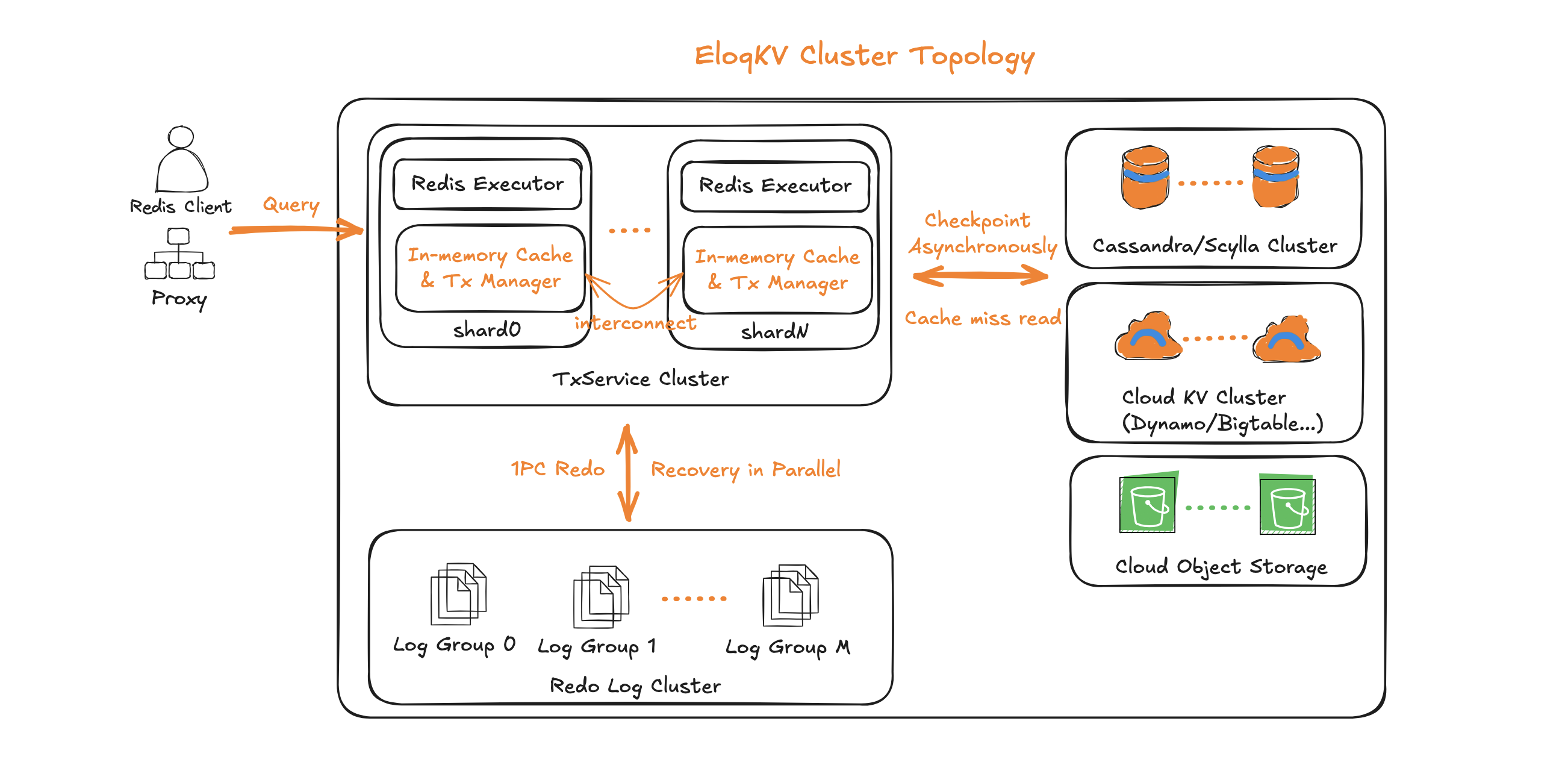
EloqKV is a decoupled, distributed database built on Data Substrate, the innovative new database foundation developed by EloqData.
Each EloqKV instance includes a frontend, compatible with the Redis protocol, deployed together with the core TxService to handle data operations. A logically independent LogService handles Write Ahead Logging (WAL) to ensure persistence, while a Storage Service manages memory state checkpoints and cold data storage.
EloqKV is a fully featured key-value database that supports both pure in-memory caching mode and durable transactional mode. In both use cases, it delivers outstanding performance compared to other solutions.
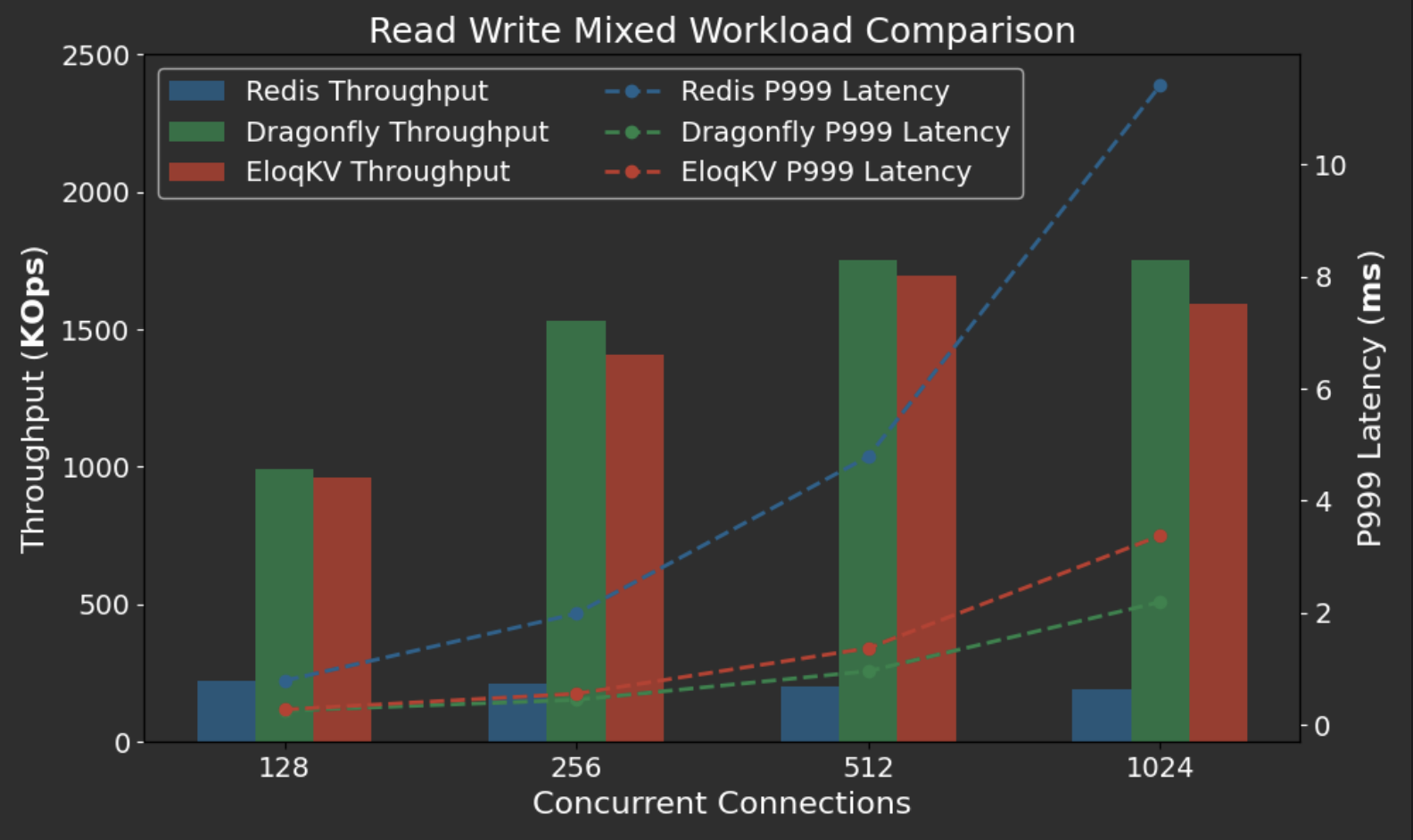
In cache scenarios, on a reasonable modern multi-core server EloqKV significantly outperforms Redis and ValKey and achieves performances comparable to DragonflyDB, a multi-threaded in-memory cache with Redis API. Unlike Redis and DragonflyDB, EloqKV is a full featured database that also excels in clustered, durable, and fully ACID-compliant transactional setups. See full benchmark
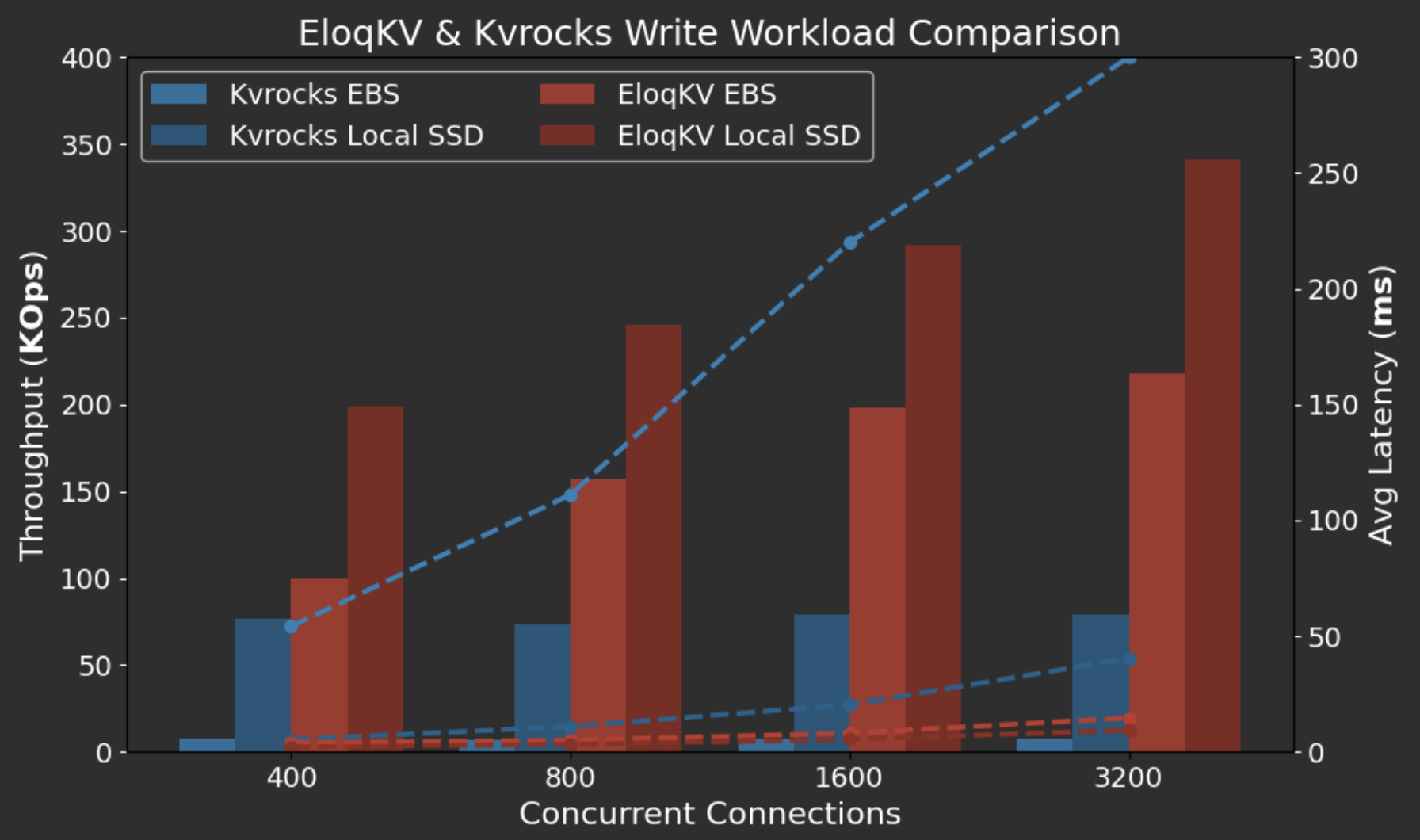
When running with full durability, EloqKV outperforms other Redis-compatible stores like Apache KVRocks by a large margin. Unlike these datastores that merely swap cold data to disks, EloqKV offers real, rollback-capable transactions with high throughput and ACID guarantees. See full benchmark
We recommend using our eloqdata/ubuntu-dev:24.04 development image (build
toolchain and CI test tooling pre-installed), then pulling EloqKV inside it.
docker pull eloqdata/ubuntu-dev:24.04
docker run -it --name eloq eloqdata/ubuntu-dev:24.04
git clone https://github.com/eloqdata/eloqkv.git
cd eloqkv
Alternatively, you can also pull the source code in an existing Linux environment. Ubuntu 24.04 is preferred.
git clone https://github.com/eloqdata/eloqkv.git
cd eloqkv
bash scripts/checkout_product_submodules.sh
bash scripts/install_dependency_ubuntu2404.sh
scripts/checkout_product_submodules.sh checks out the product submodules.
scripts/install_dependency_ubuntu2404.sh then installs the build
dependencies: the system packages plus the third-party workspace (grpc,
rocksdb-cloud, abseil, ...), which is fetched and built from source under
data_substrate/third_party/. This is the same script the from-scratch build
CI runs, so a successful local run matches CI.
It installs build dependencies only — the Python test tooling is baked into the
eloqdata/ubuntu-dev image and is not needed just to build.
mkdir build
cd build
cmake -DCMAKE_BUILD_TYPE=Release -DCMAKE_INSTALL_PREFIX=./install ..
make -j$(nproc)
make install
The source build links against the shared libraries installed in Data
Substrate's third-party workspace. Return to the repository root and add those
library directories to LD_LIBRARY_PATH before starting EloqKV:
cd ..
export LD_LIBRARY_PATH="$PWD/data_substrate/third_party/install/lib:$PWD/data_substrate/third_party/install/lib64${LD_LIBRARY_PATH:+:$LD_LIBRARY_PATH}"
./build/install/bin/eloqkv --config=eloqkv.ini
The exported value applies to the current shell. New terminals must export it again before running a source-built EloqKV.
EloqKV is released under a dual license. You may choose to use it under the terms of either:
See the LICENSE file for details.

401 followers · starred Dec 2025
296 followers · starred Jan 2026
377 followers · starred Jan 2026
1,844 followers · starred Sep 2026
High Performance Redis-API Compatible Distributed Database with Persistency, Scalability, Full ACID Transactions, and Tiered S3 Storage Cost Efficiency
See the code
EloqKV is a high-performance distributed database with a Redis/ValKey compatible API. It offers features like ACID transactions, full elasticity and scalability, tiered storage, and session-style transaction syntax — all while preserving Redis' simplicity and usability. EloqKV is engineered for developers who need a modern no-compromise database solution to power the next generation of demanding applications in the AI era.
This repo contains the code for the pluggable Redis API layer. See Architecture for more details. The API sits on top of EloqData's Data Substrate modular database foundation. Product source dependencies are checked out as submodules; forked third-party libraries are managed under Data Substrate's third_party workspace.
Why Choose EloqKV Over Redis?
| Feature | Redis | EloqKV |
|---|---|---|
| High Performance | Single-threaded | Multi-threaded (1.6million QPS on c6g.8xlarge) |
| Transactions | MULTI/EXEC (No Rollback) | Redis API plus BEGIN/COMMIT/ROLLBACK (ACID) |
| Distributed Transactions | CROSSSLOT Error | ACID distributed transactions |
| Data Durability | Limited, AOF/RDB snapshots | Replicated WAL + Tiered Storage |
| Cold Data | Must fit in memory | Auto-tiering to disk |
| Client Transparency | Cluster needs specific client | Same client for a single server or a cluster |
In addition to the standard (but limited) Redis transaction syntax (MULTI/EXEC), EloqKV also support Session-style interactive transactions.
-- Transfer funds between accounts atomically
BEGIN
  GET user:1000:balance     	 -- returns 1000
  INCRBY user:1000:balance -500  -- returns ok
  INCRBY user:2000:balance +500  -- returns ok
COMMIT
-- Rollback on failure
MULTI limitations — write transactions like a SQL database, with similar ACID gurantees and better performance.Cross-node strong consistency without hash slot constraints
-- Example of cross-node transfer
BEGIN
  INCRBY user:1000:balance -500      -- node A
  HSET order:2000:status "paid"      -- node B
COMMIT
CROSSSLOT Errors:Enables atomic operations across multiple nodes, unlike Redis Cluster which blocks cross-slot transactions.redis-cli -h eloqkv-server SET key "value" # Works out of the box!
We recommend using Docker for a quick local try-out of EloqKV.
1. Start a Single Node using Docker:
Note: EloqKV enables
io_uringby default for high performance. To avoid initialization errors on some platforms (e.g., macOS Docker), you must run with--privilegedand set custom ulimits.
# Create subnet for containers.
docker network create --subnet=172.20.0.0/16 eloqnet

docker run -d --privileged --ulimit memlock=-1:-1 --net eloqnet --ip 172.20.0.10 -p 6379:6379 --name=eloqkv eloqdata/eloqkv
Or using Docker Compose:
Create a docker-compose.yml file:
services:
  eloqkv:
    image: eloqdata/eloqkv:latest
    container_name: eloqkv
    ports:
      - "6379:6379"
    command: -enable_wal=true
    privileged: true
    ulimits:
      memlock: -1
    volumes:
      - ./data/EloqKv:/home/eloquser/EloqKV/eloq_data
Start the container:
docker-compose up -d
2. Verify Installation:
redis-cli -h 172.20.0.10

172.20.0.10:6379> set hello world
OK
172.20.0.10:6379> get hello
"world"
EloqCtl is the cluster management tool for EloqKV.
To deploy an EloqKV cluster in production, download EloqCtl and follow the deployment guide.
Download the EloqKV tarball from the EloqData website.
Follow the instruction guide to set up and run EloqKV on your local machine.
EloqKV is a decoupled, distributed database built on Data Substrate, the innovative new database foundation developed by EloqData.
Each EloqKV instance includes a frontend, compatible with the Redis protocol, deployed together with the core TxService to handle data operations. A logically independent LogService handles Write Ahead Logging (WAL) to ensure persistence, while a Storage Service manages memory state checkpoints and cold data storage.
EloqKV is a fully featured key-value database that supports both pure in-memory caching mode and durable transactional mode. In both use cases, it delivers outstanding performance compared to other solutions.
In cache scenarios, on a reasonable modern multi-core server EloqKV significantly outperforms Redis and ValKey and achieves performances comparable to DragonflyDB, a multi-threaded in-memory cache with Redis API. Unlike Redis and DragonflyDB, EloqKV is a full featured database that also excels in clustered, durable, and fully ACID-compliant transactional setups. See full benchmark
When running with full durability, EloqKV outperforms other Redis-compatible stores like Apache KVRocks by a large margin. Unlike these datastores that merely swap cold data to disks, EloqKV offers real, rollback-capable transactions with high throughput and ACID guarantees. See full benchmark
We recommend using our eloqdata/ubuntu-dev:24.04 development image (build
toolchain and CI test tooling pre-installed), then pulling EloqKV inside it.
docker pull eloqdata/ubuntu-dev:24.04
docker run -it --name eloq eloqdata/ubuntu-dev:24.04
git clone https://github.com/eloqdata/eloqkv.git
cd eloqkv
Alternatively, you can also pull the source code in an existing Linux environment. Ubuntu 24.04 is preferred.
git clone https://github.com/eloqdata/eloqkv.git
cd eloqkv
bash scripts/checkout_product_submodules.sh
bash scripts/install_dependency_ubuntu2404.sh
scripts/checkout_product_submodules.sh checks out the product submodules.
scripts/install_dependency_ubuntu2404.sh then installs the build
dependencies: the system packages plus the third-party workspace (grpc,
rocksdb-cloud, abseil, ...), which is fetched and built from source under
data_substrate/third_party/. This is the same script the from-scratch build
CI runs, so a successful local run matches CI.
It installs build dependencies only — the Python test tooling is baked into the
eloqdata/ubuntu-dev image and is not needed just to build.
mkdir build
cd build
cmake -DCMAKE_BUILD_TYPE=Release -DCMAKE_INSTALL_PREFIX=./install ..
make -j$(nproc)
make install
The source build links against the shared libraries installed in Data
Substrate's third-party workspace. Return to the repository root and add those
library directories to LD_LIBRARY_PATH before starting EloqKV:
cd ..
export LD_LIBRARY_PATH="$PWD/data_substrate/third_party/install/lib:$PWD/data_substrate/third_party/install/lib64${LD_LIBRARY_PATH:+:$LD_LIBRARY_PATH}"
./build/install/bin/eloqkv --config=eloqkv.ini
The exported value applies to the current shell. New terminals must export it again before running a source-built EloqKV.
EloqKV is released under a dual license. You may choose to use it under the terms of either:
See the LICENSE file for details.
401 followers · starred Dec 2025
296 followers · starred Jan 2026
377 followers · starred Jan 2026
1,844 followers · starred Sep 2026