
Quickly open diff splits against your undo history in nvim
Lua
1
114 commits
updated Oct 2, 2026
See what people are saying
README
diffundo.nvim
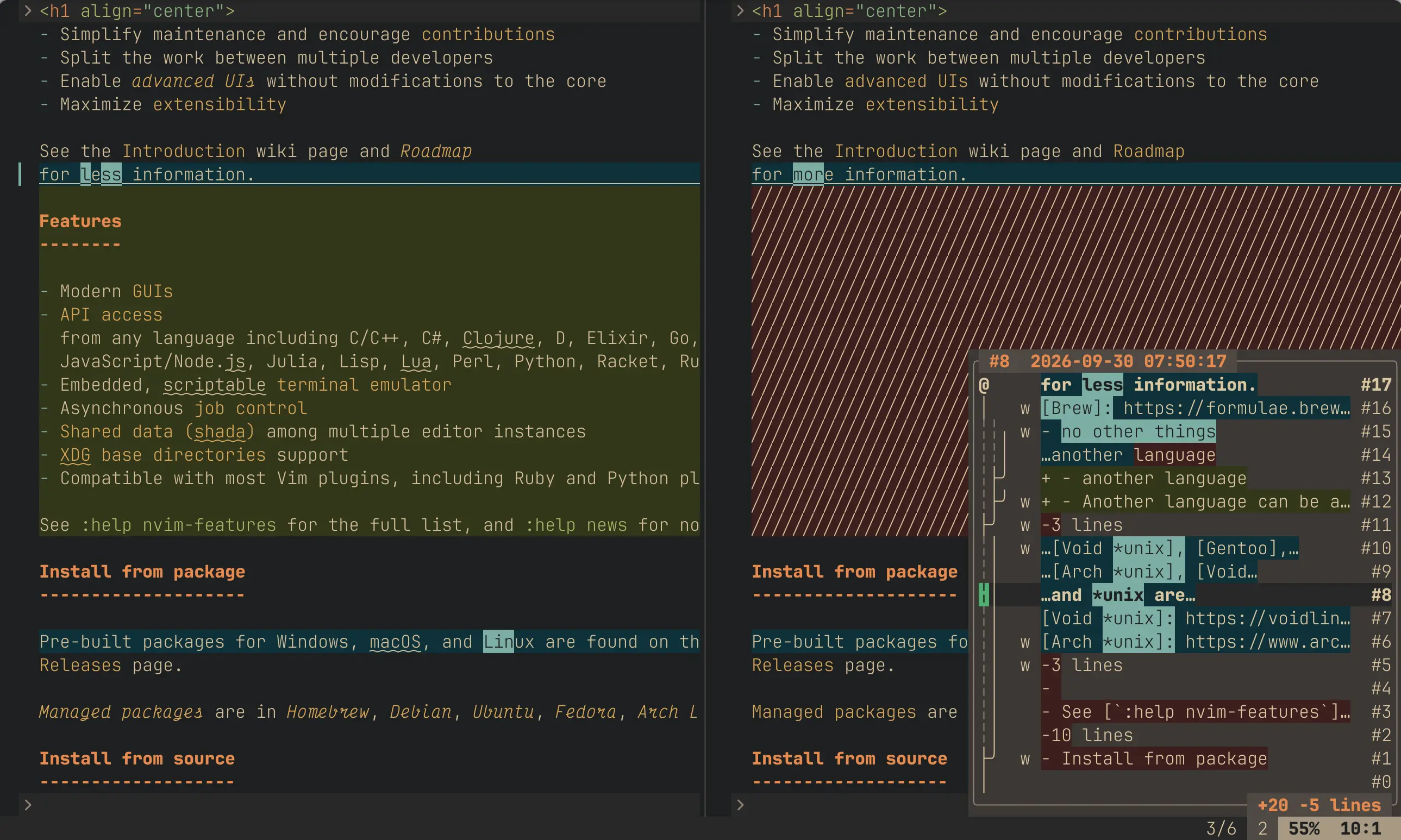
Open a vertical diffsplit against a files undo history, and quickly find and pull changes from your undo history into your current buffer.
Requires neovim 0.10 or newer.
Installation
Use your favorite package manager to install this plugin. Example configuration:
return {
  "dsummersl/diffundo.nvim",
  dependencies = {
    "tpope/vim-repeat",
  },
  config = function()
    vim.keymap.set("n", "<leader>du", ":Diffundo earlier<cr>", { desc = "Diffundo earlier" })
    vim.keymap.set("n", "<leader>dl", ":Diffundo later<cr>", { desc = "Diffundo later" })
    vim.keymap.set("n", "<leader>dU", ":Diffundo earlier 1f<cr>", { desc = "Diffundo earlier 1f (write)" })
    vim.keymap.set("n", "<leader>dL", ":Diffundo later 1f<cr>", { desc = "Diffundo later 1f (write)" })
    vim.keymap.set("n", "<leader>d/", ":Diffundo search ", { desc = "Diffundo search" })
    vim.keymap.set("n", "<leader>df", ":Diffundo focus<cr>", { desc = "Diffundo focus" })
    vim.keymap.set("n", "<leader>dc", ":Diffundo close<cr>", { desc = "Diffundo close" })
  end,
}
Commands
The :Diffundo command acts as 'diff wrapper' around the builtin :earlier, :later, and :undo ex commands.
Subcommands that open a diff split:
:Diffundo earlier <count>- ...against an older state (see :earlier):Diffundo later <count>- ...against a newer state (see :earlier):Diffundo undo <n>- ...against a specific undo state (see [:undo {n}]):Diffundo search <pattern>- ...against the next undo that introduced text that added<pattern>. Usesearch!to search undos that removed<pattern>.
Other commands:
:Diffundo focus- open the diff split and focus on the history pane. If the diff split is already open, focuses on the history pane.:Diffundo close- close the diff and hovering history window.
History pane
miniview
While the diff split is open, a small pane in the diff window's lower right corner shows what the diff split is comparing.
╭─ #4  2026-09-26 10:12:03 ────────╮   <- what we're currently diffing, and when the change happened
│@ w + return x                 #12│   <- the undo # of your current buffer (what you're editing now); `w` = written to disk
│┆     7 undos 1w                  │   <- states in between (total + # written to disk)
│╷ w - local y = 1               #4│   <- the undo that the diff shows (the write column is its own column)
│┆     3 undos                     │   <- states below...
╰──────────────────── +3 -5 lines ─╯
focus mode
When you use :Diffundo focus the pane expands to show the full undo
history and you are put into history window so that you can explore the full undo tree.
j/kare plain motions (not mapped by the plugin).J/Kmove to the next/previous undo that was written to disk.<cr>puts the state under the cursor in the diff split.<c-cr>moves your buffer to the undo under the cursor (the diff stays where it is).q/<esc>collapse the pane back to the diff and source windows.
Configuration
require("diffundo").setup(opts) is the only configuration surface; options
merge over the built-in defaults, and the plugin works unchanged with no
setup() call at all. The defaults, pane keymaps included, are:
require("diffundo").setup({
  -- history = true                            -- show the history pane
  -- glyphs = { buffer = "@", write = "w", gap = "┆", ellipsis = "…" }
  -- date_format = "%Y-%m-%d %H:%M:%S"         -- or function(time) -> string
  -- history_width = 40                        -- pane width
  -- fold_min = 3                              -- expanded-view fold threshold
  -- keys = {
  --   pane = {
  --     J = function(api) api.move_save(1) end,       -- next written state
  --     K = function(api) api.move_save(-1) end,      -- previous written state
  --     ["<cr>"] = function(api) api.place() end,     -- diff the state under the cursor
  --     ["<c-cr>"] = function(api) api.apply() end,   -- move the buffer to that state
  --     q = function(api) api.collapse(true) end,     -- collapse and return
  --     ["<esc>"] = function(api) api.collapse(true) end,
  --   },
  -- },
})
See doc/diffundo.txt for more information.
Development
Requires lua, luarocks, stylua, selene, ast-grep, lua-language-server, and jq on PATH.
make setup
make ci
The plugin lives in lua/diffundo and is tested with busted against a fake of
the neovim API, so no editor process is needed. make ci runs busted (with
coverage), selene, stylua, ast-grep, lua-language-server and a complexity check.
The commands are also covered by a separate end-to-end test that drives a real headless neovim through denops.vim:
make e2e
It needs deno and nvim. make gen prints the undotree and rendered history
text that real neovim produces for each sample undo shape in
tests/e2e/gen_samples.ts; that output is the ground truth the golden busted
tests in spec/tree_spec.lua and spec/history_spec.lua are derived from.
Architecture Decision Records live in docs/adr; see AGENTS.md for the
day-to-day commands.
About
I managed the vim-mundo plugin for many years; this is my sense of the successor to it for neovim.
Similar repos


Languages
Lua
83.4%
TypeScript
15.8%
Quickly open diff splits against your undo history in nvim
Lua
1
114 commits
updated Oct 2, 2026
See what people are saying
README
diffundo.nvim
Open a vertical diffsplit against a files undo history, and quickly find and pull changes from your undo history into your current buffer.
Requires neovim 0.10 or newer.
Installation
Use your favorite package manager to install this plugin. Example configuration:
return {
  "dsummersl/diffundo.nvim",
  dependencies = {
    "tpope/vim-repeat",
  },
  config = function()
    vim.keymap.set("n", "<leader>du", ":Diffundo earlier<cr>", { desc = "Diffundo earlier" })
    vim.keymap.set("n", "<leader>dl", ":Diffundo later<cr>", { desc = "Diffundo later" })
    vim.keymap.set("n", "<leader>dU", ":Diffundo earlier 1f<cr>", { desc = "Diffundo earlier 1f (write)" })
    vim.keymap.set("n", "<leader>dL", ":Diffundo later 1f<cr>", { desc = "Diffundo later 1f (write)" })
    vim.keymap.set("n", "<leader>d/", ":Diffundo search ", { desc = "Diffundo search" })
    vim.keymap.set("n", "<leader>df", ":Diffundo focus<cr>", { desc = "Diffundo focus" })
    vim.keymap.set("n", "<leader>dc", ":Diffundo close<cr>", { desc = "Diffundo close" })
  end,
}
Commands
The :Diffundo command acts as 'diff wrapper' around the builtin :earlier, :later, and :undo ex commands.
Subcommands that open a diff split:
:Diffundo earlier <count>- ...against an older state (see :earlier):Diffundo later <count>- ...against a newer state (see :earlier):Diffundo undo <n>- ...against a specific undo state (see [:undo {n}]):Diffundo search <pattern>- ...against the next undo that introduced text that added<pattern>. Usesearch!to search undos that removed<pattern>.
Other commands:
:Diffundo focus- open the diff split and focus on the history pane. If the diff split is already open, focuses on the history pane.:Diffundo close- close the diff and hovering history window.
History pane
miniview
While the diff split is open, a small pane in the diff window's lower right corner shows what the diff split is comparing.
╭─ #4  2026-09-26 10:12:03 ────────╮   <- what we're currently diffing, and when the change happened
│@ w + return x                 #12│   <- the undo # of your current buffer (what you're editing now); `w` = written to disk
│┆     7 undos 1w                  │   <- states in between (total + # written to disk)
│╷ w - local y = 1               #4│   <- the undo that the diff shows (the write column is its own column)
│┆     3 undos                     │   <- states below...
╰──────────────────── +3 -5 lines ─╯
focus mode
When you use :Diffundo focus the pane expands to show the full undo
history and you are put into history window so that you can explore the full undo tree.
j/kare plain motions (not mapped by the plugin).J/Kmove to the next/previous undo that was written to disk.<cr>puts the state under the cursor in the diff split.<c-cr>moves your buffer to the undo under the cursor (the diff stays where it is).q/<esc>collapse the pane back to the diff and source windows.
Configuration
require("diffundo").setup(opts) is the only configuration surface; options
merge over the built-in defaults, and the plugin works unchanged with no
setup() call at all. The defaults, pane keymaps included, are:
require("diffundo").setup({
  -- history = true                            -- show the history pane
  -- glyphs = { buffer = "@", write = "w", gap = "┆", ellipsis = "…" }
  -- date_format = "%Y-%m-%d %H:%M:%S"         -- or function(time) -> string
  -- history_width = 40                        -- pane width
  -- fold_min = 3                              -- expanded-view fold threshold
  -- keys = {
  --   pane = {
  --     J = function(api) api.move_save(1) end,       -- next written state
  --     K = function(api) api.move_save(-1) end,      -- previous written state
  --     ["<cr>"] = function(api) api.place() end,     -- diff the state under the cursor
  --     ["<c-cr>"] = function(api) api.apply() end,   -- move the buffer to that state
  --     q = function(api) api.collapse(true) end,     -- collapse and return
  --     ["<esc>"] = function(api) api.collapse(true) end,
  --   },
  -- },
})
See doc/diffundo.txt for more information.
Development
Requires lua, luarocks, stylua, selene, ast-grep, lua-language-server, and jq on PATH.
make setup
make ci
The plugin lives in lua/diffundo and is tested with busted against a fake of
the neovim API, so no editor process is needed. make ci runs busted (with
coverage), selene, stylua, ast-grep, lua-language-server and a complexity check.
The commands are also covered by a separate end-to-end test that drives a real headless neovim through denops.vim:
make e2e
It needs deno and nvim. make gen prints the undotree and rendered history
text that real neovim produces for each sample undo shape in
tests/e2e/gen_samples.ts; that output is the ground truth the golden busted
tests in spec/tree_spec.lua and spec/history_spec.lua are derived from.
Architecture Decision Records live in docs/adr; see AGENTS.md for the
day-to-day commands.
About
I managed the vim-mundo plugin for many years; this is my sense of the successor to it for neovim.
Similar repos
Languages
Lua
83.4%
TypeScript
15.8%