
An Open Source Codebase Intelligence for AI agents and Developers for javascript, typescript, reactjs, nextjs, python, java, go and rust for easy PR review, fast Onboarding and deep architectural understanding
See the codeSee what people are saying
README
DevLens
Codebase Intelligence for AI agents and Developers.
Analyze your repo once. Your AI agent then queries a precomputed code graph through MCP — ranked files, call flow, impact, and security — instead of re-reading your codebase file by file. Ranked first of nine tools on every quality measure in our public benchmark.



Click the image to watch the demo
Why DevLens?
- Your agent stops burning tokens. One MCP call returns a task-shaped packet — the files and symbols that matter, ranked, within a token budget. No grep loops, no re-reading files.
- It wins the benchmark. First of nine tools on correctness, F1, recall, and precision — the only tool that leads every quality column.
- It is fast and small. 67 ms per call, packets 6.7× smaller than the closest graph competitor, and it never exceeds the token budget you set.
- Developers get it too. Interactive graph visualization, blast radius before you change a symbol, PR review packets, and per-node security analysis.
Benchmarks
We benchmarked DevLens MCP against seven other code graph and retrieval tools — Graphify, codegraph, serena, semble, codebase-memory, and others. One headless coding agent, one model, one real TypeScript repository, 133 real questions written from actual pull requests and symbols, two runs each: 2,394 agent runs in total.
| DevLens OSS | Graphify | codegraph | serena | semble | codebase-memory | |
|---|---|---|---|---|---|---|
| Correctness | 🥇 0.694 | 0.662 | 0.674 | 0.656 | 0.652 | 0.644 |
| F1 | 🥇 0.562 | 0.548 | 0.555 | 0.545 | 0.535 | 0.544 |
| Latency per call | 67 ms | 2,469 ms | 2,736 ms | 106 ms | 508 ms | 1,100 ms |
| Response packet | 2,230 tokens | 15,020 tokens | 6,339 tokens | 8 tokens* | 736 tokens | 294 tokens |
| Token budget compliance | 100% | median 2.5× over | — | — | — | — |
| Graph size | 10,346 nodes / 19,847 edges | 16,999 / 71,694 | not measured | — | — | 26,299 / 99,321 |
* serena's symbol tool returned no results on every question, so its tiny packet means it found nothing, not that it is efficient. The low response-payload figures for codebase-memory, semble, and BM25-style tools come from line lists rather than structured answers.
DevLens is the only tool ranked first on correctness, F1, recall, and precision — and it wins with the fastest calls and one of the smallest packets. Head-to-head against Graphify on identical questions: packet 6.7× smaller on all 54 of 54 comparable questions, ~37× faster per call, and a paired 15 wins to 9 losses.
The pattern behind the numbers: syntactic tools return big blobs or bare line lists. DevLens returns a task-shaped packet from a type-resolved graph — the files that matter, ranked, within your token budget, in milliseconds.
Full methodology, all nine tools, five languages: docs/PUBLIC-BENCHMARKS.md
How DevLens compares
DevLens is the only tool in this space that combines native semantic parsing, per-node AI summaries with per-node security analysis, and framework-aware data edges — and the only option you can use commercially under AGPL.
| Dimension | DevLens | Graphify | GitNexus | Sourcegraph | DeepWiki |
|---|---|---|---|---|---|
| Parsing depth | Native semantic parsers (TS compiler, Python ast, go/types, JavaParser, syn), type-resolved | tree-sitter (syntactic, no type info) | tree-sitter + native bindings (no type info) | SCIP/LSIF symbol index + language servers (no semantic parse) | LLM reads source directly (no structured parser) |
| Edge quality | Type-checked IMPLEMENTS/EXTENDS, framework routes (Next.js, Django, Spring, Gin, axum), ORM data edges (READS_FROM/WRITES_TO) | EXTRACTED/INFERRED/AMBIGUOUS tags, no type or framework awareness | call chains, clusters, route_map, no ORM or data edges | precise symbol cross-references (SCIP), no type-checked inheritance | docs-level relationships (no structured graph) |
| Per-node AI summaries | Technical + business + security with severity on every node | No (LLM used for docs and concepts) | No (embeddings for semantic query) | Via Cody (hover and inline docs, chat-level) | Auto-generated docs per symbol (no security, no technical/business split) |
| Security analysis | Per-node severity + blast-radius reach with real exploit descriptions | No | Partial (opt-in PDG/taint) | No (compliance certifications only) | No |
| Agent / MCP integration | CLI + self-describing MCP server + Web UI | CLI + local skill (no MCP) | CLI + 17-tool MCP + hooks (AGENTS.md) | MCP server (cross-repo search, not per-repo graph queries) | Unknown (no public MCP integration) |
| Language coverage | TS/JS, Python, Java, Go, Rust with native parsers for each | 12 code families + docs/images (shallow syntactic) | Many via tree-sitter (Dart/Kotlin/Swift), shallow syntactic | 30+ via language servers (symbol-level, no semantic edges) | Any (LLM reads source, no structured extraction) |
| License / pricing | AGPL-3.0, free, including commercial use | Apache-2.0 | PolyForm Noncommercial (cannot use commercially) | Open-source core, Enterprise paid | Free for public repos, enterprise tiers unlisted |
(Feature comparison from public sources, Aug 2026.)
Why teams choose DevLens: semantic edges that syntactic tools cannot produce, per-node security analysis no other open-source tool provides, benchmark-winning retrieval quality, and a single MCP front door — free for commercial use.
Quick Start
Step 1 — Install the CLI
npm install -g @devlensio/cli
Or install the standalone binary (no Node.js needed):
# Linux / macOS
curl -fsSL https://raw.githubusercontent.com/devlensio/devlensOSS/main/scripts/install.sh | sh

# Windows (PowerShell)
irm https://raw.githubusercontent.com/devlensio/devlensOSS/main/scripts/install.ps1 | iex
Step 2 — Configure a model (optional)
Only needed if you want AI summaries. Structure-only analysis works offline with no API key.
devlens init
This walks you through picking a provider, API type, key, endpoint, and model interactively — press ESC at any step to go back a stage. See Configuration for recommended models.
Step 3 — Analyze your repo
cd your-project
devlens analyze . --summarize
This builds the graph, generates summaries, and creates the search index — once. After this, everything below is instant.
Step 4 — Connect your AI agent
Start the MCP server:
devlens mcp
Then register it in your agent. Pick your tool:
Claude Code / Claude Desktop
claude mcp add devlens -- devlens mcp
Cursor — add to .cursor/mcp.json:
{
  "mcpServers": {
    "devlens": { "command": "devlens", "args": ["mcp"] }
  }
}
Codex — add to ~/.codex/config.toml:
[mcp_servers.devlens]
command = "devlens"
args = ["mcp"]
Hermes — add to config.yaml:
mcp:
  servers:
    devlens:
      command: devlens
      args: [mcp]
Any other MCP client — the server speaks standard MCP over stdio. Point your client at the command devlens mcp. For an HTTP transport instead:
devlens mcp http -p 7000
The server self-describes its full tool list through tools/list, so your agent discovers everything on its own. That's it — ask your agent "how does auth work in this repo?" and watch it query the graph instead of reading files.
What your agent can ask
The server self-describes every tool's parameters through tools/list — your agent fills them in automatically. Every graph tool takes a graphId (returned by list_analyzed_repos / analyze) plus the arguments below.
| Tool | Key arguments | What it does |
|---|---|---|
resolve_context | task (required), intent, focus, tokenBudget | The front door. One call returns a task-shaped packet: ranked nodes with one-line meanings, call flow, involved files, key code bodies, security flags, and an id map — all within a token budget. Intents: pinpoint, reference-list, flow, overview, concept, security-audit, exploratory. |
blast_radius | symbol (required) | Cheap change-impact wrapper: what depends on a symbol, packed small. |
find_symbols | query (required) | Cheap BM25F name lookup: nodeIds plus file:line, no graph, no source. |
get_node | nodeId (required) | Full detail for one node: technical, business, and security summaries plus metadata. |
get_node_code | nodeId (required) | Raw source for one node (expensive, so use it last). |
get_blast_radius / get_khop | nodeId (required), radius | Upstream dependents or downstream dependencies out to a chosen radius. |
get_summaries | nodeIds (required) | Batch-read summaries for several node ids. |
get_security_issues | minSeverity | Security findings ranked by severity then impact, with the severity distribution and how much of the graph was assessed. |
check_freshness | — | Is the graph stale versus the working tree? |
get_subgraph | seedNodeId (required) | The cohesive cluster (module) a node belongs to. |
list_cycles | — | Circular dependencies. |
get_nodes_in_path | path (required) | Every node in a file or folder. |
find_nodes | filters (name, nodeTypes, filePath, minScore, severity) | Flexible node search. |
get_coverage | — | How much of the graph has summaries. |
Plus repo-level tools: architecture_brief (one-call architecture report), security_brief (ranked security report), review_pr (from/to commits — PR review packet), onboarding_tour (modules, routes, flows, glossary), analyze_changes (from/to commits — commit diff impact), analyze (analyze a repo path), get_repo_overview, and get_context (raw keyword/seed context query) — 24 tools in total.
Every response carries a provenance block (commitHash, analyzedAt, hasGit), so your agent always knows which snapshot answered the question.
Full reference:
docs/mcp-reference.md
Supported languages
DevLens parses five language families with native parsers (no AI, no regex, no tree-sitter) and understands their frameworks. Summaries are never generated silently: you confirm before tokens are spent, and structure-only analysis needs no provider at all.
| Language | Frameworks / stacks the graph understands | What gets parsed |
|---|---|---|
| TypeScript / JavaScript | React, Next.js (app and pages router), Express/Hono/Fastify, React Router, TanStack Router, any Node | components, hooks, state stores, classes, methods, functions, routes |
| Python | FastAPI, Flask, Django (+DRF), SQLAlchemy / Django ORM, Celery, Pydantic | classes, methods, functions, routes, data models |
| Java | Spring Boot (controllers, JPA, Spring Data repositories) | classes, methods, interfaces, enums, routes |
| Go | net/http, Gin, Echo, chi, Fiber, GORM, database/sql | structs, interfaces, methods, functions, routes |
| Rust | axum, actix-web, rocket, utoipa, Diesel | structs, enums, traits, impl blocks, methods, functions, routes |
Each repo is analyzed with its language's own parser (Python ast, JavaParser, Go go/ast plus go/types, Rust syn, TS compiler API), so edges are real: type-checked interfaces (IMPLEMENTS), framework routes (HANDLES), and ORM data layers (READS_FROM, WRITES_TO).
For developers: the Web UI
For when you want to see your codebase laid out as an interactive graph.
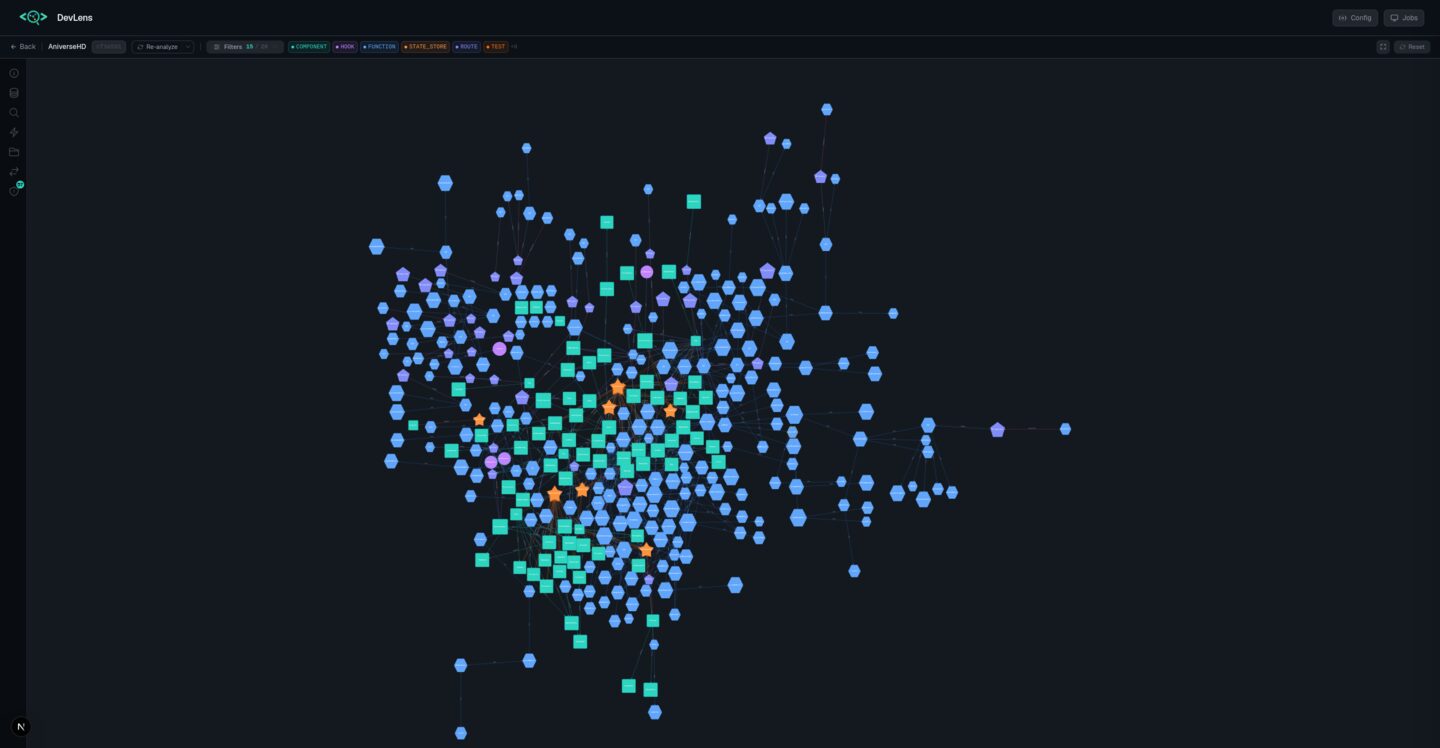
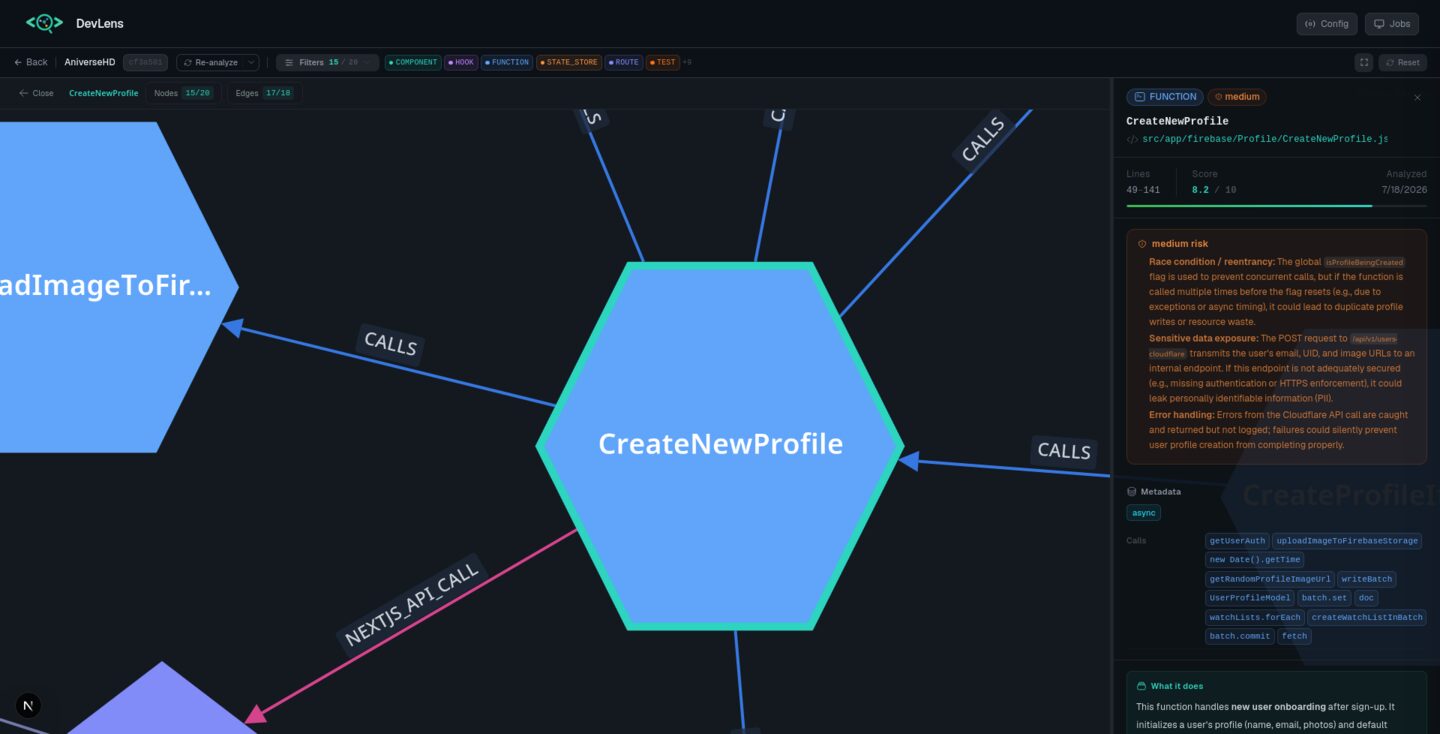
Open the Web UI, paste your repo path, and explore a force-directed canvas. Click any node to see its summaries, callers, callees, and security flags. Search, filter, and diff commits across versions. The Project panel shows search index readiness with a one-click reindex action.
bun start # from the source repo: API + Web UI on one port (http://localhost:3000)
The Web UI runs from the source tree, it is not bundled into the installed CLI binary.
CLI
For scripts, CI, and fast answers without leaving the terminal. Every command supports --json for piping into scripts, -v/--verbose for diagnostics, and --quiet for minimal output.
Analyze and summarize
| Command | What it does |
|---|---|
devlens detect [path] [--deps] | Inspect a repo before analyzing: language, manifest, dependency count, source files |
devlens analyze [path] [--summarize] [--force-summarize] | Build the graph and its search index (optionally add AI summaries) |
devlens summarize [target] | (Re)generate technical, business, and security summaries |
devlens status | Which repos are analyzed, their language and summary coverage |
devlens doctor | Environment health check: git, storage, LLM provider, and the four extractor runtimes (go, rust, java, python) |
devlens init | First-time setup: configure the LLM provider interactively |
Explore and understand
| Command | What it does |
|---|---|
devlens overview | Big picture: language, framework, stats, central nodes |
devlens top-nodes [-l <n>] | Highest-scoring (most central) nodes |
devlens find-nodes <name> [-t <type>] | Search by name, type, file, or severity (for example -t ROUTE) |
devlens nodes-in-path <path> | All nodes in a file or folder |
devlens get-node <id> | Full detail for one node: summaries, callers, callees |
devlens node-code <id> | Raw source for a node (expensive, prefer get-node) |
devlens architecture | One-call architecture brief: modules, routes, flows, health |
devlens get-context <query> | Token-budgeted context packet for an agent |
Impact and quality
| Command | What it does |
|---|---|
devlens blast-radius <id> | What breaks if I change this (upstream dependents) |
devlens khop <id> | What does it depend on (downstream) |
devlens subgraph <seed> | The cohesive cluster (module) a node belongs to |
devlens cycles | Circular dependencies |
devlens security [--min-severity ...] | Security findings with severity and explanation |
devlens security-brief | Ranked security report with blast-radius reach |
devlens diff <from> <to> | Compare two analyzed commits |
devlens review-pr <from> <to> | PR review packet: diff, impact, tests, security delta |
devlens check-freshness | Is the graph stale versus HEAD? |
Manage and integrate
| Command | What it does |
|---|---|
devlens config | View or set LLM provider config (~/.devlens/config.json) |
devlens repos | List analyzed repos |
devlens graphs list | delete | Manage stored graphs |
devlens reindex [graphId] [commitHash] [--force] | Rebuild the local search index (.search.json) without re-analyzing. No arguments reindexes the latest commit of every graph |
devlens serve | Start the backend HTTP API only (used by the MCP server and the Web UI) |
devlens mcp | Run the MCP server (see Quick Start) |
devlens update [--check] | Update the CLI to the latest published version — package manager auto-detected (npm/pnpm/yarn/bun). --check only checks and reports (pipeable with --json); offline, up-to-date, source-checkout, and non-global installs each get an explicit message |
Hands-on examples
devlens analyze . --summarize             # graph + summaries + search index
devlens find-nodes -t ROUTE               # every route in the app
devlens blast-radius "src/auth/login.ts::login"
devlens reindex                          # index everything up front
Full reference:
src/cli/README.mdfor every command with options and examples.
How to summarize
Summaries are per-node AI descriptions that make querying much richer. Run them during analysis, or any time later:
devlens analyze . --summarize                  # during analysis (recommended)
devlens summarize .                            # current directory's repo
devlens summarize <graphId>                    # a stored graph
devlens summarize . --force-summarize          # re-generate even if summarized
devlens summarize . --provider openai --provider-name deepseek --model deepseek-v4-flash
When a repo is re-summarized, only nodes without summaries are processed, so tokens are not spent twice. Configure your provider once with devlens init.
Configuration
Config lives in ~/.devlens/config.json, set via devlens init or devlens config. Models are discovered dynamically from each provider's /models endpoint, so there are no hardcoded model lists — pick whatever fits your budget and quality bar.
devlens config --set                            # interactive setup
devlens config --provider openai --provider-name deepseek --model deepseek-v4-flash --api-key <key>
devlens config --active openai:deepseek         # switch saved provider
devlens doctor                                  # health check
What DevLens understands
A graph is per repo and per language. Node types include FILE, FUNCTION, METHOD, CLASS, INTERFACE, STRUCT, ENUM, TRAIT, IMPL_BLOCK, ROUTE, COMPONENT, HOOK, STATE_STORE, UTILITY, TEST, STORY, and THIRD_PARTY (language dependent). Every node carries an importance score plus its functional, technical, and security summaries once summarized.
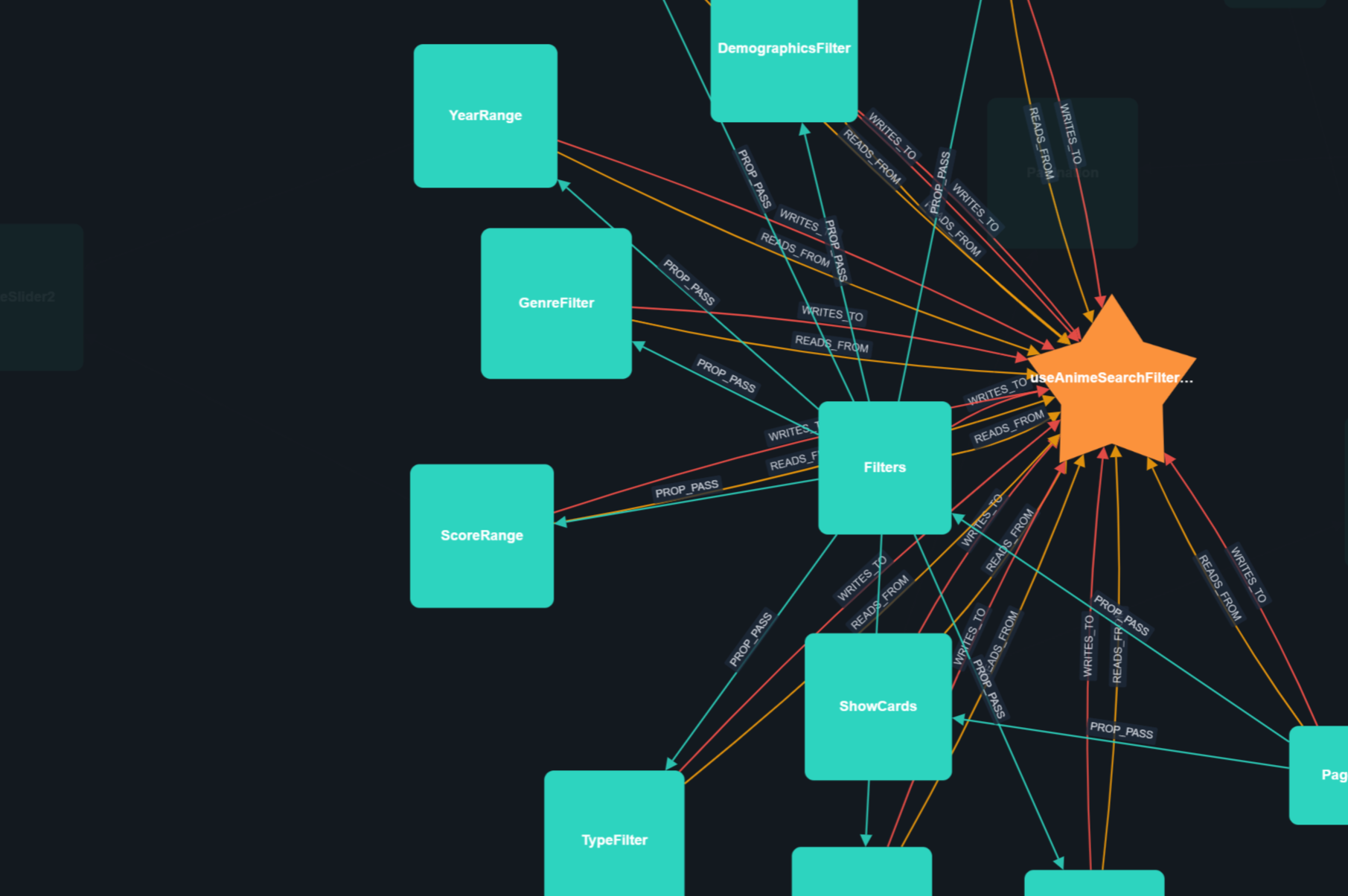
Edge types (the connections the graph draws): CALLS, IMPORTS, READS_FROM, WRITES_TO, PROP_PASS, EMITS, LISTENS, WRAPPED_BY, GUARDS, HANDLES, TESTS, USES, NEXTJS_API_CALL, NAVIGATES_TO, IMPLEMENTS (class to interface, trait, or ABC), EXTENDS (class to base class). EXPORTS, THROWS, MODULE, and PACKAGE are reserved for future languages.
Router awareness: routes are real graph nodes, for Next.js (app and pages), React Router, TanStack Router, wouter, Express, Fastify, Hono, Koa, Django URLconf and DRF, Flask blueprints, @RestController (Spring), Gin, Echo, chi, plain HTTP handlers, axum, actix, and rocket.
Search index
Each analyzed commit gets a derived BM25F search index next to the graph, at ~/.devlens/graphs/<graphId>/commits/<commitHash>.search.json.
- Every
devlens analyzeanddevlens summarizerebuilds the index for the commit it produced, so search is ready immediately. - Graphs built by older DevLens versions have no index. They are indexed lazily on the first search, or you can index everything up front with
devlens reindex. - The index is derived data: deleting it is safe, it rebuilds on demand.
devlens reindex                                  # latest commit of every graph
devlens reindex <graphId>                        # every commit of one graph
devlens reindex <graphId> <commitHash> --force   # one commit, rebuilt even if present
The same operations are available over HTTP: POST /api/reindex and POST /api/reindex/:graphId?commitHash=...&force=1.
Screenshots
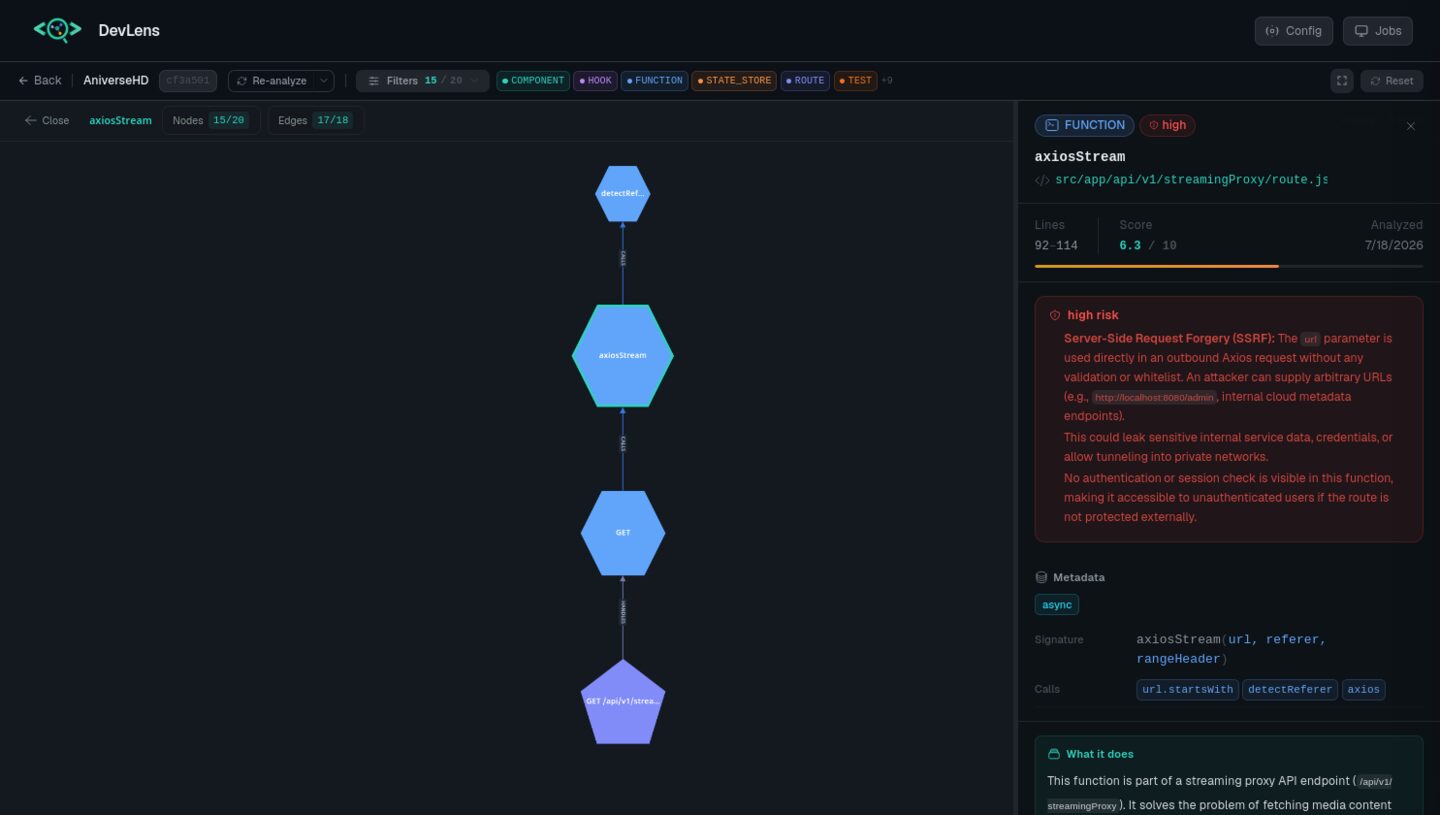
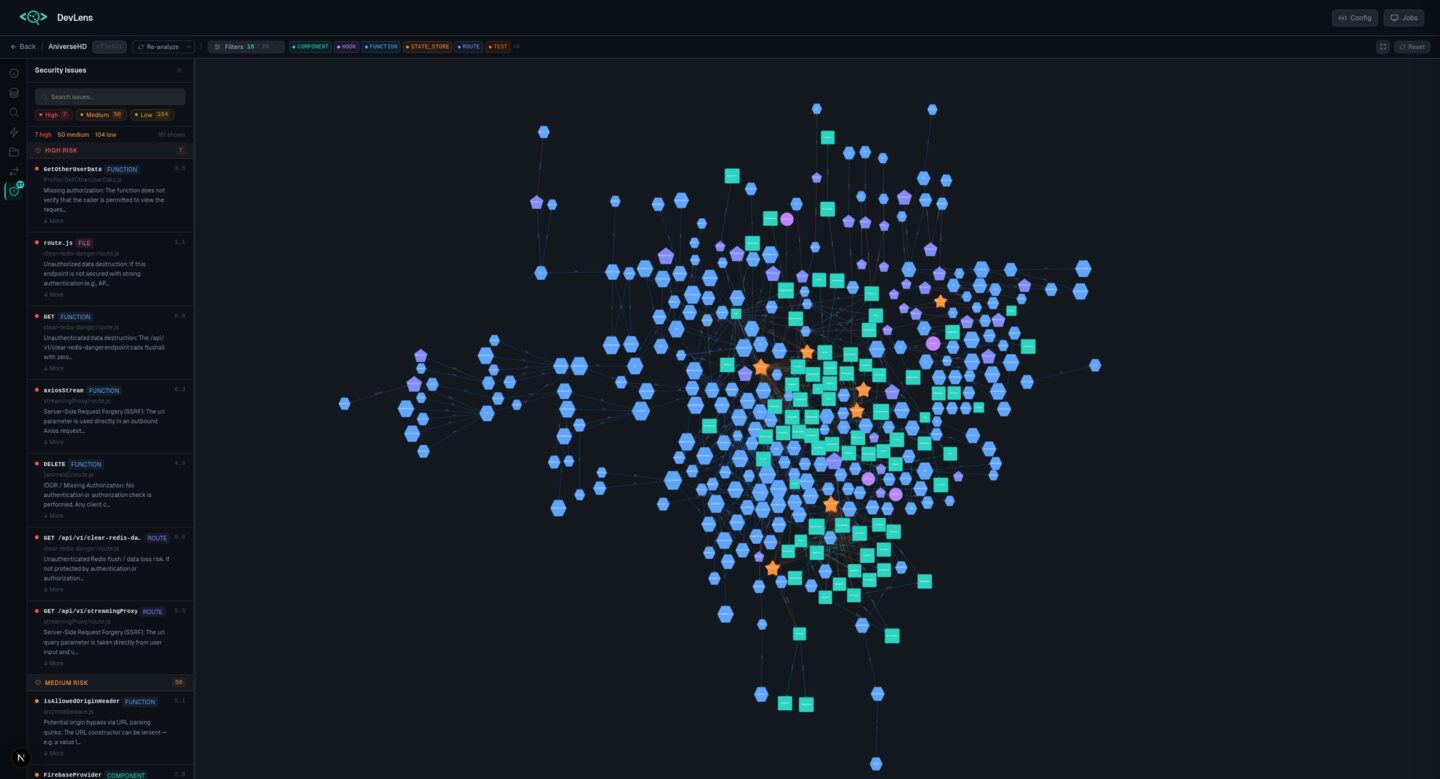
Graph explorer · node inspector with summaries and security risk · focused subgraph · security findings
Why it's fast and cheaper
A node summary is roughly 50 tokens. The file it describes is roughly 2,000. Querying summaries and graph slices costs a fraction of reading files, so humans get answers faster and AI agents spend dramatically fewer tokens on the same task.
Who is this for
- Developers and teams: onboard in hours not weeks, review PRs with impact context, catch circular dependencies and god-files, keep living documentation.
- Engineering leaders: a bird's-eye architecture view, spot debt before it becomes a crisis.
- AI-augmented developers: stop letting your agent burn tokens re-reading files; it queries the graph instead.
Repository layout
devlensOSS/
├── src/
│   ├── cli/                  # `devlens` CLI (commander program + commands)
│   ├── core/                 # Shared query core (CLI + MCP, they never drift)
│   ├── mcp/                  # MCP server (stdio + HTTP) and packet renderer
│   ├── search/               # Local BM25F search stack (index, query, cache)
│   └── server/               # HTTP API for the Web UI + Next.js proxy
├── frontend/                 # Next.js graph visualizer (Cytoscape)
├── plugins/devlens/          # Deprecated agent skill source (old installs)
├── packages/skill-installer/ # @devlensio/skill (deprecated)
├── bin/ + npm/<platform>/    # Launcher and prebuilt binary packages
├── scripts/                  # Release tooling + start.mjs (bun start build-or-skip)
└── server.json               # MCP registry manifest
The analysis engine (native parsers and graph build) ships as the separate devlensio package.
DevLens Cloud
A hosted version is in development: shareable graphs, team workspaces, live per-commit documentation with node summaries, detailed PR analysis (summary, impact, security), commit diffs showing added/modified/deleted nodes, an AI-native chat over your codebase, and no local setup.
License
AGPL-3.0. Part of the devlensio family of tools.
Similar repos


Languages
TypeScript
88.8%
JavaScript
5.9%
Python
3.1%
Shell
1.3%
An Open Source Codebase Intelligence for AI agents and Developers for javascript, typescript, reactjs, nextjs, python, java, go and rust for easy PR review, fast Onboarding and deep architectural understanding
See the codeSee what people are saying
README
DevLens
Codebase Intelligence for AI agents and Developers.
Analyze your repo once. Your AI agent then queries a precomputed code graph through MCP — ranked files, call flow, impact, and security — instead of re-reading your codebase file by file. Ranked first of nine tools on every quality measure in our public benchmark.
Click the image to watch the demo
Why DevLens?
- Your agent stops burning tokens. One MCP call returns a task-shaped packet — the files and symbols that matter, ranked, within a token budget. No grep loops, no re-reading files.
- It wins the benchmark. First of nine tools on correctness, F1, recall, and precision — the only tool that leads every quality column.
- It is fast and small. 67 ms per call, packets 6.7× smaller than the closest graph competitor, and it never exceeds the token budget you set.
- Developers get it too. Interactive graph visualization, blast radius before you change a symbol, PR review packets, and per-node security analysis.
Benchmarks
We benchmarked DevLens MCP against seven other code graph and retrieval tools — Graphify, codegraph, serena, semble, codebase-memory, and others. One headless coding agent, one model, one real TypeScript repository, 133 real questions written from actual pull requests and symbols, two runs each: 2,394 agent runs in total.
| DevLens OSS | Graphify | codegraph | serena | semble | codebase-memory | |
|---|---|---|---|---|---|---|
| Correctness | 🥇 0.694 | 0.662 | 0.674 | 0.656 | 0.652 | 0.644 |
| F1 | 🥇 0.562 | 0.548 | 0.555 | 0.545 | 0.535 | 0.544 |
| Latency per call | 67 ms | 2,469 ms | 2,736 ms | 106 ms | 508 ms | 1,100 ms |
| Response packet | 2,230 tokens | 15,020 tokens | 6,339 tokens | 8 tokens* | 736 tokens | 294 tokens |
| Token budget compliance | 100% | median 2.5× over | — | — | — | — |
| Graph size | 10,346 nodes / 19,847 edges | 16,999 / 71,694 | not measured | — | — | 26,299 / 99,321 |
* serena's symbol tool returned no results on every question, so its tiny packet means it found nothing, not that it is efficient. The low response-payload figures for codebase-memory, semble, and BM25-style tools come from line lists rather than structured answers.
DevLens is the only tool ranked first on correctness, F1, recall, and precision — and it wins with the fastest calls and one of the smallest packets. Head-to-head against Graphify on identical questions: packet 6.7× smaller on all 54 of 54 comparable questions, ~37× faster per call, and a paired 15 wins to 9 losses.
The pattern behind the numbers: syntactic tools return big blobs or bare line lists. DevLens returns a task-shaped packet from a type-resolved graph — the files that matter, ranked, within your token budget, in milliseconds.
Full methodology, all nine tools, five languages: docs/PUBLIC-BENCHMARKS.md
How DevLens compares
DevLens is the only tool in this space that combines native semantic parsing, per-node AI summaries with per-node security analysis, and framework-aware data edges — and the only option you can use commercially under AGPL.
| Dimension | DevLens | Graphify | GitNexus | Sourcegraph | DeepWiki |
|---|---|---|---|---|---|
| Parsing depth | Native semantic parsers (TS compiler, Python ast, go/types, JavaParser, syn), type-resolved | tree-sitter (syntactic, no type info) | tree-sitter + native bindings (no type info) | SCIP/LSIF symbol index + language servers (no semantic parse) | LLM reads source directly (no structured parser) |
| Edge quality | Type-checked IMPLEMENTS/EXTENDS, framework routes (Next.js, Django, Spring, Gin, axum), ORM data edges (READS_FROM/WRITES_TO) | EXTRACTED/INFERRED/AMBIGUOUS tags, no type or framework awareness | call chains, clusters, route_map, no ORM or data edges | precise symbol cross-references (SCIP), no type-checked inheritance | docs-level relationships (no structured graph) |
| Per-node AI summaries | Technical + business + security with severity on every node | No (LLM used for docs and concepts) | No (embeddings for semantic query) | Via Cody (hover and inline docs, chat-level) | Auto-generated docs per symbol (no security, no technical/business split) |
| Security analysis | Per-node severity + blast-radius reach with real exploit descriptions | No | Partial (opt-in PDG/taint) | No (compliance certifications only) | No |
| Agent / MCP integration | CLI + self-describing MCP server + Web UI | CLI + local skill (no MCP) | CLI + 17-tool MCP + hooks (AGENTS.md) | MCP server (cross-repo search, not per-repo graph queries) | Unknown (no public MCP integration) |
| Language coverage | TS/JS, Python, Java, Go, Rust with native parsers for each | 12 code families + docs/images (shallow syntactic) | Many via tree-sitter (Dart/Kotlin/Swift), shallow syntactic | 30+ via language servers (symbol-level, no semantic edges) | Any (LLM reads source, no structured extraction) |
| License / pricing | AGPL-3.0, free, including commercial use | Apache-2.0 | PolyForm Noncommercial (cannot use commercially) | Open-source core, Enterprise paid | Free for public repos, enterprise tiers unlisted |
(Feature comparison from public sources, Aug 2026.)
Why teams choose DevLens: semantic edges that syntactic tools cannot produce, per-node security analysis no other open-source tool provides, benchmark-winning retrieval quality, and a single MCP front door — free for commercial use.
Quick Start
Step 1 — Install the CLI
npm install -g @devlensio/cli
Or install the standalone binary (no Node.js needed):
# Linux / macOS
curl -fsSL https://raw.githubusercontent.com/devlensio/devlensOSS/main/scripts/install.sh | sh

# Windows (PowerShell)
irm https://raw.githubusercontent.com/devlensio/devlensOSS/main/scripts/install.ps1 | iex
Step 2 — Configure a model (optional)
Only needed if you want AI summaries. Structure-only analysis works offline with no API key.
devlens init
This walks you through picking a provider, API type, key, endpoint, and model interactively — press ESC at any step to go back a stage. See Configuration for recommended models.
Step 3 — Analyze your repo
cd your-project
devlens analyze . --summarize
This builds the graph, generates summaries, and creates the search index — once. After this, everything below is instant.
Step 4 — Connect your AI agent
Start the MCP server:
devlens mcp
Then register it in your agent. Pick your tool:
Claude Code / Claude Desktop
claude mcp add devlens -- devlens mcp
Cursor — add to .cursor/mcp.json:
{
  "mcpServers": {
    "devlens": { "command": "devlens", "args": ["mcp"] }
  }
}
Codex — add to ~/.codex/config.toml:
[mcp_servers.devlens]
command = "devlens"
args = ["mcp"]
Hermes — add to config.yaml:
mcp:
  servers:
    devlens:
      command: devlens
      args: [mcp]
Any other MCP client — the server speaks standard MCP over stdio. Point your client at the command devlens mcp. For an HTTP transport instead:
devlens mcp http -p 7000
The server self-describes its full tool list through tools/list, so your agent discovers everything on its own. That's it — ask your agent "how does auth work in this repo?" and watch it query the graph instead of reading files.
What your agent can ask
The server self-describes every tool's parameters through tools/list — your agent fills them in automatically. Every graph tool takes a graphId (returned by list_analyzed_repos / analyze) plus the arguments below.
| Tool | Key arguments | What it does |
|---|---|---|
resolve_context | task (required), intent, focus, tokenBudget | The front door. One call returns a task-shaped packet: ranked nodes with one-line meanings, call flow, involved files, key code bodies, security flags, and an id map — all within a token budget. Intents: pinpoint, reference-list, flow, overview, concept, security-audit, exploratory. |
blast_radius | symbol (required) | Cheap change-impact wrapper: what depends on a symbol, packed small. |
find_symbols | query (required) | Cheap BM25F name lookup: nodeIds plus file:line, no graph, no source. |
get_node | nodeId (required) | Full detail for one node: technical, business, and security summaries plus metadata. |
get_node_code | nodeId (required) | Raw source for one node (expensive, so use it last). |
get_blast_radius / get_khop | nodeId (required), radius | Upstream dependents or downstream dependencies out to a chosen radius. |
get_summaries | nodeIds (required) | Batch-read summaries for several node ids. |
get_security_issues | minSeverity | Security findings ranked by severity then impact, with the severity distribution and how much of the graph was assessed. |
check_freshness | — | Is the graph stale versus the working tree? |
get_subgraph | seedNodeId (required) | The cohesive cluster (module) a node belongs to. |
list_cycles | — | Circular dependencies. |
get_nodes_in_path | path (required) | Every node in a file or folder. |
find_nodes | filters (name, nodeTypes, filePath, minScore, severity) | Flexible node search. |
get_coverage | — | How much of the graph has summaries. |
Plus repo-level tools: architecture_brief (one-call architecture report), security_brief (ranked security report), review_pr (from/to commits — PR review packet), onboarding_tour (modules, routes, flows, glossary), analyze_changes (from/to commits — commit diff impact), analyze (analyze a repo path), get_repo_overview, and get_context (raw keyword/seed context query) — 24 tools in total.
Every response carries a provenance block (commitHash, analyzedAt, hasGit), so your agent always knows which snapshot answered the question.
Full reference:
docs/mcp-reference.md
Supported languages
DevLens parses five language families with native parsers (no AI, no regex, no tree-sitter) and understands their frameworks. Summaries are never generated silently: you confirm before tokens are spent, and structure-only analysis needs no provider at all.
| Language | Frameworks / stacks the graph understands | What gets parsed |
|---|---|---|
| TypeScript / JavaScript | React, Next.js (app and pages router), Express/Hono/Fastify, React Router, TanStack Router, any Node | components, hooks, state stores, classes, methods, functions, routes |
| Python | FastAPI, Flask, Django (+DRF), SQLAlchemy / Django ORM, Celery, Pydantic | classes, methods, functions, routes, data models |
| Java | Spring Boot (controllers, JPA, Spring Data repositories) | classes, methods, interfaces, enums, routes |
| Go | net/http, Gin, Echo, chi, Fiber, GORM, database/sql | structs, interfaces, methods, functions, routes |
| Rust | axum, actix-web, rocket, utoipa, Diesel | structs, enums, traits, impl blocks, methods, functions, routes |
Each repo is analyzed with its language's own parser (Python ast, JavaParser, Go go/ast plus go/types, Rust syn, TS compiler API), so edges are real: type-checked interfaces (IMPLEMENTS), framework routes (HANDLES), and ORM data layers (READS_FROM, WRITES_TO).
For developers: the Web UI
For when you want to see your codebase laid out as an interactive graph.
Open the Web UI, paste your repo path, and explore a force-directed canvas. Click any node to see its summaries, callers, callees, and security flags. Search, filter, and diff commits across versions. The Project panel shows search index readiness with a one-click reindex action.
bun start # from the source repo: API + Web UI on one port (http://localhost:3000)
The Web UI runs from the source tree, it is not bundled into the installed CLI binary.
CLI
For scripts, CI, and fast answers without leaving the terminal. Every command supports --json for piping into scripts, -v/--verbose for diagnostics, and --quiet for minimal output.
Analyze and summarize
| Command | What it does |
|---|---|
devlens detect [path] [--deps] | Inspect a repo before analyzing: language, manifest, dependency count, source files |
devlens analyze [path] [--summarize] [--force-summarize] | Build the graph and its search index (optionally add AI summaries) |
devlens summarize [target] | (Re)generate technical, business, and security summaries |
devlens status | Which repos are analyzed, their language and summary coverage |
devlens doctor | Environment health check: git, storage, LLM provider, and the four extractor runtimes (go, rust, java, python) |
devlens init | First-time setup: configure the LLM provider interactively |
Explore and understand
| Command | What it does |
|---|---|
devlens overview | Big picture: language, framework, stats, central nodes |
devlens top-nodes [-l <n>] | Highest-scoring (most central) nodes |
devlens find-nodes <name> [-t <type>] | Search by name, type, file, or severity (for example -t ROUTE) |
devlens nodes-in-path <path> | All nodes in a file or folder |
devlens get-node <id> | Full detail for one node: summaries, callers, callees |
devlens node-code <id> | Raw source for a node (expensive, prefer get-node) |
devlens architecture | One-call architecture brief: modules, routes, flows, health |
devlens get-context <query> | Token-budgeted context packet for an agent |
Impact and quality
| Command | What it does |
|---|---|
devlens blast-radius <id> | What breaks if I change this (upstream dependents) |
devlens khop <id> | What does it depend on (downstream) |
devlens subgraph <seed> | The cohesive cluster (module) a node belongs to |
devlens cycles | Circular dependencies |
devlens security [--min-severity ...] | Security findings with severity and explanation |
devlens security-brief | Ranked security report with blast-radius reach |
devlens diff <from> <to> | Compare two analyzed commits |
devlens review-pr <from> <to> | PR review packet: diff, impact, tests, security delta |
devlens check-freshness | Is the graph stale versus HEAD? |
Manage and integrate
| Command | What it does |
|---|---|
devlens config | View or set LLM provider config (~/.devlens/config.json) |
devlens repos | List analyzed repos |
devlens graphs list | delete | Manage stored graphs |
devlens reindex [graphId] [commitHash] [--force] | Rebuild the local search index (.search.json) without re-analyzing. No arguments reindexes the latest commit of every graph |
devlens serve | Start the backend HTTP API only (used by the MCP server and the Web UI) |
devlens mcp | Run the MCP server (see Quick Start) |
devlens update [--check] | Update the CLI to the latest published version — package manager auto-detected (npm/pnpm/yarn/bun). --check only checks and reports (pipeable with --json); offline, up-to-date, source-checkout, and non-global installs each get an explicit message |
Hands-on examples
devlens analyze . --summarize             # graph + summaries + search index
devlens find-nodes -t ROUTE               # every route in the app
devlens blast-radius "src/auth/login.ts::login"
devlens reindex                          # index everything up front
Full reference:
src/cli/README.mdfor every command with options and examples.
How to summarize
Summaries are per-node AI descriptions that make querying much richer. Run them during analysis, or any time later:
devlens analyze . --summarize                  # during analysis (recommended)
devlens summarize .                            # current directory's repo
devlens summarize <graphId>                    # a stored graph
devlens summarize . --force-summarize          # re-generate even if summarized
devlens summarize . --provider openai --provider-name deepseek --model deepseek-v4-flash
When a repo is re-summarized, only nodes without summaries are processed, so tokens are not spent twice. Configure your provider once with devlens init.
Configuration
Config lives in ~/.devlens/config.json, set via devlens init or devlens config. Models are discovered dynamically from each provider's /models endpoint, so there are no hardcoded model lists — pick whatever fits your budget and quality bar.
devlens config --set                            # interactive setup
devlens config --provider openai --provider-name deepseek --model deepseek-v4-flash --api-key <key>
devlens config --active openai:deepseek         # switch saved provider
devlens doctor                                  # health check
What DevLens understands
A graph is per repo and per language. Node types include FILE, FUNCTION, METHOD, CLASS, INTERFACE, STRUCT, ENUM, TRAIT, IMPL_BLOCK, ROUTE, COMPONENT, HOOK, STATE_STORE, UTILITY, TEST, STORY, and THIRD_PARTY (language dependent). Every node carries an importance score plus its functional, technical, and security summaries once summarized.
Edge types (the connections the graph draws): CALLS, IMPORTS, READS_FROM, WRITES_TO, PROP_PASS, EMITS, LISTENS, WRAPPED_BY, GUARDS, HANDLES, TESTS, USES, NEXTJS_API_CALL, NAVIGATES_TO, IMPLEMENTS (class to interface, trait, or ABC), EXTENDS (class to base class). EXPORTS, THROWS, MODULE, and PACKAGE are reserved for future languages.
Router awareness: routes are real graph nodes, for Next.js (app and pages), React Router, TanStack Router, wouter, Express, Fastify, Hono, Koa, Django URLconf and DRF, Flask blueprints, @RestController (Spring), Gin, Echo, chi, plain HTTP handlers, axum, actix, and rocket.
Search index
Each analyzed commit gets a derived BM25F search index next to the graph, at ~/.devlens/graphs/<graphId>/commits/<commitHash>.search.json.
- Every
devlens analyzeanddevlens summarizerebuilds the index for the commit it produced, so search is ready immediately. - Graphs built by older DevLens versions have no index. They are indexed lazily on the first search, or you can index everything up front with
devlens reindex. - The index is derived data: deleting it is safe, it rebuilds on demand.
devlens reindex                                  # latest commit of every graph
devlens reindex <graphId>                        # every commit of one graph
devlens reindex <graphId> <commitHash> --force   # one commit, rebuilt even if present
The same operations are available over HTTP: POST /api/reindex and POST /api/reindex/:graphId?commitHash=...&force=1.
Screenshots
Graph explorer · node inspector with summaries and security risk · focused subgraph · security findings
Why it's fast and cheaper
A node summary is roughly 50 tokens. The file it describes is roughly 2,000. Querying summaries and graph slices costs a fraction of reading files, so humans get answers faster and AI agents spend dramatically fewer tokens on the same task.
Who is this for
- Developers and teams: onboard in hours not weeks, review PRs with impact context, catch circular dependencies and god-files, keep living documentation.
- Engineering leaders: a bird's-eye architecture view, spot debt before it becomes a crisis.
- AI-augmented developers: stop letting your agent burn tokens re-reading files; it queries the graph instead.
Repository layout
devlensOSS/
├── src/
│   ├── cli/                  # `devlens` CLI (commander program + commands)
│   ├── core/                 # Shared query core (CLI + MCP, they never drift)
│   ├── mcp/                  # MCP server (stdio + HTTP) and packet renderer
│   ├── search/               # Local BM25F search stack (index, query, cache)
│   └── server/               # HTTP API for the Web UI + Next.js proxy
├── frontend/                 # Next.js graph visualizer (Cytoscape)
├── plugins/devlens/          # Deprecated agent skill source (old installs)
├── packages/skill-installer/ # @devlensio/skill (deprecated)
├── bin/ + npm/<platform>/    # Launcher and prebuilt binary packages
├── scripts/                  # Release tooling + start.mjs (bun start build-or-skip)
└── server.json               # MCP registry manifest
The analysis engine (native parsers and graph build) ships as the separate devlensio package.
DevLens Cloud
A hosted version is in development: shareable graphs, team workspaces, live per-commit documentation with node summaries, detailed PR analysis (summary, impact, security), commit diffs showing added/modified/deleted nodes, an AI-native chat over your codebase, and no local setup.
License
AGPL-3.0. Part of the devlensio family of tools.
Similar repos
Languages
TypeScript
88.8%
JavaScript
5.9%
Python
3.1%
Shell
1.3%