
README
SpeechEditBench

Paper | Dataset | Evaluation Guide
SpeechEditBench is a bilingual multi-attribute benchmark for instruction-guided speech editing. Each example pairs source speech with a natural-language edit instruction, and the evaluator checks whether a system achieves the requested edit while preserving the expected lexical content.
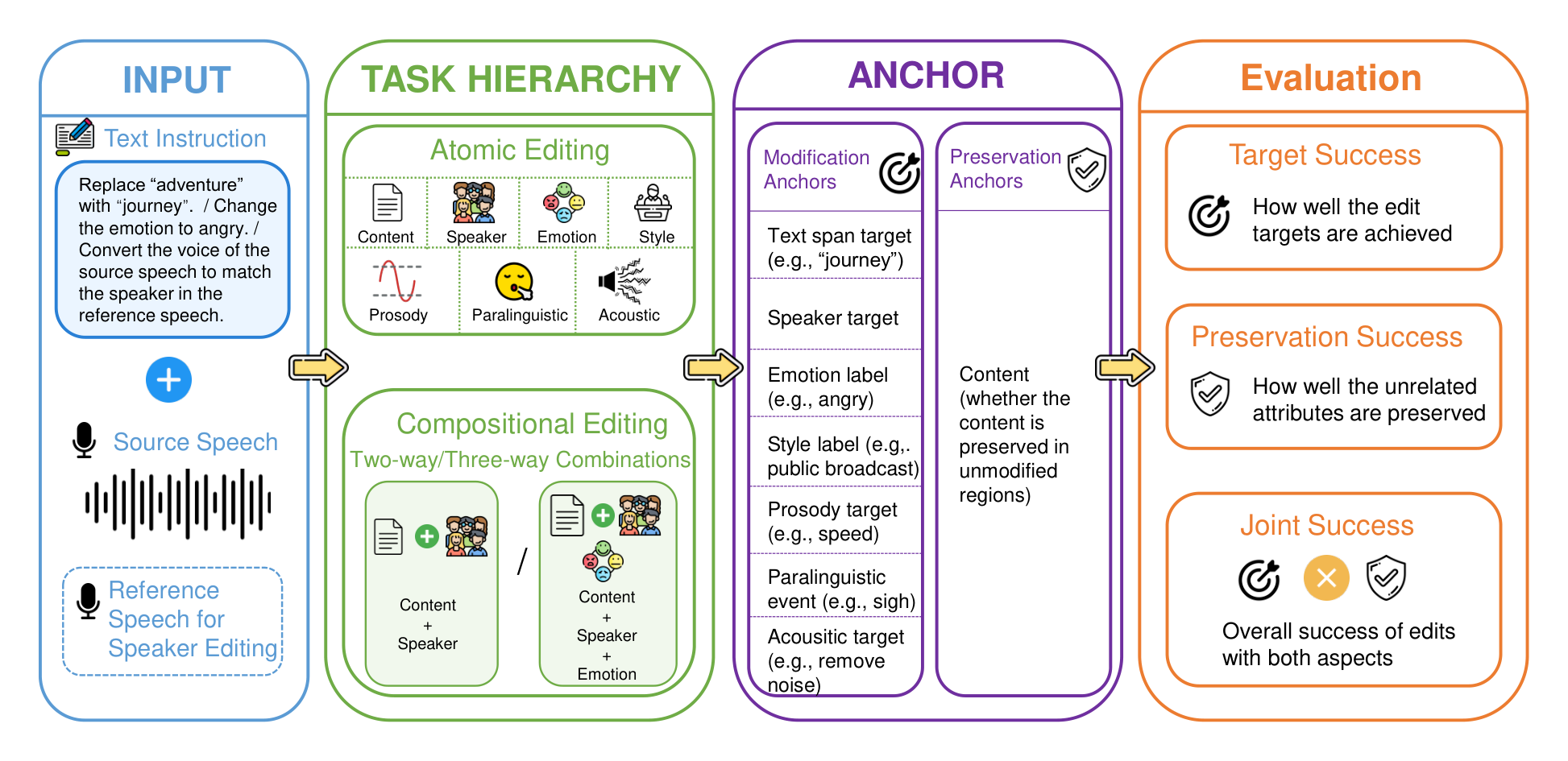
The benchmark covers seven atomic editing tasks and compositional editing:
content_editingspeaker_editingemotion_editingstyle_editingprosody_editingparalinguistic_editingacoustic_editingcompositional_editing
This repository contains the benchmark metadata, evaluation code, release manifest, and user-facing documentation. The full audio assets are distributed through Hugging Face.
Data
The v1.1 release contains 4,700 samples across 8 tasks and 5,400 audio files in the full data release.
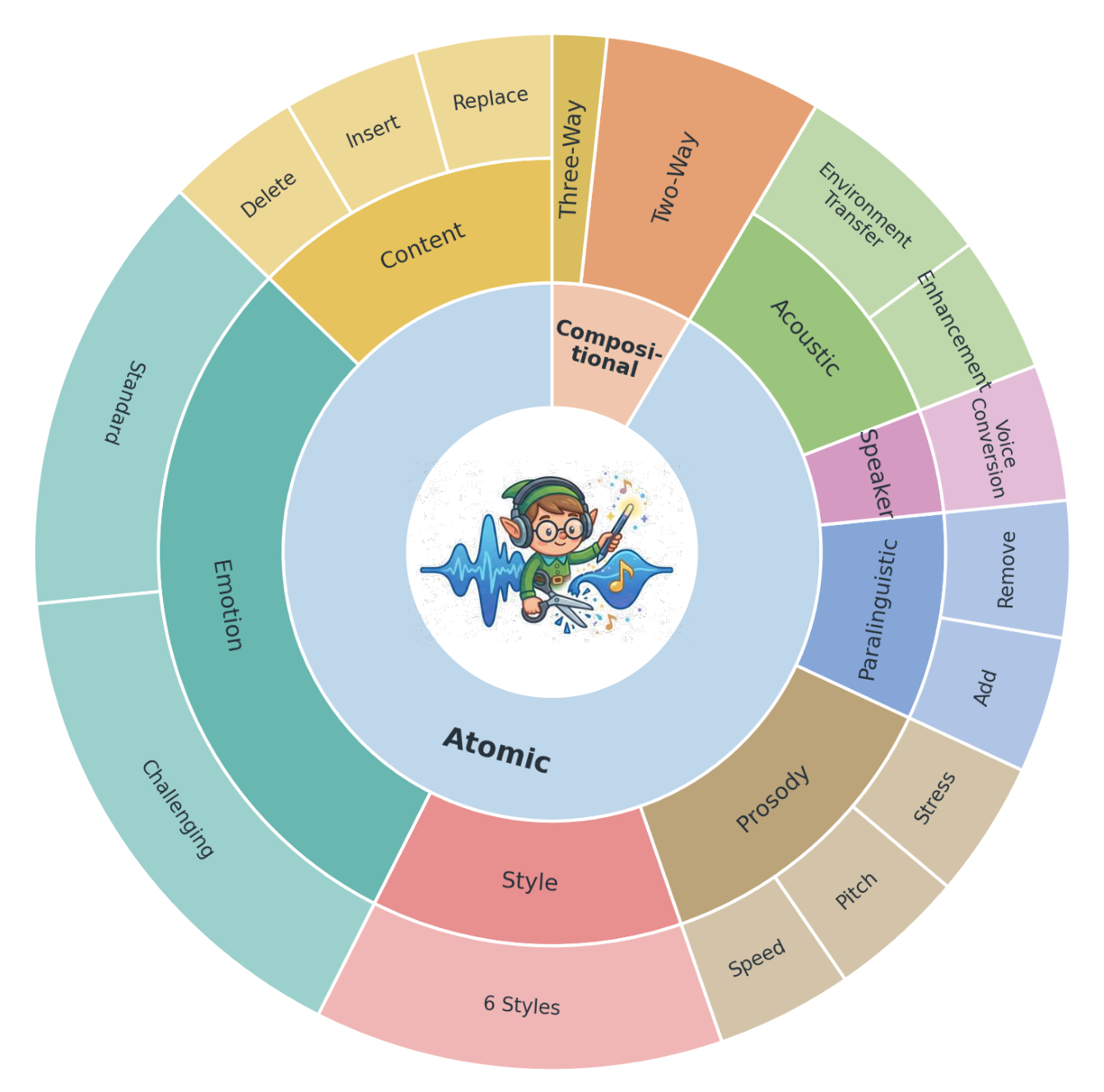
The GitHub repository includes data/*/samples.jsonl for inspecting task
schemas. Audio files are not stored in git. Download the released audio assets
from Hugging Face:
git clone https://github.com/daxintan-cuhk/SpeechEditBench.git
cd SpeechEditBench

python scripts/download_hf_dataset.py \
  --repo-id DiscreteSpeech/SpeechEditBench \
  --revision v1.1
The download helper uses the local samples.jsonl files to fetch the benchmark
metadata and referenced audio assets only, so it will not overwrite this
repository's README or documentation and will not download extra unused audio
files from the Hugging Face repository. Use --all-data to mirror every file
under data/**, or --all-files to download the complete Hugging Face
snapshot.
After download, the repository should contain:
data/<task_id>/samples.jsonl
data/<task_id>/audio/**
See docs/data.md for schema notes, the task input protocol, and release manifest details.
Installation
Create an environment with Python 3.11, which is the tested baseline for the
v1.1 release, then install the Python dependencies. requirements.txt installs
both the lightweight dataset helpers and the full evaluator stack:
conda create -n speecheditbench python=3.11
conda activate speecheditbench
pip install -r requirements.txt
For data download or metadata inspection only, use:
pip install -r requirements-core.txt
Several metrics require external evaluator models such as Whisper, Paraformer, WavLM, UTMOS, DNSMOS, and PANNs. These large files are not included in this repository. See docs/eval_models.md for the expected paths and upstream sources.
To check local evaluator readiness:
python scripts/check_eval_setup.py
The evaluator model download commands are listed in docs/eval_models.md.
Model Outputs
For each sample, save the edited audio as:
<output_dir>/<sample_id>.wav
The evaluator also accepts .flac and .mp3, and it can read outputs placed in
an audio/ subdirectory:
<output_dir>/audio/<sample_id>.wav
For all-task evaluation, use:
<output_root>/<task_id>/<sample_id>.wav
or:
<output_root>/<task_id>/audio/<sample_id>.wav
In the standard benchmark setting, the model-visible inputs are the source
audio_path, the natural-language instruction, and speaker reference audio
only for speaker-editing tasks/components. Ground-truth anchor fields and
acoustic target_reference_path entries are evaluator labels, not hidden model
inputs.
Evaluation
Run one task:
python scripts/run_eval.py \
  --task content_editing \
  --output-dir outputs/my_model/content_editing \
  --model-name my_model
Run all tasks:
python scripts/run_eval.py \
  --task all \
  --output-root outputs/my_model \
  --model-name my_model
Runner messages default to Chinese. Use English runner messages with:
python scripts/run_eval.py \
  --task content_editing \
  --output-dir outputs/my_model/content_editing \
  --model-name my_model \
  --cli-lang en
Results are written under:
eval_results/<model_name>/<task_id>/<eval_set>/
See docs/evaluation.md for metric definitions, output layout, and task-specific notes.
Use --strict when you want CI-style failure semantics: missing outputs and
per-sample evaluation errors will make the runner exit non-zero. Task-level
preflight errors, task exceptions, and zero evaluated outputs always exit
non-zero.
Version
The current release manifest is:
release_manifests/v1.1/dataset_manifest.json
License
The SpeechEditBench code, documentation, metadata, and benchmark assets authored by the SpeechEditBench contributors are released under the Apache License 2.0. See LICENSE.
The benchmark is derived from multiple upstream speech corpora. Users are responsible for complying with the applicable upstream dataset licenses and terms when using the released audio assets.
Citation
If you use SpeechEditBench, please cite:
@article{zhang2026speecheditbench,
  title={SpeechEditBench: A Bilingual Multi-Attribute Benchmark for Instruction-Guided Speech Editing},
  author={Zhang, Hanlin and Tan, Daxin and Tao, Dehua and Chen, Xiao and Tan, Haochen and Song, Linqi},
  journal={arXiv preprint arXiv:2606.01804},
  year={2026}
}
Contributors

1 commits
Similar repos






Languages
Python
100.0%
README
SpeechEditBench
Paper | Dataset | Evaluation Guide
SpeechEditBench is a bilingual multi-attribute benchmark for instruction-guided speech editing. Each example pairs source speech with a natural-language edit instruction, and the evaluator checks whether a system achieves the requested edit while preserving the expected lexical content.
The benchmark covers seven atomic editing tasks and compositional editing:
content_editingspeaker_editingemotion_editingstyle_editingprosody_editingparalinguistic_editingacoustic_editingcompositional_editing
This repository contains the benchmark metadata, evaluation code, release manifest, and user-facing documentation. The full audio assets are distributed through Hugging Face.
Data
The v1.1 release contains 4,700 samples across 8 tasks and 5,400 audio files in the full data release.
The GitHub repository includes data/*/samples.jsonl for inspecting task
schemas. Audio files are not stored in git. Download the released audio assets
from Hugging Face:
git clone https://github.com/daxintan-cuhk/SpeechEditBench.git
cd SpeechEditBench

python scripts/download_hf_dataset.py \
  --repo-id DiscreteSpeech/SpeechEditBench \
  --revision v1.1
The download helper uses the local samples.jsonl files to fetch the benchmark
metadata and referenced audio assets only, so it will not overwrite this
repository's README or documentation and will not download extra unused audio
files from the Hugging Face repository. Use --all-data to mirror every file
under data/**, or --all-files to download the complete Hugging Face
snapshot.
After download, the repository should contain:
data/<task_id>/samples.jsonl
data/<task_id>/audio/**
See docs/data.md for schema notes, the task input protocol, and release manifest details.
Installation
Create an environment with Python 3.11, which is the tested baseline for the
v1.1 release, then install the Python dependencies. requirements.txt installs
both the lightweight dataset helpers and the full evaluator stack:
conda create -n speecheditbench python=3.11
conda activate speecheditbench
pip install -r requirements.txt
For data download or metadata inspection only, use:
pip install -r requirements-core.txt
Several metrics require external evaluator models such as Whisper, Paraformer, WavLM, UTMOS, DNSMOS, and PANNs. These large files are not included in this repository. See docs/eval_models.md for the expected paths and upstream sources.
To check local evaluator readiness:
python scripts/check_eval_setup.py
The evaluator model download commands are listed in docs/eval_models.md.
Model Outputs
For each sample, save the edited audio as:
<output_dir>/<sample_id>.wav
The evaluator also accepts .flac and .mp3, and it can read outputs placed in
an audio/ subdirectory:
<output_dir>/audio/<sample_id>.wav
For all-task evaluation, use:
<output_root>/<task_id>/<sample_id>.wav
or:
<output_root>/<task_id>/audio/<sample_id>.wav
In the standard benchmark setting, the model-visible inputs are the source
audio_path, the natural-language instruction, and speaker reference audio
only for speaker-editing tasks/components. Ground-truth anchor fields and
acoustic target_reference_path entries are evaluator labels, not hidden model
inputs.
Evaluation
Run one task:
python scripts/run_eval.py \
  --task content_editing \
  --output-dir outputs/my_model/content_editing \
  --model-name my_model
Run all tasks:
python scripts/run_eval.py \
  --task all \
  --output-root outputs/my_model \
  --model-name my_model
Runner messages default to Chinese. Use English runner messages with:
python scripts/run_eval.py \
  --task content_editing \
  --output-dir outputs/my_model/content_editing \
  --model-name my_model \
  --cli-lang en
Results are written under:
eval_results/<model_name>/<task_id>/<eval_set>/
See docs/evaluation.md for metric definitions, output layout, and task-specific notes.
Use --strict when you want CI-style failure semantics: missing outputs and
per-sample evaluation errors will make the runner exit non-zero. Task-level
preflight errors, task exceptions, and zero evaluated outputs always exit
non-zero.
Version
The current release manifest is:
release_manifests/v1.1/dataset_manifest.json
License
The SpeechEditBench code, documentation, metadata, and benchmark assets authored by the SpeechEditBench contributors are released under the Apache License 2.0. See LICENSE.
The benchmark is derived from multiple upstream speech corpora. Users are responsible for complying with the applicable upstream dataset licenses and terms when using the released audio assets.
Citation
If you use SpeechEditBench, please cite:
@article{zhang2026speecheditbench,
  title={SpeechEditBench: A Bilingual Multi-Attribute Benchmark for Instruction-Guided Speech Editing},
  author={Zhang, Hanlin and Tan, Daxin and Tao, Dehua and Chen, Xiao and Tan, Haochen and Song, Linqi},
  journal={arXiv preprint arXiv:2606.01804},
  year={2026}
}
Similar repos
Contributors
1 commits
Languages
Python
100.0%