Narrated product films made on your own machine: screen-recorded demo walkthroughs, animated explainers, or both. Preset, described or consented cloned voices, talking-head presenter, mood-matched music.
Python
0
11 commits
updated Oct 15, 2026
Narrated product films, made on your own machine. Record a walkthrough of your web app, make a fully
animated explainer, or cut both into one film, then pick the voice, presenter, music mood and output formats
with a one-page reel.yaml.
Everything runs locally: the browser, the voices, the music, the encoding. Nothing is uploaded.
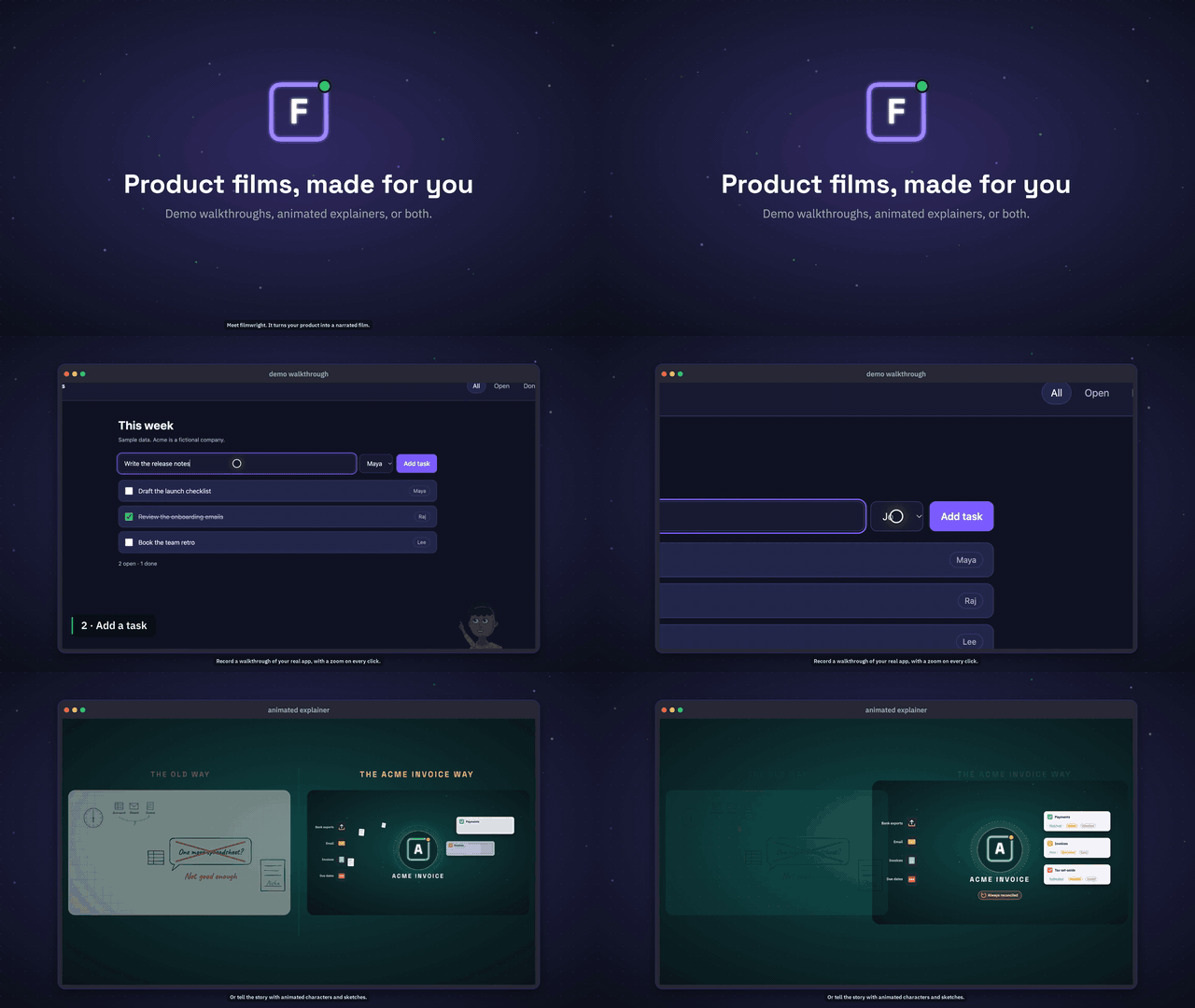
▶ Watch the 30-second sample with sound, made with filmwright itself
(source): narrated by Qwen3-TTS (preset voice ryan) on a Mac, with an upbeat score
from the built-in composer.
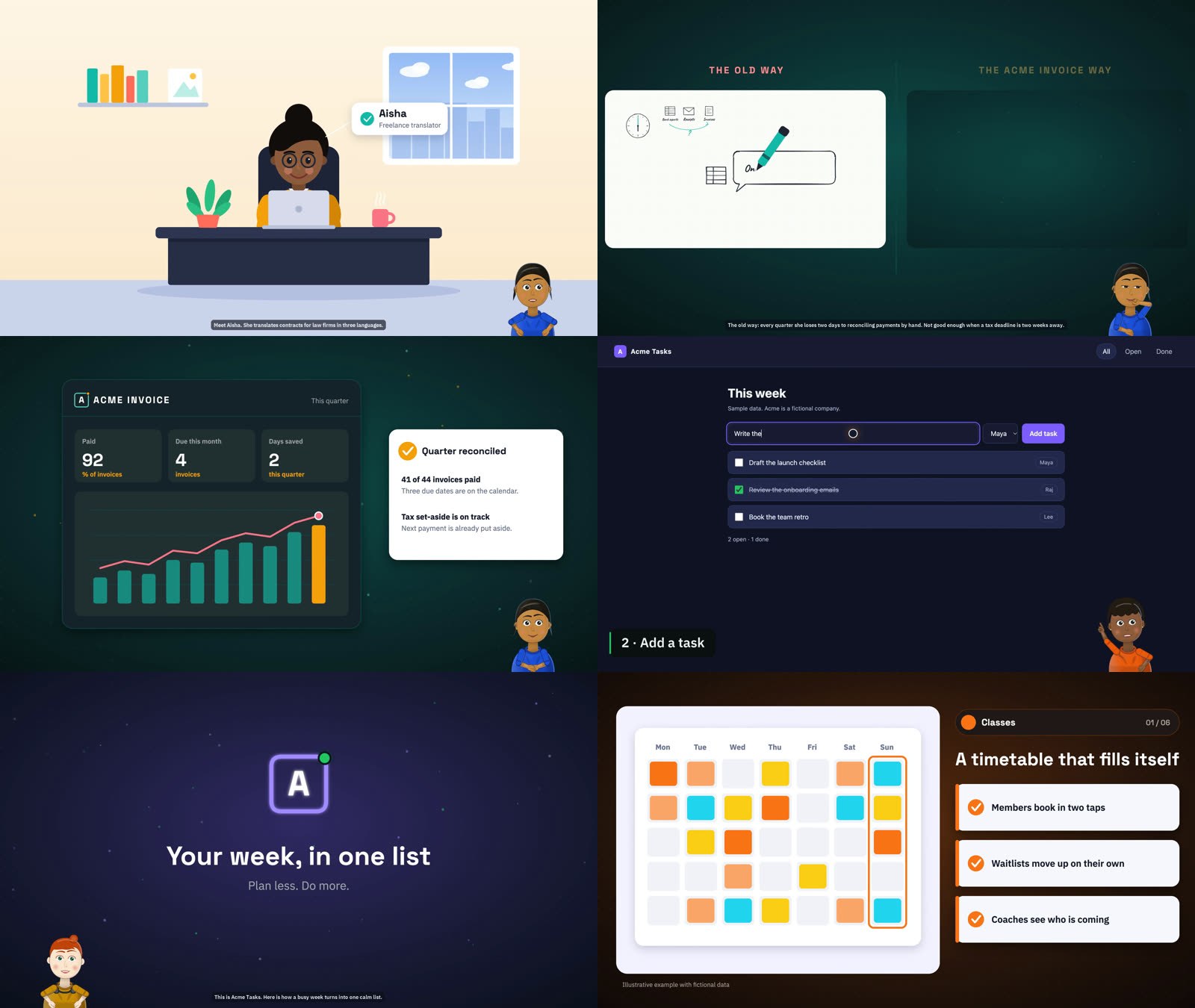
Frames from the bundled examples (fictional Acme products, sample data).
| Demo walkthrough | Animated explainer | Both | |
|---|---|---|---|
| What it shows | Your real app, recorded in a browser | Characters, whiteboard sketches, motion graphics | Animated scenes and recordings in one film |
| Made from | scenarios.yaml (what to click) + video.yaml (what to say) | stories.json (one story per film) or a feature montage | film.yaml (scenes and clips, in order) |
| Camera | Zooms on every real click, typing and scroll | Frame-exact animation, identical on every render | Both |
| Choice | Options |
|---|---|
| Film type | demo, explainer (story or montage), both |
| Narration voice | preset (built-in narrators), described (describe a voice in words), clone (your own voice, with consent), system (works anywhere) |
| Talking head | an animated, lip-synced presenter in the corner, 10 characters, or none |
| Music | original score in a mood: upbeat, calm, corporate, inspiring, playful, epic, sad, suspense, or none; downbeats land on scene changes |
| Captions | small and burned in at the bottom, plus an .srt |
| Outputs | 4k, hd, vertical (9:16), square (1:1), web (720p/480p + WebVTT), gif teaser |
| Disclosure | note the synthetic voice in the file metadata, on an end card, or not at all |
pip install "git+https://github.com/dassjaylabs/filmwright"
filmwright setup             # ffmpeg, open-source Chromium, espeak-ng, Rhubarb Lip Sync
filmwright doctor            # what this machine can run

filmwright new my-film       # answers a few questions, writes my-film/reel.yaml and starter files
filmwright build my-film     # makes the film; files land in my-film/out/final/
filmwright new asks what you're making:
What are you making?
  1. Demo walkthrough: record your real product in a browser, narrated, with zooms on each action (default)
  2. Animated explainer: characters, whiteboard sketches and motion graphics, no screen recording
  3. Both: animated scenes and screen recordings in one narrated film
Narration voice?
  1. Preset voice  2. Described voice  3. Cloned voice  4. System voice
Add an animated talking-head presenter? [y/N]
Music?  upbeat · calm · corporate · inspiring · playful · epic · sad · suspense · none
Outputs (4k, hd, vertical, square, web, gif) [4k,hd]
Every question has a flag, so scripts and CI can skip the prompts:
filmwright new launch-film --mode explainer --format story --voice preset --talking-head no \
  --music inspiring --outputs 4k,hd,square --yes
git clone https://github.com/dassjaylabs/filmwright && cd filmwright
pip install -e .
filmwright build examples/demo-app      # records the bundled sample app "Acme Tasks" and narrates it
filmwright build examples/explainer     # three animated story films
filmwright build examples/montage       # a one-minute feature montage in 16:9, 9:16 and 1:1
python examples/both/make_sample_clip.py && filmwright build examples/both   # animation + a recording
The examples use Acme, a fictional company, and sample data. examples/README.md lists all eight, from a feature montage for a gym app to stories in a cloned voice.
| Voice | Needs | Notes |
|---|---|---|
preset | Apple Silicon, one-time model download (filmwright setup --voice preset) | Built-in narrators such as ryan and aiden; each sentence is checked by transcription and regenerated if garbled |
described | as above (--voice described) | "Warm, unhurried narrator with a gentle British accent" |
clone | as above (--voice clone) and a short recording | Consent required: see below |
system | nothing (espeak-ng) | Robotic, but works on any machine and in CI |
The neural voices are Qwen3-TTS 1.7B, and Whisper large-v3-turbo listens to every sentence it speaks: a garbled, cut-off or runaway take is regenerated before it reaches the film. See models, tools and fallbacks.
On machines without Apple Silicon, preset and described fall back to the system voice with a note; a cloned
voice never falls back silently.
Clone only your own voice, or a voice whose owner has agreed. filmwright records the speaker, has them confirm a consent statement, and stores a consent record tied to the exact recording (its SHA-256). Clone mode refuses to run without a matching record, and there is no setting that skips it.
filmwright voice clone passage                       # text to read aloud
filmwright voice clone record --speaker "Your Name"  # record it, then confirm consent
filmwright voice clone preview --play
For a full desktop voice-cloning app built on the same voice models, see clodio.
There is no LLM inside filmwright. It doesn't write your script, design your scenes or call any AI service. You (or an AI assistant you choose, such as Claude Code with the bundled skill) write the scenarios, stories and narration as plain YAML. filmwright turns them into a film. The only neural networks are the speech models below, and they run on your machine.
| Job | What does it | Model or tool | Size · licence |
|---|---|---|---|
Narration, preset | built-in narrators: ryan, aiden, serena, vivian, dylan, eric, uncle_fu, ono_anna, sohee | Qwen3-TTS 1.7B CustomVoice | 4.2 GB · Apache-2.0 |
Narration, described | turns a sentence ("calm narrator in her thirties") into a voice, renders it once as a reference, then clones that reference so the voice stays the same across the film | Qwen3-TTS 1.7B VoiceDesign + Base | 4.2 GB each · Apache-2.0 |
Voice cloning, clone | speaks in a recorded voice, only with a matching consent record | Qwen3-TTS 1.7B Base | 4.2 GB · Apache-2.0 |
| Read-back check | transcribes every narrated sentence; a garbled, cut-off or runaway take is regenerated with a new seed (up to 3 tries, best kept, failures listed). Also transcribes clone recordings | Whisper large-v3-turbo | 1.6 GB · MIT |
| Runs the speech models | Apple Silicon inference | MLX + mlx-audio (bf16/fp16 conversions by mlx-community) | MIT |
Narration, system | robotic but works anywhere, no download | espeak-ng | GPL-3.0 (separate program) |
| Animation | animated scenes are HTML pages driven by filmwright's own timeline engine, rendered frame by frame, so every run gives the same film | motion.js (filmwright) + rough.js for the hand-drawn look, in Chromium | MIT |
| Characters | 10 presenters and the story characters are drawn as SVG in code, with rigged arms, blinks, nods and gestures. No image model | filmwright | MIT |
| Lip sync | mouth shapes timed to the narration | Rhubarb Lip Sync | MIT |
| Demo recording | drives your web app and records it, with zooms on each action | Playwright + open-source Chromium | Apache-2.0 / BSD |
| Music | an original score per mood (tempo, key, chords, arrangement) with a downbeat on every scene change. No AI music model | filmwright's composer, synthesised with NumPy | MIT |
| Sound effects | clicks, whooshes, risers, impacts | filmwright's synthesiser | MIT |
| Encoding | mixing, loudness, captions, every output format | ffmpeg | LGPL/GPL (separate program) |
The models download once from Hugging Face, and only the ones the chosen voice type needs
(filmwright setup --voice preset|described|clone).
| If... | filmwright... |
|---|---|
| the Mac isn't Apple Silicon, or mlx-audio isn't installed | uses the system voice for preset and described, and says so |
clone can't run, or the consent record is missing or doesn't match the recording | stops with an error. A cloned voice never silently becomes a different voice |
| a sentence never reads back cleanly after 3 tries | keeps the best take and lists the sentence at the end |
| Rhubarb isn't installed | moves the presenter's mouth with the narration's loudness (not true lip sync) |
| there's no open-source Chromium build for the platform | uses Chrome for Testing and reports it as FALLBACK in filmwright doctor |
| you'd rather use your own music | demo films take music: {file: ...} (docs/film.md) |
Why no music model: local music models are gigabytes, often licensed for non-commercial use only, give a different track each run, and can't place a downbeat on an exact cut. The built-in composer has none of those problems and needs no setup (docs/music.md).
Apple M5 Max, macOS 26.5, Python 3.11 and 3.13, mlx 0.32.4, mlx-audio 0.5.9, ffmpeg 8.1, Rhubarb 1.14.0, with
mlx-community/Qwen3-TTS-12Hz-1.7B-{CustomVoice,VoiceDesign,Base}-bf16 and
mlx-community/whisper-large-v3-turbo-asr-fp16. On that machine a sentence takes about 3 seconds to speak and check.
CI runs the test suite and a system-voice build on Ubuntu and macOS (Python 3.11 and 3.12). Full component list:
THIRD_PARTY_LICENSES.md.
disclosure: metadata (the default) writes "Narration uses a synthetic voice" (or "a cloned voice, used with
consent") into each video's metadata. end-card also adds a two-second closing card. none adds nothing. Check
the rules that apply where you publish: some platforms and jurisdictions require disclosing synthetic or
altered media.
reel.yaml) · Install · ArchitectureThis repository is also a Claude Code plugin. Inside Claude Code:
/plugin marketplace add dassjaylabs/filmwright
/plugin install filmwright@filmwright
Then ask for "a demo video of the new settings page" or "three animated explainers for our onboarding". The skill agrees the options with you, writes the scenarios or stories, builds the film and checks it.
filmwright setup installs ffmpeg, espeak-ng, an open-source Chromium and Rhubarb
Lip Sync, and prints any command that needs an admin password for you to run.If filmwright saves you time, a ⭐ on GitHub helps other people find it. Films you made with it, bug reports and ideas are just as welcome in Issues.
Contributions are welcome. See CONTRIBUTING.md and the Code of Conduct; code contributions need a one-time Contributor License Agreement. Report security issues privately (SECURITY.md).
MIT licensed. The filmwright name and logo are not covered by the license (TRADEMARKS.md).
Everything filmwright bundles or installs is open source; see THIRD_PARTY_LICENSES.md. The animation engine (motion.js) is part of this project.
Narrated product films made on your own machine: screen-recorded demo walkthroughs, animated explainers, or both. Preset, described or consented cloned voices, talking-head presenter, mood-matched music.
Python
0
11 commits
updated Oct 15, 2026
Narrated product films, made on your own machine. Record a walkthrough of your web app, make a fully
animated explainer, or cut both into one film, then pick the voice, presenter, music mood and output formats
with a one-page reel.yaml.
Everything runs locally: the browser, the voices, the music, the encoding. Nothing is uploaded.
▶ Watch the 30-second sample with sound, made with filmwright itself
(source): narrated by Qwen3-TTS (preset voice ryan) on a Mac, with an upbeat score
from the built-in composer.
Frames from the bundled examples (fictional Acme products, sample data).
| Demo walkthrough | Animated explainer | Both | |
|---|---|---|---|
| What it shows | Your real app, recorded in a browser | Characters, whiteboard sketches, motion graphics | Animated scenes and recordings in one film |
| Made from | scenarios.yaml (what to click) + video.yaml (what to say) | stories.json (one story per film) or a feature montage | film.yaml (scenes and clips, in order) |
| Camera | Zooms on every real click, typing and scroll | Frame-exact animation, identical on every render | Both |
| Choice | Options |
|---|---|
| Film type | demo, explainer (story or montage), both |
| Narration voice | preset (built-in narrators), described (describe a voice in words), clone (your own voice, with consent), system (works anywhere) |
| Talking head | an animated, lip-synced presenter in the corner, 10 characters, or none |
| Music | original score in a mood: upbeat, calm, corporate, inspiring, playful, epic, sad, suspense, or none; downbeats land on scene changes |
| Captions | small and burned in at the bottom, plus an .srt |
| Outputs | 4k, hd, vertical (9:16), square (1:1), web (720p/480p + WebVTT), gif teaser |
| Disclosure | note the synthetic voice in the file metadata, on an end card, or not at all |
pip install "git+https://github.com/dassjaylabs/filmwright"
filmwright setup             # ffmpeg, open-source Chromium, espeak-ng, Rhubarb Lip Sync
filmwright doctor            # what this machine can run

filmwright new my-film       # answers a few questions, writes my-film/reel.yaml and starter files
filmwright build my-film     # makes the film; files land in my-film/out/final/
filmwright new asks what you're making:
What are you making?
  1. Demo walkthrough: record your real product in a browser, narrated, with zooms on each action (default)
  2. Animated explainer: characters, whiteboard sketches and motion graphics, no screen recording
  3. Both: animated scenes and screen recordings in one narrated film
Narration voice?
  1. Preset voice  2. Described voice  3. Cloned voice  4. System voice
Add an animated talking-head presenter? [y/N]
Music?  upbeat · calm · corporate · inspiring · playful · epic · sad · suspense · none
Outputs (4k, hd, vertical, square, web, gif) [4k,hd]
Every question has a flag, so scripts and CI can skip the prompts:
filmwright new launch-film --mode explainer --format story --voice preset --talking-head no \
  --music inspiring --outputs 4k,hd,square --yes
git clone https://github.com/dassjaylabs/filmwright && cd filmwright
pip install -e .
filmwright build examples/demo-app      # records the bundled sample app "Acme Tasks" and narrates it
filmwright build examples/explainer     # three animated story films
filmwright build examples/montage       # a one-minute feature montage in 16:9, 9:16 and 1:1
python examples/both/make_sample_clip.py && filmwright build examples/both   # animation + a recording
The examples use Acme, a fictional company, and sample data. examples/README.md lists all eight, from a feature montage for a gym app to stories in a cloned voice.
| Voice | Needs | Notes |
|---|---|---|
preset | Apple Silicon, one-time model download (filmwright setup --voice preset) | Built-in narrators such as ryan and aiden; each sentence is checked by transcription and regenerated if garbled |
described | as above (--voice described) | "Warm, unhurried narrator with a gentle British accent" |
clone | as above (--voice clone) and a short recording | Consent required: see below |
system | nothing (espeak-ng) | Robotic, but works on any machine and in CI |
The neural voices are Qwen3-TTS 1.7B, and Whisper large-v3-turbo listens to every sentence it speaks: a garbled, cut-off or runaway take is regenerated before it reaches the film. See models, tools and fallbacks.
On machines without Apple Silicon, preset and described fall back to the system voice with a note; a cloned
voice never falls back silently.
Clone only your own voice, or a voice whose owner has agreed. filmwright records the speaker, has them confirm a consent statement, and stores a consent record tied to the exact recording (its SHA-256). Clone mode refuses to run without a matching record, and there is no setting that skips it.
filmwright voice clone passage                       # text to read aloud
filmwright voice clone record --speaker "Your Name"  # record it, then confirm consent
filmwright voice clone preview --play
For a full desktop voice-cloning app built on the same voice models, see clodio.
There is no LLM inside filmwright. It doesn't write your script, design your scenes or call any AI service. You (or an AI assistant you choose, such as Claude Code with the bundled skill) write the scenarios, stories and narration as plain YAML. filmwright turns them into a film. The only neural networks are the speech models below, and they run on your machine.
| Job | What does it | Model or tool | Size · licence |
|---|---|---|---|
Narration, preset | built-in narrators: ryan, aiden, serena, vivian, dylan, eric, uncle_fu, ono_anna, sohee | Qwen3-TTS 1.7B CustomVoice | 4.2 GB · Apache-2.0 |
Narration, described | turns a sentence ("calm narrator in her thirties") into a voice, renders it once as a reference, then clones that reference so the voice stays the same across the film | Qwen3-TTS 1.7B VoiceDesign + Base | 4.2 GB each · Apache-2.0 |
Voice cloning, clone | speaks in a recorded voice, only with a matching consent record | Qwen3-TTS 1.7B Base | 4.2 GB · Apache-2.0 |
| Read-back check | transcribes every narrated sentence; a garbled, cut-off or runaway take is regenerated with a new seed (up to 3 tries, best kept, failures listed). Also transcribes clone recordings | Whisper large-v3-turbo | 1.6 GB · MIT |
| Runs the speech models | Apple Silicon inference | MLX + mlx-audio (bf16/fp16 conversions by mlx-community) | MIT |
Narration, system | robotic but works anywhere, no download | espeak-ng | GPL-3.0 (separate program) |
| Animation | animated scenes are HTML pages driven by filmwright's own timeline engine, rendered frame by frame, so every run gives the same film | motion.js (filmwright) + rough.js for the hand-drawn look, in Chromium | MIT |
| Characters | 10 presenters and the story characters are drawn as SVG in code, with rigged arms, blinks, nods and gestures. No image model | filmwright | MIT |
| Lip sync | mouth shapes timed to the narration | Rhubarb Lip Sync | MIT |
| Demo recording | drives your web app and records it, with zooms on each action | Playwright + open-source Chromium | Apache-2.0 / BSD |
| Music | an original score per mood (tempo, key, chords, arrangement) with a downbeat on every scene change. No AI music model | filmwright's composer, synthesised with NumPy | MIT |
| Sound effects | clicks, whooshes, risers, impacts | filmwright's synthesiser | MIT |
| Encoding | mixing, loudness, captions, every output format | ffmpeg | LGPL/GPL (separate program) |
The models download once from Hugging Face, and only the ones the chosen voice type needs
(filmwright setup --voice preset|described|clone).
| If... | filmwright... |
|---|---|
| the Mac isn't Apple Silicon, or mlx-audio isn't installed | uses the system voice for preset and described, and says so |
clone can't run, or the consent record is missing or doesn't match the recording | stops with an error. A cloned voice never silently becomes a different voice |
| a sentence never reads back cleanly after 3 tries | keeps the best take and lists the sentence at the end |
| Rhubarb isn't installed | moves the presenter's mouth with the narration's loudness (not true lip sync) |
| there's no open-source Chromium build for the platform | uses Chrome for Testing and reports it as FALLBACK in filmwright doctor |
| you'd rather use your own music | demo films take music: {file: ...} (docs/film.md) |
Why no music model: local music models are gigabytes, often licensed for non-commercial use only, give a different track each run, and can't place a downbeat on an exact cut. The built-in composer has none of those problems and needs no setup (docs/music.md).
Apple M5 Max, macOS 26.5, Python 3.11 and 3.13, mlx 0.32.4, mlx-audio 0.5.9, ffmpeg 8.1, Rhubarb 1.14.0, with
mlx-community/Qwen3-TTS-12Hz-1.7B-{CustomVoice,VoiceDesign,Base}-bf16 and
mlx-community/whisper-large-v3-turbo-asr-fp16. On that machine a sentence takes about 3 seconds to speak and check.
CI runs the test suite and a system-voice build on Ubuntu and macOS (Python 3.11 and 3.12). Full component list:
THIRD_PARTY_LICENSES.md.
disclosure: metadata (the default) writes "Narration uses a synthetic voice" (or "a cloned voice, used with
consent") into each video's metadata. end-card also adds a two-second closing card. none adds nothing. Check
the rules that apply where you publish: some platforms and jurisdictions require disclosing synthetic or
altered media.
reel.yaml) · Install · ArchitectureThis repository is also a Claude Code plugin. Inside Claude Code:
/plugin marketplace add dassjaylabs/filmwright
/plugin install filmwright@filmwright
Then ask for "a demo video of the new settings page" or "three animated explainers for our onboarding". The skill agrees the options with you, writes the scenarios or stories, builds the film and checks it.
filmwright setup installs ffmpeg, espeak-ng, an open-source Chromium and Rhubarb
Lip Sync, and prints any command that needs an admin password for you to run.If filmwright saves you time, a ⭐ on GitHub helps other people find it. Films you made with it, bug reports and ideas are just as welcome in Issues.
Contributions are welcome. See CONTRIBUTING.md and the Code of Conduct; code contributions need a one-time Contributor License Agreement. Report security issues privately (SECURITY.md).
MIT licensed. The filmwright name and logo are not covered by the license (TRADEMARKS.md).
Everything filmwright bundles or installs is open source; see THIRD_PARTY_LICENSES.md. The animation engine (motion.js) is part of this project.



