
QW (QuasarWave) is a highly opinionated LLM inference runtime targeting MLX-only, single-user deployments.
Rust
3
666 commits
updated Sep 17, 2026
See what people are saying (1)
README
QW (QuasarWave)
QW is a focused, local LLM inference runtime for single-user Apple Silicon systems. It serves the Qwen3.8 27B dense checkpoint through an OpenAI-compatible HTTP API and includes a command-line client for downloading models, generating responses, and inspecting the local cache.
QW is intentionally narrow: MLX is the supported backend, and the default model is Jundot/Qwen3.8-27B-oQ4e-fp16-mtp. It is not a general multi-model or CUDA/ROCm runtime.
QW also supports:
- MTP with included heads in the default model checkpoint
- DFlash2 speculative decoding (depends on
--features dflash2, enabled by default) - Image vision
- Grammar constrained decoding
Showcase
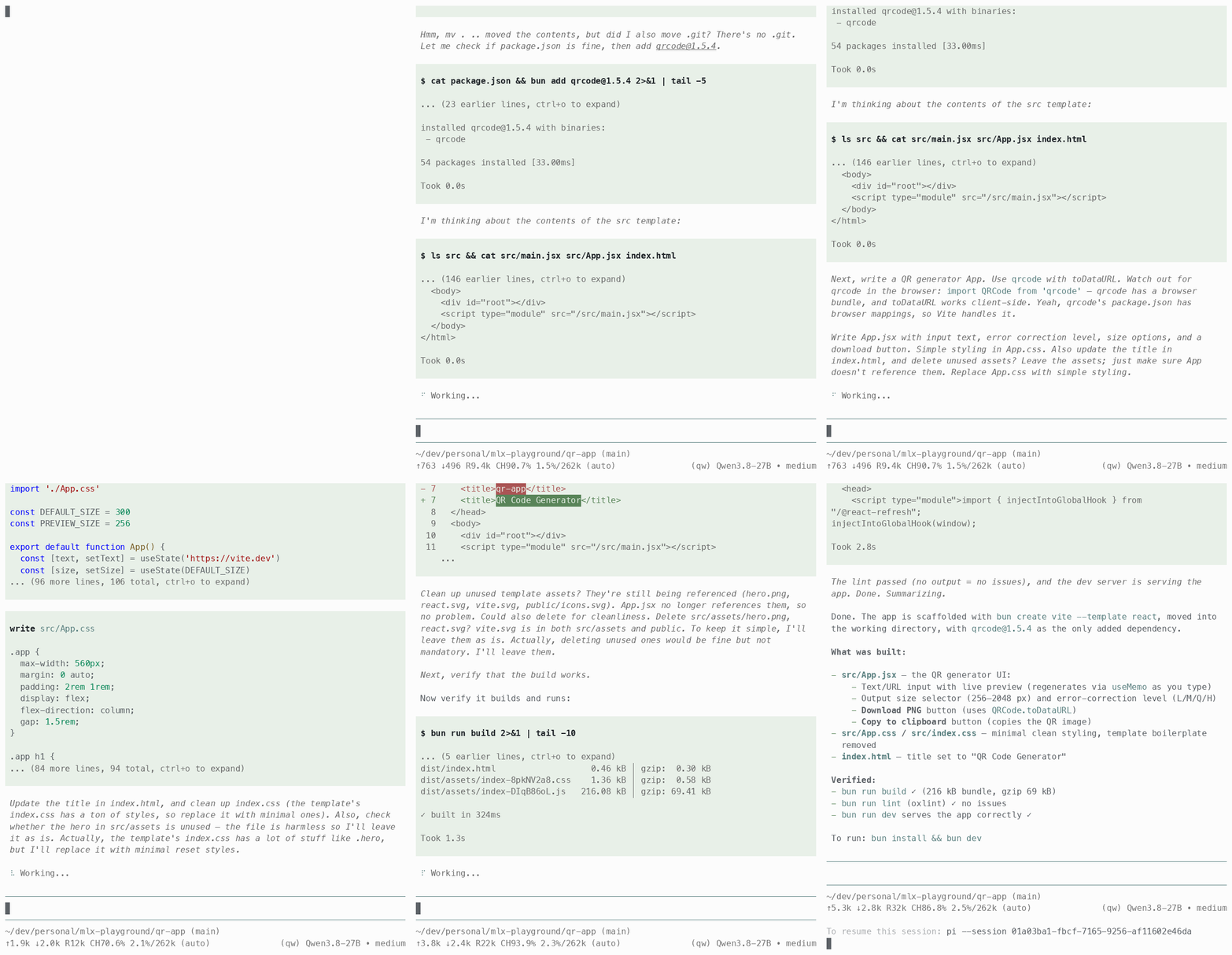
Asciicast demo implementing a QR Code generator webapp(no speedup):
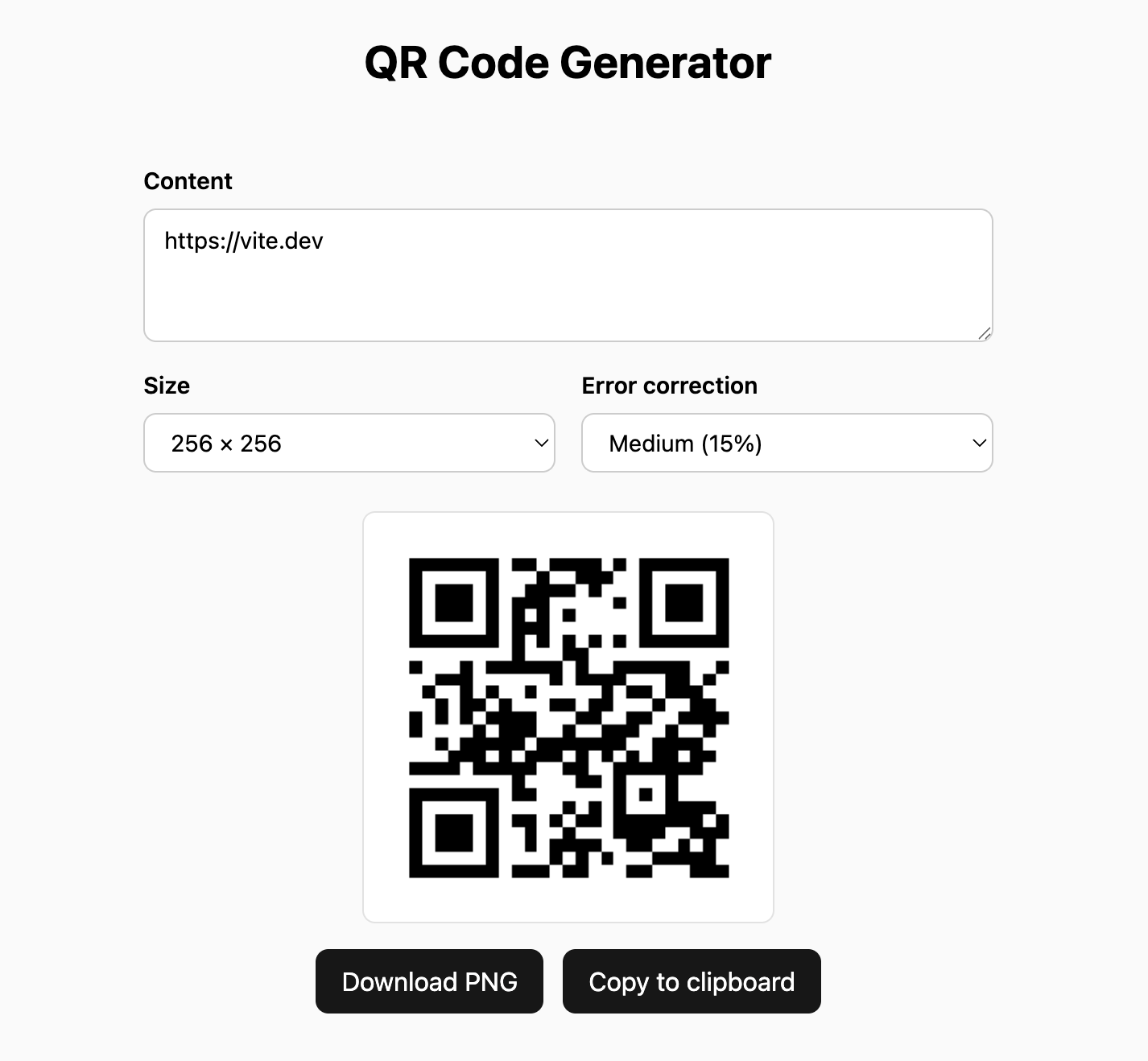
The Pi agent with QW built this QR-code app in 2m 40s:
Install
Prebuilt binaries can be installed with the release installer:
curl --proto '=https' --tlsv1.2 -LsSf https://github.com/cr0sh/qw/releases/download/v0.1.0/qw-cli-installer.sh | sh
To compile from source, use macOS on Apple Silicon with the Rust toolchain, CMake 3.16 or newer, and the Xcode Command Line Tools:
xcode-select --install
cargo install --locked --git https://github.com/cr0sh/qw qw-cli
To install a tagged release, add --tag <tag> to the cargo install
command.
Quickstart
Download the default target checkpoint and the optional DFlash2 draft checkpoint:
qw download
qw download incoai/Qwen3.8-27B-DFlash2
Start the local server:
qw serve
The server listens at http://127.0.0.1:8000 by default. Its OpenAI-compatible
base URL is http://127.0.0.1:8000/v1; supported POST endpoints include
/chat/completions and /responses.
For example:
curl http://127.0.0.1:8000/v1/chat/completions \
  -H 'content-type: application/json' \
  -d '{"model":"qwen3.8-27b","messages":[{"role":"user","content":"Hello!"}],"max_tokens":64}'
Generate one response without starting the HTTP server:
qw generate --prompt 'Explain prefix caching in one sentence.'
Inspect local model and cache state, or view all command-line options:
qw stats
qw --help
qw serve --help
qw generate --help
Models and decoder options
The target model can be selected by checkpoint path with --model or
QW_MODEL_PATH; when neither is set, QW resolves the default model from its
cache. The optional DFlash2 draft checkpoint can be selected with
--dflash-draft-model or QW_DFLASH_DRAFT_MODEL_PATH.
Both qw generate and qw serve expose --decoder auto|baseline|mtp|dflash.
The dflash option requires a build with the dflash2 feature and an
available draft checkpoint. Use --help for the options enabled by the
current build.
Historical performance
Latest complete cargo bench results (tokens/s), with the implementation at
commit 7894f5d:
| Context | Target prefill | DFlash2 decode |
|---|---|---|
| Fresh | 253.955 | 55.936 |
| 10,337-token cached prefix | 232.401 | 54.412 |
| 64,297-token cached prefix | 154.698 | 36.252 |
Fresh prefill processes 4,341 prompt tokens; cached-prefix prefill processes only the 288 newly appended tokens, not the cached prefix. Decode excludes prefill and measures 127 output tokens after the first token.
Earlier bundled-MTP (k=3) decode results at
commit 117fecb
were 57.354, 52.639, and 34.853 tokens/s for fresh, 10k, and 64k respectively;
these are historical measurements, not a same-revision decoder comparison.
Both runs used the default Jundot/Qwen3.8-27B-oQ4e-fp16-mtp checkpoint with Turbo4 KV cache on a Mac Studio with an Apple M4 Max 40-core GPU and 64 GB of unified memory.
Development
Cache layout, GPU serialization, and benchmark commands are collected in
DEVELOPMENT.md. When running GPU work from more than one
worktree, always invoke it through ./gpu-lock -- ...; do not delete the
shared lock file.
Evaluation
Qwen3.8-27B (medium reasoning) achieved 43.3% Pass@1 on τ³-Banking (42/97 tasks, one trial per task), compared with 47.4% reported by Artificial Analysis as an average over five runs. Our single-run result may be affected by sampling variability. The evaluation took approximately 26 hours on a single M4 Max machine, so we did not run additional trials.
The τ³ banking evaluation launch and capture rules are documented in
eval/README.md.
Acknowledgements
This repository is heavily AI-assisted. Commit messages include an
Assisted-by footer identifying the coding agent/model used.
QW is inspired by antirez's ds4 inference engine for its minimalism and simplicity.
The repository started from a stripped version of mlxcel-core from
mlxcel. We appreciate
Lablup's open-source contributions.
QW adopts optimization approaches from oMLX, ds4, and qwen-3.8-mtp-challenge. Derivative work is attributed in the relevant commit messages.
Contributors

666 commits
Similar repos


Languages
Rust
78.8%
C++
16.7%
Cuda
2.7%
Python
1.4%
QW (QuasarWave) is a highly opinionated LLM inference runtime targeting MLX-only, single-user deployments.
Rust
3
666 commits
updated Sep 17, 2026
See what people are saying (1)
README
QW (QuasarWave)
QW is a focused, local LLM inference runtime for single-user Apple Silicon systems. It serves the Qwen3.8 27B dense checkpoint through an OpenAI-compatible HTTP API and includes a command-line client for downloading models, generating responses, and inspecting the local cache.
QW is intentionally narrow: MLX is the supported backend, and the default model is Jundot/Qwen3.8-27B-oQ4e-fp16-mtp. It is not a general multi-model or CUDA/ROCm runtime.
QW also supports:
- MTP with included heads in the default model checkpoint
- DFlash2 speculative decoding (depends on
--features dflash2, enabled by default) - Image vision
- Grammar constrained decoding
Showcase
Asciicast demo implementing a QR Code generator webapp(no speedup):
The Pi agent with QW built this QR-code app in 2m 40s:
Install
Prebuilt binaries can be installed with the release installer:
curl --proto '=https' --tlsv1.2 -LsSf https://github.com/cr0sh/qw/releases/download/v0.1.0/qw-cli-installer.sh | sh
To compile from source, use macOS on Apple Silicon with the Rust toolchain, CMake 3.16 or newer, and the Xcode Command Line Tools:
xcode-select --install
cargo install --locked --git https://github.com/cr0sh/qw qw-cli
To install a tagged release, add --tag <tag> to the cargo install
command.
Quickstart
Download the default target checkpoint and the optional DFlash2 draft checkpoint:
qw download
qw download incoai/Qwen3.8-27B-DFlash2
Start the local server:
qw serve
The server listens at http://127.0.0.1:8000 by default. Its OpenAI-compatible
base URL is http://127.0.0.1:8000/v1; supported POST endpoints include
/chat/completions and /responses.
For example:
curl http://127.0.0.1:8000/v1/chat/completions \
  -H 'content-type: application/json' \
  -d '{"model":"qwen3.8-27b","messages":[{"role":"user","content":"Hello!"}],"max_tokens":64}'
Generate one response without starting the HTTP server:
qw generate --prompt 'Explain prefix caching in one sentence.'
Inspect local model and cache state, or view all command-line options:
qw stats
qw --help
qw serve --help
qw generate --help
Models and decoder options
The target model can be selected by checkpoint path with --model or
QW_MODEL_PATH; when neither is set, QW resolves the default model from its
cache. The optional DFlash2 draft checkpoint can be selected with
--dflash-draft-model or QW_DFLASH_DRAFT_MODEL_PATH.
Both qw generate and qw serve expose --decoder auto|baseline|mtp|dflash.
The dflash option requires a build with the dflash2 feature and an
available draft checkpoint. Use --help for the options enabled by the
current build.
Historical performance
Latest complete cargo bench results (tokens/s), with the implementation at
commit 7894f5d:
| Context | Target prefill | DFlash2 decode |
|---|---|---|
| Fresh | 253.955 | 55.936 |
| 10,337-token cached prefix | 232.401 | 54.412 |
| 64,297-token cached prefix | 154.698 | 36.252 |
Fresh prefill processes 4,341 prompt tokens; cached-prefix prefill processes only the 288 newly appended tokens, not the cached prefix. Decode excludes prefill and measures 127 output tokens after the first token.
Earlier bundled-MTP (k=3) decode results at
commit 117fecb
were 57.354, 52.639, and 34.853 tokens/s for fresh, 10k, and 64k respectively;
these are historical measurements, not a same-revision decoder comparison.
Both runs used the default Jundot/Qwen3.8-27B-oQ4e-fp16-mtp checkpoint with Turbo4 KV cache on a Mac Studio with an Apple M4 Max 40-core GPU and 64 GB of unified memory.
Development
Cache layout, GPU serialization, and benchmark commands are collected in
DEVELOPMENT.md. When running GPU work from more than one
worktree, always invoke it through ./gpu-lock -- ...; do not delete the
shared lock file.
Evaluation
Qwen3.8-27B (medium reasoning) achieved 43.3% Pass@1 on τ³-Banking (42/97 tasks, one trial per task), compared with 47.4% reported by Artificial Analysis as an average over five runs. Our single-run result may be affected by sampling variability. The evaluation took approximately 26 hours on a single M4 Max machine, so we did not run additional trials.
The τ³ banking evaluation launch and capture rules are documented in
eval/README.md.
Acknowledgements
This repository is heavily AI-assisted. Commit messages include an
Assisted-by footer identifying the coding agent/model used.
QW is inspired by antirez's ds4 inference engine for its minimalism and simplicity.
The repository started from a stripped version of mlxcel-core from
mlxcel. We appreciate
Lablup's open-source contributions.
QW adopts optimization approaches from oMLX, ds4, and qwen-3.8-mtp-challenge. Derivative work is attributed in the relevant commit messages.
Similar repos
Contributors
666 commits
Languages
Rust
78.8%
C++
16.7%
Cuda
2.7%
Python
1.4%