Neural Networks with low bit weights on low end 32 bit microcontrollers such as the CH32V003 RISC-V Microcontroller and others
C
345
195 commits
updated Sep 13, 2026
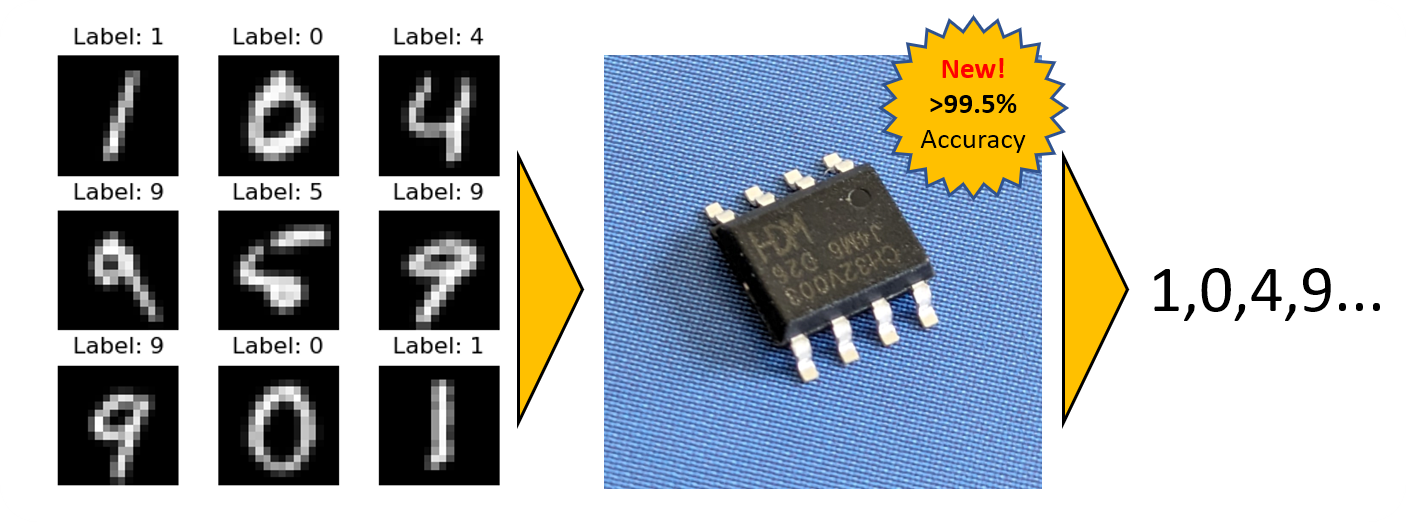
BitNetMCU is a project focused on the training and inference of low-bit quantized neural networks, specifically designed to run efficiently on low-end microcontrollers like the CH32V003. Quantization aware training (QAT) and fine-tuning of model structure and inference code allowed surpassing 99% Test accuracy on a 16x16 MNIST dataset without using multiplication instructions and in only 2kb of RAM and 16kb of Flash.
Update Introducing a new model architecture based on deep separable convolutions allowed to push the accuracy even further to 99.55% accuracy, meeting state-of-the-art MNIST accuracy for CNNs while still fitting into the same memory constraints. This model requires a hardware multiplier, which is available in many low-end RISC-V and ARM Cortex-M0 microcontrollers.
The training pipeline is based on PyTorch and should run anywhere. The inference engine is implemented in Ansi-C and can be easily ported to any Microcontroller.
You can my buildlogs on the project in the docs/ directory here and CNN details here. Latest update on optimize fc here.
Also see BitNetMCU blog articles
BitNetMCU/
│
├── docs/                      # Report
├── mcu/                       # MCU specific code for CH32V003
├── modeldata/                 # Pre-trained models
│
├── BitNetMCU.py               # Pytorch model and QAT classes
├── BitNetMCU_inference.c      # C code for inference
├── BitNetMCU_inference.h      # Header file for C inference code
├── BitNetMCU_MNIST_test.c     # Test script for MNIST dataset
├── BitNetMCU_MNIST_test_data.h# MNIST test data in header format (generated)
├── BitNetMCU_model.h          # Model data in C header format (generated)
├── exportquant.py             # Script to convert trained model to quantized format
├── test_inference.py          # Script to test C implementation of inference
├── training.py                # Training script for the neural network
└── trainingparameters.yaml    # Configuration file for training parameters
The data pipeline is split into several Python scripts for flexibility:
Configuration: Modify trainingparameters.yaml to set all hyperparameters for training the model.
Training the Model: The training.py script is used to train the model and store the weights as a .pth file in the modeldata/ folder. The model weights are still in float format at this stage, as they are quantized on-the-fly during training.
Exporting the Quantized Model: The exportquant.py script is used to convert the model into a quantized format. The quantized model weights are exported to the C header file BitNetMCU_model.h.
Optional: Testing the C-Model: Compile and execute BitNetMCU_MNIST_test.c to test inference of ten digits. The model data is included from BitNetMCU_MNIST_test_data.h, and the test data is included from the BitNetMCU_MNIST_test_data.h file.
Optional: Verification C vs Python Model on full dataset: The inference code, along with the model data, is compiled into a DLL. The test-inference.py script calls the DLL and compares the results with the original Python model. This allows for an accurate comparison to the entire MNIST test data set of 10,000 images.
Optional: Testing inference on the MCU: follow the instructions in mcu/readme.md. Porting to architectures other than CH32V003 is straightforward and the files in the mcu directory can serve as a reference.
quantscale as a hyperparameter to influence weight scaling. Updated documentation on new quantization schemes.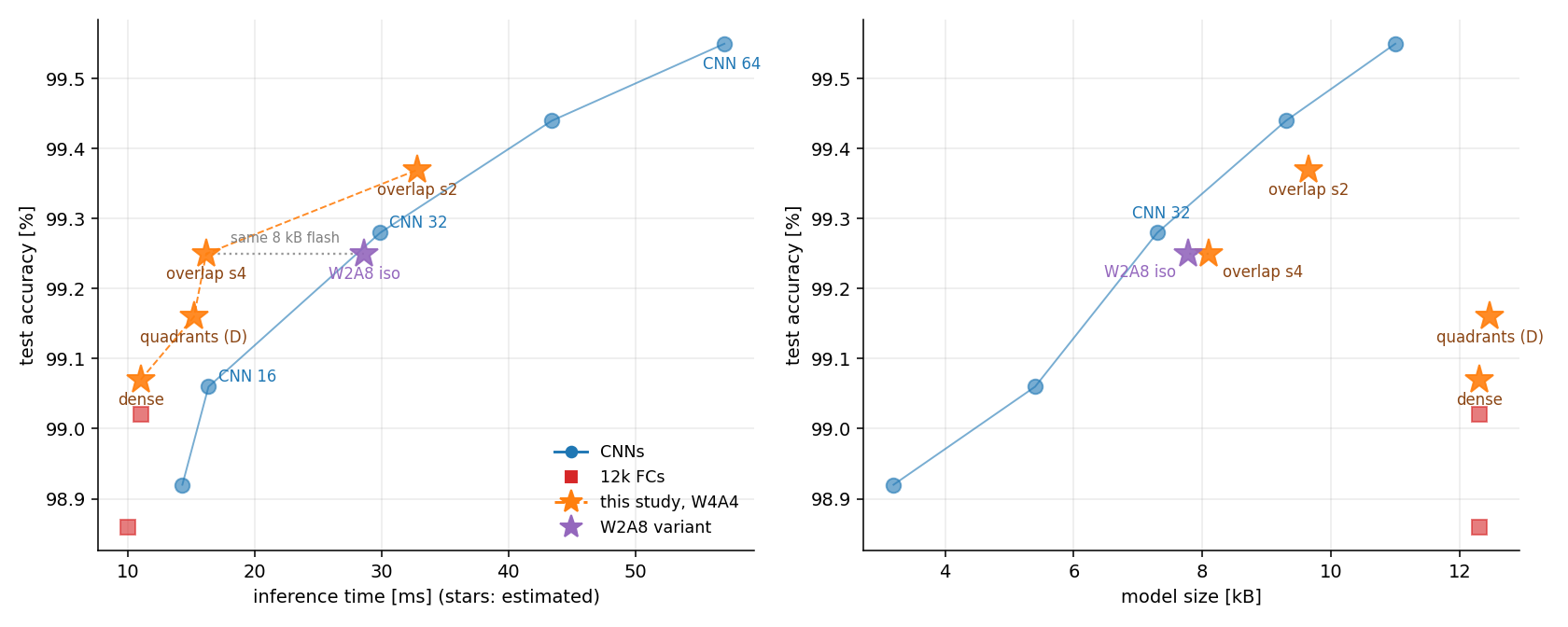
24 followers · starred Jul 2024
8 followers · starred Jul 2024
791 followers · starred Apr 2024
29 followers · starred Apr 2024
Neural Networks with low bit weights on low end 32 bit microcontrollers such as the CH32V003 RISC-V Microcontroller and others
C
345
195 commits
updated Sep 13, 2026
BitNetMCU is a project focused on the training and inference of low-bit quantized neural networks, specifically designed to run efficiently on low-end microcontrollers like the CH32V003. Quantization aware training (QAT) and fine-tuning of model structure and inference code allowed surpassing 99% Test accuracy on a 16x16 MNIST dataset without using multiplication instructions and in only 2kb of RAM and 16kb of Flash.
Update Introducing a new model architecture based on deep separable convolutions allowed to push the accuracy even further to 99.55% accuracy, meeting state-of-the-art MNIST accuracy for CNNs while still fitting into the same memory constraints. This model requires a hardware multiplier, which is available in many low-end RISC-V and ARM Cortex-M0 microcontrollers.
The training pipeline is based on PyTorch and should run anywhere. The inference engine is implemented in Ansi-C and can be easily ported to any Microcontroller.
You can my buildlogs on the project in the docs/ directory here and CNN details here. Latest update on optimize fc here.
Also see BitNetMCU blog articles
BitNetMCU/
│
├── docs/                      # Report
├── mcu/                       # MCU specific code for CH32V003
├── modeldata/                 # Pre-trained models
│
├── BitNetMCU.py               # Pytorch model and QAT classes
├── BitNetMCU_inference.c      # C code for inference
├── BitNetMCU_inference.h      # Header file for C inference code
├── BitNetMCU_MNIST_test.c     # Test script for MNIST dataset
├── BitNetMCU_MNIST_test_data.h# MNIST test data in header format (generated)
├── BitNetMCU_model.h          # Model data in C header format (generated)
├── exportquant.py             # Script to convert trained model to quantized format
├── test_inference.py          # Script to test C implementation of inference
├── training.py                # Training script for the neural network
└── trainingparameters.yaml    # Configuration file for training parameters
The data pipeline is split into several Python scripts for flexibility:
Configuration: Modify trainingparameters.yaml to set all hyperparameters for training the model.
Training the Model: The training.py script is used to train the model and store the weights as a .pth file in the modeldata/ folder. The model weights are still in float format at this stage, as they are quantized on-the-fly during training.
Exporting the Quantized Model: The exportquant.py script is used to convert the model into a quantized format. The quantized model weights are exported to the C header file BitNetMCU_model.h.
Optional: Testing the C-Model: Compile and execute BitNetMCU_MNIST_test.c to test inference of ten digits. The model data is included from BitNetMCU_MNIST_test_data.h, and the test data is included from the BitNetMCU_MNIST_test_data.h file.
Optional: Verification C vs Python Model on full dataset: The inference code, along with the model data, is compiled into a DLL. The test-inference.py script calls the DLL and compares the results with the original Python model. This allows for an accurate comparison to the entire MNIST test data set of 10,000 images.
Optional: Testing inference on the MCU: follow the instructions in mcu/readme.md. Porting to architectures other than CH32V003 is straightforward and the files in the mcu directory can serve as a reference.
quantscale as a hyperparameter to influence weight scaling. Updated documentation on new quantization schemes.
24 followers · starred Jul 2024
8 followers · starred Jul 2024
791 followers · starred Apr 2024
29 followers · starred Apr 2024



