an open-source alternative to the dots, bots and muses of the world, run an office of claude code/codex like agents on your laptop, sandboxes or anywhere, uses your existing subscriptions
See the code


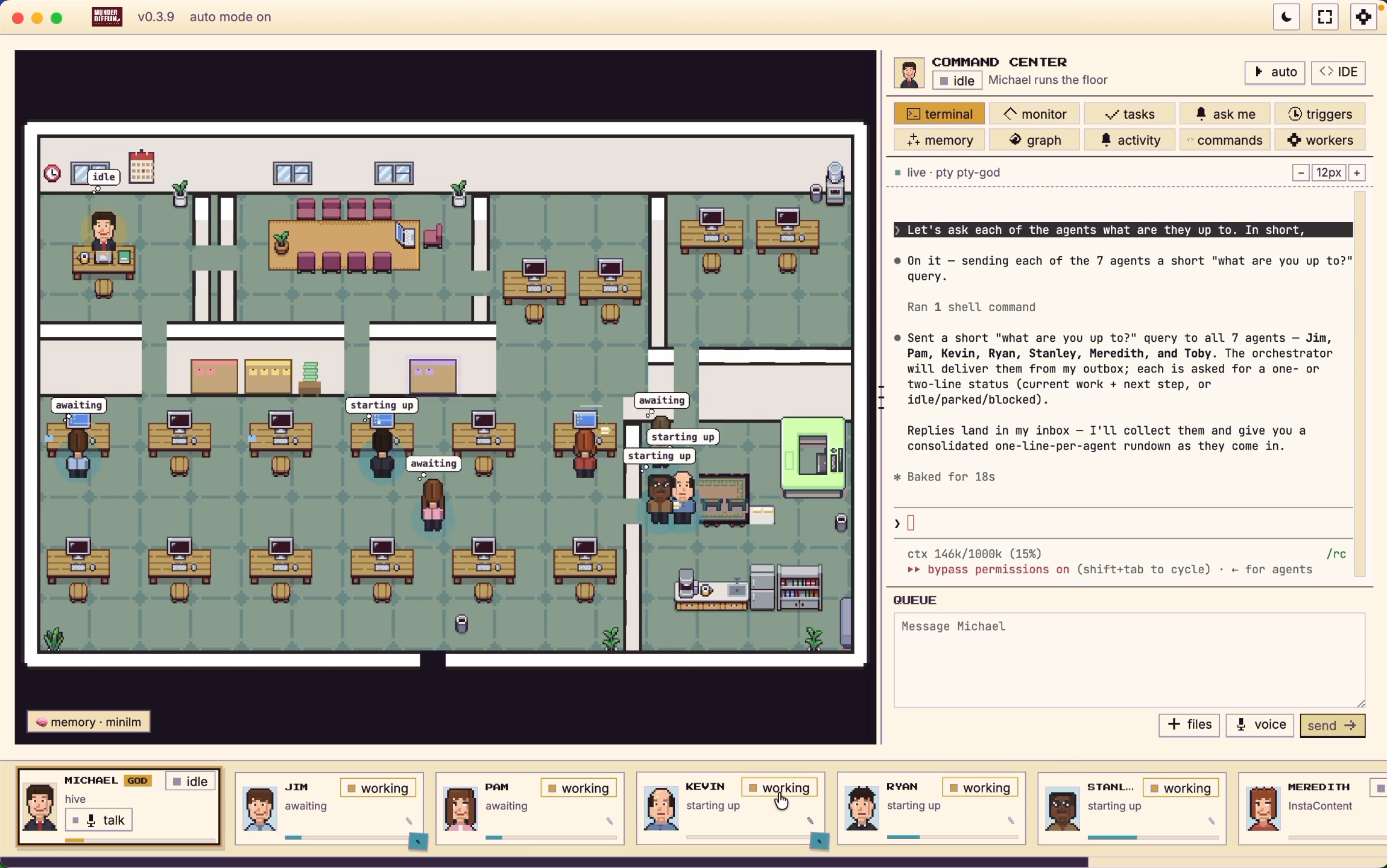
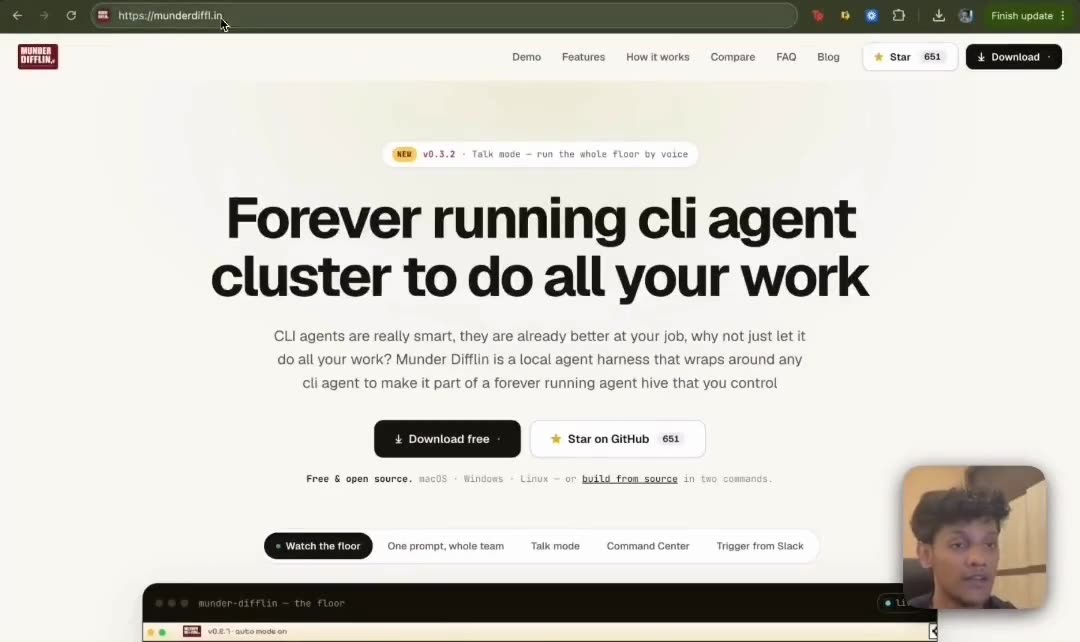
Free, open source and performant. A multi-agent harness that works with the subscriptions you already pay for, on their hourly limits. It turns the terminal coding CLI you already run into a clone of you, one that keeps working while you're away and coordinates a whole office of agents on your own machine.
Wraps Claude Code, Antigravity (Gemini), OpenAI Codex, xAI Grok, Kimi Code, Gemini CLI, Qwen, OpenCode, Crush, pi.dev, GitHub Copilot CLI, and Cursor, with bring-your-own keys and local LLMs. Agents that message, route, and remember, coordinated by your clone (Michael) and visualized as avatars at work on a shared office floor.
Electron · React · TypeScript · Pixi.js · xterm.js · node-pty







⬇ Download 0.5.3 for macOS, Windows or Linux
macOS builds are signed and notarized. You do not need to build from source to use it. The open source build is on the GitHub releases page.
Cancel your Granola and Wispr Flow subscriptions. 0.5.3 dictates into any app and transcribes your meetings, all running locally.
Launch offer: the Pro annual plan for $150 USD, adjusted for purchasing power in different countries and as low as $100 a year. Get Pro
[!NOTE] The world's best agents. The world's worst paper company. Munder Difflin takes the terminal-agent CLIs you already run (
claude,agy,codex,grok,kimi,qwen,opencode,crush,pi, andcopilot) and turns them into a self-coordinating team: each agent gets long-term memory, a mailbox, and a desk on a 2D office floor, and your clone (Michael) routes work between them while you watch. He's the boss of the floor; you're still the boss of him.
Bring the CLI you already pay for. Every one of these runs as a real process in its own terminal, with your existing subscription and its hourly limits. If it runs in a terminal, it can run here.
Claude Code Codex · GPT Grok · xAI Kimi Code Gemini CLI Antigravity · Gemini Qwen OpenCode Crush · Charm Pi GitHub Copilot Cursor + any custom command
Plus bring your own keys and local models through Ollama, LM Studio or vLLM.
Munder Difflin is a desktop app that wraps real terminal-agent CLIs as fully-capable agents, wires them into a hive mind, and puts your clone in charge. Michael is the one agent you talk to in order to get things done. Under the hood it runs the fastest memory layer in the world so every agent remembers what it learns and recalls it instantly.
claude, agy, codex, grok, kimi, qwen, opencode, crush, pi, copilot, or custom session runs as a real
process in a pseudo-terminal (node-pty), byte-for-byte authentic, rendered with xterm.js. you ── talk to ──► ┌─────────────┐
│ GOD agent │ orchestrator / supervisor
│ (Michael's │ roster · routing · adjudication
│ office) │ blackboard · task ledger
└──────┬──────┘
│ assigns · routes · escalates
┌────────────────────────┼────────────────────────┐
▼ ▼ ▼
┌───────────┐ ┌───────────┐ ┌───────────┐
│ agent A │ message │ agent B │ message │ agent C │
│ provider │ ─────────► │ provider │ ─────────► │ provider │
│ + memory │ │ + memory │ │ + memory │
└───────────┘ └───────────┘ └───────────┘
└──────── shared hive: memory · mailbox · blackboard · log ───────┘
claude, agy, codex, or custom)
with its own working directory, identity, and provider-specific lifecycle.outbox/; the harness's router delivers into recipients' inbox/. No agent ever touches git
(single-committer design avoids index.lock corruption).See HIVE.md for the full multi-agent design, SPEC.md for the
terminal/event plane, and DESIGN.md for the visual system.
Cancel your Granola and Wispr Flow subscriptionsDictate into any app. Hold Option on the Mac, or Control+Alt+Space on Windows and Linux (X11), talk, and let go. The words land in whatever field is in front of you, and in every text box inside Munder Difflin. The message box mic works in the free build too. Meetings hear both sides, in Stapler, part of Pro. Your microphone is written as You and the call's audio as Them, on Mac, Windows and Linux. Shift+Command+Space starts and stops a meeting on the Mac, Control+Shift+Space on Windows and Linux. Correct the transcript, add a description, and send it to any of your agents. Transcription on your machine. A Whisper model ships inside the app and is the default engine. A larger model is one download away, Apple's on device recogniser works on macOS 26, and Groq stays off unless you add a key. 126 built in technical names plus your own words. English for now. 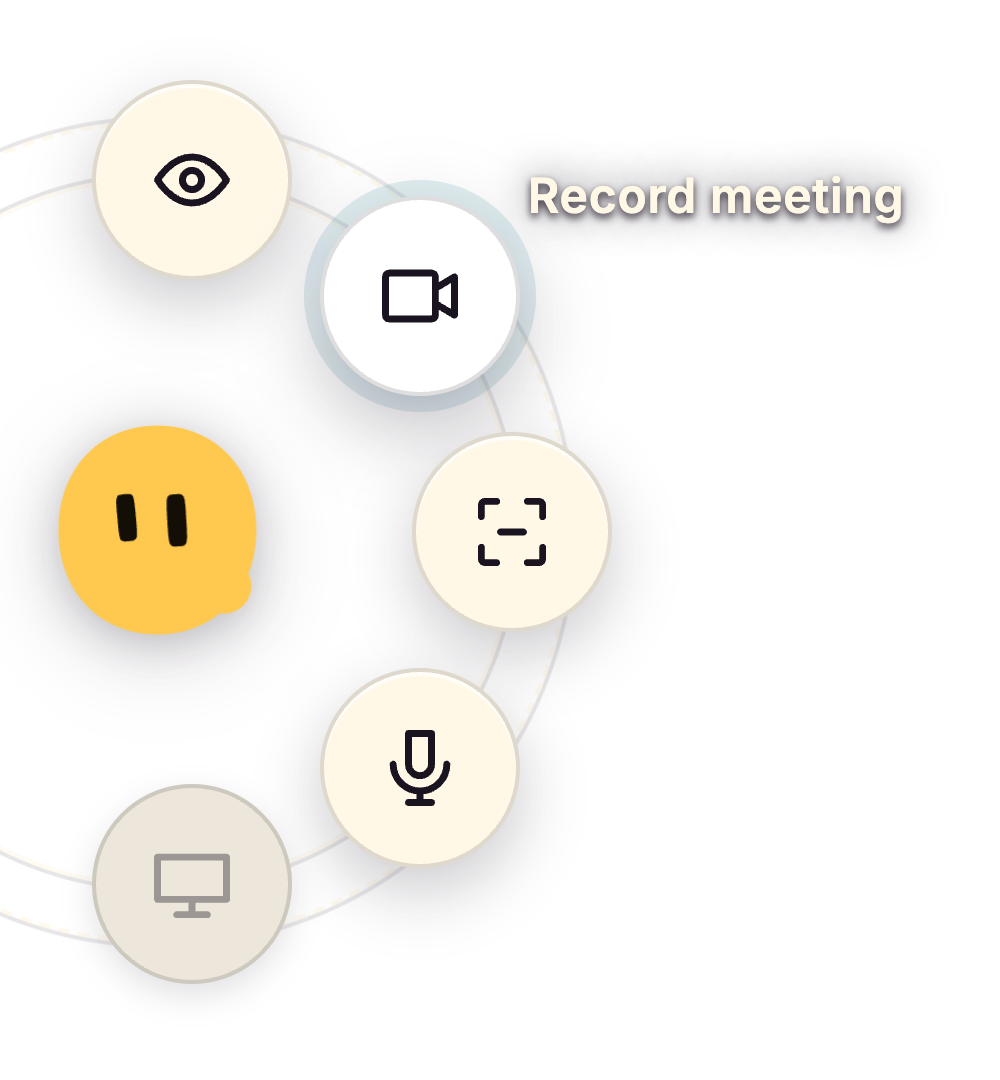
|
One row per agent, and it tells you everythingClassic, the free skin, gets the new agent cards: status, engine, model, a context gauge, the ticket it is on and the action it is taking right now, a crash strip instead of a silent terminal, and a right click menu for the common jobs. Pro gets the new sidebar: Tasks, Inbox, Automations, Memory, Capabilities and the Stapler at the top, agents grouped under their projects, a live line per agent, Asked you on the row when an agent has a question, notes you can search, and Keep my agent order to drag agents and projects where you want them. Drag the sidebar's edge to make it wider, hover a ticket for its details, or switch to agents and notes only. |
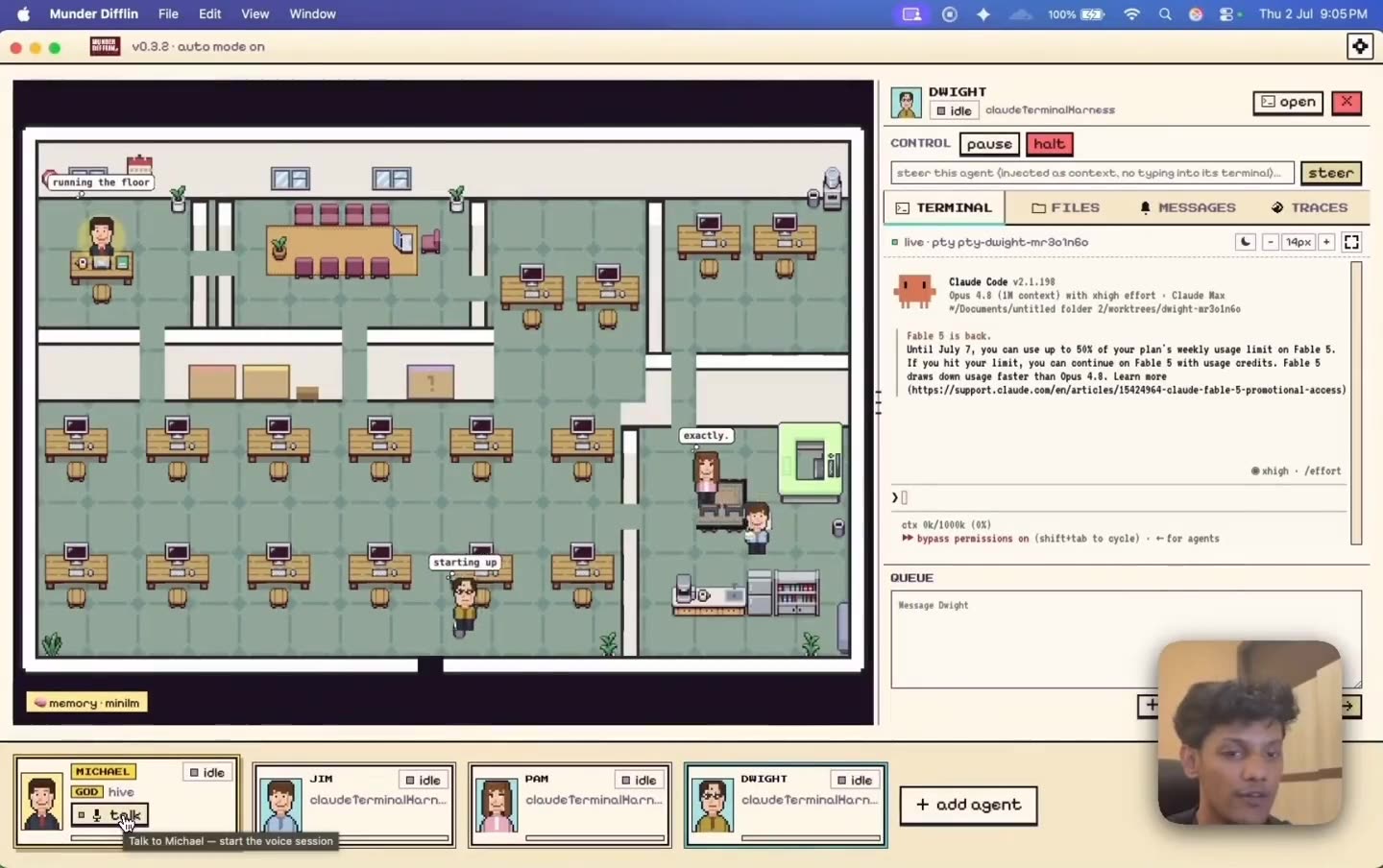
Talk to one agent, not twelveMichael is your clone and the only agent you brief. He assigns the work, routes the traffic, and escalates the few things that actually need you. |
|
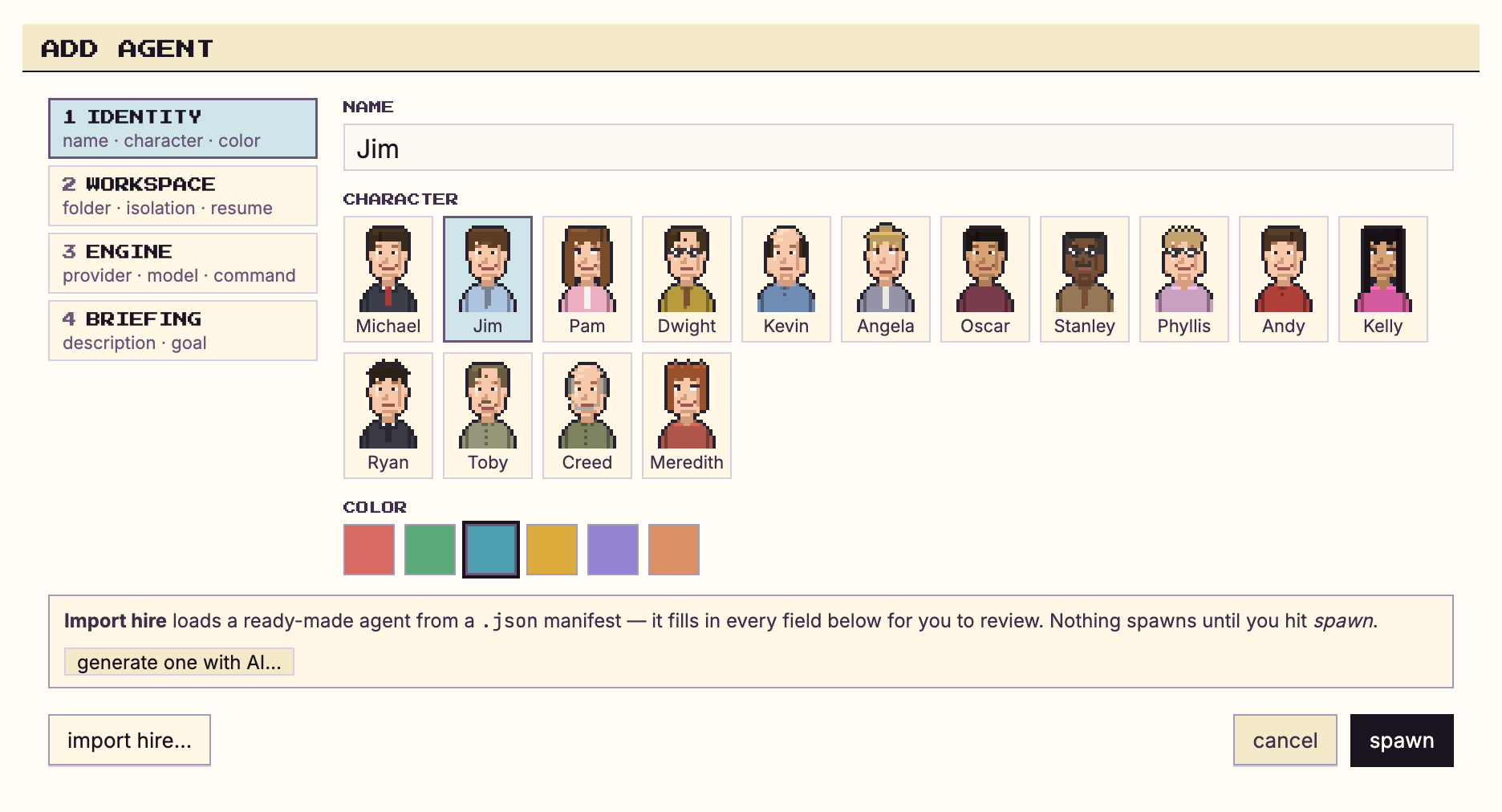
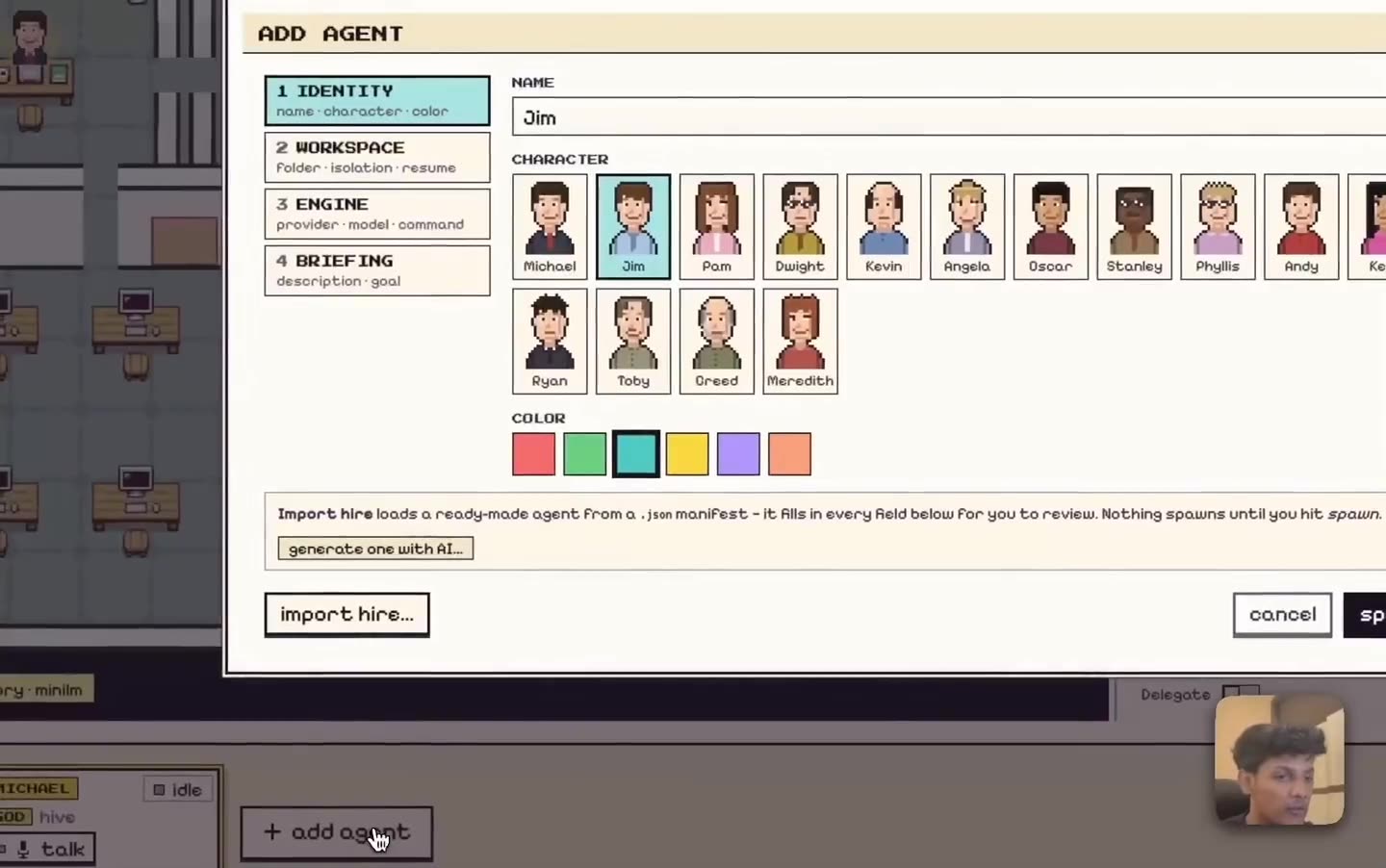
Hire an agent in a few clicksPick the CLI, the model and the autonomy, give it a desk, and it starts working. Import a ready made role from the Agent Gallery if you would rather not start from scratch. |
|
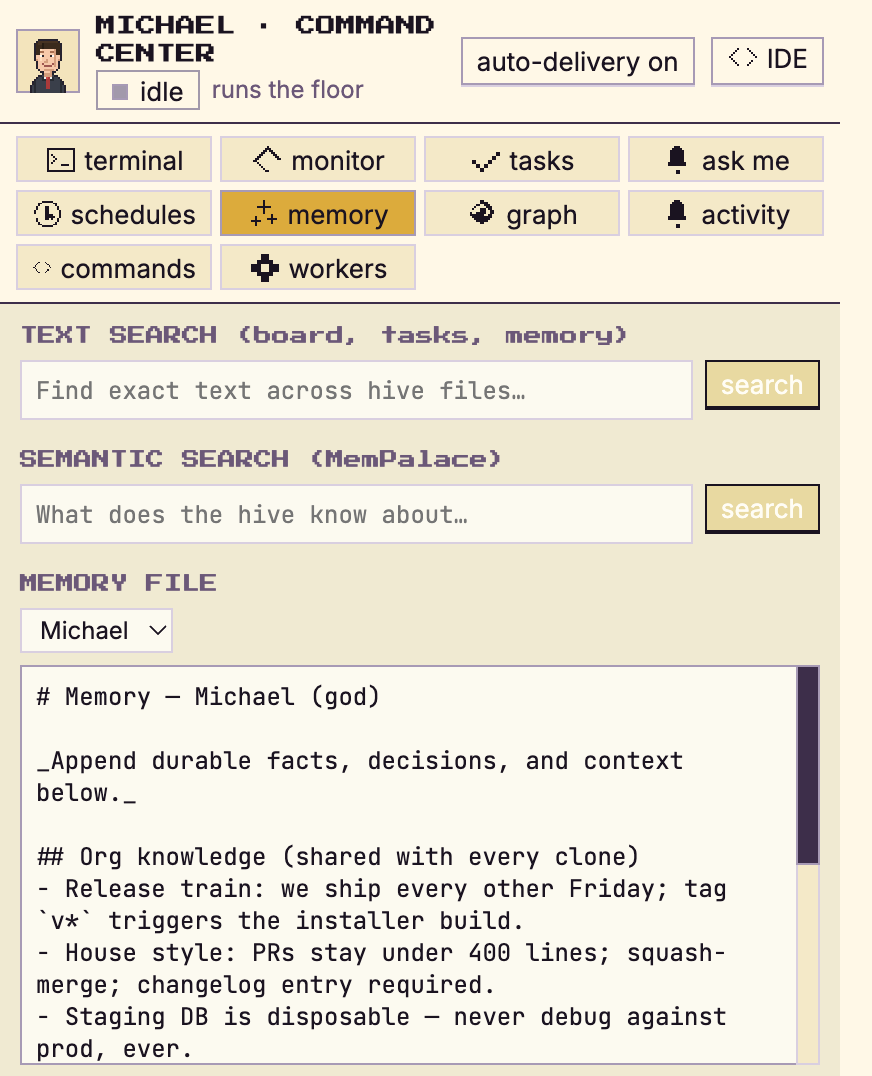
Memory that survives the sessionEvery agent keeps markdown memory that is mined into a shared, searchable palace. Close the app, come back tomorrow, and they still know what they learned. |
|
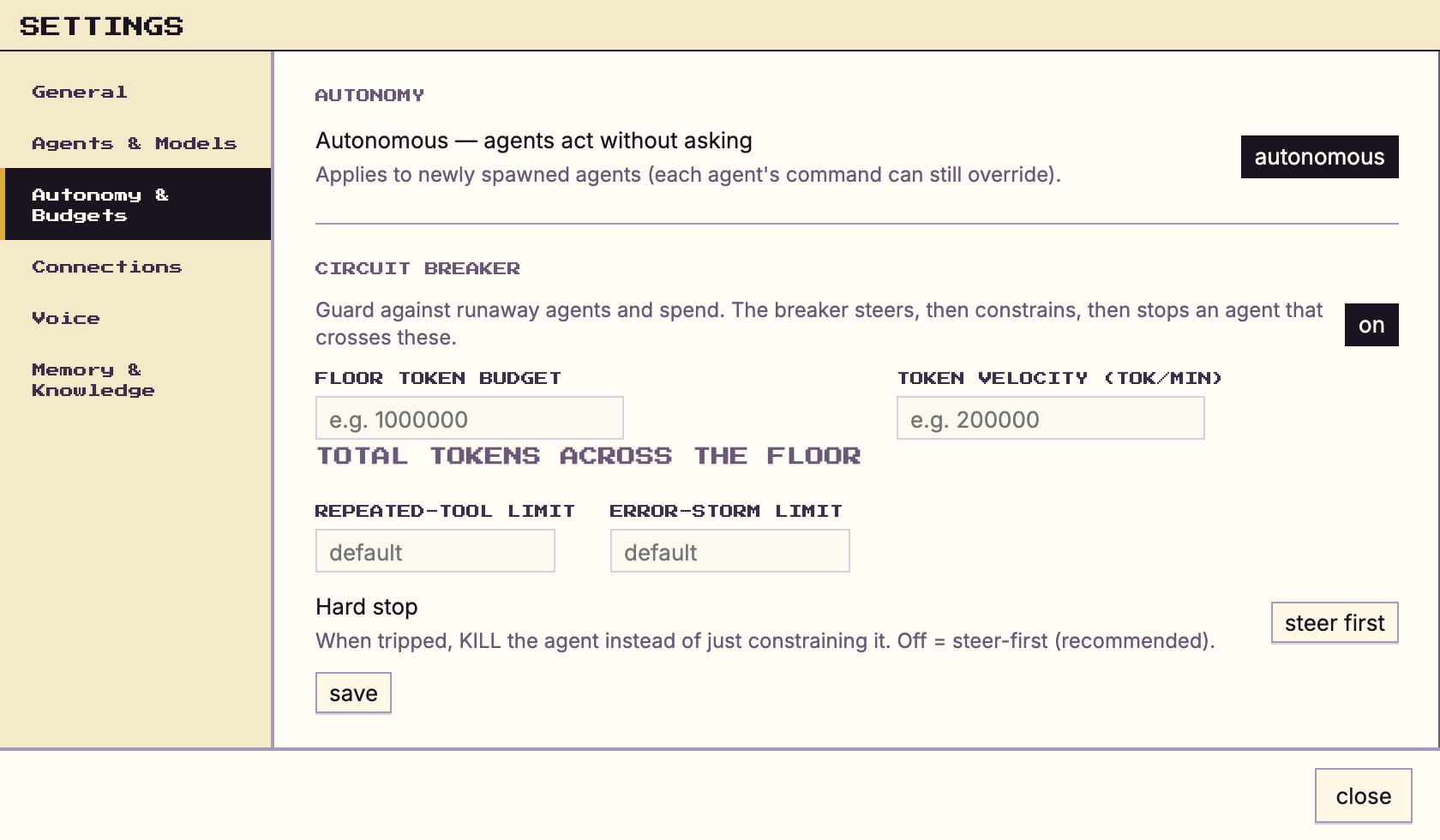
Autonomy with a leashSet how far each agent may go on its own. Spend, scope and destructive operations come back to you, and a circuit breaker steers, constrains, then stops anything that loops or runs away. |
|
Watch the whole floor workAgents walk to stations as they work and envelopes fly desk to desk when they message each other. Click any desk to read that terminal live, and type straight back into it. |
|
Set up onceThe onboarding wizard checks what you already have, and offers to install what is missing rather than sending you to a docs page. |
|
The floor
node-pty PTY, rendered with xterm.js.Memory & coordination
Control & safety
Command Center
Getting work in and out
munderdifflin://hire link; import only pre-fills the form, a human still spawns it. Browse roles at the Agent Gallery.latest once a check confirms you are current. A manual download is the fallback for when the updater cannot fetch the build itself. The first run afterwards opens that release's notes as a designed page rather than a version number.[!NOTE] Status: v0.5.3. Cancel your Granola and Wispr Flow subscriptions. The Stapler does both, all running locally, and every agent gets easier to start, restart and steer. Dictate into any app: hold Option on the Mac (Microphone and Accessibility permissions), or Control+Alt+Space on Windows and Linux X11, talk, and let go. Wayland says why it cannot. Meetings hear both sides in Stapler, part of Pro: You and Them, on Mac, Windows and Linux, transcribed locally, then corrected, described and sent to any of your agents. Transcription on your machine: a bundled Whisper model by default, an optional 190 MB larger model, Apple's on device recogniser on macOS 26, and Groq only if you add a key. 0.5.3 transcribes English. The bundled model is English only; on macOS 26 dictation runs on Apple's engine, which follows the Mac's language and we have tested it in English. Other languages arrive as a model download in a later release. A missing CLI is a card, not an error: install and sign in from inside the app for every engine, with Set up manually when either fails. Ask me on every agent's Inbox, answered from one box over the composer. More than one floor: File, New Floor (Shift+Command+N, or Control+Shift+N) runs another office on its own folder, with its own agents, board and memory, and one licence covers every floor. Send now goes straight in, Restart & Continue keeps the conversation for every engine, and Opus 5.5 is the default Claude model. Settings, redesigned: one Save for everything, inbound webhooks for GitHub, Linear, Telegram and your own, each with the agent that answers it, and custom secrets stored encrypted beside your provider keys. Crashes keep your work: a crashed agent keeps its uncommitted work. The IDE opens on Command+I with find and replace, the sidebar's reorder handle sits on the right in Arabic, and code in the IDE reads left to right in every language. Automatic compaction runs every 40 minutes at 30 percent of the context window, the same bar on every model size, where the previous default was every two hours at 60 percent. Tasks you can follow: every ticket gets a three letter key like V53-299, taken from the hive folder's name or set in Settings, Autonomy. Each agent has a Tasks tab beside Inbox and Terminal with what it did and when, the Tasks screen filters by Today, This week, This month or All time, and a card drops anywhere in a column. Hover a ticket in the sidebar for its details. The Pro sidebar is as wide as you drag it, and one setting shows only agents and notes. With more than one floor open, each window and Dock icon carries the office's number. Stapler fixes: the mic stops at the click, no words are lost at a pause, Record message never gets stuck, the drag follows your pointer, Reset puts it in the middle of the screen, and it never ends up off screen. Fixes: a restarted agent's terminal takes the mouse again, the hive repository no longer swallows agent git folders into its object database and the disk space comes back, and one hook event now renders one sidebar row with the task ledger read once. Not in this release: the Kimi scroll and queue bug, which we could not reproduce, and it is first on the 0.5.4 list. Launch offer: the Pro annual plan for $150 USD, adjusted for purchasing power in different countries and as low as $100 a year. Get Pro Before that, v0.4.6 brought a Simplified Chinese and Arabic interface with right to left support and self hosted fonts, the update badge that runs the real download and restart, and the security work on CLI name validation and analytics. If you're on 0.3.8, update: that build's usage-limit guard never released the agents it held, and it has been removed entirely. macOS (signed & notarized), Windows, and Linux builds are on the download page. The open source build is on the releases page.
Most people want this one. Munder Difflin is free and open source. Signed and notarized macOS builds of 0.5.3, plus Windows and Linux, are on the download page. The open source build is on the latest GitHub release. Install it, open it, and the wizard takes you the rest of the way. You do not need Node, a toolchain, or this repository.
You do still need at least one agent CLI on your machine. From 0.5.3 a missing CLI shows as a card in the agent's terminal: Install runs the command, you sign in inside the app, and the agent starts. Settings → Prerequisites lists the rest.
Pro adds Stapler and the new sidebar. Launch offer: the annual plan for $150 USD, adjusted for purchasing power, as low as $100 a year. Get Pro
Everything below is for contributors and for people who want to run an unreleased build.
node-pty's native addon. On macOS, install Xcode Command Line Tools:
xcode-select --install
PATH, one of Claude Code
(claude, the default), Antigravity (agy), OpenAI Codex (codex), xAI Grok (grok),
Kimi Code (kimi), Gemini CLI (gemini), Qwen (qwen), OpenCode (opencode),
Crush (crush), pi.dev (pi), GitHub Copilot (copilot), or Cursor (cursor-agent).
Most missing CLIs self-heal: the harness runs the installer in the
terminal and continues into the new binary.git clone https://github.com/chaitanyagiri/munder-difflin.git
cd munder-difflin
npm install # postinstall rebuilds node-pty against Electron's ABI
npm run dev # launches the Electron app with hot reload
On first launch you'll go through the onboarding wizard, then land on the floor. Use Add agent to spawn your first session. The GOD agent seats itself in Michael's office automatically.
npm run build      # production build via electron-vite
npm run preview    # preview the production build
npm run typecheck  # type-check the node (main/preload) and web (renderer) projects
If
node-ptyfails to load after an Electron upgrade, re-runnpm install(thepostinstallhook runselectron-rebuildagainst the current Electron ABI).
Two data planes feed one renderer: a terminal plane that owns the PTYs, the filesystem and git, and an event plane that runs the hive, the hook server and the router. The renderer talks to both only through a typed bridge.
The full diagrams, the module by module project structure, and the design system live in
docs/ARCHITECTURE.md. They moved out of this file so it can explain
the product rather than the codebase. Also see HIVE.md for the multi-agent design,
SPEC.md for the terminal and event plane, and DESIGN.md for the
visual system.
Shipped through v0.5.3: local dictation into any app and meetings with both sides of the call,
with the model in the installer, the new agent cards in the free build and a new Pro sidebar, a
missing CLI you install and sign in to from inside the app, Ask me on every Inbox, more than one
floor on one machine, ticket keys and a Tasks tab on every agent, redesigned Settings with inbound webhooks and custom secrets, Opus 5.5 as the default Claude
model, one compaction bar for every model size, a Simplified Chinese and Arabic interface with right to left
support
and self-hosted fonts, twelve agent engines with BYOK keys and local LLMs, voice orchestration,
the hive (memory · mailboxes · blackboard · event log), Command Center with kanban and weekday
schedules, a built-in Monaco IDE with git rails, integrations registry + secret broker,
Slack-spawned workers, shareable hires and the Agent Gallery, observability and the circuit
breaker, durable persistence, session resume, multi-window floors, one click updates, a Skills
browser, a live Prerequisites check, cost reporting folded from the ledger, semantic memory
that works on Apple Silicon, and an updater that installs the build instead of pointing at it.
Full history in CHANGELOG.md.
Next up:
Contributions are welcome. This is pre-release software with a lot of surface area. Start with
CONTRIBUTING.md. The short version: fork, npm install && npm run dev, keep
npm run typecheck green, and derive any new UI from DESIGN.md tokens. Good
first areas: wiring real hook events, the add-agent flow, the config drawer, and cross-platform work.
[!IMPORTANT] Every pull request must show a before and an after: screenshots, or a recording when the thing moves, under the
### Beforeand### Afterheadings in the PR template. This is checked automatically and a PR without it does not merge. "My change has no UI" is not an exemption; it just changes what the evidence looks like. See Evidence is mandatory.
Questions, bugs, or want to show off your office? Join the Discord: https://discord.gg/SEDzP5ZPk5. Add your Discord handle to a PR and you'll get the employee of the month role when it merges.
Looking for somewhere to start? The
good first issue
list is kept stocked with small, self contained work that has a clear finish line.
Everyone whose code is in Munder Difflin is listed in CONTRIBUTORS.md.
If that is you, it is yours to point at. The list is generated from the pull requests themselves and
updates on its own, so you appear without having to ask. It also names the contributions that are in
main but that GitHub shows as closed rather than merged, because that was our mistake to record
and not theirs to explain.
Official builds send a small set of anonymous usage events (app opened, agent spawned, feature
used), never prompts, code, file paths, or agent output. The complete event list, the anonymity
guarantees, and the three ways to opt out (Settings toggle, DO_NOT_TRACK, or building from
source, forks compile with no key and send nothing) are documented in
TELEMETRY.md.
[!IMPORTANT] Asset licensing. The bundled pixel art (tilesets and maps) is Modern Interiors - RPG Tileset [16X16] by LimeZu, used under the Complete Version licence, which permits editing and use in commercial and non-commercial projects. Credit to LimeZu is required by that licence and must stay in place. The Office cast is not LimeZu art. It is drawn procedurally in
portraitArt.ts. Seesrc/renderer/src/assets/ATTRIBUTION.md.
The source code is licensed under the MIT License. See LICENSE. The MIT grant
covers the code only; the bundled pixel art is licensed separately from LimeZu and is carved out in
LICENSE-ASSETS. Munder Difflin is an affectionate parody and is not affiliated with NBC's The Office or
Dunder Mifflin.
shahar061/the-office for the office tileset/map vendoring.landing-remotion/).(top 24 of 36)
396 followers · starred Aug 2026
67 followers · starred Sep 2026
204 followers · starred Aug 2026
211 followers · starred Aug 2026
an open-source alternative to the dots, bots and muses of the world, run an office of claude code/codex like agents on your laptop, sandboxes or anywhere, uses your existing subscriptions
See the code
Free, open source and performant. A multi-agent harness that works with the subscriptions you already pay for, on their hourly limits. It turns the terminal coding CLI you already run into a clone of you, one that keeps working while you're away and coordinates a whole office of agents on your own machine.
Wraps Claude Code, Antigravity (Gemini), OpenAI Codex, xAI Grok, Kimi Code, Gemini CLI, Qwen, OpenCode, Crush, pi.dev, GitHub Copilot CLI, and Cursor, with bring-your-own keys and local LLMs. Agents that message, route, and remember, coordinated by your clone (Michael) and visualized as avatars at work on a shared office floor.
Electron · React · TypeScript · Pixi.js · xterm.js · node-pty
⬇ Download 0.5.3 for macOS, Windows or Linux
macOS builds are signed and notarized. You do not need to build from source to use it. The open source build is on the GitHub releases page.
Cancel your Granola and Wispr Flow subscriptions. 0.5.3 dictates into any app and transcribes your meetings, all running locally.
Launch offer: the Pro annual plan for $150 USD, adjusted for purchasing power in different countries and as low as $100 a year. Get Pro
[!NOTE] The world's best agents. The world's worst paper company. Munder Difflin takes the terminal-agent CLIs you already run (
claude,agy,codex,grok,kimi,qwen,opencode,crush,pi, andcopilot) and turns them into a self-coordinating team: each agent gets long-term memory, a mailbox, and a desk on a 2D office floor, and your clone (Michael) routes work between them while you watch. He's the boss of the floor; you're still the boss of him.
Bring the CLI you already pay for. Every one of these runs as a real process in its own terminal, with your existing subscription and its hourly limits. If it runs in a terminal, it can run here.
Claude Code Codex · GPT Grok · xAI Kimi Code Gemini CLI Antigravity · Gemini Qwen OpenCode Crush · Charm Pi GitHub Copilot Cursor + any custom command
Plus bring your own keys and local models through Ollama, LM Studio or vLLM.
Munder Difflin is a desktop app that wraps real terminal-agent CLIs as fully-capable agents, wires them into a hive mind, and puts your clone in charge. Michael is the one agent you talk to in order to get things done. Under the hood it runs the fastest memory layer in the world so every agent remembers what it learns and recalls it instantly.
claude, agy, codex, grok, kimi, qwen, opencode, crush, pi, copilot, or custom session runs as a real
process in a pseudo-terminal (node-pty), byte-for-byte authentic, rendered with xterm.js. you ── talk to ──► ┌─────────────┐
│ GOD agent │ orchestrator / supervisor
│ (Michael's │ roster · routing · adjudication
│ office) │ blackboard · task ledger
└──────┬──────┘
│ assigns · routes · escalates
┌────────────────────────┼────────────────────────┐
▼ ▼ ▼
┌───────────┐ ┌───────────┐ ┌───────────┐
│ agent A │ message │ agent B │ message │ agent C │
│ provider │ ─────────► │ provider │ ─────────► │ provider │
│ + memory │ │ + memory │ │ + memory │
└───────────┘ └───────────┘ └───────────┘
└──────── shared hive: memory · mailbox · blackboard · log ───────┘
claude, agy, codex, or custom)
with its own working directory, identity, and provider-specific lifecycle.outbox/; the harness's router delivers into recipients' inbox/. No agent ever touches git
(single-committer design avoids index.lock corruption).See HIVE.md for the full multi-agent design, SPEC.md for the
terminal/event plane, and DESIGN.md for the visual system.
Cancel your Granola and Wispr Flow subscriptionsDictate into any app. Hold Option on the Mac, or Control+Alt+Space on Windows and Linux (X11), talk, and let go. The words land in whatever field is in front of you, and in every text box inside Munder Difflin. The message box mic works in the free build too. Meetings hear both sides, in Stapler, part of Pro. Your microphone is written as You and the call's audio as Them, on Mac, Windows and Linux. Shift+Command+Space starts and stops a meeting on the Mac, Control+Shift+Space on Windows and Linux. Correct the transcript, add a description, and send it to any of your agents. Transcription on your machine. A Whisper model ships inside the app and is the default engine. A larger model is one download away, Apple's on device recogniser works on macOS 26, and Groq stays off unless you add a key. 126 built in technical names plus your own words. English for now.
|
One row per agent, and it tells you everythingClassic, the free skin, gets the new agent cards: status, engine, model, a context gauge, the ticket it is on and the action it is taking right now, a crash strip instead of a silent terminal, and a right click menu for the common jobs. Pro gets the new sidebar: Tasks, Inbox, Automations, Memory, Capabilities and the Stapler at the top, agents grouped under their projects, a live line per agent, Asked you on the row when an agent has a question, notes you can search, and Keep my agent order to drag agents and projects where you want them. Drag the sidebar's edge to make it wider, hover a ticket for its details, or switch to agents and notes only. |
Talk to one agent, not twelveMichael is your clone and the only agent you brief. He assigns the work, routes the traffic, and escalates the few things that actually need you. |
|
Hire an agent in a few clicksPick the CLI, the model and the autonomy, give it a desk, and it starts working. Import a ready made role from the Agent Gallery if you would rather not start from scratch. |
|
Memory that survives the sessionEvery agent keeps markdown memory that is mined into a shared, searchable palace. Close the app, come back tomorrow, and they still know what they learned. |
|
Autonomy with a leashSet how far each agent may go on its own. Spend, scope and destructive operations come back to you, and a circuit breaker steers, constrains, then stops anything that loops or runs away. |
|
Watch the whole floor workAgents walk to stations as they work and envelopes fly desk to desk when they message each other. Click any desk to read that terminal live, and type straight back into it. |
|
Set up onceThe onboarding wizard checks what you already have, and offers to install what is missing rather than sending you to a docs page. |
|
The floor
node-pty PTY, rendered with xterm.js.Memory & coordination
Control & safety
Command Center
Getting work in and out
munderdifflin://hire link; import only pre-fills the form, a human still spawns it. Browse roles at the Agent Gallery.latest once a check confirms you are current. A manual download is the fallback for when the updater cannot fetch the build itself. The first run afterwards opens that release's notes as a designed page rather than a version number.[!NOTE] Status: v0.5.3. Cancel your Granola and Wispr Flow subscriptions. The Stapler does both, all running locally, and every agent gets easier to start, restart and steer. Dictate into any app: hold Option on the Mac (Microphone and Accessibility permissions), or Control+Alt+Space on Windows and Linux X11, talk, and let go. Wayland says why it cannot. Meetings hear both sides in Stapler, part of Pro: You and Them, on Mac, Windows and Linux, transcribed locally, then corrected, described and sent to any of your agents. Transcription on your machine: a bundled Whisper model by default, an optional 190 MB larger model, Apple's on device recogniser on macOS 26, and Groq only if you add a key. 0.5.3 transcribes English. The bundled model is English only; on macOS 26 dictation runs on Apple's engine, which follows the Mac's language and we have tested it in English. Other languages arrive as a model download in a later release. A missing CLI is a card, not an error: install and sign in from inside the app for every engine, with Set up manually when either fails. Ask me on every agent's Inbox, answered from one box over the composer. More than one floor: File, New Floor (Shift+Command+N, or Control+Shift+N) runs another office on its own folder, with its own agents, board and memory, and one licence covers every floor. Send now goes straight in, Restart & Continue keeps the conversation for every engine, and Opus 5.5 is the default Claude model. Settings, redesigned: one Save for everything, inbound webhooks for GitHub, Linear, Telegram and your own, each with the agent that answers it, and custom secrets stored encrypted beside your provider keys. Crashes keep your work: a crashed agent keeps its uncommitted work. The IDE opens on Command+I with find and replace, the sidebar's reorder handle sits on the right in Arabic, and code in the IDE reads left to right in every language. Automatic compaction runs every 40 minutes at 30 percent of the context window, the same bar on every model size, where the previous default was every two hours at 60 percent. Tasks you can follow: every ticket gets a three letter key like V53-299, taken from the hive folder's name or set in Settings, Autonomy. Each agent has a Tasks tab beside Inbox and Terminal with what it did and when, the Tasks screen filters by Today, This week, This month or All time, and a card drops anywhere in a column. Hover a ticket in the sidebar for its details. The Pro sidebar is as wide as you drag it, and one setting shows only agents and notes. With more than one floor open, each window and Dock icon carries the office's number. Stapler fixes: the mic stops at the click, no words are lost at a pause, Record message never gets stuck, the drag follows your pointer, Reset puts it in the middle of the screen, and it never ends up off screen. Fixes: a restarted agent's terminal takes the mouse again, the hive repository no longer swallows agent git folders into its object database and the disk space comes back, and one hook event now renders one sidebar row with the task ledger read once. Not in this release: the Kimi scroll and queue bug, which we could not reproduce, and it is first on the 0.5.4 list. Launch offer: the Pro annual plan for $150 USD, adjusted for purchasing power in different countries and as low as $100 a year. Get Pro Before that, v0.4.6 brought a Simplified Chinese and Arabic interface with right to left support and self hosted fonts, the update badge that runs the real download and restart, and the security work on CLI name validation and analytics. If you're on 0.3.8, update: that build's usage-limit guard never released the agents it held, and it has been removed entirely. macOS (signed & notarized), Windows, and Linux builds are on the download page. The open source build is on the releases page.
Most people want this one. Munder Difflin is free and open source. Signed and notarized macOS builds of 0.5.3, plus Windows and Linux, are on the download page. The open source build is on the latest GitHub release. Install it, open it, and the wizard takes you the rest of the way. You do not need Node, a toolchain, or this repository.
You do still need at least one agent CLI on your machine. From 0.5.3 a missing CLI shows as a card in the agent's terminal: Install runs the command, you sign in inside the app, and the agent starts. Settings → Prerequisites lists the rest.
Pro adds Stapler and the new sidebar. Launch offer: the annual plan for $150 USD, adjusted for purchasing power, as low as $100 a year. Get Pro
Everything below is for contributors and for people who want to run an unreleased build.
node-pty's native addon. On macOS, install Xcode Command Line Tools:
xcode-select --install
PATH, one of Claude Code
(claude, the default), Antigravity (agy), OpenAI Codex (codex), xAI Grok (grok),
Kimi Code (kimi), Gemini CLI (gemini), Qwen (qwen), OpenCode (opencode),
Crush (crush), pi.dev (pi), GitHub Copilot (copilot), or Cursor (cursor-agent).
Most missing CLIs self-heal: the harness runs the installer in the
terminal and continues into the new binary.git clone https://github.com/chaitanyagiri/munder-difflin.git
cd munder-difflin
npm install # postinstall rebuilds node-pty against Electron's ABI
npm run dev # launches the Electron app with hot reload
On first launch you'll go through the onboarding wizard, then land on the floor. Use Add agent to spawn your first session. The GOD agent seats itself in Michael's office automatically.
npm run build      # production build via electron-vite
npm run preview    # preview the production build
npm run typecheck  # type-check the node (main/preload) and web (renderer) projects
If
node-ptyfails to load after an Electron upgrade, re-runnpm install(thepostinstallhook runselectron-rebuildagainst the current Electron ABI).
Two data planes feed one renderer: a terminal plane that owns the PTYs, the filesystem and git, and an event plane that runs the hive, the hook server and the router. The renderer talks to both only through a typed bridge.
The full diagrams, the module by module project structure, and the design system live in
docs/ARCHITECTURE.md. They moved out of this file so it can explain
the product rather than the codebase. Also see HIVE.md for the multi-agent design,
SPEC.md for the terminal and event plane, and DESIGN.md for the
visual system.
Shipped through v0.5.3: local dictation into any app and meetings with both sides of the call,
with the model in the installer, the new agent cards in the free build and a new Pro sidebar, a
missing CLI you install and sign in to from inside the app, Ask me on every Inbox, more than one
floor on one machine, ticket keys and a Tasks tab on every agent, redesigned Settings with inbound webhooks and custom secrets, Opus 5.5 as the default Claude
model, one compaction bar for every model size, a Simplified Chinese and Arabic interface with right to left
support
and self-hosted fonts, twelve agent engines with BYOK keys and local LLMs, voice orchestration,
the hive (memory · mailboxes · blackboard · event log), Command Center with kanban and weekday
schedules, a built-in Monaco IDE with git rails, integrations registry + secret broker,
Slack-spawned workers, shareable hires and the Agent Gallery, observability and the circuit
breaker, durable persistence, session resume, multi-window floors, one click updates, a Skills
browser, a live Prerequisites check, cost reporting folded from the ledger, semantic memory
that works on Apple Silicon, and an updater that installs the build instead of pointing at it.
Full history in CHANGELOG.md.
Next up:
Contributions are welcome. This is pre-release software with a lot of surface area. Start with
CONTRIBUTING.md. The short version: fork, npm install && npm run dev, keep
npm run typecheck green, and derive any new UI from DESIGN.md tokens. Good
first areas: wiring real hook events, the add-agent flow, the config drawer, and cross-platform work.
[!IMPORTANT] Every pull request must show a before and an after: screenshots, or a recording when the thing moves, under the
### Beforeand### Afterheadings in the PR template. This is checked automatically and a PR without it does not merge. "My change has no UI" is not an exemption; it just changes what the evidence looks like. See Evidence is mandatory.
Questions, bugs, or want to show off your office? Join the Discord: https://discord.gg/SEDzP5ZPk5. Add your Discord handle to a PR and you'll get the employee of the month role when it merges.
Looking for somewhere to start? The
good first issue
list is kept stocked with small, self contained work that has a clear finish line.
Everyone whose code is in Munder Difflin is listed in CONTRIBUTORS.md.
If that is you, it is yours to point at. The list is generated from the pull requests themselves and
updates on its own, so you appear without having to ask. It also names the contributions that are in
main but that GitHub shows as closed rather than merged, because that was our mistake to record
and not theirs to explain.
Official builds send a small set of anonymous usage events (app opened, agent spawned, feature
used), never prompts, code, file paths, or agent output. The complete event list, the anonymity
guarantees, and the three ways to opt out (Settings toggle, DO_NOT_TRACK, or building from
source, forks compile with no key and send nothing) are documented in
TELEMETRY.md.
[!IMPORTANT] Asset licensing. The bundled pixel art (tilesets and maps) is Modern Interiors - RPG Tileset [16X16] by LimeZu, used under the Complete Version licence, which permits editing and use in commercial and non-commercial projects. Credit to LimeZu is required by that licence and must stay in place. The Office cast is not LimeZu art. It is drawn procedurally in
portraitArt.ts. Seesrc/renderer/src/assets/ATTRIBUTION.md.
The source code is licensed under the MIT License. See LICENSE. The MIT grant
covers the code only; the bundled pixel art is licensed separately from LimeZu and is carved out in
LICENSE-ASSETS. Munder Difflin is an affectionate parody and is not affiliated with NBC's The Office or
Dunder Mifflin.
shahar061/the-office for the office tileset/map vendoring.landing-remotion/).(top 24 of 36)
396 followers · starred Aug 2026
67 followers · starred Sep 2026
204 followers · starred Aug 2026
211 followers · starred Aug 2026