
Karel dataset for program synthesis and program induction
Python
79
3 commits
updated Dec 24, 2017
README
Karel Dataset
This is the code used to generate the Karel dataset as described in following papers:
- Leveraging Grammar and Reinforcement Learning for Neural Program Synthesis (code)
- Neural Program Meta-Induction
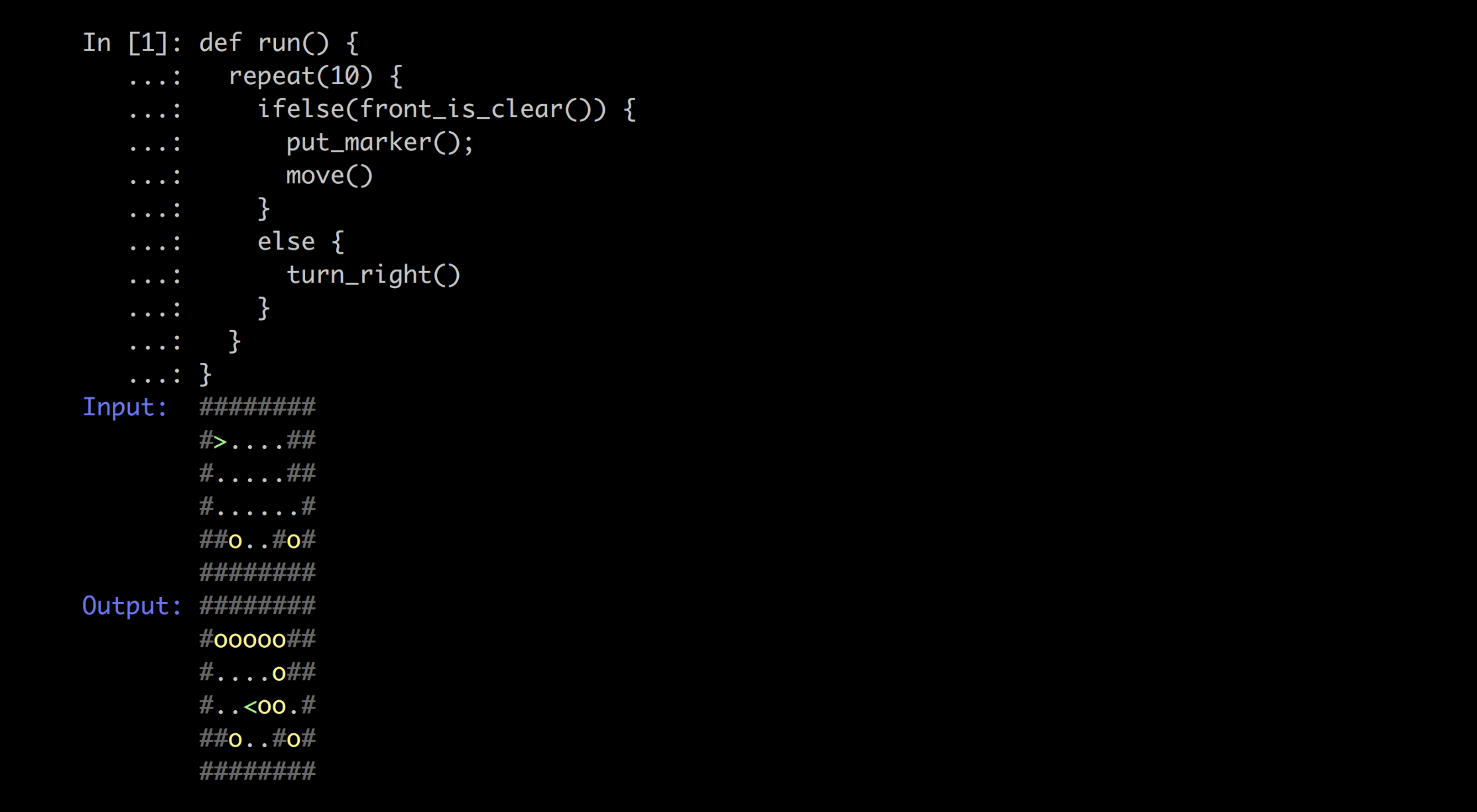
Introduction
Karel is an educational programming languag. The Domain-specific language for Karel programs is:
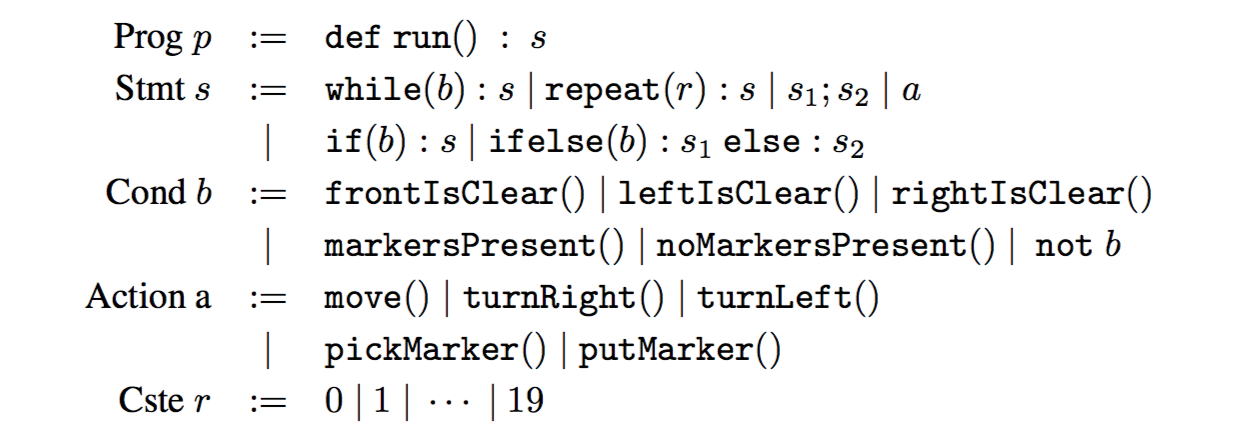
but I added {, } and removed : to explicitly represent the scope without tabspace.
The state of the grid world are represented as a H x W x 16 tensor. Each cell of grid is the 16-dimensional vector indicated as:
| Index | Description |
|---|---|
| 0 | Hero facing North |
| 1 | Hero facing South |
| 2 | Hero facing West |
| 3 | Hero facing East |
| 4 | Wall or not |
| 5 | 0 marker |
| 6 | 1 marker |
| 7 | 2 marker |
| 8 | 3 marker |
| 9 | 4 marker |
| 10 | 5 marker |
| 11 | 6 marker |
| 12 | 7 marker |
| 13 | 8 marker |
| 14 | 9 marker |
| 15 | 10 marker |
Usage
0. Installation
To install karel package:
$ pip install karel
1. Data generation
There are two types of parser which can be defined with --parser_type:
curly: Karel + curly braces ({,})synthesis: Karel for program synthesis (examples can be found here)
To generate programs and its input/output examples:
$ python generate.py --data_dir=data --max_depth=5 --parser_type=synthesis
which will generate data/train.npz, data/test.npz and data/val.npz and you can use these data with:
data = np.load(npz_path)
for input, output, code in zip(data['inputs'], data[outputs'], data['codes']):
    train(input, output, code)
To generate programs only as text:
$ python generate.py --mode=text --beautify=True --parser_type=curly
and it will generate data/train.txt, data/test.txt and data/val.txt that contain codes like:
def run() {
  while(right_is_clear()) {
    repeat(7) {
      put_marker()
    }
  }
}
def run() {
  while(left_is_clear()) {
    repeat(13) {
      pick_marker()
    }
  }

  while(no_markers_present()) {
    ifelse(right_is_clear()) {
      put_marker()
    }
    else {
      pick_marker()
    }
  }
}
2. Interpreter
To run Karel interpreter (with random grid world):
$ python -m karel.parser_with_curly
In [1]: def run() {
   ...:   repeat(7) {
   ...:     ifelse(front_is_clear()) {
   ...:       move()
   ...:     }
   ...:     else {
   ...:       turn_right()
   ...:     }
   ...:   }
   ...: }
Input:  ########
        #.1.1#.#
        ##..1..#
        #.11.1##
        #1>1..1#
        ##....1#
        #.#....#
        ########
Output: ########
        #.1.1#.#
        ##..1..#
        #.11.1##
        #1.1..1#
        ##....1#
        #.#...v#
        ########
In [2]:
or,
$ python -m karel.parser_for_synthesis
In [1]: DEF run m( IF c( frontIsClear c) i( turnRight move i) m)
Input:  ########
        #....#.#
        #......#
        #.oo..##
        #o>....#
        #.....o#
        #......#
        ########
Output: ########
        #....#.#
        #......#
        #.oo..##
        #o.....#
        #.v...o#
        #......#
        ########
In [2]:
To run Karel interpreter with a world file (ex. assets/simple.world):
$ python -m karel.parser_with_curly --world=assets/simple.world
In [1]: def run() {
   ...:   repeat(7) {
   ...:     ifelse(front_is_clear()) {
   ...:       put_marker();
   ...:       move()
   ...:     }
   ...:     else {
   ...:       turn_right()
   ...:     }
   ...:   }
   ...: }
Input:  ########
        #....#.#
        ##..o..#
        #.....##
        #.>....#
        ##.....#
        #.#....#
        ########
Output: ########
        #....#.#
        ##..o..#
        #.....##
        #.ooooo#
        ##....o#
        #.#...v#
        ########
In [2]:
Author
Taehoon Kim / @carpedm20
Contributors

3 commits
Similar repos







Languages
Python
100.0%
Karel dataset for program synthesis and program induction
Python
79
3 commits
updated Dec 24, 2017
README
Karel Dataset
This is the code used to generate the Karel dataset as described in following papers:
- Leveraging Grammar and Reinforcement Learning for Neural Program Synthesis (code)
- Neural Program Meta-Induction
Introduction
Karel is an educational programming languag. The Domain-specific language for Karel programs is:
but I added {, } and removed : to explicitly represent the scope without tabspace.
The state of the grid world are represented as a H x W x 16 tensor. Each cell of grid is the 16-dimensional vector indicated as:
| Index | Description |
|---|---|
| 0 | Hero facing North |
| 1 | Hero facing South |
| 2 | Hero facing West |
| 3 | Hero facing East |
| 4 | Wall or not |
| 5 | 0 marker |
| 6 | 1 marker |
| 7 | 2 marker |
| 8 | 3 marker |
| 9 | 4 marker |
| 10 | 5 marker |
| 11 | 6 marker |
| 12 | 7 marker |
| 13 | 8 marker |
| 14 | 9 marker |
| 15 | 10 marker |
Usage
0. Installation
To install karel package:
$ pip install karel
1. Data generation
There are two types of parser which can be defined with --parser_type:
curly: Karel + curly braces ({,})synthesis: Karel for program synthesis (examples can be found here)
To generate programs and its input/output examples:
$ python generate.py --data_dir=data --max_depth=5 --parser_type=synthesis
which will generate data/train.npz, data/test.npz and data/val.npz and you can use these data with:
data = np.load(npz_path)
for input, output, code in zip(data['inputs'], data[outputs'], data['codes']):
    train(input, output, code)
To generate programs only as text:
$ python generate.py --mode=text --beautify=True --parser_type=curly
and it will generate data/train.txt, data/test.txt and data/val.txt that contain codes like:
def run() {
  while(right_is_clear()) {
    repeat(7) {
      put_marker()
    }
  }
}
def run() {
  while(left_is_clear()) {
    repeat(13) {
      pick_marker()
    }
  }

  while(no_markers_present()) {
    ifelse(right_is_clear()) {
      put_marker()
    }
    else {
      pick_marker()
    }
  }
}
2. Interpreter
To run Karel interpreter (with random grid world):
$ python -m karel.parser_with_curly
In [1]: def run() {
   ...:   repeat(7) {
   ...:     ifelse(front_is_clear()) {
   ...:       move()
   ...:     }
   ...:     else {
   ...:       turn_right()
   ...:     }
   ...:   }
   ...: }
Input:  ########
        #.1.1#.#
        ##..1..#
        #.11.1##
        #1>1..1#
        ##....1#
        #.#....#
        ########
Output: ########
        #.1.1#.#
        ##..1..#
        #.11.1##
        #1.1..1#
        ##....1#
        #.#...v#
        ########
In [2]:
or,
$ python -m karel.parser_for_synthesis
In [1]: DEF run m( IF c( frontIsClear c) i( turnRight move i) m)
Input:  ########
        #....#.#
        #......#
        #.oo..##
        #o>....#
        #.....o#
        #......#
        ########
Output: ########
        #....#.#
        #......#
        #.oo..##
        #o.....#
        #.v...o#
        #......#
        ########
In [2]:
To run Karel interpreter with a world file (ex. assets/simple.world):
$ python -m karel.parser_with_curly --world=assets/simple.world
In [1]: def run() {
   ...:   repeat(7) {
   ...:     ifelse(front_is_clear()) {
   ...:       put_marker();
   ...:       move()
   ...:     }
   ...:     else {
   ...:       turn_right()
   ...:     }
   ...:   }
   ...: }
Input:  ########
        #....#.#
        ##..o..#
        #.....##
        #.>....#
        ##.....#
        #.#....#
        ########
Output: ########
        #....#.#
        ##..o..#
        #.....##
        #.ooooo#
        ##....o#
        #.#...v#
        ########
In [2]:
Author
Taehoon Kim / @carpedm20
Similar repos
Contributors
3 commits
Languages
Python
100.0%