
Open, calibrated, single-pass typed-decision models (4B & 27B) for finance and trading
See the codeSee what people are saying
README
Eikos
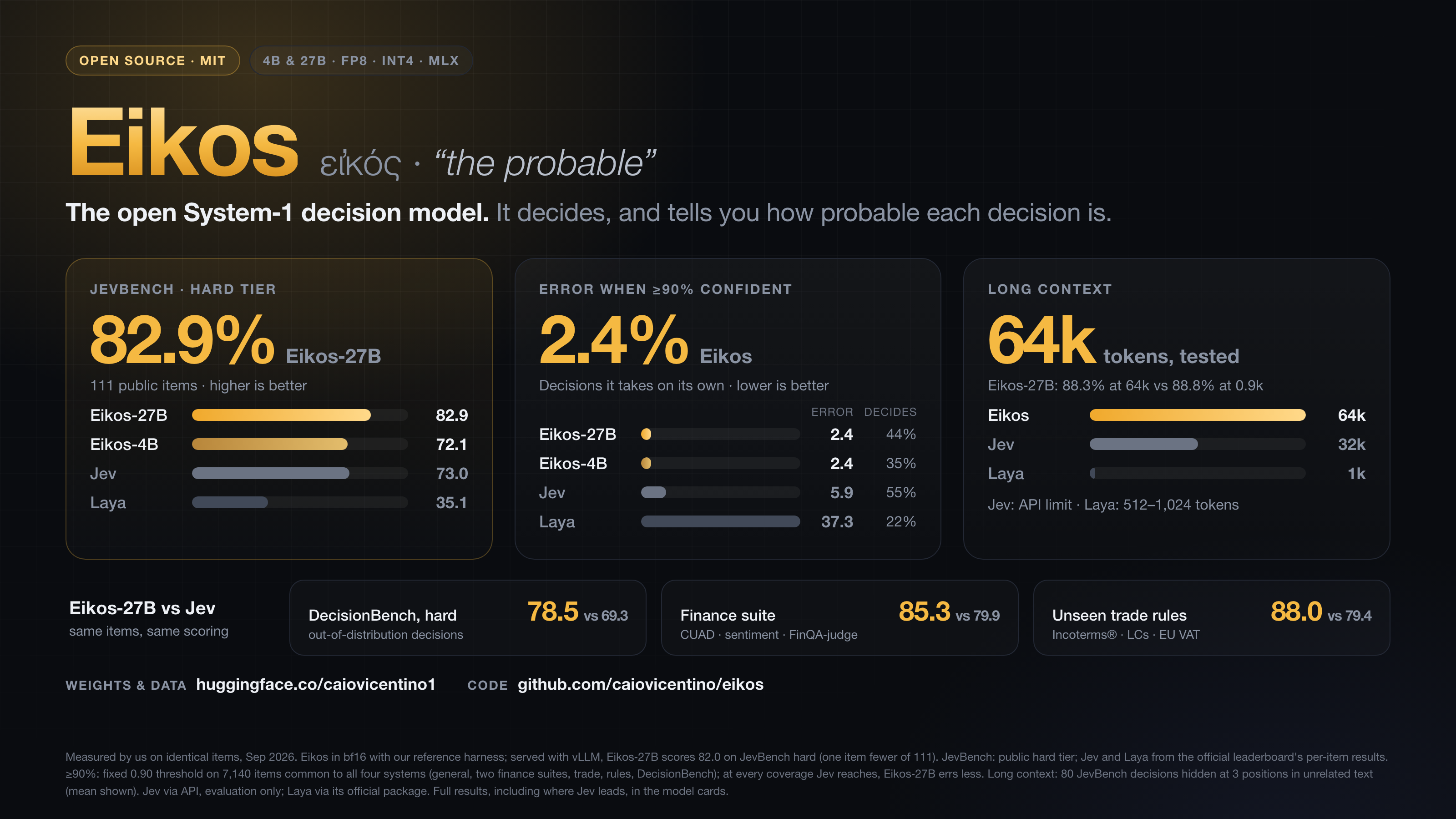
Eikos (εἰκός, "the probable") is a family of open typed-decision models, released under MIT. Each model:
- answers a structured question about a given state in one forward pass;
- returns a calibrated probability for every option, so a caller can act on confident decisions and escalate the rest.
It comes in two sizes, Eikos-4B and Eikos-27B, each with bf16, FP8 and INT4 GPU builds and MLX builds for Apple Silicon. The focus is global finance, trading and trade finance: applying stated rules, policies and rulebooks to a case.
This repository contains everything used to build the models:
-
the serving and inference code;
-
the data pipeline;
-
training;
-
quantization;
-
the evaluation harness.
-
Models:
caiovicentino1/Eikos-4B,caiovicentino1/Eikos-27B(with-FP8,-INT4and-MLXbuilds). -
Data:
caiovicentino1/eikos-decisions, the exact training data with per-row attribution. -
Live demo: Eikos-4B on Hugging Face Spaces (ZeroGPU; all three question types, up to 100 options in one pass).
| Headline (our harness, same items for every system) | Eikos-27B | Eikos-4B | Jev | Laya |
|---|---|---|---|---|
| JevBench public, hard tier | 82.9 | 72.1 | 73.0 | 35.1 |
| Error when ≥90% confident (7,140 items, 6 suites) | 2.4% | 2.4% | 5.9% | 37.3% |
| Accuracy with the decision hidden in 64k tokens (mean of 3 positions) | 88.3 | 74.2 | — (API limit 32k) | — (512–1k context) |
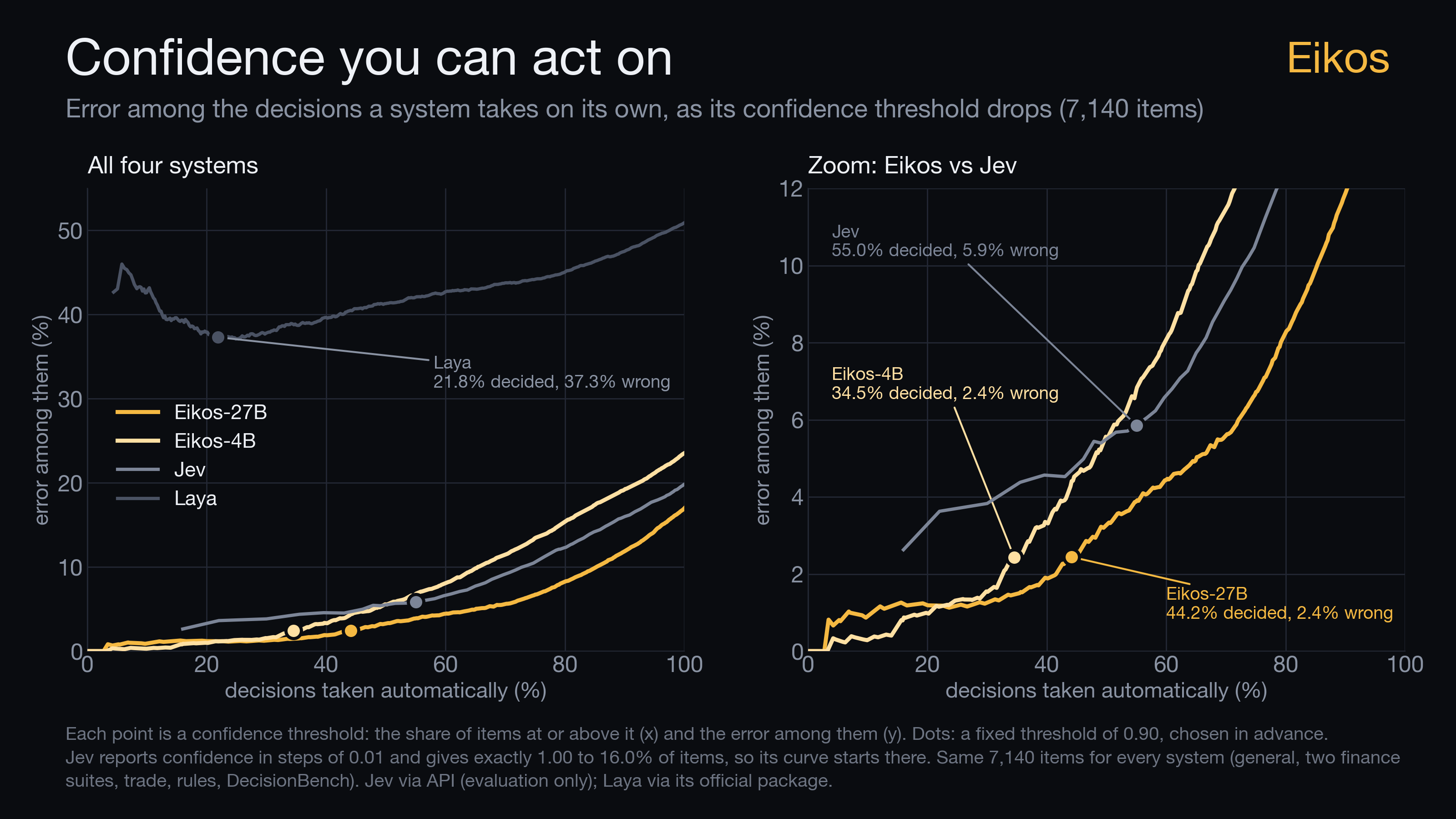
The model cards have the full tables, the per-build validation (bf16, FP8, INT4, MLX) and the limitations.
Layout
| Folder | What it holds |
|---|---|
eikos/ | Inference library and server: • decision_core (prompt, option labels A–Z, AA, AB, …: up to 588 options in one pass, per-model limit in decision_config.json; tournament beyond);• letter_adapter (letter-logit readout; PyTorch, SGLang and vLLM backends; prefix cache);• serve.py (HTTP API + agent sessions);• mlx_decide.py (Apple Silicon). |
examples/ | Local demo and a game-loop latency benchmark |
scripts/ | serve_vllm.sh (production serving), train_final.sh (exact final recipes), build_eval_suites.sh |
data_pipeline/ | Item generation with blind teacher labeling (gen_pipeline.py), programmatic generators (prog_*.py), long-context dossiers, PT↔EN views, decontamination and the training snapshot |
training/ | Trainer (train_dec.py: soft cross-entropy on letter logits, rationale loss, view consistency, optional JEPA losses), LoRA merge and export to the official checkpoint layout, model soup, merge check |
quantization/ | FP8 and INT4 (GPTQ) with llm-compressor, MLX validation, and the gate that compares builds with bf16 on the same items |
evaluation/ | vLLM and PyTorch harnesses, JevBench and DecisionBench runners, suite builders, long-context probe, parallelism benchmark, release tables, and the Jev and Laya comparisons |
release_tools/ | Builds the public dataset, including its decontamination and privacy scans, and converts it back to the trainer's format |
Install
git clone https://github.com/caiovicentino/eikos eikos && cd eikos
pip install -e .              # inference library (torch + transformers)
pip install -e ".[vllm]"      # production serving: vLLM >= 0.30.0 is REQUIRED (see below)
pip install -e ".[mlx]"       # Apple Silicon
pip install -e ".[train]"     # data pipeline, training and evaluation
pip install -e ".[quant]"     # FP8 / INT4 quantization (llm-compressor)
cp .env.example .env          # working dirs and optional API endpoints; then: set -a; source .env; set +a
Serve
scripts/serve_vllm.sh <MODEL_DIR> 8001                        # vLLM engine (letter readout + hybrid prefix cache)
python eikos/serve.py --model <MODEL_DIR> --vllm-url http://127.0.0.1:8001 --port 8000
vLLM ≥ 0.30.0 is required. On this hybrid (Gated DeltaNet) architecture, older builds return wrong answers when several long requests are batched together. We measured drops of 3–6 points on long, shared-document items with vLLM 0.11. With 0.30, batched results match the PyTorch reference.
serve_vllm.shrefuses to start on older versions. It also sets--max-num-seqs 64(change it withMAX_NUM_SEQS): with vLLM's default of 1024, a 27B build does not start on one 80–96 GB GPU.
curl -s localhost:8000/v1/systemone -d '{
  "state": "Order ticket #A-2231. Retail client. BUY 1,500 XYZ at market. Equity USD 48,000. Last price USD 41.20. Rule 4.2: a single order may not exceed 50% of equity without written supervisor approval. Approvals on file: none.",
  "questions": {
    "allowed": {"type": "noul", "instructions": "Under rule 4.2, can this order be executed as submitted?",
                "criteria": {"true": "complies with rule 4.2", "false": "breaches rule 4.2"}},
    "action":  {"type": "choice", "instructions": "What should the desk do?",
                "criteria": {"execute": "send as submitted", "request_approval": "hold and ask a supervisor",
                             "reduce_size": "cut the order to the allowed size", "reject": "refuse the order"}}
  }}'
All questions in a request are answered in one pass over the shared state, which the prefix cache processes once.
The server also supports agent sessions with an incremental state: POST /v1/sessions, .../append,
.../systemone.
On a Mac:
python eikos/mlx_decide.py <MLX_MODEL_DIR>
python examples/local_demo.py <MODEL_DIR> mps
Reproduce
Everything below reads and writes under EIKOS_HOME (default: the current directory) and EIKOS_RUNS (default:
runs/).
1. Data
The simplest path is to start from the released dataset and convert it back to the trainer's format:
hf download caiovicentino1/eikos-decisions --repo-type dataset --local-dir eikos-decisions
python release_tools/release_to_train.py eikos-decisions snap_4b eikos-4b    # or: snap_27b eikos-27b
The conversion is lossless. The train, dev and held-out assignment and the soft targets match our runs exactly. The release does leave out 2% of the rows we trained on (see the dataset card), so a retrained model will be close to ours but not bit-identical.
To regenerate the data from scratch instead:
- Generated items (
data_pipeline/gen_pipeline.py).- A writer model writes items with a gold answer and a rationale. A teacher labels them blindly, and only items where the teacher agrees with the gold answer are kept.
- The teacher is GLM-5.3-Flash at maximum reasoning effort, on any OpenAI-compatible endpoint
(
TEACHER_API_URL,TEACHER_API_KEY). - The writer is the same GLM, or a local Qwen3.8-27B server (
GEN_API,GEN_MODEL).
- Programmatic items with exact answers:
python data_pipeline/prog_{prob,temporal,fin,trade,rules}.py N SEED > data/prog_*.jsonl;prog_rules.py --holdoutmakes the new-domain rules;prog_finjudge.py(TAT-QA) anddedup_finjudge.py;prog_judge.py Qwen/Qwen3.5-0.8B cuda:0 data/prog_judge.jsonl(GSM8K train) andfix_judge.py;prog_finentity.py FinEntity.json(human-labeled entity sentiment).
- Long-context dossiers and views:
make_long.pybuilds the dossiers;make_views.pymakes the PT↔EN translations and needs a translation endpoint. - Snapshot:
data_pipeline/snapshot_final.sh <snapshot_dir>. It sets the per-source quotas and applies 8-gram decontamination against the public JevBench items. It also excludes FinQA-derived items and the trade rule families reserved for evaluation.
2. Train
hf download Qwen/Qwen3.5-4B --local-dir models/Qwen3.5-4B
BASE_MODEL=models/Qwen3.5-4B scripts/train_final.sh 4b-B 0 ckpt/4b_B snap_4b snap_4b/views.jsonl.views
BASE_MODEL=models/Qwen3.5-4B scripts/train_final.sh 4b-E 1 ckpt/4b_E snap_4b snap_4b/views.jsonl.views
python training/merge_export.py models/Qwen3.5-4B ckpt/4b_B/adapter ckpt/4b_B/standalone ckpt/4b_B/calib.json
python training/merge_export.py models/Qwen3.5-4B ckpt/4b_E/adapter ckpt/4b_E/standalone ckpt/4b_E/calib.json
python training/make_soup.py Eikos-4B ckpt/4b_B/standalone_release ckpt/4b_E/standalone_release   # released 4B
# 27B: scripts/train_final.sh 27b <gpu> ckpt/27b snap_27b, then merge_export.py (its *_release folder is Eikos-27B)
The final recipes:
- LoRA rank 64, 1 epoch, learning rate 1e-4;
- soft cross-entropy on the option-letter logits, with option-order permutation;
- auxiliary rationale loss with weight 0.3;
- PT↔EN views with a symmetric KL of 0.5 (4B);
- light JEPA losses of 0.2 (recipe E).
merge_export.py writes the model in the official Qwen checkpoint layout, so the same folder loads in
transformers, vLLM and SGLang. training/check_merged.py checks that the merged model reproduces base + LoRA.
The released models use T = 1 (calib.json). The model card explains why.
3. Quantize
python quantization/quantize_llmc.py Eikos-4B Eikos-4B-FP8 fp8
CALIB_SNAPSHOT=snap_4b python quantization/quantize_llmc.py Eikos-4B Eikos-4B-INT4 int4 256   # GPTQ W4A16, 256 training items
mlx_lm convert --hf-path Eikos-4B --mlx-path Eikos-4B-MLX-8bit -q --q-bits 8 --q-group-size 64   # 4-bit: --q-bits 4
A build ships only if it passes the gate against bf16 on the same items (quantization/compare_quant.py):
- accuracy within 1 point;
- ECE within 0.01;
- at least 97% of answers unchanged.
We also report where the changed answers fall. They are mostly on items where bf16 itself was unsure.
4. Evaluate
scripts/build_eval_suites.sh             # rebuilds the third-party suites from their sources (evaluation only)
cp eikos-decisions/eval/suite_*.jsonl .  # our own trade and rules suites ship with the dataset
python evaluation/eval_vllm_suite.py Eikos-4B ALL rel_4b_bf16 0.85   # 7 suites, vLLM, batching + prefix cache
python evaluation/release_table.py rel   # accuracy per suite, ECE, and the >=0.90 decide/error policy
python evaluation/probe_long_ctx.py Eikos-27B 0.85 80                # decision hidden in 4k/16k/64k tokens, 3 depths
python evaluation/bench_vllm_prefix.py Eikos-4B all 0.85             # parallelism: many questions over one state
evaluation/eval_jev_suite.py and evaluation/eval_laya_suite.py run the same suites through Jev (API, evaluation
only; JEV_API_URL and JEV_API_KEY) and Laya (official laya package). evaluation/compare_models.py builds the
side-by-side table.
Notes
- No evaluation data was used for training.
- The dataset card lists the decontamination checks against every suite we report.
- The held-out family, topic and language (Spanish) are never trained on.
- Scope:
- The models apply the rules they are given. They do not predict prices, and they are not legal, tax or investment advice.
- Single-pass models do not do long multi-step reasoning; see RuleArena in the model card.
License
- Code: MIT (
LICENSE). - Models: MIT for our fine-tuning deltas; the base models are Apache-2.0.
- Data: CC BY 4.0, with per-row upstream licenses.
- Third-party credits are listed in
NOTICE.
Citation
@misc{eikos2026,
  title  = {Eikos: open, calibrated, single-pass typed-decision models for finance and trading},
  author = {Caio Vicentino},
  year   = {2026},
  url    = {https://github.com/caiovicentino/eikos}
}
Contributors

7 commits
Similar repos





Languages
Python
98.2%
Shell
1.8%
Open, calibrated, single-pass typed-decision models (4B & 27B) for finance and trading
See the codeSee what people are saying
README
Eikos
Eikos (εἰκός, "the probable") is a family of open typed-decision models, released under MIT. Each model:
- answers a structured question about a given state in one forward pass;
- returns a calibrated probability for every option, so a caller can act on confident decisions and escalate the rest.
It comes in two sizes, Eikos-4B and Eikos-27B, each with bf16, FP8 and INT4 GPU builds and MLX builds for Apple Silicon. The focus is global finance, trading and trade finance: applying stated rules, policies and rulebooks to a case.
This repository contains everything used to build the models:
-
the serving and inference code;
-
the data pipeline;
-
training;
-
quantization;
-
the evaluation harness.
-
Models:
caiovicentino1/Eikos-4B,caiovicentino1/Eikos-27B(with-FP8,-INT4and-MLXbuilds). -
Data:
caiovicentino1/eikos-decisions, the exact training data with per-row attribution. -
Live demo: Eikos-4B on Hugging Face Spaces (ZeroGPU; all three question types, up to 100 options in one pass).
| Headline (our harness, same items for every system) | Eikos-27B | Eikos-4B | Jev | Laya |
|---|---|---|---|---|
| JevBench public, hard tier | 82.9 | 72.1 | 73.0 | 35.1 |
| Error when ≥90% confident (7,140 items, 6 suites) | 2.4% | 2.4% | 5.9% | 37.3% |
| Accuracy with the decision hidden in 64k tokens (mean of 3 positions) | 88.3 | 74.2 | — (API limit 32k) | — (512–1k context) |
The model cards have the full tables, the per-build validation (bf16, FP8, INT4, MLX) and the limitations.
Layout
| Folder | What it holds |
|---|---|
eikos/ | Inference library and server: • decision_core (prompt, option labels A–Z, AA, AB, …: up to 588 options in one pass, per-model limit in decision_config.json; tournament beyond);• letter_adapter (letter-logit readout; PyTorch, SGLang and vLLM backends; prefix cache);• serve.py (HTTP API + agent sessions);• mlx_decide.py (Apple Silicon). |
examples/ | Local demo and a game-loop latency benchmark |
scripts/ | serve_vllm.sh (production serving), train_final.sh (exact final recipes), build_eval_suites.sh |
data_pipeline/ | Item generation with blind teacher labeling (gen_pipeline.py), programmatic generators (prog_*.py), long-context dossiers, PT↔EN views, decontamination and the training snapshot |
training/ | Trainer (train_dec.py: soft cross-entropy on letter logits, rationale loss, view consistency, optional JEPA losses), LoRA merge and export to the official checkpoint layout, model soup, merge check |
quantization/ | FP8 and INT4 (GPTQ) with llm-compressor, MLX validation, and the gate that compares builds with bf16 on the same items |
evaluation/ | vLLM and PyTorch harnesses, JevBench and DecisionBench runners, suite builders, long-context probe, parallelism benchmark, release tables, and the Jev and Laya comparisons |
release_tools/ | Builds the public dataset, including its decontamination and privacy scans, and converts it back to the trainer's format |
Install
git clone https://github.com/caiovicentino/eikos eikos && cd eikos
pip install -e .              # inference library (torch + transformers)
pip install -e ".[vllm]"      # production serving: vLLM >= 0.30.0 is REQUIRED (see below)
pip install -e ".[mlx]"       # Apple Silicon
pip install -e ".[train]"     # data pipeline, training and evaluation
pip install -e ".[quant]"     # FP8 / INT4 quantization (llm-compressor)
cp .env.example .env          # working dirs and optional API endpoints; then: set -a; source .env; set +a
Serve
scripts/serve_vllm.sh <MODEL_DIR> 8001                        # vLLM engine (letter readout + hybrid prefix cache)
python eikos/serve.py --model <MODEL_DIR> --vllm-url http://127.0.0.1:8001 --port 8000
vLLM ≥ 0.30.0 is required. On this hybrid (Gated DeltaNet) architecture, older builds return wrong answers when several long requests are batched together. We measured drops of 3–6 points on long, shared-document items with vLLM 0.11. With 0.30, batched results match the PyTorch reference.
serve_vllm.shrefuses to start on older versions. It also sets--max-num-seqs 64(change it withMAX_NUM_SEQS): with vLLM's default of 1024, a 27B build does not start on one 80–96 GB GPU.
curl -s localhost:8000/v1/systemone -d '{
  "state": "Order ticket #A-2231. Retail client. BUY 1,500 XYZ at market. Equity USD 48,000. Last price USD 41.20. Rule 4.2: a single order may not exceed 50% of equity without written supervisor approval. Approvals on file: none.",
  "questions": {
    "allowed": {"type": "noul", "instructions": "Under rule 4.2, can this order be executed as submitted?",
                "criteria": {"true": "complies with rule 4.2", "false": "breaches rule 4.2"}},
    "action":  {"type": "choice", "instructions": "What should the desk do?",
                "criteria": {"execute": "send as submitted", "request_approval": "hold and ask a supervisor",
                             "reduce_size": "cut the order to the allowed size", "reject": "refuse the order"}}
  }}'
All questions in a request are answered in one pass over the shared state, which the prefix cache processes once.
The server also supports agent sessions with an incremental state: POST /v1/sessions, .../append,
.../systemone.
On a Mac:
python eikos/mlx_decide.py <MLX_MODEL_DIR>
python examples/local_demo.py <MODEL_DIR> mps
Reproduce
Everything below reads and writes under EIKOS_HOME (default: the current directory) and EIKOS_RUNS (default:
runs/).
1. Data
The simplest path is to start from the released dataset and convert it back to the trainer's format:
hf download caiovicentino1/eikos-decisions --repo-type dataset --local-dir eikos-decisions
python release_tools/release_to_train.py eikos-decisions snap_4b eikos-4b    # or: snap_27b eikos-27b
The conversion is lossless. The train, dev and held-out assignment and the soft targets match our runs exactly. The release does leave out 2% of the rows we trained on (see the dataset card), so a retrained model will be close to ours but not bit-identical.
To regenerate the data from scratch instead:
- Generated items (
data_pipeline/gen_pipeline.py).- A writer model writes items with a gold answer and a rationale. A teacher labels them blindly, and only items where the teacher agrees with the gold answer are kept.
- The teacher is GLM-5.3-Flash at maximum reasoning effort, on any OpenAI-compatible endpoint
(
TEACHER_API_URL,TEACHER_API_KEY). - The writer is the same GLM, or a local Qwen3.8-27B server (
GEN_API,GEN_MODEL).
- Programmatic items with exact answers:
python data_pipeline/prog_{prob,temporal,fin,trade,rules}.py N SEED > data/prog_*.jsonl;prog_rules.py --holdoutmakes the new-domain rules;prog_finjudge.py(TAT-QA) anddedup_finjudge.py;prog_judge.py Qwen/Qwen3.5-0.8B cuda:0 data/prog_judge.jsonl(GSM8K train) andfix_judge.py;prog_finentity.py FinEntity.json(human-labeled entity sentiment).
- Long-context dossiers and views:
make_long.pybuilds the dossiers;make_views.pymakes the PT↔EN translations and needs a translation endpoint. - Snapshot:
data_pipeline/snapshot_final.sh <snapshot_dir>. It sets the per-source quotas and applies 8-gram decontamination against the public JevBench items. It also excludes FinQA-derived items and the trade rule families reserved for evaluation.
2. Train
hf download Qwen/Qwen3.5-4B --local-dir models/Qwen3.5-4B
BASE_MODEL=models/Qwen3.5-4B scripts/train_final.sh 4b-B 0 ckpt/4b_B snap_4b snap_4b/views.jsonl.views
BASE_MODEL=models/Qwen3.5-4B scripts/train_final.sh 4b-E 1 ckpt/4b_E snap_4b snap_4b/views.jsonl.views
python training/merge_export.py models/Qwen3.5-4B ckpt/4b_B/adapter ckpt/4b_B/standalone ckpt/4b_B/calib.json
python training/merge_export.py models/Qwen3.5-4B ckpt/4b_E/adapter ckpt/4b_E/standalone ckpt/4b_E/calib.json
python training/make_soup.py Eikos-4B ckpt/4b_B/standalone_release ckpt/4b_E/standalone_release   # released 4B
# 27B: scripts/train_final.sh 27b <gpu> ckpt/27b snap_27b, then merge_export.py (its *_release folder is Eikos-27B)
The final recipes:
- LoRA rank 64, 1 epoch, learning rate 1e-4;
- soft cross-entropy on the option-letter logits, with option-order permutation;
- auxiliary rationale loss with weight 0.3;
- PT↔EN views with a symmetric KL of 0.5 (4B);
- light JEPA losses of 0.2 (recipe E).
merge_export.py writes the model in the official Qwen checkpoint layout, so the same folder loads in
transformers, vLLM and SGLang. training/check_merged.py checks that the merged model reproduces base + LoRA.
The released models use T = 1 (calib.json). The model card explains why.
3. Quantize
python quantization/quantize_llmc.py Eikos-4B Eikos-4B-FP8 fp8
CALIB_SNAPSHOT=snap_4b python quantization/quantize_llmc.py Eikos-4B Eikos-4B-INT4 int4 256   # GPTQ W4A16, 256 training items
mlx_lm convert --hf-path Eikos-4B --mlx-path Eikos-4B-MLX-8bit -q --q-bits 8 --q-group-size 64   # 4-bit: --q-bits 4
A build ships only if it passes the gate against bf16 on the same items (quantization/compare_quant.py):
- accuracy within 1 point;
- ECE within 0.01;
- at least 97% of answers unchanged.
We also report where the changed answers fall. They are mostly on items where bf16 itself was unsure.
4. Evaluate
scripts/build_eval_suites.sh             # rebuilds the third-party suites from their sources (evaluation only)
cp eikos-decisions/eval/suite_*.jsonl .  # our own trade and rules suites ship with the dataset
python evaluation/eval_vllm_suite.py Eikos-4B ALL rel_4b_bf16 0.85   # 7 suites, vLLM, batching + prefix cache
python evaluation/release_table.py rel   # accuracy per suite, ECE, and the >=0.90 decide/error policy
python evaluation/probe_long_ctx.py Eikos-27B 0.85 80                # decision hidden in 4k/16k/64k tokens, 3 depths
python evaluation/bench_vllm_prefix.py Eikos-4B all 0.85             # parallelism: many questions over one state
evaluation/eval_jev_suite.py and evaluation/eval_laya_suite.py run the same suites through Jev (API, evaluation
only; JEV_API_URL and JEV_API_KEY) and Laya (official laya package). evaluation/compare_models.py builds the
side-by-side table.
Notes
- No evaluation data was used for training.
- The dataset card lists the decontamination checks against every suite we report.
- The held-out family, topic and language (Spanish) are never trained on.
- Scope:
- The models apply the rules they are given. They do not predict prices, and they are not legal, tax or investment advice.
- Single-pass models do not do long multi-step reasoning; see RuleArena in the model card.
License
- Code: MIT (
LICENSE). - Models: MIT for our fine-tuning deltas; the base models are Apache-2.0.
- Data: CC BY 4.0, with per-row upstream licenses.
- Third-party credits are listed in
NOTICE.
Citation
@misc{eikos2026,
  title  = {Eikos: open, calibrated, single-pass typed-decision models for finance and trading},
  author = {Caio Vicentino},
  year   = {2026},
  url    = {https://github.com/caiovicentino/eikos}
}
Similar repos
Contributors
7 commits
Languages
Python
98.2%
Shell
1.8%