[!NOTE] This branch (
orca-port) is a frozen, outdated fork — usemainfor the latest.
orca-port: architectural changes in this fork (R5 → R25 + Orca + R22 + serve hardening)Three-tier expert serving for boxes that cannot hold the model in RAM. src/core/expert_source.cpp + include/strata/core/expert_source.hpp + src/program/generate.cpp + src/core/expert_cache.cpp:
pread ring + reader pool (R5). Non-redundant VRAM slice past the hot tier (hot_blobs skip), --dump-profile / --dump-counts + tools/make_profile_from_counts.py for trace-derived routing profiles, --expert-cache -2 baseline, condvar-parked readers, memlock + nice wrapper (run-engine-mlock.sh). open_sized per-layer slot-base fix (all layers admitted from slot 0); fill scans past per-layer quotas to full and verifies the first-admitted pair, not profile[0].WILLNEEDed 96,231 blobs for 15,007 real misses. Fix: hot-tier guard in ring-full fallback (2.4 → 6.1 tok/s on IQ3_XXS), whole-blob pread + DONTNEED + MADV_HUGEPAGE in pin_hot, two-pass dispatch (begin_layer / wait_layer: resident experts compute while the layer's reads fly), honest BlobStats, ring invalidated at layer 0. Remainder wall: drive QD1 latency (~2.8 ms) × 48 serial layers, not bandwidth (~10–11 tok/s decode, coherent).blob() checks tier before ring + clears stale ring claims; read_blob_raw stats-free path; prefill staging 6-thread pool, ring 8 → 12 (later 48 slots / 16 threads, R10.2); frequency-aware eviction, prefill LRU admissions (default-off, env-gated), phase attribution. Fixes domain-shift collapse (33% hits / 0.2 tok/s → 100% RAM / 43.9 tok/s in that test).O_DIRECT expert reads (R13a). Twin O_RDONLY|O_DIRECT fd + thread-local 4 KiB-aligned bounce (blob offsets 256 B-aligned, ring dsts are heap vectors) for ring / prefill-staging / tier-fill reads. Kills the per-read page-cache alloc/copy/DONTNEED cycle (R8.2: ~39% CPU in kernel page management). Buffered pread + DONTNEED fallback, STRATA_NO_ODIRECT=1 A/B arm. Also surfaces cudaErrorString on NativeEmbed pin failure (found persistence-mode off: cudaErrorDevicesUnavailable on every start).8f12655). cudaHostRegister pins pages (unswappable): a 24 GiB registered + mlocked tier + KV pools + desktop = zero headroom → swap storm → cublasCreate death (2026-10-04/05, twice). Fix: register in ~2 GiB whole-slot slices (12 per 24 GiB, hot_reg_), shed_pressure(bytes): score-based (freq + freshness, epoch-guarded, ties to arena end), unregister + munlock + MADV_DONTNEED, slots to free list; regrow_pressure(bytes): one end-slice per call, double hysteresis (server MemAvailable >= floor + 2.5 GiB + engine >= slice + 1 GiB). Static tiers refill only into the free list (never evict profile). Server thread (serve/server.py: STRATA_MEM_FLOOR_MIB=1536, 2 s cadence, SHED/REGROW between requests via _in_request gate).Prefill tiling, not bigger chunks (R10–R11, src/prefill/prefill.cpp, src/prefill/kernels.cu):
moe scatter-accumulate kernel; mixed-fp32 tile-sized write-only. Warm 11 k prefill 50 → 694 tok/s (chunk 14336 / tile 768). Prefill admissions count=0 recovers decode while keeping warm prefill; VRAM-tier refills via pinned pread staging (was 354 s of 4 KiB PCIe faults); kSplit runtime knob (kSplit=2 measured worse).m.mixed is tile-sized per-tile scratch indexed with chunk offset t0; for t0>0 gr_mix overwrote mixed_bf/mixed_h/bo (router + shared expert + native projections) → !!!-forever degenerate output on any chunk > tile. R22 persistence: GEMM block (cuBLAS handle + dequant scratch + workspace) created once in init (borrowed-region head carve), never per-prompt cublasCreate; alloc_all keeps pure-accounting takes so offsets match bytes_needed().CPU + CUDA kernels (src/kernels/cpu/iq_avx512.cpp, src/kernels/cpu/expert.cpp, src/kernels/cuda/native_moe.cu, src/kernels/cuda/sampler.cu, bf16_gemv / s2_gemv* / qsa* / rope / ple / kv_* / prefill/gemm.cu):
IQ4_NL down kernel (3× per-token ggml at nt=5); vpsignb(g,g) = |g| sign bug fix (weight signs never applied; caught by new iq4nl_fuzz after repetitive output; float parity 1.3e-2 hid it); row_dot_z next-8-block prefetch; pool spin/tasks knobs (2500 µs default) + pool_bench / bwbench.IQ4_XS decode-once kernel (hillclimb 1): row_dot_iq4xs / gu_rows_iq4xs / iq4xs_gu_rows_nt for gu type 23 (Q8_K acts); per-32-value sub-block decodes once across nt tokens (same structure as iq4nl_rows_multi); 200-trial fuzz bitwise-identical to ggml AVX2; layers 0–5 parity 1.2–1.4e-2 (activation-noise class). Static host tier + prefill-admit off (LRU churn collapsed decode 12 → 2.5 tok/s, prefill 325 → 94); --expert-cache-per-layer (default fill ~3% GPU hits); --dump-counts Orca-native profile.native_moe combine: per-block shared-memory weight broadcast (was 640×10 __ldgs), fmaf, __launch_bounds__(256), true LDG.128 float4 path for n_embd%4==0 with 16 B base check; sampler: per-block unique-count cache (O(n_vocab·hlen) → O(nunique), bit-identical) + __launch_bounds__(1024); __ldg / const __restrict__ hygiene across the kernel set.Orca port plumbing (tools/, strata-orca-*.json, src/program/generate.cpp):
make_native_head.py seek + 64 MiB chunked copy (never read_bytes() a tens-of-GB shard); probe_gguf.py header-only growing parse (16 MiB doubling); gguf_reader API fixes. repair_heretic_pack.py: IQ4_XS (136 B super-block) + IQ4_NL (18 B block) → BF16 via KVALUES_IQ4NL + RNE. Native PLE/ple_block keys accept any native_mmvq_supported type (Orca key). Endpoint strata-orca-iq4xs.json: port 8104, PLE from model shard 1, 24 GiB hot, 1500-slot cache, 16 k prefill, spec-4, q4_0 KV, 128 k ctx. R2–R4: static-shared wins, defrag 3×, knob A/B (p12/spec6 reject, c1600 keep).Serve robustness (serve/server.py, srv.sh, serve/test_server.py — 23 + 20 + 18 contract tests):
max_tokens: clamp to room left (only zero-room prompts 400 as overflow for compaction; removes fit_max_tokens gate). Engine faults finish with finish_reason (no room to answer → compact-and-retry, else server_error + transient; retrying is safe), never bare EOF. Watchdog 300 s (180 s was ~2× one 16 k prefill chunk). Failover waits with heartbeats (READY_WAIT_S 600 s) instead of context (0) 400. Stale-output desync guard (phantom length fix: out-of-step queue check + engine replace, DRAIN_S 90 s, poll() fix, best-effort close()). Infra faults (prefill/cublas/cuda/OOM/workspace) auto-replace engine in background; spawn-hang guard 300 s; disconnect survival. Baselines in-tree: R13 honest 6-topic 6.3/8.0/9.2 tok/s (decode = serial QD1 wall), R14 parity PASS + 102 k ctx on q4_0 KV, R25 r14_multiturn_bench median 9.0 / max 17.9 tok/s, suite 84% (5 environmental failures).Run a 125-billion-parameter AI model on a normal gaming PC
one NVIDIA card (12-24 GB) + 64 GB of RAM · Windows or Linux · one click to install
Strata runs Qwen3.8-Flash-Next - a large, smart AI model that normally needs a server - on your own PC. It writes its answers at 60-95 tokens per second (a token is about ¾ of a word): faster than you can read.
Jump to: Is my PC enough? · Install · How fast? · Which model? · Using it · Problems? · How it works · All the details
| You need | |
|---|---|
| Graphics card | NVIDIA RTX 30, 40 or 50 series with 12 GB of VRAM or more |
| Memory (RAM) | 64 GB |
| Free disk space | ~80 GB (an SSD makes the first start much faster) |
| System | Windows 10/11, or Linux |
That's it. The only thing you install yourself is a current NVIDIA driver (nvidia.com/drivers or the NVIDIA App). Everything else - Python, the engine, the model - is set up for you.
Windows
git clone it).START-HERE.bat.Then it downloads everything (the model is ~70 GB, so the first time takes a while - you can stop and it picks up
where it left off) and starts the model. Your browser opens the Strata app at http://127.0.0.1:8080.
Next time, just double-click START-HERE.bat again: it starts right away, nothing is downloaded twice. Close its
window to stop the model.
Linux: run ./setup.sh - same questions, same result.
Measured on an RTX 5070 (12 GB), a Ryzen 5 7600 and 64 GB of RAM:
| Size | Writes answers (short chat) | Writes answers (128K context) | Reads your prompt |
|---|---|---|---|
| Q2_0 | 95 tokens/s | 65 tokens/s | 539 tokens/s |
| IQ2_XS | 78 tokens/s | 52 tokens/s | 463 tokens/s |
| IQ3_XXS | 66 tokens/s | 45 tokens/s | 410 tokens/s |
| IQ3_S | 54 tokens/s | 42 tokens/s | 374 tokens/s |
A card with more VRAM is faster, because more of the model fits on the GPU: an RTX 3090 (24 GB) should do roughly 100-140 tokens per second. All measurements, long-context numbers and estimates for other cards are in the details.
The size (the same model, compressed more or less):
| Size | Download | Speed | Quality | Pick it if... |
|---|---|---|---|---|
| Q2_0 | 66 GB | fastest | good | you want speed |
| IQ2_XS | 68 GB | fast | better | you want a good all-rounder (recommended) |
| IQ3_XXS | 76 GB | slower | great | you want better answers (uses 43 GB of your 64 GB RAM) |
| IQ3_S | 84 GB | slowest | best: matches the full model on the published tests | you want the very best answers (original model only; uses 50 GB of your 64 GB RAM, so close other big programs) |
The version:
Not sure? Take IQ2_XS. You can add another one later with START-HERE.bat --setup.
http://127.0.0.1:8080 - the Strata app (it opens by itself when the model starts): Chat, a
live Monitor of the model and your GPU/CPU/RAM, and About with the settings and addresses..venv\Scripts\python chat.pyhttp://127.0.0.1:8080/v1, any API key and any model name. Apps that use Anthropic's API: http://127.0.0.1:8080/v1/messages./think low in chat.py, or with your app's "reasoning effort" setting. Off is fastest; high is best for hard questions.chat.py type /image <path>; in apps just attach them.Good to know: it answers one request at a time. The first message of a chat is read in full (about 1 minute per 30,000 tokens); after that it keeps the conversation and reads only what is new, so follow-ups start in seconds.
| What you see | What to do |
|---|---|
the NVIDIA driver is too old | Update the driver (NVIDIA App or nvidia.com/drivers), restart the PC, run START-HERE.bat again. |
| It stopped during download or setup | Run START-HERE.bat again - it continues where it stopped. |
port 8080 is already in use | Strata is already running - look for its window. |
| The first start takes minutes | Normal: it loads 35-43 GB into RAM. The next start is faster. |
| Slow, and the disk light is busy | Not enough free RAM: close other programs (browsers use a lot), or pick Q2_0 / IQ2_XS. |
| "prompt exceeds the context" | The conversation is longer than the context you chose: run START-HERE.bat --setup and pick more. |
More in the full troubleshooting table. Still stuck? Open an issue and attach
strata-<model>.log from this folder.
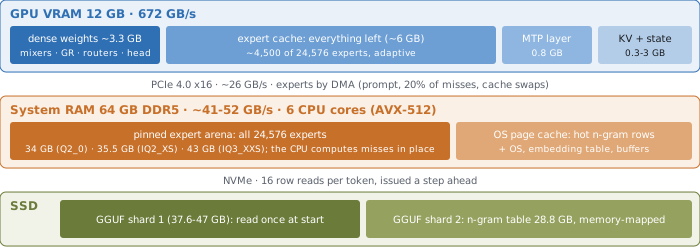
A model this big doesn't fit on a gaming graphics card. Strata splits the work between the parts of your PC:
The full story is in the paper and the details.
[!NOTE] This branch (
orca-port) is a frozen, outdated fork — usemainfor the latest.
orca-port: architectural changes in this fork (R5 → R25 + Orca + R22 + serve hardening)Three-tier expert serving for boxes that cannot hold the model in RAM. src/core/expert_source.cpp + include/strata/core/expert_source.hpp + src/program/generate.cpp + src/core/expert_cache.cpp:
pread ring + reader pool (R5). Non-redundant VRAM slice past the hot tier (hot_blobs skip), --dump-profile / --dump-counts + tools/make_profile_from_counts.py for trace-derived routing profiles, --expert-cache -2 baseline, condvar-parked readers, memlock + nice wrapper (run-engine-mlock.sh). open_sized per-layer slot-base fix (all layers admitted from slot 0); fill scans past per-layer quotas to full and verifies the first-admitted pair, not profile[0].WILLNEEDed 96,231 blobs for 15,007 real misses. Fix: hot-tier guard in ring-full fallback (2.4 → 6.1 tok/s on IQ3_XXS), whole-blob pread + DONTNEED + MADV_HUGEPAGE in pin_hot, two-pass dispatch (begin_layer / wait_layer: resident experts compute while the layer's reads fly), honest BlobStats, ring invalidated at layer 0. Remainder wall: drive QD1 latency (~2.8 ms) × 48 serial layers, not bandwidth (~10–11 tok/s decode, coherent).blob() checks tier before ring + clears stale ring claims; read_blob_raw stats-free path; prefill staging 6-thread pool, ring 8 → 12 (later 48 slots / 16 threads, R10.2); frequency-aware eviction, prefill LRU admissions (default-off, env-gated), phase attribution. Fixes domain-shift collapse (33% hits / 0.2 tok/s → 100% RAM / 43.9 tok/s in that test).O_DIRECT expert reads (R13a). Twin O_RDONLY|O_DIRECT fd + thread-local 4 KiB-aligned bounce (blob offsets 256 B-aligned, ring dsts are heap vectors) for ring / prefill-staging / tier-fill reads. Kills the per-read page-cache alloc/copy/DONTNEED cycle (R8.2: ~39% CPU in kernel page management). Buffered pread + DONTNEED fallback, STRATA_NO_ODIRECT=1 A/B arm. Also surfaces cudaErrorString on NativeEmbed pin failure (found persistence-mode off: cudaErrorDevicesUnavailable on every start).8f12655). cudaHostRegister pins pages (unswappable): a 24 GiB registered + mlocked tier + KV pools + desktop = zero headroom → swap storm → cublasCreate death (2026-10-04/05, twice). Fix: register in ~2 GiB whole-slot slices (12 per 24 GiB, hot_reg_), shed_pressure(bytes): score-based (freq + freshness, epoch-guarded, ties to arena end), unregister + munlock + MADV_DONTNEED, slots to free list; regrow_pressure(bytes): one end-slice per call, double hysteresis (server MemAvailable >= floor + 2.5 GiB + engine >= slice + 1 GiB). Static tiers refill only into the free list (never evict profile). Server thread (serve/server.py: STRATA_MEM_FLOOR_MIB=1536, 2 s cadence, SHED/REGROW between requests via _in_request gate).Prefill tiling, not bigger chunks (R10–R11, src/prefill/prefill.cpp, src/prefill/kernels.cu):
moe scatter-accumulate kernel; mixed-fp32 tile-sized write-only. Warm 11 k prefill 50 → 694 tok/s (chunk 14336 / tile 768). Prefill admissions count=0 recovers decode while keeping warm prefill; VRAM-tier refills via pinned pread staging (was 354 s of 4 KiB PCIe faults); kSplit runtime knob (kSplit=2 measured worse).m.mixed is tile-sized per-tile scratch indexed with chunk offset t0; for t0>0 gr_mix overwrote mixed_bf/mixed_h/bo (router + shared expert + native projections) → !!!-forever degenerate output on any chunk > tile. R22 persistence: GEMM block (cuBLAS handle + dequant scratch + workspace) created once in init (borrowed-region head carve), never per-prompt cublasCreate; alloc_all keeps pure-accounting takes so offsets match bytes_needed().CPU + CUDA kernels (src/kernels/cpu/iq_avx512.cpp, src/kernels/cpu/expert.cpp, src/kernels/cuda/native_moe.cu, src/kernels/cuda/sampler.cu, bf16_gemv / s2_gemv* / qsa* / rope / ple / kv_* / prefill/gemm.cu):
IQ4_NL down kernel (3× per-token ggml at nt=5); vpsignb(g,g) = |g| sign bug fix (weight signs never applied; caught by new iq4nl_fuzz after repetitive output; float parity 1.3e-2 hid it); row_dot_z next-8-block prefetch; pool spin/tasks knobs (2500 µs default) + pool_bench / bwbench.IQ4_XS decode-once kernel (hillclimb 1): row_dot_iq4xs / gu_rows_iq4xs / iq4xs_gu_rows_nt for gu type 23 (Q8_K acts); per-32-value sub-block decodes once across nt tokens (same structure as iq4nl_rows_multi); 200-trial fuzz bitwise-identical to ggml AVX2; layers 0–5 parity 1.2–1.4e-2 (activation-noise class). Static host tier + prefill-admit off (LRU churn collapsed decode 12 → 2.5 tok/s, prefill 325 → 94); --expert-cache-per-layer (default fill ~3% GPU hits); --dump-counts Orca-native profile.native_moe combine: per-block shared-memory weight broadcast (was 640×10 __ldgs), fmaf, __launch_bounds__(256), true LDG.128 float4 path for n_embd%4==0 with 16 B base check; sampler: per-block unique-count cache (O(n_vocab·hlen) → O(nunique), bit-identical) + __launch_bounds__(1024); __ldg / const __restrict__ hygiene across the kernel set.Orca port plumbing (tools/, strata-orca-*.json, src/program/generate.cpp):
make_native_head.py seek + 64 MiB chunked copy (never read_bytes() a tens-of-GB shard); probe_gguf.py header-only growing parse (16 MiB doubling); gguf_reader API fixes. repair_heretic_pack.py: IQ4_XS (136 B super-block) + IQ4_NL (18 B block) → BF16 via KVALUES_IQ4NL + RNE. Native PLE/ple_block keys accept any native_mmvq_supported type (Orca key). Endpoint strata-orca-iq4xs.json: port 8104, PLE from model shard 1, 24 GiB hot, 1500-slot cache, 16 k prefill, spec-4, q4_0 KV, 128 k ctx. R2–R4: static-shared wins, defrag 3×, knob A/B (p12/spec6 reject, c1600 keep).Serve robustness (serve/server.py, srv.sh, serve/test_server.py — 23 + 20 + 18 contract tests):
max_tokens: clamp to room left (only zero-room prompts 400 as overflow for compaction; removes fit_max_tokens gate). Engine faults finish with finish_reason (no room to answer → compact-and-retry, else server_error + transient; retrying is safe), never bare EOF. Watchdog 300 s (180 s was ~2× one 16 k prefill chunk). Failover waits with heartbeats (READY_WAIT_S 600 s) instead of context (0) 400. Stale-output desync guard (phantom length fix: out-of-step queue check + engine replace, DRAIN_S 90 s, poll() fix, best-effort close()). Infra faults (prefill/cublas/cuda/OOM/workspace) auto-replace engine in background; spawn-hang guard 300 s; disconnect survival. Baselines in-tree: R13 honest 6-topic 6.3/8.0/9.2 tok/s (decode = serial QD1 wall), R14 parity PASS + 102 k ctx on q4_0 KV, R25 r14_multiturn_bench median 9.0 / max 17.9 tok/s, suite 84% (5 environmental failures).Run a 125-billion-parameter AI model on a normal gaming PC
one NVIDIA card (12-24 GB) + 64 GB of RAM · Windows or Linux · one click to install
Strata runs Qwen3.8-Flash-Next - a large, smart AI model that normally needs a server - on your own PC. It writes its answers at 60-95 tokens per second (a token is about ¾ of a word): faster than you can read.
Jump to: Is my PC enough? · Install · How fast? · Which model? · Using it · Problems? · How it works · All the details
| You need | |
|---|---|
| Graphics card | NVIDIA RTX 30, 40 or 50 series with 12 GB of VRAM or more |
| Memory (RAM) | 64 GB |
| Free disk space | ~80 GB (an SSD makes the first start much faster) |
| System | Windows 10/11, or Linux |
That's it. The only thing you install yourself is a current NVIDIA driver (nvidia.com/drivers or the NVIDIA App). Everything else - Python, the engine, the model - is set up for you.
Windows
git clone it).START-HERE.bat.Then it downloads everything (the model is ~70 GB, so the first time takes a while - you can stop and it picks up
where it left off) and starts the model. Your browser opens the Strata app at http://127.0.0.1:8080.
Next time, just double-click START-HERE.bat again: it starts right away, nothing is downloaded twice. Close its
window to stop the model.
Linux: run ./setup.sh - same questions, same result.
Measured on an RTX 5070 (12 GB), a Ryzen 5 7600 and 64 GB of RAM:
| Size | Writes answers (short chat) | Writes answers (128K context) | Reads your prompt |
|---|---|---|---|
| Q2_0 | 95 tokens/s | 65 tokens/s | 539 tokens/s |
| IQ2_XS | 78 tokens/s | 52 tokens/s | 463 tokens/s |
| IQ3_XXS | 66 tokens/s | 45 tokens/s | 410 tokens/s |
| IQ3_S | 54 tokens/s | 42 tokens/s | 374 tokens/s |
A card with more VRAM is faster, because more of the model fits on the GPU: an RTX 3090 (24 GB) should do roughly 100-140 tokens per second. All measurements, long-context numbers and estimates for other cards are in the details.
The size (the same model, compressed more or less):
| Size | Download | Speed | Quality | Pick it if... |
|---|---|---|---|---|
| Q2_0 | 66 GB | fastest | good | you want speed |
| IQ2_XS | 68 GB | fast | better | you want a good all-rounder (recommended) |
| IQ3_XXS | 76 GB | slower | great | you want better answers (uses 43 GB of your 64 GB RAM) |
| IQ3_S | 84 GB | slowest | best: matches the full model on the published tests | you want the very best answers (original model only; uses 50 GB of your 64 GB RAM, so close other big programs) |
The version:
Not sure? Take IQ2_XS. You can add another one later with START-HERE.bat --setup.
http://127.0.0.1:8080 - the Strata app (it opens by itself when the model starts): Chat, a
live Monitor of the model and your GPU/CPU/RAM, and About with the settings and addresses..venv\Scripts\python chat.pyhttp://127.0.0.1:8080/v1, any API key and any model name. Apps that use Anthropic's API: http://127.0.0.1:8080/v1/messages./think low in chat.py, or with your app's "reasoning effort" setting. Off is fastest; high is best for hard questions.chat.py type /image <path>; in apps just attach them.Good to know: it answers one request at a time. The first message of a chat is read in full (about 1 minute per 30,000 tokens); after that it keeps the conversation and reads only what is new, so follow-ups start in seconds.
| What you see | What to do |
|---|---|
the NVIDIA driver is too old | Update the driver (NVIDIA App or nvidia.com/drivers), restart the PC, run START-HERE.bat again. |
| It stopped during download or setup | Run START-HERE.bat again - it continues where it stopped. |
port 8080 is already in use | Strata is already running - look for its window. |
| The first start takes minutes | Normal: it loads 35-43 GB into RAM. The next start is faster. |
| Slow, and the disk light is busy | Not enough free RAM: close other programs (browsers use a lot), or pick Q2_0 / IQ2_XS. |
| "prompt exceeds the context" | The conversation is longer than the context you chose: run START-HERE.bat --setup and pick more. |
More in the full troubleshooting table. Still stuck? Open an issue and attach
strata-<model>.log from this folder.
A model this big doesn't fit on a gaming graphics card. Strata splits the work between the parts of your PC:
The full story is in the paper and the details.



