This project provides a brief overview and platform for benchmarking deepfake detection technology. Everything here was done or obtained using FREE / open-source services only.
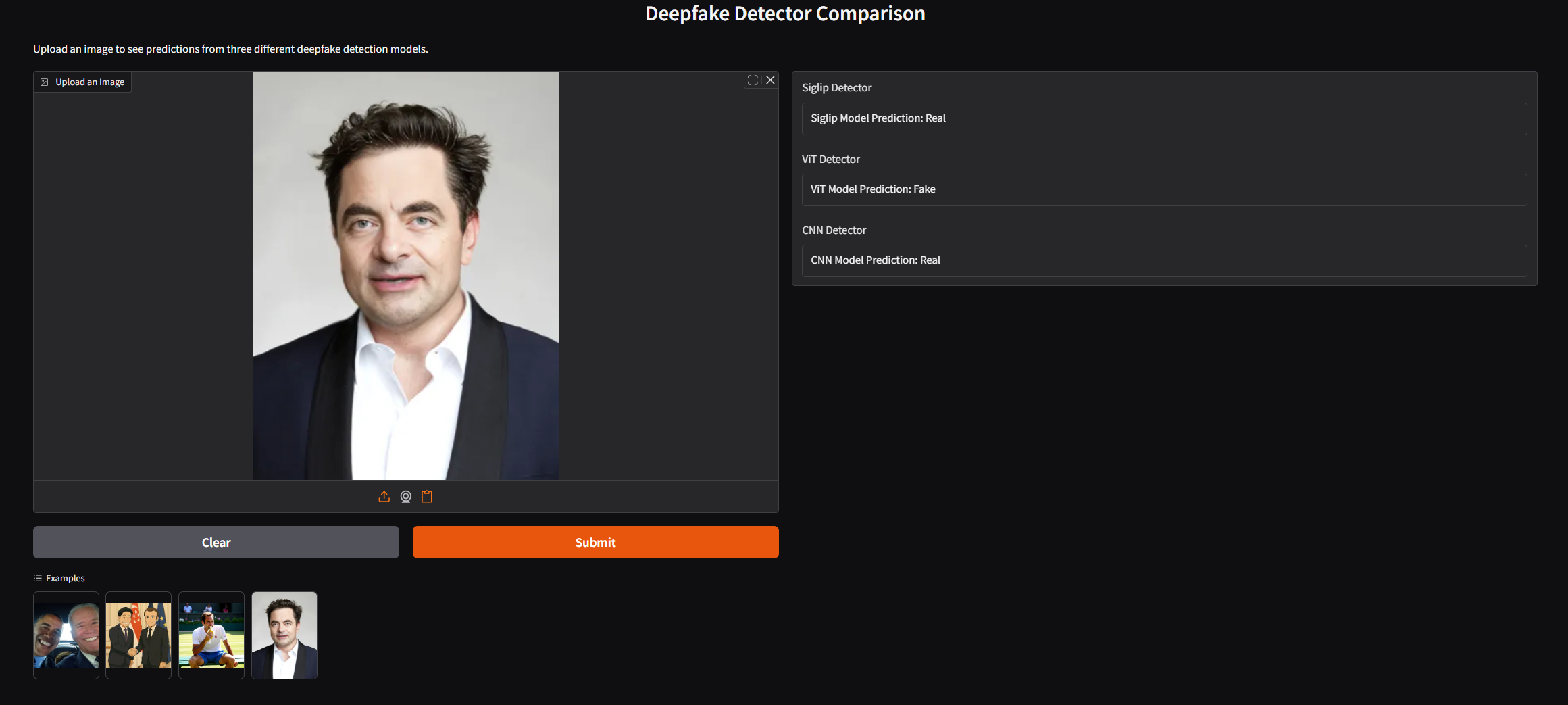
This is me below!

As part of the requirements for Task 1, real and generated images were collected in order to benchmark the detectors we are interested in. The data was obtained from a variety of sources, including 'from the wild', faceswapping, and self generated images based on fixed prompts. Some images were generated to mimick certain specific persons and actions in order to stress test the detectors.
More info about the data collection process can be found here!
3 models of different architectures were used to classify the images into either Real or Fake. These models were chosen as they are open-source and lightweight which means we can achieve considerable results without a commercial GPU.
| Model | Architecture | Source | Challenges |
|---|---|---|---|
| Deep-Fake-Detector-v2-Model | ViT | https://huggingface.co/prithivMLmods/Deep-Fake-Detector-v2-Model | The labels are different so had to decode, and I realised changing the thresholding helps or else the standard 0.5 will just classify everything as Fake |
| Deepfake-Detect-Siglip2 | SigLip | https://huggingface.co/prithivMLmods/Deepfake-Detect-Siglip2 | nil |
| DeepFake-Detector | CNN | https://huggingface.co/MaanVad3r/DeepFake-Detector | Pretty old and basic model so we dont expect good performance |
This repo contains 2 functions, either run an automated pipeline for mass evalualtion via pipeline.py or create an interface for users to evaluate individual images via Gradio app.py
For Gradio app
git clone
docker build -t deepfake-benchmarking .
docker run -p 7860:7860 deepfake-benchmarking
go to http://127.0.0.1:7860/
For automated pipeline
docker run --rm deepfake-benchmarking python pipeline.py
This was developed in windows with Nvidia 4060 GPU
Upload your image here to see if the detectors work or not lol.
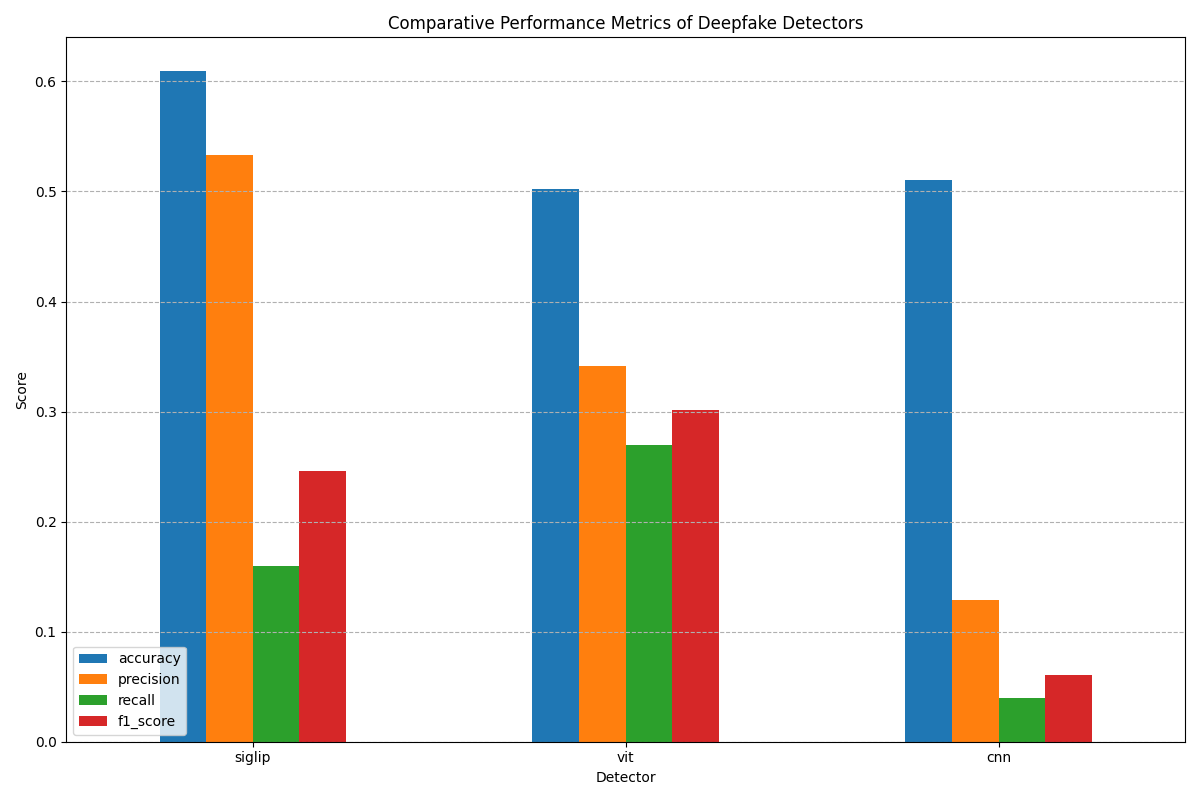
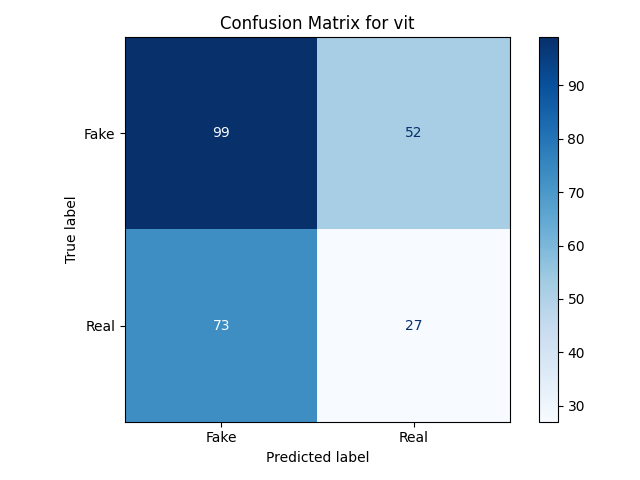
This section contains analysis of the performances of the 3 detectors on my curated dataset. I measure their performances by Accuracy, Precision, Recall, F1 score.
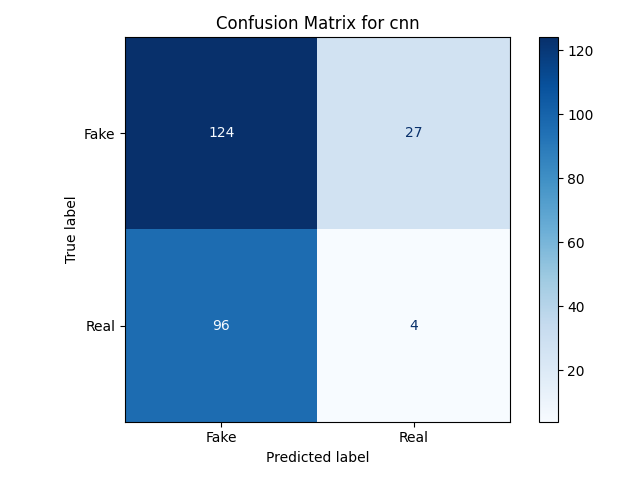
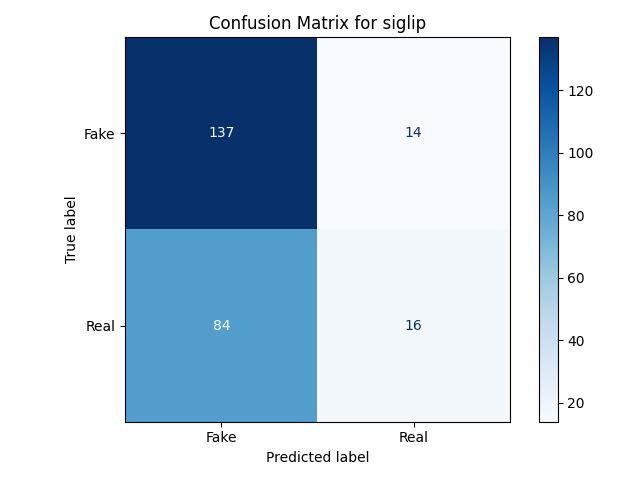
| CNN | Siglip | ViT |
|---|---|---|
 |  |  |
A random sample of images was taken and the model predictions are shown:

From all above, we can conclude that the models tend to err on the safe side and have a high tendancy to predict Fake, resulting 'high' accuracy in detecting fake images, but also a lot of misclassifications in terms of False Positives.
This project provides a brief overview and platform for benchmarking deepfake detection technology. Everything here was done or obtained using FREE / open-source services only.
This is me below!
As part of the requirements for Task 1, real and generated images were collected in order to benchmark the detectors we are interested in. The data was obtained from a variety of sources, including 'from the wild', faceswapping, and self generated images based on fixed prompts. Some images were generated to mimick certain specific persons and actions in order to stress test the detectors.
More info about the data collection process can be found here!
3 models of different architectures were used to classify the images into either Real or Fake. These models were chosen as they are open-source and lightweight which means we can achieve considerable results without a commercial GPU.
| Model | Architecture | Source | Challenges |
|---|---|---|---|
| Deep-Fake-Detector-v2-Model | ViT | https://huggingface.co/prithivMLmods/Deep-Fake-Detector-v2-Model | The labels are different so had to decode, and I realised changing the thresholding helps or else the standard 0.5 will just classify everything as Fake |
| Deepfake-Detect-Siglip2 | SigLip | https://huggingface.co/prithivMLmods/Deepfake-Detect-Siglip2 | nil |
| DeepFake-Detector | CNN | https://huggingface.co/MaanVad3r/DeepFake-Detector | Pretty old and basic model so we dont expect good performance |
This repo contains 2 functions, either run an automated pipeline for mass evalualtion via pipeline.py or create an interface for users to evaluate individual images via Gradio app.py
For Gradio app
git clone
docker build -t deepfake-benchmarking .
docker run -p 7860:7860 deepfake-benchmarking
go to http://127.0.0.1:7860/
For automated pipeline
docker run --rm deepfake-benchmarking python pipeline.py
This was developed in windows with Nvidia 4060 GPU
Upload your image here to see if the detectors work or not lol.
This section contains analysis of the performances of the 3 detectors on my curated dataset. I measure their performances by Accuracy, Precision, Recall, F1 score.
| CNN | Siglip | ViT |
|---|---|---|
| | |
A random sample of images was taken and the model predictions are shown:
From all above, we can conclude that the models tend to err on the safe side and have a high tendancy to predict Fake, resulting 'high' accuracy in detecting fake images, but also a lot of misclassifications in terms of False Positives.



