A complete computer system in small, readable OCaml programs: a kernel, a shell, C and ML compilers, an editor, a windowing system and more.
See the code
A whole computer system in small, readable OCaml programs: an ARM emulator, a kernel, a shell, C and ML compilers, an assembler and a linker, an editor, a build system, a database, version control, and more.
Website: aryx.github.io/IX, with a code map of the whole repository to explore in the browser (below).
IX is a way to learn how a computer system works, end to end, by reading its code. Each part of the system is a separate program, and each program is small enough to read in a few sittings. None of them is a toy, though. The emulator runs real ARM binaries, the compiler makes them, and the kernel boots a real operating system's user programs, up to its windowing system and the network.
The system IX follows is Plan 9, the successor of Unix written at
Bell Labs by Unix's own authors. Plan 9 is small, clean, and complete:
it has its own kernel, compilers, shell (rc), build tool (mk),
editor and windowing system (rio). It is explained program by
program in Principia Softwarica, a
series of books I (Yoann Padioleau) wrote, and my
xix project ports those programs to
OCaml at full size. You don't need to know either to read IX. IX
takes the same programs and makes each of them as small as it can.
Teaching people is the main goal of IX, and the test it sets itself is that one person can understand all of it, not only each program.
Most software fails that test. A kernel, a compiler or a browser of today is millions of lines and grows every year, until no single person understands it, its own authors included. Plan 9 is one of the few exceptions, which is why IX follows it.
Most of IX's code is written by an AI (see Who wrote it), but it does not start from nothing. It starts from designs made by people (Plan 9's, xv6's, xix's), and it is directed to write the smallest and most readable code that does the job. That code is then meant to become literate programs, as in Principia Softwarica: books of a reasonable size that explain all of the code to a human reader.
That is the paradox of IX. The trend these days is to use AI to write more and more code, faster than anyone can read it, until only the AI can add a feature to the program. This was already partly true before AI: many programs had grown so big that they were very hard to change. IX uses AI the other way. Here it rewrites giant programs in far less code, until a whole system is small enough for a person to understand again, and to extend: by hand, or by asking the AI, but in a way that person can still follow. AI can help people take back control of the programs they use.
AI makes the programs smaller. Humans understand more.
Each program in IX comes in two versions:
mini-mk, mini-rc, mini-cc, ...): a faithful
reimplementation of the Plan 9 program, only smaller. It is named
after the original and does the same thing: its output is the
original's, byte for byte. The executables mini-cc and mini-ld
make are the ones Plan 9's compiler and linker make. Together, the
mini programs are m-IX (a nod to Knuth's MIX computer).tiny-build, tiny-shell, tiny-c, ...): a free
variant, in a single file under tiny/. It is named after
what it does, not after the original. It keeps the idea of the
original and redesigns the rest, now that compatibility no longer
matters. Together, the tiny programs are t-IX.For example, mini-mk reads real Plan 9 mkfiles and builds all of
xix from them, and all of Principia Softwarica's Plan 9, kernel
included. tiny-build is a build system in one file of about
450 lines. It keeps mk's rules and % patterns, and uses content
digests instead of timestamps. Reading the two side by side shows
what is essential to a build system and what is history.
IX's code map shows the
whole repository as a map, in the browser: each folder a region, each
file a block the size of its code, each block the code itself once you
zoom in. Every folder and file carries a one-line summary, and the
X-ray (x) shows each part's skeleton, the few definitions the rest
hangs on and how they connect. / searches, a click on a name shows
its definition, g shows the dependencies between the parts as a
matrix, and h lists every key.
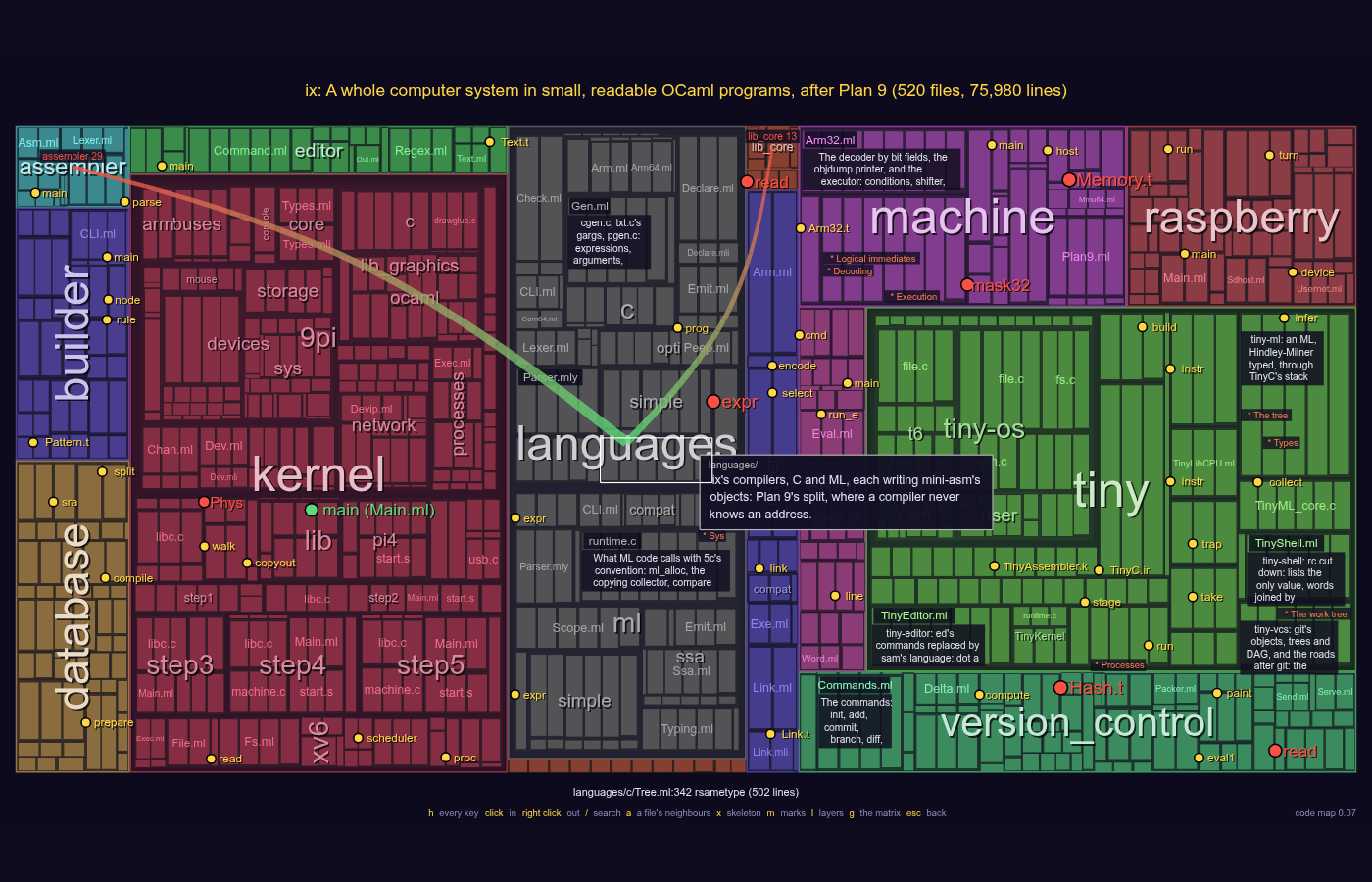
A link can open it on any part of the code:
a folder,
a file,
a definition;
the tables below link each program so. It is tinybox's code map, from
ocaml-elm-playground,
after the author's codemap; what it
says of each part comes from the .codemapconfig files in each
directory.
The line counts are OCaml, comments and .mli files included, tests
excluded. Each program's map link opens it in the code map.
| program | what it is | lines | Plan 9 original | code |
|---|---|---|---|---|
| mini-5i | an ARM emulator for user programs, arm32 and arm64, with Linux's or Plan 9's system calls | 4,300 | 5i | machine/ (map) |
| mini-qemu | a Raspberry Pi 1 and Pi 4 (MMU, interrupts, timer, UART, SD card, framebuffer, USB keyboard, mouse and network), which boots xv6, Plan 9 and IX's own kernels, as QEMU does | 3,500 | QEMU's raspi machines | raspberry/ (map) |
| mini-9pi | Plan 9's kernel in OCaml, on the Pi 1 and the Pi 4: boots Plan 9's own user programs up to the shell, the rio windowing system and TCP | 9,000 | 9pi | kernels/9pi/ (map) |
| mini-xv6 | MIT's teaching kernel xv6 in OCaml, on the Pi 1 and the Pi 4 | 1,600 | xv6 | kernels/xv6/ (map) |
| mini-cc | the C compiler for arm and arm64; the same instructions as Plan 9's 5c and 7c | 4,600 | 5c, 7c | languages/c/ (map) |
| mini-ml | a native compiler for OCaml (the subset IX is written in), for arm and arm64; it compiles all of IX, the kernels included | 4,300 | ocaml-light's ocamlopt | languages/ml/ (map) |
| mini-asm | the assembler for arm and arm64 | 800 | 5a, 7a | assembler/ (map) |
| mini-ld | the linker, to Plan 9's a.out, Linux's ELF and macOS's Mach-O (arm64); the same executables as the original's, byte for byte | 2,600 | 5l, 7l | linker/ (map) |
| mini-rc | the shell | 2,100 | rc | shell/ (map) |
| mini-ed | the line editor | 1,200 | ed | editors/ed/ (map) |
| mini-mk | the build system; builds all of xix and of Principia Softwarica's Plan 9 from their mkfiles | 2,400 | mk | builder/ (map) |
| mini-chidb | a relational database: SQL, a query optimizer, B-trees | 2,900 | chidb, SQLite's teaching twin | database/ (map) |
| mini-git, mini-diff, mini-merge3 | version control, compatible with git repositories | 4,700 | git9, diff | version_control/ (map) |
That is about 46,000 lines of OCaml, with mini-lex and mini-yacc
(1,200) and what the two kernels share. Under them: 4,600 lines of C and
assembly (mini-ml's runtime, the kernels' start), and the libraries,
lib_core/ (map) (what the programs share, mini-ml's
standard library and the C library under it: 16,200),
lib_crypto/ (map) (SHA-1) and
lib_compression/ (map) (zlib).
m-IX is about 67,000 lines in all (make loc; its log is
docs/loc.md).
Each one is a single file in tiny/ (map).
tiny/README.md says what idea each one keeps from
its original and what it redesigns.
| program | what it is | lines | mini twin | file |
|---|---|---|---|---|
| tiny-arm | an arm64 CPU for user programs: it runs what tiny-assembler, tiny-c and tiny-ml make, as Linux would | 460 | mini-5i | TinyCPUArm.ml, TinyLibArm.ml (map) |
| tiny-pi | tiny-arm's CPU in a Pi 4: exception levels, exceptions, timer, interrupt controller, UART; its page of kernel also runs under QEMU | 370 | mini-qemu | TinyMachinePi.ml (map) |
| tiny-cpu | a CPU of our own design, for teaching, with its assembler | 560 | mini-5i, Knuth's MIX | TinyCPU.ml, TinyLibCPU.ml (map) |
| tiny-machine | tiny-cpu with what a kernel needs: two modes, traps, a timer, protection, a console, a disk | 420 | mini-qemu | TinyMachine.ml (map) |
| tiny-kernel | a kernel in ML for tiny-machine: fork and exec, preemption, pipes, files | 570 | mini-9pi | TinyKernel.ml (map) |
| tiny-c | a C subset compiler, to arm64 and to tiny-cpu | 1,200 | mini-cc | TinyC.ml (map) |
| tiny-ml | an ML compiler (Hindley-Milner types, closures, exceptions, a garbage collector) to arm64 and to tiny-cpu | 1,750 | mini-ml | TinyML.ml (map) |
| tiny-assembler | assembler and linker in one, to arm64 executables (or a kernel's raw image) | 710 | mini-asm, mini-ld | TinyAssembler.ml (map) |
| tiny-shell | a shell in rc's spirit: lists as the only value | 680 | mini-rc | TinyShell.ml (map) |
| tiny-editor | an editor with sam's command language | 800 | mini-ed | TinyEditor.ml (map) |
| tiny-build | a build system: rules, %, digests, -j | 440 | mini-mk | TinyBuildSystem.ml (map) |
| tiny-db | a database whose query language is the relational algebra, over a copy-on-write B-tree | 620 | mini-chidb | TinyDatabase.ml (map) |
| tiny-vcs | version control with git's objects, an undo log, and no staging area | 690 | mini-git | TinyVCS.ml (map) |
That is about 9,000 lines of OCaml; with the operating system below,
t-IX is about 16,000 lines in all. tiny-cpu and tiny-machine also
run tiny/tiny-os/ (map), an operating system written for
them in their assembly and in C for tiny-c: a page-long kernel (v0),
an xv6-like kernel with a disk and a shell (v6), and a free variant of
it (t6).
make          # builds everything; the executables are then in bin/
make test
./bin/mini-mk -h            # every program has -h, with examples
./mini-pi mini-9pi          # boot mini-9pi on mini-qemu, with ix's own programs (mini-rc...)
./mini-pi mini-9pi-principia -g   # with principia's programs and SD card: type rio
./tiny-machine v6           # boot tiny-os's xv6-like kernel on tiny-machine
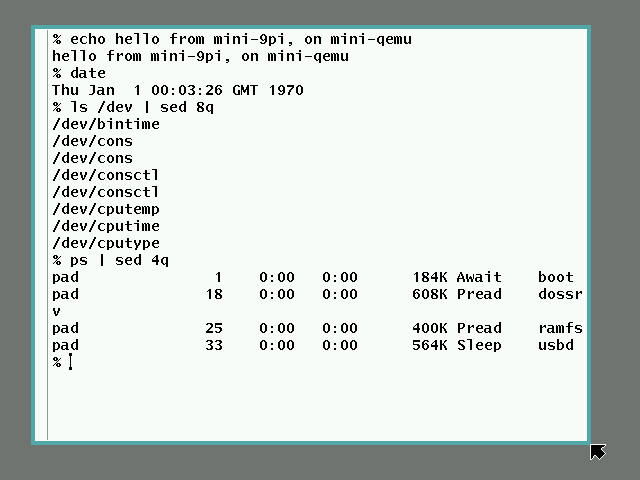
mini-9pi under mini-qemu, running Plan 9's own rio
(kernels/9pi/tests/screenshot.py made the picture):
The tests, short and whole:
make test-lite      # under a minute, on all the cores: unit tests, mini-ml on IX,
                    # IX built by IX from nothing, a kernel booted
make test-all       # every test suite, one after the other, with a summary: half an
                    # hour (tests/all.sh -l lists them; -quick: the short ones)
dune install installs both the mini and the tiny executables.
make build-docker builds and tests IX in a fresh Ubuntu (the
Dockerfile, which GitHub Actions runs with OCaml 4.14.2
and 5.1.1).
The plans, tutorials, manuals and related-work notes are indexed in docs/README.md, and docs/projects.md maps the projects inside IX: the machines (real ARM, or our own) and what runs on each.
IX builds itself. The first build needs a compiler from outside:
make uses dune, OCaml 4.14 and, under OCaml, gcc. After it, IX's own
tools are enough: mini-mk runs the mkfiles, mini-ml, mini-lex and
mini-yacc compile the OCaml, mini-cc and mini-asm the C library and
mini-ml's runtime, mini-ar and mini-ld link. No OCaml compiler, gcc,
GNU binutils or glibc is run or linked; the results are under _mk/.
make                # stage 0: IX built by OCaml and dune (bin/)
make ix             # stage 1: IX built by stage 0's tools, for arm64 (make ix-arm: for arm)
make test-fixpoint  # stage 2: IX built by stage 1's tools: the same files
make kernels-ix     # mini-xv6 and mini-9pi for the Pi 4, the same way
make test-ix        # each program of stage 1 against dune's build of it
Stage 2 is the fixed point: IX built by the programs that IX built
gives the same 383 files as stage 1, byte for byte, in about a minute
on a large machine. On arm, where the programs run under qemu-arm, the
second and third builds are the same 358 files (make test-fixpoint-arm). The kernels built this way boot on the Pi 4 under
mini-qemu and QEMU and pass the same checks as the ones built by
ocaml-light and gcc (make test-kernels-ix).
What is not built by IX: mini-qemu, which opens its window with SDL, and the tests. The plan and its history are in docs/plans/plan_mkfiles.md and docs/plans/plan_ml_bootstrap.md.
There is a good tradition of teaching computer systems by their code: Nand2Tetris (The Elements of Computing Systems) for the whole stack, Minix (Operating Systems: Design and Implementation) for an operating system, and xv6 for a kernel. The Nand2Tetris route makes everything minimal: a made-up machine, a made-up assembler, a made-up OS. IX aims for the full stack too, but makes the programs tiny, not the things they deal with:
codesign), and
Plan 9's a.out. So you can use the toolchain for programs on your
own machine, as with goken. The
same binary runs on IX's emulator, on
QEMU and on a real ARM machine. Running it on several and comparing
the results is the main test.One group of tiny programs takes the other road on purpose. tiny-cpu and tiny-machine are a made-up machine, as Knuth's MIX and MMIX (MMIXware: A RISC Computer for the Third Millennium) and Nand2Tetris's Hack are, because what they teach is the design of an instruction set: the choices a real one made for history's reasons, made again with hindsight. They stand next to tiny-arm and tiny-pi, the same two programs for real ARM, so that the two roads can be compared.
The rest of the system, following the Principia Softwarica books (the names are not final):
| part | mini | tiny | Plan 9 original |
|---|---|---|---|
| Debuggers | mini-db, mini-acid | tiny-debugger | db, acid |
| Profilers | mini-prof | tiny-profiler | prof, tprof |
| Graphics stack | mini-draw | tiny-draw | libdraw, libmemdraw, devdraw |
| Windowing system | mini-rio | tiny-windows | rio |
| GUI toolkit | mini-panel | tiny-gui | libpanel |
| Network stack | mini-ip | tiny-net | devip, libip, lib9p |
| Web browser | mini-mothra | tiny-browser | mothra, webfs |
| Command-line utilities | mini-cat, mini-ls, mini-grep, mini-hoc, mini-awk, mini-dc, mini-bc, ... | cat, ls, grep, sed, awk, hoc, dc, bc | |
| Games | the author's playground's, on its library (games/, lib_playground/): Tetris | games/4s |
mini-9pi already has parts of some of these in its kernel (the draw device, the IP stack), with Plan 9's C programs running on top.
Everything is OCaml, the kernel included, and it runs as a real
binary. Unlike Nachos, where the "OS" is ordinary code running on
the host, mini-9pi is an actual ARM binary: a thin layer of C and
assembly boots the machine and starts a stripped-down OCaml runtime,
and the kernel is OCaml from there on. The same binary boots on
mini-qemu and on QEMU, and is meant for a real Raspberry Pi too.
Processes, address
spaces, context switches, supervisor and user mode and the system
call boundary are therefore real. Today mini-9pi is compiled by
ocaml-light's ocamlopt; mini-ml is being written to take over.
 user program (a.out)                          user mode
 ----------------- SWI / trap / irq -----------------------
 mini-9pi (OCaml + thin C/asm runtime shim)     supervisor mode
 ---------------------------------------------------------------
 ARM CPU + CP15 (MMU, modes): a real Raspberry Pi, or
 mini-qemu emulating one, with disk, timer, framebuffer,
 keyboard, mouse and network
Most tools are terminal programs. They read and write files,
stdin and stdout, and depend on nothing graphical. They follow
xix's capability style (Cap.*) for
OS access.
Only mini-qemu depends on a GUI library (SDL), to show the machine's framebuffer and feed it the keyboard and mouse. The machine itself is a pure library, so it also runs in a terminal. The graphical programs (rio and those it runs) run inside the machine and draw into its framebuffer, as on a real computer.
IX is mostly written by Claude (Anthropic's AI, in Claude Code), under my direction: I choose the design and review the code, and Claude writes most of the lines, for people to read (the goal). xix, on the other hand, I mostly wrote myself. Putting each mini program next to its xix twin makes a fair comparison of the two ways of working. The project started on 2026-09-21; docs/history.md tells how.
docs/yoann_notes/prompt-history.md
shows the other side of that work: every prompt I wrote to Claude to
build IX, in order and verbatim (typos included), each followed by a
short summary of Claude's answer. Hooks in .claude/ append the
entries as I work, so the file grows with the repository. Read next to
git log, it shows what directing an AI to write a codebase looks like
day to day.
IX is 9 in roman numerals (Plan 9), and ix is xix with a letter
removed: a smaller xix, as 9 is smaller than 19. It is also the "-ix"
of Unix, Minix and Linux with nothing in front. And it has two
letters, like rc, mk, ed and the other Unix and Plan 9 names,
and like "ai", which writes most of it. In text it is written IX, as
UNIX was, and ix where it is a name in the code (ix_core, ix_db).
LGPL 2.1 with the OCaml-style linking exception, like xix: see license.txt and copyright.txt.
324 followers · starred Oct 2026
453 followers · starred Sep 2026
366 followers · starred Oct 2026
23 followers · starred Oct 2026
A complete computer system in small, readable OCaml programs: a kernel, a shell, C and ML compilers, an editor, a windowing system and more.
See the codeA whole computer system in small, readable OCaml programs: an ARM emulator, a kernel, a shell, C and ML compilers, an assembler and a linker, an editor, a build system, a database, version control, and more.
Website: aryx.github.io/IX, with a code map of the whole repository to explore in the browser (below).
IX is a way to learn how a computer system works, end to end, by reading its code. Each part of the system is a separate program, and each program is small enough to read in a few sittings. None of them is a toy, though. The emulator runs real ARM binaries, the compiler makes them, and the kernel boots a real operating system's user programs, up to its windowing system and the network.
The system IX follows is Plan 9, the successor of Unix written at
Bell Labs by Unix's own authors. Plan 9 is small, clean, and complete:
it has its own kernel, compilers, shell (rc), build tool (mk),
editor and windowing system (rio). It is explained program by
program in Principia Softwarica, a
series of books I (Yoann Padioleau) wrote, and my
xix project ports those programs to
OCaml at full size. You don't need to know either to read IX. IX
takes the same programs and makes each of them as small as it can.
Teaching people is the main goal of IX, and the test it sets itself is that one person can understand all of it, not only each program.
Most software fails that test. A kernel, a compiler or a browser of today is millions of lines and grows every year, until no single person understands it, its own authors included. Plan 9 is one of the few exceptions, which is why IX follows it.
Most of IX's code is written by an AI (see Who wrote it), but it does not start from nothing. It starts from designs made by people (Plan 9's, xv6's, xix's), and it is directed to write the smallest and most readable code that does the job. That code is then meant to become literate programs, as in Principia Softwarica: books of a reasonable size that explain all of the code to a human reader.
That is the paradox of IX. The trend these days is to use AI to write more and more code, faster than anyone can read it, until only the AI can add a feature to the program. This was already partly true before AI: many programs had grown so big that they were very hard to change. IX uses AI the other way. Here it rewrites giant programs in far less code, until a whole system is small enough for a person to understand again, and to extend: by hand, or by asking the AI, but in a way that person can still follow. AI can help people take back control of the programs they use.
AI makes the programs smaller. Humans understand more.
Each program in IX comes in two versions:
mini-mk, mini-rc, mini-cc, ...): a faithful
reimplementation of the Plan 9 program, only smaller. It is named
after the original and does the same thing: its output is the
original's, byte for byte. The executables mini-cc and mini-ld
make are the ones Plan 9's compiler and linker make. Together, the
mini programs are m-IX (a nod to Knuth's MIX computer).tiny-build, tiny-shell, tiny-c, ...): a free
variant, in a single file under tiny/. It is named after
what it does, not after the original. It keeps the idea of the
original and redesigns the rest, now that compatibility no longer
matters. Together, the tiny programs are t-IX.For example, mini-mk reads real Plan 9 mkfiles and builds all of
xix from them, and all of Principia Softwarica's Plan 9, kernel
included. tiny-build is a build system in one file of about
450 lines. It keeps mk's rules and % patterns, and uses content
digests instead of timestamps. Reading the two side by side shows
what is essential to a build system and what is history.
IX's code map shows the
whole repository as a map, in the browser: each folder a region, each
file a block the size of its code, each block the code itself once you
zoom in. Every folder and file carries a one-line summary, and the
X-ray (x) shows each part's skeleton, the few definitions the rest
hangs on and how they connect. / searches, a click on a name shows
its definition, g shows the dependencies between the parts as a
matrix, and h lists every key.
A link can open it on any part of the code:
a folder,
a file,
a definition;
the tables below link each program so. It is tinybox's code map, from
ocaml-elm-playground,
after the author's codemap; what it
says of each part comes from the .codemapconfig files in each
directory.
The line counts are OCaml, comments and .mli files included, tests
excluded. Each program's map link opens it in the code map.
| program | what it is | lines | Plan 9 original | code |
|---|---|---|---|---|
| mini-5i | an ARM emulator for user programs, arm32 and arm64, with Linux's or Plan 9's system calls | 4,300 | 5i | machine/ (map) |
| mini-qemu | a Raspberry Pi 1 and Pi 4 (MMU, interrupts, timer, UART, SD card, framebuffer, USB keyboard, mouse and network), which boots xv6, Plan 9 and IX's own kernels, as QEMU does | 3,500 | QEMU's raspi machines | raspberry/ (map) |
| mini-9pi | Plan 9's kernel in OCaml, on the Pi 1 and the Pi 4: boots Plan 9's own user programs up to the shell, the rio windowing system and TCP | 9,000 | 9pi | kernels/9pi/ (map) |
| mini-xv6 | MIT's teaching kernel xv6 in OCaml, on the Pi 1 and the Pi 4 | 1,600 | xv6 | kernels/xv6/ (map) |
| mini-cc | the C compiler for arm and arm64; the same instructions as Plan 9's 5c and 7c | 4,600 | 5c, 7c | languages/c/ (map) |
| mini-ml | a native compiler for OCaml (the subset IX is written in), for arm and arm64; it compiles all of IX, the kernels included | 4,300 | ocaml-light's ocamlopt | languages/ml/ (map) |
| mini-asm | the assembler for arm and arm64 | 800 | 5a, 7a | assembler/ (map) |
| mini-ld | the linker, to Plan 9's a.out, Linux's ELF and macOS's Mach-O (arm64); the same executables as the original's, byte for byte | 2,600 | 5l, 7l | linker/ (map) |
| mini-rc | the shell | 2,100 | rc | shell/ (map) |
| mini-ed | the line editor | 1,200 | ed | editors/ed/ (map) |
| mini-mk | the build system; builds all of xix and of Principia Softwarica's Plan 9 from their mkfiles | 2,400 | mk | builder/ (map) |
| mini-chidb | a relational database: SQL, a query optimizer, B-trees | 2,900 | chidb, SQLite's teaching twin | database/ (map) |
| mini-git, mini-diff, mini-merge3 | version control, compatible with git repositories | 4,700 | git9, diff | version_control/ (map) |
That is about 46,000 lines of OCaml, with mini-lex and mini-yacc
(1,200) and what the two kernels share. Under them: 4,600 lines of C and
assembly (mini-ml's runtime, the kernels' start), and the libraries,
lib_core/ (map) (what the programs share, mini-ml's
standard library and the C library under it: 16,200),
lib_crypto/ (map) (SHA-1) and
lib_compression/ (map) (zlib).
m-IX is about 67,000 lines in all (make loc; its log is
docs/loc.md).
Each one is a single file in tiny/ (map).
tiny/README.md says what idea each one keeps from
its original and what it redesigns.
| program | what it is | lines | mini twin | file |
|---|---|---|---|---|
| tiny-arm | an arm64 CPU for user programs: it runs what tiny-assembler, tiny-c and tiny-ml make, as Linux would | 460 | mini-5i | TinyCPUArm.ml, TinyLibArm.ml (map) |
| tiny-pi | tiny-arm's CPU in a Pi 4: exception levels, exceptions, timer, interrupt controller, UART; its page of kernel also runs under QEMU | 370 | mini-qemu | TinyMachinePi.ml (map) |
| tiny-cpu | a CPU of our own design, for teaching, with its assembler | 560 | mini-5i, Knuth's MIX | TinyCPU.ml, TinyLibCPU.ml (map) |
| tiny-machine | tiny-cpu with what a kernel needs: two modes, traps, a timer, protection, a console, a disk | 420 | mini-qemu | TinyMachine.ml (map) |
| tiny-kernel | a kernel in ML for tiny-machine: fork and exec, preemption, pipes, files | 570 | mini-9pi | TinyKernel.ml (map) |
| tiny-c | a C subset compiler, to arm64 and to tiny-cpu | 1,200 | mini-cc | TinyC.ml (map) |
| tiny-ml | an ML compiler (Hindley-Milner types, closures, exceptions, a garbage collector) to arm64 and to tiny-cpu | 1,750 | mini-ml | TinyML.ml (map) |
| tiny-assembler | assembler and linker in one, to arm64 executables (or a kernel's raw image) | 710 | mini-asm, mini-ld | TinyAssembler.ml (map) |
| tiny-shell | a shell in rc's spirit: lists as the only value | 680 | mini-rc | TinyShell.ml (map) |
| tiny-editor | an editor with sam's command language | 800 | mini-ed | TinyEditor.ml (map) |
| tiny-build | a build system: rules, %, digests, -j | 440 | mini-mk | TinyBuildSystem.ml (map) |
| tiny-db | a database whose query language is the relational algebra, over a copy-on-write B-tree | 620 | mini-chidb | TinyDatabase.ml (map) |
| tiny-vcs | version control with git's objects, an undo log, and no staging area | 690 | mini-git | TinyVCS.ml (map) |
That is about 9,000 lines of OCaml; with the operating system below,
t-IX is about 16,000 lines in all. tiny-cpu and tiny-machine also
run tiny/tiny-os/ (map), an operating system written for
them in their assembly and in C for tiny-c: a page-long kernel (v0),
an xv6-like kernel with a disk and a shell (v6), and a free variant of
it (t6).
make          # builds everything; the executables are then in bin/
make test
./bin/mini-mk -h            # every program has -h, with examples
./mini-pi mini-9pi          # boot mini-9pi on mini-qemu, with ix's own programs (mini-rc...)
./mini-pi mini-9pi-principia -g   # with principia's programs and SD card: type rio
./tiny-machine v6           # boot tiny-os's xv6-like kernel on tiny-machine
mini-9pi under mini-qemu, running Plan 9's own rio
(kernels/9pi/tests/screenshot.py made the picture):
The tests, short and whole:
make test-lite      # under a minute, on all the cores: unit tests, mini-ml on IX,
                    # IX built by IX from nothing, a kernel booted
make test-all       # every test suite, one after the other, with a summary: half an
                    # hour (tests/all.sh -l lists them; -quick: the short ones)
dune install installs both the mini and the tiny executables.
make build-docker builds and tests IX in a fresh Ubuntu (the
Dockerfile, which GitHub Actions runs with OCaml 4.14.2
and 5.1.1).
The plans, tutorials, manuals and related-work notes are indexed in docs/README.md, and docs/projects.md maps the projects inside IX: the machines (real ARM, or our own) and what runs on each.
IX builds itself. The first build needs a compiler from outside:
make uses dune, OCaml 4.14 and, under OCaml, gcc. After it, IX's own
tools are enough: mini-mk runs the mkfiles, mini-ml, mini-lex and
mini-yacc compile the OCaml, mini-cc and mini-asm the C library and
mini-ml's runtime, mini-ar and mini-ld link. No OCaml compiler, gcc,
GNU binutils or glibc is run or linked; the results are under _mk/.
make                # stage 0: IX built by OCaml and dune (bin/)
make ix             # stage 1: IX built by stage 0's tools, for arm64 (make ix-arm: for arm)
make test-fixpoint  # stage 2: IX built by stage 1's tools: the same files
make kernels-ix     # mini-xv6 and mini-9pi for the Pi 4, the same way
make test-ix        # each program of stage 1 against dune's build of it
Stage 2 is the fixed point: IX built by the programs that IX built
gives the same 383 files as stage 1, byte for byte, in about a minute
on a large machine. On arm, where the programs run under qemu-arm, the
second and third builds are the same 358 files (make test-fixpoint-arm). The kernels built this way boot on the Pi 4 under
mini-qemu and QEMU and pass the same checks as the ones built by
ocaml-light and gcc (make test-kernels-ix).
What is not built by IX: mini-qemu, which opens its window with SDL, and the tests. The plan and its history are in docs/plans/plan_mkfiles.md and docs/plans/plan_ml_bootstrap.md.
There is a good tradition of teaching computer systems by their code: Nand2Tetris (The Elements of Computing Systems) for the whole stack, Minix (Operating Systems: Design and Implementation) for an operating system, and xv6 for a kernel. The Nand2Tetris route makes everything minimal: a made-up machine, a made-up assembler, a made-up OS. IX aims for the full stack too, but makes the programs tiny, not the things they deal with:
codesign), and
Plan 9's a.out. So you can use the toolchain for programs on your
own machine, as with goken. The
same binary runs on IX's emulator, on
QEMU and on a real ARM machine. Running it on several and comparing
the results is the main test.One group of tiny programs takes the other road on purpose. tiny-cpu and tiny-machine are a made-up machine, as Knuth's MIX and MMIX (MMIXware: A RISC Computer for the Third Millennium) and Nand2Tetris's Hack are, because what they teach is the design of an instruction set: the choices a real one made for history's reasons, made again with hindsight. They stand next to tiny-arm and tiny-pi, the same two programs for real ARM, so that the two roads can be compared.
The rest of the system, following the Principia Softwarica books (the names are not final):
| part | mini | tiny | Plan 9 original |
|---|---|---|---|
| Debuggers | mini-db, mini-acid | tiny-debugger | db, acid |
| Profilers | mini-prof | tiny-profiler | prof, tprof |
| Graphics stack | mini-draw | tiny-draw | libdraw, libmemdraw, devdraw |
| Windowing system | mini-rio | tiny-windows | rio |
| GUI toolkit | mini-panel | tiny-gui | libpanel |
| Network stack | mini-ip | tiny-net | devip, libip, lib9p |
| Web browser | mini-mothra | tiny-browser | mothra, webfs |
| Command-line utilities | mini-cat, mini-ls, mini-grep, mini-hoc, mini-awk, mini-dc, mini-bc, ... | cat, ls, grep, sed, awk, hoc, dc, bc | |
| Games | the author's playground's, on its library (games/, lib_playground/): Tetris | games/4s |
mini-9pi already has parts of some of these in its kernel (the draw device, the IP stack), with Plan 9's C programs running on top.
Everything is OCaml, the kernel included, and it runs as a real
binary. Unlike Nachos, where the "OS" is ordinary code running on
the host, mini-9pi is an actual ARM binary: a thin layer of C and
assembly boots the machine and starts a stripped-down OCaml runtime,
and the kernel is OCaml from there on. The same binary boots on
mini-qemu and on QEMU, and is meant for a real Raspberry Pi too.
Processes, address
spaces, context switches, supervisor and user mode and the system
call boundary are therefore real. Today mini-9pi is compiled by
ocaml-light's ocamlopt; mini-ml is being written to take over.
 user program (a.out)                          user mode
 ----------------- SWI / trap / irq -----------------------
 mini-9pi (OCaml + thin C/asm runtime shim)     supervisor mode
 ---------------------------------------------------------------
 ARM CPU + CP15 (MMU, modes): a real Raspberry Pi, or
 mini-qemu emulating one, with disk, timer, framebuffer,
 keyboard, mouse and network
Most tools are terminal programs. They read and write files,
stdin and stdout, and depend on nothing graphical. They follow
xix's capability style (Cap.*) for
OS access.
Only mini-qemu depends on a GUI library (SDL), to show the machine's framebuffer and feed it the keyboard and mouse. The machine itself is a pure library, so it also runs in a terminal. The graphical programs (rio and those it runs) run inside the machine and draw into its framebuffer, as on a real computer.
IX is mostly written by Claude (Anthropic's AI, in Claude Code), under my direction: I choose the design and review the code, and Claude writes most of the lines, for people to read (the goal). xix, on the other hand, I mostly wrote myself. Putting each mini program next to its xix twin makes a fair comparison of the two ways of working. The project started on 2026-09-21; docs/history.md tells how.
docs/yoann_notes/prompt-history.md
shows the other side of that work: every prompt I wrote to Claude to
build IX, in order and verbatim (typos included), each followed by a
short summary of Claude's answer. Hooks in .claude/ append the
entries as I work, so the file grows with the repository. Read next to
git log, it shows what directing an AI to write a codebase looks like
day to day.
IX is 9 in roman numerals (Plan 9), and ix is xix with a letter
removed: a smaller xix, as 9 is smaller than 19. It is also the "-ix"
of Unix, Minix and Linux with nothing in front. And it has two
letters, like rc, mk, ed and the other Unix and Plan 9 names,
and like "ai", which writes most of it. In text it is written IX, as
UNIX was, and ix where it is a name in the code (ix_core, ix_db).
LGPL 2.1 with the OCaml-style linking exception, like xix: see license.txt and copyright.txt.
324 followers · starred Oct 2026
453 followers · starred Sep 2026
366 followers · starred Oct 2026
23 followers · starred Oct 2026



