Based on the proxy gateway service of dubbo-go, it solves the problem that the external protocol calls the internal Dubbo cluster. At present, it supports HTTP and gRPC[developing].
See the code


English | 中文
Dubbo-Go-Pixiu is a next-generation AI / API Gateway built on Dubbo-go, empowering seamless connections to LLMs and MCPs with unified access, intelligent extensions, and cost-efficient management. At the same time, Pixiu bridges external protocols with internal Dubbo clusters, supporting HTTP, gRPC, Dubbo2, and Triple for high-performance, scalable integration.
⭐ New Capability: Pixiu has evolved into a universal AI Gateway, designed to simplify and unify access to LLMs and AI service providers — whether from public vendors or self-hosted models.
⭐ New Capability: Pixiu has also evolved into a Kubernetes Ingress Controller, enabling native management of API and AI traffic within Kubernetes clusters through declarative routing and Pixiu’s flexible governance model.
👉 Try it now: Explore our official samples
Pixiu has evolved into a universal AI Gateway, designed to simplify and unify access to LLMs and AI service providers — whether from public vendors or self-hosted models.
With Pixiu, you can:
Unified Access to AI Models: Connect effortlessly to OpenAI, Anthropic, or any custom / on-prem LLM or MCP service through a single, consistent API gateway layer.
MCP Server Exposure: Expose your existing HTTP APIs and backend services as MCP Servers through Pixiu, enabling AI applications to directly invoke your business logic.
Flexible Extension for AI Workloads: Apply authentication, caching, rate-limiting, retry policy, observability, or even model orchestration — all through Pixiu's plugin system.
Multi-Tenant & Cost-Efficient: Implement fine-grained cost control, auditing, and token accounting for large-scale AI deployments.
Future-Proof Architecture: Designed for the hybrid world of API + AI traffic — bridging traditional microservices with the AI-first era.
✨ Now also a Kubernetes Ingress Controller: Pixiu’s AI gateway abilities can now be applied directly at the cluster ingress layer — allowing traffic governance, routing, and observability to be defined declaratively via Kubernetes APIs.
👉 Try it now: Explore our AI Gateway Samples: LLM and MCP
⚡ High Performance: Built with Go for ultra-low latency and high throughput, Pixiu is optimized for large-scale API traffic and LLM workloads.
🧩 Highly Extensible: A powerful plugin and filter framework makes it easy to extend or customize gateway behavior — from routing and authentication to observability and AI-specific use cases.
🎯 Developer Friendly: Simple configuration, unified management plane, and clear observability make Pixiu ideal for both developers and platform engineers.
🌩️ Cloud-Native by Design: Works seamlessly in Kubernetes, supports declarative configuration, and integrates easily with Dubbo, Spring Cloud, or custom backends.
🔗 Seamless Dubbo Integration: The official sidecar solution for connecting non-Java applications (Go, Python, Node.js, etc.) to Dubbo services.
| Category | Description |
|---|---|
| 🚀 Protocol Processing | Supports proxying and translation between HTTP, gRPC, Dubbo2, and Triple protocols, delivering rich protocol gateway features. |
| 🛡️ Security & Auth | HTTPS, JWT, OAuth2, and other security mechanisms to safeguard your APIs and AI endpoints. |
| 🔍 Service Discovery | Integrates with Zookeeper, Nacos, or any service registry to discover Dubbo and Spring Cloud services automatically. |
| ⚖️ Traffic Governance | Integrates with Sentinel for fine-grained rate limiting, circuit breaking, and traffic shaping. |
| 📈 Observability | OpenTelemetry and Jaeger support for full tracing, metrics, and logging visibility. |
| 🎨 Visual Management | The Pixiu-admin UI offers real-time visual configuration for gateway rules and policies. |
We also provide Docker images for quick and easy deployment.
1. Build Docker Image from Source Code
Make sure you are in the root directory of the project (where the Dockerfile is located), then run the following command to build the image:
# You can customize the image name and tag, here we use dubbo-go-pixiu:local
docker build -t dubbo-go-pixiu:local .
It may take a few minutes to build. Once successful, you can use the local image named dubbo-go-pixiu:local.
2. Run Pixiu with Default Configuration
Start a container using the local image you just built:
docker run --name pixiu-gateway -p 8888:8888 -d dubbo-go-pixiu:local
3. Run with Custom Configuration File
If you need to use your own configuration file, you can mount a local file to the container's /etc/pixiu/ directory.
# make sure to use the local image name you built, i.e., dubbo-go-pixiu:local
docker run --name pixiu-gateway -p 8888:8888 -d \
    -v /your/local/path/conf.yaml:/etc/pixiu/conf.yaml \
    -v /your/local/path/log.yml:/etc/pixiu/log.yml \
    dubbo-go-pixiu:local
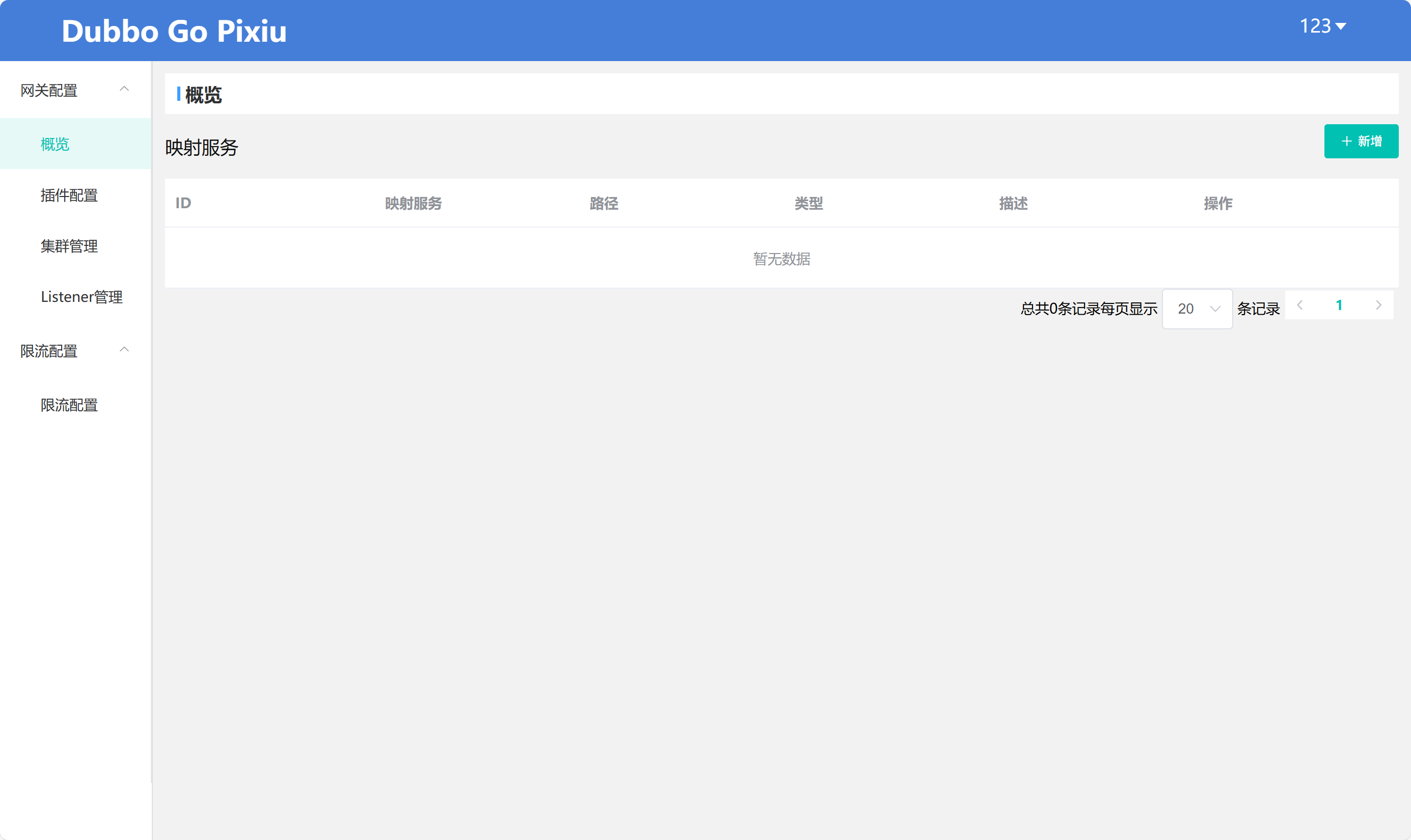
Manage traffic, routing via pixiu-admin.
For a single-instance development deployment, start Docker Compose without a key:
docker compose up -d
When DUBBOGO_PIXIU_JWT_SIGN_KEY is empty, the admin generates a random key in memory for that process. It is never written to a file: restarting the backend invalidates its admin JWTs, and separate replicas cannot verify each other's tokens. For production or multiple replicas, configure the same unique random key of at least 32 bytes in every instance, for example through a secret manager. For Compose, you can put it in a private .env file (generate one with openssl rand -hex 32); do not commit that file. The former default dubbo-go-pixiu and short configured keys are rejected.
👉 Access admin UI at: http://localhost:8080
We warmly welcome all forms of contributions! Whether it's submitting an issue, proposing a new feature, or contributing code, your participation is vital to the project.
Join Our Community:
Join our discussion group through Ding talk, WeChat, or Discord.
discord https://discord.gg/C5ywvytg
If you like Dubbo-Go-Pixiu, please ⭐ star us on GitHub!
This project is licensed under the Apache License, Version 2.0.
Overall
Maintained
Code review
Go module
Latest release
Releases this year
801 followers · starred Jul 2023
168 followers · starred Aug 2022
677 followers · starred Apr 2021
53 followers · starred Dec 2021
Based on the proxy gateway service of dubbo-go, it solves the problem that the external protocol calls the internal Dubbo cluster. At present, it supports HTTP and gRPC[developing].
See the code
English | 中文
Dubbo-Go-Pixiu is a next-generation AI / API Gateway built on Dubbo-go, empowering seamless connections to LLMs and MCPs with unified access, intelligent extensions, and cost-efficient management. At the same time, Pixiu bridges external protocols with internal Dubbo clusters, supporting HTTP, gRPC, Dubbo2, and Triple for high-performance, scalable integration.
⭐ New Capability: Pixiu has evolved into a universal AI Gateway, designed to simplify and unify access to LLMs and AI service providers — whether from public vendors or self-hosted models.
⭐ New Capability: Pixiu has also evolved into a Kubernetes Ingress Controller, enabling native management of API and AI traffic within Kubernetes clusters through declarative routing and Pixiu’s flexible governance model.
👉 Try it now: Explore our official samples
Pixiu has evolved into a universal AI Gateway, designed to simplify and unify access to LLMs and AI service providers — whether from public vendors or self-hosted models.
With Pixiu, you can:
Unified Access to AI Models: Connect effortlessly to OpenAI, Anthropic, or any custom / on-prem LLM or MCP service through a single, consistent API gateway layer.
MCP Server Exposure: Expose your existing HTTP APIs and backend services as MCP Servers through Pixiu, enabling AI applications to directly invoke your business logic.
Flexible Extension for AI Workloads: Apply authentication, caching, rate-limiting, retry policy, observability, or even model orchestration — all through Pixiu's plugin system.
Multi-Tenant & Cost-Efficient: Implement fine-grained cost control, auditing, and token accounting for large-scale AI deployments.
Future-Proof Architecture: Designed for the hybrid world of API + AI traffic — bridging traditional microservices with the AI-first era.
✨ Now also a Kubernetes Ingress Controller: Pixiu’s AI gateway abilities can now be applied directly at the cluster ingress layer — allowing traffic governance, routing, and observability to be defined declaratively via Kubernetes APIs.
👉 Try it now: Explore our AI Gateway Samples: LLM and MCP
⚡ High Performance: Built with Go for ultra-low latency and high throughput, Pixiu is optimized for large-scale API traffic and LLM workloads.
🧩 Highly Extensible: A powerful plugin and filter framework makes it easy to extend or customize gateway behavior — from routing and authentication to observability and AI-specific use cases.
🎯 Developer Friendly: Simple configuration, unified management plane, and clear observability make Pixiu ideal for both developers and platform engineers.
🌩️ Cloud-Native by Design: Works seamlessly in Kubernetes, supports declarative configuration, and integrates easily with Dubbo, Spring Cloud, or custom backends.
🔗 Seamless Dubbo Integration: The official sidecar solution for connecting non-Java applications (Go, Python, Node.js, etc.) to Dubbo services.
| Category | Description |
|---|---|
| 🚀 Protocol Processing | Supports proxying and translation between HTTP, gRPC, Dubbo2, and Triple protocols, delivering rich protocol gateway features. |
| 🛡️ Security & Auth | HTTPS, JWT, OAuth2, and other security mechanisms to safeguard your APIs and AI endpoints. |
| 🔍 Service Discovery | Integrates with Zookeeper, Nacos, or any service registry to discover Dubbo and Spring Cloud services automatically. |
| ⚖️ Traffic Governance | Integrates with Sentinel for fine-grained rate limiting, circuit breaking, and traffic shaping. |
| 📈 Observability | OpenTelemetry and Jaeger support for full tracing, metrics, and logging visibility. |
| 🎨 Visual Management | The Pixiu-admin UI offers real-time visual configuration for gateway rules and policies. |
We also provide Docker images for quick and easy deployment.
1. Build Docker Image from Source Code
Make sure you are in the root directory of the project (where the Dockerfile is located), then run the following command to build the image:
# You can customize the image name and tag, here we use dubbo-go-pixiu:local
docker build -t dubbo-go-pixiu:local .
It may take a few minutes to build. Once successful, you can use the local image named dubbo-go-pixiu:local.
2. Run Pixiu with Default Configuration
Start a container using the local image you just built:
docker run --name pixiu-gateway -p 8888:8888 -d dubbo-go-pixiu:local
3. Run with Custom Configuration File
If you need to use your own configuration file, you can mount a local file to the container's /etc/pixiu/ directory.
# make sure to use the local image name you built, i.e., dubbo-go-pixiu:local
docker run --name pixiu-gateway -p 8888:8888 -d \
    -v /your/local/path/conf.yaml:/etc/pixiu/conf.yaml \
    -v /your/local/path/log.yml:/etc/pixiu/log.yml \
    dubbo-go-pixiu:local
Manage traffic, routing via pixiu-admin.
For a single-instance development deployment, start Docker Compose without a key:
docker compose up -d
When DUBBOGO_PIXIU_JWT_SIGN_KEY is empty, the admin generates a random key in memory for that process. It is never written to a file: restarting the backend invalidates its admin JWTs, and separate replicas cannot verify each other's tokens. For production or multiple replicas, configure the same unique random key of at least 32 bytes in every instance, for example through a secret manager. For Compose, you can put it in a private .env file (generate one with openssl rand -hex 32); do not commit that file. The former default dubbo-go-pixiu and short configured keys are rejected.
👉 Access admin UI at: http://localhost:8080
We warmly welcome all forms of contributions! Whether it's submitting an issue, proposing a new feature, or contributing code, your participation is vital to the project.
Join Our Community:
Join our discussion group through Ding talk, WeChat, or Discord.
discord https://discord.gg/C5ywvytg
If you like Dubbo-Go-Pixiu, please ⭐ star us on GitHub!
This project is licensed under the Apache License, Version 2.0.
Overall
Maintained
Code review
Go module
Latest release
Releases this year
801 followers · starred Jul 2023
168 followers · starred Aug 2022
677 followers · starred Apr 2021
53 followers · starred Dec 2021