The same mdast as remark-parse, much faster. Drop-in for unified, identical output, plus an incremental parser for streaming LLM output.
JavaScript
0
18 commits
updated Oct 12, 2026
The same mdast as remark-parse, much faster.
Live demo: a long chat answer streamed into react-markdown (left) and into
samemark/stream (right), with per-update timings measured in your browser and a check that both DOMs are identical,
plus a playground that compares samemark's tree with mdast-util-from-markdown as you type.
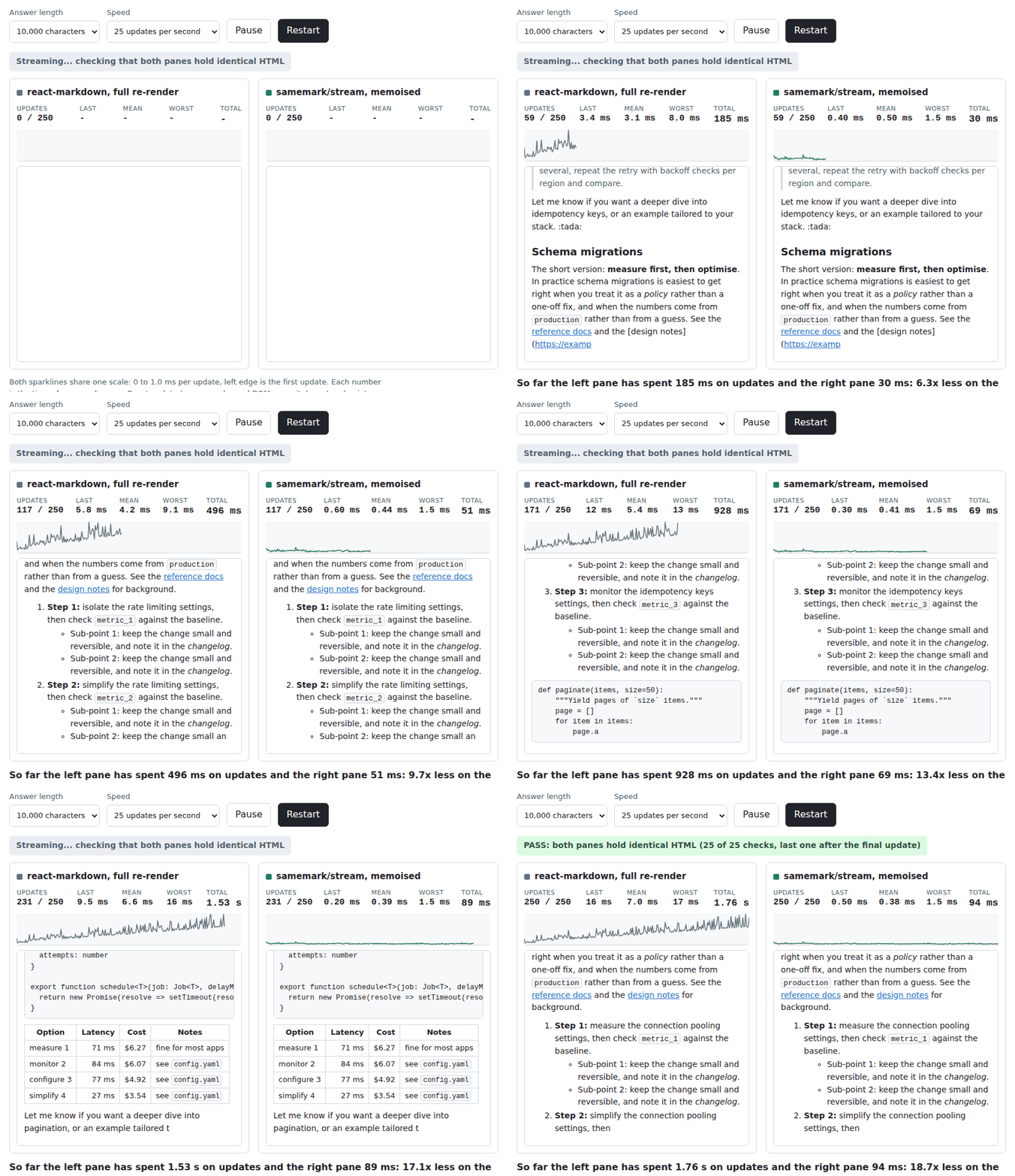
The capture above is the live demo, recorded in headless Chromium on a GitHub Actions runner (capture run 38066505899: 250 updates, 1.76 s of update time on the left, 94 ms on the right, identical HTML at all 25 checks). On your own device the numbers will differ; they are measured in your browser.

samemark is a markdown parser that returns the same mdast tree as mdast-util-from-markdown with GFM (what
remark-parse + remark-gfm produce), positions included, and falls back to that real parser for anything it
does not reproduce exactly.
micromark by Titus Wormer defines the behavior; this parser matches it and falls back to it. Its test suite and its output are the specification.
How it was made. AI agents wrote most of the code. Every change is checked against micromark's own output: the full tree must be equal, node by node, on thousands of real documents, the CommonMark spec examples, and tens of millions of generated inputs. Nothing here relies on trust in the author or the model; the checks are in this repository and the commands to run them are below.
In a real unified pipeline (markdown to HTML with remark-gfm, remark-rehype, rehype-stringify) the whole run is
6.2x to 10.3x faster with samemark as the parser, across six inputs on a GitHub Actions runner (Node 24, median of
7 rounds, identical HTML on every file). Parsing alone is 28x to 47x faster; the rest of the pipeline is unchanged,
which is why the end-to-end number is smaller.
Streaming a 30,000 character chat answer into a real DOM in Chromium, samemark/stream with memoised blocks spends
60x less main-thread time than react-markdown re-rendering the whole message on every chunk, and 77x less with the
CPU throttled 6x as a phone proxy (79.4 s down to 1.03 s over 750 pushes; 103 ms down to 1.1 ms per push), with the same
DOM. Swapping only the parser inside react-markdown gives 5x to 6x.
Building a 239-page Astro site took 29.6 s with remark-parse and 22.9 s with samemark (23% less).
All numbers come from one CI run (38036885270) and are
reproducible with npm run bench. Details and method: Benchmarks.
parse(source) returns an mdast Root equal to fromMarkdown(source, {extensions: [gfm()], mdastExtensions: [gfmFromMarkdown()]}).remarkParseFast is a drop-in for remark-parse in a unified processor.remark-gfm, remark-frontmatter (yaml, toml or both) and remark-math (with or without singleDollarTextMath)
are implemented natively, alone or together. Anything else (remark-directive, MDX, custom frontmatter fences,
other micromark extensions) is detected and given to the real parser. You get micromark's answer, at micromark's
speed.micromark-util-*
packages plus ccount and decode-named-character-reference) and nothing else. mdast-util-from-markdown is
only needed for the fallback, as an optional peer dependency.npm install samemark
# for the fallback (recommended; the main entry imports it):
npm install mdast-util-from-markdown unified remark-gfm
Node 18 or newer, or any runtime with ES2020 and TextDecoder (browsers, Deno, Bun, edge runtimes).
With unified, replace remark-parse:
import {unified} from 'unified'
import remarkGfm from 'remark-gfm'
import remarkRehype from 'remark-rehype'
import rehypeStringify from 'rehype-stringify'
import remarkParseFast from 'samemark'

const file = await unified()
  .use(remarkParseFast) // instead of remark-parse
  .use(remarkGfm)
  .use(remarkRehype)
  .use(rehypeStringify)
  .process('# Hello *world*')
Inside a framework that already installs remark-parse (Astro, MDX, Next.js plugins), add it to remarkPlugins;
it replaces the parser after remark-gfm has registered, which is the order it needs:
// astro.config.mjs
import remarkParseFast from 'samemark'
export default {markdown: {remarkPlugins: [remarkParseFast]}}
With react-markdown (it builds a unified processor on every render with remark-parse first, so a plugin that sets the
parser takes over; verified by the benchmark below):
import Markdown from 'react-markdown'
import remarkGfm from 'remark-gfm'
import remarkParseFast from 'samemark'

const plugins = [remarkParseFast, remarkGfm] // define once, outside the component

export const Answer = ({text}) => <Markdown remarkPlugins={plugins}>{text}</Markdown>
Chat apps re-render the whole message on every streamed token, so the parser runs again over a growing string each time; see the react-markdown numbers in Benchmarks.
Without a processor:
import {parse} from 'samemark'
const tree = parse('# Hello *world*') // mdast Root
| Entry | Fallback | Imports |
|---|---|---|
samemark | the real parser, mdast-util-from-markdown (optional peer) | needs mdast-util-from-markdown installed |
samemark/stream | none; incremental parser for streamed text, stock GFM with optional frontmatter and math | the six helper packages; also CommonJS |
samemark/core | none: throws on unsupported extensions, unless remark-parse was set up before the plugin (it then takes over) or {fallback} is passed | only the six helper packages; also require('samemark/core') from CommonJS |
The main entry also runs a one-time check per processor: three small documents are parsed by both parsers with the processor's own extensions; any difference sends that processor to the fallback (reason: "self-check ... failed"). That guards against a micromark release that changes behavior. It is a tripwire, not a proof.
Both parse(source, options) and remarkParseFast(options) take:
| Option | Meaning |
|---|---|
strict | Throw instead of falling back (also when the fast parser itself throws). Default false. |
onFallback(reason) | Called with a reason string for every document parsed by the fallback. |
warn | One console.warn per distinct fallback reason. |
fallback(text, ctx) | Parser to use instead of the default fallback. ctx has extensions, mdastExtensions, settings. |
parse additionally accepts extensions and mdastExtensions (the arrays you would give fromMarkdown). Left out,
stock GFM is assumed. source may be a string, a Uint8Array (UTF-8) or an object with toString().
Nobody should find out about a fallback in a profiler. stats is exported by both entries:
import {stats, check} from 'samemark'
stats // {fast: 120, fallback: 0, lastFallbackReason: null}
check(micromarkExtensions, fromMarkdownExtensions) // null when the fast path is exact, else the reason
Chat UIs re-parse the whole message every time a token arrives. With samemark as the parser that re-parse is 3x to 7x
cheaper depending on the runtime, with identical output (react-markdown numbers in Benchmarks).
samemark/stream removes the re-parse: it is incremental, and it stays exactly identical to parsing the whole text.
import {createStreamParser} from 'samemark/stream'

const stream = createStreamParser()          // options: {frontmatter, math}, same meaning as remark-frontmatter / remark-math
for await (const chunk of tokens) {
  const tree = stream.push(chunk)            // mdast Root, equal to parse(everything pushed so far), positions included
  render(tree)
}
stream.end()                                 // final tree; stream.reset() starts a new message
parse() returns for all text so far, which equals micromark's tree. Chunks
can split anything: a token, a fence, a table row, a link.React.memo keyed on the node skips them. The cost of a push is the new text plus the unfinished
tail, not the whole message.require('samemark/stream') from CommonJS.A React integration lives in examples/react-chat/StreamMarkdown.jsx: a
useMarkdownStream() hook and a <StreamMarkdown tree> component that renders the mdast with mdast-util-to-hast and
hast-util-to-jsx-runtime, one memoised block per top-level node, applying the same URL sanitising and raw HTML
handling as react-markdown. Its HTML equals react-markdown's for the whole message (test/stream.test.mjs, and the DOM
comparison in the Chromium benchmark below).
import {StreamMarkdown, useMarkdownStream} from './StreamMarkdown.jsx'

function Answer({tokens}) {                  // tokens: an async iterable of strings
  const {tree, push, reset} = useMarkdownStream()
  useEffect(() => {
    reset()
    ;(async () => { for await (const chunk of tokens) push(chunk) })()
  }, [tokens])
  return <StreamMarkdown tree={tree} />
}
Parser only, from node bench/stream-bench.mjs in CI (ubuntu-latest, 12 characters per push, a generated LLM-style
answer): total time to push the whole answer, a full re-parse per push against createStreamParser.
| Answer length | Full re-parse per push | samemark/stream | Speedup |
|---|---|---|---|
| 10,451 characters | 422 ms | 66 ms | 6.4x |
| 30,416 characters | 981 ms | 54 ms | 18.2x |
| 100,193 characters | 9,232 ms | 133 ms | 69.4x |
Identity of that parser, in CI: 48,196,453 pushes over 465,378 documents (corpus replays, fuzz strings, 1-character, random, token-like and whole-line chunkings, with and without frontmatter and math), each tree compared with a full parse; 0 failing.

React render included (DOM commit, memoised blocks):
From CI run 38036885270 (Chromium, GitHub Actions runner); reproduce locally with npm run bench:stream (jsdom, smaller numbers) or run the bench workflow.
One chat message streamed 40 characters per push into a real DOM node (Chromium 156.0.8078.4, React 19 production, flushSync per push, so each push is parse + React render + DOM commit; layout and paint are not included). (a) react-markdown re-rendering the whole message per push, (b) the same with samemark as the parser, (c) the stream parser with per-block memoisation (examples/react-chat). "Total" is the sum of all push times on the main thread. The DOM after the final push, and after every 25th push, is compared with (a): the last column.
| CPU | Variant | Pushes | Total | Per push p50 | p95 | worst | Same DOM as (a) |
|---|---|---|---|---|---|---|---|
| no throttling | (a) react-markdown, whole message per push | 750 | 11.29 s | 15 ms | 28 ms | 32 ms | 31/31 |
| no throttling | (b) react-markdown + samemark | 750 | 2.24 s (5.0x less) | 2.9 ms | 5.0 ms | 31 ms | 31/31 |
| no throttling | (c) stream parser + memoised blocks | 750 | 187 ms (60.3x less) | 0.2 ms | 0.6 ms | 6.4 ms | 31/31 |
| 4x slower | (a) react-markdown, whole message per push | 750 | 50.91 s | 67 ms | 126 ms | 141 ms | 31/31 |
| 4x slower | (b) react-markdown + samemark | 750 | 9.85 s (5.2x less) | 13 ms | 24 ms | 122 ms | 31/31 |
| 4x slower | (c) stream parser + memoised blocks | 750 | 669 ms (76.1x less) | 0.8 ms | 2.2 ms | 30 ms | 31/31 |
| 6x slower | (a) react-markdown, whole message per push | 750 | 79.43 s | 103 ms | 198 ms | 219 ms | 31/31 |
| 6x slower | (b) react-markdown + samemark | 750 | 15.33 s (5.2x less) | 20 ms | 36 ms | 207 ms | 31/31 |
| 6x slower | (c) stream parser + memoised blocks | 750 | 1.03 s (77.0x less) | 1.1 ms | 3.2 ms | 45 ms | 31/31 |
Environment: Node v24.21.0, GitHub Actions ubuntu24 X64 (github-hosted), INTEL(R) XEON(R) PLATINUM 8573C x4, linux x64. Each cell is the median of 7 rounds after one warm-up round, one fresh process per cell.
(a) is what a chat UI does today: react-markdown re-parses and re-renders the whole message on every push. (b) swaps the parser only. (c) is examples/react-chat.

Each snippet was run against this repository; the unified, frontmatter and fallback ones print what is shown.
unified pipeline (markdown to HTML):
import {unified} from 'unified'
import remarkGfm from 'remark-gfm'
import remarkRehype from 'remark-rehype'
import rehypeStringify from 'rehype-stringify'
import remarkParseFast from 'samemark'

const file = await unified()
  .use(remarkParseFast)
  .use(remarkGfm)
  .use(remarkRehype)
  .use(rehypeStringify)
  .process('# Hello *world*\n\n| a | b |\n|---|---|\n| ~~x~~ | y |')
console.log(String(file))
// <h1>Hello <em>world</em></h1>
// <table> ... <td><del>x</del></td> ... </table>
react-markdown, one line changed:
import Markdown from 'react-markdown'
import remarkGfm from 'remark-gfm'
import remarkParseFast from 'samemark'

const plugins = [remarkParseFast, remarkGfm] // module level: not recreated per render
export const Answer = ({text}) => <Markdown remarkPlugins={plugins}>{text}</Markdown>
Streaming chat with samemark/stream. In React use examples/react-chat
(the live demo runs it). Without a framework:
import {createStreamParser} from 'samemark/stream'

const stream = createStreamParser()
let tree
for (const chunk of ['# Hel', 'lo\n\nSome **bo', 'ld** text\n\n- a\n- b\n']) {
  tree = stream.push(chunk) // same tree as parse(everything so far); finished blocks keep their identity
}
console.log(tree.children.map(node => node.type)) // [ 'heading', 'paragraph', 'list' ]
Astro:
// astro.config.mjs
import remarkParseFast from 'samemark'
export default {markdown: {remarkPlugins: [remarkParseFast]}}
Frontmatter and math stay on the fast path:
import remarkFrontmatter from 'remark-frontmatter'
import remarkMath from 'remark-math'
import {stats} from 'samemark'

const file = await unified()
  .use(remarkParseFast)
  .use(remarkGfm)
  .use(remarkFrontmatter)
  .use(remarkMath)
  .use(remarkRehype)
  .use(rehypeStringify)
  .process('---\ntitle: Notes\n---\n\nEuler: $e^{i\\pi}+1=0$\n')
console.log(String(file)) // <p>Euler: <code class="language-math math-inline">e^{i\pi}+1=0</code></p>
console.log(stats)        // { fast: 1, fallback: 0, lastFallbackReason: null }
samemark parses math into the same inlineMath and math nodes as remark-math; typesetting is the renderer's job, exactly as with
remark-parse. Add rehype-katex (or rehype-mathjax) after remark-rehype to turn them into equations:
import rehypeKatex from 'rehype-katex'

unified().use(remarkParseFast).use(remarkGfm).use(remarkMath).use(remarkRehype).use(rehypeKatex).use(rehypeStringify)
samemark/core in the browser (no fallback import; the browser build is about 20 KB gzipped, see
Bundle size). It needs a bundler that honours package exports, such as esbuild or Vite:
import {parse} from 'samemark/core'

const tree = parse('# Hello *world*') // mdast Root, GFM
Checking fallbacks so nobody finds one in a profiler:
import remarkDirective from 'remark-directive'
import remarkParseFast, {stats} from 'samemark'

const reasons = []
await unified()
  .use(remarkParseFast, {onFallback: reason => reasons.push(reason)})
  .use(remarkGfm)
  .use(remarkDirective) // not in the supported set: the real parser takes over
  .use(remarkRehype)
  .use(rehypeStringify)
  .process(':::note\nhi\n:::')
console.log(reasons) // ['micromark extension not in the supported set (GFM, frontmatter, math): ...']
console.log(stats)   // { fast: 0, fallback: 1, lastFallbackReason: '...' }
Pass {strict: true} to throw instead of falling back.
Exact statement. The fast path is verified, and only verified, against these pinned versions
(package.json devDependencies, installed by npm ci):
| Package | Version |
|---|---|
| micromark | 4.0.3 |
| micromark-extension-gfm | 3.0.0 |
| mdast-util-gfm | 3.1.0 |
| mdast-util-from-markdown | 2.1.0 |
| remark-parse | 11.0.0 |
| remark-gfm | 4.0.1 |
| unified | 11.0.5 |
Other versions are not claimed. A newer micromark that changes output is caught by the main entry's self-check
(it then uses the fallback), and by npm test in this repository, which fails if the stock GFM construct set
changes (node scripts/gen-signature.mjs --check).
What counts as supported is decided by construct names, not by function source, so minified bundles of
micromark keep the fast path (tested with an esbuild --minify bundle that includes the frontmatter and math
extensions). Settings that hide in closures (singleTilde: false, singleDollarTextMath: false, which fences a
frontmatter matter uses, anywhere: true) are read by running the real tokenizers on probe strings; the result is
compared with what the stock configuration does. Any unknown construct, any disable entry, a custom or anywhere
frontmatter matter, or a missing GFM piece means fallback.
Generated by node scripts/compat-table.mjs from the same cases npm test asserts (each fast row is also compared with remark-parse on a document that exercises it):
| Setup | Path | Reported reason |
|---|---|---|
| remark-gfm | fast | |
| remark-gfm twice | fast | |
remark-gfm with tablePipeAlign / tableCellPadding (serialisation options only) | fast | |
| remark-gfm + remark-breaks (tree transform only) | fast | |
| remark-gfm + remark-smartypants (tree transform only) | fast | |
remark-gfm with singleTilde: false | fallback (real parser) | strikethrough is not the stock GFM one (singleTilde: false or unknown tokenizer) |
| remark-gfm + remark-frontmatter (yaml) | fast | |
remark-gfm + remark-frontmatter ['yaml', 'toml'] | fast | |
remark-gfm + remark-frontmatter 'toml' | fast | |
remark-gfm + remark-frontmatter with a custom fence (same type, other fence) | fallback (real parser) | frontmatter fences differ from the stock yaml matters (custom or anywhere matter) |
| remark-gfm + remark-frontmatter with a custom matter type | fallback (real parser) | micromark extension not in the supported set (GFM, frontmatter, math): flow|unnamed construct at code 60 ('<') |
remark-gfm + remark-frontmatter with anywhere: true | fallback (real parser) | frontmatter fences differ from the stock yaml matters (custom or anywhere matter) |
| remark-gfm + remark-math | fast | |
remark-gfm + remark-math with singleDollarTextMath: false | fast | |
| remark-gfm + remark-frontmatter + remark-math | fast | |
| remark-frontmatter + remark-math without remark-gfm | fallback (real parser) | GFM is not fully enabled (missing micromark construct attentionMarkers|126) |
| remark-gfm + remark-directive | fallback (real parser) | micromark extension not in the supported set (GFM, frontmatter, math): flow|unnamed construct at code 58 (':') |
| remark-gfm + remark-frontmatter + remark-directive | fallback (real parser) | micromark extension not in the supported set (GFM, frontmatter, math): flow|unnamed construct at code 45 ('-') |
| remark-mdx (MDX) | fallback (real parser) | GFM is not fully enabled (missing micromark construct attentionMarkers|126) |
| remark-gfm + remark-mdx | fallback (real parser) | micromark extension not in the supported set (GFM, frontmatter, math): disable|{"null":["autolink","codeIndented","htmlFlow","htmlText"]} |
| no remark-gfm (CommonMark only) | fallback (real parser) | no GFM extensions (CommonMark-only parsing needs the fallback) |
| unknown micromark construct | fallback (real parser) | micromark extension not in the supported set (GFM, frontmatter, math): text|atSign |
micromark disable entry | fallback (real parser) | micromark extension not in the supported set (GFM, frontmatter, math): disable|{"null":["codeIndented"]} |
Frameworks. Astro (plain markdown, remark-gfm default): fast. Starlight adds remark-directive for asides,
so it falls back and gains nothing. Docusaurus and MDX compile through micromark-extension-mdxjs: fallback.
@mdx-js/mdx with format: 'md' and remark-gfm: fast.
Correctness at a glance (every row compares the full tree, positions included, against mdast-util-from-markdown + GFM; details and commands in the table below):
| Check | Scale | Result | Reproduce |
|---|---|---|---|
| CommonMark and GFM spec examples | 652 CommonMark 0.31.2, 672 GFM spec and 30 GFM extension examples | all identical | npm run check |
| Pinned docs corpora and synthetic corpus | Node.js API docs and changelog, Rust book, Vite docs, React changelog, 240 generated documents | all identical | npm run corpus && npm run check |
| README corpus | 4,780 npm package READMEs | all identical at the last run | node bench/readme-corpus.mjs && node bench/run.mjs --readme --nospeed |
| Held-out files | 10,893 non-README markdown files | all identical at the last run | node bench/heldout.mjs --roots=DIR |
| Differential fuzz | tens of millions of generated inputs (the weekly full matrix is about 60M) | 0 failing; known corner shapes are listed in KNOWN_GAPS.md | node bench/fuzz.mjs --mode=regress, ci.yml, full.yml |
| Stream parser, tree after every push | 48,196,453 pushes over 465,378 documents | 0 failing | node bench/stream-diff.mjs --mode=regress, full.yml |
"Identical" means JSON-equal trees including every position, not "looks the same" (firstDiff in
bench/common.mjs; undefined fields are treated as absent).
| Check | What | Command |
|---|---|---|
| Spec | all 652 CommonMark 0.31.2 examples, the 672 GFM spec examples and the 30 GFM extension examples, full tree compared | npm run check |
| Docs and synthetic corpora | Node.js API docs and changelog, Rust book, Vite docs, a React changelog (pinned commits, fetched in CI, bench/corpora.json) and 240 generated documents (bench/synthetic.mjs), full tree compared | npm run corpus && npm run check |
| README corpus (development) | 4,780 README.md files of npm packages (30 MB) collected on the author's machine, full tree compared (all identical at the last run). 4,648 of them are in bench/readme-corpus-manifest.json (package, version, sha256) and can be rebuilt from npm, slowly | node bench/readme-corpus.mjs && node bench/run.mjs --readme --nospeed |
| CommonMark spec | all 652 examples of spec 0.31.2 | npm run check |
| Held-out | 10,893 non-README markdown files from the author's machine, never used while writing the parser (all identical at the last run). The file list is machine specific, so others cannot repeat this exact set; pass your own list | node bench/heldout.mjs --roots=DIR |
| Differential fuzzing | exhaustive strings (17 characters, length up to 6), random, token-biased, mutations of corpus paragraphs, spec crossovers | node bench/fuzz.mjs --mode=exhaustive --maxlen=5 --shard=0/64 (the full matrix, about 60M cases in 60 jobs, is .github/workflows/full.yml, weekly or by hand; ci.yml runs about 2M cases on every push) |
| Frontmatter and math | the corpus and spec examples with yaml / toml / custom frontmatter prepended (CRLF, unclosed fences, not at the start) and with math enabled, plus extension-aware fuzzing | node bench/frontmatter.mjs --sample=24 |
| Streaming | samemark/stream replays documents in random chunk sizes; the tree after every push must equal a full parse, and micromark's at checkpoints (corpus, spec examples, edge inputs, definitions arriving late) | node bench/stream-diff.mjs --mode=regress, node --test test/stream.test.mjs |
| Regressions | every input that ever failed | node bench/fuzz.mjs --mode=regress |
| Edge inputs | CRLF, CR, BOM, NUL, lone surrogates, empty, 50k-character lines, deep nesting, unicode, tabs; 10 MB inputs in CI | node --test test/edge.test.mjs; BIG=1 for 10 MB |
| Packaging | minified bundle keeps the fast path, edge-runtime VM, Chromium, Deno, Node 18 to 24, packed tarball in an empty project | npm test; ci.yml (Node 18 to 24, packed tarball), full.yml (Deno, Chromium, 10 MB inputs) |
Third-party text is never committed. The docs corpora are fetched at pinned commits (licences: MIT for Node.js, Vite and React, MIT or Apache-2.0 for the Rust book, BSD-2-Clause code with CC-BY-SA spec text for the GFM spec examples), the README corpus is rebuilt from npm by sha256 manifest, and the synthetic corpus is generated from a seed.
On the tested set (spec examples, corpora, held-out, edge inputs) there are none. Differential fuzzing did find shapes that differ, all block-level corners around footnote definitions and lists; they are listed with minimal inputs in KNOWN_GAPS.md and none occurs in a real document so far. What is not covered by the identity claim: non-GFM extensions (they fall back, by design), non-string input types, and pipelines other than the ones in the compatibility table.
Behavior that is different on purpose: micromark throws a RangeError on roughly 10,000 levels of nesting; samemark
parses it. Large single inputs: micromark's time grows faster than linearly with document size (a mixed document took
1.6 s at 400 KB, 5.1 s at 800 KB and 19 s at 1.6 MB on a fast laptop; one 500 KB paragraph of inline markup takes 16 s;
a 10 MB comparison ran 42 minutes and exhausted a 6 GB heap), while samemark parsed a 10 MB mixed document in about
0.4 s. That is why the full-tree comparison in the edge tests stops at 2 to 3 MB and the 10 MB cases only check that
samemark finishes and does not throw.
Which numbers come from which input. The tables below were produced by the bench workflow (and the parser-level
stream benchmark by bench/stream-bench.mjs) while the project lived in a private repository. Rows named
"README corpus" ran on the 4,780-file development corpus of npm package READMEs (a 1 in 4 or 1 in 16 sample for the
slower tests; 4,648 of the files are rebuildable from bench/readme-corpus-manifest.json). Rows named after a
repository (node-api-docs, rust-book, vite-docs, node-changelog-v22, react-changelog) ran on the pinned
commits in bench/corpora.json; anyone can fetch exactly those with npm run corpus. The react-markdown tables use
the generated chat-style answer (bench/perf/chat-text.mjs), the Astro site uses the three docs sets, and
npm run bench on a fresh checkout measures the pinned docs sets plus the synthetic corpus (and the README corpus
with --readme once it is rebuilt). Runner CPUs differ between jobs and runs, so compare the ratios within a table, not
absolute times across tables.
Environment: Node v24.21.0, GitHub Actions ubuntu24 X64 (github-hosted), AMD EPYC 7763 64-Core Processor x4, linux x64. Each cell is the median of 7 rounds after one warm-up round, one fresh process per cell.
unified().use(parser).use(remarkGfm).use(remarkRehype).use(rehypeStringify), with remark-parse or with samemark as the parser. Output HTML is compared file by file.
| Input | Files | Size | remark-parse | samemark | Speedup | Parse share before | Parse share after | Identical HTML |
|---|---|---|---|---|---|---|---|---|
| node-api-docs | 70 | 4.75 MB | 5.00 s | 486 ms | 10.3x | 92% | 33% | 70/70 |
| node-changelog-v22 | 1 | 0.88 MB | 1.33 s | 171 ms | 7.8x | 89% | 21% | 1/1 |
| rust-book | 112 | 1.22 MB | 1.07 s | 125 ms | 8.6x | 93% | 40% | 112/112 |
| vite-docs | 57 | 0.56 MB | 570 ms | 73 ms | 7.8x | 92% | 29% | 57/57 |
| react-changelog | 1 | 0.30 MB | 498 ms | 71 ms | 7.0x | 90% | 19% | 1/1 |
| synthetic corpus (240 generated documents) | 66 | 0.25 MB | 546 ms | 89 ms | 6.2x | 88% | 22% | 66/66 |
Content pipeline, as a docs or blog site runs it: remark-gfm, remark-frontmatter (yaml) and remark-math before remark-rehype. vite-docs has real frontmatter in every page; the synthetic (or README) documents get a generated block so every file has one. Both sides are compared on the HTML.
| Input | Files | Size | remark-parse | samemark | Speedup | Identical HTML | samemark path |
|---|---|---|---|---|---|---|---|
| synthetic corpus (240 generated documents) with a frontmatter block added | 66 | 0.26 MB | 559 ms | 95 ms | 5.9x | 66/66 | fast |
| vite-docs | 57 | 0.56 MB | 543 ms | 66 ms | 8.2x | 57/57 | fast |
| react-changelog | 1 | 0.30 MB | 517 ms | 70 ms | 7.3x | 1/1 | fast |
For context, other converters on the same input (different pipeline and output: HTML strings, no mdast, not drop-in replacements):
| Input | markdown-it render (HTML) | marked parse (HTML) |
|---|---|---|
| node-api-docs | 477 ms | 449 ms |
| node-changelog-v22 | 182 ms | 144 ms |
| rust-book | 122 ms | 103 ms |
| vite-docs | 74 ms | 66 ms |
| react-changelog | 71 ms | 57 ms |
| synthetic corpus (240 generated documents) | 89 ms | 70 ms |
Environment: Node v24.21.0, GitHub Actions ubuntu24 X64 (github-hosted), AMD EPYC 7763 64-Core Processor x4, linux x64. Each cell is the median of 7 rounds after one warm-up round, one fresh process per cell.
renderToStaticMarkup, React production build)react-markdown 10.1.0 builds a new unified processor on every render (unified().use(remarkParse).use(remarkPlugins)...), so remarkPlugins={[remarkParseFast, remarkGfm]} replaces its parser on every render. The input is a synthetic chat-style answer (headings, lists, code, tables, links; bench/perf/chat-text.mjs). Output HTML is compared at 120 prefix lengths, partial constructs included: 120/120 identical. samemark path: 6148 fast, 0 fallback.
One update at a fixed message length (this is also the cost of rendering a finished long answer):
| Message length | react-markdown default | with samemark | Speedup |
|---|---|---|---|
| 10,000 characters | 36 ms | 5 ms | 6.5x |
| 30,000 characters | 92 ms | 13 ms | 7.0x |
Streaming simulation: the message grows by a few characters at a time and the whole message is re-rendered after each step, as chat apps do:
| Stream | Updates | default: total / mean / worst update | samemark: total / mean / worst update | Speedup |
|---|---|---|---|---|
| to 10,000 characters, 20 per step | 500 | 3.25 s / 6 ms / 16 ms | 676 ms / 1 ms / 4 ms | 4.8x |
| to 30,000 characters, 20 per step | 1500 | 27.98 s / 19 ms / 47 ms | 5.31 s / 4 ms / 9 ms | 5.3x |
Chromium 156.0.8078.4, react-markdown 10.1.0 production bundle, renderToStaticMarkup in the page. CPU throttling uses DevTools Emulation.setCPUThrottlingRate (4x and 6x slowdown of the main thread). It is a proxy for a slower device, not a measurement of one. Same chat-style input as the desktop table; streaming steps are 100 characters here to keep the throttled runs short.
| CPU | Update at 10,000 characters: default / samemark | Update at 30,000 characters: default / samemark | Stream to 10,000: mean update default / samemark | Stream to 30,000: mean update default / samemark | Identical HTML |
|---|---|---|---|---|---|
| no throttling | 9.6 ms / 2.0 ms (4.8x) | 29 ms / 5.4 ms (5.4x) | 5.1 ms / 1.0 ms (4.9x) | 14 ms / 2.7 ms (5.3x) | 60/60 |
| 4x slower | 45 ms / 7.9 ms (5.7x) | 145 ms / 22 ms (6.6x) | 24 ms / 4.3 ms (5.5x) | 65 ms / 12 ms (5.5x) | 60/60 |
| 6x slower | 70 ms / 12 ms (6.0x) | 200 ms / 35 ms (5.8x) | 35 ms / 6.5 ms (5.3x) | 102 ms / 18 ms (5.8x) | 60/60 |
One chat message streamed 40 characters per push into a real DOM node (Chromium 156.0.8078.4, React 19 production, flushSync per push, so each push is parse + React render + DOM commit; layout and paint are not included). (a) react-markdown re-rendering the whole message per push, (b) the same with samemark as the parser, (c) the stream parser with per-block memoisation (examples/react-chat). "Total" is the sum of all push times on the main thread. The DOM after the final push, and after every 25th push, is compared with (a): the last column.
| CPU | Variant | Pushes | Total | Per push p50 | p95 | worst | Same DOM as (a) |
|---|---|---|---|---|---|---|---|
| no throttling | (a) react-markdown, whole message per push | 750 | 11.29 s | 15 ms | 28 ms | 32 ms | 31/31 |
| no throttling | (b) react-markdown + samemark | 750 | 2.24 s (5.0x less) | 2.9 ms | 5.0 ms | 31 ms | 31/31 |
| no throttling | (c) stream parser + memoised blocks | 750 | 187 ms (60.3x less) | 0.2 ms | 0.6 ms | 6.4 ms | 31/31 |
| 4x slower | (a) react-markdown, whole message per push | 750 | 50.91 s | 67 ms | 126 ms | 141 ms | 31/31 |
| 4x slower | (b) react-markdown + samemark | 750 | 9.85 s (5.2x less) | 13 ms | 24 ms | 122 ms | 31/31 |
| 4x slower | (c) stream parser + memoised blocks | 750 | 669 ms (76.1x less) | 0.8 ms | 2.2 ms | 30 ms | 31/31 |
| 6x slower | (a) react-markdown, whole message per push | 750 | 79.43 s | 103 ms | 198 ms | 219 ms | 31/31 |
| 6x slower | (b) react-markdown + samemark | 750 | 15.33 s (5.2x less) | 20 ms | 36 ms | 207 ms | 31/31 |
| 6x slower | (c) stream parser + memoised blocks | 750 | 1.03 s (77.0x less) | 1.1 ms | 3.2 ms | 45 ms | 31/31 |
Environment: Node v24.21.0, GitHub Actions ubuntu24 X64 (github-hosted), INTEL(R) XEON(R) PLATINUM 8573C x4, linux x64. Each cell is the median of 7 rounds after one warm-up round, one fresh process per cell.
Same mdast on both sides (mdast-util-from-markdown with micromark-extension-gfm and mdast-util-gfm, the reference). "Identical" counts files whose full tree, positions included, is equal.
| Input | Files | Size | mdast-util-from-markdown + GFM | samemark | Speedup | Identical |
|---|---|---|---|---|---|---|
| node-api-docs | 70 | 4.75 MB | 4.34 s | 121 ms | 35.7x | 70/70 |
| node-changelog-v22 | 1 | 0.88 MB | 1.06 s | 23 ms | 46.8x | 1/1 |
| rust-book | 112 | 1.22 MB | 921 ms | 32 ms | 29.1x | 112/112 |
| vite-docs | 57 | 0.56 MB | 486 ms | 17 ms | 27.9x | 57/57 |
| react-changelog | 1 | 0.30 MB | 414 ms | 13 ms | 31.7x | 1/1 |
| synthetic corpus (240 generated documents) | 240 | 1.08 MB | 1.54 s | 51 ms | 30.3x | 240/240 |
Other parsers on the same input. Different output: markdown-it returns a token list and marked returns its own token tree, neither is mdast, and neither is a drop-in replacement. Shown for scale only.
| Input | markdown-it parse (tokens) | marked lexer (tokens) |
|---|---|---|
| node-api-docs | 423 ms | 298 ms |
| node-changelog-v22 | 154 ms | 81 ms |
| rust-book | 94 ms | 63 ms |
| vite-docs | 64 ms | 34 ms |
| react-changelog | 61 ms | 30 ms |
| synthetic corpus (240 generated documents) | 210 ms | 139 ms |
Environment: Node v24.21.0, GitHub Actions ubuntu24 X64 (github-hosted), AMD EPYC 7763 64-Core Processor x4, linux x64. Each cell is the median of 7 rounds after one warm-up round, one fresh process per cell.
@mdx-js/mdx compile)Plain format: 'md' with remark-gfm, default parser versus samemark as the parser. format: 'mdx' loads micromark-extension-mdxjs, which is not in the stock GFM set, so samemark falls back there by design; it is measured on the files that are valid MDX to show the overhead is nil. Compiled output is compared.
| Input | Format | Files compiled | default | with samemark | Speedup | Identical output | samemark path |
|---|---|---|---|---|---|---|---|
| node-api-docs | md | 70 of 70 | 6.21 s | 1.55 s | 4.0x | yes | 280 fast, 0 fallback |
| node-api-docs | mdx | 0 of 70 | n/a | n/a | n/a | n/a | no file in this set is valid MDX |
| node-changelog-v22 | md | 1 of 1 | 1.68 s | 509 ms | 3.3x | yes | 4 fast, 0 fallback |
| node-changelog-v22 | mdx | 0 of 1 | n/a | n/a | n/a | n/a | no file in this set is valid MDX |
| rust-book | md | 112 of 112 | 1.34 s | 367 ms | 3.7x | yes | 448 fast, 0 fallback |
| rust-book | mdx | 29 of 112 | 245 ms | 251 ms | 1.0x | yes | 0 fast, 116 fallback |
rust-book, vite-docs, node-api-docs (6.53 MB of markdown), stock Astro markdown pipeline (remark-parse, remark-gfm, smartypants, Shiki, rehype-raw). Cold build each time (dist, .astro and the Vite cache removed), 3 builds per variant alternating, median shown, Node v24.21.0, AMD EPYC 7763 64-Core Processor x4.
| Parser | Build wall clock | Time inside the markdown parser | Parser share of build | Documents parsed | Fell back |
|---|---|---|---|---|---|
| remark-parse (default) | 29.6 s | 7.07 s | 23.9% | 239 | n/a |
| samemark | 22.9 s | 0.50 s | 2.2% | 239 | 0 |
Build time saved: 6.7 s (22.7%). Parser time saved: 6.57 s.
Individual builds (s): default 29.2, 29.6, 29.7; samemark 22.7, 22.9, 23.3.
Reading the react-markdown numbers. The speedup per update is smaller than the parse-only number because React rendering and the hast to JSX step are unchanged. It differs by runtime: Node 6.5x to 7.0x, unthrottled Chromium 4.8x to 5.4x, throttled Chromium 5.3x to 6.6x. I do not have a verified explanation for why the ratio grows under CPU throttling (throttling slows the main thread; garbage collection and compilation threads are not slowed the same way, which is a guess, not a measurement). The absolute numbers are the practical result: a finished 30,000 character answer renders in 35 ms instead of 200 ms at 6x throttle.
Reproduce:
npm ci
npm run bench:small   # a few seconds: the synthetic corpus sample plus one changelog, laptop sized
npm run bench         # the full run (what CI ran), fetches the pinned documents first
npm run bench prints the exact tables above. Method: each cell is one fresh Node process (own JIT and heap),
one warm-up round, then the median of the stated number of rounds over all files of the input; GC is forced between
rounds; both sides are compared for identical output before timings are reported (the run fails otherwise).
markdown-it and marked are included for scale only: they produce tokens or HTML, not mdast, and are not drop-in
replacements. Documents: bench/corpora.json pins repository, commit and sha256 of every set.
Minified with esbuild, ESM, platform neutral. node scripts/size.mjs reproduces the table.
| bundle | minified | gzip | brotli |
|---|---|---|---|
| samemark/core (parser + 6 helper packages, everything the fast path needs) | 87.4 KB | 31.2 KB | 27.0 KB |
samemark/core for browsers (bundler uses the browser condition: entities decoded by the DOM) | 52.6 KB | 19.5 KB | 17.4 KB |
| samemark main entry, mdast-util-from-markdown left external (peer) | 88.4 KB | 31.7 KB | 27.5 KB |
| samemark main entry, everything bundled (includes mdast-util-from-markdown + micromark) | 144.0 KB | 47.1 KB | 40.9 KB |
| of which: decode-named-character-reference (HTML entity table) | 35.0 KB | 11.6 KB | 9.6 KB |
| baseline: mdast-util-from-markdown + micromark-extension-gfm + mdast-util-gfm | 114.6 KB | 34.6 KB | 29.7 KB |
| baseline: unified + remark-parse + remark-gfm | 143.6 KB | 44.1 KB | 37.8 KB |
The browser row is what a bundler produces for browsers: decode-named-character-reference then decodes entities through the DOM instead of shipping its 35 KB table. Edge runtimes (workerd, worker, edge-light, deno) get the table.
Sätteri, the Rust engine that is the default markdown processor in Astro 7, says in its docs that it "isn't a drop-in replacement for unified" and that existing remark and rehype plugins won't run unmodified. samemark is for the projects that stay on unified: the same mdast, existing plugins run unchanged, and it is plain JavaScript with no native binary.
micromark-util-*, ccount, decode-named-character-reference).MIT. Third-party licences of the code bundled in dist/core.cjs are in dist/LICENSES.txt.
The same mdast as remark-parse, much faster. Drop-in for unified, identical output, plus an incremental parser for streaming LLM output.
JavaScript
0
18 commits
updated Oct 12, 2026
The same mdast as remark-parse, much faster.
Live demo: a long chat answer streamed into react-markdown (left) and into
samemark/stream (right), with per-update timings measured in your browser and a check that both DOMs are identical,
plus a playground that compares samemark's tree with mdast-util-from-markdown as you type.
The capture above is the live demo, recorded in headless Chromium on a GitHub Actions runner (capture run 38066505899: 250 updates, 1.76 s of update time on the left, 94 ms on the right, identical HTML at all 25 checks). On your own device the numbers will differ; they are measured in your browser.
samemark is a markdown parser that returns the same mdast tree as mdast-util-from-markdown with GFM (what
remark-parse + remark-gfm produce), positions included, and falls back to that real parser for anything it
does not reproduce exactly.
micromark by Titus Wormer defines the behavior; this parser matches it and falls back to it. Its test suite and its output are the specification.
How it was made. AI agents wrote most of the code. Every change is checked against micromark's own output: the full tree must be equal, node by node, on thousands of real documents, the CommonMark spec examples, and tens of millions of generated inputs. Nothing here relies on trust in the author or the model; the checks are in this repository and the commands to run them are below.
In a real unified pipeline (markdown to HTML with remark-gfm, remark-rehype, rehype-stringify) the whole run is
6.2x to 10.3x faster with samemark as the parser, across six inputs on a GitHub Actions runner (Node 24, median of
7 rounds, identical HTML on every file). Parsing alone is 28x to 47x faster; the rest of the pipeline is unchanged,
which is why the end-to-end number is smaller.
Streaming a 30,000 character chat answer into a real DOM in Chromium, samemark/stream with memoised blocks spends
60x less main-thread time than react-markdown re-rendering the whole message on every chunk, and 77x less with the
CPU throttled 6x as a phone proxy (79.4 s down to 1.03 s over 750 pushes; 103 ms down to 1.1 ms per push), with the same
DOM. Swapping only the parser inside react-markdown gives 5x to 6x.
Building a 239-page Astro site took 29.6 s with remark-parse and 22.9 s with samemark (23% less).
All numbers come from one CI run (38036885270) and are
reproducible with npm run bench. Details and method: Benchmarks.
parse(source) returns an mdast Root equal to fromMarkdown(source, {extensions: [gfm()], mdastExtensions: [gfmFromMarkdown()]}).remarkParseFast is a drop-in for remark-parse in a unified processor.remark-gfm, remark-frontmatter (yaml, toml or both) and remark-math (with or without singleDollarTextMath)
are implemented natively, alone or together. Anything else (remark-directive, MDX, custom frontmatter fences,
other micromark extensions) is detected and given to the real parser. You get micromark's answer, at micromark's
speed.micromark-util-*
packages plus ccount and decode-named-character-reference) and nothing else. mdast-util-from-markdown is
only needed for the fallback, as an optional peer dependency.npm install samemark
# for the fallback (recommended; the main entry imports it):
npm install mdast-util-from-markdown unified remark-gfm
Node 18 or newer, or any runtime with ES2020 and TextDecoder (browsers, Deno, Bun, edge runtimes).
With unified, replace remark-parse:
import {unified} from 'unified'
import remarkGfm from 'remark-gfm'
import remarkRehype from 'remark-rehype'
import rehypeStringify from 'rehype-stringify'
import remarkParseFast from 'samemark'

const file = await unified()
  .use(remarkParseFast) // instead of remark-parse
  .use(remarkGfm)
  .use(remarkRehype)
  .use(rehypeStringify)
  .process('# Hello *world*')
Inside a framework that already installs remark-parse (Astro, MDX, Next.js plugins), add it to remarkPlugins;
it replaces the parser after remark-gfm has registered, which is the order it needs:
// astro.config.mjs
import remarkParseFast from 'samemark'
export default {markdown: {remarkPlugins: [remarkParseFast]}}
With react-markdown (it builds a unified processor on every render with remark-parse first, so a plugin that sets the
parser takes over; verified by the benchmark below):
import Markdown from 'react-markdown'
import remarkGfm from 'remark-gfm'
import remarkParseFast from 'samemark'

const plugins = [remarkParseFast, remarkGfm] // define once, outside the component

export const Answer = ({text}) => <Markdown remarkPlugins={plugins}>{text}</Markdown>
Chat apps re-render the whole message on every streamed token, so the parser runs again over a growing string each time; see the react-markdown numbers in Benchmarks.
Without a processor:
import {parse} from 'samemark'
const tree = parse('# Hello *world*') // mdast Root
| Entry | Fallback | Imports |
|---|---|---|
samemark | the real parser, mdast-util-from-markdown (optional peer) | needs mdast-util-from-markdown installed |
samemark/stream | none; incremental parser for streamed text, stock GFM with optional frontmatter and math | the six helper packages; also CommonJS |
samemark/core | none: throws on unsupported extensions, unless remark-parse was set up before the plugin (it then takes over) or {fallback} is passed | only the six helper packages; also require('samemark/core') from CommonJS |
The main entry also runs a one-time check per processor: three small documents are parsed by both parsers with the processor's own extensions; any difference sends that processor to the fallback (reason: "self-check ... failed"). That guards against a micromark release that changes behavior. It is a tripwire, not a proof.
Both parse(source, options) and remarkParseFast(options) take:
| Option | Meaning |
|---|---|
strict | Throw instead of falling back (also when the fast parser itself throws). Default false. |
onFallback(reason) | Called with a reason string for every document parsed by the fallback. |
warn | One console.warn per distinct fallback reason. |
fallback(text, ctx) | Parser to use instead of the default fallback. ctx has extensions, mdastExtensions, settings. |
parse additionally accepts extensions and mdastExtensions (the arrays you would give fromMarkdown). Left out,
stock GFM is assumed. source may be a string, a Uint8Array (UTF-8) or an object with toString().
Nobody should find out about a fallback in a profiler. stats is exported by both entries:
import {stats, check} from 'samemark'
stats // {fast: 120, fallback: 0, lastFallbackReason: null}
check(micromarkExtensions, fromMarkdownExtensions) // null when the fast path is exact, else the reason
Chat UIs re-parse the whole message every time a token arrives. With samemark as the parser that re-parse is 3x to 7x
cheaper depending on the runtime, with identical output (react-markdown numbers in Benchmarks).
samemark/stream removes the re-parse: it is incremental, and it stays exactly identical to parsing the whole text.
import {createStreamParser} from 'samemark/stream'

const stream = createStreamParser()          // options: {frontmatter, math}, same meaning as remark-frontmatter / remark-math
for await (const chunk of tokens) {
  const tree = stream.push(chunk)            // mdast Root, equal to parse(everything pushed so far), positions included
  render(tree)
}
stream.end()                                 // final tree; stream.reset() starts a new message
parse() returns for all text so far, which equals micromark's tree. Chunks
can split anything: a token, a fence, a table row, a link.React.memo keyed on the node skips them. The cost of a push is the new text plus the unfinished
tail, not the whole message.require('samemark/stream') from CommonJS.A React integration lives in examples/react-chat/StreamMarkdown.jsx: a
useMarkdownStream() hook and a <StreamMarkdown tree> component that renders the mdast with mdast-util-to-hast and
hast-util-to-jsx-runtime, one memoised block per top-level node, applying the same URL sanitising and raw HTML
handling as react-markdown. Its HTML equals react-markdown's for the whole message (test/stream.test.mjs, and the DOM
comparison in the Chromium benchmark below).
import {StreamMarkdown, useMarkdownStream} from './StreamMarkdown.jsx'

function Answer({tokens}) {                  // tokens: an async iterable of strings
  const {tree, push, reset} = useMarkdownStream()
  useEffect(() => {
    reset()
    ;(async () => { for await (const chunk of tokens) push(chunk) })()
  }, [tokens])
  return <StreamMarkdown tree={tree} />
}
Parser only, from node bench/stream-bench.mjs in CI (ubuntu-latest, 12 characters per push, a generated LLM-style
answer): total time to push the whole answer, a full re-parse per push against createStreamParser.
| Answer length | Full re-parse per push | samemark/stream | Speedup |
|---|---|---|---|
| 10,451 characters | 422 ms | 66 ms | 6.4x |
| 30,416 characters | 981 ms | 54 ms | 18.2x |
| 100,193 characters | 9,232 ms | 133 ms | 69.4x |
Identity of that parser, in CI: 48,196,453 pushes over 465,378 documents (corpus replays, fuzz strings, 1-character, random, token-like and whole-line chunkings, with and without frontmatter and math), each tree compared with a full parse; 0 failing.
React render included (DOM commit, memoised blocks):
From CI run 38036885270 (Chromium, GitHub Actions runner); reproduce locally with npm run bench:stream (jsdom, smaller numbers) or run the bench workflow.
One chat message streamed 40 characters per push into a real DOM node (Chromium 156.0.8078.4, React 19 production, flushSync per push, so each push is parse + React render + DOM commit; layout and paint are not included). (a) react-markdown re-rendering the whole message per push, (b) the same with samemark as the parser, (c) the stream parser with per-block memoisation (examples/react-chat). "Total" is the sum of all push times on the main thread. The DOM after the final push, and after every 25th push, is compared with (a): the last column.
| CPU | Variant | Pushes | Total | Per push p50 | p95 | worst | Same DOM as (a) |
|---|---|---|---|---|---|---|---|
| no throttling | (a) react-markdown, whole message per push | 750 | 11.29 s | 15 ms | 28 ms | 32 ms | 31/31 |
| no throttling | (b) react-markdown + samemark | 750 | 2.24 s (5.0x less) | 2.9 ms | 5.0 ms | 31 ms | 31/31 |
| no throttling | (c) stream parser + memoised blocks | 750 | 187 ms (60.3x less) | 0.2 ms | 0.6 ms | 6.4 ms | 31/31 |
| 4x slower | (a) react-markdown, whole message per push | 750 | 50.91 s | 67 ms | 126 ms | 141 ms | 31/31 |
| 4x slower | (b) react-markdown + samemark | 750 | 9.85 s (5.2x less) | 13 ms | 24 ms | 122 ms | 31/31 |
| 4x slower | (c) stream parser + memoised blocks | 750 | 669 ms (76.1x less) | 0.8 ms | 2.2 ms | 30 ms | 31/31 |
| 6x slower | (a) react-markdown, whole message per push | 750 | 79.43 s | 103 ms | 198 ms | 219 ms | 31/31 |
| 6x slower | (b) react-markdown + samemark | 750 | 15.33 s (5.2x less) | 20 ms | 36 ms | 207 ms | 31/31 |
| 6x slower | (c) stream parser + memoised blocks | 750 | 1.03 s (77.0x less) | 1.1 ms | 3.2 ms | 45 ms | 31/31 |
Environment: Node v24.21.0, GitHub Actions ubuntu24 X64 (github-hosted), INTEL(R) XEON(R) PLATINUM 8573C x4, linux x64. Each cell is the median of 7 rounds after one warm-up round, one fresh process per cell.
(a) is what a chat UI does today: react-markdown re-parses and re-renders the whole message on every push. (b) swaps the parser only. (c) is examples/react-chat.
Each snippet was run against this repository; the unified, frontmatter and fallback ones print what is shown.
unified pipeline (markdown to HTML):
import {unified} from 'unified'
import remarkGfm from 'remark-gfm'
import remarkRehype from 'remark-rehype'
import rehypeStringify from 'rehype-stringify'
import remarkParseFast from 'samemark'

const file = await unified()
  .use(remarkParseFast)
  .use(remarkGfm)
  .use(remarkRehype)
  .use(rehypeStringify)
  .process('# Hello *world*\n\n| a | b |\n|---|---|\n| ~~x~~ | y |')
console.log(String(file))
// <h1>Hello <em>world</em></h1>
// <table> ... <td><del>x</del></td> ... </table>
react-markdown, one line changed:
import Markdown from 'react-markdown'
import remarkGfm from 'remark-gfm'
import remarkParseFast from 'samemark'

const plugins = [remarkParseFast, remarkGfm] // module level: not recreated per render
export const Answer = ({text}) => <Markdown remarkPlugins={plugins}>{text}</Markdown>
Streaming chat with samemark/stream. In React use examples/react-chat
(the live demo runs it). Without a framework:
import {createStreamParser} from 'samemark/stream'

const stream = createStreamParser()
let tree
for (const chunk of ['# Hel', 'lo\n\nSome **bo', 'ld** text\n\n- a\n- b\n']) {
  tree = stream.push(chunk) // same tree as parse(everything so far); finished blocks keep their identity
}
console.log(tree.children.map(node => node.type)) // [ 'heading', 'paragraph', 'list' ]
Astro:
// astro.config.mjs
import remarkParseFast from 'samemark'
export default {markdown: {remarkPlugins: [remarkParseFast]}}
Frontmatter and math stay on the fast path:
import remarkFrontmatter from 'remark-frontmatter'
import remarkMath from 'remark-math'
import {stats} from 'samemark'

const file = await unified()
  .use(remarkParseFast)
  .use(remarkGfm)
  .use(remarkFrontmatter)
  .use(remarkMath)
  .use(remarkRehype)
  .use(rehypeStringify)
  .process('---\ntitle: Notes\n---\n\nEuler: $e^{i\\pi}+1=0$\n')
console.log(String(file)) // <p>Euler: <code class="language-math math-inline">e^{i\pi}+1=0</code></p>
console.log(stats)        // { fast: 1, fallback: 0, lastFallbackReason: null }
samemark parses math into the same inlineMath and math nodes as remark-math; typesetting is the renderer's job, exactly as with
remark-parse. Add rehype-katex (or rehype-mathjax) after remark-rehype to turn them into equations:
import rehypeKatex from 'rehype-katex'

unified().use(remarkParseFast).use(remarkGfm).use(remarkMath).use(remarkRehype).use(rehypeKatex).use(rehypeStringify)
samemark/core in the browser (no fallback import; the browser build is about 20 KB gzipped, see
Bundle size). It needs a bundler that honours package exports, such as esbuild or Vite:
import {parse} from 'samemark/core'

const tree = parse('# Hello *world*') // mdast Root, GFM
Checking fallbacks so nobody finds one in a profiler:
import remarkDirective from 'remark-directive'
import remarkParseFast, {stats} from 'samemark'

const reasons = []
await unified()
  .use(remarkParseFast, {onFallback: reason => reasons.push(reason)})
  .use(remarkGfm)
  .use(remarkDirective) // not in the supported set: the real parser takes over
  .use(remarkRehype)
  .use(rehypeStringify)
  .process(':::note\nhi\n:::')
console.log(reasons) // ['micromark extension not in the supported set (GFM, frontmatter, math): ...']
console.log(stats)   // { fast: 0, fallback: 1, lastFallbackReason: '...' }
Pass {strict: true} to throw instead of falling back.
Exact statement. The fast path is verified, and only verified, against these pinned versions
(package.json devDependencies, installed by npm ci):
| Package | Version |
|---|---|
| micromark | 4.0.3 |
| micromark-extension-gfm | 3.0.0 |
| mdast-util-gfm | 3.1.0 |
| mdast-util-from-markdown | 2.1.0 |
| remark-parse | 11.0.0 |
| remark-gfm | 4.0.1 |
| unified | 11.0.5 |
Other versions are not claimed. A newer micromark that changes output is caught by the main entry's self-check
(it then uses the fallback), and by npm test in this repository, which fails if the stock GFM construct set
changes (node scripts/gen-signature.mjs --check).
What counts as supported is decided by construct names, not by function source, so minified bundles of
micromark keep the fast path (tested with an esbuild --minify bundle that includes the frontmatter and math
extensions). Settings that hide in closures (singleTilde: false, singleDollarTextMath: false, which fences a
frontmatter matter uses, anywhere: true) are read by running the real tokenizers on probe strings; the result is
compared with what the stock configuration does. Any unknown construct, any disable entry, a custom or anywhere
frontmatter matter, or a missing GFM piece means fallback.
Generated by node scripts/compat-table.mjs from the same cases npm test asserts (each fast row is also compared with remark-parse on a document that exercises it):
| Setup | Path | Reported reason |
|---|---|---|
| remark-gfm | fast | |
| remark-gfm twice | fast | |
remark-gfm with tablePipeAlign / tableCellPadding (serialisation options only) | fast | |
| remark-gfm + remark-breaks (tree transform only) | fast | |
| remark-gfm + remark-smartypants (tree transform only) | fast | |
remark-gfm with singleTilde: false | fallback (real parser) | strikethrough is not the stock GFM one (singleTilde: false or unknown tokenizer) |
| remark-gfm + remark-frontmatter (yaml) | fast | |
remark-gfm + remark-frontmatter ['yaml', 'toml'] | fast | |
remark-gfm + remark-frontmatter 'toml' | fast | |
remark-gfm + remark-frontmatter with a custom fence (same type, other fence) | fallback (real parser) | frontmatter fences differ from the stock yaml matters (custom or anywhere matter) |
| remark-gfm + remark-frontmatter with a custom matter type | fallback (real parser) | micromark extension not in the supported set (GFM, frontmatter, math): flow|unnamed construct at code 60 ('<') |
remark-gfm + remark-frontmatter with anywhere: true | fallback (real parser) | frontmatter fences differ from the stock yaml matters (custom or anywhere matter) |
| remark-gfm + remark-math | fast | |
remark-gfm + remark-math with singleDollarTextMath: false | fast | |
| remark-gfm + remark-frontmatter + remark-math | fast | |
| remark-frontmatter + remark-math without remark-gfm | fallback (real parser) | GFM is not fully enabled (missing micromark construct attentionMarkers|126) |
| remark-gfm + remark-directive | fallback (real parser) | micromark extension not in the supported set (GFM, frontmatter, math): flow|unnamed construct at code 58 (':') |
| remark-gfm + remark-frontmatter + remark-directive | fallback (real parser) | micromark extension not in the supported set (GFM, frontmatter, math): flow|unnamed construct at code 45 ('-') |
| remark-mdx (MDX) | fallback (real parser) | GFM is not fully enabled (missing micromark construct attentionMarkers|126) |
| remark-gfm + remark-mdx | fallback (real parser) | micromark extension not in the supported set (GFM, frontmatter, math): disable|{"null":["autolink","codeIndented","htmlFlow","htmlText"]} |
| no remark-gfm (CommonMark only) | fallback (real parser) | no GFM extensions (CommonMark-only parsing needs the fallback) |
| unknown micromark construct | fallback (real parser) | micromark extension not in the supported set (GFM, frontmatter, math): text|atSign |
micromark disable entry | fallback (real parser) | micromark extension not in the supported set (GFM, frontmatter, math): disable|{"null":["codeIndented"]} |
Frameworks. Astro (plain markdown, remark-gfm default): fast. Starlight adds remark-directive for asides,
so it falls back and gains nothing. Docusaurus and MDX compile through micromark-extension-mdxjs: fallback.
@mdx-js/mdx with format: 'md' and remark-gfm: fast.
Correctness at a glance (every row compares the full tree, positions included, against mdast-util-from-markdown + GFM; details and commands in the table below):
| Check | Scale | Result | Reproduce |
|---|---|---|---|
| CommonMark and GFM spec examples | 652 CommonMark 0.31.2, 672 GFM spec and 30 GFM extension examples | all identical | npm run check |
| Pinned docs corpora and synthetic corpus | Node.js API docs and changelog, Rust book, Vite docs, React changelog, 240 generated documents | all identical | npm run corpus && npm run check |
| README corpus | 4,780 npm package READMEs | all identical at the last run | node bench/readme-corpus.mjs && node bench/run.mjs --readme --nospeed |
| Held-out files | 10,893 non-README markdown files | all identical at the last run | node bench/heldout.mjs --roots=DIR |
| Differential fuzz | tens of millions of generated inputs (the weekly full matrix is about 60M) | 0 failing; known corner shapes are listed in KNOWN_GAPS.md | node bench/fuzz.mjs --mode=regress, ci.yml, full.yml |
| Stream parser, tree after every push | 48,196,453 pushes over 465,378 documents | 0 failing | node bench/stream-diff.mjs --mode=regress, full.yml |
"Identical" means JSON-equal trees including every position, not "looks the same" (firstDiff in
bench/common.mjs; undefined fields are treated as absent).
| Check | What | Command |
|---|---|---|
| Spec | all 652 CommonMark 0.31.2 examples, the 672 GFM spec examples and the 30 GFM extension examples, full tree compared | npm run check |
| Docs and synthetic corpora | Node.js API docs and changelog, Rust book, Vite docs, a React changelog (pinned commits, fetched in CI, bench/corpora.json) and 240 generated documents (bench/synthetic.mjs), full tree compared | npm run corpus && npm run check |
| README corpus (development) | 4,780 README.md files of npm packages (30 MB) collected on the author's machine, full tree compared (all identical at the last run). 4,648 of them are in bench/readme-corpus-manifest.json (package, version, sha256) and can be rebuilt from npm, slowly | node bench/readme-corpus.mjs && node bench/run.mjs --readme --nospeed |
| CommonMark spec | all 652 examples of spec 0.31.2 | npm run check |
| Held-out | 10,893 non-README markdown files from the author's machine, never used while writing the parser (all identical at the last run). The file list is machine specific, so others cannot repeat this exact set; pass your own list | node bench/heldout.mjs --roots=DIR |
| Differential fuzzing | exhaustive strings (17 characters, length up to 6), random, token-biased, mutations of corpus paragraphs, spec crossovers | node bench/fuzz.mjs --mode=exhaustive --maxlen=5 --shard=0/64 (the full matrix, about 60M cases in 60 jobs, is .github/workflows/full.yml, weekly or by hand; ci.yml runs about 2M cases on every push) |
| Frontmatter and math | the corpus and spec examples with yaml / toml / custom frontmatter prepended (CRLF, unclosed fences, not at the start) and with math enabled, plus extension-aware fuzzing | node bench/frontmatter.mjs --sample=24 |
| Streaming | samemark/stream replays documents in random chunk sizes; the tree after every push must equal a full parse, and micromark's at checkpoints (corpus, spec examples, edge inputs, definitions arriving late) | node bench/stream-diff.mjs --mode=regress, node --test test/stream.test.mjs |
| Regressions | every input that ever failed | node bench/fuzz.mjs --mode=regress |
| Edge inputs | CRLF, CR, BOM, NUL, lone surrogates, empty, 50k-character lines, deep nesting, unicode, tabs; 10 MB inputs in CI | node --test test/edge.test.mjs; BIG=1 for 10 MB |
| Packaging | minified bundle keeps the fast path, edge-runtime VM, Chromium, Deno, Node 18 to 24, packed tarball in an empty project | npm test; ci.yml (Node 18 to 24, packed tarball), full.yml (Deno, Chromium, 10 MB inputs) |
Third-party text is never committed. The docs corpora are fetched at pinned commits (licences: MIT for Node.js, Vite and React, MIT or Apache-2.0 for the Rust book, BSD-2-Clause code with CC-BY-SA spec text for the GFM spec examples), the README corpus is rebuilt from npm by sha256 manifest, and the synthetic corpus is generated from a seed.
On the tested set (spec examples, corpora, held-out, edge inputs) there are none. Differential fuzzing did find shapes that differ, all block-level corners around footnote definitions and lists; they are listed with minimal inputs in KNOWN_GAPS.md and none occurs in a real document so far. What is not covered by the identity claim: non-GFM extensions (they fall back, by design), non-string input types, and pipelines other than the ones in the compatibility table.
Behavior that is different on purpose: micromark throws a RangeError on roughly 10,000 levels of nesting; samemark
parses it. Large single inputs: micromark's time grows faster than linearly with document size (a mixed document took
1.6 s at 400 KB, 5.1 s at 800 KB and 19 s at 1.6 MB on a fast laptop; one 500 KB paragraph of inline markup takes 16 s;
a 10 MB comparison ran 42 minutes and exhausted a 6 GB heap), while samemark parsed a 10 MB mixed document in about
0.4 s. That is why the full-tree comparison in the edge tests stops at 2 to 3 MB and the 10 MB cases only check that
samemark finishes and does not throw.
Which numbers come from which input. The tables below were produced by the bench workflow (and the parser-level
stream benchmark by bench/stream-bench.mjs) while the project lived in a private repository. Rows named
"README corpus" ran on the 4,780-file development corpus of npm package READMEs (a 1 in 4 or 1 in 16 sample for the
slower tests; 4,648 of the files are rebuildable from bench/readme-corpus-manifest.json). Rows named after a
repository (node-api-docs, rust-book, vite-docs, node-changelog-v22, react-changelog) ran on the pinned
commits in bench/corpora.json; anyone can fetch exactly those with npm run corpus. The react-markdown tables use
the generated chat-style answer (bench/perf/chat-text.mjs), the Astro site uses the three docs sets, and
npm run bench on a fresh checkout measures the pinned docs sets plus the synthetic corpus (and the README corpus
with --readme once it is rebuilt). Runner CPUs differ between jobs and runs, so compare the ratios within a table, not
absolute times across tables.
Environment: Node v24.21.0, GitHub Actions ubuntu24 X64 (github-hosted), AMD EPYC 7763 64-Core Processor x4, linux x64. Each cell is the median of 7 rounds after one warm-up round, one fresh process per cell.
unified().use(parser).use(remarkGfm).use(remarkRehype).use(rehypeStringify), with remark-parse or with samemark as the parser. Output HTML is compared file by file.
| Input | Files | Size | remark-parse | samemark | Speedup | Parse share before | Parse share after | Identical HTML |
|---|---|---|---|---|---|---|---|---|
| node-api-docs | 70 | 4.75 MB | 5.00 s | 486 ms | 10.3x | 92% | 33% | 70/70 |
| node-changelog-v22 | 1 | 0.88 MB | 1.33 s | 171 ms | 7.8x | 89% | 21% | 1/1 |
| rust-book | 112 | 1.22 MB | 1.07 s | 125 ms | 8.6x | 93% | 40% | 112/112 |
| vite-docs | 57 | 0.56 MB | 570 ms | 73 ms | 7.8x | 92% | 29% | 57/57 |
| react-changelog | 1 | 0.30 MB | 498 ms | 71 ms | 7.0x | 90% | 19% | 1/1 |
| synthetic corpus (240 generated documents) | 66 | 0.25 MB | 546 ms | 89 ms | 6.2x | 88% | 22% | 66/66 |
Content pipeline, as a docs or blog site runs it: remark-gfm, remark-frontmatter (yaml) and remark-math before remark-rehype. vite-docs has real frontmatter in every page; the synthetic (or README) documents get a generated block so every file has one. Both sides are compared on the HTML.
| Input | Files | Size | remark-parse | samemark | Speedup | Identical HTML | samemark path |
|---|---|---|---|---|---|---|---|
| synthetic corpus (240 generated documents) with a frontmatter block added | 66 | 0.26 MB | 559 ms | 95 ms | 5.9x | 66/66 | fast |
| vite-docs | 57 | 0.56 MB | 543 ms | 66 ms | 8.2x | 57/57 | fast |
| react-changelog | 1 | 0.30 MB | 517 ms | 70 ms | 7.3x | 1/1 | fast |
For context, other converters on the same input (different pipeline and output: HTML strings, no mdast, not drop-in replacements):
| Input | markdown-it render (HTML) | marked parse (HTML) |
|---|---|---|
| node-api-docs | 477 ms | 449 ms |
| node-changelog-v22 | 182 ms | 144 ms |
| rust-book | 122 ms | 103 ms |
| vite-docs | 74 ms | 66 ms |
| react-changelog | 71 ms | 57 ms |
| synthetic corpus (240 generated documents) | 89 ms | 70 ms |
Environment: Node v24.21.0, GitHub Actions ubuntu24 X64 (github-hosted), AMD EPYC 7763 64-Core Processor x4, linux x64. Each cell is the median of 7 rounds after one warm-up round, one fresh process per cell.
renderToStaticMarkup, React production build)react-markdown 10.1.0 builds a new unified processor on every render (unified().use(remarkParse).use(remarkPlugins)...), so remarkPlugins={[remarkParseFast, remarkGfm]} replaces its parser on every render. The input is a synthetic chat-style answer (headings, lists, code, tables, links; bench/perf/chat-text.mjs). Output HTML is compared at 120 prefix lengths, partial constructs included: 120/120 identical. samemark path: 6148 fast, 0 fallback.
One update at a fixed message length (this is also the cost of rendering a finished long answer):
| Message length | react-markdown default | with samemark | Speedup |
|---|---|---|---|
| 10,000 characters | 36 ms | 5 ms | 6.5x |
| 30,000 characters | 92 ms | 13 ms | 7.0x |
Streaming simulation: the message grows by a few characters at a time and the whole message is re-rendered after each step, as chat apps do:
| Stream | Updates | default: total / mean / worst update | samemark: total / mean / worst update | Speedup |
|---|---|---|---|---|
| to 10,000 characters, 20 per step | 500 | 3.25 s / 6 ms / 16 ms | 676 ms / 1 ms / 4 ms | 4.8x |
| to 30,000 characters, 20 per step | 1500 | 27.98 s / 19 ms / 47 ms | 5.31 s / 4 ms / 9 ms | 5.3x |
Chromium 156.0.8078.4, react-markdown 10.1.0 production bundle, renderToStaticMarkup in the page. CPU throttling uses DevTools Emulation.setCPUThrottlingRate (4x and 6x slowdown of the main thread). It is a proxy for a slower device, not a measurement of one. Same chat-style input as the desktop table; streaming steps are 100 characters here to keep the throttled runs short.
| CPU | Update at 10,000 characters: default / samemark | Update at 30,000 characters: default / samemark | Stream to 10,000: mean update default / samemark | Stream to 30,000: mean update default / samemark | Identical HTML |
|---|---|---|---|---|---|
| no throttling | 9.6 ms / 2.0 ms (4.8x) | 29 ms / 5.4 ms (5.4x) | 5.1 ms / 1.0 ms (4.9x) | 14 ms / 2.7 ms (5.3x) | 60/60 |
| 4x slower | 45 ms / 7.9 ms (5.7x) | 145 ms / 22 ms (6.6x) | 24 ms / 4.3 ms (5.5x) | 65 ms / 12 ms (5.5x) | 60/60 |
| 6x slower | 70 ms / 12 ms (6.0x) | 200 ms / 35 ms (5.8x) | 35 ms / 6.5 ms (5.3x) | 102 ms / 18 ms (5.8x) | 60/60 |
One chat message streamed 40 characters per push into a real DOM node (Chromium 156.0.8078.4, React 19 production, flushSync per push, so each push is parse + React render + DOM commit; layout and paint are not included). (a) react-markdown re-rendering the whole message per push, (b) the same with samemark as the parser, (c) the stream parser with per-block memoisation (examples/react-chat). "Total" is the sum of all push times on the main thread. The DOM after the final push, and after every 25th push, is compared with (a): the last column.
| CPU | Variant | Pushes | Total | Per push p50 | p95 | worst | Same DOM as (a) |
|---|---|---|---|---|---|---|---|
| no throttling | (a) react-markdown, whole message per push | 750 | 11.29 s | 15 ms | 28 ms | 32 ms | 31/31 |
| no throttling | (b) react-markdown + samemark | 750 | 2.24 s (5.0x less) | 2.9 ms | 5.0 ms | 31 ms | 31/31 |
| no throttling | (c) stream parser + memoised blocks | 750 | 187 ms (60.3x less) | 0.2 ms | 0.6 ms | 6.4 ms | 31/31 |
| 4x slower | (a) react-markdown, whole message per push | 750 | 50.91 s | 67 ms | 126 ms | 141 ms | 31/31 |
| 4x slower | (b) react-markdown + samemark | 750 | 9.85 s (5.2x less) | 13 ms | 24 ms | 122 ms | 31/31 |
| 4x slower | (c) stream parser + memoised blocks | 750 | 669 ms (76.1x less) | 0.8 ms | 2.2 ms | 30 ms | 31/31 |
| 6x slower | (a) react-markdown, whole message per push | 750 | 79.43 s | 103 ms | 198 ms | 219 ms | 31/31 |
| 6x slower | (b) react-markdown + samemark | 750 | 15.33 s (5.2x less) | 20 ms | 36 ms | 207 ms | 31/31 |
| 6x slower | (c) stream parser + memoised blocks | 750 | 1.03 s (77.0x less) | 1.1 ms | 3.2 ms | 45 ms | 31/31 |
Environment: Node v24.21.0, GitHub Actions ubuntu24 X64 (github-hosted), INTEL(R) XEON(R) PLATINUM 8573C x4, linux x64. Each cell is the median of 7 rounds after one warm-up round, one fresh process per cell.
Same mdast on both sides (mdast-util-from-markdown with micromark-extension-gfm and mdast-util-gfm, the reference). "Identical" counts files whose full tree, positions included, is equal.
| Input | Files | Size | mdast-util-from-markdown + GFM | samemark | Speedup | Identical |
|---|---|---|---|---|---|---|
| node-api-docs | 70 | 4.75 MB | 4.34 s | 121 ms | 35.7x | 70/70 |
| node-changelog-v22 | 1 | 0.88 MB | 1.06 s | 23 ms | 46.8x | 1/1 |
| rust-book | 112 | 1.22 MB | 921 ms | 32 ms | 29.1x | 112/112 |
| vite-docs | 57 | 0.56 MB | 486 ms | 17 ms | 27.9x | 57/57 |
| react-changelog | 1 | 0.30 MB | 414 ms | 13 ms | 31.7x | 1/1 |
| synthetic corpus (240 generated documents) | 240 | 1.08 MB | 1.54 s | 51 ms | 30.3x | 240/240 |
Other parsers on the same input. Different output: markdown-it returns a token list and marked returns its own token tree, neither is mdast, and neither is a drop-in replacement. Shown for scale only.
| Input | markdown-it parse (tokens) | marked lexer (tokens) |
|---|---|---|
| node-api-docs | 423 ms | 298 ms |
| node-changelog-v22 | 154 ms | 81 ms |
| rust-book | 94 ms | 63 ms |
| vite-docs | 64 ms | 34 ms |
| react-changelog | 61 ms | 30 ms |
| synthetic corpus (240 generated documents) | 210 ms | 139 ms |
Environment: Node v24.21.0, GitHub Actions ubuntu24 X64 (github-hosted), AMD EPYC 7763 64-Core Processor x4, linux x64. Each cell is the median of 7 rounds after one warm-up round, one fresh process per cell.
@mdx-js/mdx compile)Plain format: 'md' with remark-gfm, default parser versus samemark as the parser. format: 'mdx' loads micromark-extension-mdxjs, which is not in the stock GFM set, so samemark falls back there by design; it is measured on the files that are valid MDX to show the overhead is nil. Compiled output is compared.
| Input | Format | Files compiled | default | with samemark | Speedup | Identical output | samemark path |
|---|---|---|---|---|---|---|---|
| node-api-docs | md | 70 of 70 | 6.21 s | 1.55 s | 4.0x | yes | 280 fast, 0 fallback |
| node-api-docs | mdx | 0 of 70 | n/a | n/a | n/a | n/a | no file in this set is valid MDX |
| node-changelog-v22 | md | 1 of 1 | 1.68 s | 509 ms | 3.3x | yes | 4 fast, 0 fallback |
| node-changelog-v22 | mdx | 0 of 1 | n/a | n/a | n/a | n/a | no file in this set is valid MDX |
| rust-book | md | 112 of 112 | 1.34 s | 367 ms | 3.7x | yes | 448 fast, 0 fallback |
| rust-book | mdx | 29 of 112 | 245 ms | 251 ms | 1.0x | yes | 0 fast, 116 fallback |
rust-book, vite-docs, node-api-docs (6.53 MB of markdown), stock Astro markdown pipeline (remark-parse, remark-gfm, smartypants, Shiki, rehype-raw). Cold build each time (dist, .astro and the Vite cache removed), 3 builds per variant alternating, median shown, Node v24.21.0, AMD EPYC 7763 64-Core Processor x4.
| Parser | Build wall clock | Time inside the markdown parser | Parser share of build | Documents parsed | Fell back |
|---|---|---|---|---|---|
| remark-parse (default) | 29.6 s | 7.07 s | 23.9% | 239 | n/a |
| samemark | 22.9 s | 0.50 s | 2.2% | 239 | 0 |
Build time saved: 6.7 s (22.7%). Parser time saved: 6.57 s.
Individual builds (s): default 29.2, 29.6, 29.7; samemark 22.7, 22.9, 23.3.
Reading the react-markdown numbers. The speedup per update is smaller than the parse-only number because React rendering and the hast to JSX step are unchanged. It differs by runtime: Node 6.5x to 7.0x, unthrottled Chromium 4.8x to 5.4x, throttled Chromium 5.3x to 6.6x. I do not have a verified explanation for why the ratio grows under CPU throttling (throttling slows the main thread; garbage collection and compilation threads are not slowed the same way, which is a guess, not a measurement). The absolute numbers are the practical result: a finished 30,000 character answer renders in 35 ms instead of 200 ms at 6x throttle.
Reproduce:
npm ci
npm run bench:small   # a few seconds: the synthetic corpus sample plus one changelog, laptop sized
npm run bench         # the full run (what CI ran), fetches the pinned documents first
npm run bench prints the exact tables above. Method: each cell is one fresh Node process (own JIT and heap),
one warm-up round, then the median of the stated number of rounds over all files of the input; GC is forced between
rounds; both sides are compared for identical output before timings are reported (the run fails otherwise).
markdown-it and marked are included for scale only: they produce tokens or HTML, not mdast, and are not drop-in
replacements. Documents: bench/corpora.json pins repository, commit and sha256 of every set.
Minified with esbuild, ESM, platform neutral. node scripts/size.mjs reproduces the table.
| bundle | minified | gzip | brotli |
|---|---|---|---|
| samemark/core (parser + 6 helper packages, everything the fast path needs) | 87.4 KB | 31.2 KB | 27.0 KB |
samemark/core for browsers (bundler uses the browser condition: entities decoded by the DOM) | 52.6 KB | 19.5 KB | 17.4 KB |
| samemark main entry, mdast-util-from-markdown left external (peer) | 88.4 KB | 31.7 KB | 27.5 KB |
| samemark main entry, everything bundled (includes mdast-util-from-markdown + micromark) | 144.0 KB | 47.1 KB | 40.9 KB |
| of which: decode-named-character-reference (HTML entity table) | 35.0 KB | 11.6 KB | 9.6 KB |
| baseline: mdast-util-from-markdown + micromark-extension-gfm + mdast-util-gfm | 114.6 KB | 34.6 KB | 29.7 KB |
| baseline: unified + remark-parse + remark-gfm | 143.6 KB | 44.1 KB | 37.8 KB |
The browser row is what a bundler produces for browsers: decode-named-character-reference then decodes entities through the DOM instead of shipping its 35 KB table. Edge runtimes (workerd, worker, edge-light, deno) get the table.
Sätteri, the Rust engine that is the default markdown processor in Astro 7, says in its docs that it "isn't a drop-in replacement for unified" and that existing remark and rehype plugins won't run unmodified. samemark is for the projects that stay on unified: the same mdast, existing plugins run unchanged, and it is plain JavaScript with no native binary.
micromark-util-*, ccount, decode-named-character-reference).MIT. Third-party licences of the code bundled in dist/core.cjs are in dist/LICENSES.txt.



