
On-device workflow automation for Android — n8n meets Tasker. Every device capability is a node. Visual DAG editor, AI chat operator, 14 AI providers, on-device RAG, MCP support.
Kotlin
0
3 commits
updated Sep 27, 2026
See what people are saying
README

Mahout
On-device workflow automation for Android — n8n meets Tasker.




Every device capability is a node. Wire any node to any other node. Build automation workflows visually, or describe what you want and let Build with AI draft it. Run them manually, on schedules, or from real-world triggers — notifications, location, sensors, media, and more.
All AI runs on-device (Gemini Nano) or through your own API keys — no cloud subscription, no account, your data stays on your phone.
Screenshots
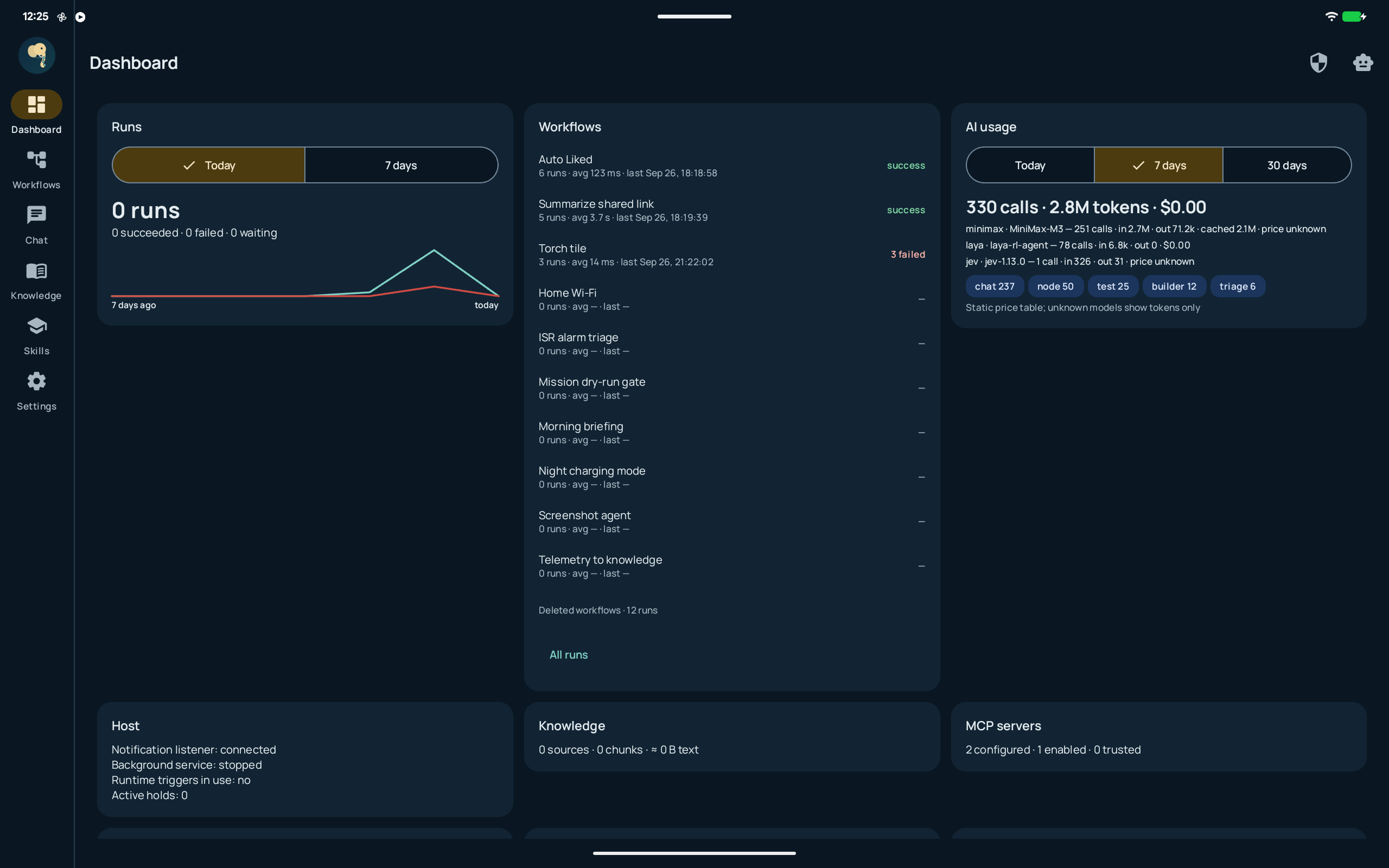 | 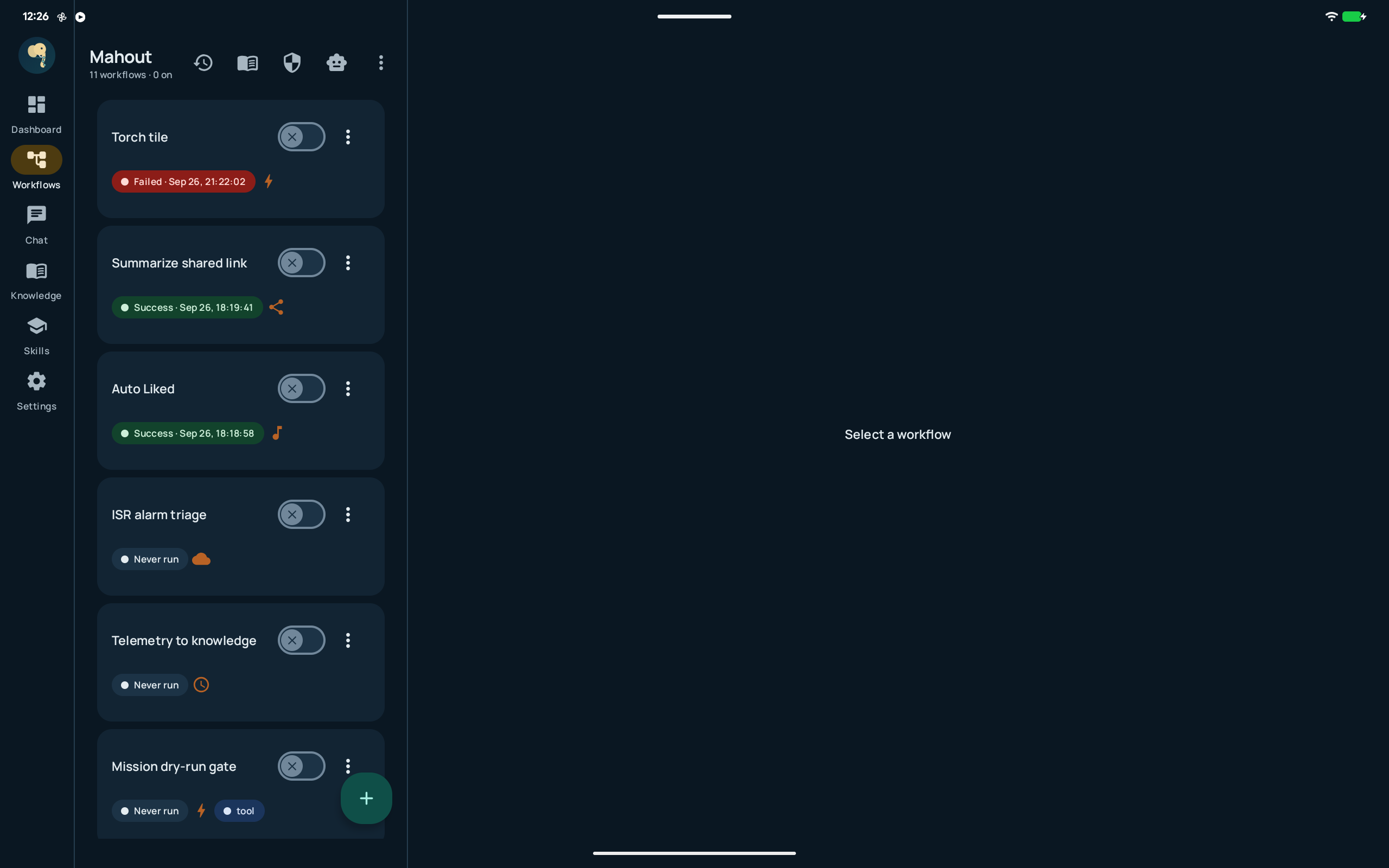 |
| Dashboard Run counts, AI spend, system health | Workflows All your automations, one list |
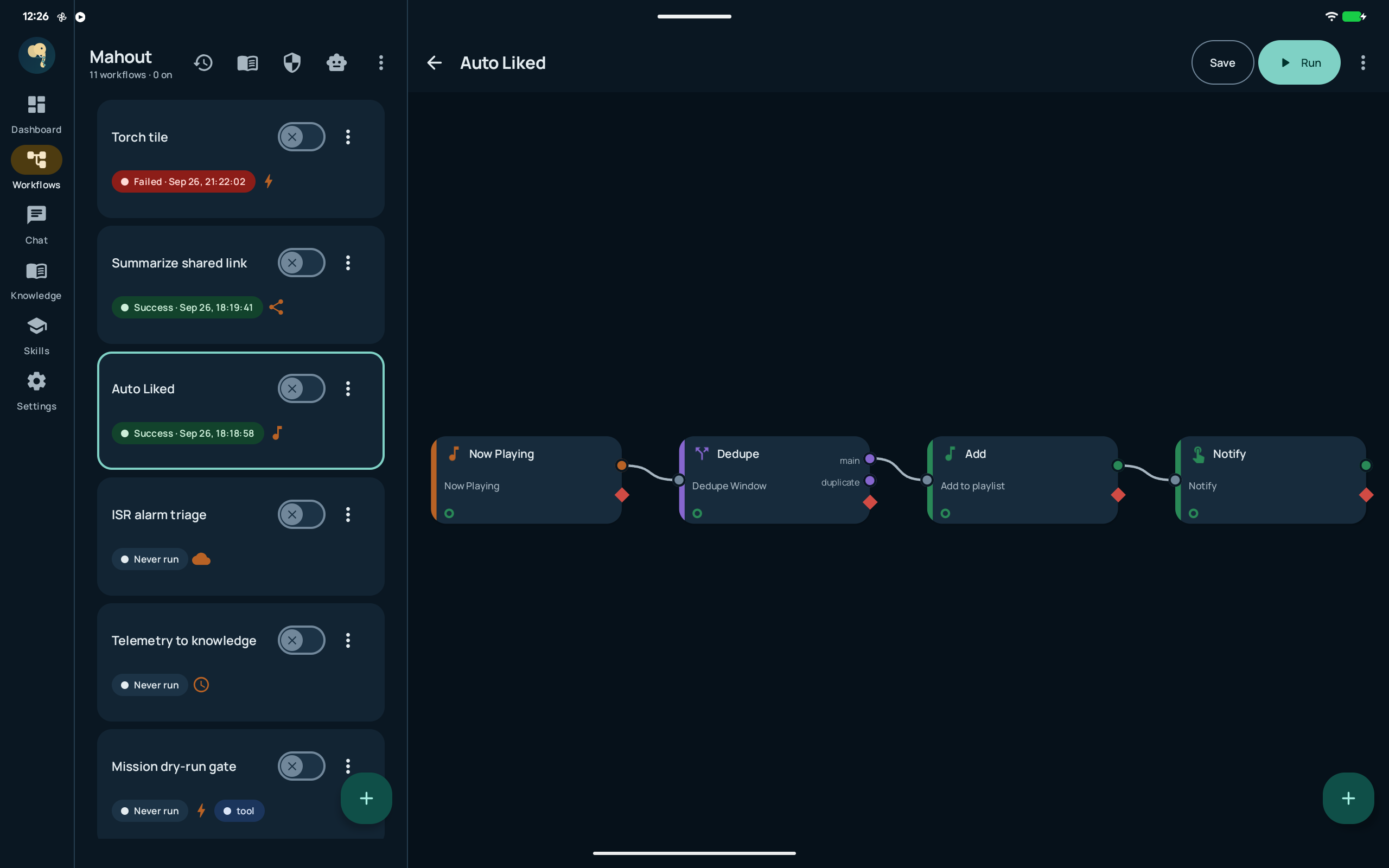 | 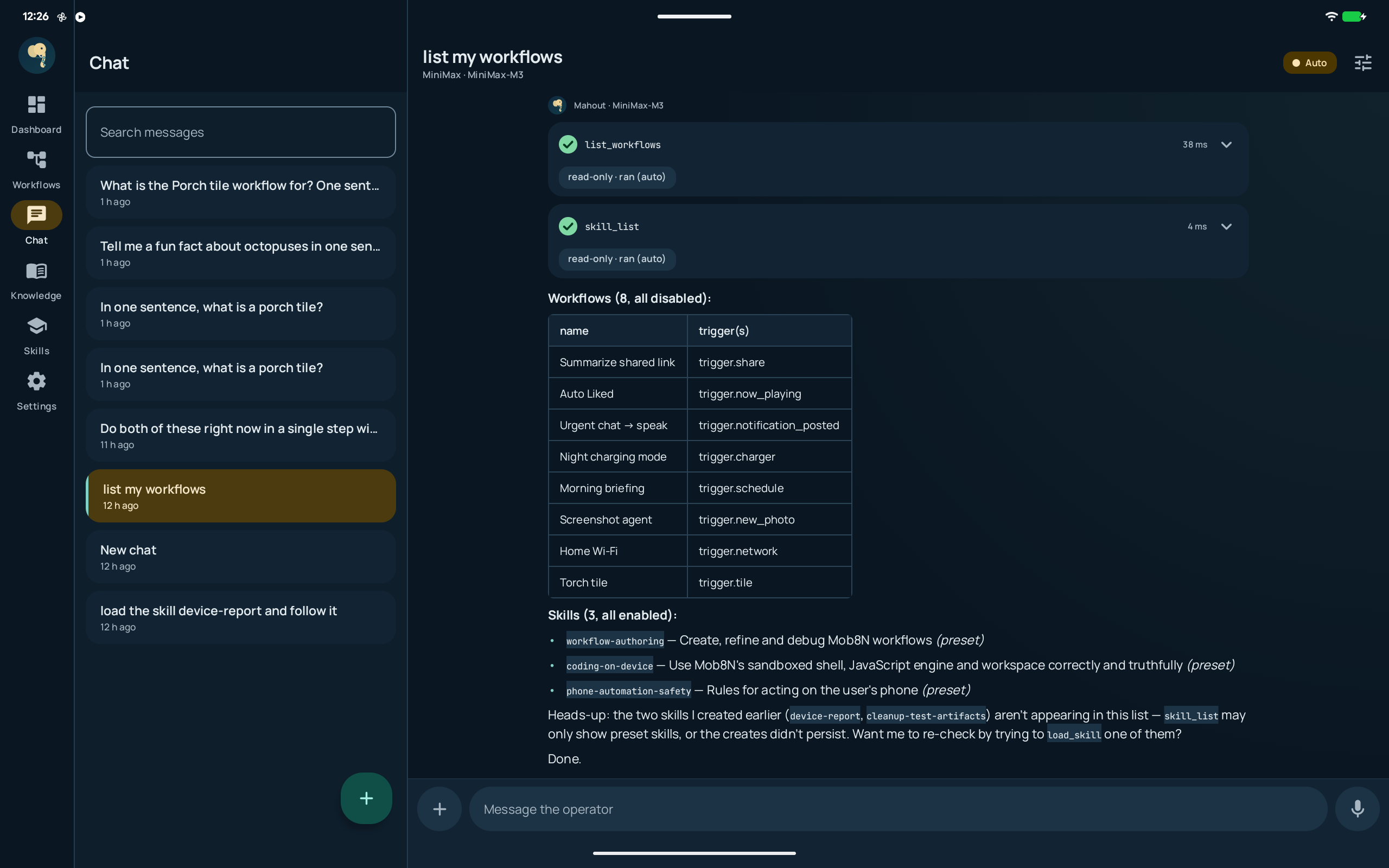 |
| Editor Drag-drop DAG canvas | Chat Operator AI assistant, token-by-token streaming |
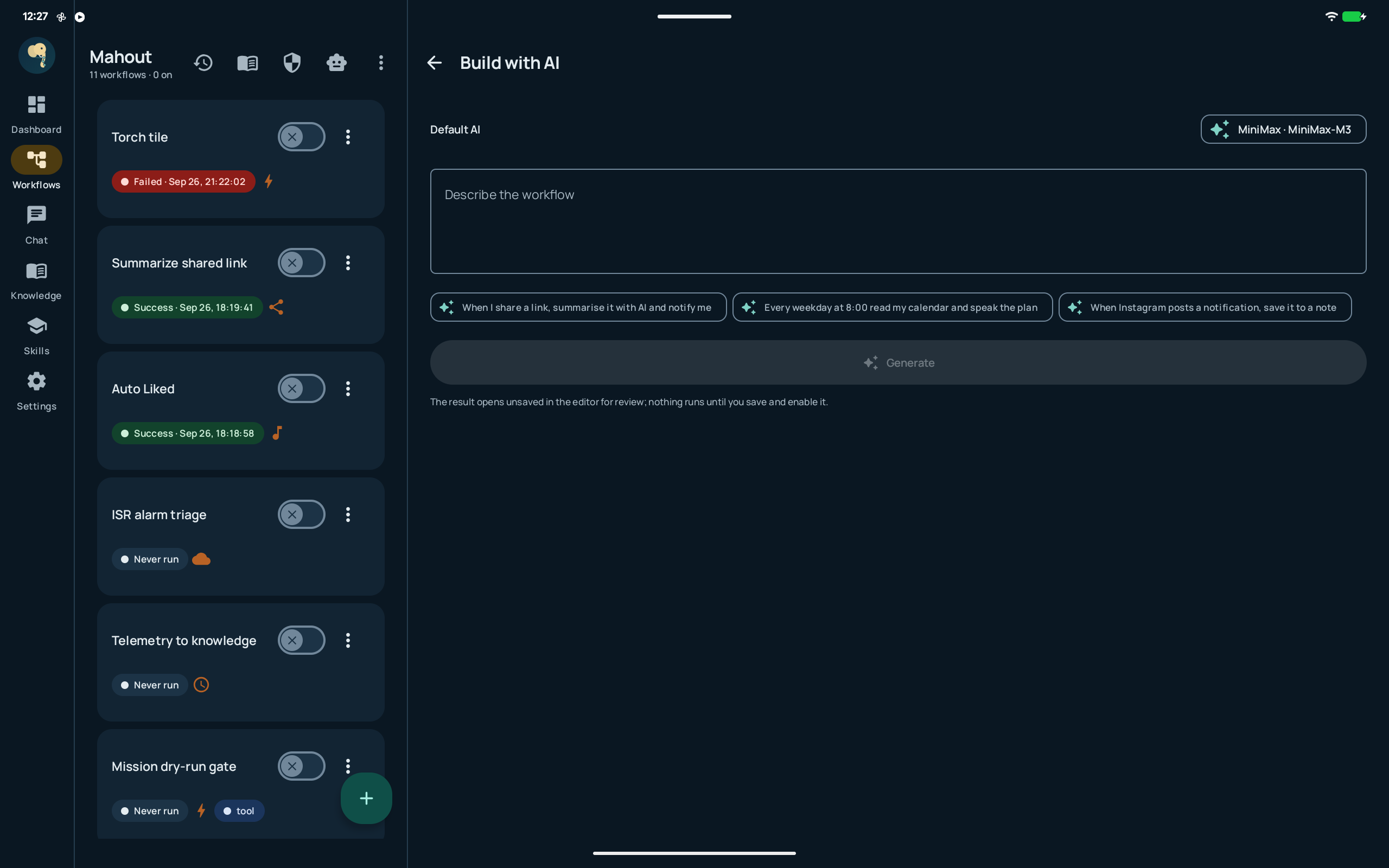 | 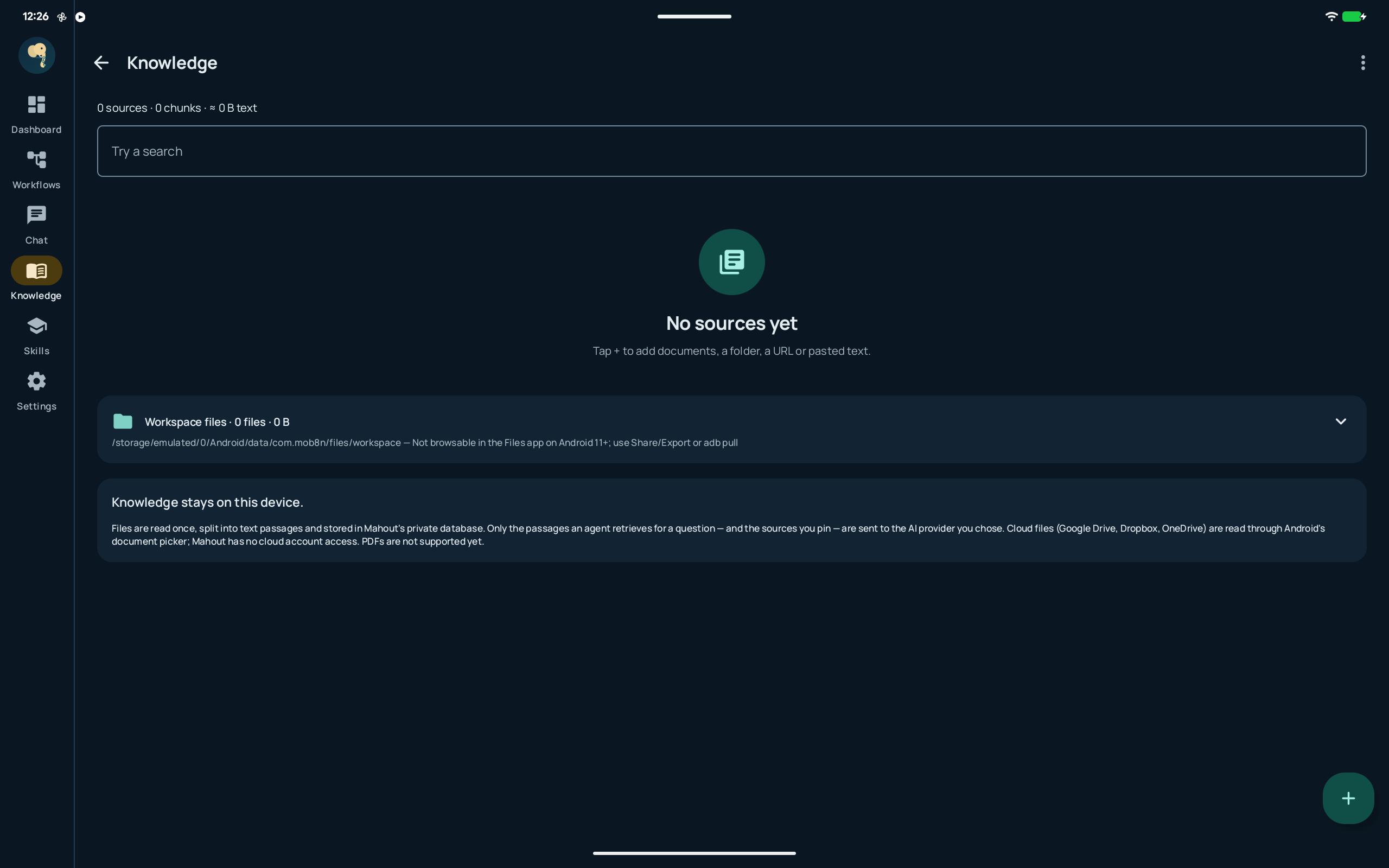 |
| Build with AI Describe a workflow, AI drafts it | Knowledge On-device RAG index |
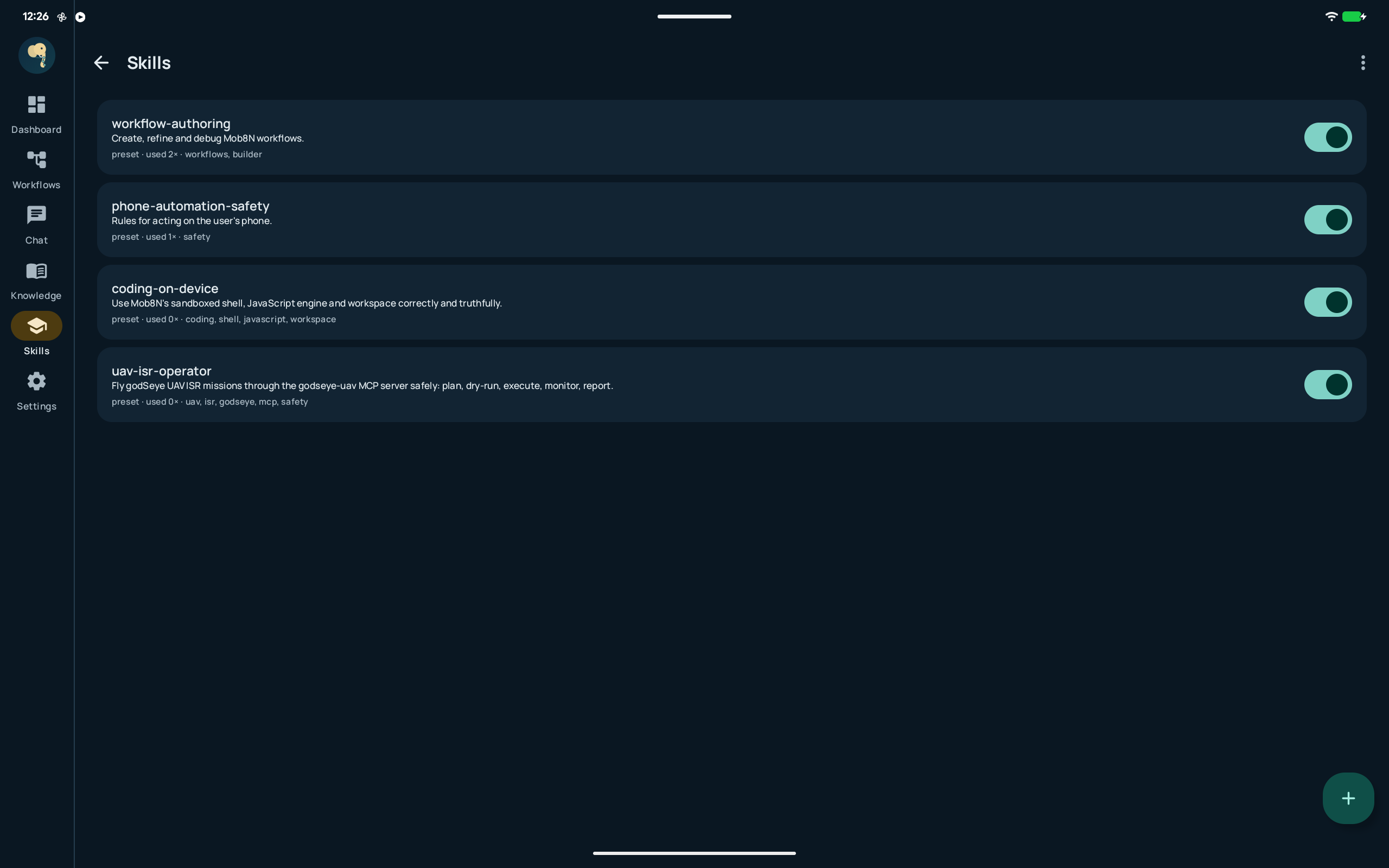 | 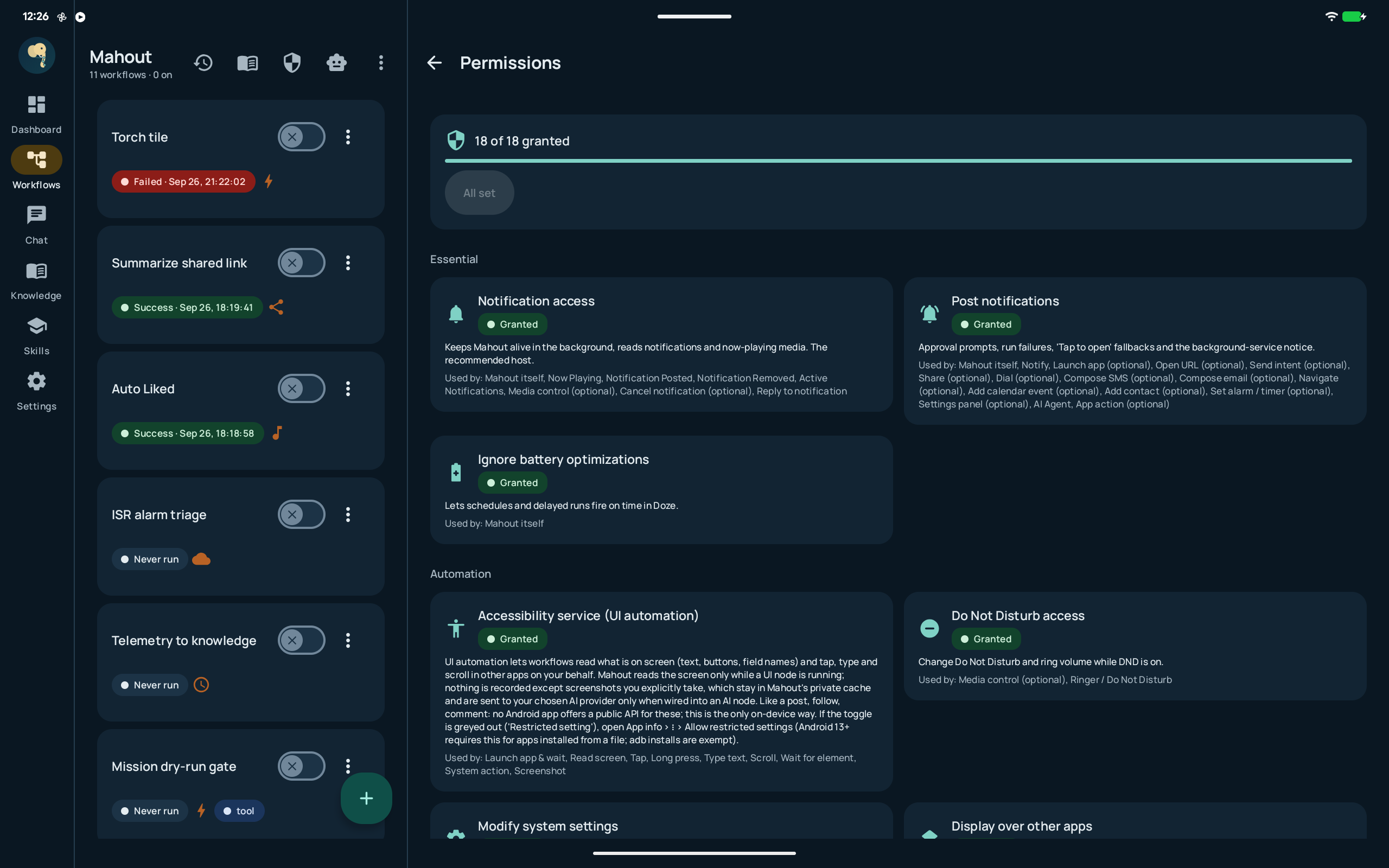 |
| Skills Agent skills + enable switches | Permissions One-tap grant-all stepper |
How It Works
Nodes & Lanes
Every node is one self-contained Kotlin object : Node — a spec (params, inputs/outputs, gates, timeout) plus an execute(ctx, input) method. Nine lanes organise ~90+ nodes:
| Lane | What it contains |
|---|---|
| Triggers | Manual, schedule, notifications, sensors, location, calendar, webhooks, charging, proximity, system broadcasts |
| Data | HTTP requests, device info, media metadata, knowledge search, variable store |
| Logic | Conditions (if/else), loops, JS eval, text & math, merge, wait/delay |
| AI | Ask AI, Classify, Extract, Agent (tool-using loop), MCP tool/resource, Decision routing |
| Actions | Notifications, system settings (torch, DND, Wi-Fi, Bluetooth), send intents, file writes, playlist entries, knowledge ingest |
| Apps | Deep-link launches, shell commands, JS runtime, workspace file I/O, UI automation (Accessibility) |
Visual Editor
A draggable, zoomable DAG canvas. Drop nodes from the palette, wire them together, configure params. The same params that drive the UI also drive Agent tool schemas, templating, validation, and log redaction.
Template System
Fields are wired through a simple syntax that feels like a templating language:
{{title}}  {{meta.artist}}  {{items[0].name}}    ← current item fields
{{$node.HTTP.body.x}}                             ← upstream node's first output
{{$vars.counter}}                                  ← global variable
{{$now}} {{$date}} {{$time}}                      ← built-in values
{{field ?? "default"}}                            ← fallback when missing
Chat Operator
An approval-gated AI assistant that manages your workflows, runs, knowledge, skills, and a coding sandbox — all from a natural-language interface. Four permission modes:
- Plan — no tools, read-only thinking
- Ask — per-call approval
- Auto — risk-based: safe actions (read/search) never ask, coding actions (shell/JS) ask, destructive actions (delete, UI automation) always require approval
- Bypass — time-limited full automatic, with a kill switch
The chat streams token-by-token and retains a turn history with tool-use results.
AI Providers
11 OpenAI-compatible providers (OpenAI, OpenRouter, MiniMax, Gemini, Grok, DeepSeek, Mistral, Groq, Together, Ollama, Custom) + Claude SDK + Gemini Nano (on-device). All through your own keys — no Mahout cloud costs anything.
Knowledge Base
On-device RAG: index documents, folders, URLs, pasted text, Notes, and Playlists. Room FTS4 storage with BM25 ranking. The Agent can search it with knowledge_search.
MCP Support
Connect remote MCP servers (stdio or SSE) and expose their tools to the Agent or as plain workflow nodes.
Panels
Running workflows control (suspend, cancel, resume), background host monitor, second-opinion, risk assessment, and System One decision engine — all from the Dashboard.
Build
# Prerequisites: Android Studio Koala+, Java 17, Gradle 8.7+, NDK (for Room schema export)

git clone https://github.com/ankurCES/Mahout.git
cd Mahout

# Build & install
./build.sh profile   # or debug; or ./gradlew :app:installDebug
adb install -r app/build/outputs/apk/profile/app-profile.apk
See docs/PLAN-v5.md for the verification smoke-test plan.
Architecture
Mob8NApp (manual DI)
  ├── Catalog (fused lane lists)
  ├── Engine (facade: start, save, run, chat, knowledge, skills)
  │   ├── TriggerHub (receiver/worker event dispatch)
  │   ├── Executor (pure Kotlin DAG runner, JVM-testable)
  │   ├── Knowledge (Room FTS4 RAG)
  │   ├── RoomPersistence (Room DAO seam)
  │   └── HostService / NotifListener (two live hosts)
  └── Lanes
      ├── core/      Nodes, Graph, Executor, Template, Params, Gates, Persistence
      ├── triggers/  Schedule, notifications, sensors, location, webhooks
      ├── data/      HTTP, device, media, knowledge, store
      ├── logic/     Conditions, loops, JS, text/math, wait
      ├── actions/   Notify, settings, intents, files, playlist
      ├── ai/        Ask, classify, extract, Agent, MCP Client, streaming
      ├── apps/      Shell, JS runtime, UI automation, workspace
      └── ui/        All Compose screens, theme, motion
Key design decisions:
- One currency:
kotlinx.serialization.json.JsonObjectfor items, logs, templates, LLM I/O, Room blobs. No DTOs. - One node = one
object : Node: spec + execute in the same file, appended to its lane'salllist. - Pure-Kotlin executor: no Android types in core except a nullable
Contexthandle. JVM-testable. - Two live hosts:
NotifListenerService(system-kept-alive) +HostService(specialUse FGS when needed). - Suspend/resume survives process death: engine state persisted to Room before notifying or enqueuing a delay.
- Manual DI, no Hilt, no ViewModels, no navigation-compose, no Retrofit/Moshi/Gson.
- Ponytail comments mark deliberate shortcuts with a ceiling and an upgrade path.
- Secrets: plaintext app-private prefs, excluded from backup, masked in UI, redacted from logs.
Testing
./gradlew test # 674+ JVM unit tests (pure-Kotlin core, template, graph, permissions, motion)
The core executor, template engine, graph validation, param validation, gates, motion tokens, and dashboard math are all JVM-tested. Android instrumentation tests cover the rest.
License
MIT — see the LICENSE file.
Built with Kotlin, Compose, and an elephant's patience.
Contributors

3 commits
Similar repos


Languages
Kotlin
99.9%
On-device workflow automation for Android — n8n meets Tasker. Every device capability is a node. Visual DAG editor, AI chat operator, 14 AI providers, on-device RAG, MCP support.
Kotlin
0
3 commits
updated Sep 27, 2026
See what people are saying
README
Mahout
On-device workflow automation for Android — n8n meets Tasker.
Every device capability is a node. Wire any node to any other node. Build automation workflows visually, or describe what you want and let Build with AI draft it. Run them manually, on schedules, or from real-world triggers — notifications, location, sensors, media, and more.
All AI runs on-device (Gemini Nano) or through your own API keys — no cloud subscription, no account, your data stays on your phone.
Screenshots
| |
| Dashboard Run counts, AI spend, system health | Workflows All your automations, one list |
| |
| Editor Drag-drop DAG canvas | Chat Operator AI assistant, token-by-token streaming |
| |
| Build with AI Describe a workflow, AI drafts it | Knowledge On-device RAG index |
| |
| Skills Agent skills + enable switches | Permissions One-tap grant-all stepper |
How It Works
Nodes & Lanes
Every node is one self-contained Kotlin object : Node — a spec (params, inputs/outputs, gates, timeout) plus an execute(ctx, input) method. Nine lanes organise ~90+ nodes:
| Lane | What it contains |
|---|---|
| Triggers | Manual, schedule, notifications, sensors, location, calendar, webhooks, charging, proximity, system broadcasts |
| Data | HTTP requests, device info, media metadata, knowledge search, variable store |
| Logic | Conditions (if/else), loops, JS eval, text & math, merge, wait/delay |
| AI | Ask AI, Classify, Extract, Agent (tool-using loop), MCP tool/resource, Decision routing |
| Actions | Notifications, system settings (torch, DND, Wi-Fi, Bluetooth), send intents, file writes, playlist entries, knowledge ingest |
| Apps | Deep-link launches, shell commands, JS runtime, workspace file I/O, UI automation (Accessibility) |
Visual Editor
A draggable, zoomable DAG canvas. Drop nodes from the palette, wire them together, configure params. The same params that drive the UI also drive Agent tool schemas, templating, validation, and log redaction.
Template System
Fields are wired through a simple syntax that feels like a templating language:
{{title}}  {{meta.artist}}  {{items[0].name}}    ← current item fields
{{$node.HTTP.body.x}}                             ← upstream node's first output
{{$vars.counter}}                                  ← global variable
{{$now}} {{$date}} {{$time}}                      ← built-in values
{{field ?? "default"}}                            ← fallback when missing
Chat Operator
An approval-gated AI assistant that manages your workflows, runs, knowledge, skills, and a coding sandbox — all from a natural-language interface. Four permission modes:
- Plan — no tools, read-only thinking
- Ask — per-call approval
- Auto — risk-based: safe actions (read/search) never ask, coding actions (shell/JS) ask, destructive actions (delete, UI automation) always require approval
- Bypass — time-limited full automatic, with a kill switch
The chat streams token-by-token and retains a turn history with tool-use results.
AI Providers
11 OpenAI-compatible providers (OpenAI, OpenRouter, MiniMax, Gemini, Grok, DeepSeek, Mistral, Groq, Together, Ollama, Custom) + Claude SDK + Gemini Nano (on-device). All through your own keys — no Mahout cloud costs anything.
Knowledge Base
On-device RAG: index documents, folders, URLs, pasted text, Notes, and Playlists. Room FTS4 storage with BM25 ranking. The Agent can search it with knowledge_search.
MCP Support
Connect remote MCP servers (stdio or SSE) and expose their tools to the Agent or as plain workflow nodes.
Panels
Running workflows control (suspend, cancel, resume), background host monitor, second-opinion, risk assessment, and System One decision engine — all from the Dashboard.
Build
# Prerequisites: Android Studio Koala+, Java 17, Gradle 8.7+, NDK (for Room schema export)

git clone https://github.com/ankurCES/Mahout.git
cd Mahout

# Build & install
./build.sh profile   # or debug; or ./gradlew :app:installDebug
adb install -r app/build/outputs/apk/profile/app-profile.apk
See docs/PLAN-v5.md for the verification smoke-test plan.
Architecture
Mob8NApp (manual DI)
  ├── Catalog (fused lane lists)
  ├── Engine (facade: start, save, run, chat, knowledge, skills)
  │   ├── TriggerHub (receiver/worker event dispatch)
  │   ├── Executor (pure Kotlin DAG runner, JVM-testable)
  │   ├── Knowledge (Room FTS4 RAG)
  │   ├── RoomPersistence (Room DAO seam)
  │   └── HostService / NotifListener (two live hosts)
  └── Lanes
      ├── core/      Nodes, Graph, Executor, Template, Params, Gates, Persistence
      ├── triggers/  Schedule, notifications, sensors, location, webhooks
      ├── data/      HTTP, device, media, knowledge, store
      ├── logic/     Conditions, loops, JS, text/math, wait
      ├── actions/   Notify, settings, intents, files, playlist
      ├── ai/        Ask, classify, extract, Agent, MCP Client, streaming
      ├── apps/      Shell, JS runtime, UI automation, workspace
      └── ui/        All Compose screens, theme, motion
Key design decisions:
- One currency:
kotlinx.serialization.json.JsonObjectfor items, logs, templates, LLM I/O, Room blobs. No DTOs. - One node = one
object : Node: spec + execute in the same file, appended to its lane'salllist. - Pure-Kotlin executor: no Android types in core except a nullable
Contexthandle. JVM-testable. - Two live hosts:
NotifListenerService(system-kept-alive) +HostService(specialUse FGS when needed). - Suspend/resume survives process death: engine state persisted to Room before notifying or enqueuing a delay.
- Manual DI, no Hilt, no ViewModels, no navigation-compose, no Retrofit/Moshi/Gson.
- Ponytail comments mark deliberate shortcuts with a ceiling and an upgrade path.
- Secrets: plaintext app-private prefs, excluded from backup, masked in UI, redacted from logs.
Testing
./gradlew test # 674+ JVM unit tests (pure-Kotlin core, template, graph, permissions, motion)
The core executor, template engine, graph validation, param validation, gates, motion tokens, and dashboard math are all JVM-tested. Android instrumentation tests cover the rest.
License
MIT — see the LICENSE file.
Built with Kotlin, Compose, and an elephant's patience.
Similar repos
Contributors
3 commits
Languages
Kotlin
99.9%