
README

-red?style=for-the-badge&logo=arxiv)



A curated collection of papers, benchmarks, datasets, and resources for the SLM-as-a-Judge paradigm.
📑 60+ Papers • 🧠 15+ Judge Systems • 🏗️ 5 Model Families • 📊 10 Benchmarks • ≤14B Parameters
📢 Latest News
| Date | Update |
|---|---|
| Jun 2026 | Project website launched: anishh15.github.io/Awesome-SLM-as-a-Judge |
| Jun 2026 | Survey paper released: Small Language Models as Judges: A Survey |
| May 2026 | Repository launched as companion to our EMNLP 2026 survey submission |
🔥 Latest Papers

🌳 Table of Contents
- Latest News
- Latest Papers
- About This Repository
- Overview
- Key Insights from the Survey
- Paper List
- 1. Foundational LLM-as-a-Judge Work
- 2. Specialized & Fine-Tuned Judge Models
- 3. Token Budget, Reasoning Efficiency & Overthinking
- 4. Ensemble & Panel-Based Methods
- 5. Multi-Agent Debate & Deliberation
- 6. Persona Effects & Prompt Sensitivity
- 7. Judge Biases, Preference Leakage & Uncertainty
- 8. Adversarial Robustness
- 9. Multilingual Evaluation
- 10. Self-Evolving & Self-Improving Judges
- 11. Alignment, RLHF & Training Methods
- 12. Reasoning & Chain-of-Thought
- 13. Model Papers
- Benchmarks & Datasets
- Related Surveys
- Citation
- Contributing
🌟 About This Repository
This repository accompanies our survey paper "Small Language Models as Judges: A Survey", which provides the first comprehensive review of the emerging paradigm where Small Language Models (SLMs), operationally defined as models with ≤14B parameters that can run on a single consumer GPU, serve as automated evaluators.
We organize the rapidly expanding literature around a structured taxonomy spanning five key dimensions:
- Background & Motivation: Why SLM judges, formal definitions, and evaluation formalism
- Individual SLM Judging: Specialized judges, token budgets, capability thresholds, overthinking, biases, and thinking modes
- Multi-Agent Strategies: Ensembles, debate, output optimization, and persona robustness
- Benchmarks & Metrics: Meta-evaluation infrastructure, adversarial robustness
- Challenges & Future Directions: Open research problems along the verifiability gradient
We will continuously update this repository with the latest papers and resources. If you find this helpful, please ⭐ star the repo!
📬 Missing a paper? Feel free to open an issue or submit a pull request.
📊 Overview
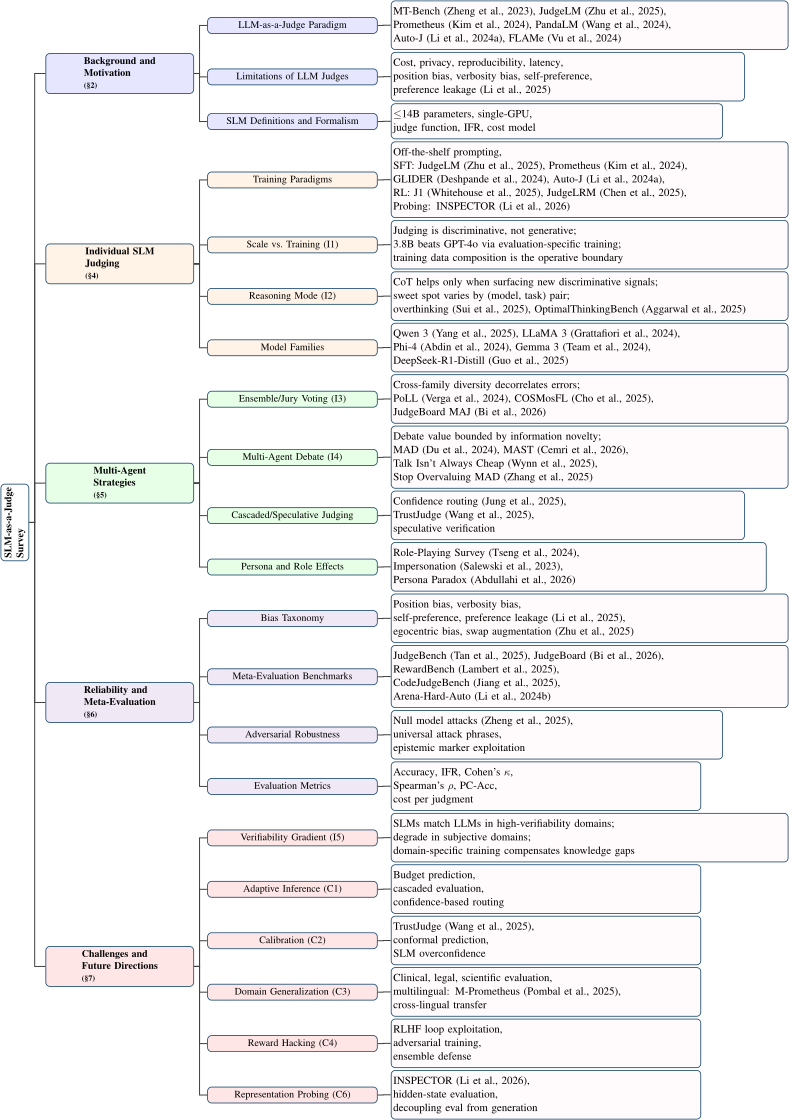
Figure: Taxonomy of the SLM-as-a-Judge survey, organized around five key dimensions: background and motivation, individual SLM judging, multi-agent strategies, benchmarks and metrics, and challenges and future directions.
🔬 Key Insights from the Survey
Our survey identifies five convergent insights with multi-paper evidence:
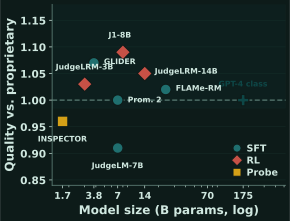
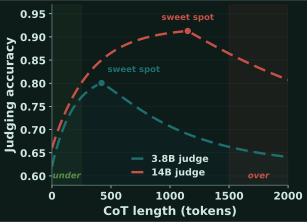
Left: Scale vs. capability, where fine-tuned 3-8B judges match proprietary models on standard benchmarks. Right: Reasoning tokens help only when they carry new discriminative signal.
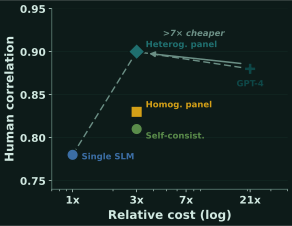
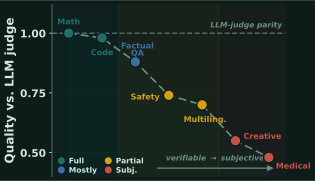
Left: Heterogeneous SLM juries decorrelate errors more effectively than scaling a single judge. Right: The verifiability gradient, where SLM judges approach parity in high-verifiability domains but degrade for subjective tasks.
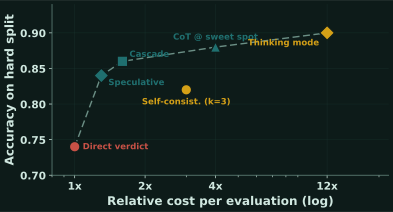
The cost-quality frontier: SLM judges occupy a practical sweet spot for most automated evaluation.
📑 Paper List
1. Foundational LLM-as-a-Judge Work


2. Specialized & Fine-Tuned Judge Models
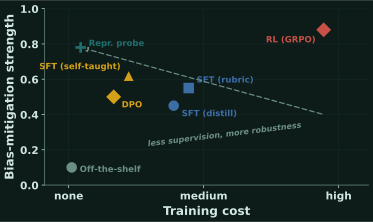
Figure: Comparison of training paradigms for SLM judge systems.


3. Token Budget, Reasoning Efficiency & Overthinking
4. Ensemble & Panel-Based Methods
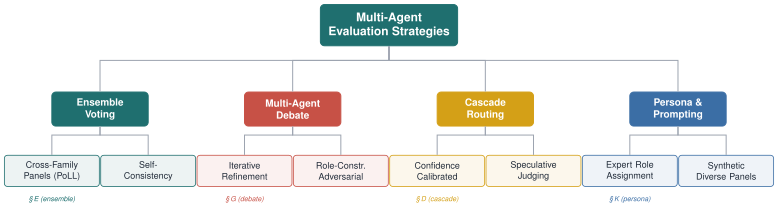
Figure: Taxonomy of multi-agent evaluation strategies: ensembles, juries, and debate.
5. Multi-Agent Debate & Deliberation
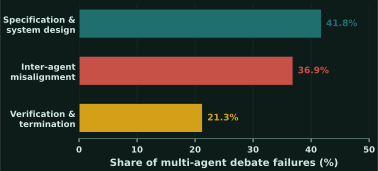
Figure: Failure modes in multi-agent debate systems (MAST taxonomy).
6. Persona Effects & Prompt Sensitivity

7. Judge Biases, Preference Leakage & Uncertainty
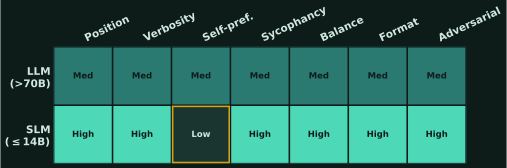
Figure: Heatmap of structural biases across judge models and evaluation settings.
8. Adversarial Robustness
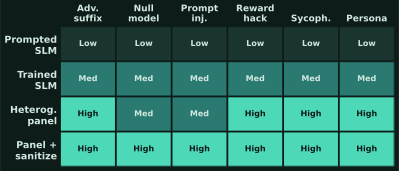
Figure: Defense strategies against adversarial attacks on LLM judges.
| Title | Venue | Year | Links |
|---|---|---|---|
 Cheating Automatic LLM Benchmarks: Null Models Achieve High Win Rates | ICLR (Oral) | 2025 | [pdf] [code] |
| One Token to Fool LLM-as-a-Judge | ArXiv | 2025 | [pdf] |
9. Multilingual Evaluation
| Title | Venue | Year | Links |
|---|---|---|---|
| M-Prometheus: A Suite of Open Multilingual LLM Judges | ArXiv | 2025 | [pdf] |
10. Self-Evolving & Self-Improving Judges
| Title | Venue | Year | Links |
|---|---|---|---|
| Self-Taught Evaluators | ArXiv | 2024 | [pdf] |
| DEBATE, TRAIN, EVOLVE: Self-Evolution of Language Model Reasoning | EMNLP | 2025 | [pdf] |
| Weak-to-Strong Generalization: Eliciting Strong Capabilities With Weak Supervision | ArXiv | 2023 | [pdf] |
11. Alignment, RLHF & Training Methods
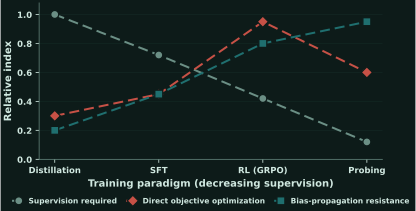
Figure: Supervision paradigms for training SLM judges.
12. Reasoning & Chain-of-Thought
| Title | Venue | Year | Links |
|---|---|---|---|
| Chain-of-Thought Prompting Elicits Reasoning in Large Language Models | NeurIPS | 2022 | [pdf] |
 DeepSeek-R1: Incentivizing Reasoning in LLMs through Reinforcement Learning | Nature | 2025 | [pdf] [code] |
13. Model Papers
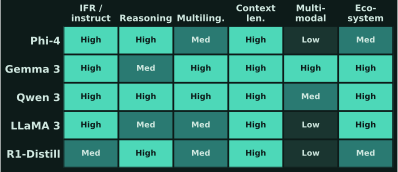
Figure: Capability heatmap across SLM model families.
📦 Benchmarks & Datasets
Meta-Evaluation Benchmarks
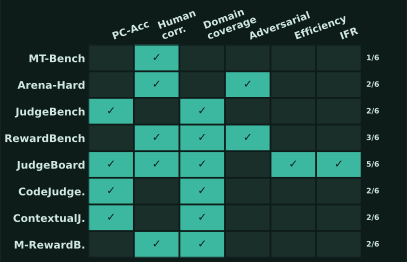
Figure: Coverage of meta-evaluation benchmarks across evaluation dimensions.
| Benchmark | Description | Paper |
|---|---|---|
| MT-Bench | 80 multi-turn questions, 8 categories, pairwise + single-scoring | Zheng et al., 2023 |
| JudgeBench | 350 challenging response pairs across knowledge, reasoning, math, coding | Tan et al., 2025 |
| RewardBench | Evaluation of reward models across chat, safety, reasoning | Lambert et al., 2025 |
| JudgeBoard | Benchmarking small language models for reasoning evaluation | Bi et al., 2026 |
| CodeJudgeBench | Benchmarking LLM-as-a-Judge for coding tasks | Jiang et al., 2025 |
| ContextualJudgeBench | Evaluating judges in contextual settings | Xu et al., 2025 |
Reasoning & Math Benchmarks (Used as Evaluation Substrates)
| Benchmark | Description | Paper |
|---|---|---|
| GSM8K | 8.5K grade-school math word problems | Cobbe et al., 2021 |
| MATH | 12.5K competition-level math problems across 7 topics | Hendrycks et al., 2021 |
| MMLU | Massive Multitask Language Understanding benchmark | Hendrycks et al., 2020 |
Code & Safety Benchmarks
| Benchmark | Description | Paper |
|---|---|---|
| SWE-bench | Can language models resolve real-world GitHub issues? | Jimenez et al., 2024 |
| LiveCodeBench | Holistic and contamination-free evaluation for code | Jain et al., 2025 |
| DecodingTrust | Comprehensive assessment of trustworthiness in GPT models | Wang et al., 2023 |
| TruthfulQA | Measuring how models mimic human falsehoods | Lin et al., 2022 |
Foundational NLP Evaluation Metrics
| Metric | Description | Paper |
|---|---|---|
| BLEU | Automatic evaluation of machine translation | Papineni et al., 2002 |
| BERTScore | Evaluating text generation with BERT embeddings | Zhang et al., 2019 |
| COMET | Neural framework for MT evaluation | Rei et al., 2020 |
📚 Related Surveys
| Survey | Focus | Year | Links |
|---|---|---|---|
| A Survey on LLM-as-a-Judge | Formal definitions, reliability, bias in LLM-based evaluation | 2024 | [pdf] |
| From Generation to Judgment: Opportunities and Challenges of LLM-as-a-Judge | Transition from generation to judgment | 2024 | [pdf] |
 LLMs-as-Judges: A Comprehensive Survey on LLM-based Evaluation Methods | Comprehensive review of LLM evaluation methods | 2024 | [pdf] [repo] |
 Efficient Large Language Models: A Survey | Efficiency techniques for large models | 2023 | [pdf] [repo] |
| Small Language Models: Survey, Measurements, and Insights | SLM architectures and deployment | 2024 | [pdf] |
| Stop Overthinking: A Survey on Efficient Reasoning for LLMs | Efficient reasoning and overthinking phenomenon | 2025 | [pdf] |
📖 Citation
If you find this survey and repository useful for your research, please cite our paper:
@article{laddha2026slmjudge,
  title   = {Small Language Models as Judges: A Survey},
  author  = {Anish Laddha and Nitesh Pradhan and Gaurav Srivastava},
  year    = {2026},
  url     = {https://github.com/anishh15/Awesome-SLM-as-a-Judge}
}
🤝 Contributing
We welcome contributions from the community! If you'd like to add a paper, fix a link, or suggest improvements:
- Open an Issue: Describe the paper or resource you'd like to add at github.com/anishh15/Awesome-SLM-as-a-Judge/issues.
- Submit a Pull Request: Use the following format for new paper entries:
|  <br> [**Paper Title**](arxiv_link) | Venue | Year | [[pdf]](link) [[code]](link) |
Please make sure to include:
- ✅ Correct arXiv or venue link
- ✅ Code/model links if available
- ✅ Correct categorization within our taxonomy
📞 Contact & Support
- 📧 Email: anshladdha15@gmail.com, nitesh.pradhan@lnmiit.ac.in, gks@vt.edu
- 🐛 Issues: GitHub Issues
📄 License
MIT License -- see LICENSE for details.



Made with ❤️ by Anish Laddha, Nitesh Pradhan, and Gaurav Srivastava
Similar repos


Languages
JavaScript
76.2%
CSS
22.0%
HTML
1.8%
README
A curated collection of papers, benchmarks, datasets, and resources for the SLM-as-a-Judge paradigm.
📑 60+ Papers • 🧠 15+ Judge Systems • 🏗️ 5 Model Families • 📊 10 Benchmarks • ≤14B Parameters
📢 Latest News
| Date | Update |
|---|---|
| Jun 2026 | Project website launched: anishh15.github.io/Awesome-SLM-as-a-Judge |
| Jun 2026 | Survey paper released: Small Language Models as Judges: A Survey |
| May 2026 | Repository launched as companion to our EMNLP 2026 survey submission |
🔥 Latest Papers
🌳 Table of Contents
- Latest News
- Latest Papers
- About This Repository
- Overview
- Key Insights from the Survey
- Paper List
- 1. Foundational LLM-as-a-Judge Work
- 2. Specialized & Fine-Tuned Judge Models
- 3. Token Budget, Reasoning Efficiency & Overthinking
- 4. Ensemble & Panel-Based Methods
- 5. Multi-Agent Debate & Deliberation
- 6. Persona Effects & Prompt Sensitivity
- 7. Judge Biases, Preference Leakage & Uncertainty
- 8. Adversarial Robustness
- 9. Multilingual Evaluation
- 10. Self-Evolving & Self-Improving Judges
- 11. Alignment, RLHF & Training Methods
- 12. Reasoning & Chain-of-Thought
- 13. Model Papers
- Benchmarks & Datasets
- Related Surveys
- Citation
- Contributing
🌟 About This Repository
This repository accompanies our survey paper "Small Language Models as Judges: A Survey", which provides the first comprehensive review of the emerging paradigm where Small Language Models (SLMs), operationally defined as models with ≤14B parameters that can run on a single consumer GPU, serve as automated evaluators.
We organize the rapidly expanding literature around a structured taxonomy spanning five key dimensions:
- Background & Motivation: Why SLM judges, formal definitions, and evaluation formalism
- Individual SLM Judging: Specialized judges, token budgets, capability thresholds, overthinking, biases, and thinking modes
- Multi-Agent Strategies: Ensembles, debate, output optimization, and persona robustness
- Benchmarks & Metrics: Meta-evaluation infrastructure, adversarial robustness
- Challenges & Future Directions: Open research problems along the verifiability gradient
We will continuously update this repository with the latest papers and resources. If you find this helpful, please ⭐ star the repo!
📬 Missing a paper? Feel free to open an issue or submit a pull request.
📊 Overview
Figure: Taxonomy of the SLM-as-a-Judge survey, organized around five key dimensions: background and motivation, individual SLM judging, multi-agent strategies, benchmarks and metrics, and challenges and future directions.
🔬 Key Insights from the Survey
Our survey identifies five convergent insights with multi-paper evidence:
Left: Scale vs. capability, where fine-tuned 3-8B judges match proprietary models on standard benchmarks. Right: Reasoning tokens help only when they carry new discriminative signal.
Left: Heterogeneous SLM juries decorrelate errors more effectively than scaling a single judge. Right: The verifiability gradient, where SLM judges approach parity in high-verifiability domains but degrade for subjective tasks.
The cost-quality frontier: SLM judges occupy a practical sweet spot for most automated evaluation.
📑 Paper List
1. Foundational LLM-as-a-Judge Work
2. Specialized & Fine-Tuned Judge Models
Figure: Comparison of training paradigms for SLM judge systems.
3. Token Budget, Reasoning Efficiency & Overthinking
4. Ensemble & Panel-Based Methods
Figure: Taxonomy of multi-agent evaluation strategies: ensembles, juries, and debate.
5. Multi-Agent Debate & Deliberation
Figure: Failure modes in multi-agent debate systems (MAST taxonomy).
6. Persona Effects & Prompt Sensitivity
7. Judge Biases, Preference Leakage & Uncertainty
Figure: Heatmap of structural biases across judge models and evaluation settings.
8. Adversarial Robustness
Figure: Defense strategies against adversarial attacks on LLM judges.
| Title | Venue | Year | Links |
|---|---|---|---|
| Cheating Automatic LLM Benchmarks: Null Models Achieve High Win Rates | ICLR (Oral) | 2025 | [pdf] [code] |
| One Token to Fool LLM-as-a-Judge | ArXiv | 2025 | [pdf] |
9. Multilingual Evaluation
| Title | Venue | Year | Links |
|---|---|---|---|
| M-Prometheus: A Suite of Open Multilingual LLM Judges | ArXiv | 2025 | [pdf] |
10. Self-Evolving & Self-Improving Judges
| Title | Venue | Year | Links |
|---|---|---|---|
| Self-Taught Evaluators | ArXiv | 2024 | [pdf] |
| DEBATE, TRAIN, EVOLVE: Self-Evolution of Language Model Reasoning | EMNLP | 2025 | [pdf] |
| Weak-to-Strong Generalization: Eliciting Strong Capabilities With Weak Supervision | ArXiv | 2023 | [pdf] |
11. Alignment, RLHF & Training Methods
Figure: Supervision paradigms for training SLM judges.
12. Reasoning & Chain-of-Thought
| Title | Venue | Year | Links |
|---|---|---|---|
| Chain-of-Thought Prompting Elicits Reasoning in Large Language Models | NeurIPS | 2022 | [pdf] |
| DeepSeek-R1: Incentivizing Reasoning in LLMs through Reinforcement Learning | Nature | 2025 | [pdf] [code] |
13. Model Papers
Figure: Capability heatmap across SLM model families.
📦 Benchmarks & Datasets
Meta-Evaluation Benchmarks
Figure: Coverage of meta-evaluation benchmarks across evaluation dimensions.
| Benchmark | Description | Paper |
|---|---|---|
| MT-Bench | 80 multi-turn questions, 8 categories, pairwise + single-scoring | Zheng et al., 2023 |
| JudgeBench | 350 challenging response pairs across knowledge, reasoning, math, coding | Tan et al., 2025 |
| RewardBench | Evaluation of reward models across chat, safety, reasoning | Lambert et al., 2025 |
| JudgeBoard | Benchmarking small language models for reasoning evaluation | Bi et al., 2026 |
| CodeJudgeBench | Benchmarking LLM-as-a-Judge for coding tasks | Jiang et al., 2025 |
| ContextualJudgeBench | Evaluating judges in contextual settings | Xu et al., 2025 |
Reasoning & Math Benchmarks (Used as Evaluation Substrates)
| Benchmark | Description | Paper |
|---|---|---|
| GSM8K | 8.5K grade-school math word problems | Cobbe et al., 2021 |
| MATH | 12.5K competition-level math problems across 7 topics | Hendrycks et al., 2021 |
| MMLU | Massive Multitask Language Understanding benchmark | Hendrycks et al., 2020 |
Code & Safety Benchmarks
| Benchmark | Description | Paper |
|---|---|---|
| SWE-bench | Can language models resolve real-world GitHub issues? | Jimenez et al., 2024 |
| LiveCodeBench | Holistic and contamination-free evaluation for code | Jain et al., 2025 |
| DecodingTrust | Comprehensive assessment of trustworthiness in GPT models | Wang et al., 2023 |
| TruthfulQA | Measuring how models mimic human falsehoods | Lin et al., 2022 |
Foundational NLP Evaluation Metrics
| Metric | Description | Paper |
|---|---|---|
| BLEU | Automatic evaluation of machine translation | Papineni et al., 2002 |
| BERTScore | Evaluating text generation with BERT embeddings | Zhang et al., 2019 |
| COMET | Neural framework for MT evaluation | Rei et al., 2020 |
📚 Related Surveys
| Survey | Focus | Year | Links |
|---|---|---|---|
| A Survey on LLM-as-a-Judge | Formal definitions, reliability, bias in LLM-based evaluation | 2024 | [pdf] |
| From Generation to Judgment: Opportunities and Challenges of LLM-as-a-Judge | Transition from generation to judgment | 2024 | [pdf] |
| LLMs-as-Judges: A Comprehensive Survey on LLM-based Evaluation Methods | Comprehensive review of LLM evaluation methods | 2024 | [pdf] [repo] |
| Efficient Large Language Models: A Survey | Efficiency techniques for large models | 2023 | [pdf] [repo] |
| Small Language Models: Survey, Measurements, and Insights | SLM architectures and deployment | 2024 | [pdf] |
| Stop Overthinking: A Survey on Efficient Reasoning for LLMs | Efficient reasoning and overthinking phenomenon | 2025 | [pdf] |
📖 Citation
If you find this survey and repository useful for your research, please cite our paper:
@article{laddha2026slmjudge,
  title   = {Small Language Models as Judges: A Survey},
  author  = {Anish Laddha and Nitesh Pradhan and Gaurav Srivastava},
  year    = {2026},
  url     = {https://github.com/anishh15/Awesome-SLM-as-a-Judge}
}
🤝 Contributing
We welcome contributions from the community! If you'd like to add a paper, fix a link, or suggest improvements:
- Open an Issue: Describe the paper or resource you'd like to add at github.com/anishh15/Awesome-SLM-as-a-Judge/issues.
- Submit a Pull Request: Use the following format for new paper entries:
|  <br> [**Paper Title**](arxiv_link) | Venue | Year | [[pdf]](link) [[code]](link) |
Please make sure to include:
- ✅ Correct arXiv or venue link
- ✅ Code/model links if available
- ✅ Correct categorization within our taxonomy
📞 Contact & Support
- 📧 Email: anshladdha15@gmail.com, nitesh.pradhan@lnmiit.ac.in, gks@vt.edu
- 🐛 Issues: GitHub Issues
📄 License
MIT License -- see LICENSE for details.
Made with ❤️ by Anish Laddha, Nitesh Pradhan, and Gaurav Srivastava
Similar repos
Languages
JavaScript
76.2%
CSS
22.0%
HTML
1.8%