TurboOCR, >200 img/s OmnidocBench. TensorRT FP16, PP-OCRv6, HTTP + gRPC
See the code🧪 Apple Metal and Intel OpenVINO backends are in testing, with AMD ROCm in development. NVIDIA is the only backend shipped today.
English | 简体中文
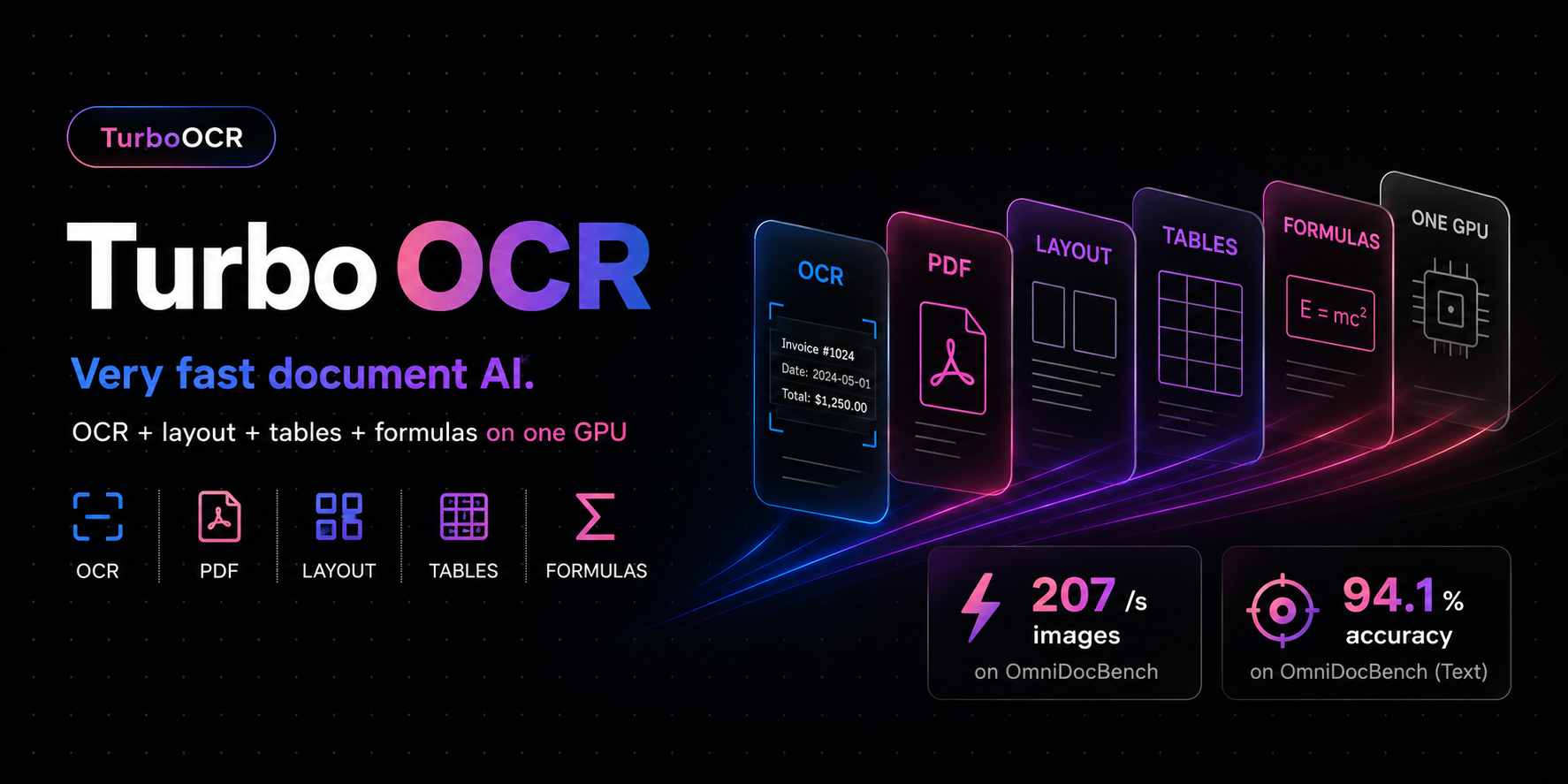
The fastest GPU document parser — OCR · layout · tables · formulas → Markdown, at 200–559 images/s on one GPU.
C++ / CUDA / TensorRT / PP-OCRv6 — Linux + NVIDIA GPU
New medium / small / tiny tiers · higher accuracy · faster defaults · breaking changes
⭐ Star TurboOCR on GitHub — it helps others (and agents) find it.










Quick Start · Accuracy · Benchmarks · Models · v3 changes · API · Docs
An extremely fast GPU document parser — not just OCR. PP-OCRv6 detection + recognition, plus layout, tables (→ HTML), formulas (→ LaTeX) and reading-order Markdown, the whole pipeline on a single multi-stream CUDA/TensorRT engine, locally (no VLM), behind HTTP and gRPC. Whole-page OCR runs at up to 559 images/s on receipts (one RTX 5090), and full structured parsing (layout + tables + formulas) at ~20 pages/s — where VLM document parsers like PaddleOCR-VL run ~1 page/s. On forms and receipts it is accurate and 15–90× faster than classic OCR engines.
tiny (default) / small / medium?words=1 adds every word of a line with its own box, cut at the line's real ink gaps/metricsFull documentation: docs/
Requirements: Linux, NVIDIA driver 595+, Turing or newer GPU (RTX 20-series / GTX 16-series+). Plan for ~4 GB VRAM text-only and ~8 GB for the full pipeline (layout + tables + formulas); each extra PIPELINE_POOL_SIZE replica adds roughly another full set, so lower it on smaller cards.
docker run --gpus all -p 8000:8000 -p 50051:50051 \
  -v trt-cache:/home/ocr/.cache/turbo-ocr \
  ghcr.io/aiptimizer/turboocr:latest
First startup builds TensorRT engines from ONNX. This takes about 90 seconds on a
5090 GPU and up to an hour on older ones. Set TRT_OPT_LEVEL=3 to cut build time
3 to 5x with a small speed regression. The named volume caches the engines, so
subsequent starts are instant. During the build, requests return a connection
refused error from nginx until the backend is ready. nginx (port 8000)
reverse-proxies to Drogon (port 8080), and both start automatically.
curl -X POST http://localhost:8000/ocr/raw \
  --data-binary @document.png -H "Content-Type: image/png"
{"results": [{"text": "Invoice Total", "confidence": 0.97, "bounding_box": [[42,10],[210,10],[210,38],[42,38]]}]}
All weights are baked into the image — just set the backend env var to load a stage (no paths needed). Layout is on by default; each extra stage still only runs when the request asks for it.
# text + layout (default)
docker run --gpus all -p 8000:8000 -p 50051:50051 \
  -v trt-cache:/home/ocr/.cache/turbo-ocr ghcr.io/aiptimizer/turboocr:latest

# + tables (→ HTML)       add  -e TABLE_BACKEND=slanext
# + formulas (→ LaTeX)    add  -e FORMULA_BACKEND=ppformulanet_s
# + both                  add  -e TABLE_BACKEND=slanext -e FORMULA_BACKEND=ppformulanet_s
# bigger / other language add  -e OCR_MODEL=medium   (tiny | small | medium | arabic | eslav | korean | thai | greek)
Then opt in per request (combine freely; tables/formulas auto-enable layout):
curl -X POST "http://localhost:8000/ocr/raw?layout=1&tables=1&formulas=1" \
  --data-binary @paper.png -H "Content-Type: image/png"
# PDF:  POST /ocr/pdf   ·   PDF → Markdown: POST /ocr/pdf?markdown=1   ·   page → Markdown: POST /ocr/markdown   ·   gRPC: port 50051
GET /capabilities reports which stages a running server has loaded.
→ Docker & deployment · Build from source
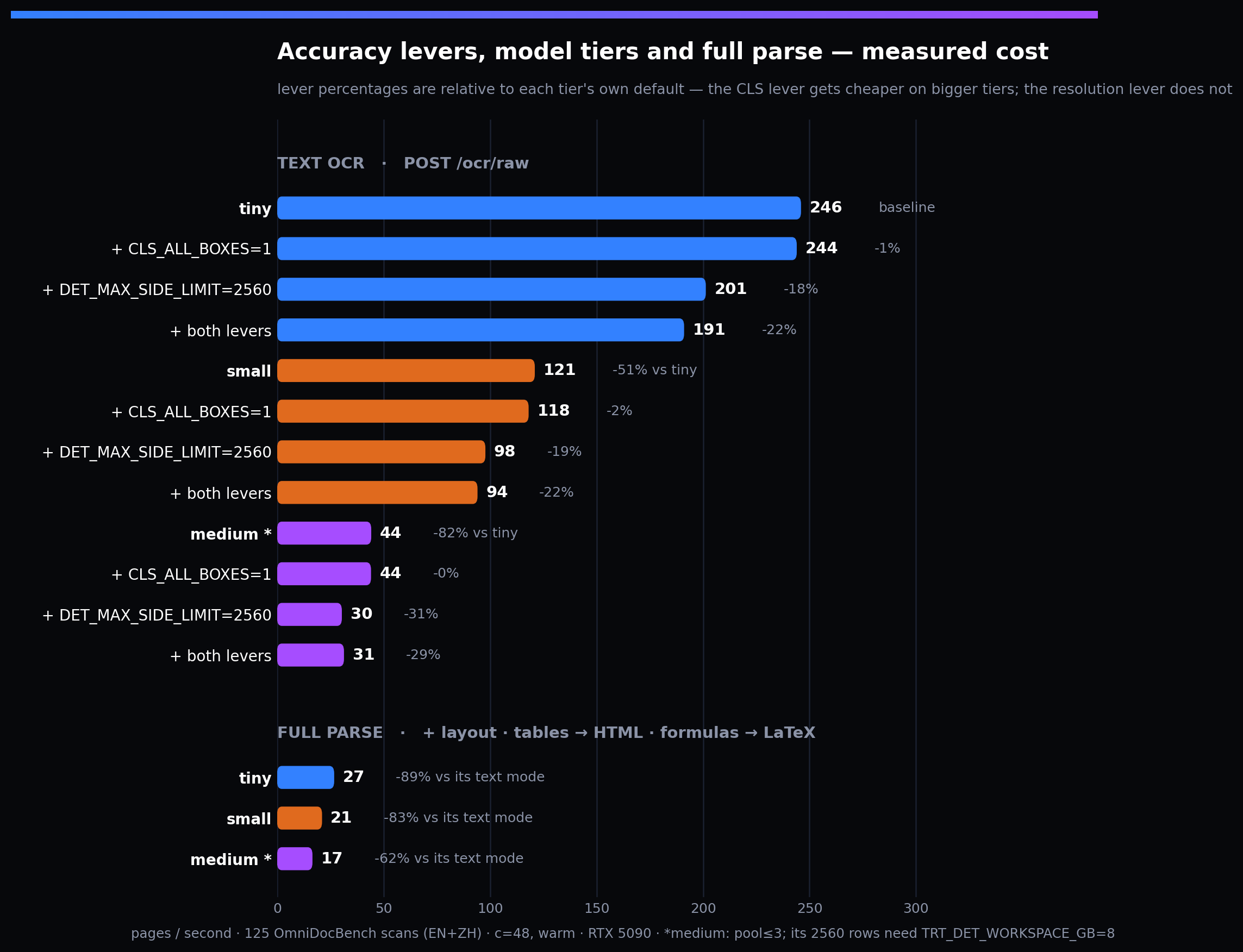
The defaults maximize throughput. Three levers trade speed for accuracy:
1. Bigger model tier — -e OCR_MODEL=small or medium. Same languages, same API; small fixes most of tiny's misreads (lost spaces, stylized fonts) at ~half the speed, medium is the most accurate.
2. Higher detection resolution — images whose long side exceeds 1280 px are downscaled before detection (recognition always reads full-res crops), so small text on phone screenshots or dense scans can go undetected. Raise the cap:
-e DET_MAX_SIDE_LIMIT=2560 # one-time engine rebuild, then cached
3. Orientation on every line — by default the 0°/180° classifier only checks vertical-looking lines, so an upside-down horizontal line is never corrected. For scans with mixed or rotated lines:
-e CLS_ALL_BOXES=1                                # check every line (small throughput cost)
-e CLS_ONNX=x1_0                                  # optional: full-width classifier variant
What each of these costs, measured (every combination, plus full parse with tables + formulas):
On a single RTX 5090, vs every common OCR engine:
→ Full benchmarks & methodology
The pipeline is a small stack of specialised models, not one monolith. Text detection + recognition + line orientation always run; everything else is opt-in and only loads when configured. Each stage links to its own model page.
| Stage | Model / arch | Size | Selected by | Docs |
|---|---|---|---|---|
| Text detection | PP-OCRv6 det (DB, three tiers) | 1.7 / 9.4 / 59 MB | OCR_MODEL tier (tiny/small/medium) | detection |
| Text recognition | PP-OCRv6 rec (CRNN + CTC, Latin + Chinese + Japanese) | 4.3 / 20 / 73 MB | OCR_MODEL tier — default tiny | recognition · selection |
| Line orientation | PP-LCNet textline angle classifier (0°/180° per line) | ~1 MB | always on (vertical lines only; every line with CLS_ALL_BOXES=1) | classification |
| Page orientation | PP-LCNet_x1_0_doc_ori (0/90/180/270 whole page) | ~7 MB | per request via /ocr/pdf?autorotate=1 | http api |
| Layout | PP-DocLayoutV3 (RT-DETR-L, 25 classes) | ~124 MB | per request via ?layout=1; disable with DISABLE_LAYOUT=1 | layout |
| Table → HTML | SLANet-Plus (TRT FP16 CNN encoder + hand-written C++ GRU decoder) | ~5 MB | TABLE_BACKEND=slanext (encoder auto-resolved from the bundle) | table |
| Formula → LaTeX | PP-FormulaNet-S, in-process pure-C++ (ORT-CUDA-13, no Python) | ~294 MB | FORMULA_BACKEND=ppformulanet_s | formula |
The three OCR tiers (tiny/small/medium) trade speed for accuracy, not language
coverage — all cover Latin + Chinese + Japanese (Getting higher accuracy).
Other scripts use retained PP-OCRv5 recognizers, also via OCR_MODEL: arabic,
eslav (Cyrillic), korean, thai, greek. The legacy v5 Latin det/rec can also
be swapped in for A/B comparison — see Running legacy PP-OCRv5.
Table and formula recognition are strictly opt-in, per request. The router
only loads a backend when one is configured at startup, and a stage runs only
when the request explicitly asks for it with ?tables=1 and/or ?formulas=1
(gRPC: the tables / formulas request fields). layout alone never triggers
them, so the default path pays nothing. When requested (and a backend is loaded),
the response gains tables (HTML + cell quads) and/or formulas (LaTeX) arrays.
tables=1/formulas=1 auto-enable layout. Asking for a stage the server wasn't
started with is a hard error (400 TABLE_BACKEND_DISABLED / FORMULA_BACKEND_DISABLED),
never a silent empty result — check GET /capabilities for what a server supports.
(/ocr/markdown always includes both, best-effort, since a faithful Markdown export
needs them.)
| Capability | Enable at startup | Recognizer |
|---|---|---|
| Formula → LaTeX | FORMULA_BACKEND=ppformulanet_s | PP-FormulaNet-S |
| Table → HTML | TABLE_BACKEND=slanext (encoder auto-resolved from the bundle) | SLANet-Plus |
Startup + request examples are in Quick Start above.
v3 renames the server binaries, moves the default engine to PP-OCRv6, and changes several defaults (timeouts, detection resize, input caps). If you are coming from v2.x, read the full migration guide: Upgrading to v3 — breaking changes.
One binary serves HTTP and gRPC from a shared GPU pipeline pool.
| Endpoint | Purpose |
|---|---|
POST /ocr/raw | OCR raw image bytes (fastest) |
POST /ocr | OCR base64 image in JSON |
POST /ocr/pixels | Zero-decode raw pixel buffer |
POST /ocr/batch | Batch of images |
POST /ocr/pdf | PDF → text (optional page images & auto-rotate); ?markdown=1 → whole PDF as Markdown |
POST /ocr/markdown | Page → faithful Markdown (GPU build; requires layout) |
POST /infer | OCR + layout / reading-order / blocks in one structured response |
GET /capabilities | Runtime feature & route discovery |
GET /metrics | Prometheus metrics |
GET /health · /health/live · /health/ready | Liveness / readiness probes |
All OCR endpoints accept ?layout=1 (region detection + reading order),
?words=1 (word-level boxes inside every line), and ?tables=1 / ?formulas=1
to additionally run table → HTML / formula → LaTeX on detected regions (strict
opt-in — see Tables & formulas).
→ HTTP API · gRPC API · Monitoring
Everything is configured by environment variable (and an equivalent CLI flag). Common ones:
| Variable | Default | Description |
|---|---|---|
OCR_MODEL | tiny | tiny / small / medium, or a PP-OCRv5 script model |
DISABLE_LAYOUT | 0 | 1 skips the layout model (~300–500 MB VRAM) |
LAYOUT_MERGE_MODE | all | Nested-box policy: all (keep every box) / outer (outer regions only) / inner (innermost only). Old large/small/union accepted as aliases. |
LAYOUT_KEEP_NESTED_CHILDREN | 0 | Only affects outer/inner modes: 1 still keeps the model's nested child regions (figure_title, footnote, formula_number, paragraph_title) instead of dropping them inside a parent. Formulas are always kept; no effect under default all. |
CLS_ALL_BOXES | 0 | 1 runs the 0°/180° orientation classifier on every text line instead of only vertical-looking ones — for scans with mixed or upside-down lines. |
REQUEST_TIMEOUT_MS | 60000 | Per-request inference deadline; on overrun returns 504 and frees the slot. 0 = unbounded (pre-v3 behaviour). |
IDLE_CONNECTION_TIMEOUT_S | 120 | How long one HTTP request may run (the server and the bundled nginx close a connection silent that long); raise it for long PDFs, 0 = no limit |
PIPELINE_POOL_SIZE | auto | Concurrent GPU pipelines |
→ Full configuration reference (35+ variables)
# Docker (recommended)
docker build -f docker/Dockerfile.gpu -t turboocr .
docker run --gpus all -p 8000:8000 -p 50051:50051 \
  -v trt-cache:/home/ocr/.cache/turbo-ocr turboocr

# Native (PP-OCRv6 models auto-fetched into ./models/ on first build)
cmake -B build            # finds CUDA and TensorRT itself; -DTENSORRT_DIR=<dir> to point at an unpacked tarball
cmake --build build -j$(nproc)
LD_LIBRARY_PATH=/usr/local/tensorrt/lib ./build/turboocr-server
Needs GCC 13.3+/C++20, CUDA + TensorRT 10.2+, OpenCV 4.x, Drogon 1.9+, gRPC.
Wuffs and PDFium are vendored in third_party/.
→ Build guide & GPU-architecture notes
Built on open-source work:
MIT. See LICENSE.
⭐ Star TurboOCR on GitHub
Sponsored by Miruiq — AI-powered data extraction from PDFs and documents — and DiaIQ.
768 followers · starred Jul 2026
635 followers · starred Jul 2026
32 followers · starred Aug 2026
109 followers · starred Jul 2026
TurboOCR, >200 img/s OmnidocBench. TensorRT FP16, PP-OCRv6, HTTP + gRPC
See the code🧪 Apple Metal and Intel OpenVINO backends are in testing, with AMD ROCm in development. NVIDIA is the only backend shipped today.
English | 简体中文
The fastest GPU document parser — OCR · layout · tables · formulas → Markdown, at 200–559 images/s on one GPU.
C++ / CUDA / TensorRT / PP-OCRv6 — Linux + NVIDIA GPU
New medium / small / tiny tiers · higher accuracy · faster defaults · breaking changes
⭐ Star TurboOCR on GitHub — it helps others (and agents) find it.
Quick Start · Accuracy · Benchmarks · Models · v3 changes · API · Docs
An extremely fast GPU document parser — not just OCR. PP-OCRv6 detection + recognition, plus layout, tables (→ HTML), formulas (→ LaTeX) and reading-order Markdown, the whole pipeline on a single multi-stream CUDA/TensorRT engine, locally (no VLM), behind HTTP and gRPC. Whole-page OCR runs at up to 559 images/s on receipts (one RTX 5090), and full structured parsing (layout + tables + formulas) at ~20 pages/s — where VLM document parsers like PaddleOCR-VL run ~1 page/s. On forms and receipts it is accurate and 15–90× faster than classic OCR engines.
tiny (default) / small / medium?words=1 adds every word of a line with its own box, cut at the line's real ink gaps/metricsFull documentation: docs/
Requirements: Linux, NVIDIA driver 595+, Turing or newer GPU (RTX 20-series / GTX 16-series+). Plan for ~4 GB VRAM text-only and ~8 GB for the full pipeline (layout + tables + formulas); each extra PIPELINE_POOL_SIZE replica adds roughly another full set, so lower it on smaller cards.
docker run --gpus all -p 8000:8000 -p 50051:50051 \
  -v trt-cache:/home/ocr/.cache/turbo-ocr \
  ghcr.io/aiptimizer/turboocr:latest
First startup builds TensorRT engines from ONNX. This takes about 90 seconds on a
5090 GPU and up to an hour on older ones. Set TRT_OPT_LEVEL=3 to cut build time
3 to 5x with a small speed regression. The named volume caches the engines, so
subsequent starts are instant. During the build, requests return a connection
refused error from nginx until the backend is ready. nginx (port 8000)
reverse-proxies to Drogon (port 8080), and both start automatically.
curl -X POST http://localhost:8000/ocr/raw \
  --data-binary @document.png -H "Content-Type: image/png"
{"results": [{"text": "Invoice Total", "confidence": 0.97, "bounding_box": [[42,10],[210,10],[210,38],[42,38]]}]}
All weights are baked into the image — just set the backend env var to load a stage (no paths needed). Layout is on by default; each extra stage still only runs when the request asks for it.
# text + layout (default)
docker run --gpus all -p 8000:8000 -p 50051:50051 \
  -v trt-cache:/home/ocr/.cache/turbo-ocr ghcr.io/aiptimizer/turboocr:latest

# + tables (→ HTML)       add  -e TABLE_BACKEND=slanext
# + formulas (→ LaTeX)    add  -e FORMULA_BACKEND=ppformulanet_s
# + both                  add  -e TABLE_BACKEND=slanext -e FORMULA_BACKEND=ppformulanet_s
# bigger / other language add  -e OCR_MODEL=medium   (tiny | small | medium | arabic | eslav | korean | thai | greek)
Then opt in per request (combine freely; tables/formulas auto-enable layout):
curl -X POST "http://localhost:8000/ocr/raw?layout=1&tables=1&formulas=1" \
  --data-binary @paper.png -H "Content-Type: image/png"
# PDF:  POST /ocr/pdf   ·   PDF → Markdown: POST /ocr/pdf?markdown=1   ·   page → Markdown: POST /ocr/markdown   ·   gRPC: port 50051
GET /capabilities reports which stages a running server has loaded.
→ Docker & deployment · Build from source
The defaults maximize throughput. Three levers trade speed for accuracy:
1. Bigger model tier — -e OCR_MODEL=small or medium. Same languages, same API; small fixes most of tiny's misreads (lost spaces, stylized fonts) at ~half the speed, medium is the most accurate.
2. Higher detection resolution — images whose long side exceeds 1280 px are downscaled before detection (recognition always reads full-res crops), so small text on phone screenshots or dense scans can go undetected. Raise the cap:
-e DET_MAX_SIDE_LIMIT=2560 # one-time engine rebuild, then cached
3. Orientation on every line — by default the 0°/180° classifier only checks vertical-looking lines, so an upside-down horizontal line is never corrected. For scans with mixed or rotated lines:
-e CLS_ALL_BOXES=1                                # check every line (small throughput cost)
-e CLS_ONNX=x1_0                                  # optional: full-width classifier variant
What each of these costs, measured (every combination, plus full parse with tables + formulas):
On a single RTX 5090, vs every common OCR engine:
→ Full benchmarks & methodology
The pipeline is a small stack of specialised models, not one monolith. Text detection + recognition + line orientation always run; everything else is opt-in and only loads when configured. Each stage links to its own model page.
| Stage | Model / arch | Size | Selected by | Docs |
|---|---|---|---|---|
| Text detection | PP-OCRv6 det (DB, three tiers) | 1.7 / 9.4 / 59 MB | OCR_MODEL tier (tiny/small/medium) | detection |
| Text recognition | PP-OCRv6 rec (CRNN + CTC, Latin + Chinese + Japanese) | 4.3 / 20 / 73 MB | OCR_MODEL tier — default tiny | recognition · selection |
| Line orientation | PP-LCNet textline angle classifier (0°/180° per line) | ~1 MB | always on (vertical lines only; every line with CLS_ALL_BOXES=1) | classification |
| Page orientation | PP-LCNet_x1_0_doc_ori (0/90/180/270 whole page) | ~7 MB | per request via /ocr/pdf?autorotate=1 | http api |
| Layout | PP-DocLayoutV3 (RT-DETR-L, 25 classes) | ~124 MB | per request via ?layout=1; disable with DISABLE_LAYOUT=1 | layout |
| Table → HTML | SLANet-Plus (TRT FP16 CNN encoder + hand-written C++ GRU decoder) | ~5 MB | TABLE_BACKEND=slanext (encoder auto-resolved from the bundle) | table |
| Formula → LaTeX | PP-FormulaNet-S, in-process pure-C++ (ORT-CUDA-13, no Python) | ~294 MB | FORMULA_BACKEND=ppformulanet_s | formula |
The three OCR tiers (tiny/small/medium) trade speed for accuracy, not language
coverage — all cover Latin + Chinese + Japanese (Getting higher accuracy).
Other scripts use retained PP-OCRv5 recognizers, also via OCR_MODEL: arabic,
eslav (Cyrillic), korean, thai, greek. The legacy v5 Latin det/rec can also
be swapped in for A/B comparison — see Running legacy PP-OCRv5.
Table and formula recognition are strictly opt-in, per request. The router
only loads a backend when one is configured at startup, and a stage runs only
when the request explicitly asks for it with ?tables=1 and/or ?formulas=1
(gRPC: the tables / formulas request fields). layout alone never triggers
them, so the default path pays nothing. When requested (and a backend is loaded),
the response gains tables (HTML + cell quads) and/or formulas (LaTeX) arrays.
tables=1/formulas=1 auto-enable layout. Asking for a stage the server wasn't
started with is a hard error (400 TABLE_BACKEND_DISABLED / FORMULA_BACKEND_DISABLED),
never a silent empty result — check GET /capabilities for what a server supports.
(/ocr/markdown always includes both, best-effort, since a faithful Markdown export
needs them.)
| Capability | Enable at startup | Recognizer |
|---|---|---|
| Formula → LaTeX | FORMULA_BACKEND=ppformulanet_s | PP-FormulaNet-S |
| Table → HTML | TABLE_BACKEND=slanext (encoder auto-resolved from the bundle) | SLANet-Plus |
Startup + request examples are in Quick Start above.
v3 renames the server binaries, moves the default engine to PP-OCRv6, and changes several defaults (timeouts, detection resize, input caps). If you are coming from v2.x, read the full migration guide: Upgrading to v3 — breaking changes.
One binary serves HTTP and gRPC from a shared GPU pipeline pool.
| Endpoint | Purpose |
|---|---|
POST /ocr/raw | OCR raw image bytes (fastest) |
POST /ocr | OCR base64 image in JSON |
POST /ocr/pixels | Zero-decode raw pixel buffer |
POST /ocr/batch | Batch of images |
POST /ocr/pdf | PDF → text (optional page images & auto-rotate); ?markdown=1 → whole PDF as Markdown |
POST /ocr/markdown | Page → faithful Markdown (GPU build; requires layout) |
POST /infer | OCR + layout / reading-order / blocks in one structured response |
GET /capabilities | Runtime feature & route discovery |
GET /metrics | Prometheus metrics |
GET /health · /health/live · /health/ready | Liveness / readiness probes |
All OCR endpoints accept ?layout=1 (region detection + reading order),
?words=1 (word-level boxes inside every line), and ?tables=1 / ?formulas=1
to additionally run table → HTML / formula → LaTeX on detected regions (strict
opt-in — see Tables & formulas).
→ HTTP API · gRPC API · Monitoring
Everything is configured by environment variable (and an equivalent CLI flag). Common ones:
| Variable | Default | Description |
|---|---|---|
OCR_MODEL | tiny | tiny / small / medium, or a PP-OCRv5 script model |
DISABLE_LAYOUT | 0 | 1 skips the layout model (~300–500 MB VRAM) |
LAYOUT_MERGE_MODE | all | Nested-box policy: all (keep every box) / outer (outer regions only) / inner (innermost only). Old large/small/union accepted as aliases. |
LAYOUT_KEEP_NESTED_CHILDREN | 0 | Only affects outer/inner modes: 1 still keeps the model's nested child regions (figure_title, footnote, formula_number, paragraph_title) instead of dropping them inside a parent. Formulas are always kept; no effect under default all. |
CLS_ALL_BOXES | 0 | 1 runs the 0°/180° orientation classifier on every text line instead of only vertical-looking ones — for scans with mixed or upside-down lines. |
REQUEST_TIMEOUT_MS | 60000 | Per-request inference deadline; on overrun returns 504 and frees the slot. 0 = unbounded (pre-v3 behaviour). |
IDLE_CONNECTION_TIMEOUT_S | 120 | How long one HTTP request may run (the server and the bundled nginx close a connection silent that long); raise it for long PDFs, 0 = no limit |
PIPELINE_POOL_SIZE | auto | Concurrent GPU pipelines |
→ Full configuration reference (35+ variables)
# Docker (recommended)
docker build -f docker/Dockerfile.gpu -t turboocr .
docker run --gpus all -p 8000:8000 -p 50051:50051 \
  -v trt-cache:/home/ocr/.cache/turbo-ocr turboocr

# Native (PP-OCRv6 models auto-fetched into ./models/ on first build)
cmake -B build            # finds CUDA and TensorRT itself; -DTENSORRT_DIR=<dir> to point at an unpacked tarball
cmake --build build -j$(nproc)
LD_LIBRARY_PATH=/usr/local/tensorrt/lib ./build/turboocr-server
Needs GCC 13.3+/C++20, CUDA + TensorRT 10.2+, OpenCV 4.x, Drogon 1.9+, gRPC.
Wuffs and PDFium are vendored in third_party/.
→ Build guide & GPU-architecture notes
Built on open-source work:
MIT. See LICENSE.
⭐ Star TurboOCR on GitHub
Sponsored by Miruiq — AI-powered data extraction from PDFs and documents — and DiaIQ.
768 followers · starred Jul 2026
635 followers · starred Jul 2026
32 followers · starred Aug 2026
109 followers · starred Jul 2026