Master AI inference, AI agent harness systems, and hardware engineering — then design a physical AI chip. That is the goal.
See the codeThe AI Hardware Engineer Roadmap
A hands-on curriculum for understanding, optimizing, and deploying AI on real hardware — GPU kernels, agent runtimes, embedded systems, and Jetson — with a path toward designing the accelerator underneath. Start with one working experiment; finish with results someone else can reproduce.
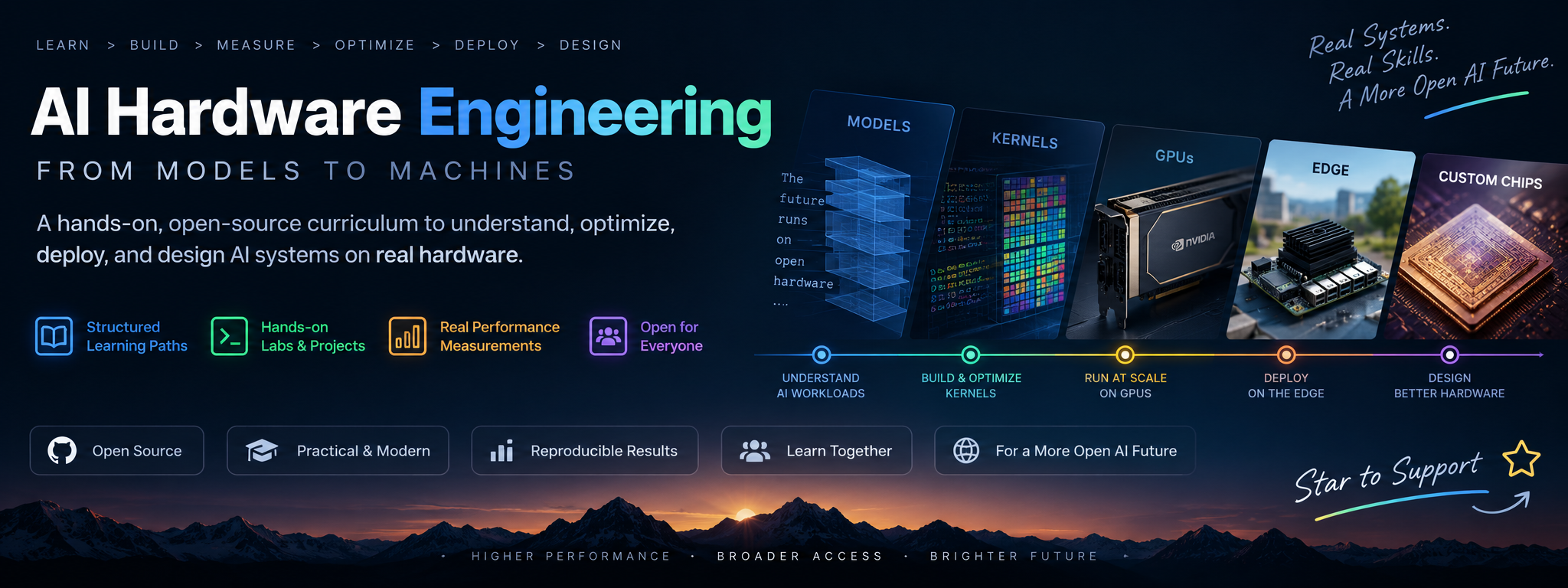
Master AI inference, AI agent harness systems, and hardware engineering — then design a physical AI chip.
The endpoint is a single die that runs production AI workloads, hosts a real agent runtime, and talks to the physical world over Wi-Fi/BLE/Thread — a Jetson-class AI brain fused with an ESP32-class wireless stack on one chip. Designing it takes three working skill sets at once: inference engineering (Qwen-class decode, kernels, quantization, rooflines, multi-GPU serving), agent harness systems (sessions, tools, multi-agent loops, RAG, evals, production observability), and hardware engineering (RTL, embedded Linux, Jetson, ESP32, RF, ASIC flow). This roadmap teaches all three side by side — the chip is the artifact, but the three pillars are the actual work.
Baseline: comfortable with Python or C++, and basic Linux command-line use. No prior hardware background required.
Already past the basics? Phase 1 and Phase 2 exist to fill specific gaps — digital logic, embedded Linux — not to gate you. If you already know CUDA/C++, go straight to Phase 3 and pick up Phase 1–2 material only where a later module says you need it.
If you only want to call an LLM API, this isn't for you. If you want to design the silicon that calls it, keep reading.
Pick the finish line that matches what you want to be able to do, not a track number.
| Path | You'll build | Finish-line artifact | Start here |
|---|---|---|---|
| AI Inference Engineering | Transformer execution, GEMV/GEMM kernels, quantization, serving | A benchmark report: predicted vs. measured tok/s on a real model, with the gap explained | Phase 3 — AI Workloads |
| AI Agent Harness Systems | Sessions, tool calling, multi-agent loops, evals, observability | A production-shaped agent harness running end to end | Agentic AI & GenAI — 42 lectures |
| Physical Hardware Engineering | Boards, embedded Linux, RTL, FPGA, ASIC flow | A board you brought up yourself, or an accelerator spec with real numbers | Phase 1 — Digital Foundations |
Each path stands on its own — you don't need the other two to get something real out of it. The Path below is where all three converge into the physical-AI-chip endpoint.
(Already picked a path above? This section is the deep-dive on why the three connect — skip to The Path if you just want the phase-by-phase breakdown.)
This roadmap is not three unrelated study tracks. It is a co-design loop. The inference workload tells you what the silicon must accelerate, the agent harness tells you what product behavior the runtime must support, and the hardware platform tells you what power, memory, I/O, security, and manufacturing constraints are real.
                               TARGET ARTIFACT
┌────────────────────────────────────────────────────────────────────────────┐
│                         Physical AI Agent Chip                             │
│ Linux-capable CPU + NPU/GPU/DLA + SRAM/DRAM fabric + ISP/audio/sensors     │
│ + Wi-Fi/BLE/Thread/Zigbee + secure boot/OTA + local agent runtime support  │
└────────────────────────────────────┬───────────────────────────────────────┘
                                     │
        ┌────────────────────────────┼────────────────────────────┐
        ▼                            ▼                            ▼
┌───────────────────────┐  ┌───────────────────────┐  ┌───────────────────────┐
│  AI Inference Systems │  │ Agent Harness Systems │  │ Physical HW Platform  │
├───────────────────────┤  ├───────────────────────┤  ├───────────────────────┤
│ Transformer execution │  │ Sessions and memory   │  │ Digital logic + RTL   │
│ GEMV/GEMM kernels     │  │ Tool/skill execution  │  │ CPU/NPU/GPU/DLA arch  │
│ Attention + KV cache  │  │ Gateway/RPC protocols │  │ SRAM/DRAM/DMA fabric  │
│ Quantization formats  │  │ Planner/executor loop │  │ MIPI CSI-2 + ISP      │
│ Tensor/pipeline para. │  │ Multi-agent control   │  │ Audio/GPIO/CAN/I2C    │
│ Serving schedulers    │  │ Evals and guardrails  │  │ Embedded Linux/L4T    │
│ CUDA/Triton kernels   │  │ Telemetry and tracing │  │ ESP32-class wireless  │
│ Roofline profiling    │  │ Product update path   │  │ FPGA -> ASIC flow     │
│ Real models: Qwen etc │  │ OpenClaw/SDKs/APIs    │  │ Board -> SoC thinking │
└───────────┬───────────┘  └───────────┬───────────┘  └───────────┬───────────┘
            │                          │                          │
            └──────────────┬───────────┴───────────┬──────────────┘
                           ▼                       ▼
        ┌────────────────────────────────────────────────────────────────┐
        │ Cross-layer contracts you learn to write                       │
        ├────────────────────────────────────────────────────────────────┤
        │ Workload contract: tokens/s, TTFT, context length, KV memory,  │
        │ batch shape, precision, latency tail, power budget.            │
        │ Runtime contract: APIs, cancellation, scheduling, security,    │
        │ observability, OTA, failure recovery, agent state persistence. │
        │ Hardware contract: MAC array, SRAM size, DMA plan, interconnect│
        │ bandwidth, radio wake events, camera/audio I/O, boot chain.    │
        └────────────────────────────────────────────────────────────────┘

                              CONVERGENCE PATH
┌────────────────────────────────────────────────────────────────────────────┐
│ Jetson-class AI subsystem        -> NPU/GPU/DLA/CPU compute tile           │
│ ESP32-class connectivity         -> Wi-Fi/BLE/Thread/Zigbee radio block    │
│ Camera, audio, and sensors       -> MIPI CSI-2, ISP, codecs, low-power I/O │
│ Agent runtime and serving stack  -> scheduler, memory manager, telemetry   │
│ FPGA/RTL/HLS/MLIR experiments    -> accelerator spec and tape-out target   │
└────────────────────────────────────────────────────────────────────────────┘
The workload your chip will run. This pillar teaches transformer execution from the bottom up: tokenization, embeddings, QKV projection, RoPE, attention, MLP, sampling, KV cache growth, quantization, batching, and serving. You learn why decode is often memory-bandwidth bound, why prefill and decode behave differently, and how GEMV/GEMM kernels, CUDA Graphs, FlashAttention, paged attention, tensor parallelism, and roofline analysis change the system.
Output of this pillar: benchmark reports, kernel experiments, model-memory budgets, quantization choices, and workload contracts precise enough to drive an accelerator architecture.
The software stack that lives above your chip. This pillar covers agentic runtimes, session models, gateway RPCs, tool calling, skills, multi-agent loops, RAG, evals, observability, policy controls, and product update flows. A physical AI chip does not just run matmuls. It runs user-facing loops with state, timeouts, cancellations, tool failures, network events, sensor interrupts, and safety constraints.
Output of this pillar: a production-style agent harness with clear runtime interfaces, telemetry, evals, tool boundaries, scheduling requirements, and the operational behavior your chip must support.
The substrate itself. This pillar starts with digital design, computer architecture, C/C++ systems work, embedded Linux, Jetson Orin, custom carrier boards, L4T, TensorRT/DLA, ESP32, OpenThread, Zigbee, ESP-Hosted, sensors, camera bring-up, audio, power, thermal, compliance, and manufacturing. Then it moves toward FPGA, HLS, MLIR/compiler work, RTL, SoC architecture, and AI chip design.
Output of this pillar: working boards, bring-up logs, Linux images, wireless integration, sensor pipelines, FPGA/RTL prototypes, and a credible chip spec with compute, memory, I/O, security, and manufacturing constraints.
| Design question | Inference pillar answers | Agent pillar answers | Hardware pillar answers |
|---|---|---|---|
| How fast must the chip be? | TTFT, tok/s, batch shape, context length | User-visible latency, tool-loop timing | MACs, SRAM, DRAM bandwidth, clocks |
| How much memory is enough? | Weights, KV cache, activations, quantization | Session state, tool buffers, logs | SRAM, LPDDR, DMA, cache hierarchy |
| How does it talk to the world? | Streaming inference, multimodal inputs | Events, RPC, tools, wake-on-demand | Wi-Fi/BLE/Thread/Zigbee, MIPI, audio |
| How does it ship safely? | Reproducible benchmarks, model updates | Evals, policy, observability, rollback | Secure boot, OTA, compliance, test |
Why the combination? A chip without a runtime is a brick. A runtime without an agent stack is a benchmark. An agent stack without inference cost discipline is a demo. An inference accelerator that cannot talk to the physical world over wireless, camera, audio, and sensor interfaces is a coprocessor someone else has to integrate. The three pillars are how you build a chip that ships in a real physical product: workload, runtime, radio, sensors, board, compiler, and silicon aligned from the start.
The reason for this roadmap, written as a checklist:
That last bullet is the goal. The first six exist to make it real.
Everything in this roadmap maps onto an 8-layer stack. The point isn't to memorize layers — it's to understand how decisions in one layer ripple through the others.
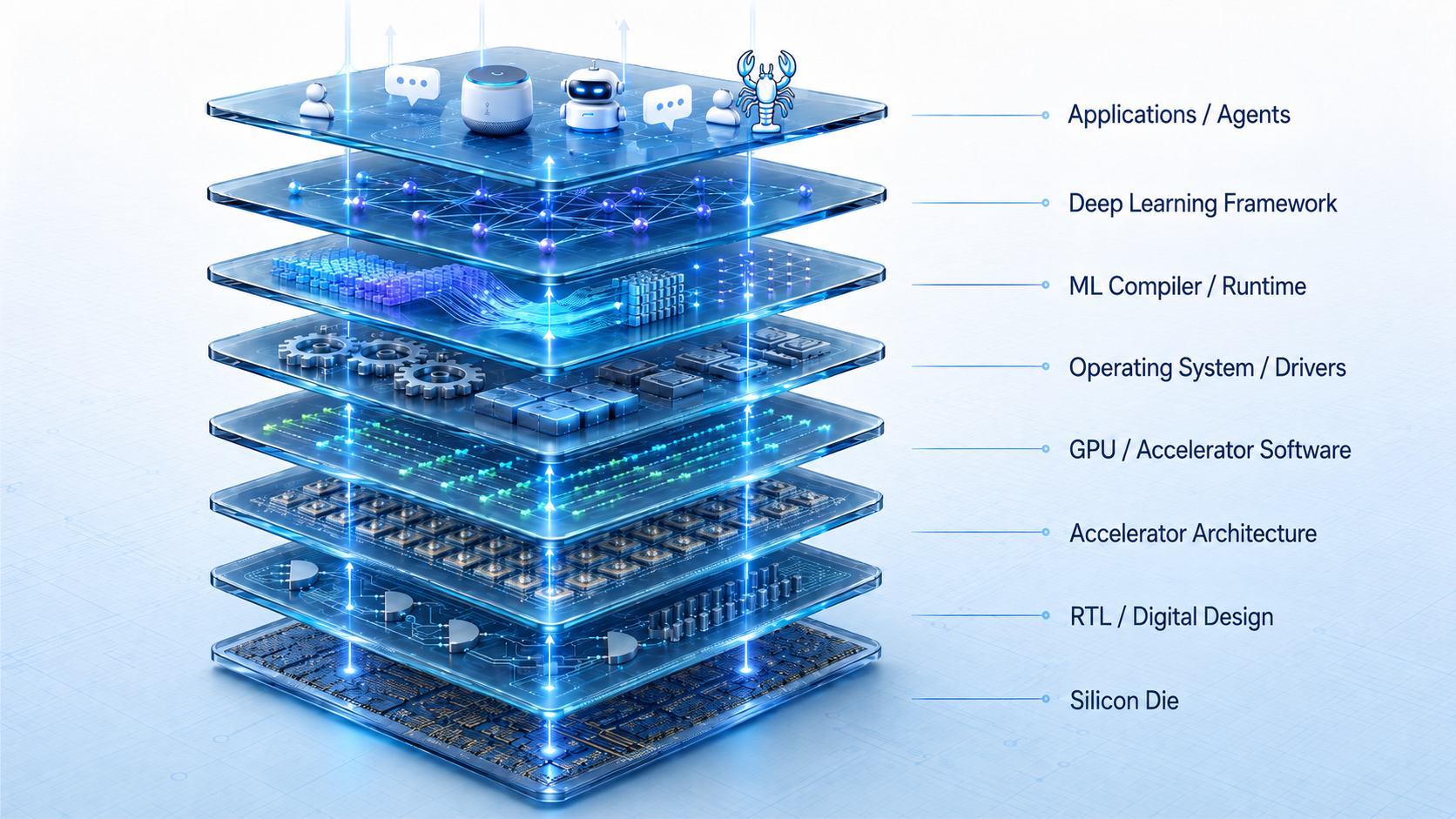
When you're designing a chip, every layer is a constraint and a degree of freedom. The roadmap teaches you to read the whole column.
Five phases. The first four are foundation; the fifth is where the three pillars converge.
The language of hardware. Logic gates → GPU code.
| Module | What you'll learn |
|---|---|
| Digital Design & HDL | Verilog/SystemVerilog, simulation, the language you'll later write your accelerator in |
| Computer Architecture | CPUs, GPUs, caches, memory hierarchies — the mental model behind your chip |
| Operating Systems | Processes, drivers, scheduling — what your chip's host actually does |
| C++ & Parallel Computing | SIMD, OpenMP, CUDA, ROCm, OpenCL/SYCL |
Get hands-on with real hardware. MCUs, sensors, embedded Linux.
| Module | What you'll learn |
|---|---|
| Schematic & PCB Design | Read schematics, design carrier boards |
| Embedded Software | Cortex-M, FreeRTOS, SPI/I²C/CAN, IoT (OpenThread, Zigbee) |
| Embedded Linux | Yocto, PetaLinux, driver bring-up |
| Product Design | Going from prototype to shippable product |
Understand the workloads your chip must serve. Core + two tracks.
Core (everyone):
Track A — Hardware & Edge AI: Computer vision, sensor fusion, Voice AI, Edge AI & optimization. Feeds Phase 4B and Phase 5C.
Track B — Agentic AI & ML Engineering: 42 lectures on agent harnesses, LangGraph, multi-agent systems, RAG, evaluation, production runtime discipline, OpenClaw, OpenAI Agents SDK, security, plus a Qwen3.5-4B-Base Unsloth fine-tuning course. This is the agent harness pillar in its primary form — read in order if your destination is the chip + runtime + harness story.
Take AI to real silicon. Three specialized tracks.
| Track | Focus | Pillar |
|---|---|---|
| A — Xilinx FPGA | Vivado, Zynq MPSoC, HLS, driver dev, video pipeline | Hardware |
| B — NVIDIA Jetson | Orin platform, custom carrier, L4T, OTA, TensorRT/DLA | Hardware + Inference |
| C — DL Inference Optimization | MLIR, TVM, Triton, kernel engineering, quantization, runtimes | Inference |
You don't have to do all three. But to land at chip design, you want enough of A to write RTL, enough of B to know what an inference platform looks like, and enough of C to know how a compiler will target your chip.
The three pillars converge here. Specialization tracks plus the chip-design endpoint.
| Track | What you'll specialize in | Pillar(s) |
|---|---|---|
| A — GPU Infrastructure | Multi-GPU, NVLink, NCCL, AMD ROCm/HIP, MI300X | Inference |
| B — HPC (CUDA-X) | cuBLAS, cuDNN, NVSHMEM, 40+ libraries | Inference |
| C — Edge AI | Holoscan, Edge LLM Inference Internals, Qwen Inference Optimization (6-lecture series), AI-driven wireless | Inference |
| D — Robotics | ROS 2, Nav2, motion planning, swarm, Isaac Sim and Isaac Lab (14-lecture course), Deep RL for Robot Learning (15-lecture course), VLA optimization | Hardware + Inference |
| E — Autonomous Vehicles | openpilot, BEV perception, ISO 26262, TRACE32 debug | Hardware + Inference |
| F — AI Chip Design | The endpoint. Systolic arrays, dataflow architectures, tinygrad↔hardware, RISC-V AI accelerator design, ASIC flow — and the integration question: how do you put an NPU, an ESP32-class radio, an ISP, and a Linux CPU on one die? | All three |
| G — ML Systems Engineering | Training systems, inference runtimes, GPU scheduling, distributed serving, compiler/runtime work, observability | Inference + Infrastructure |
The signature path: Phase 1 → Phase 2 → Phase 3 (Core + Track B) → Phase 4 (selected) → Phase 5C + Phase 5F.
The MLSys path: Phase 1 §3/§4 → Phase 3 Core → Phase 4B/4C → Phase 5A/B/C → Phase 5G.
The deepest, most current technical content lives in these Phase 5 lectures — read them as a single arc:
| # | Lecture | What it teaches |
|---|---|---|
| 1 | Edge LLM Inference Internals | GEMV vs GEMM rooflines, K-quants, KV-cache math, Jetson nvpmodel/jetson_clocks diagnostics |
| 2 | Qwen Architecture Deep Dive | Qwen3-4B and Qwen2.5-72B side by side, GQA, RoPE-NeoX, SwiGLU, full config.json → tensor-shape derivation |
| 3 | Quantizing Qwen3-4B to Q4 | Q4_K_M vs AWQ vs GPTQ, why V and FFN-down get upgraded, calibration, GGUF layout |
| 4 | Decode Optimization on Jetson | 0.2 → 30 tok/s ladder, fused QKV/gate-up, CUDA Graphs, INT8 KV, speculative decoding |
| 5 | Qwen2.5-72B Multi-GPU FP16 | TP=8 partitioning, NCCL hot path, paged attention, YaRN, runtime recipes |
| 6 | Cross-Model & Production Serving | Speculative decoding pairings, edge/cloud routing, observability, capacity planning |
| 7 | Batched GEMM vs Normal GEMM | cuBLAS API forms, column-major dance, tensor cores, bit-exact reproducibility |
| 8 | AI Inference Engineer 2026 — special course | The full 2026 production inference stack as a 27-lecture arc: dense → MoE, Hopper → Blackwell, FP16 → FP8 → FP4, vLLM / SGLang / TensorRT-LLM, tensor parallelism, collective/communication internals, disaggregated prefill/decode, rooflines |
| 9 | Optimizing a Real Engine — Part 4 case study | 10 lectures on a measured optimization history: Kimi K3 (2.8T, 896 experts) on 8× H200, 1.01 → 60.17 tok/s at 128k across ~96 PRs. Building a benchmark that cannot be gamed, diagnosing the binding ceiling, launch geometry, fusion, split-context attention, expert sharding + Amdahl, CUDA graphs, batched prefill, and bugs that make the benchmark better |
Read them in order if you're new. Skip to whichever solves your current problem if you're not.
Don't read this like a book. Treat it like a build-and-measure curriculum.
For every block:
Each artifact is a brick in the chip you're going to design.
Before you start, decide three things:
Every serious module in this roadmap should end with evidence, not vibes.
Use this standard for each course block:
| Step | What to do | Evidence |
|---|---|---|
| Understand | Learn the concept and why it matters in the stack | short design note or diagram |
| Build | Implement the subsystem, kernel, model path, driver, board flow, or runtime feature | code, RTL, config, schematic, or build script |
| Measure | Collect real numbers | latency, throughput, memory, power, timing, utilization, accuracy, area, or boot time |
| Debug | Explain at least one failure mode | log, waveform, profiler trace, ILA capture, or root-cause note |
| Ship | Package the work for review | README, commands, raw results, and final report |
Weak completion:
I read about CUDA, TensorRT, and FPGAs.
Strong completion:
I built a TensorRT INT8 benchmark on Orin Nano, captured latency/RAM/power,
compared it to FP16, and explained why one layer stayed memory-bound.
The roadmap is intentionally broad, but the completion standard is narrow: build something real, measure it, and explain the tradeoff.
These projects exist for you to study, not just read about:
| Project | Why it's here |
|---|---|
jetson-llm-runtime · GeniePod/genie-ai-runtime v1.0.0 | Custom Jetson LLM inference runtime — every GEMV/GEMM kernel, KV cache, paged-attention path, build flow. The scaffold in this folder graduated into the production runtime at GeniePod/genie-ai-runtime: 38 tok/s prefill, +115 % vs llama-bench on Orin Nano Super 8 GB, tensor-core MMQ, persistent KV, INT8 KV default, OpenAI-shape HTTP server. The inference pillar in code. |
| llm-inference-viz | Interactive 3D visualization of dense decoder-only LLM inference — walk the forward pass, watch each stage land memory- vs compute-bound on an H200 roofline, and shard the model across GPUs with tensor parallelism. The inference mental model, made visible; companion to the AI Inference Engineer 2026 course. |
| jetson-esp-hosted | Jetson-validated ESP-Hosted fork for SPI/Wi-Fi/BLE bring-up. The embedded pillar in code. |
| tinygrad | ~10 K-line ML framework. The cleanest place to read framework → compiler → kernel → backend in one repo. |
| openpilot | Production ADAS stack. End-to-end perception, ML, and embedded software on one board. |
The roadmap is full-stack on purpose, but it produces several well-paid specialist roles along the way:
| Role | Key Phases |
|---|---|
| AI Inference Engineer | 3 + 4C + 5A/B/C |
| ML Systems Engineer | 1 + 3 + 4B/4C + 5A/B/C/G |
| AI Compiler Engineer | 1 + 4C + 5B |
| Edge AI Engineer | 3A + 4B + 5C |
| GPU Runtime / Kernel Engineer | 1 + 4B + 5A |
| Agentic AI / Agent Harness Engineer | 3B (full lecture series) + 5C |
| Embedded / Firmware Engineer | 1 + 2 + 4B |
| Autonomous Vehicles Engineer | 3A + 4B + 5E |
| RTL / FPGA Design Engineer | 1 + 4A |
| AI Accelerator Architect | 1 + 4A + 5F |
| Physical AI Chip Architect | Full path — Jetson + ESP32 fused into one SoC; the chip-design endpoint |
→ See Roles & Market Analysis for salary data, 23 sub-roles, remote percentages, and hiring signals.
A physical AI chip — Jetson-class brain + ESP32-class radio + sensors + Linux on one die — is one of the most demanding engineering projects a small team can attempt. It needs:
Most people learn one pillar. Some learn two. This roadmap is for the people who want to learn all three, and then build the thing that puts an AI agent in a real product — talking to sensors, talking to networks, talking to humans, off a single SoC.

Build the workload. Build the runtime. Build the radio. Build the silicon. Ship the physical AI chip.
⭐ Star this repo if you're on this path — it helps the next engineer find it.

75 followers · starred Feb 2026
42 followers · starred May 2026
44 followers · starred Jun 2026
7 followers · starred Aug 2026
Master AI inference, AI agent harness systems, and hardware engineering — then design a physical AI chip. That is the goal.
See the codeThe AI Hardware Engineer Roadmap
A hands-on curriculum for understanding, optimizing, and deploying AI on real hardware — GPU kernels, agent runtimes, embedded systems, and Jetson — with a path toward designing the accelerator underneath. Start with one working experiment; finish with results someone else can reproduce.
Master AI inference, AI agent harness systems, and hardware engineering — then design a physical AI chip.
The endpoint is a single die that runs production AI workloads, hosts a real agent runtime, and talks to the physical world over Wi-Fi/BLE/Thread — a Jetson-class AI brain fused with an ESP32-class wireless stack on one chip. Designing it takes three working skill sets at once: inference engineering (Qwen-class decode, kernels, quantization, rooflines, multi-GPU serving), agent harness systems (sessions, tools, multi-agent loops, RAG, evals, production observability), and hardware engineering (RTL, embedded Linux, Jetson, ESP32, RF, ASIC flow). This roadmap teaches all three side by side — the chip is the artifact, but the three pillars are the actual work.
Baseline: comfortable with Python or C++, and basic Linux command-line use. No prior hardware background required.
Already past the basics? Phase 1 and Phase 2 exist to fill specific gaps — digital logic, embedded Linux — not to gate you. If you already know CUDA/C++, go straight to Phase 3 and pick up Phase 1–2 material only where a later module says you need it.
If you only want to call an LLM API, this isn't for you. If you want to design the silicon that calls it, keep reading.
Pick the finish line that matches what you want to be able to do, not a track number.
| Path | You'll build | Finish-line artifact | Start here |
|---|---|---|---|
| AI Inference Engineering | Transformer execution, GEMV/GEMM kernels, quantization, serving | A benchmark report: predicted vs. measured tok/s on a real model, with the gap explained | Phase 3 — AI Workloads |
| AI Agent Harness Systems | Sessions, tool calling, multi-agent loops, evals, observability | A production-shaped agent harness running end to end | Agentic AI & GenAI — 42 lectures |
| Physical Hardware Engineering | Boards, embedded Linux, RTL, FPGA, ASIC flow | A board you brought up yourself, or an accelerator spec with real numbers | Phase 1 — Digital Foundations |
Each path stands on its own — you don't need the other two to get something real out of it. The Path below is where all three converge into the physical-AI-chip endpoint.
(Already picked a path above? This section is the deep-dive on why the three connect — skip to The Path if you just want the phase-by-phase breakdown.)
This roadmap is not three unrelated study tracks. It is a co-design loop. The inference workload tells you what the silicon must accelerate, the agent harness tells you what product behavior the runtime must support, and the hardware platform tells you what power, memory, I/O, security, and manufacturing constraints are real.
                               TARGET ARTIFACT
┌────────────────────────────────────────────────────────────────────────────┐
│                         Physical AI Agent Chip                             │
│ Linux-capable CPU + NPU/GPU/DLA + SRAM/DRAM fabric + ISP/audio/sensors     │
│ + Wi-Fi/BLE/Thread/Zigbee + secure boot/OTA + local agent runtime support  │
└────────────────────────────────────┬───────────────────────────────────────┘
                                     │
        ┌────────────────────────────┼────────────────────────────┐
        ▼                            ▼                            ▼
┌───────────────────────┐  ┌───────────────────────┐  ┌───────────────────────┐
│  AI Inference Systems │  │ Agent Harness Systems │  │ Physical HW Platform  │
├───────────────────────┤  ├───────────────────────┤  ├───────────────────────┤
│ Transformer execution │  │ Sessions and memory   │  │ Digital logic + RTL   │
│ GEMV/GEMM kernels     │  │ Tool/skill execution  │  │ CPU/NPU/GPU/DLA arch  │
│ Attention + KV cache  │  │ Gateway/RPC protocols │  │ SRAM/DRAM/DMA fabric  │
│ Quantization formats  │  │ Planner/executor loop │  │ MIPI CSI-2 + ISP      │
│ Tensor/pipeline para. │  │ Multi-agent control   │  │ Audio/GPIO/CAN/I2C    │
│ Serving schedulers    │  │ Evals and guardrails  │  │ Embedded Linux/L4T    │
│ CUDA/Triton kernels   │  │ Telemetry and tracing │  │ ESP32-class wireless  │
│ Roofline profiling    │  │ Product update path   │  │ FPGA -> ASIC flow     │
│ Real models: Qwen etc │  │ OpenClaw/SDKs/APIs    │  │ Board -> SoC thinking │
└───────────┬───────────┘  └───────────┬───────────┘  └───────────┬───────────┘
            │                          │                          │
            └──────────────┬───────────┴───────────┬──────────────┘
                           ▼                       ▼
        ┌────────────────────────────────────────────────────────────────┐
        │ Cross-layer contracts you learn to write                       │
        ├────────────────────────────────────────────────────────────────┤
        │ Workload contract: tokens/s, TTFT, context length, KV memory,  │
        │ batch shape, precision, latency tail, power budget.            │
        │ Runtime contract: APIs, cancellation, scheduling, security,    │
        │ observability, OTA, failure recovery, agent state persistence. │
        │ Hardware contract: MAC array, SRAM size, DMA plan, interconnect│
        │ bandwidth, radio wake events, camera/audio I/O, boot chain.    │
        └────────────────────────────────────────────────────────────────┘

                              CONVERGENCE PATH
┌────────────────────────────────────────────────────────────────────────────┐
│ Jetson-class AI subsystem        -> NPU/GPU/DLA/CPU compute tile           │
│ ESP32-class connectivity         -> Wi-Fi/BLE/Thread/Zigbee radio block    │
│ Camera, audio, and sensors       -> MIPI CSI-2, ISP, codecs, low-power I/O │
│ Agent runtime and serving stack  -> scheduler, memory manager, telemetry   │
│ FPGA/RTL/HLS/MLIR experiments    -> accelerator spec and tape-out target   │
└────────────────────────────────────────────────────────────────────────────┘
The workload your chip will run. This pillar teaches transformer execution from the bottom up: tokenization, embeddings, QKV projection, RoPE, attention, MLP, sampling, KV cache growth, quantization, batching, and serving. You learn why decode is often memory-bandwidth bound, why prefill and decode behave differently, and how GEMV/GEMM kernels, CUDA Graphs, FlashAttention, paged attention, tensor parallelism, and roofline analysis change the system.
Output of this pillar: benchmark reports, kernel experiments, model-memory budgets, quantization choices, and workload contracts precise enough to drive an accelerator architecture.
The software stack that lives above your chip. This pillar covers agentic runtimes, session models, gateway RPCs, tool calling, skills, multi-agent loops, RAG, evals, observability, policy controls, and product update flows. A physical AI chip does not just run matmuls. It runs user-facing loops with state, timeouts, cancellations, tool failures, network events, sensor interrupts, and safety constraints.
Output of this pillar: a production-style agent harness with clear runtime interfaces, telemetry, evals, tool boundaries, scheduling requirements, and the operational behavior your chip must support.
The substrate itself. This pillar starts with digital design, computer architecture, C/C++ systems work, embedded Linux, Jetson Orin, custom carrier boards, L4T, TensorRT/DLA, ESP32, OpenThread, Zigbee, ESP-Hosted, sensors, camera bring-up, audio, power, thermal, compliance, and manufacturing. Then it moves toward FPGA, HLS, MLIR/compiler work, RTL, SoC architecture, and AI chip design.
Output of this pillar: working boards, bring-up logs, Linux images, wireless integration, sensor pipelines, FPGA/RTL prototypes, and a credible chip spec with compute, memory, I/O, security, and manufacturing constraints.
| Design question | Inference pillar answers | Agent pillar answers | Hardware pillar answers |
|---|---|---|---|
| How fast must the chip be? | TTFT, tok/s, batch shape, context length | User-visible latency, tool-loop timing | MACs, SRAM, DRAM bandwidth, clocks |
| How much memory is enough? | Weights, KV cache, activations, quantization | Session state, tool buffers, logs | SRAM, LPDDR, DMA, cache hierarchy |
| How does it talk to the world? | Streaming inference, multimodal inputs | Events, RPC, tools, wake-on-demand | Wi-Fi/BLE/Thread/Zigbee, MIPI, audio |
| How does it ship safely? | Reproducible benchmarks, model updates | Evals, policy, observability, rollback | Secure boot, OTA, compliance, test |
Why the combination? A chip without a runtime is a brick. A runtime without an agent stack is a benchmark. An agent stack without inference cost discipline is a demo. An inference accelerator that cannot talk to the physical world over wireless, camera, audio, and sensor interfaces is a coprocessor someone else has to integrate. The three pillars are how you build a chip that ships in a real physical product: workload, runtime, radio, sensors, board, compiler, and silicon aligned from the start.
The reason for this roadmap, written as a checklist:
That last bullet is the goal. The first six exist to make it real.
Everything in this roadmap maps onto an 8-layer stack. The point isn't to memorize layers — it's to understand how decisions in one layer ripple through the others.
When you're designing a chip, every layer is a constraint and a degree of freedom. The roadmap teaches you to read the whole column.
Five phases. The first four are foundation; the fifth is where the three pillars converge.
The language of hardware. Logic gates → GPU code.
| Module | What you'll learn |
|---|---|
| Digital Design & HDL | Verilog/SystemVerilog, simulation, the language you'll later write your accelerator in |
| Computer Architecture | CPUs, GPUs, caches, memory hierarchies — the mental model behind your chip |
| Operating Systems | Processes, drivers, scheduling — what your chip's host actually does |
| C++ & Parallel Computing | SIMD, OpenMP, CUDA, ROCm, OpenCL/SYCL |
Get hands-on with real hardware. MCUs, sensors, embedded Linux.
| Module | What you'll learn |
|---|---|
| Schematic & PCB Design | Read schematics, design carrier boards |
| Embedded Software | Cortex-M, FreeRTOS, SPI/I²C/CAN, IoT (OpenThread, Zigbee) |
| Embedded Linux | Yocto, PetaLinux, driver bring-up |
| Product Design | Going from prototype to shippable product |
Understand the workloads your chip must serve. Core + two tracks.
Core (everyone):
Track A — Hardware & Edge AI: Computer vision, sensor fusion, Voice AI, Edge AI & optimization. Feeds Phase 4B and Phase 5C.
Track B — Agentic AI & ML Engineering: 42 lectures on agent harnesses, LangGraph, multi-agent systems, RAG, evaluation, production runtime discipline, OpenClaw, OpenAI Agents SDK, security, plus a Qwen3.5-4B-Base Unsloth fine-tuning course. This is the agent harness pillar in its primary form — read in order if your destination is the chip + runtime + harness story.
Take AI to real silicon. Three specialized tracks.
| Track | Focus | Pillar |
|---|---|---|
| A — Xilinx FPGA | Vivado, Zynq MPSoC, HLS, driver dev, video pipeline | Hardware |
| B — NVIDIA Jetson | Orin platform, custom carrier, L4T, OTA, TensorRT/DLA | Hardware + Inference |
| C — DL Inference Optimization | MLIR, TVM, Triton, kernel engineering, quantization, runtimes | Inference |
You don't have to do all three. But to land at chip design, you want enough of A to write RTL, enough of B to know what an inference platform looks like, and enough of C to know how a compiler will target your chip.
The three pillars converge here. Specialization tracks plus the chip-design endpoint.
| Track | What you'll specialize in | Pillar(s) |
|---|---|---|
| A — GPU Infrastructure | Multi-GPU, NVLink, NCCL, AMD ROCm/HIP, MI300X | Inference |
| B — HPC (CUDA-X) | cuBLAS, cuDNN, NVSHMEM, 40+ libraries | Inference |
| C — Edge AI | Holoscan, Edge LLM Inference Internals, Qwen Inference Optimization (6-lecture series), AI-driven wireless | Inference |
| D — Robotics | ROS 2, Nav2, motion planning, swarm, Isaac Sim and Isaac Lab (14-lecture course), Deep RL for Robot Learning (15-lecture course), VLA optimization | Hardware + Inference |
| E — Autonomous Vehicles | openpilot, BEV perception, ISO 26262, TRACE32 debug | Hardware + Inference |
| F — AI Chip Design | The endpoint. Systolic arrays, dataflow architectures, tinygrad↔hardware, RISC-V AI accelerator design, ASIC flow — and the integration question: how do you put an NPU, an ESP32-class radio, an ISP, and a Linux CPU on one die? | All three |
| G — ML Systems Engineering | Training systems, inference runtimes, GPU scheduling, distributed serving, compiler/runtime work, observability | Inference + Infrastructure |
The signature path: Phase 1 → Phase 2 → Phase 3 (Core + Track B) → Phase 4 (selected) → Phase 5C + Phase 5F.
The MLSys path: Phase 1 §3/§4 → Phase 3 Core → Phase 4B/4C → Phase 5A/B/C → Phase 5G.
The deepest, most current technical content lives in these Phase 5 lectures — read them as a single arc:
| # | Lecture | What it teaches |
|---|---|---|
| 1 | Edge LLM Inference Internals | GEMV vs GEMM rooflines, K-quants, KV-cache math, Jetson nvpmodel/jetson_clocks diagnostics |
| 2 | Qwen Architecture Deep Dive | Qwen3-4B and Qwen2.5-72B side by side, GQA, RoPE-NeoX, SwiGLU, full config.json → tensor-shape derivation |
| 3 | Quantizing Qwen3-4B to Q4 | Q4_K_M vs AWQ vs GPTQ, why V and FFN-down get upgraded, calibration, GGUF layout |
| 4 | Decode Optimization on Jetson | 0.2 → 30 tok/s ladder, fused QKV/gate-up, CUDA Graphs, INT8 KV, speculative decoding |
| 5 | Qwen2.5-72B Multi-GPU FP16 | TP=8 partitioning, NCCL hot path, paged attention, YaRN, runtime recipes |
| 6 | Cross-Model & Production Serving | Speculative decoding pairings, edge/cloud routing, observability, capacity planning |
| 7 | Batched GEMM vs Normal GEMM | cuBLAS API forms, column-major dance, tensor cores, bit-exact reproducibility |
| 8 | AI Inference Engineer 2026 — special course | The full 2026 production inference stack as a 27-lecture arc: dense → MoE, Hopper → Blackwell, FP16 → FP8 → FP4, vLLM / SGLang / TensorRT-LLM, tensor parallelism, collective/communication internals, disaggregated prefill/decode, rooflines |
| 9 | Optimizing a Real Engine — Part 4 case study | 10 lectures on a measured optimization history: Kimi K3 (2.8T, 896 experts) on 8× H200, 1.01 → 60.17 tok/s at 128k across ~96 PRs. Building a benchmark that cannot be gamed, diagnosing the binding ceiling, launch geometry, fusion, split-context attention, expert sharding + Amdahl, CUDA graphs, batched prefill, and bugs that make the benchmark better |
Read them in order if you're new. Skip to whichever solves your current problem if you're not.
Don't read this like a book. Treat it like a build-and-measure curriculum.
For every block:
Each artifact is a brick in the chip you're going to design.
Before you start, decide three things:
Every serious module in this roadmap should end with evidence, not vibes.
Use this standard for each course block:
| Step | What to do | Evidence |
|---|---|---|
| Understand | Learn the concept and why it matters in the stack | short design note or diagram |
| Build | Implement the subsystem, kernel, model path, driver, board flow, or runtime feature | code, RTL, config, schematic, or build script |
| Measure | Collect real numbers | latency, throughput, memory, power, timing, utilization, accuracy, area, or boot time |
| Debug | Explain at least one failure mode | log, waveform, profiler trace, ILA capture, or root-cause note |
| Ship | Package the work for review | README, commands, raw results, and final report |
Weak completion:
I read about CUDA, TensorRT, and FPGAs.
Strong completion:
I built a TensorRT INT8 benchmark on Orin Nano, captured latency/RAM/power,
compared it to FP16, and explained why one layer stayed memory-bound.
The roadmap is intentionally broad, but the completion standard is narrow: build something real, measure it, and explain the tradeoff.
These projects exist for you to study, not just read about:
| Project | Why it's here |
|---|---|
jetson-llm-runtime · GeniePod/genie-ai-runtime v1.0.0 | Custom Jetson LLM inference runtime — every GEMV/GEMM kernel, KV cache, paged-attention path, build flow. The scaffold in this folder graduated into the production runtime at GeniePod/genie-ai-runtime: 38 tok/s prefill, +115 % vs llama-bench on Orin Nano Super 8 GB, tensor-core MMQ, persistent KV, INT8 KV default, OpenAI-shape HTTP server. The inference pillar in code. |
| llm-inference-viz | Interactive 3D visualization of dense decoder-only LLM inference — walk the forward pass, watch each stage land memory- vs compute-bound on an H200 roofline, and shard the model across GPUs with tensor parallelism. The inference mental model, made visible; companion to the AI Inference Engineer 2026 course. |
| jetson-esp-hosted | Jetson-validated ESP-Hosted fork for SPI/Wi-Fi/BLE bring-up. The embedded pillar in code. |
| tinygrad | ~10 K-line ML framework. The cleanest place to read framework → compiler → kernel → backend in one repo. |
| openpilot | Production ADAS stack. End-to-end perception, ML, and embedded software on one board. |
The roadmap is full-stack on purpose, but it produces several well-paid specialist roles along the way:
| Role | Key Phases |
|---|---|
| AI Inference Engineer | 3 + 4C + 5A/B/C |
| ML Systems Engineer | 1 + 3 + 4B/4C + 5A/B/C/G |
| AI Compiler Engineer | 1 + 4C + 5B |
| Edge AI Engineer | 3A + 4B + 5C |
| GPU Runtime / Kernel Engineer | 1 + 4B + 5A |
| Agentic AI / Agent Harness Engineer | 3B (full lecture series) + 5C |
| Embedded / Firmware Engineer | 1 + 2 + 4B |
| Autonomous Vehicles Engineer | 3A + 4B + 5E |
| RTL / FPGA Design Engineer | 1 + 4A |
| AI Accelerator Architect | 1 + 4A + 5F |
| Physical AI Chip Architect | Full path — Jetson + ESP32 fused into one SoC; the chip-design endpoint |
→ See Roles & Market Analysis for salary data, 23 sub-roles, remote percentages, and hiring signals.
A physical AI chip — Jetson-class brain + ESP32-class radio + sensors + Linux on one die — is one of the most demanding engineering projects a small team can attempt. It needs:
Most people learn one pillar. Some learn two. This roadmap is for the people who want to learn all three, and then build the thing that puts an AI agent in a real product — talking to sensors, talking to networks, talking to humans, off a single SoC.
Build the workload. Build the runtime. Build the radio. Build the silicon. Ship the physical AI chip.
⭐ Star this repo if you're on this path — it helps the next engineer find it.
75 followers · starred Feb 2026
42 followers · starred May 2026
44 followers · starred Jun 2026
7 followers · starred Aug 2026



