
From self-improving agents to co-evolving, open-ended agent ecosystems.
See the codeREADME
Awesome Agentic Evolution



From self-improving agents to co-evolving, open-ended agent ecosystems.
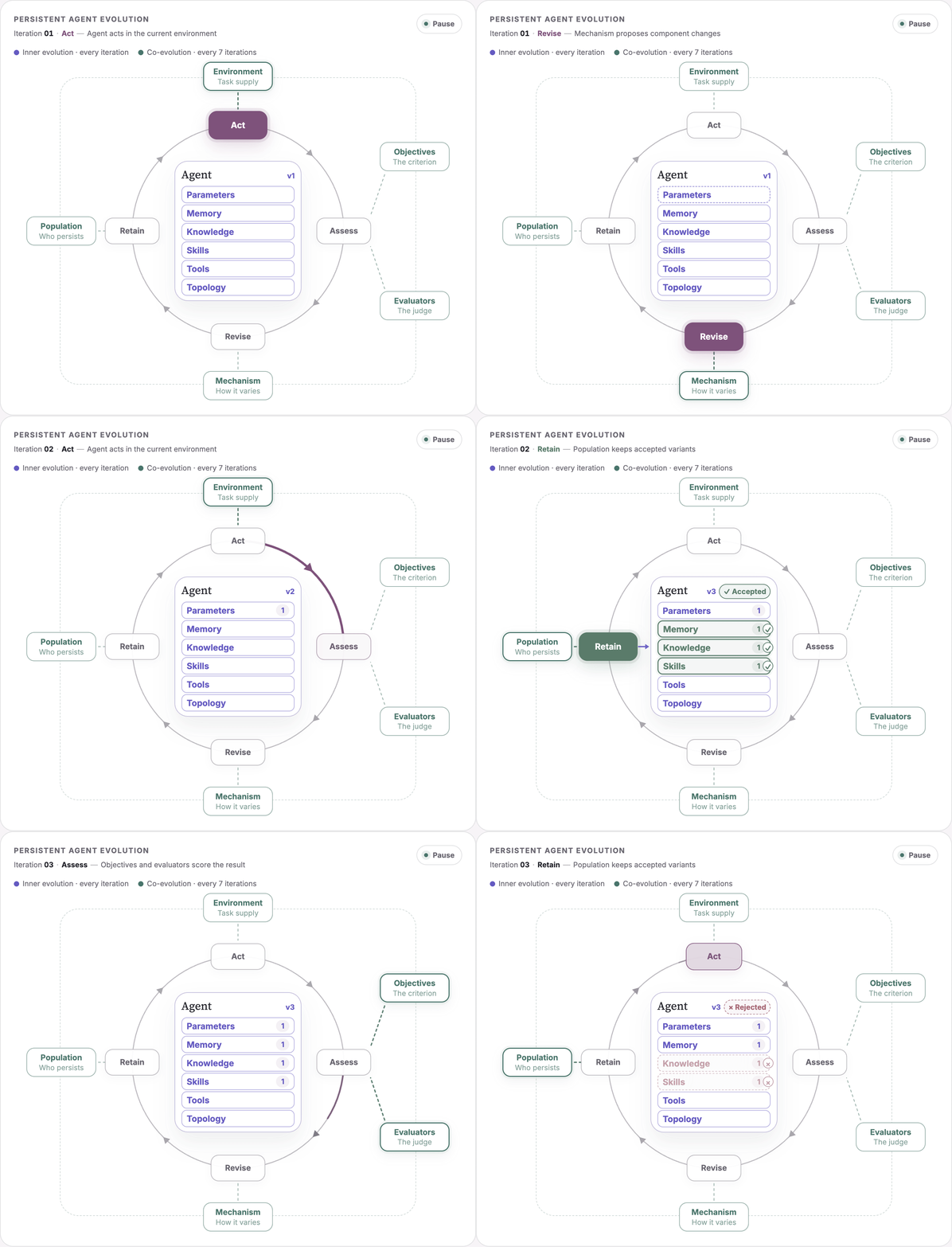
A community-curated index of agents that preserve improvements across attempts, sessions, or generations. The collection maps what changes, what feedback drives the change, what persists, and how the claimed improvement is evaluated.
Explore the living research dashboard →
Last editorial review: 2026-09-20 (structure and selected sources; not a full evidence audit)
Writing a survey? Begin with the survey workspace, the complete inventory and extraction status, and the classification rules. The repository is an evolving evidence base, not yet a completed systematic review or a verified living survey.
Contents
- Scope
- Taxonomy
- Start Here
- Survey Workspace
- Resource Map
- Benchmarks and Evaluation
- Articles and Technical Posts
- Related Awesome Lists
- Community and Long-Term Outputs
- Contributing
Scope
Agentic evolution requires a persistent update: an artifact changed during one improvement cycle must influence future behavior. A resource is in scope when it makes at least three elements legible:
- the artifact being updated;
- the feedback, reward, evaluator, or environmental signal driving the update;
- the retained result and an evaluation showing whether it helped.
Generic agent frameworks, static retrieval systems, and one-shot self-correction are out of scope unless they participate in a persistent improvement loop. Benchmarks and evaluators are listed separately because they measure evolution but do not necessarily evolve themselves.
Taxonomy
The primary classification question is which persistent artifact is edited, not which mechanism a paper uses or which application it studies.
- Parameters: model weights, policies, adapters, or other trainable state.
- Memory: agent-specific traces, reflections, summaries, and experience records retained across future attempts.
- Knowledge: external or decontextualized world knowledge, retrieval corpora, knowledge bases, schemas, and reusable factual assets.
- Skills: reusable procedural instructions, routines, and callable strategies for completing classes of tasks.
- Tools: executable interfaces, APIs, code modules, and expert agents the agent can invoke.
- Topology: prompts, routing, control flow, graph connectivity, role decomposition, and run-time orchestration.
- Co-evolution: coupled change in the agent and one or more external factors: objectives, evaluators, environments, update mechanisms, or populations.
Resources may have multiple targets, but each is listed once under its primary
target. The Targets line records other independently editable artifacts.
Implementation code is not a separate category: classify the behavioral
artifact that the code changes—for example, a generated tool under Tools or
a rewritten control graph under Topology.
Boundary rule: self-history belongs to Memory; externally reusable world information belongs to Knowledge. When a system bundles both, annotate both only if they can be updated independently.
Co-evolution is a cross-cutting relation, not a seventh internal artifact.
Use its section when coupled adaptation is the central contribution; put
Co-evolution first there and list the internal targets afterwards. Merely
using tools, memory, or multiple agents does not mean those objects evolve.
See definitions, counterexamples, and classification decisions.
Start Here
Read these surveys for orientation, then compare their coverage using the survey questions and outline. They are background sources, not additional method entries.
- Self-Improvements in Modern Agentic Systems: A Survey — A 2026 system-level view of self-induced updates to foundation models and agent scaffolds.
- A Survey of Self-Evolving Agents: What, When, How, and Where to Evolve — Organizes the field by update target, timing, feedback, and application.
- A Comprehensive Survey of Self-Evolving AI Agents — Presents a feedback-loop perspective spanning models, workflows, and domain-specific evolution.
- A Survey on Self-Evolution of Large Language Models — Background on self-generated experience and parameter-level updates.
Survey Workspace
| Need | Start here |
|---|---|
| Find and classify a resource | Taxonomy and boundary rules |
| Inspect all entries and missing extraction | Inventory · machine-readable JSON |
| Compare update loops and evidence | Extraction protocol · source-checked seed matrix |
| Plan chapters and resolve gaps | Research questions · review queue |
| Understand the repository layout | Documentation map |
The inventory is generated from this README. Detailed reviews live separately; missing reviews remain explicitly unextracted. Link checks, source reading, full evidence review, and experimental reproduction are different activities.
Resource Map
Entries appear once under their primary persistent target and are alphabetized within each category. Paper, code, and article links for the same work stay together. These are indexed resources, not a count of survey-verified papers. Repository-only implementations and paper-linked work are distinguished in the structured inventory; results are author-reported unless an evidence record explicitly documents independent reproduction.
Parameters
- AgentEvolver — Couples task generation, experience synthesis, and reinforcement learning for persistent agent improvement. Targets: Parameters, Memory, Co-evolution.
- ARISE-RL: Reward-Gated Self-Evolution — Co-evolves a rubric/task generator and tool-using solver, gating memory-augmented self-distillation on reward improvement across deep-research and travel-planning tasks. Targets: Parameters, Co-evolution.
- Astar — Trains an evolution-guiding model from industrial iteration histories, uses a surrogate reward evaluator, and guides 20 consecutive iterations with offline and online gains. Targets: Parameters.
- Benchmark-as-Teacher — Paper. Uses held-out-safe stage states and stage rubrics to select curricula, updates the policy with GRPO, and gates each checkpoint on the fixed benchmark contract. Targets: Parameters, Co-evolution.
- CAFE: Self-Improving Search Agents Need Co-Evolving Feedback — Co-evolves a search agent and critic from matched failures, alternating online and offline feedback updates with gains across seven search benchmarks and six out-of-domain sets. Targets: Parameters, Co-evolution.
- FlowBalance — Reweights policy updates from verifier-derived group advantage and calibrated self-guidance, retaining or reversing on-policy signals to improve reasoning reward and training stability. Targets: Parameters.
- GenRubric — Paper. Uses rubric-induced self-consistency rewards to evolve rubric-generation parameters from unlabeled queries, with agreement gains on human-annotated benchmarks and held-out domains. Targets: Parameters.
- RecurSE: Bounded Recursive Self-Evaluation for LLM Rubric Judges — Co-evolves a rubric judge and checker with decoupled self-reward, validation-based early stopping, held-out generalization, and ablations against frozen-checker and teacher baselines. Targets: Parameters, Co-evolution.
- Self-Rewarding Language Models — Uses the model as both instruction follower and judge during iterative training. Targets: Parameters.
- STaR — Iteratively generates successful rationales and updates model parameters on the retained examples. Targets: Parameters.
- WebWorld — Uses browser-issued acceptance certificates to ratchet verified web-code transitions into training data, improving HTMLBench and MiniAppBench under matched training. Targets: Parameters.
Memory
- A Self-Evolving Multi-Agent Framework Defense against LLM Jailbreak Attacks — Abstracts successful jailbreaks into reusable method-level rules, retains them across interactions, and reduces attack success across four families while preserving benign utility. Targets: Memory.
- APEx: Distillation of Agent Procedural Experience — Distills trajectory memories into procedural skills, then adapts a research planner with reward-guided test-time reinforcement learning across seven benchmarks. Targets: Memory, Parameters.
- Areev — Uses deterministic, evidence-citing analyzers to propose memory changes, requires named approval, stores inverse records, and remeasures outcomes so regressions can be reverted. Targets: Memory, Tools.
- AutoMem — Searches task-adaptive memory architectures from historical trajectories and failure-guided module feedback, reporting gains across three benchmarks and two backbones. Targets: Memory, Topology.
- CHIME: Credit-Aware Hierarchical Memory Evolution — Separates planning and execution memory banks, attributes outcomes before retention, and transfers credit-aware memories across four long-horizon benchmarks and backbone models. Targets: Memory.
- CrystalMem — Reversibly demotes and verifies memory entries under changing byte budgets, using influence-aware retention and evaluation across seven environments, seventeen methods, and six backbones. Targets: Memory.
- DiagEvo — Extracts recurring failure causes into hierarchical error memory, targets challenger generation at active weaknesses, and improves nine benchmarks across three solvers. Targets: Memory.
- earcon — A local OpenAI-compatible proxy that distills session outcomes into SQLite experience cards and injects them into future tasks, with a discrete-action maze evaluation. Targets: Memory.
- Evolve — Paper. Learns reusable memory guidelines from trajectories with conflict resolution, feeds them into later sessions, and reports AppWorld reliability gains with provenance-aware storage. Targets: Memory.
- EvolveBank — Distills success and failure trajectories into a deduplicated strategy bank, tracks downstream win rates, freezes the bank for held-out τ-bench evaluation, and reports a parity result. Targets: Memory.
- ExpeL — Paper. Distills transferable insights from successes and failures without updating model weights. Targets: Memory.
- GeoForge — Converts grounded trajectories into workflow-graph, action-experience, and SOP memories, then safety-gated distillation reuses them for tool planning across geospatial benchmarks. Targets: Memory, Skills, Topology.
- KOPE: Experience-Driven Workflow and Experience Graph Memory — Records hardware-kernel optimization decisions and correctness/performance feedback in an experience graph, then retrieves it under a fixed budget for continual optimization. Targets: Memory.
- Living-Harness — Converts evaluated trajectories into bounded episodic-memory and state-graph repairs that persist across episodes and improve interactive benchmark performance. Targets: Memory, Topology.
- Luclas — Learns from task outcomes through persistent SQLite episodes and lessons plus versioned self-updating policies, with daily compression, explicit corrections, and inspectable drift safeguards. Targets: Memory, Topology.
- Membrane — Paper. Evolves a contrastive safety-memory store from paired harmful/safe prompts and label-free test-time review, with HarmBench and AgentHarm evaluations. Targets: Memory.
- MemOS — Applies natural-language feedback and correction to persistent memory, adds tiered skill evolution, and publishes LoCoMo, LongMemEval, and OmniMemEval results. Targets: Memory, Skills, Knowledge.
- MemSkill — Paper. Learns memory-skill selection and evolves reusable routines from difficult cases. Targets: Memory, Skills.
- MetaMem — Paper. Edits retained memory-use experiences from judged answers and reflections, then evaluates selected checkpoints on held-out folds of long-term memory QA. Targets: Memory.
- OpenViking — Stores memories, resources, and skills in a browsable context filesystem; commits session experience to long-term memory and reports LoCoMo/tau2-bench gains with reproducible scripts. Targets: Memory, Knowledge, Skills.
- R2-MAD: Remember and Reweight — Paper. Builds persistent debate experience memory, retrieves cases using consensus-aware states, and reweights peer influence by historical reliability across four reasoning benchmarks. Targets: Memory.
- Recuris — Paper. Evolves targeted Skill Memory from structured traces with paired held-out validation, releases frozen splits, and reports cross-task transfer across 37 model–benchmark pairs. Targets: Memory, Skills.
- Reflexio — Turns user corrections and successful interactions into persistent profiles and playbooks, aggregates approved cross-user lessons, and reports a warm-baseline GDPVal comparison across two host agents. Targets: Memory, Skills.
- Reflexion — Paper. Stores verbal reflections in episodic memory for later trials. Targets: Memory.
- ReMe — Code. Distills execution experience into reusable memory, adds successful lessons, and prunes low-utility records; compares fixed and dynamically updated pools on tool-use benchmarks. Targets: Memory.
- RoMeRL — Paper. Uses bounded task-slot memory states whose contents and utilities update from environment rewards, reducing persistent reward contamination across lifelong benchmarks. Targets: Memory.
- Rudder — Preserves reviewed lessons, decisions, and skills from agent work in durable context for future runs, with a documented local-case-equal GDPVal harness comparison. Targets: Memory, Skills, Topology.
- SelfMem — Uses memory tools and feedback signals to evaluate and refine a reusable long-context memory strategy. Targets: Memory.
- SimSkill — Paper. Explores SUMO traffic tasks, verifies solutions with action–critic feedback, and consolidates episodic, procedural, and semantic memories into a reusable library evaluated on two held-out benchmarks. Targets: Memory, Knowledge, Skills.
- SSE-Bio — Paper. Maintains structured reasoning and template memory, trains a retrieval proxy from decision-contrastive feedback, and reports gains on three biomedical QA benchmarks. Targets: Memory, Parameters.
- Tree-of-Experience — Organizes reusable experience as a reasoning-aligned tree, calibrates path reliability from environmental outcomes, and evaluates transfer on Game of 24 and FinEvolveBench. Targets: Memory.
Knowledge
- Adaptive Reflective Interactive Agent (ARIA) — Maintains a timestamped knowledge repository from targeted human guidance, detects conflicts, and evaluates adaptation on changing-domain tasks. Targets: Knowledge.
- CoEvoKG — Paper. Writes verified search evidence back into a knowledge graph that co-evolves with a proposer–solver loop and is evaluated on six multi-hop QA benchmarks. Targets: Knowledge, Co-evolution.
- ContDa — Paper. Rewrites a persistent tool-documentation corpus from API observations and relation-aware exploration, evaluating adaptation and retention on evolving StableToolBench and RestBench toolsets. Targets: Knowledge.
- Knowledge-Centric Self-Improvement — Paper. Runs disposable agents that distill evidence-grounded forums into shared knowledge, then seeds later attempts; gains transfer across held-out tasks and model families. Targets: Knowledge.
- ProofEvolve: Neuro-Symbolic Evolution for Formal Automated Theorem Proving — Evolves Lean-verified proof DAGs with neural variation operators, retaining checked schemas across problems and exposing residual subgoals for typed recombination across three benchmarks. Targets: Knowledge, Topology.
- VISA: Agentic Self-Evolving Data Synthesis for Multimodal Instruction Following — Synthesizes multimodal instructions from persistent constraint memory, writes verifier and target-model failures back into later rounds, and improves MM-IFEval while preserving general capability across seven public benchmarks. Targets: Knowledge, Memory.
Skills
- AgentDescent — Paper. Evolves skills, prompts, harness modules, and verifiers through parallel proposals, reward scoring, and asynchronous aggregator merges, with live-model results and per-run raw data. Targets: Skills, Tools, Topology.
- cambium — Admission-gates evolving skill, tool, and prompt libraries, measures retrieval separately, rejects reward-hacking candidates, and reports held-out transfer from a reproducible 27-task demo. Targets: Skills, Tools, Topology.
- Coalition-Aware Skill Reliability — Audits coalition-level skill contributions and masks transfer-harmful entries, improving LoCoMo, LongMemEval, HotpotQA, and ALFWorld while exposing isolation-evaluation failures. Targets: Skills.
- COBRA-Skills — Allocates skill evaluations with a learned reward predictor and replaces low-scoring skills through mutation and crossover, with separate optimization and held-out test stages. Targets: Skills, Co-evolution.
- CoEvoSkills — Paper. Builds multi-file Skills through a generate–verify–refine loop, co-evolving a skill generator and surrogate verifier before isolated fresh-agent transfer tests. Targets: Skills, Co-evolution.
- CoSkill — Paper. Jointly trains reasoning and meta-skill agents over a hierarchical Skill Bank, promoting lineage-tracked edits from improvement rewards with ALFWorld/WebShop results. Targets: Skills, Parameters.
- ERSkill — Evolves reusable retrieval programs and a learned router from judged rollouts, retaining validation-selected skills for memory QA and cross-dataset transfer. Official code not located; reproduction unverified. Targets: Skills, Parameters, Memory.
- Evo-Harness — Paper. Compiles noisy one-shot trajectories into reusable skill harnesses for cross-task adaptation, evaluating a frozen agent across five realistic benchmarks. Targets: Skills, Topology.
- From Memory to Skills — Governs the evidence-grounded conversion of retained traces into callable skills. Targets: Skills, Memory.
- HypoForge — Learns reusable scientific skills from stage-specific critique and execution outcomes, enabling continual improvement without fine-tuning and outperforming framework and skill-level baselines. Targets: Skills.
- Learning Globally Reusable Skills for Coding Agents — Co-evolves a skill-relation graph with global skill consolidation and replay verification, reporting cross-task and regression-aware gains on coding-agent tasks. Targets: Skills, Topology.
- Meta Context Engineering (MCE) — Paper. Co-evolves context-engineering skills and context artifacts through agentic crossover and bi-level optimization, with released artifacts and five-domain offline/online evaluation. Targets: Skills, Knowledge.
- MUSE-Autoskill — Treats skills as testable, reusable assets that are refined across tasks. Targets: Skills.
- OpenSkill — Paper. Builds and refines reusable skills against self-created, evidence-grounded virtual tests, then evaluates frozen skills on held-out target tasks. Targets: Skills.
- PenguinHarness — Agents evaluate and optimize their own Skills from benchmark feedback, snapshot each round, and expose observable traces for review. Targets: Skills.
- PILOT in the Loop — Steers active workers during execution and distills procedures and failure modes into reusable skills and memory, improving three long-horizon benchmarks. Targets: Skills, Memory.
- PRACTICE — Trains a dedicated learner to add, refine, merge, and remove a persistent skill library from trajectories, improving successive rounds for frozen embodied executors. Targets: Skills.
- RedEvoAgent — Distills cross-case red-team trajectories into attack skills, retains only validation-improving updates through a ratchet, and transfers across target harnesses. Run only in an isolated sandbox. Targets: Skills.
- RethinkSkill — Paper. Provides a reproducible controlled skill-evolution harness that compares success-only, failure-only, and mixed feedback across 42 matched runs with held-out, robustness, and transfer checks. Targets: Skills.
- Retrospective Harness Optimization — Paper. Uses unlabeled past trajectories and self-preference to retain skill and tool updates that improve held-out behavior. Targets: Skills, Tools.
- RewardHarness — Paper. Evolves scoring skills and tool prompts from preference feedback, retaining updates through held-out validation and rollback. Targets: Skills, Tools.
- SAGE — Accumulates a persistent skill library and trains skill generation and use with outcome-grounded rewards. Targets: Skills, Parameters.
- Search2Skill — Searches for capability gaps, distills external evidence into a persistent skill library with rubric-based reinforcement learning, and improves streaming and held-out expert-domain evaluation. Targets: Skills, Parameters.
- self-evolve — Runs multi-round skill or repository self-iteration in an isolated worktree with deterministic acceptance, heterogeneous signals, archive lineage, and rollback; its tests cover 555 cases. Targets: Skills, Tools.
- SESA: Self-Evolving Search Agents — Paper. Distills informative self-play failures into bounded skill memory that reshapes the solver and challenger frontier across held-out QA benchmarks. Targets: Skills, Memory, Parameters, Co-evolution.
- skill-up — Turns structured evaluation failures into persistent skill and regression-suite repairs through repeated skill-upper iterations with rule, script, or agent judges. Targets: Skills, Co-evolution.
- SkillAdam — Paper. Refines reusable skill documents using persistent issue histories and volatility-controlled edits, retains accepted revisions, and evaluates frozen-agent performance on separate test partitions. Use isolated environments. Targets: Skills, Memory.
- SkillGLoW: Procedural-Family Skill Consolidation — Aggregates task-local skills into procedural-family priors, admits them only after non-degradation checks, and transfers compact procedures across four continual task domains. Targets: Skills.
- SkillHEX — Uses falsifiable self-tests and evidence-guided tree search to explore persistent skill revisions under sparse feedback, evaluated on 87 SkillsBench tasks. Targets: Skills.
- SkillHone — Paper. Evolves whole skill folders through persistent decision history, practice probes, and regression-gated PRs, with validation-gated deep-research evaluation. Run only in an isolated sandbox. Targets: Skills.
- SkillOpt — Paper. Optimizes natural-language procedures from scored trajectories with validation-gated updates. Targets: Skills.
- SkillProx — Paper. Runs a closed-loop forward/backward skill-evolution process: measured outcomes roll back regressions, and utility audits gate consolidation or removal before held-out evaluation; official code is forthcoming. Targets: Skills.
- SkillZip — Compresses evolving skills with typed structural sharing and coverage constraints; its Zip-on-Write mode incorporates each patch without replaying tasks or reparsing history. Targets: Skills.
- SkillZip Pro — Continually compresses progressively loaded skill bundles after each evolution patch, preserving routes and reporting 38% bundle-token reduction without quality loss in a production moderation harness. Targets: Skills.
- TRACE — Paper. Refines a persistent Skill Bank by contrasting successful and failed trajectories, then reports Pass^3 gains on public and hidden CAR-bench sets. Targets: Skills.
- Voyager — Paper. Grows an executable skill library through environment feedback and an automatic curriculum. Targets: Skills, Co-evolution.
- When Self-Evolution Backfires — Shows skill pools can contaminate later skills and proposes pre-commit heterogeneous critics plus marginal-gain subset selection, evaluated on Terminal-Bench 2. Targets: Skills.
- WikiSkill — Consolidates execution experience into a persistent wiki that guides later skill updates, with cross-model transfer and ablations showing knowledge accumulation matters. Targets: Skills, Knowledge.
- xskill — Paper. Distills anonymized agent trajectories into versioned team skills, canary-tests revisions on real traffic, and reports benchmark gains with rollback-ready lineage. Targets: Skills, Memory.
Tools
- AgentFactory — Paper. Stores successful solutions as executable Python subagents, refines them from execution feedback, and evaluates reusable capability growth across later tasks. Run only in an isolated sandbox. Targets: Tools.
- Mem²Evolve — Paper. Couples experience distillation with dynamic creation of tools and expert agents. Targets: Tools, Memory, Skills, Co-evolution.
- SciToolAgent-Evo — Evolves an ontology-backed scientific tool graph and skill/experience memory through contrastive trajectories and bandit-gated acquisition, evaluated on 900 OpenSciToolBench tasks. Targets: Tools, Knowledge, Memory.
Topology
- A-Evolve — Paper. A position paper and framework treating deployment-time improvement as optimization over persistent agent state; empirical scope requires separate extraction. Targets: Topology.
- A-SR: Self-Evolving Agentic LLMs for Symbolic Regression — Routes evaluator feedback through role policies and process memory, adapts coordination within runs, and distills trajectories across runs with held-out symbolic-regression evaluation. Targets: Topology, Memory, Parameters.
- ADAS — Paper. Searches agent designs expressed as code and retains an archive of evaluated candidates. Targets: Topology.
- AegisEvo — Governs sandboxed harness search with statistical quality, safety, canary, promotion, and rollback gates, publishing deterministic fixtures and reproducible reports. Targets: Topology.
- AgentSquare — Paper. Searches a modular space of planning, reasoning, tool-use, and memory components. Targets: Topology, Memory, Skills, Tools.
- AutoDesign — Paper. Learns a reusable design harness around fixed models, retaining one-component updates only when training improves without regressing an independent development set, then evaluates matched configurations on PosterBench. Targets: Topology, Tools, Skills.
- CausalForge — Paper. Uses Lean-checked proofs and statement audits in a self-improving theorem pipeline, with public formal libraries and run records. Targets: Topology.
- CineForge: Self-Improving Agents for Long-Horizon Video Generation — Consolidates production trajectories into bounded, stage-local policy patches, validates them by structural replay and paired evaluation, and improves scores on a 100-script suite plus two public benchmarks. Targets: Topology.
- Darwin Gödel Machine — Paper · Article. Rewrites coding-agent implementations and empirically validates descendants. Run only in an isolated sandbox. Targets: Topology, Skills, Tools.
- EMAS: Evolving Multi-Agent System — Paper. Converts recurring trace diagnoses into prompt or topology revisions, paired-validates each candidate, and persists accepted versions while retaining rejected proposals for audit. Targets: Topology.
- EvoAgentX — Builds, evaluates, and evolves multi-agent workflows with pluggable optimization algorithms. Targets: Topology.
- Factory — Provides tracker-controlled coding-agent loops with isolated worktrees, repeatable verification, CI/review gates, Git lineage, and offline regression demos. Run only in an isolated sandbox. Targets: Topology.
- From General Agents to RCA Experts: A Self-Evolving Harness for Root Cause Analysis — Converts successful and failed RCA trajectories into atomic expertise updates, admits them through dual-gate verification, and reports gains on two public benchmarks plus an industrial deployment. Targets: Topology, Knowledge.
- GPTSwarm — Paper. Represents language agents as graphs and optimizes node prompts and connectivity. Targets: Topology.
- HarnessEvolve — Aligns failed runs with reference trajectories, then quality- and performance-gates harness snapshots against held-out validation to reduce shortcut learning and forgetting. Targets: Topology.
- HarnessLens — Paper. Evolves OpenCode, Codex CLI, and Pi harnesses through behavior-aware diagnosis and selective verification, with blind-test entrypoints, pinned reproducibility, and four-benchmark evaluation. Run only in an isolated sandbox. Targets: Topology.
- JIT-Agent — Paper. Distills performance signals from an archive of prior harness configurations to synthesize, repair, and improve task-adaptive harnesses across model families and benchmarks. Targets: Topology.
- MANTA: Multi-Agent Network Topology Adaptation — Adapts roles, links, execution order, and visibility from trace audits during execution, retains a cross-run topology playbook, and evaluates transfer across five benchmarks. Targets: Topology, Memory.
- Meta-Harness — Implements recorded-tape harness replay, persistent checkpoints, candidate selection, and separate search/holdout protocols; replay does not imply fresh-model reproducibility. Run only in an isolated sandbox. Targets: Topology, Skills.
- Meta^n: Recursive Self-Improvement through Emergent Depth — Paper. Recursively writes executable helpers and pre-processors from lower-layer traces, archives evaluated chains, and reports gains across eight benchmark families. Run only in an isolated sandbox. Targets: Topology, Skills.
- MetaVideoAgent — Paper. Profiles a video distribution, diagnoses trajectory failures, and evolves responsible modules across four rounds with evolution and held-out VA-EvoBench splits. Run only in an isolated sandbox. Targets: Topology.
- Naive Prompt Optimization — Iteratively revises prompts from teacher-model rollout feedback and transfers single-lineage improvements across tasks and interactive games. Targets: Topology.
- Open-Ended Optimization (OEO) — Composes the improvement route online under fixed objectives, budgets, data boundaries, and evaluators, comparing persistent skill updates with SkillOpt and GEPA. Targets: Topology, Skills.
- OpenEvolve — Provides an open evolutionary coding loop inspired by AlphaEvolve. Targets: Topology.
- Proteus — Provides a harness-agnostic, snapshot-based evolution loop with evaluator gates, crystallization tests, rollback, and git histories for measuring persistent change. Run only in an isolated sandbox. Targets: Topology.
- Raven — Combines terminal execution, tracing, durable memory, skills, reusable workflows, and an opt-in Evolver with independent benchmark harnesses for long-running agent improvement. Run only in an isolated sandbox. Targets: Topology, Memory, Skills.
- Reef — Connects live inference, feedback, candidate training, evaluator selection, and versioned delivery for model weights or harness skills, with recipes and task-level result reports. Run only in an isolated sandbox. Targets: Topology, Parameters, Skills.
- ROSClaw — Provides a simulation-first physical-agent control plane that turns feedback into hashed controller candidates, fail-closed gates, and rollback targets; real-hardware activation is blocked. Run only in an isolated sandbox. Targets: Topology.
- RSIHub — Runs evaluator-driven evolution over prompts, skills, harnesses, and agent code with frozen scoring, bounded mutation, Git lineage, rollback, and reproducible benchmark recipes. Run only in an isolated sandbox. Targets: Topology, Skills.
- RubSE — Paper. Generates UI code with typed rubrics as visual feedback, retains selected repair history across rounds, and evaluates six VLMs on three UI-to-code benchmarks for stable iterative improvement. Targets: Topology, Memory.
- Self-Improving Agent Ecosystem — Provides contracts, schemas, deterministic fixtures, and validation for evaluator-driven loops with isolated candidates, evidence lineage, promotion gates, rollback, and external health checks. Targets: Topology.
- VideoHarness-RSI: Recursive Harness Self-Improvement for Long-Video Understanding — Searches executable context constructors around a frozen VLM, retaining evaluation-selected variants and transferring the selected harness to additional long-video benchmarks. Targets: Topology.
- yoyo — Runs an autonomous coding-agent loop that reads source and community issues, test-gates commits or reverts, and synthesizes durable memory across sessions. Run only in an isolated sandbox. Targets: Topology, Memory.
Co-evolution
- Agent0 — Paper. Co-evolves a task curriculum and a tool-using executor without human-curated task data. Targets: Co-evolution, Parameters.
- CORAL — Paper. Runs autonomous coding-agent organizations in isolated worktrees, sharing persistent attempts, notes, and skills while a grader scores commits and agents iterate on open-ended tasks. Targets: Co-evolution, Topology, Tools.
- Double Ratchet — Paper. Co-evolves an inspectable drawback-detector metric with a lifecycle-managed skill library, using anchored references and locked-set validation to expose evaluator collapse. Targets: Co-evolution, Skills.
- Environment Evolution for Terminal Agents — Evolves terminal environments off-policy along difficulty directions to sustain learning signals, improving long-horizon RL on Terminal-Bench 2.1. Targets: Co-evolution.
- Group-Evolving Agents (GEA) — Paper. Evolves populations of agent workflows and tools through archived experience sharing, retaining cross-lineage improvements on held-out coding benchmarks. Run only in an isolated sandbox. Targets: Co-evolution, Topology, Tools.
- HELIX — Paper. Composes source-traceable harness variants, evaluates sibling rollouts, and turns verified successes, regressions, and preferences into data for later model updates; reports LiveCodeBench and SWE-Bench results. Targets: Co-evolution, Topology.
- J-Zero — Co-evolves challenger, solver, and judge from zero data, using known-order preference pairs and adversarial tasks to improve through ten iterations. Targets: Co-evolution, Parameters.
- MEGA: Self-Evolving Agent Optimization Infrastructure via Wisdom Graph — Distills sessions into durable wisdom assets and a typed graph, then feeds controlled operational evidence back into workflow optimization and the evolving curation strategy. Targets: Co-evolution, Knowledge, Topology.
- SafeEvolve — Paper. Turns on-policy safety trajectories into bounded safety-prompt and SkillBank revisions, then trains policy use with SFT and GRPO under safety and utility gates. Run only in an isolated sandbox. Targets: Co-evolution, Parameters, Skills.
- SBCO: Self-Supervised, Verifier-Grounded Harness Optimization — Jointly updates a decomposed verifier bank and planning-agent harness from self-graded feedback via block-coordinate ascent, without human labels. Targets: Co-evolution, Topology.
- Self-Modifying Lean Proof Agents — Co-evolves a Lean proof workflow and benchmark curriculum, using compiler and Lean verification feedback across 15 generations with a held-out miniF2F split. Targets: Co-evolution, Topology, Tools.
- Task-CoEvolve — Co-evolves harness code and validation-task sampling, focusing evaluation on discriminative tasks while retaining unbiased full-set estimates and reducing evaluation cost. Targets: Co-evolution, Topology.
- WebEvolver — Paper. Co-trains a policy and world model from real trajectories, then uses the model for synthetic training and look-ahead evaluation. Targets: Co-evolution, Parameters.
Co-evolution denotes coupled change, not simply multi-agent execution. See boundary decisions before assigning secondary targets.
Benchmarks and Evaluation
Evaluate retained improvement separately from extra inference compute. The subsections distinguish task streams, measurement controls, safety audits, and general task benchmarks; none automatically demonstrates persistent learning.
Longitudinal and adaptation evaluation
- AgentStream — Paper. Evaluates five self-evolving methods in isolated, sequential, and interleaved task streams across three models, exposing model-, method-, and stream-dependent reliability.
- AI4AI-Bench — Releases 10 frozen research repositories, hidden evaluators, 29 configurations, and every scored submission for testing whether agents can rewrite training algorithms.
- ASPIRE — Hides expert-authored tasks behind vague goals and scores whether agents choose data, updates, and validation signals, exposing transfer and stability failures.
- Continual Skill Bench — Paper. Evaluates continual skill reuse across five domains and 100-task sequences, comparing in-context adaptation with explicit skill maintenance.
- Evo-Bench — Paper. Holds policy, seed harness, and budget fixed while scoring autonomous harness evolution on disjoint validation and evaluation suites.
- EvoHarnessBench — Separates fresh-state deployment from persistent adaptation under externally expanding tool, skill, and specialist-agent pools, measuring retention and transfer with held-out evaluation.
- Experience-driven Lifelong Learning — Proposes a framework and benchmark for continuous agent growth.
- FinEvo-Bench — A longitudinal benchmark with 120 financial workflow tasks, interleaved streams, paired state-reset controls, expert-validated rubrics, and compliance metrics for retained- experience gains.
- PACE-Bench — Paper. Tests whether code-driven designs adapt after source-to-target physics mutations, with diagnostic sandbox feedback across 144 pairs and 180 evaluation environments.
- reef-eval — Provides Harbor-compatible autoresearch and continual task streams with state snapshots, tamper-resistant scoring, and anytime, forgetting, and transfer metrics.
- RSIBench-Data — Paper. Audits whether researcher agents turn checkpoint feedback into reusable training-data strategies under fixed training, evaluation, and budget controls.
- S3Gym — Separates permissive exploration from held-out game evaluation while comparing history, summary-memory, and parameter updates for self-improvement.
- SEAGym: An Evaluation Environment for Self-Evolving LLM Agents — Paper. Measures persistent harness updates across train, frozen validation, held-out ID/OOD transfer, replay, and cost views, with checkpointed states and reproducible configurations.
- StudyBench — Paper. Releases fixed textbook materials, application/transfer splits, and evaluation scripts to measure whether self-evolution converts study material into transferable capability.
- tide-eval — An Apache-2.0 evaluation infrastructure for self-evolving agents on Harbor: carries memory, skills, or harness state across task streams with per-step snapshots, and reports anytime, forgetting, and transfer metrics.
Reliability and evaluation controls
- Cheap Verifiers, Large Blind Spots — Audits self-improving verifier cascades with true-error controls, showing in-loop metrics can improve while delivered quality degrades under blind-spot feedback.
- On the Fragility of Self-Improving Agents — Paper. Re-evaluates memory-based self-improving agents across repeated runs and shuffled task orders, releasing trajectories to measure variance, order sensitivity, and specification effects.
- Phantom Gains — Audits self-improvement claims against measured frozen controls, replacing noisy transition statistics with per-problem tests and false-discovery-rate control.
- Sealed Exogenous Acceptance Loop (SEAL) — Keeps its audit hidden from evolving policies and self-tests, returning only accept/reject and retaining the whole incumbent after a clear regression.
Safety, poisoning, and recoverability
- Auditing Harness Tampering — Audits authorization, provenance, and completeness violations in self-modifying harnesses using tampered-benign pairs, localization tasks, and real-trajectory persistence analysis.
- Auditing Self-Evolution in Financial Agents — Audits three self-evolving agents with sealed endpoints, state replay, execution-grounded checks, and security metrics, exposing capability gains that increase exposure and unauthorized state changes.
- ECLIPSE — Builds and iteratively verifies stealthy tool-chain injections, releasing LASE-Bench for long-horizon safety evaluation. Run only in an isolated sandbox.
- EVOMAL: Self-Poisoning in Self-Evolving Coding Agents — Measures self-poisoning propagation in evolving skill libraries across six models and 153 SWE-bench tasks, and evaluates a counter-prompt defense without task-completion loss.
- EvoSkill Injection — Defines a red-team threat model, EvoSkillBench trajectories, and post-attack safety tests for persistent malicious-skill formation and repeated activation. Run only in an isolated sandbox.
- EvoUndo — Evaluates recoverability of model-generated prompt, tool, middleware, and harness mutations across counterfactual states on 600 unseen tasks, exposing grounding and recovery-language bottlenecks.
- HarnessRisk — Paper. Benchmarks agent-harness safety across configuration, capability extension, runtime, persistence, action control, and recovery using sandboxed cases with trajectory evidence and explicit utility, attack, persistence, and detection metrics.
- PerMemSafe — Paper. Benchmarks implicit personalized safety across evolving long-horizon memory, with committed data, evaluation logs, and a risk-aware memory baseline.
- SIR: Self-Improving Red Teaming — Distills failed computer-use attacks into reusable principles with deterministic filesystem, service, and permission oracles; report transfer evidence and run only in an isolated sandbox.
- SkillJack — Paper. Releases poisoned-trajectory data and cross-system experiments showing experience-to-skill backdoors survive source deletion and can activate on benign queries. Run only in an isolated sandbox.
- When Experience Becomes Instruction — Demonstrates trajectory-poisoning attacks that promote malicious behaviors into persistent skill banks, with transfer tests across six LLM evolvers and two architectures.
General agent benchmarks
- AgentBench — Evaluates agents across multiple interactive environments.
- GAIA — Tests assistants on tasks requiring reasoning, tools, and multimodal information.
- SWE-bench — Supplies real-world software issues used by self-improving coding-agent systems.
For comparison tables, record the frozen backbone and baseline, optimizer-visible versus held-out data, update budget, multiple seeds or uncertainty, transfer and forgetting, safety regressions, and retained artifact versions. Use the evidence extraction protocol, not a single headline score.
Articles and Technical Posts
- AlphaEvolve: A Gemini-powered coding agent for designing advanced algorithms — A first-party description of an evolutionary loop combining proposals with automated evaluators.
- AlphaEvolve: How our coding agent is scaling impact across fields — A 2026 first-party update on deployments and scientific applications.
- LLM Powered Autonomous Agents — A foundation for reflection, memory, planning, and tool use.
Related Awesome Lists
- Awesome Self-Evolving Agents — EvoAgentX
- Awesome Self-Evolving Agents — XMUDeepLIT
- Awesome Self-Improving Agents
- Awesome Self-Evolution of LLM
Community and Long-Term Outputs
The repository is community-first and is building a structured evidence base. The evidence may support a living survey and conference tutorial after the public maturity gates in the Roadmap are met.
Repository contributions are credited publicly. Sustained, substantive work in curation, reproducibility, analysis, writing, software, visualization, or revision can qualify contributors for survey-paper authorship. Decisions follow transparent CRediT-style roles rather than maintainer status.
Contributing
Suggestions and pull requests are welcome. Read CONTRIBUTING.md before submitting a resource.
This index favors evidence over hype. A large star count is neither necessary nor sufficient; a resource should make the update target, feedback loop, persistent artifact, and evaluation legible.
License
Contributors

69 commits

2 commits
Similar repos


Languages
JavaScript
58.1%
CSS
27.8%
HTML
12.2%
Ruby
1.9%
From self-improving agents to co-evolving, open-ended agent ecosystems.
See the codeREADME
Awesome Agentic Evolution
From self-improving agents to co-evolving, open-ended agent ecosystems.
A community-curated index of agents that preserve improvements across attempts, sessions, or generations. The collection maps what changes, what feedback drives the change, what persists, and how the claimed improvement is evaluated.
Explore the living research dashboard →
Last editorial review: 2026-09-20 (structure and selected sources; not a full evidence audit)
Writing a survey? Begin with the survey workspace, the complete inventory and extraction status, and the classification rules. The repository is an evolving evidence base, not yet a completed systematic review or a verified living survey.
Contents
- Scope
- Taxonomy
- Start Here
- Survey Workspace
- Resource Map
- Benchmarks and Evaluation
- Articles and Technical Posts
- Related Awesome Lists
- Community and Long-Term Outputs
- Contributing
Scope
Agentic evolution requires a persistent update: an artifact changed during one improvement cycle must influence future behavior. A resource is in scope when it makes at least three elements legible:
- the artifact being updated;
- the feedback, reward, evaluator, or environmental signal driving the update;
- the retained result and an evaluation showing whether it helped.
Generic agent frameworks, static retrieval systems, and one-shot self-correction are out of scope unless they participate in a persistent improvement loop. Benchmarks and evaluators are listed separately because they measure evolution but do not necessarily evolve themselves.
Taxonomy
The primary classification question is which persistent artifact is edited, not which mechanism a paper uses or which application it studies.
- Parameters: model weights, policies, adapters, or other trainable state.
- Memory: agent-specific traces, reflections, summaries, and experience records retained across future attempts.
- Knowledge: external or decontextualized world knowledge, retrieval corpora, knowledge bases, schemas, and reusable factual assets.
- Skills: reusable procedural instructions, routines, and callable strategies for completing classes of tasks.
- Tools: executable interfaces, APIs, code modules, and expert agents the agent can invoke.
- Topology: prompts, routing, control flow, graph connectivity, role decomposition, and run-time orchestration.
- Co-evolution: coupled change in the agent and one or more external factors: objectives, evaluators, environments, update mechanisms, or populations.
Resources may have multiple targets, but each is listed once under its primary
target. The Targets line records other independently editable artifacts.
Implementation code is not a separate category: classify the behavioral
artifact that the code changes—for example, a generated tool under Tools or
a rewritten control graph under Topology.
Boundary rule: self-history belongs to Memory; externally reusable world information belongs to Knowledge. When a system bundles both, annotate both only if they can be updated independently.
Co-evolution is a cross-cutting relation, not a seventh internal artifact.
Use its section when coupled adaptation is the central contribution; put
Co-evolution first there and list the internal targets afterwards. Merely
using tools, memory, or multiple agents does not mean those objects evolve.
See definitions, counterexamples, and classification decisions.
Start Here
Read these surveys for orientation, then compare their coverage using the survey questions and outline. They are background sources, not additional method entries.
- Self-Improvements in Modern Agentic Systems: A Survey — A 2026 system-level view of self-induced updates to foundation models and agent scaffolds.
- A Survey of Self-Evolving Agents: What, When, How, and Where to Evolve — Organizes the field by update target, timing, feedback, and application.
- A Comprehensive Survey of Self-Evolving AI Agents — Presents a feedback-loop perspective spanning models, workflows, and domain-specific evolution.
- A Survey on Self-Evolution of Large Language Models — Background on self-generated experience and parameter-level updates.
Survey Workspace
| Need | Start here |
|---|---|
| Find and classify a resource | Taxonomy and boundary rules |
| Inspect all entries and missing extraction | Inventory · machine-readable JSON |
| Compare update loops and evidence | Extraction protocol · source-checked seed matrix |
| Plan chapters and resolve gaps | Research questions · review queue |
| Understand the repository layout | Documentation map |
The inventory is generated from this README. Detailed reviews live separately; missing reviews remain explicitly unextracted. Link checks, source reading, full evidence review, and experimental reproduction are different activities.
Resource Map
Entries appear once under their primary persistent target and are alphabetized within each category. Paper, code, and article links for the same work stay together. These are indexed resources, not a count of survey-verified papers. Repository-only implementations and paper-linked work are distinguished in the structured inventory; results are author-reported unless an evidence record explicitly documents independent reproduction.
Parameters
- AgentEvolver — Couples task generation, experience synthesis, and reinforcement learning for persistent agent improvement. Targets: Parameters, Memory, Co-evolution.
- ARISE-RL: Reward-Gated Self-Evolution — Co-evolves a rubric/task generator and tool-using solver, gating memory-augmented self-distillation on reward improvement across deep-research and travel-planning tasks. Targets: Parameters, Co-evolution.
- Astar — Trains an evolution-guiding model from industrial iteration histories, uses a surrogate reward evaluator, and guides 20 consecutive iterations with offline and online gains. Targets: Parameters.
- Benchmark-as-Teacher — Paper. Uses held-out-safe stage states and stage rubrics to select curricula, updates the policy with GRPO, and gates each checkpoint on the fixed benchmark contract. Targets: Parameters, Co-evolution.
- CAFE: Self-Improving Search Agents Need Co-Evolving Feedback — Co-evolves a search agent and critic from matched failures, alternating online and offline feedback updates with gains across seven search benchmarks and six out-of-domain sets. Targets: Parameters, Co-evolution.
- FlowBalance — Reweights policy updates from verifier-derived group advantage and calibrated self-guidance, retaining or reversing on-policy signals to improve reasoning reward and training stability. Targets: Parameters.
- GenRubric — Paper. Uses rubric-induced self-consistency rewards to evolve rubric-generation parameters from unlabeled queries, with agreement gains on human-annotated benchmarks and held-out domains. Targets: Parameters.
- RecurSE: Bounded Recursive Self-Evaluation for LLM Rubric Judges — Co-evolves a rubric judge and checker with decoupled self-reward, validation-based early stopping, held-out generalization, and ablations against frozen-checker and teacher baselines. Targets: Parameters, Co-evolution.
- Self-Rewarding Language Models — Uses the model as both instruction follower and judge during iterative training. Targets: Parameters.
- STaR — Iteratively generates successful rationales and updates model parameters on the retained examples. Targets: Parameters.
- WebWorld — Uses browser-issued acceptance certificates to ratchet verified web-code transitions into training data, improving HTMLBench and MiniAppBench under matched training. Targets: Parameters.
Memory
- A Self-Evolving Multi-Agent Framework Defense against LLM Jailbreak Attacks — Abstracts successful jailbreaks into reusable method-level rules, retains them across interactions, and reduces attack success across four families while preserving benign utility. Targets: Memory.
- APEx: Distillation of Agent Procedural Experience — Distills trajectory memories into procedural skills, then adapts a research planner with reward-guided test-time reinforcement learning across seven benchmarks. Targets: Memory, Parameters.
- Areev — Uses deterministic, evidence-citing analyzers to propose memory changes, requires named approval, stores inverse records, and remeasures outcomes so regressions can be reverted. Targets: Memory, Tools.
- AutoMem — Searches task-adaptive memory architectures from historical trajectories and failure-guided module feedback, reporting gains across three benchmarks and two backbones. Targets: Memory, Topology.
- CHIME: Credit-Aware Hierarchical Memory Evolution — Separates planning and execution memory banks, attributes outcomes before retention, and transfers credit-aware memories across four long-horizon benchmarks and backbone models. Targets: Memory.
- CrystalMem — Reversibly demotes and verifies memory entries under changing byte budgets, using influence-aware retention and evaluation across seven environments, seventeen methods, and six backbones. Targets: Memory.
- DiagEvo — Extracts recurring failure causes into hierarchical error memory, targets challenger generation at active weaknesses, and improves nine benchmarks across three solvers. Targets: Memory.
- earcon — A local OpenAI-compatible proxy that distills session outcomes into SQLite experience cards and injects them into future tasks, with a discrete-action maze evaluation. Targets: Memory.
- Evolve — Paper. Learns reusable memory guidelines from trajectories with conflict resolution, feeds them into later sessions, and reports AppWorld reliability gains with provenance-aware storage. Targets: Memory.
- EvolveBank — Distills success and failure trajectories into a deduplicated strategy bank, tracks downstream win rates, freezes the bank for held-out τ-bench evaluation, and reports a parity result. Targets: Memory.
- ExpeL — Paper. Distills transferable insights from successes and failures without updating model weights. Targets: Memory.
- GeoForge — Converts grounded trajectories into workflow-graph, action-experience, and SOP memories, then safety-gated distillation reuses them for tool planning across geospatial benchmarks. Targets: Memory, Skills, Topology.
- KOPE: Experience-Driven Workflow and Experience Graph Memory — Records hardware-kernel optimization decisions and correctness/performance feedback in an experience graph, then retrieves it under a fixed budget for continual optimization. Targets: Memory.
- Living-Harness — Converts evaluated trajectories into bounded episodic-memory and state-graph repairs that persist across episodes and improve interactive benchmark performance. Targets: Memory, Topology.
- Luclas — Learns from task outcomes through persistent SQLite episodes and lessons plus versioned self-updating policies, with daily compression, explicit corrections, and inspectable drift safeguards. Targets: Memory, Topology.
- Membrane — Paper. Evolves a contrastive safety-memory store from paired harmful/safe prompts and label-free test-time review, with HarmBench and AgentHarm evaluations. Targets: Memory.
- MemOS — Applies natural-language feedback and correction to persistent memory, adds tiered skill evolution, and publishes LoCoMo, LongMemEval, and OmniMemEval results. Targets: Memory, Skills, Knowledge.
- MemSkill — Paper. Learns memory-skill selection and evolves reusable routines from difficult cases. Targets: Memory, Skills.
- MetaMem — Paper. Edits retained memory-use experiences from judged answers and reflections, then evaluates selected checkpoints on held-out folds of long-term memory QA. Targets: Memory.
- OpenViking — Stores memories, resources, and skills in a browsable context filesystem; commits session experience to long-term memory and reports LoCoMo/tau2-bench gains with reproducible scripts. Targets: Memory, Knowledge, Skills.
- R2-MAD: Remember and Reweight — Paper. Builds persistent debate experience memory, retrieves cases using consensus-aware states, and reweights peer influence by historical reliability across four reasoning benchmarks. Targets: Memory.
- Recuris — Paper. Evolves targeted Skill Memory from structured traces with paired held-out validation, releases frozen splits, and reports cross-task transfer across 37 model–benchmark pairs. Targets: Memory, Skills.
- Reflexio — Turns user corrections and successful interactions into persistent profiles and playbooks, aggregates approved cross-user lessons, and reports a warm-baseline GDPVal comparison across two host agents. Targets: Memory, Skills.
- Reflexion — Paper. Stores verbal reflections in episodic memory for later trials. Targets: Memory.
- ReMe — Code. Distills execution experience into reusable memory, adds successful lessons, and prunes low-utility records; compares fixed and dynamically updated pools on tool-use benchmarks. Targets: Memory.
- RoMeRL — Paper. Uses bounded task-slot memory states whose contents and utilities update from environment rewards, reducing persistent reward contamination across lifelong benchmarks. Targets: Memory.
- Rudder — Preserves reviewed lessons, decisions, and skills from agent work in durable context for future runs, with a documented local-case-equal GDPVal harness comparison. Targets: Memory, Skills, Topology.
- SelfMem — Uses memory tools and feedback signals to evaluate and refine a reusable long-context memory strategy. Targets: Memory.
- SimSkill — Paper. Explores SUMO traffic tasks, verifies solutions with action–critic feedback, and consolidates episodic, procedural, and semantic memories into a reusable library evaluated on two held-out benchmarks. Targets: Memory, Knowledge, Skills.
- SSE-Bio — Paper. Maintains structured reasoning and template memory, trains a retrieval proxy from decision-contrastive feedback, and reports gains on three biomedical QA benchmarks. Targets: Memory, Parameters.
- Tree-of-Experience — Organizes reusable experience as a reasoning-aligned tree, calibrates path reliability from environmental outcomes, and evaluates transfer on Game of 24 and FinEvolveBench. Targets: Memory.
Knowledge
- Adaptive Reflective Interactive Agent (ARIA) — Maintains a timestamped knowledge repository from targeted human guidance, detects conflicts, and evaluates adaptation on changing-domain tasks. Targets: Knowledge.
- CoEvoKG — Paper. Writes verified search evidence back into a knowledge graph that co-evolves with a proposer–solver loop and is evaluated on six multi-hop QA benchmarks. Targets: Knowledge, Co-evolution.
- ContDa — Paper. Rewrites a persistent tool-documentation corpus from API observations and relation-aware exploration, evaluating adaptation and retention on evolving StableToolBench and RestBench toolsets. Targets: Knowledge.
- Knowledge-Centric Self-Improvement — Paper. Runs disposable agents that distill evidence-grounded forums into shared knowledge, then seeds later attempts; gains transfer across held-out tasks and model families. Targets: Knowledge.
- ProofEvolve: Neuro-Symbolic Evolution for Formal Automated Theorem Proving — Evolves Lean-verified proof DAGs with neural variation operators, retaining checked schemas across problems and exposing residual subgoals for typed recombination across three benchmarks. Targets: Knowledge, Topology.
- VISA: Agentic Self-Evolving Data Synthesis for Multimodal Instruction Following — Synthesizes multimodal instructions from persistent constraint memory, writes verifier and target-model failures back into later rounds, and improves MM-IFEval while preserving general capability across seven public benchmarks. Targets: Knowledge, Memory.
Skills
- AgentDescent — Paper. Evolves skills, prompts, harness modules, and verifiers through parallel proposals, reward scoring, and asynchronous aggregator merges, with live-model results and per-run raw data. Targets: Skills, Tools, Topology.
- cambium — Admission-gates evolving skill, tool, and prompt libraries, measures retrieval separately, rejects reward-hacking candidates, and reports held-out transfer from a reproducible 27-task demo. Targets: Skills, Tools, Topology.
- Coalition-Aware Skill Reliability — Audits coalition-level skill contributions and masks transfer-harmful entries, improving LoCoMo, LongMemEval, HotpotQA, and ALFWorld while exposing isolation-evaluation failures. Targets: Skills.
- COBRA-Skills — Allocates skill evaluations with a learned reward predictor and replaces low-scoring skills through mutation and crossover, with separate optimization and held-out test stages. Targets: Skills, Co-evolution.
- CoEvoSkills — Paper. Builds multi-file Skills through a generate–verify–refine loop, co-evolving a skill generator and surrogate verifier before isolated fresh-agent transfer tests. Targets: Skills, Co-evolution.
- CoSkill — Paper. Jointly trains reasoning and meta-skill agents over a hierarchical Skill Bank, promoting lineage-tracked edits from improvement rewards with ALFWorld/WebShop results. Targets: Skills, Parameters.
- ERSkill — Evolves reusable retrieval programs and a learned router from judged rollouts, retaining validation-selected skills for memory QA and cross-dataset transfer. Official code not located; reproduction unverified. Targets: Skills, Parameters, Memory.
- Evo-Harness — Paper. Compiles noisy one-shot trajectories into reusable skill harnesses for cross-task adaptation, evaluating a frozen agent across five realistic benchmarks. Targets: Skills, Topology.
- From Memory to Skills — Governs the evidence-grounded conversion of retained traces into callable skills. Targets: Skills, Memory.
- HypoForge — Learns reusable scientific skills from stage-specific critique and execution outcomes, enabling continual improvement without fine-tuning and outperforming framework and skill-level baselines. Targets: Skills.
- Learning Globally Reusable Skills for Coding Agents — Co-evolves a skill-relation graph with global skill consolidation and replay verification, reporting cross-task and regression-aware gains on coding-agent tasks. Targets: Skills, Topology.
- Meta Context Engineering (MCE) — Paper. Co-evolves context-engineering skills and context artifacts through agentic crossover and bi-level optimization, with released artifacts and five-domain offline/online evaluation. Targets: Skills, Knowledge.
- MUSE-Autoskill — Treats skills as testable, reusable assets that are refined across tasks. Targets: Skills.
- OpenSkill — Paper. Builds and refines reusable skills against self-created, evidence-grounded virtual tests, then evaluates frozen skills on held-out target tasks. Targets: Skills.
- PenguinHarness — Agents evaluate and optimize their own Skills from benchmark feedback, snapshot each round, and expose observable traces for review. Targets: Skills.
- PILOT in the Loop — Steers active workers during execution and distills procedures and failure modes into reusable skills and memory, improving three long-horizon benchmarks. Targets: Skills, Memory.
- PRACTICE — Trains a dedicated learner to add, refine, merge, and remove a persistent skill library from trajectories, improving successive rounds for frozen embodied executors. Targets: Skills.
- RedEvoAgent — Distills cross-case red-team trajectories into attack skills, retains only validation-improving updates through a ratchet, and transfers across target harnesses. Run only in an isolated sandbox. Targets: Skills.
- RethinkSkill — Paper. Provides a reproducible controlled skill-evolution harness that compares success-only, failure-only, and mixed feedback across 42 matched runs with held-out, robustness, and transfer checks. Targets: Skills.
- Retrospective Harness Optimization — Paper. Uses unlabeled past trajectories and self-preference to retain skill and tool updates that improve held-out behavior. Targets: Skills, Tools.
- RewardHarness — Paper. Evolves scoring skills and tool prompts from preference feedback, retaining updates through held-out validation and rollback. Targets: Skills, Tools.
- SAGE — Accumulates a persistent skill library and trains skill generation and use with outcome-grounded rewards. Targets: Skills, Parameters.
- Search2Skill — Searches for capability gaps, distills external evidence into a persistent skill library with rubric-based reinforcement learning, and improves streaming and held-out expert-domain evaluation. Targets: Skills, Parameters.
- self-evolve — Runs multi-round skill or repository self-iteration in an isolated worktree with deterministic acceptance, heterogeneous signals, archive lineage, and rollback; its tests cover 555 cases. Targets: Skills, Tools.
- SESA: Self-Evolving Search Agents — Paper. Distills informative self-play failures into bounded skill memory that reshapes the solver and challenger frontier across held-out QA benchmarks. Targets: Skills, Memory, Parameters, Co-evolution.
- skill-up — Turns structured evaluation failures into persistent skill and regression-suite repairs through repeated skill-upper iterations with rule, script, or agent judges. Targets: Skills, Co-evolution.
- SkillAdam — Paper. Refines reusable skill documents using persistent issue histories and volatility-controlled edits, retains accepted revisions, and evaluates frozen-agent performance on separate test partitions. Use isolated environments. Targets: Skills, Memory.
- SkillGLoW: Procedural-Family Skill Consolidation — Aggregates task-local skills into procedural-family priors, admits them only after non-degradation checks, and transfers compact procedures across four continual task domains. Targets: Skills.
- SkillHEX — Uses falsifiable self-tests and evidence-guided tree search to explore persistent skill revisions under sparse feedback, evaluated on 87 SkillsBench tasks. Targets: Skills.
- SkillHone — Paper. Evolves whole skill folders through persistent decision history, practice probes, and regression-gated PRs, with validation-gated deep-research evaluation. Run only in an isolated sandbox. Targets: Skills.
- SkillOpt — Paper. Optimizes natural-language procedures from scored trajectories with validation-gated updates. Targets: Skills.
- SkillProx — Paper. Runs a closed-loop forward/backward skill-evolution process: measured outcomes roll back regressions, and utility audits gate consolidation or removal before held-out evaluation; official code is forthcoming. Targets: Skills.
- SkillZip — Compresses evolving skills with typed structural sharing and coverage constraints; its Zip-on-Write mode incorporates each patch without replaying tasks or reparsing history. Targets: Skills.
- SkillZip Pro — Continually compresses progressively loaded skill bundles after each evolution patch, preserving routes and reporting 38% bundle-token reduction without quality loss in a production moderation harness. Targets: Skills.
- TRACE — Paper. Refines a persistent Skill Bank by contrasting successful and failed trajectories, then reports Pass^3 gains on public and hidden CAR-bench sets. Targets: Skills.
- Voyager — Paper. Grows an executable skill library through environment feedback and an automatic curriculum. Targets: Skills, Co-evolution.
- When Self-Evolution Backfires — Shows skill pools can contaminate later skills and proposes pre-commit heterogeneous critics plus marginal-gain subset selection, evaluated on Terminal-Bench 2. Targets: Skills.
- WikiSkill — Consolidates execution experience into a persistent wiki that guides later skill updates, with cross-model transfer and ablations showing knowledge accumulation matters. Targets: Skills, Knowledge.
- xskill — Paper. Distills anonymized agent trajectories into versioned team skills, canary-tests revisions on real traffic, and reports benchmark gains with rollback-ready lineage. Targets: Skills, Memory.
Tools
- AgentFactory — Paper. Stores successful solutions as executable Python subagents, refines them from execution feedback, and evaluates reusable capability growth across later tasks. Run only in an isolated sandbox. Targets: Tools.
- Mem²Evolve — Paper. Couples experience distillation with dynamic creation of tools and expert agents. Targets: Tools, Memory, Skills, Co-evolution.
- SciToolAgent-Evo — Evolves an ontology-backed scientific tool graph and skill/experience memory through contrastive trajectories and bandit-gated acquisition, evaluated on 900 OpenSciToolBench tasks. Targets: Tools, Knowledge, Memory.
Topology
- A-Evolve — Paper. A position paper and framework treating deployment-time improvement as optimization over persistent agent state; empirical scope requires separate extraction. Targets: Topology.
- A-SR: Self-Evolving Agentic LLMs for Symbolic Regression — Routes evaluator feedback through role policies and process memory, adapts coordination within runs, and distills trajectories across runs with held-out symbolic-regression evaluation. Targets: Topology, Memory, Parameters.
- ADAS — Paper. Searches agent designs expressed as code and retains an archive of evaluated candidates. Targets: Topology.
- AegisEvo — Governs sandboxed harness search with statistical quality, safety, canary, promotion, and rollback gates, publishing deterministic fixtures and reproducible reports. Targets: Topology.
- AgentSquare — Paper. Searches a modular space of planning, reasoning, tool-use, and memory components. Targets: Topology, Memory, Skills, Tools.
- AutoDesign — Paper. Learns a reusable design harness around fixed models, retaining one-component updates only when training improves without regressing an independent development set, then evaluates matched configurations on PosterBench. Targets: Topology, Tools, Skills.
- CausalForge — Paper. Uses Lean-checked proofs and statement audits in a self-improving theorem pipeline, with public formal libraries and run records. Targets: Topology.
- CineForge: Self-Improving Agents for Long-Horizon Video Generation — Consolidates production trajectories into bounded, stage-local policy patches, validates them by structural replay and paired evaluation, and improves scores on a 100-script suite plus two public benchmarks. Targets: Topology.
- Darwin Gödel Machine — Paper · Article. Rewrites coding-agent implementations and empirically validates descendants. Run only in an isolated sandbox. Targets: Topology, Skills, Tools.
- EMAS: Evolving Multi-Agent System — Paper. Converts recurring trace diagnoses into prompt or topology revisions, paired-validates each candidate, and persists accepted versions while retaining rejected proposals for audit. Targets: Topology.
- EvoAgentX — Builds, evaluates, and evolves multi-agent workflows with pluggable optimization algorithms. Targets: Topology.
- Factory — Provides tracker-controlled coding-agent loops with isolated worktrees, repeatable verification, CI/review gates, Git lineage, and offline regression demos. Run only in an isolated sandbox. Targets: Topology.
- From General Agents to RCA Experts: A Self-Evolving Harness for Root Cause Analysis — Converts successful and failed RCA trajectories into atomic expertise updates, admits them through dual-gate verification, and reports gains on two public benchmarks plus an industrial deployment. Targets: Topology, Knowledge.
- GPTSwarm — Paper. Represents language agents as graphs and optimizes node prompts and connectivity. Targets: Topology.
- HarnessEvolve — Aligns failed runs with reference trajectories, then quality- and performance-gates harness snapshots against held-out validation to reduce shortcut learning and forgetting. Targets: Topology.
- HarnessLens — Paper. Evolves OpenCode, Codex CLI, and Pi harnesses through behavior-aware diagnosis and selective verification, with blind-test entrypoints, pinned reproducibility, and four-benchmark evaluation. Run only in an isolated sandbox. Targets: Topology.
- JIT-Agent — Paper. Distills performance signals from an archive of prior harness configurations to synthesize, repair, and improve task-adaptive harnesses across model families and benchmarks. Targets: Topology.
- MANTA: Multi-Agent Network Topology Adaptation — Adapts roles, links, execution order, and visibility from trace audits during execution, retains a cross-run topology playbook, and evaluates transfer across five benchmarks. Targets: Topology, Memory.
- Meta-Harness — Implements recorded-tape harness replay, persistent checkpoints, candidate selection, and separate search/holdout protocols; replay does not imply fresh-model reproducibility. Run only in an isolated sandbox. Targets: Topology, Skills.
- Meta^n: Recursive Self-Improvement through Emergent Depth — Paper. Recursively writes executable helpers and pre-processors from lower-layer traces, archives evaluated chains, and reports gains across eight benchmark families. Run only in an isolated sandbox. Targets: Topology, Skills.
- MetaVideoAgent — Paper. Profiles a video distribution, diagnoses trajectory failures, and evolves responsible modules across four rounds with evolution and held-out VA-EvoBench splits. Run only in an isolated sandbox. Targets: Topology.
- Naive Prompt Optimization — Iteratively revises prompts from teacher-model rollout feedback and transfers single-lineage improvements across tasks and interactive games. Targets: Topology.
- Open-Ended Optimization (OEO) — Composes the improvement route online under fixed objectives, budgets, data boundaries, and evaluators, comparing persistent skill updates with SkillOpt and GEPA. Targets: Topology, Skills.
- OpenEvolve — Provides an open evolutionary coding loop inspired by AlphaEvolve. Targets: Topology.
- Proteus — Provides a harness-agnostic, snapshot-based evolution loop with evaluator gates, crystallization tests, rollback, and git histories for measuring persistent change. Run only in an isolated sandbox. Targets: Topology.
- Raven — Combines terminal execution, tracing, durable memory, skills, reusable workflows, and an opt-in Evolver with independent benchmark harnesses for long-running agent improvement. Run only in an isolated sandbox. Targets: Topology, Memory, Skills.
- Reef — Connects live inference, feedback, candidate training, evaluator selection, and versioned delivery for model weights or harness skills, with recipes and task-level result reports. Run only in an isolated sandbox. Targets: Topology, Parameters, Skills.
- ROSClaw — Provides a simulation-first physical-agent control plane that turns feedback into hashed controller candidates, fail-closed gates, and rollback targets; real-hardware activation is blocked. Run only in an isolated sandbox. Targets: Topology.
- RSIHub — Runs evaluator-driven evolution over prompts, skills, harnesses, and agent code with frozen scoring, bounded mutation, Git lineage, rollback, and reproducible benchmark recipes. Run only in an isolated sandbox. Targets: Topology, Skills.
- RubSE — Paper. Generates UI code with typed rubrics as visual feedback, retains selected repair history across rounds, and evaluates six VLMs on three UI-to-code benchmarks for stable iterative improvement. Targets: Topology, Memory.
- Self-Improving Agent Ecosystem — Provides contracts, schemas, deterministic fixtures, and validation for evaluator-driven loops with isolated candidates, evidence lineage, promotion gates, rollback, and external health checks. Targets: Topology.
- VideoHarness-RSI: Recursive Harness Self-Improvement for Long-Video Understanding — Searches executable context constructors around a frozen VLM, retaining evaluation-selected variants and transferring the selected harness to additional long-video benchmarks. Targets: Topology.
- yoyo — Runs an autonomous coding-agent loop that reads source and community issues, test-gates commits or reverts, and synthesizes durable memory across sessions. Run only in an isolated sandbox. Targets: Topology, Memory.
Co-evolution
- Agent0 — Paper. Co-evolves a task curriculum and a tool-using executor without human-curated task data. Targets: Co-evolution, Parameters.
- CORAL — Paper. Runs autonomous coding-agent organizations in isolated worktrees, sharing persistent attempts, notes, and skills while a grader scores commits and agents iterate on open-ended tasks. Targets: Co-evolution, Topology, Tools.
- Double Ratchet — Paper. Co-evolves an inspectable drawback-detector metric with a lifecycle-managed skill library, using anchored references and locked-set validation to expose evaluator collapse. Targets: Co-evolution, Skills.
- Environment Evolution for Terminal Agents — Evolves terminal environments off-policy along difficulty directions to sustain learning signals, improving long-horizon RL on Terminal-Bench 2.1. Targets: Co-evolution.
- Group-Evolving Agents (GEA) — Paper. Evolves populations of agent workflows and tools through archived experience sharing, retaining cross-lineage improvements on held-out coding benchmarks. Run only in an isolated sandbox. Targets: Co-evolution, Topology, Tools.
- HELIX — Paper. Composes source-traceable harness variants, evaluates sibling rollouts, and turns verified successes, regressions, and preferences into data for later model updates; reports LiveCodeBench and SWE-Bench results. Targets: Co-evolution, Topology.
- J-Zero — Co-evolves challenger, solver, and judge from zero data, using known-order preference pairs and adversarial tasks to improve through ten iterations. Targets: Co-evolution, Parameters.
- MEGA: Self-Evolving Agent Optimization Infrastructure via Wisdom Graph — Distills sessions into durable wisdom assets and a typed graph, then feeds controlled operational evidence back into workflow optimization and the evolving curation strategy. Targets: Co-evolution, Knowledge, Topology.
- SafeEvolve — Paper. Turns on-policy safety trajectories into bounded safety-prompt and SkillBank revisions, then trains policy use with SFT and GRPO under safety and utility gates. Run only in an isolated sandbox. Targets: Co-evolution, Parameters, Skills.
- SBCO: Self-Supervised, Verifier-Grounded Harness Optimization — Jointly updates a decomposed verifier bank and planning-agent harness from self-graded feedback via block-coordinate ascent, without human labels. Targets: Co-evolution, Topology.
- Self-Modifying Lean Proof Agents — Co-evolves a Lean proof workflow and benchmark curriculum, using compiler and Lean verification feedback across 15 generations with a held-out miniF2F split. Targets: Co-evolution, Topology, Tools.
- Task-CoEvolve — Co-evolves harness code and validation-task sampling, focusing evaluation on discriminative tasks while retaining unbiased full-set estimates and reducing evaluation cost. Targets: Co-evolution, Topology.
- WebEvolver — Paper. Co-trains a policy and world model from real trajectories, then uses the model for synthetic training and look-ahead evaluation. Targets: Co-evolution, Parameters.
Co-evolution denotes coupled change, not simply multi-agent execution. See boundary decisions before assigning secondary targets.
Benchmarks and Evaluation
Evaluate retained improvement separately from extra inference compute. The subsections distinguish task streams, measurement controls, safety audits, and general task benchmarks; none automatically demonstrates persistent learning.
Longitudinal and adaptation evaluation
- AgentStream — Paper. Evaluates five self-evolving methods in isolated, sequential, and interleaved task streams across three models, exposing model-, method-, and stream-dependent reliability.
- AI4AI-Bench — Releases 10 frozen research repositories, hidden evaluators, 29 configurations, and every scored submission for testing whether agents can rewrite training algorithms.
- ASPIRE — Hides expert-authored tasks behind vague goals and scores whether agents choose data, updates, and validation signals, exposing transfer and stability failures.
- Continual Skill Bench — Paper. Evaluates continual skill reuse across five domains and 100-task sequences, comparing in-context adaptation with explicit skill maintenance.
- Evo-Bench — Paper. Holds policy, seed harness, and budget fixed while scoring autonomous harness evolution on disjoint validation and evaluation suites.
- EvoHarnessBench — Separates fresh-state deployment from persistent adaptation under externally expanding tool, skill, and specialist-agent pools, measuring retention and transfer with held-out evaluation.
- Experience-driven Lifelong Learning — Proposes a framework and benchmark for continuous agent growth.
- FinEvo-Bench — A longitudinal benchmark with 120 financial workflow tasks, interleaved streams, paired state-reset controls, expert-validated rubrics, and compliance metrics for retained- experience gains.
- PACE-Bench — Paper. Tests whether code-driven designs adapt after source-to-target physics mutations, with diagnostic sandbox feedback across 144 pairs and 180 evaluation environments.
- reef-eval — Provides Harbor-compatible autoresearch and continual task streams with state snapshots, tamper-resistant scoring, and anytime, forgetting, and transfer metrics.
- RSIBench-Data — Paper. Audits whether researcher agents turn checkpoint feedback into reusable training-data strategies under fixed training, evaluation, and budget controls.
- S3Gym — Separates permissive exploration from held-out game evaluation while comparing history, summary-memory, and parameter updates for self-improvement.
- SEAGym: An Evaluation Environment for Self-Evolving LLM Agents — Paper. Measures persistent harness updates across train, frozen validation, held-out ID/OOD transfer, replay, and cost views, with checkpointed states and reproducible configurations.
- StudyBench — Paper. Releases fixed textbook materials, application/transfer splits, and evaluation scripts to measure whether self-evolution converts study material into transferable capability.
- tide-eval — An Apache-2.0 evaluation infrastructure for self-evolving agents on Harbor: carries memory, skills, or harness state across task streams with per-step snapshots, and reports anytime, forgetting, and transfer metrics.
Reliability and evaluation controls
- Cheap Verifiers, Large Blind Spots — Audits self-improving verifier cascades with true-error controls, showing in-loop metrics can improve while delivered quality degrades under blind-spot feedback.
- On the Fragility of Self-Improving Agents — Paper. Re-evaluates memory-based self-improving agents across repeated runs and shuffled task orders, releasing trajectories to measure variance, order sensitivity, and specification effects.
- Phantom Gains — Audits self-improvement claims against measured frozen controls, replacing noisy transition statistics with per-problem tests and false-discovery-rate control.
- Sealed Exogenous Acceptance Loop (SEAL) — Keeps its audit hidden from evolving policies and self-tests, returning only accept/reject and retaining the whole incumbent after a clear regression.
Safety, poisoning, and recoverability
- Auditing Harness Tampering — Audits authorization, provenance, and completeness violations in self-modifying harnesses using tampered-benign pairs, localization tasks, and real-trajectory persistence analysis.
- Auditing Self-Evolution in Financial Agents — Audits three self-evolving agents with sealed endpoints, state replay, execution-grounded checks, and security metrics, exposing capability gains that increase exposure and unauthorized state changes.
- ECLIPSE — Builds and iteratively verifies stealthy tool-chain injections, releasing LASE-Bench for long-horizon safety evaluation. Run only in an isolated sandbox.
- EVOMAL: Self-Poisoning in Self-Evolving Coding Agents — Measures self-poisoning propagation in evolving skill libraries across six models and 153 SWE-bench tasks, and evaluates a counter-prompt defense without task-completion loss.
- EvoSkill Injection — Defines a red-team threat model, EvoSkillBench trajectories, and post-attack safety tests for persistent malicious-skill formation and repeated activation. Run only in an isolated sandbox.
- EvoUndo — Evaluates recoverability of model-generated prompt, tool, middleware, and harness mutations across counterfactual states on 600 unseen tasks, exposing grounding and recovery-language bottlenecks.
- HarnessRisk — Paper. Benchmarks agent-harness safety across configuration, capability extension, runtime, persistence, action control, and recovery using sandboxed cases with trajectory evidence and explicit utility, attack, persistence, and detection metrics.
- PerMemSafe — Paper. Benchmarks implicit personalized safety across evolving long-horizon memory, with committed data, evaluation logs, and a risk-aware memory baseline.
- SIR: Self-Improving Red Teaming — Distills failed computer-use attacks into reusable principles with deterministic filesystem, service, and permission oracles; report transfer evidence and run only in an isolated sandbox.
- SkillJack — Paper. Releases poisoned-trajectory data and cross-system experiments showing experience-to-skill backdoors survive source deletion and can activate on benign queries. Run only in an isolated sandbox.
- When Experience Becomes Instruction — Demonstrates trajectory-poisoning attacks that promote malicious behaviors into persistent skill banks, with transfer tests across six LLM evolvers and two architectures.
General agent benchmarks
- AgentBench — Evaluates agents across multiple interactive environments.
- GAIA — Tests assistants on tasks requiring reasoning, tools, and multimodal information.
- SWE-bench — Supplies real-world software issues used by self-improving coding-agent systems.
For comparison tables, record the frozen backbone and baseline, optimizer-visible versus held-out data, update budget, multiple seeds or uncertainty, transfer and forgetting, safety regressions, and retained artifact versions. Use the evidence extraction protocol, not a single headline score.
Articles and Technical Posts
- AlphaEvolve: A Gemini-powered coding agent for designing advanced algorithms — A first-party description of an evolutionary loop combining proposals with automated evaluators.
- AlphaEvolve: How our coding agent is scaling impact across fields — A 2026 first-party update on deployments and scientific applications.
- LLM Powered Autonomous Agents — A foundation for reflection, memory, planning, and tool use.
Related Awesome Lists
- Awesome Self-Evolving Agents — EvoAgentX
- Awesome Self-Evolving Agents — XMUDeepLIT
- Awesome Self-Improving Agents
- Awesome Self-Evolution of LLM
Community and Long-Term Outputs
The repository is community-first and is building a structured evidence base. The evidence may support a living survey and conference tutorial after the public maturity gates in the Roadmap are met.
Repository contributions are credited publicly. Sustained, substantive work in curation, reproducibility, analysis, writing, software, visualization, or revision can qualify contributors for survey-paper authorship. Decisions follow transparent CRediT-style roles rather than maintainer status.
Contributing
Suggestions and pull requests are welcome. Read CONTRIBUTING.md before submitting a resource.
This index favors evidence over hype. A large star count is neither necessary nor sufficient; a resource should make the update target, feedback loop, persistent artifact, and evaluation legible.
License
Similar repos
Contributors
69 commits
2 commits
Languages
JavaScript
58.1%
CSS
27.8%
HTML
12.2%
Ruby
1.9%