
(ICML 2026) Any3D-VLA: Enhancing VLA Robustness via Diverse Point Clouds
Python
68
7 commits
updated Feb 7, 2026
README
🦾 Any3D-VLA: Enhancing VLA Robustness via Diverse Point Clouds ☁️
⭐️ If you find this project useful, please consider giving it a star!


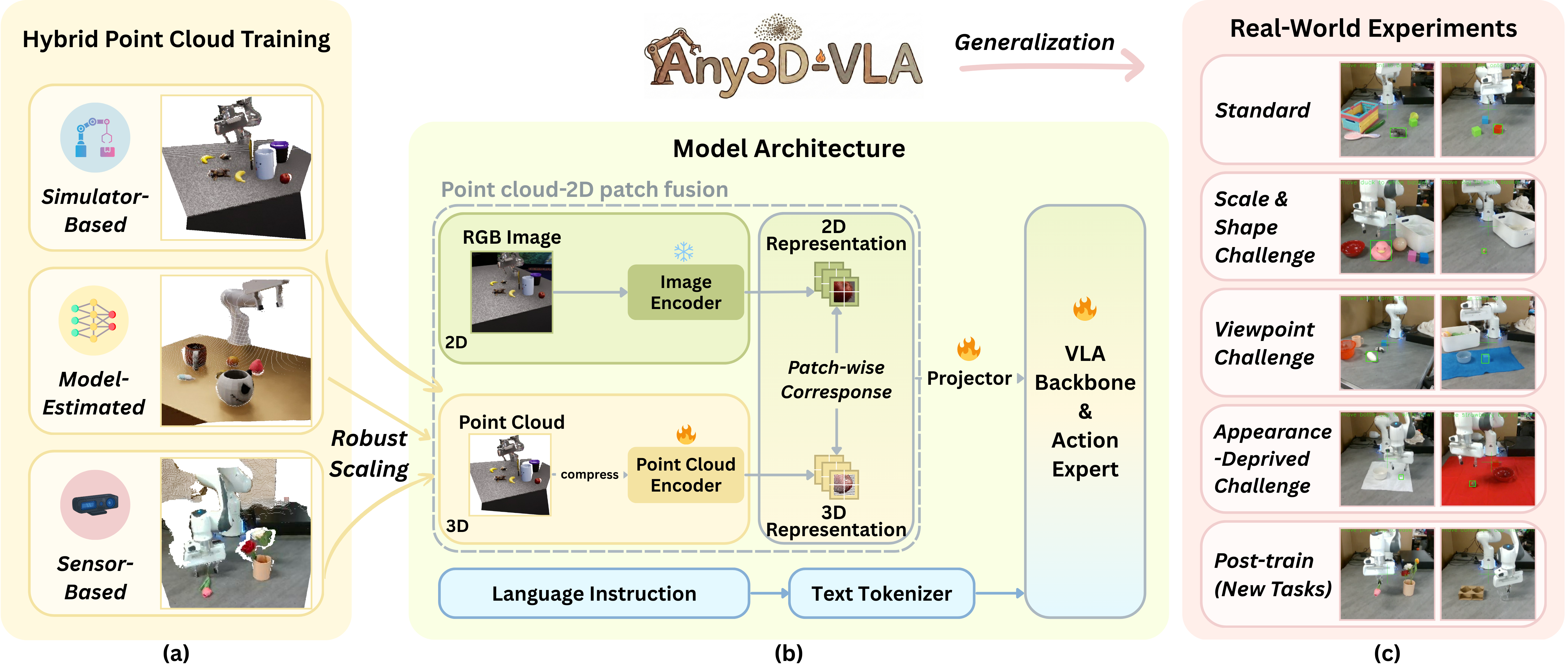
Existing Vision-Language-Action (VLA) models typically take 2D images as visual input, which limits their spatial understanding in complex scenes. How can we incorporate 3D information to enhance VLA capabilities? We conduct a pilot study across different observation spaces and visual representations. The results show that explicitly lifting visual input into point clouds yields representations that better complement their corresponding 2D representations. To address the challenges of (1) scarce 3D data and (2) the domain gap induced by cross-environment differences and depth-scale biases, we propose Any3D-VLA. It unifies the simulator, sensor, and model-estimated point clouds within a training pipeline, constructs diverse inputs, and learns domain-agnostic 3D representations that are fused with the corresponding 2D representations. Simulation and real-world experiments demonstrate Any3D-VLA's advantages in improving performance and mitigating the domain gap.
🔥 Updates
- [2026/02/03] Release the paper and model.
🛠️ Model Server
Please follow the steps below to start the model server. We provide the checkpoint of Any3D-VLA on huggingface.
Installation & Environment
We recommend using Conda to manage your environment. This project is optimized for CUDA 11.8.
conda create -n any3dvla_env python=3.12 -y
conda activate any3dvla_env

pip install -r requirements.txt --index-url https://download.pytorch.org/whl/cu118

# Install the core package in editable mode
pip install -e src/vla_network

# Clone Concerto repo
git clone https://github.com/Pointcept/Concerto.git
pip install -e .
Running the Server
To run the model server:
bash serve_mono.sh
For faster inference, add --compile to the command. It will speed up the inference around 50% with a cost of slower model loading.
💬 Supported Instructions
Our model accepts the following instructions:
pick up {object}stack {color} bowl onto {color} bowlstack {color} cube onto {color} cubemove {object} to {container}move {object} to {color} {container}pick up {color} {object}
🤖 Real-World Control Interface
Setup real-world controller following this repo.
📖 Citation
@article{fan2026any3d,
  title={Any3D-VLA: Enhancing VLA Robustness via Diverse Point Clouds},
  author={Fan, Xianzhe and Deng, Shengliang and Wu, Xiaoyang and Lu, Yuxiang and Li, Zhuoling and Yan, Mi and Zhang, Yujia and Zhang, Zhizheng and Wang, He and Zhao, Hengshuang},
  journal={arXiv preprint arXiv:2602.00807},
  year={2026}
}
Similar repos


(ICML 2026) Any3D-VLA: Enhancing VLA Robustness via Diverse Point Clouds
Python
68
7 commits
updated Feb 7, 2026
README
🦾 Any3D-VLA: Enhancing VLA Robustness via Diverse Point Clouds ☁️
⭐️ If you find this project useful, please consider giving it a star!
Existing Vision-Language-Action (VLA) models typically take 2D images as visual input, which limits their spatial understanding in complex scenes. How can we incorporate 3D information to enhance VLA capabilities? We conduct a pilot study across different observation spaces and visual representations. The results show that explicitly lifting visual input into point clouds yields representations that better complement their corresponding 2D representations. To address the challenges of (1) scarce 3D data and (2) the domain gap induced by cross-environment differences and depth-scale biases, we propose Any3D-VLA. It unifies the simulator, sensor, and model-estimated point clouds within a training pipeline, constructs diverse inputs, and learns domain-agnostic 3D representations that are fused with the corresponding 2D representations. Simulation and real-world experiments demonstrate Any3D-VLA's advantages in improving performance and mitigating the domain gap.
🔥 Updates
- [2026/02/03] Release the paper and model.
🛠️ Model Server
Please follow the steps below to start the model server. We provide the checkpoint of Any3D-VLA on huggingface.
Installation & Environment
We recommend using Conda to manage your environment. This project is optimized for CUDA 11.8.
conda create -n any3dvla_env python=3.12 -y
conda activate any3dvla_env

pip install -r requirements.txt --index-url https://download.pytorch.org/whl/cu118

# Install the core package in editable mode
pip install -e src/vla_network

# Clone Concerto repo
git clone https://github.com/Pointcept/Concerto.git
pip install -e .
Running the Server
To run the model server:
bash serve_mono.sh
For faster inference, add --compile to the command. It will speed up the inference around 50% with a cost of slower model loading.
💬 Supported Instructions
Our model accepts the following instructions:
pick up {object}stack {color} bowl onto {color} bowlstack {color} cube onto {color} cubemove {object} to {container}move {object} to {color} {container}pick up {color} {object}
🤖 Real-World Control Interface
Setup real-world controller following this repo.
📖 Citation
@article{fan2026any3d,
  title={Any3D-VLA: Enhancing VLA Robustness via Diverse Point Clouds},
  author={Fan, Xianzhe and Deng, Shengliang and Wu, Xiaoyang and Lu, Yuxiang and Li, Zhuoling and Yan, Mi and Zhang, Yujia and Zhang, Zhizheng and Wang, He and Zhao, Hengshuang},
  journal={arXiv preprint arXiv:2602.00807},
  year={2026}
}