The code implementation for TTCS: Test-Time Curriculum Synthesis for Self-Evolving.
See the code



A self-evolving framework that enhances LLM mathematical reasoning through dynamic Synthesizer-Solver co-evolution at test time.
[2026-3-3] Accepted by ICLR 2026 Lifelong Agent(LLA) workshop! See you in Rio De Janeiro, Brazil!
[2026-3-1] Update codes to fix some bugs in previous version.
[2026-2-2] TTCS got #3 Paper of the day in huggingface daily paper.
[2026-1-30] We released our paper and code.
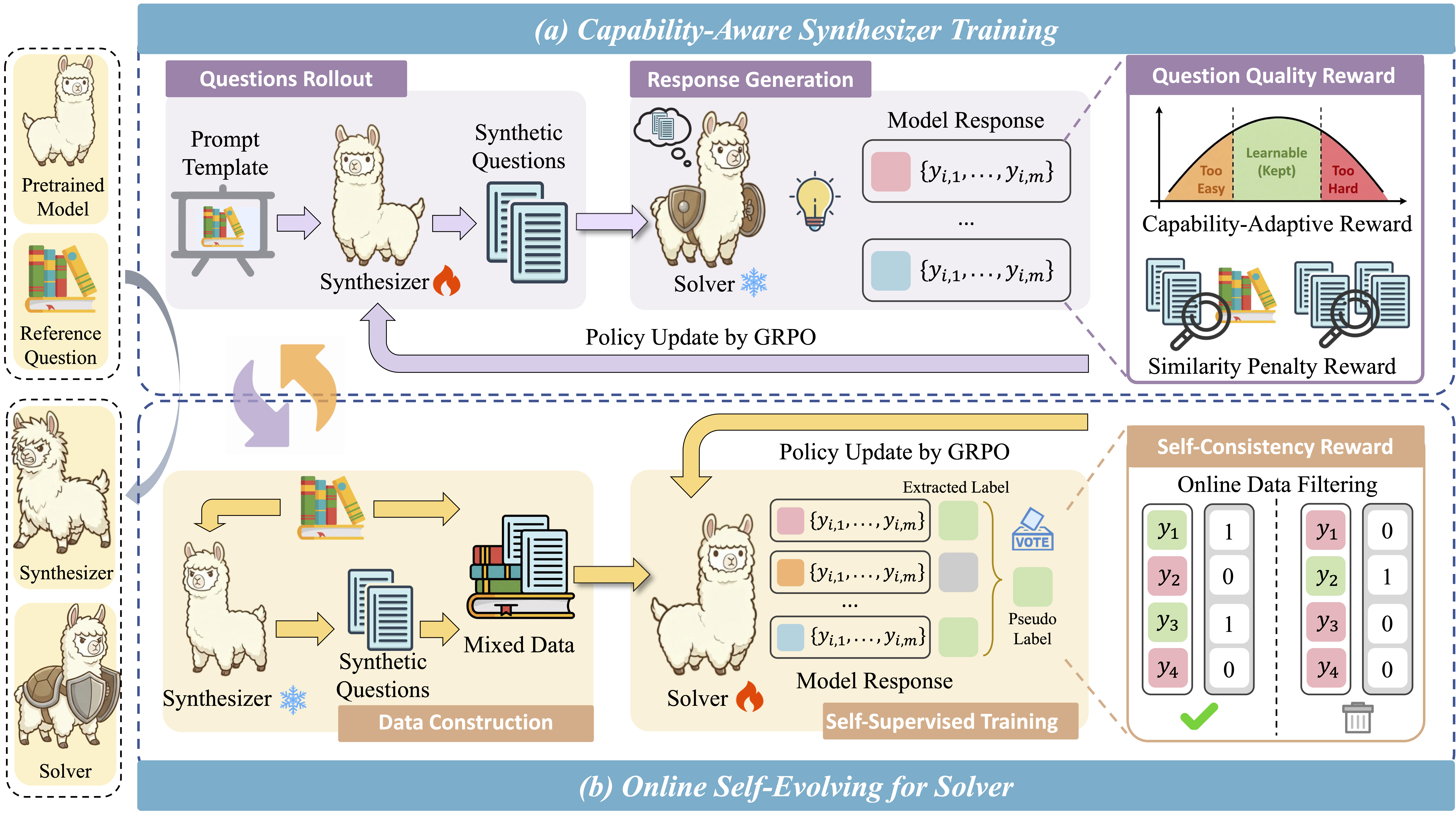
TTCS (Test-Time Curriculum Synthesis) is a co-evolving test-time training framework built on an iterative GRPO optimization loop. It consists of two agents: a Synthesizer policy $\pi_{\phi}$ and a Solver policy $\pi_{\theta}$, both initialized from the same pretrained model.
At each iteration:
The two agents co-evolve in a closed loop: the Solver's current performance provides a capability-aware training signal that shapes the Synthesizer's generation distribution, while the Synthesizer continuously supplies fresh, question-centered variants that stabilize the Solver's test-time training.
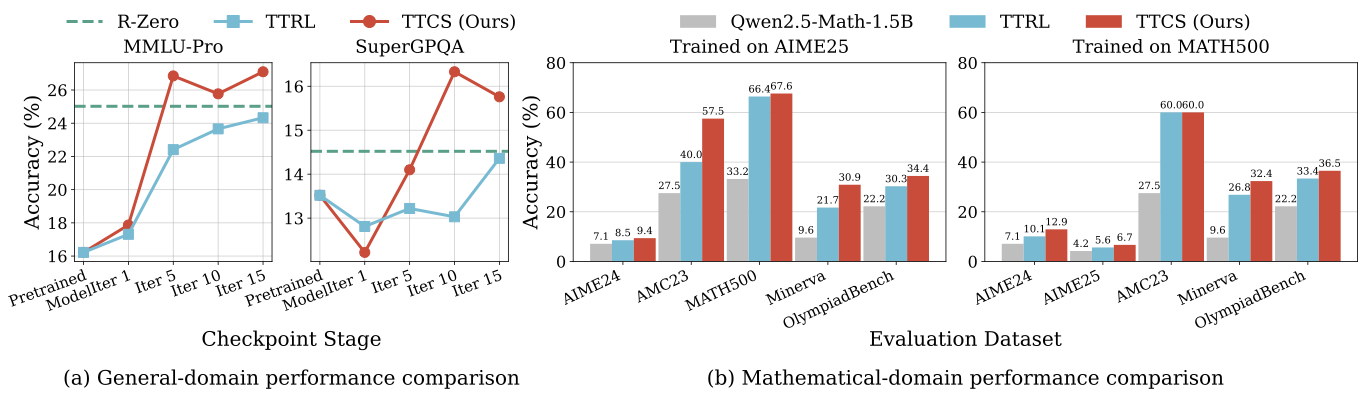
The table below compares TTCS against other baselines on mathematical reasoning benchmarks. Best results are highlighted in bold.
| Method | AIME 2024 | AIME 2025 | AMC23 | MATH-500 | Minerva | OlympiadBench | AVG |
|---|---|---|---|---|---|---|---|
| Pretrained Model | 7.10 | 4.20 | 27.50 | 33.20 | 9.60 | 22.20 | 17.30 |
| Self-Consistency | 13.30 | 10.00 | 50.00 | 49.80 | 10.70 | 31.90 | 27.62 |
| R-Zero | 10.00 | 4.58 | 47.50 | 66.20 | 30.88 | 31.01 | 31.70 |
| TTRL | 13.23 | 9.38 | 55.00 | 71.20 | 34.93 | 35.61 | 36.56 |
| TTCS (Ours) | 19.79 | 13.33 | 62.50 | 76.80 | 40.44 | 36.05 | 41.49 |
| Method | AIME 2024 | AIME 2025 | AMC23 | MATH-500 | Minerva | OlympiadBench | AVG |
|---|---|---|---|---|---|---|---|
| Pretrained Model | 12.90 | 7.90 | 45.00 | 52.80 | 18.80 | 18.70 | 26.02 |
| Self-Consistency | 20.00 | 13.30 | 52.50 | 62.20 | 22.10 | 22.80 | 32.15 |
| R-Zero | 18.13 | 7.81 | 65.00 | 78.60 | 43.38 | 39.47 | 42.07 |
| TTRL | 35.52 | 14.06 | 67.50 | 83.40 | 49.26 | 40.80 | 48.42 |
| TTCS (Ours) | 37.19 | 19.90 | 75.00 | 84.60 | 53.31 | 45.25 | 52.54 |
| Method | AIME 2024 | AIME 2025 | AMC23 | MATH-500 | Minerva | OlympiadBench | AVG |
|---|---|---|---|---|---|---|---|
| Pretrained Model | 12.10 | 5.40 | 45.00 | 72.40 | 32.70 | 39.90 | 34.58 |
| Self-Consistency | 20.00 | 10.00 | 57.50 | 79.60 | 41.20 | 44.10 | 42.07 |
| R-Zero | 11.35 | 8.65 | 55.00 | 76.20 | 45.96 | 42.73 | 39.98 |
| TTRL | 16.67 | 17.81 | 57.50 | 80.40 | 45.96 | 43.18 | 43.59 |
| TTCS (Ours) | 25.00 | 19.58 | 60.00 | 81.80 | 52.21 | 44.66 | 47.21 |
# Clone the repository
git clone https://github.com/your-org/TTCS.git
cd TTCS

# Install dependencies
pip install -r requirements.txt
Set up environment variables for your storage paths:
# Base directory for all data and results
export TTCS_BASE_DIR="/path/to/your/base"

# Model directory
export TTCS_MODEL_DIR="/path/to/your/models"

# Data directory
export TTCS_DATA_DIR="/path/to/your/data"

# Results directory
export TTCS_SAVED_RESULTS_DIR="/path/to/saved_results"
The main entry point is run_with_gpus.sh, which handles GPU allocation and launches the training pipeline:
# Run with 4 GPUs
bash src/script/run_with_gpus.sh 4

# Run with 8 GPUs
bash src/script/run_with_gpus.sh 8
The script will:
To evaluate a trained model:
bash evaluation/eval.sh <variant_name> <eval_step> <num_iterations> <base_model_name> <dataset>
A: Our experiments were conducted on servers with 4-8 GPUs. The minimum recommended setup is 4 GPUs (2 for Synthesizer, 2 for Solver/Reward). For larger models, 8 GPUs are recommended.
A: Training time depends on the model size and number of iterations. For Qwen2.5-Math-1.5B with 4 GPUs, each iteration takes approximately 4-5 hours.
A: Yes! TTCS is model-agnostic. Modify the TTCS_BASE_MODEL_NAME and TTCS_BASE_MODEL_PATH environment variables to use your preferred model.
A: Checkpoints are saved in ${TTCS_SAVED_RESULTS_DIR}/Solver_ttrl/ and ${TTCS_SAVED_RESULTS_DIR}/Synthesizer_ttrl/ for Solver and Synthesizer respectively.
Our framework builds upon the excellent work of:
If you find TTCS helpful for your research, please cite our paper:
@article{yang2026ttcs,
  title={TTCS: Test-Time Curriculum Synthesis for Self-Evolving},
  author={Yang, Chengyi and Xiang, Zhishang and Tang, Yunbo and Teng, Zongpei and Huang, Chengsong and Long, Fei and Liu, Yuhan and Su, Jinsong},
  journal={arXiv preprint arXiv:2601.22628},
  year={2026}
}
Links:
This project is licensed under the Apache License 2.0 - see the LICENSE file for details.
The code implementation for TTCS: Test-Time Curriculum Synthesis for Self-Evolving.
See the code
A self-evolving framework that enhances LLM mathematical reasoning through dynamic Synthesizer-Solver co-evolution at test time.
[2026-3-3] Accepted by ICLR 2026 Lifelong Agent(LLA) workshop! See you in Rio De Janeiro, Brazil!
[2026-3-1] Update codes to fix some bugs in previous version.
[2026-2-2] TTCS got #3 Paper of the day in huggingface daily paper.
[2026-1-30] We released our paper and code.
TTCS (Test-Time Curriculum Synthesis) is a co-evolving test-time training framework built on an iterative GRPO optimization loop. It consists of two agents: a Synthesizer policy $\pi_{\phi}$ and a Solver policy $\pi_{\theta}$, both initialized from the same pretrained model.
At each iteration:
The two agents co-evolve in a closed loop: the Solver's current performance provides a capability-aware training signal that shapes the Synthesizer's generation distribution, while the Synthesizer continuously supplies fresh, question-centered variants that stabilize the Solver's test-time training.
The table below compares TTCS against other baselines on mathematical reasoning benchmarks. Best results are highlighted in bold.
| Method | AIME 2024 | AIME 2025 | AMC23 | MATH-500 | Minerva | OlympiadBench | AVG |
|---|---|---|---|---|---|---|---|
| Pretrained Model | 7.10 | 4.20 | 27.50 | 33.20 | 9.60 | 22.20 | 17.30 |
| Self-Consistency | 13.30 | 10.00 | 50.00 | 49.80 | 10.70 | 31.90 | 27.62 |
| R-Zero | 10.00 | 4.58 | 47.50 | 66.20 | 30.88 | 31.01 | 31.70 |
| TTRL | 13.23 | 9.38 | 55.00 | 71.20 | 34.93 | 35.61 | 36.56 |
| TTCS (Ours) | 19.79 | 13.33 | 62.50 | 76.80 | 40.44 | 36.05 | 41.49 |
| Method | AIME 2024 | AIME 2025 | AMC23 | MATH-500 | Minerva | OlympiadBench | AVG |
|---|---|---|---|---|---|---|---|
| Pretrained Model | 12.90 | 7.90 | 45.00 | 52.80 | 18.80 | 18.70 | 26.02 |
| Self-Consistency | 20.00 | 13.30 | 52.50 | 62.20 | 22.10 | 22.80 | 32.15 |
| R-Zero | 18.13 | 7.81 | 65.00 | 78.60 | 43.38 | 39.47 | 42.07 |
| TTRL | 35.52 | 14.06 | 67.50 | 83.40 | 49.26 | 40.80 | 48.42 |
| TTCS (Ours) | 37.19 | 19.90 | 75.00 | 84.60 | 53.31 | 45.25 | 52.54 |
| Method | AIME 2024 | AIME 2025 | AMC23 | MATH-500 | Minerva | OlympiadBench | AVG |
|---|---|---|---|---|---|---|---|
| Pretrained Model | 12.10 | 5.40 | 45.00 | 72.40 | 32.70 | 39.90 | 34.58 |
| Self-Consistency | 20.00 | 10.00 | 57.50 | 79.60 | 41.20 | 44.10 | 42.07 |
| R-Zero | 11.35 | 8.65 | 55.00 | 76.20 | 45.96 | 42.73 | 39.98 |
| TTRL | 16.67 | 17.81 | 57.50 | 80.40 | 45.96 | 43.18 | 43.59 |
| TTCS (Ours) | 25.00 | 19.58 | 60.00 | 81.80 | 52.21 | 44.66 | 47.21 |
# Clone the repository
git clone https://github.com/your-org/TTCS.git
cd TTCS

# Install dependencies
pip install -r requirements.txt
Set up environment variables for your storage paths:
# Base directory for all data and results
export TTCS_BASE_DIR="/path/to/your/base"

# Model directory
export TTCS_MODEL_DIR="/path/to/your/models"

# Data directory
export TTCS_DATA_DIR="/path/to/your/data"

# Results directory
export TTCS_SAVED_RESULTS_DIR="/path/to/saved_results"
The main entry point is run_with_gpus.sh, which handles GPU allocation and launches the training pipeline:
# Run with 4 GPUs
bash src/script/run_with_gpus.sh 4

# Run with 8 GPUs
bash src/script/run_with_gpus.sh 8
The script will:
To evaluate a trained model:
bash evaluation/eval.sh <variant_name> <eval_step> <num_iterations> <base_model_name> <dataset>
A: Our experiments were conducted on servers with 4-8 GPUs. The minimum recommended setup is 4 GPUs (2 for Synthesizer, 2 for Solver/Reward). For larger models, 8 GPUs are recommended.
A: Training time depends on the model size and number of iterations. For Qwen2.5-Math-1.5B with 4 GPUs, each iteration takes approximately 4-5 hours.
A: Yes! TTCS is model-agnostic. Modify the TTCS_BASE_MODEL_NAME and TTCS_BASE_MODEL_PATH environment variables to use your preferred model.
A: Checkpoints are saved in ${TTCS_SAVED_RESULTS_DIR}/Solver_ttrl/ and ${TTCS_SAVED_RESULTS_DIR}/Synthesizer_ttrl/ for Solver and Synthesizer respectively.
Our framework builds upon the excellent work of:
If you find TTCS helpful for your research, please cite our paper:
@article{yang2026ttcs,
  title={TTCS: Test-Time Curriculum Synthesis for Self-Evolving},
  author={Yang, Chengyi and Xiang, Zhishang and Tang, Yunbo and Teng, Zongpei and Huang, Chengsong and Long, Fei and Liu, Yuhan and Su, Jinsong},
  journal={arXiv preprint arXiv:2601.22628},
  year={2026}
}
Links:
This project is licensed under the Apache License 2.0 - see the LICENSE file for details.



