Official implementation of "Preserve the Hard, Regenerate the Rest" — uncertainty-guided diffusion augmentation for semantic segmentation.
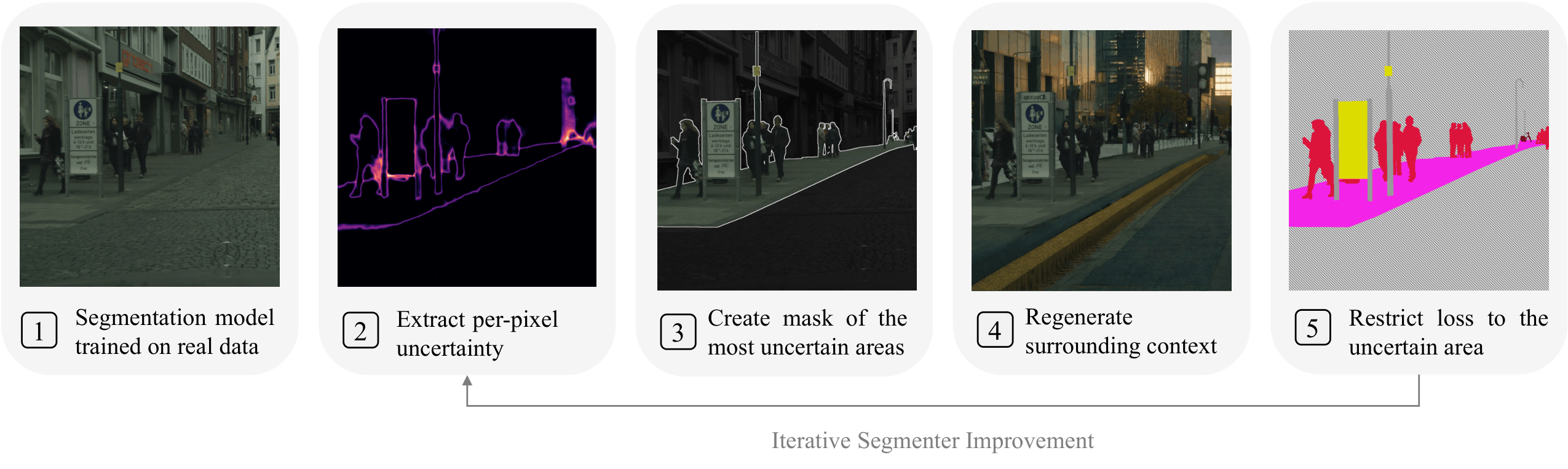
We train a segmentation model on real images, measure predictive entropy,
aggregate uncertainty over each ground-truth class, and preserve the most
uncertain classes until their union exceeds an area budget τ. An off-the-shelf
inpainter regenerates the complement; preserved pixels are pasted back from the
source, and every generated pixel—including the feathered boundary—is assigned
the dataset ignore index. The segmenter is then fine-tuned on real and synthetic
images without supervising regenerated content.
Implementation-level details live in
guided_generation/PIPELINE.md; the config
schema and dataset interface are in CONFIGURATION.md and
DATASET_CONTRACT.md.
.
├── configs/                    # Paper-matching Cityscapes/BDD100K/UAVID YAML
├── guided_generation/
│   ├── datasets/               # Dataset adapters for selection/generation
│   ├── diffusion/              # Inpainting pipelines and paste-back logic
│   ├── guidance/               # DINOv2 guide and optional diffusion guidance
│   ├── main_scripts/           # Step 1–4 entry points and local runner
│   └── sample_selection/       # Entropy-based preserve-mask selection
├── vfm4ss/                     # Segmenter, data modules, training, evaluation
├── SLURM/                      # Config-driven scheduler path
├── dataset_configs.py          # Classes, palettes, suffixes, ignore indices
├── environment.yml             # Supported conda environment
└── requirements.txt            # Fully pinned Python dependencies
Supported path: conda on a single-GPU Linux machine. Training and generation use CUDA 11.8 PyTorch wheels, so the installed NVIDIA driver must be compatible with CUDA 11.8.
git clone <REPOSITORY_URL>
cd preserve_the_hard

conda env create -f environment.yml
conda activate preserve-the-hard
export PYTHONPATH="$PWD"

python -c "import torch; print(torch.__version__, torch.cuda.is_available())"
The first run downloads the configured backbone and the paper inpainter
(diffusers/stable-diffusion-xl-1.0-inpainting-0.1).
Optionally relocate caches and pass credentials through the environment only
(never commit them):
export HF_HOME=/path/to/huggingface-cache
export TORCH_HOME=/path/to/torch-cache
export HF_TOKEN=<your-token>
export WANDB_API_KEY=<your-key>
W&B defaults to offline mode in the supplied Slurm scripts. Docker is optional;
see docker/README.md.
Datasets are not redistributed—download each from its official source and comply with its license.
Cityscapes. Register at the
download page, then extract
leftImg8bit_trainvaltest.zip and gtFine_trainvaltest.zip into
data/cityscapes (leftImg8bit/{train,val} and gtFine/{train,val}). The paper
config uses the fixed 10% subset: 297 training images and the full 500-image
validation split.
BDD100K. Download the three 10K image splits and the semantic-segmentation labels, then normalize:
mkdir -p data/bdd100k/_unpack
cd data/bdd100k/_unpack

curl -LO https://dl.cv.ethz.ch/bdd100k/data/10k_images_train.zip
curl -LO https://dl.cv.ethz.ch/bdd100k/data/10k_images_val.zip
curl -LO https://dl.cv.ethz.ch/bdd100k/data/10k_images_test.zip
curl -LO https://dl.cv.ethz.ch/bdd100k/data/bdd100k_sem_seg_labels_trainval.zip

unzip '*.zip'

cd ../../..
python -m guided_generation.main_scripts.prepare_bdd100k_semseg \
  --unpack-root data/bdd100k/_unpack \
  --output-root data/bdd100k
This yields data/bdd100k/images/10k/{train,val,test} and
labels/sem_seg/masks/{train,val}. The paper config uses 10% of the 7,000
training images (700) and all 1,000 validation images. Archives and checksums:
BDD100K index,
docs.
UAVID. Download the images-and-labels package from
uavid.nl and extract so the official sequence layout is
rooted at data/uavid_official (uavid_{train,val}/<sequence>/{Images,Labels}).
Convert RGB labels to train IDs and reproduce the paper crop (one deterministic
2048×2048 crop per frame, seed 44, resized to 1024×1024):
python -m guided_generation.main_scripts.prepare_uavid_semseg \
  --input-root data/uavid_official \
  --output-root data/uavid \
  --splits train val

python -m guided_generation.main_scripts.preprocess_uavid_scale_crops \
  --input-root data/uavid \
  --output-root temp/uavid_2048to1024 \
  --splits train val \
  --crop-size 2048 \
  --output-size 1024 \
  --crop-policy random-one \
  --label-resize nearest \
  --seed 44
This retains the paper's 200 training and 70 validation images under
temp/uavid_2048to1024/{img_dir,ann_dir}.
The smoke profile (two samples, two optimizer/denoising steps, one seed, batch size 1) verifies wiring only—it is not a meaningful experiment:
conda activate preserve-the-hard
export PYTHONPATH="$PWD"
export WANDB_MODE=disabled

python -m guided_generation.config --config configs/cityscapes.yaml --format validate
python -m guided_generation.main_scripts.run_pipeline --config configs/cityscapes.yaml --smoke
Add --dry-run to preview the exact commands without training or downloading
models.
Pick one config: configs/cityscapes.yaml, configs/bdd100k.yaml, or
configs/uavid.yaml.
Local, one command:
python -m guided_generation.main_scripts.run_pipeline --config "$CONFIG"
This runs four stages sequentially. To run them individually, pass --stages N.
Stages 2–4 require the Step 1 checkpoint:
# Step 1 — train the real-only baseline
python -m guided_generation.main_scripts.run_pipeline --config "$CONFIG" --stages 1

# Resolve the newest checkpoint (adjust the search root per config)
CKPT="$(
  find training_logs/cityscapes/real_only -type f -name '*.ckpt' -printf '%T@ %p\n' |
  sort -nr | head -n 1 | cut -d' ' -f2-
)"
test -n "$CKPT"

# Step 2 — uncertainty preserve masks · Step 3 — inpaint complement · Step 4 — fine-tune
python -m guided_generation.main_scripts.run_pipeline --config "$CONFIG" --stages 2 --checkpoint "$CKPT"
python -m guided_generation.main_scripts.run_pipeline --config "$CONFIG" --stages 3 --checkpoint "$CKPT"
python -m guided_generation.main_scripts.run_pipeline --config "$CONFIG" --stages 4 --checkpoint "$CKPT"
Step 4 runs every seed in training.fine_tune_seeds.
Slurm, one command (scripts request one GPU via #SBATCH --gres=gpu:1;
adapt if your cluster differs). The orchestrator submits four afterok-chained
jobs, each using conda run -n preserve-the-hard:
conda activate preserve-the-hard
export PYTHONPATH="$PWD"

./SLURM/run_pipeline.sh "$CONFIG"          # add DRY_RUN=1 to preview without sbatch
The YAML files are the single source of truth for local and Slurm runs.
selection.tau — per image, classes are ranked by decreasing mean
predictive entropy and added whole until their union strictly exceeds
tau × H × W (final area can exceed tau when the last class is large).
Paper iteration-1 values: Cityscapes 0.10, BDD100K 0.10, UAVID 0.15.real_split / synthetic_split
fractions. The supplied configs generate one synthetic image per retained real
image and use all of both, giving the paper's 1:1 ratio.model.encoder_name is passed unchanged to Step 1, entropy
scoring, and Step 4. Paper: vit_small_patch14_dinov2. generation:
inpainter: sdxl_inpainting
model_id: diffusers/stable-diffusion-xl-1.0-inpainting-0.1
context_guidance_strength: 0.0
num_steps: 40
cfg_guidance_scale: 7.0
mask_erosion_kernel: 0
For a later round, copy the dataset YAML, point paths.cache,
paths.synthetic, and paths.step4_logs at new round-specific locations, set
model.checkpoint to the previous round's best checkpoint, and run Steps 2–4:
python -m guided_generation.main_scripts.run_pipeline \
  --config configs/cityscapes_iteration2.yaml --stages 2,3,4
Each round builds a fresh synthetic set from the same fixed real IDs; earlier synthetic sets are not concatenated.
To add a dataset, follow DATASET_CONTRACT.md: provide
paired RGB images and integer masks, define metadata in dataset_configs.py,
register an adapter in guided_generation/datasets/registry.py and data modules
in vfm4ss/segmentation_trainer.py, then copy a YAML. Explicit registration
prevents silent class-ID or ignore-index mistakes.
Swap the backbone via any compatible timm encoder (model.encoder_name,
checkpoint: auto); the checkpoint architecture must match when resuming.
Supported inpainting backends—sdxl_inpainting, sdxl_diffusers_inpainting,
sd15_diffusers_inpainting, flux_fill, sdxl_controlnet_inpainting—are
selected with generation.inpainter / generation.model_id. Native Diffusers
and FLUX backends require context_guidance_strength: 0.0; FLUX additionally
needs an authorized HF_TOKEN after accepting the
model terms. These
optional backends are not part of the paper's main experiments.
For the Cityscapes config:
training_logs/cityscapes/real_only/.../checkpoints/*.ckpt   # Step 1 baseline
.cached_images4gen/cityscapes/iteration1/                   # source crops, labels, masks, metadata
synthetic_data/cityscapes/iteration1/                       # augmented RGB + ignore-labeled annotations
training_logs/cityscapes/iteration1/                        # Step 4 checkpoints + metrics_seed_*.json
Slurm Step 4 also writes per-run metrics under
training_logs/step4_multirun_<job-id>/. Synthetic images are written
losslessly, so JPEG-source datasets (e.g. BDD100K) receive PNG synthetic images;
Step 4 reads the recorded suffix from pipeline_metadata.json.
42 + i.MIT License. Cityscapes, BDD100K, UAVID, DINOv2, SDXL, and optional model backends remain governed by their own licenses.
Built on PyTorch, Lightning, timm, DINOv2, Hugging Face Diffusers, SDXL, and the Cityscapes, BDD100K, and UAVID datasets. Please cite and follow the license terms of every dataset and pretrained model used.
Official implementation of "Preserve the Hard, Regenerate the Rest" — uncertainty-guided diffusion augmentation for semantic segmentation.
We train a segmentation model on real images, measure predictive entropy,
aggregate uncertainty over each ground-truth class, and preserve the most
uncertain classes until their union exceeds an area budget τ. An off-the-shelf
inpainter regenerates the complement; preserved pixels are pasted back from the
source, and every generated pixel—including the feathered boundary—is assigned
the dataset ignore index. The segmenter is then fine-tuned on real and synthetic
images without supervising regenerated content.
Implementation-level details live in
guided_generation/PIPELINE.md; the config
schema and dataset interface are in CONFIGURATION.md and
DATASET_CONTRACT.md.
.
├── configs/                    # Paper-matching Cityscapes/BDD100K/UAVID YAML
├── guided_generation/
│   ├── datasets/               # Dataset adapters for selection/generation
│   ├── diffusion/              # Inpainting pipelines and paste-back logic
│   ├── guidance/               # DINOv2 guide and optional diffusion guidance
│   ├── main_scripts/           # Step 1–4 entry points and local runner
│   └── sample_selection/       # Entropy-based preserve-mask selection
├── vfm4ss/                     # Segmenter, data modules, training, evaluation
├── SLURM/                      # Config-driven scheduler path
├── dataset_configs.py          # Classes, palettes, suffixes, ignore indices
├── environment.yml             # Supported conda environment
└── requirements.txt            # Fully pinned Python dependencies
Supported path: conda on a single-GPU Linux machine. Training and generation use CUDA 11.8 PyTorch wheels, so the installed NVIDIA driver must be compatible with CUDA 11.8.
git clone <REPOSITORY_URL>
cd preserve_the_hard

conda env create -f environment.yml
conda activate preserve-the-hard
export PYTHONPATH="$PWD"

python -c "import torch; print(torch.__version__, torch.cuda.is_available())"
The first run downloads the configured backbone and the paper inpainter
(diffusers/stable-diffusion-xl-1.0-inpainting-0.1).
Optionally relocate caches and pass credentials through the environment only
(never commit them):
export HF_HOME=/path/to/huggingface-cache
export TORCH_HOME=/path/to/torch-cache
export HF_TOKEN=<your-token>
export WANDB_API_KEY=<your-key>
W&B defaults to offline mode in the supplied Slurm scripts. Docker is optional;
see docker/README.md.
Datasets are not redistributed—download each from its official source and comply with its license.
Cityscapes. Register at the
download page, then extract
leftImg8bit_trainvaltest.zip and gtFine_trainvaltest.zip into
data/cityscapes (leftImg8bit/{train,val} and gtFine/{train,val}). The paper
config uses the fixed 10% subset: 297 training images and the full 500-image
validation split.
BDD100K. Download the three 10K image splits and the semantic-segmentation labels, then normalize:
mkdir -p data/bdd100k/_unpack
cd data/bdd100k/_unpack

curl -LO https://dl.cv.ethz.ch/bdd100k/data/10k_images_train.zip
curl -LO https://dl.cv.ethz.ch/bdd100k/data/10k_images_val.zip
curl -LO https://dl.cv.ethz.ch/bdd100k/data/10k_images_test.zip
curl -LO https://dl.cv.ethz.ch/bdd100k/data/bdd100k_sem_seg_labels_trainval.zip

unzip '*.zip'

cd ../../..
python -m guided_generation.main_scripts.prepare_bdd100k_semseg \
  --unpack-root data/bdd100k/_unpack \
  --output-root data/bdd100k
This yields data/bdd100k/images/10k/{train,val,test} and
labels/sem_seg/masks/{train,val}. The paper config uses 10% of the 7,000
training images (700) and all 1,000 validation images. Archives and checksums:
BDD100K index,
docs.
UAVID. Download the images-and-labels package from
uavid.nl and extract so the official sequence layout is
rooted at data/uavid_official (uavid_{train,val}/<sequence>/{Images,Labels}).
Convert RGB labels to train IDs and reproduce the paper crop (one deterministic
2048×2048 crop per frame, seed 44, resized to 1024×1024):
python -m guided_generation.main_scripts.prepare_uavid_semseg \
  --input-root data/uavid_official \
  --output-root data/uavid \
  --splits train val

python -m guided_generation.main_scripts.preprocess_uavid_scale_crops \
  --input-root data/uavid \
  --output-root temp/uavid_2048to1024 \
  --splits train val \
  --crop-size 2048 \
  --output-size 1024 \
  --crop-policy random-one \
  --label-resize nearest \
  --seed 44
This retains the paper's 200 training and 70 validation images under
temp/uavid_2048to1024/{img_dir,ann_dir}.
The smoke profile (two samples, two optimizer/denoising steps, one seed, batch size 1) verifies wiring only—it is not a meaningful experiment:
conda activate preserve-the-hard
export PYTHONPATH="$PWD"
export WANDB_MODE=disabled

python -m guided_generation.config --config configs/cityscapes.yaml --format validate
python -m guided_generation.main_scripts.run_pipeline --config configs/cityscapes.yaml --smoke
Add --dry-run to preview the exact commands without training or downloading
models.
Pick one config: configs/cityscapes.yaml, configs/bdd100k.yaml, or
configs/uavid.yaml.
Local, one command:
python -m guided_generation.main_scripts.run_pipeline --config "$CONFIG"
This runs four stages sequentially. To run them individually, pass --stages N.
Stages 2–4 require the Step 1 checkpoint:
# Step 1 — train the real-only baseline
python -m guided_generation.main_scripts.run_pipeline --config "$CONFIG" --stages 1

# Resolve the newest checkpoint (adjust the search root per config)
CKPT="$(
  find training_logs/cityscapes/real_only -type f -name '*.ckpt' -printf '%T@ %p\n' |
  sort -nr | head -n 1 | cut -d' ' -f2-
)"
test -n "$CKPT"

# Step 2 — uncertainty preserve masks · Step 3 — inpaint complement · Step 4 — fine-tune
python -m guided_generation.main_scripts.run_pipeline --config "$CONFIG" --stages 2 --checkpoint "$CKPT"
python -m guided_generation.main_scripts.run_pipeline --config "$CONFIG" --stages 3 --checkpoint "$CKPT"
python -m guided_generation.main_scripts.run_pipeline --config "$CONFIG" --stages 4 --checkpoint "$CKPT"
Step 4 runs every seed in training.fine_tune_seeds.
Slurm, one command (scripts request one GPU via #SBATCH --gres=gpu:1;
adapt if your cluster differs). The orchestrator submits four afterok-chained
jobs, each using conda run -n preserve-the-hard:
conda activate preserve-the-hard
export PYTHONPATH="$PWD"

./SLURM/run_pipeline.sh "$CONFIG"          # add DRY_RUN=1 to preview without sbatch
The YAML files are the single source of truth for local and Slurm runs.
selection.tau — per image, classes are ranked by decreasing mean
predictive entropy and added whole until their union strictly exceeds
tau × H × W (final area can exceed tau when the last class is large).
Paper iteration-1 values: Cityscapes 0.10, BDD100K 0.10, UAVID 0.15.real_split / synthetic_split
fractions. The supplied configs generate one synthetic image per retained real
image and use all of both, giving the paper's 1:1 ratio.model.encoder_name is passed unchanged to Step 1, entropy
scoring, and Step 4. Paper: vit_small_patch14_dinov2. generation:
inpainter: sdxl_inpainting
model_id: diffusers/stable-diffusion-xl-1.0-inpainting-0.1
context_guidance_strength: 0.0
num_steps: 40
cfg_guidance_scale: 7.0
mask_erosion_kernel: 0
For a later round, copy the dataset YAML, point paths.cache,
paths.synthetic, and paths.step4_logs at new round-specific locations, set
model.checkpoint to the previous round's best checkpoint, and run Steps 2–4:
python -m guided_generation.main_scripts.run_pipeline \
  --config configs/cityscapes_iteration2.yaml --stages 2,3,4
Each round builds a fresh synthetic set from the same fixed real IDs; earlier synthetic sets are not concatenated.
To add a dataset, follow DATASET_CONTRACT.md: provide
paired RGB images and integer masks, define metadata in dataset_configs.py,
register an adapter in guided_generation/datasets/registry.py and data modules
in vfm4ss/segmentation_trainer.py, then copy a YAML. Explicit registration
prevents silent class-ID or ignore-index mistakes.
Swap the backbone via any compatible timm encoder (model.encoder_name,
checkpoint: auto); the checkpoint architecture must match when resuming.
Supported inpainting backends—sdxl_inpainting, sdxl_diffusers_inpainting,
sd15_diffusers_inpainting, flux_fill, sdxl_controlnet_inpainting—are
selected with generation.inpainter / generation.model_id. Native Diffusers
and FLUX backends require context_guidance_strength: 0.0; FLUX additionally
needs an authorized HF_TOKEN after accepting the
model terms. These
optional backends are not part of the paper's main experiments.
For the Cityscapes config:
training_logs/cityscapes/real_only/.../checkpoints/*.ckpt   # Step 1 baseline
.cached_images4gen/cityscapes/iteration1/                   # source crops, labels, masks, metadata
synthetic_data/cityscapes/iteration1/                       # augmented RGB + ignore-labeled annotations
training_logs/cityscapes/iteration1/                        # Step 4 checkpoints + metrics_seed_*.json
Slurm Step 4 also writes per-run metrics under
training_logs/step4_multirun_<job-id>/. Synthetic images are written
losslessly, so JPEG-source datasets (e.g. BDD100K) receive PNG synthetic images;
Step 4 reads the recorded suffix from pipeline_metadata.json.
42 + i.MIT License. Cityscapes, BDD100K, UAVID, DINOv2, SDXL, and optional model backends remain governed by their own licenses.
Built on PyTorch, Lightning, timm, DINOv2, Hugging Face Diffusers, SDXL, and the Cityscapes, BDD100K, and UAVID datasets. Please cite and follow the license terms of every dataset and pretrained model used.



