[INTERSPEECH 2022] This dataset is designed for multi-modal speaker diarization and lip-speech synchronization in the wild.
HTML
69
35 commits
updated Jan 24, 2024
MSDWILD: MULTI-MODAL SPEAKER DIARIZATION DATASET IN THE WILD
This dataset is designed for multi-modal speaker diarization and lip-speech synchronization in the wild. Demo
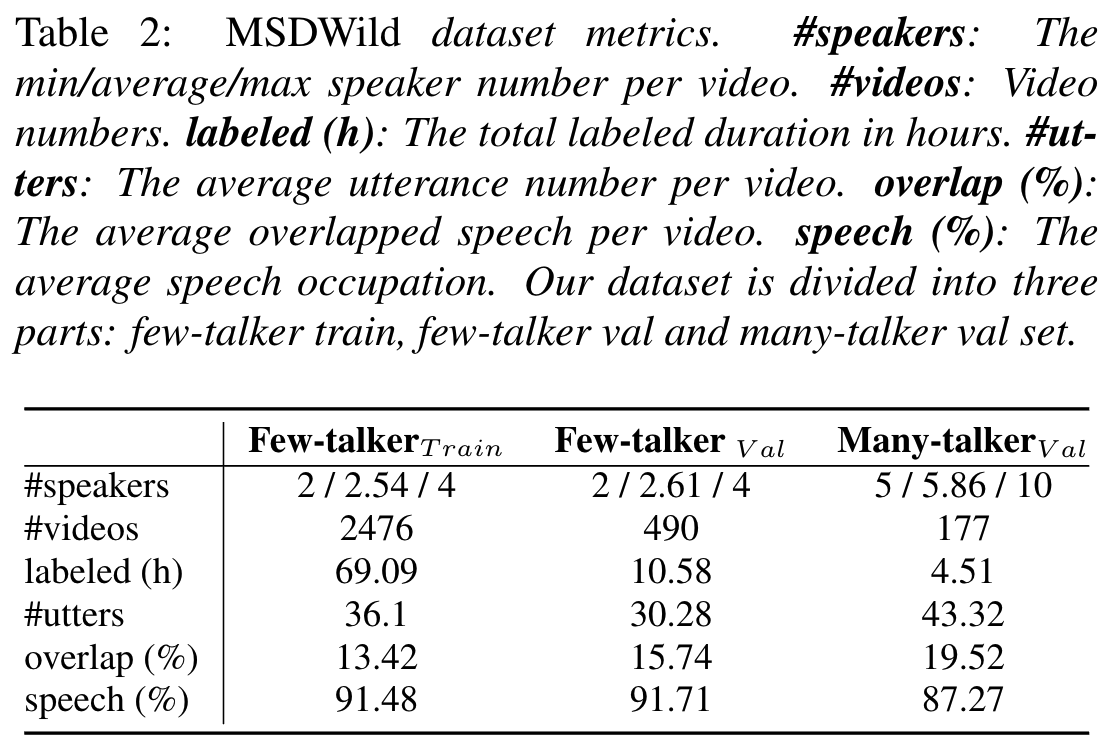
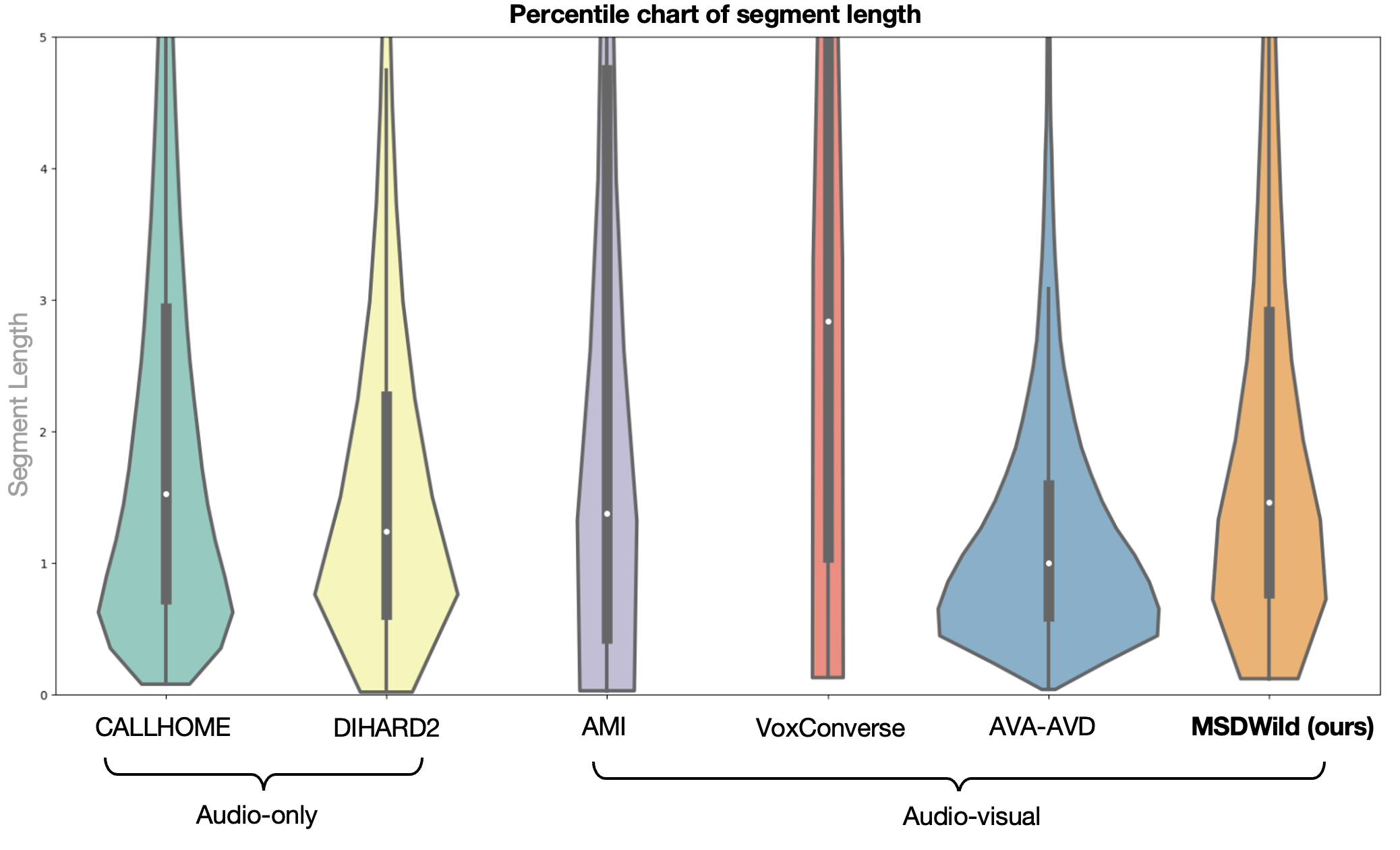
Compared with other multi-modal datasets, the segment length distribution of our dataset is close to the audio-only in-the-wild diarization dataset, e.g., CALLHOME or DIHARD2.
md5: 0057f82daaddf2ce993d1bf0679929c4
The video file name corresponds to the audio file name.
(For Chinese researchers, you can use Baidu Drive or Quark Drive (5v8a)) to speed up downloads. )
Our multimodal speaker diarization baseline includes a subtask - active speaker detection. To train the active speaker detection algorithm (TalkNet mentioned in our paper), we utilize 'cropped faces.' These are randomly generated from videos based on video content and rttm labels, and subsequently, manually rectified. However, if you choose not to use these resources, you can ignore the 'cropped faces.'
There are four categories of cropped-face videos:
NS_segmentid: The cropped face does not speak throughout the video.
SPK_segmentid: The cropped face speaks throughout the video.
TURN_segmentid_01_starttime_turntime_endtime: The cropped face does not speak from start_time to turn_time but starts speaking from turn_time to end_time.
TURN_segmentid_10_starttime_turntime_endtime: The cropped face speaks from start_time to turn_time but does not speak from turn_time to end_time.
Time is denoted in seconds format, and Segment_id corresponds to the cropped face video id within each video folder.
[Updates] Please disregard files with negative filenames (approximately 90 files).
Notes:
We have added additional bounding boxes for every facial image across the frames. Our trained annotators has reviewed the facial annotations on each frame to guarantee accuracy — no faces have been ignored or incorrectly tagged. Moreover, they have realigned any improperly positioned face bounding boxes. The refined annotations have been systematically archived in a correspondingly named directory, with the data structured in CSV files as outlined below. One Sample
CSV line: 3363,face,1,398,129,479,244,0

Description: frame id, face (fixed), face_id, x1, y1, x2, y2, 0 (fixed)
Download Link : Google Drive
(For Chinese researchers, you can use Baidu Drive or Quark Drive (5v8a)) to speed up downloads. )
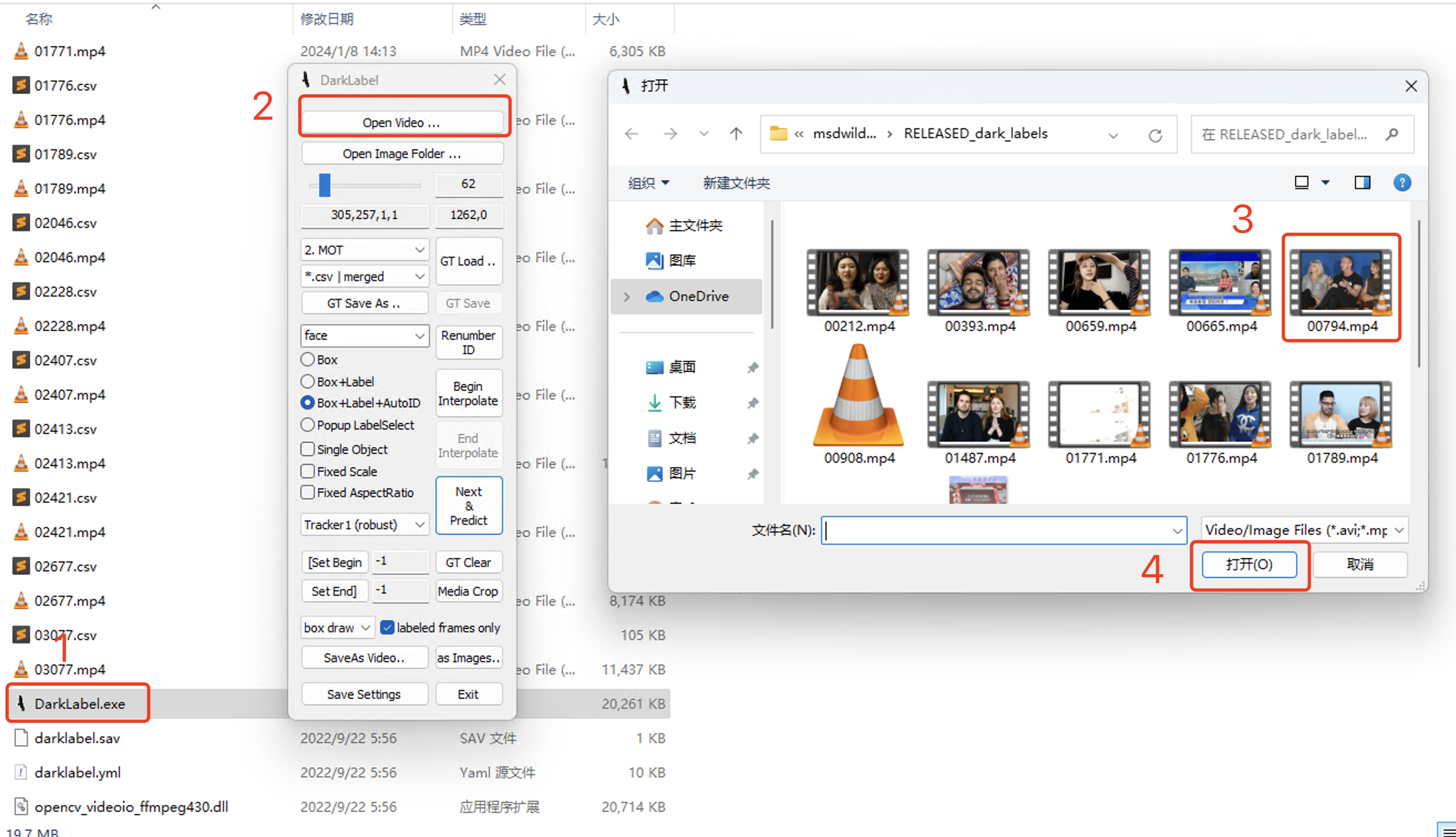
Clik DarkLabel.exe and select one video file to preview.
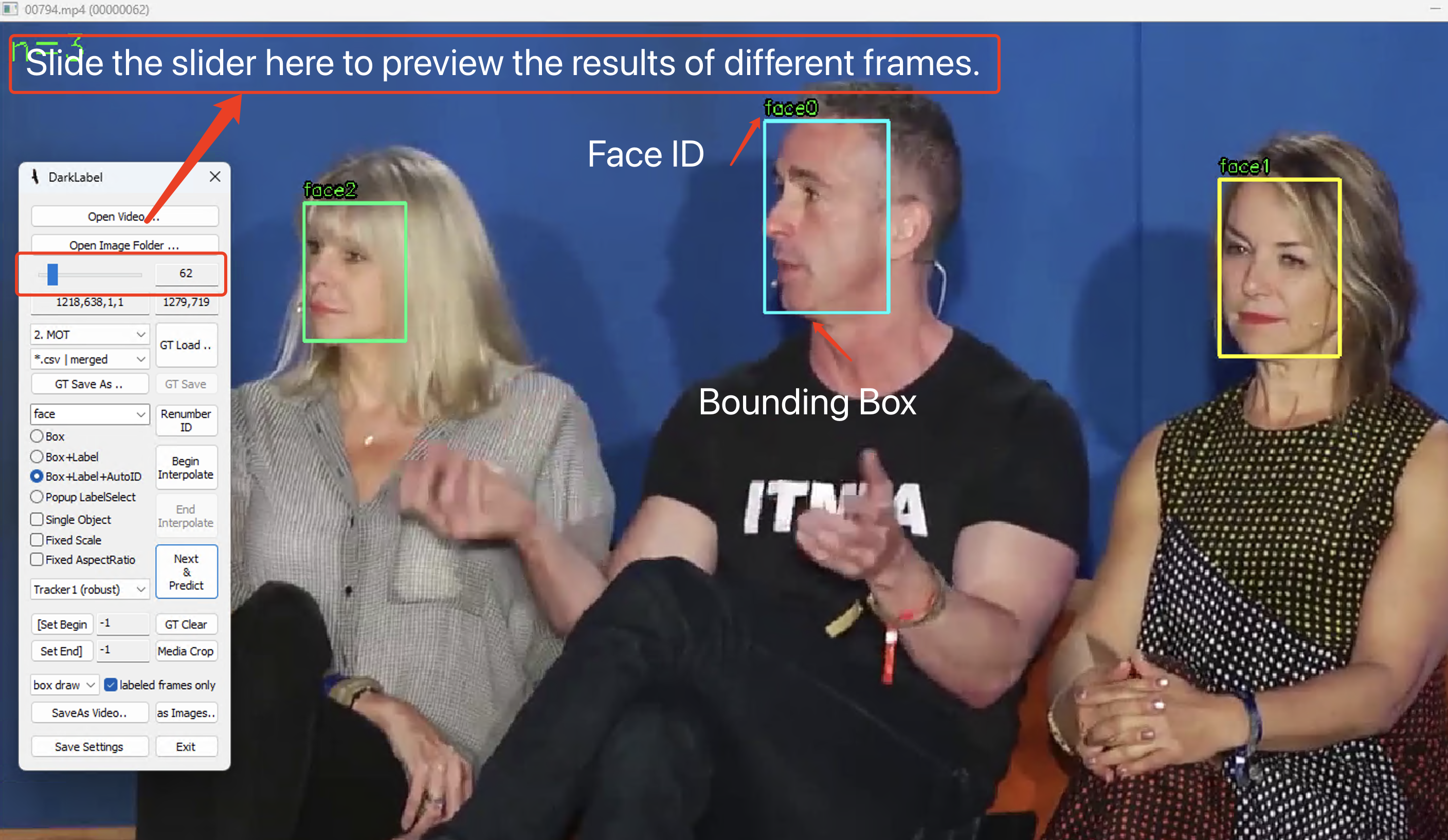
Move the slider to preview the positions and ID information of faces on different frames, not altering any other default settings.
[Update] You can also use this Link to visualize the relationship between the audio label and the visual label.
Notes:
csv file is generated by it. You can also use other tools by convert the csv file.DarkLabel only supports Windows (Win10 or Win11) currently and you may use wine (mentioned in this issue) to run on Mac or Linux.You can easily reproduce the result by the following guide.
Audio-only baseline are based on Pyannote. You can directly use Hugging Face Edition. (Experiments are conducted on Pyannote 094717b6 and its hugging face 3602c22f)
Multi-modal baseline are based on TalkNet-ASD (Pretrained models: msdwild.pretrained.model on our dataset can be downloaded from URL) for audio-visual realtion and ArcFace for face clustering.
-0.5 to 0.5.3).No other post-processing methods are used.
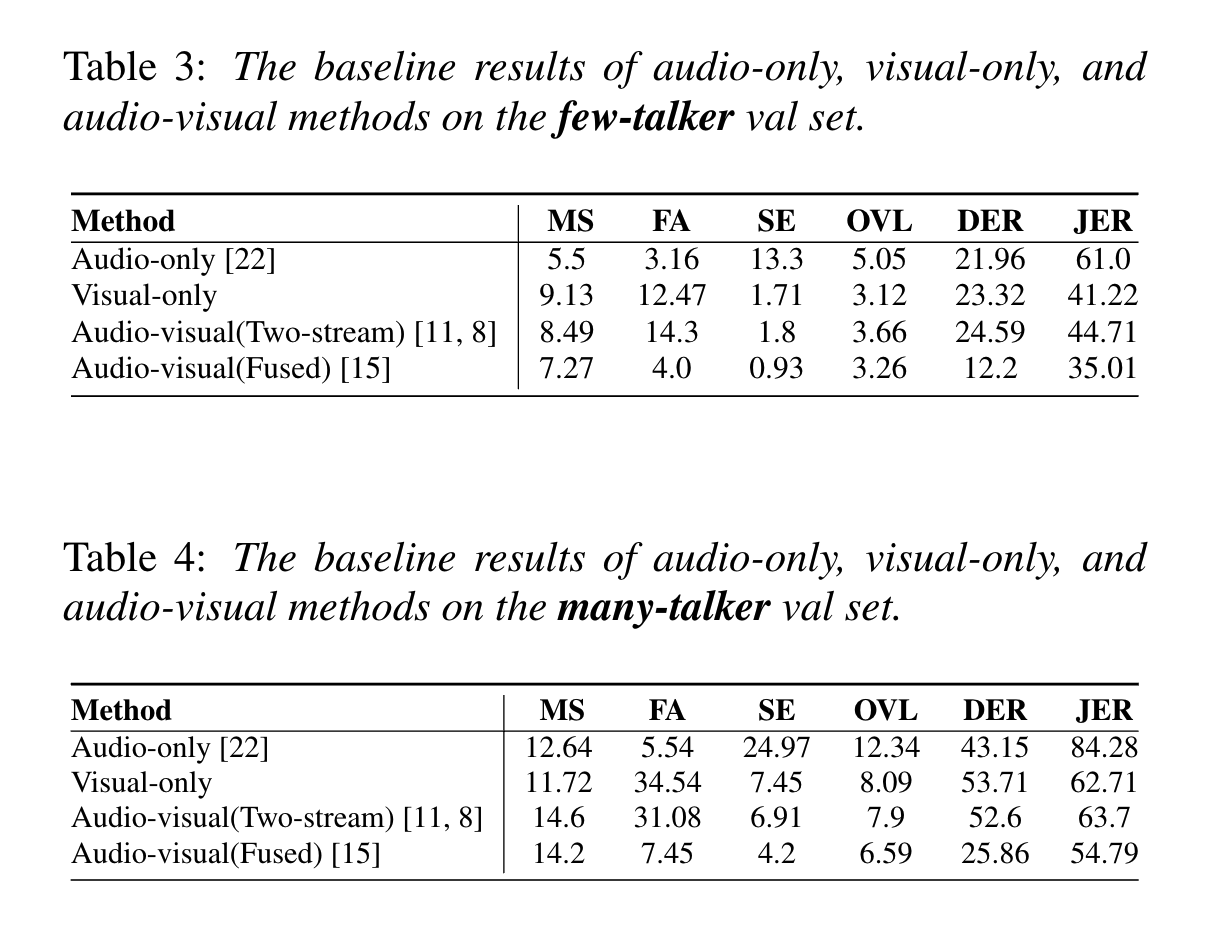
You can refer to URL to visualize the dataset based on your algorithm result.
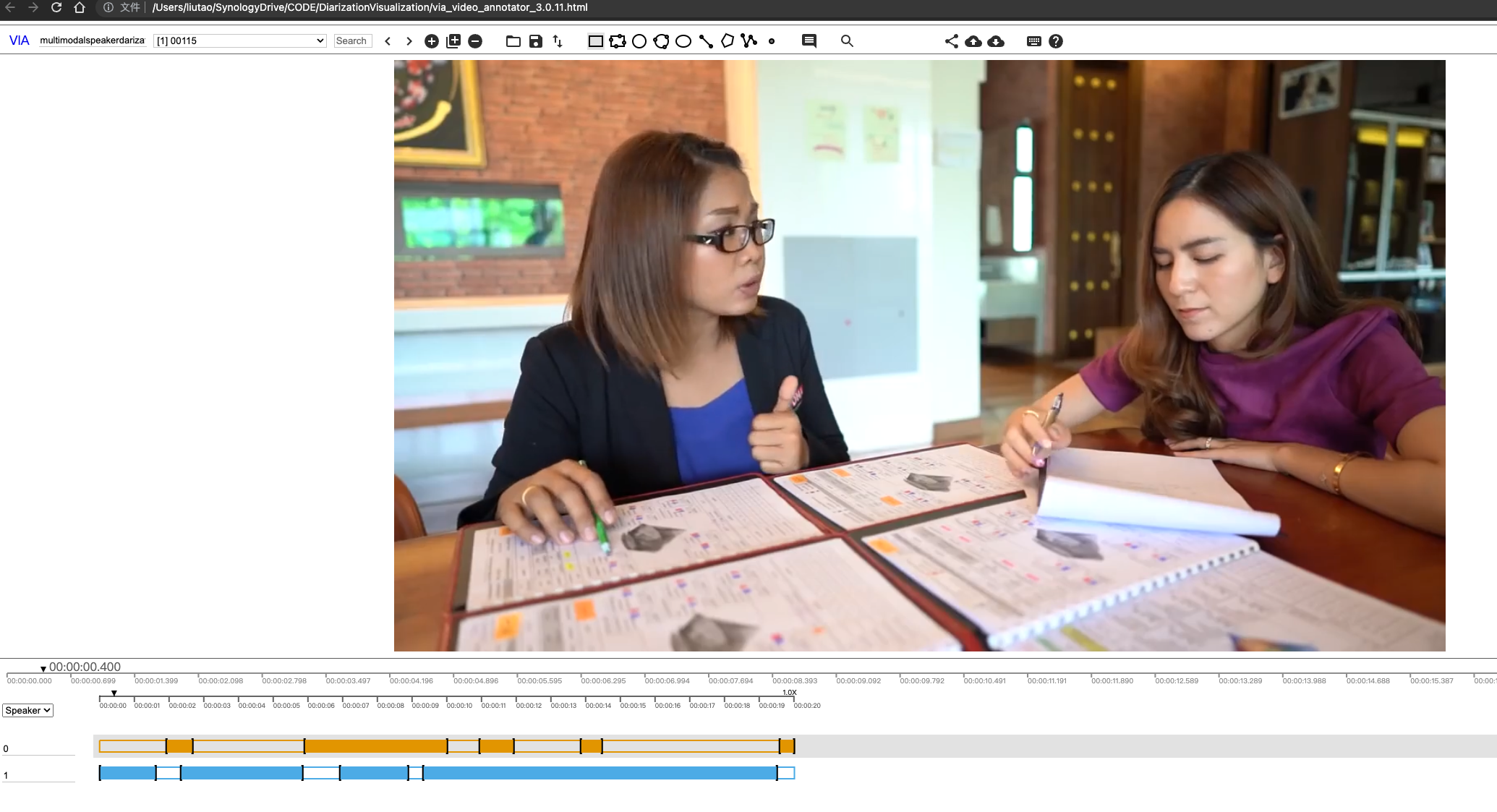
Thanks for You Zhang for helping to point out some annotation issues and improve the quality of the dataset.
@inproceedings{liu22t_interspeech,
  author={Tao Liu and Shuai Fan and Xu Xiang and Hongbo Song and Shaoxiong Lin and Jiaqi Sun and Tianyuan Han and Siyuan Chen and Binwei Yao and Sen Liu and Yifei Wu and Yanmin Qian and Kai Yu},
  title={{MSDWild: Multi-modal Speaker Diarization Dataset in the Wild}},
  year=2022,
  booktitle={Proc. Interspeech 2022},
  pages={1476--1480},
  doi={10.21437/Interspeech.2022-10466}
}
[INTERSPEECH 2022] This dataset is designed for multi-modal speaker diarization and lip-speech synchronization in the wild.
HTML
69
35 commits
updated Jan 24, 2024
MSDWILD: MULTI-MODAL SPEAKER DIARIZATION DATASET IN THE WILD
This dataset is designed for multi-modal speaker diarization and lip-speech synchronization in the wild. Demo
Compared with other multi-modal datasets, the segment length distribution of our dataset is close to the audio-only in-the-wild diarization dataset, e.g., CALLHOME or DIHARD2.
md5: 0057f82daaddf2ce993d1bf0679929c4
The video file name corresponds to the audio file name.
(For Chinese researchers, you can use Baidu Drive or Quark Drive (5v8a)) to speed up downloads. )
Our multimodal speaker diarization baseline includes a subtask - active speaker detection. To train the active speaker detection algorithm (TalkNet mentioned in our paper), we utilize 'cropped faces.' These are randomly generated from videos based on video content and rttm labels, and subsequently, manually rectified. However, if you choose not to use these resources, you can ignore the 'cropped faces.'
There are four categories of cropped-face videos:
NS_segmentid: The cropped face does not speak throughout the video.
SPK_segmentid: The cropped face speaks throughout the video.
TURN_segmentid_01_starttime_turntime_endtime: The cropped face does not speak from start_time to turn_time but starts speaking from turn_time to end_time.
TURN_segmentid_10_starttime_turntime_endtime: The cropped face speaks from start_time to turn_time but does not speak from turn_time to end_time.
Time is denoted in seconds format, and Segment_id corresponds to the cropped face video id within each video folder.
[Updates] Please disregard files with negative filenames (approximately 90 files).
Notes:
We have added additional bounding boxes for every facial image across the frames. Our trained annotators has reviewed the facial annotations on each frame to guarantee accuracy — no faces have been ignored or incorrectly tagged. Moreover, they have realigned any improperly positioned face bounding boxes. The refined annotations have been systematically archived in a correspondingly named directory, with the data structured in CSV files as outlined below. One Sample
CSV line: 3363,face,1,398,129,479,244,0

Description: frame id, face (fixed), face_id, x1, y1, x2, y2, 0 (fixed)
Download Link : Google Drive
(For Chinese researchers, you can use Baidu Drive or Quark Drive (5v8a)) to speed up downloads. )
Clik DarkLabel.exe and select one video file to preview.
Move the slider to preview the positions and ID information of faces on different frames, not altering any other default settings.
[Update] You can also use this Link to visualize the relationship between the audio label and the visual label.
Notes:
csv file is generated by it. You can also use other tools by convert the csv file.DarkLabel only supports Windows (Win10 or Win11) currently and you may use wine (mentioned in this issue) to run on Mac or Linux.You can easily reproduce the result by the following guide.
Audio-only baseline are based on Pyannote. You can directly use Hugging Face Edition. (Experiments are conducted on Pyannote 094717b6 and its hugging face 3602c22f)
Multi-modal baseline are based on TalkNet-ASD (Pretrained models: msdwild.pretrained.model on our dataset can be downloaded from URL) for audio-visual realtion and ArcFace for face clustering.
-0.5 to 0.5.3).No other post-processing methods are used.
You can refer to URL to visualize the dataset based on your algorithm result.
Thanks for You Zhang for helping to point out some annotation issues and improve the quality of the dataset.
@inproceedings{liu22t_interspeech,
  author={Tao Liu and Shuai Fan and Xu Xiang and Hongbo Song and Shaoxiong Lin and Jiaqi Sun and Tianyuan Han and Siyuan Chen and Binwei Yao and Sen Liu and Yifei Wu and Yanmin Qian and Kai Yu},
  title={{MSDWild: Multi-modal Speaker Diarization Dataset in the Wild}},
  year=2022,
  booktitle={Proc. Interspeech 2022},
  pages={1476--1480},
  doi={10.21437/Interspeech.2022-10466}
}