
Code Mode for MCP, where the sub-model is a calibrated decision model (Jev), not an LLM. Benchmarked on MCPToolBench++, LiveMCPBench, When2Call and live Claude agents.
Python
2
8 commits
updated Sep 28, 2026
See what people are saying
README
toolJev
Code Mode for MCP, where the sub-model is a decision model, not an LLM.
Your agent doesn't need an LLM for every decision.
612 tools: 77% fewer tokens. 400 tickets: 5.3x cheaper, 98.8% accurate.


Results
I benchmarked toolJev with hosted Jev on MCPToolBench++, LiveMCPBench, When2Call and live Claude Haiku agents. Several results went against my first design, and the design changed to match.
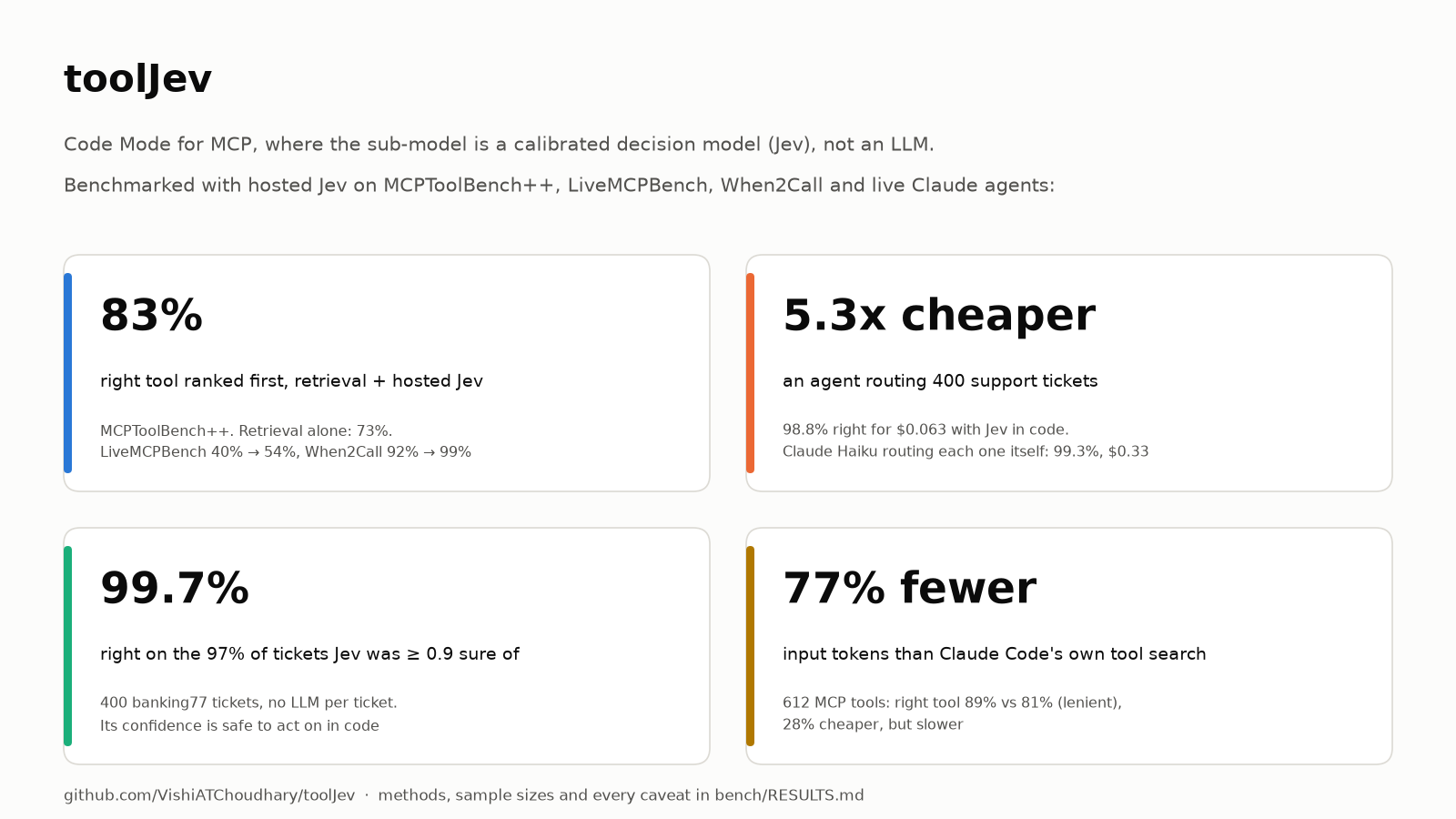
| Question | Result (hosted Jev) | Takeaway |
|---|---|---|
| Does it pick the right tool? | Right tool ranked first: 83% on MCPToolBench++, 54% on LiveMCPBench, 99% on When2Call. Retrieval alone: 73%, 40%, 92%. Jev alone, with no retrieval: 18% | Retrieval shortlists, Jev picks |
| Does it know when no tool fits? | AUROC 0.94 on When2Call near-misses (embeddings 0.74), 0.72 on LiveMCPBench (0.68), 0.89 on out-of-domain MCPToolBench++ (0.91) | The one signal that handles both kinds of miss |
| Can Jev make per-item decisions? | 98.8% on 400 support tickets, alone. The 97% it was ≥ 0.9 sure of: 99.7%. Claude Haiku doing every ticket: 99.3% | Confident answers are safe to act on in code |
| Agent routing those 400 tickets | 98.8% for $0.063, against 99.3% for $0.332 with Haiku routing each ticket itself | 5.3x cheaper at about the same accuracy |
| Agent with 612 tools | Right tool called in 89% of tasks vs 81% for Claude Code's own tool search, with 77% fewer input tokens and 28% lower cost, but slower (34 s vs 18 s) | Pays off at scale |
| Agent with 87 tools | Direct tool calling was more accurate (0.94 vs 0.89) and cheaper (local backend) | Don't bother below ~100 tools |
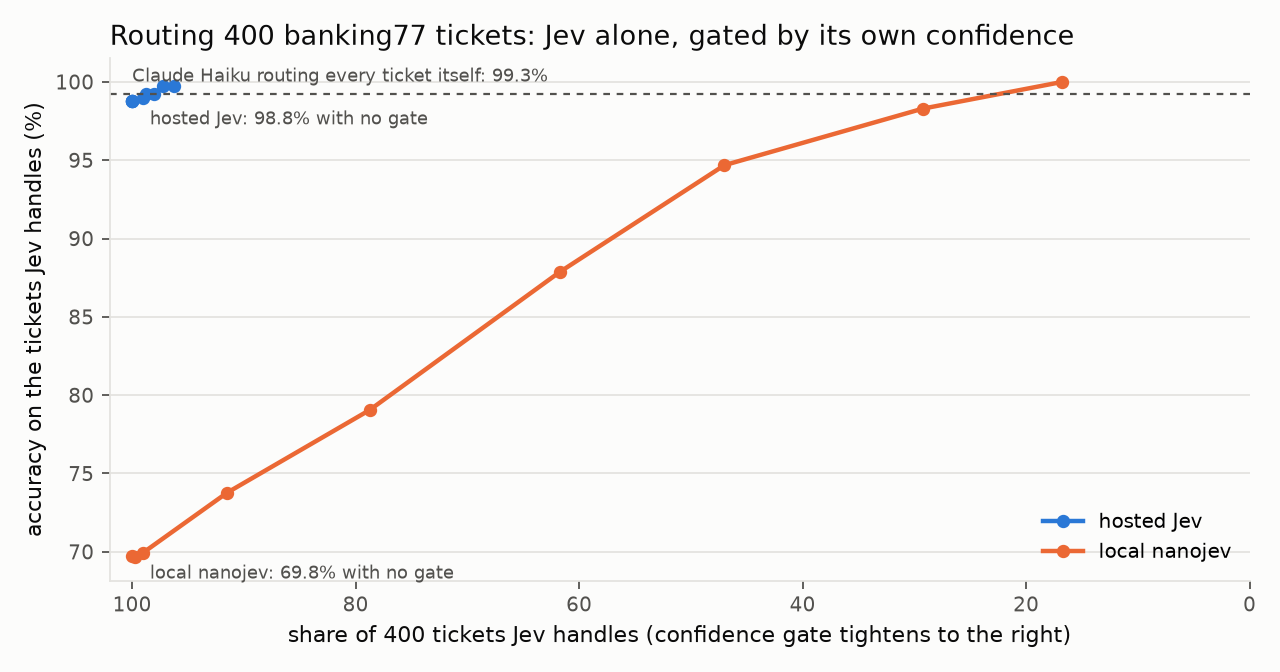
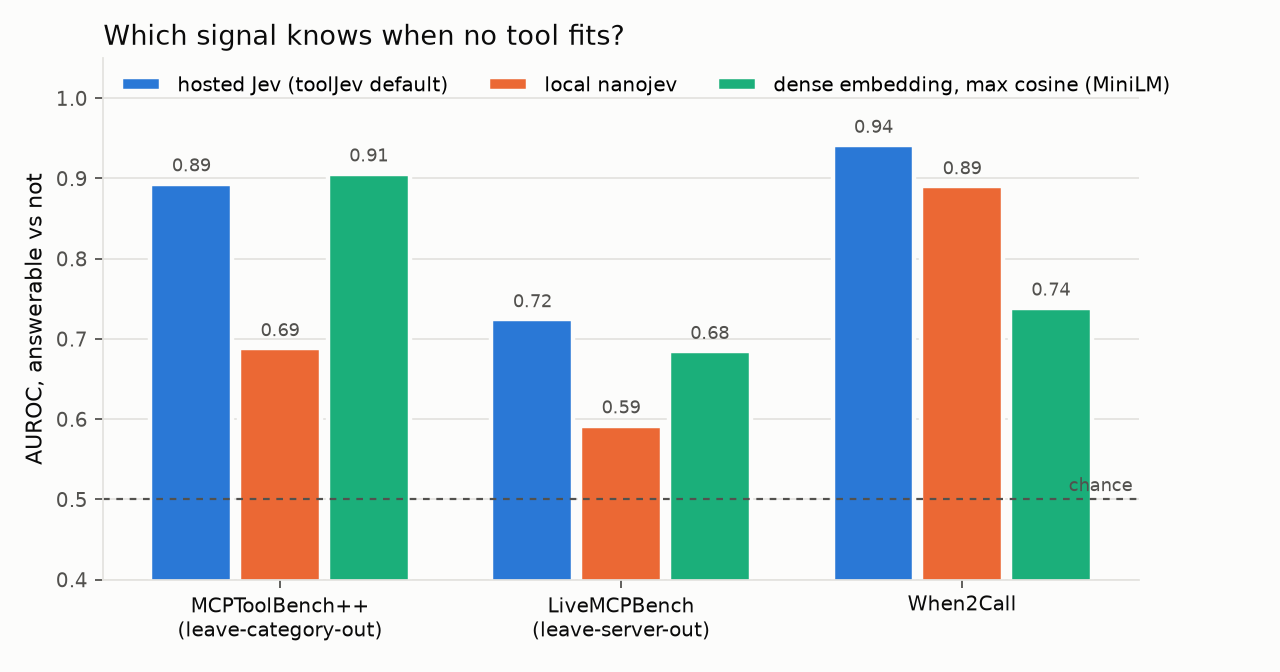
Sample sizes, methods and every caveat are in bench/RESULTS.md. The short version of the caveats:
- hosted routing numbers use up to 200 answerable + 200 unanswerable queries per benchmark
- the agent runs use 1 to 2 reps and 36 tasks per setup; at that size 89% vs 81% is three tasks
- upstream servers are mocks built from each benchmark's tool schemas
- the 87-tool agent run and the GIF use nanojev, a local stand-in for Jev that is much less accurate
What it is
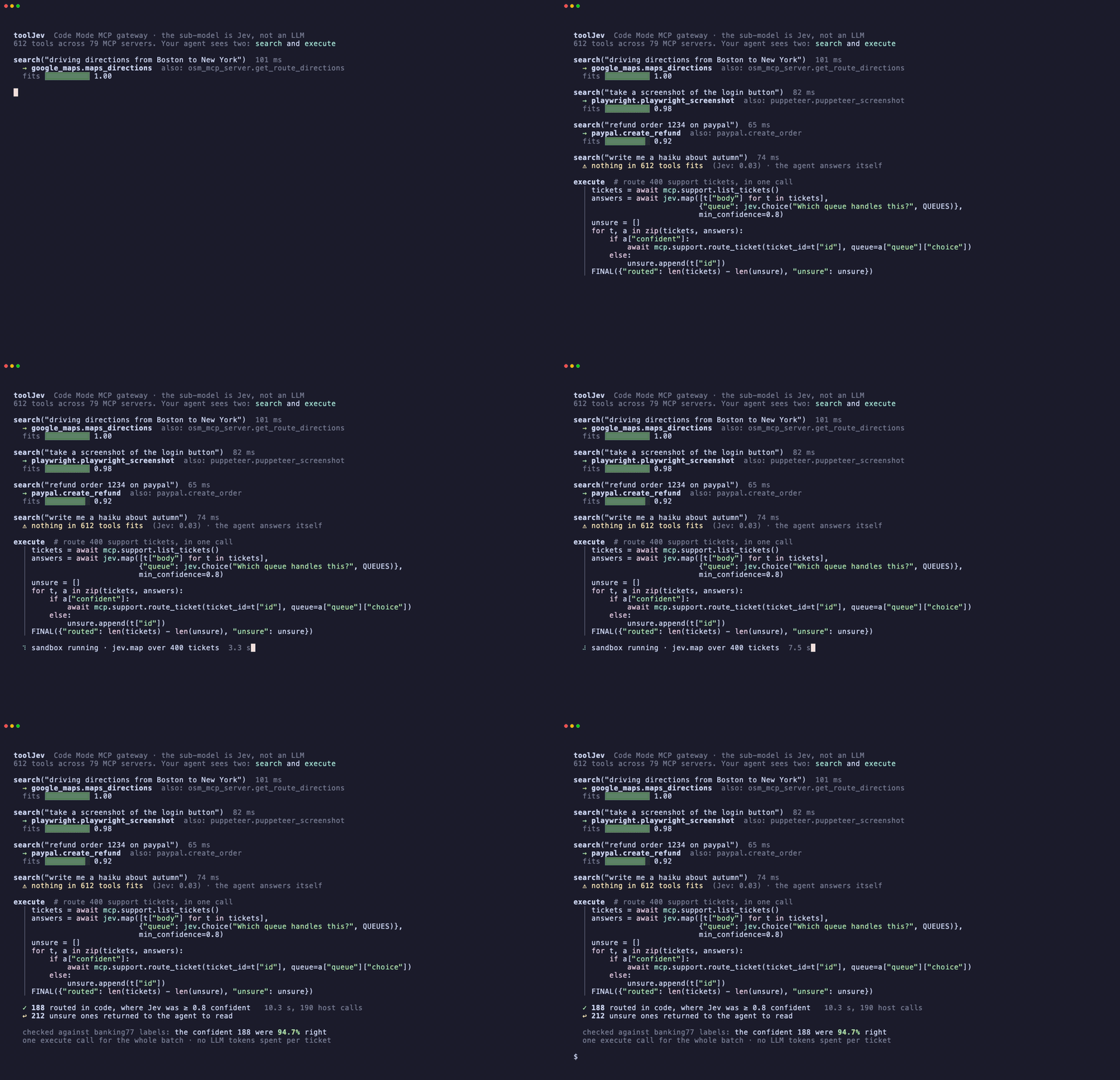
A real run with local models and no API key: uv run python examples/showcase.py
Give an agent 600 MCP tools and it drowns in tool schemas. Give it one tool call per turn, and a 400-item job takes 400 calls. toolJev sits in front of every MCP server you have and gives the agent two tools instead:
search(query)finds the few tools a request needs. Retrieval shortlists them, and Jev says whether any of them actually fits. Jev is a decision model: it returns calibrated probabilities over options you give it, never text.execute(code)runs Python the agent writes. The code calls tools asmcp.<server>.<tool>(), and makes per-item judgements withjev.choice / noul / map: typed answers in about 100 ms, no LLM turn. This is Code Mode crossed with a Recursive Language Model, with Jev in the place of the sub-LLM.
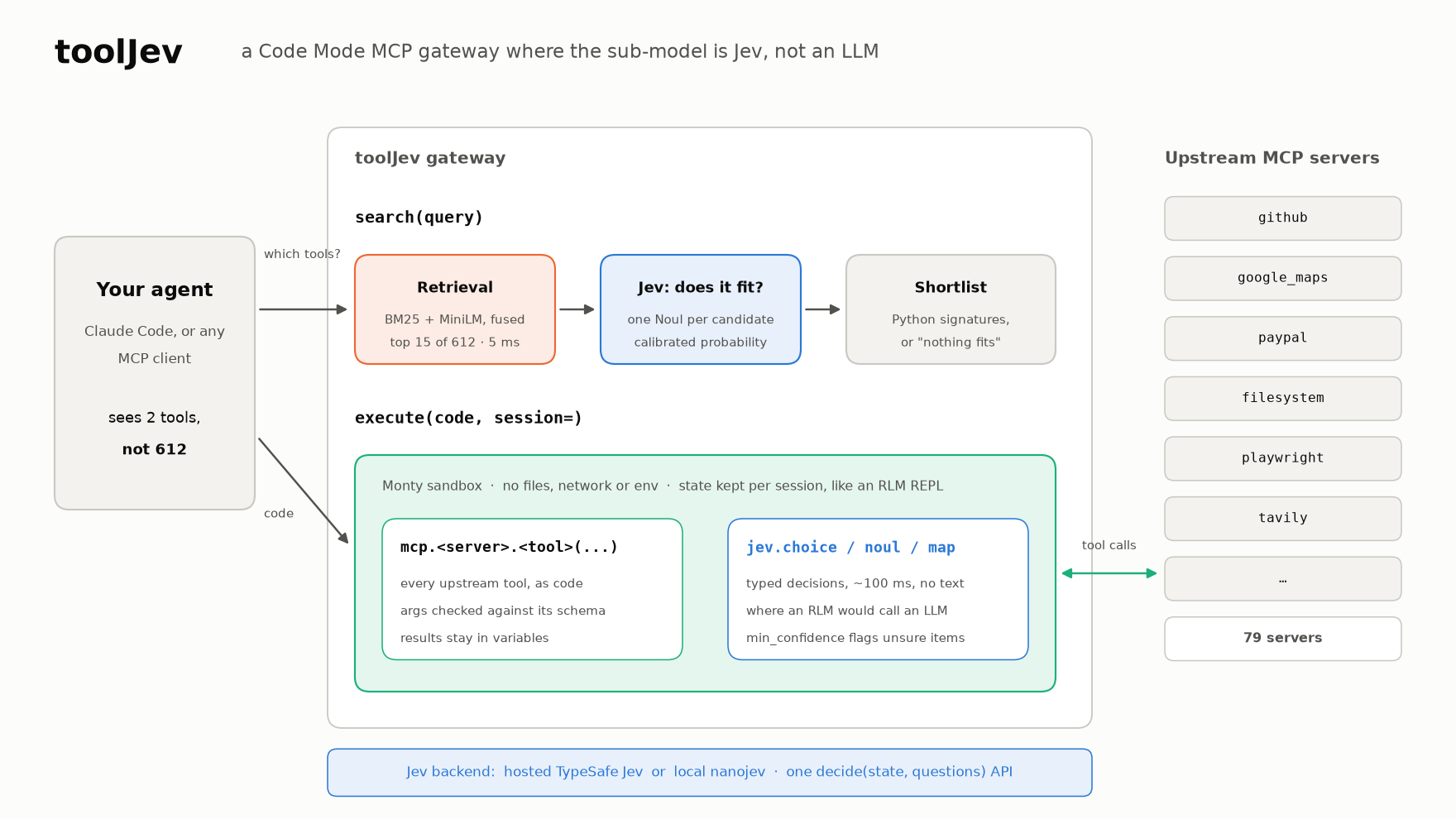
The LLM writes the plan once, Jev makes the per-item calls, and only the items Jev is unsure about come back to the LLM.
How to use it
1. Install
git clone https://github.com/VishiATChoudhary/toolJev && cd toolJev
uv venv && uv pip install -e ".[local,retrieval]"
The two extras:
localinstalls nanojev, which runs Jev-style decisions on your machine with no key. The model downloads once.retrievaladds embedding search next to BM25.
For real use, set TYPESAFE_API_KEY and use hosted Jev (backend = "hosted",
the default when the config has no [decider] table). It is much more accurate than the local
stand-in: see Results.
2. Try it
uv run python examples/showcase.py   # the GIF above: 612 tools, 400 tickets, all local
uv run python examples/demo.py       # the real gateway over MCP stdio, 3 toy upstream servers
3. Point it at your MCP servers
Write a TOML file with one table per upstream server. Anything you'd give an MCP
client goes in it: command/args/env for local servers, url/headers
for remote ones.
# tooljev.toml
[decider]
backend = "hosted"      # reads TYPESAFE_API_KEY; or "nanojev" (+ kind = "encoder") to run with no key

[servers.github]
description = "GitHub repos, issues and pull requests"
command = "npx"
args = ["-y", "@modelcontextprotocol/server-github"]
env = { GITHUB_PERSONAL_ACCESS_TOKEN = "ghp_..." }

[servers.tickets]
description = "Customer support tickets: list, assign, close"
url = "https://support.example.com/mcp"
headers = { Authorization = "Bearer ..." }
allow = ["list_tickets", "assign_ticket"]   # optional: expose only these tools
A one-line description per server helps search a lot. Every option, with its
default, is in examples/config.toml.
4. Connect your agent
toolJev is an ordinary MCP server, so any MCP client works. For Claude Code:
claude mcp add tooljev -- uv --directory /path/to/toolJev run tooljev --config /path/to/tooljev.toml
For remote clients, serve streamable HTTP with
uv run tooljev --config tooljev.toml --transport http --port 8765.
5. What your agent does with it
The agent never sees your upstream tools directly. It works in two moves.
Find tools: search("refund order 1234 on paypal") returns up to 5 tools,
each with a Python signature and a fit score. If nothing in the catalog fits,
the result carries a warning so the agent answers on its own.
Run code: execute(code) runs Python with the found tools and jev in
scope:
tickets = await mcp.support.list_tickets()
answers = await jev.map([t["body"] for t in tickets],
                        {"queue": jev.Choice("Which queue handles this?", QUEUES)},
                        min_confidence=0.8)
unsure = []
for t, a in zip(tickets, answers):
    if a["confident"]:                    # Jev is sure: act in code
        await mcp.support.route_ticket(ticket_id=t["id"], queue=a["queue"]["choice"])
    else:                                 # Jev is not: hand back to the agent
        unsure.append(t["id"])
FINAL({"unsure": unsure})                 # only this reaches the agent's context
What's in scope inside execute:
| call | returns |
|---|---|
await mcp.<server>.<tool>(**kwargs) | the tool's result; arguments are checked against its schema first |
await jev.choice(state, instructions, options) | {"choice", "probabilities", "confidence"} |
await jev.noul(state, statement) | probability the statement is true |
await jev.score(state, instructions, levels) | {"score", "probabilities", "confidence"} |
await jev.map(states, questions, min_confidence=) | one answer dict per state, plus "confident" when a threshold is given |
FINAL(value) / print(...) | what goes back to the agent (the last expression also works) |
Pass execute(code, session="work") to keep variables between calls, like a
REPL: fetch once, inspect, then act. You don't need to teach your agent any of
this; the tool descriptions do.
6. When to use it, and when not
Use it when:
- You connect hundreds of tools. At 612 tools it cut input tokens by 77% and cost by 28% against Claude Code's own tool search (right tool 89% vs 81% lenient, 72% vs 75% strict).
- Your agent does the same judgement over many items: triage, routing, filtering, labelling. With hosted Jev, 400 tickets were routed 5.3x cheaper than by the LLM, at 98.8% vs 99.3%. Gate on Jev's confidence and let the LLM take the unsure ones.
Skip it when:
- You have fewer than about 100 tools. Direct tool calling was more accurate and cheaper at 87 tools.
- You need every item right and cost doesn't matter. The LLM alone was still half a point more accurate on triage.
- Latency matters more than tokens. Each search is a hosted round trip (about 285 ms), and Code Mode adds a turn.
How it works
Backends
[decider] backend | What | Needs |
|---|---|---|
hosted (default, recommended) | TypeSafe Jev via typesafe-sdk. Search reranks with it | TYPESAFE_API_KEY |
nanojev | nanojev, a local stand-in, kind = "encoder" or "decoder". Search keeps retrieval order | nothing (downloads a model once) |
Both implement one method, decide(state, questions) -> answers, in TypeSafe's
wire format, so everything above the backend is shared. Use the encoder for
nanojev: the decoder could not tell in-catalog requests from out-of-catalog
ones.
How search decides
- Recall: BM25 and bge-base embeddings over every tool's description, fused by reciprocal rank. The top 15 go on. This takes a few milliseconds, and the embeddings are cached per tool.
- Rank and fit, in one Jev call: a Choice over the 15 candidates reorders
them, and a Noul per candidate ("this request asks to ")
becomes that tool's
fit. With hosted Jev the rerank lifts top-1 over retrieval alone on every benchmark (MCPToolBench++ 0.73 to 0.83). The local nanojev encoder reranks worse than retrieval, so with it the Choice is skipped and retrieval order stands (rerank = true/falseoverrides either way). - Nothing fits:
in_catalogis the best fit. Belowabstain_below(default 0.5), the result carries a warning but still lists the tools.abstain = "hard"returns none instead. Hiding tools cost agents more in wrong detours than a warned shortlist did. - The top
max_tools(default 5) come back, each with a Python signature.
mode = "hierarchical" (Jev picks a server, then a tool, with knockout rounds
past the 255-option limit) is the original design, kept because the benchmarks
rejected it.
Search latency on MCPToolBench++: about 285 ms p50 with hosted Jev, 74 ms with the local encoder.
Sandbox
Each execute runs in a Monty worker with
no filesystem, network or environment access. It gets a fresh worker unless it
names a session; up to 8 sessions are kept, and the least recently used one
goes first.
Limits, all set under [sandbox], are sized for bulk jobs of hundreds of items:
- 120 s wall clock and 20 s of sandbox CPU
- 256 MB of memory
- 2,000 host calls; a whole
jev.mapcounts as one call, up to 5,000 items - 16 concurrent calls
- stdout truncated at 4k characters
Behaviour worth knowing:
- A session that hits a time or memory limit is discarded, as Monty advises.
- When an upstream tool fails, sandbox code sees a catchable
RuntimeError. - Each search and execute, and every host call inside it, is logged to
~/.tooljev/traces/YYYY-MM-DD.jsonl.
The sandbox is not authorization. Anything a listed upstream tool can do,
sandbox code can do. Use per-server allow = [...] to expose less.
Not yet
- Free-text arguments. Jev cannot write them; the agent writes them in code.
- An
llm_queryfallback inside the sandbox. - Hosted Jev on the full routing sets and the 87-tool agent task. It ran on a 200 + 200 sample per benchmark.
- One combined abstention score. Fusing embedding similarity with Jev's fit is not done yet; a simple fitted combination did not beat embeddings alone.
Reproduce
uv pip install -e ".[local,retrieval,dev,bench]"
uv run pytest -m "not slow"                                      # offline: fake decider, in-process servers
uv run pytest -m slow                                            # real nanojev
uv run python -m bench.run && uv run python -m bench.report      # routing + abstention benchmarks
TYPESAFE_API_KEY=... bash bench/hosted.sh                        # every hosted-Jev run, resumable
uv run python -m bench.agent.run_agent --task triage --n 40      # agent in the loop (uses `claude -p`)
Benchmark data is not committed. Fetch it into bench/data/ as listed in
bench/RESULTS.md.
Prior art and credit
- Code Mode: Cloudflare, Anthropic and FastMCP.
- Recursive Language Models: Zhang, Kraska and Khattab.
- Jev: TypeSafe. nanojev is a small local stand-in with the same interface.
- Sandbox: Monty, by Pydantic.
- Tool retrieval: RAG-MCP, MCP-Zero and "Selection Is Retrieval, Abstention Is Not" (arXiv 2609.18672). This repo reached the same conclusion the hard way.
The full prior-art survey is in RESEARCH.md.
Similar repos


Languages
Python
99.3%
Code Mode for MCP, where the sub-model is a calibrated decision model (Jev), not an LLM. Benchmarked on MCPToolBench++, LiveMCPBench, When2Call and live Claude agents.
Python
2
8 commits
updated Sep 28, 2026
See what people are saying
README
toolJev
Code Mode for MCP, where the sub-model is a decision model, not an LLM.
Your agent doesn't need an LLM for every decision.
612 tools: 77% fewer tokens. 400 tickets: 5.3x cheaper, 98.8% accurate.
Results
I benchmarked toolJev with hosted Jev on MCPToolBench++, LiveMCPBench, When2Call and live Claude Haiku agents. Several results went against my first design, and the design changed to match.
| Question | Result (hosted Jev) | Takeaway |
|---|---|---|
| Does it pick the right tool? | Right tool ranked first: 83% on MCPToolBench++, 54% on LiveMCPBench, 99% on When2Call. Retrieval alone: 73%, 40%, 92%. Jev alone, with no retrieval: 18% | Retrieval shortlists, Jev picks |
| Does it know when no tool fits? | AUROC 0.94 on When2Call near-misses (embeddings 0.74), 0.72 on LiveMCPBench (0.68), 0.89 on out-of-domain MCPToolBench++ (0.91) | The one signal that handles both kinds of miss |
| Can Jev make per-item decisions? | 98.8% on 400 support tickets, alone. The 97% it was ≥ 0.9 sure of: 99.7%. Claude Haiku doing every ticket: 99.3% | Confident answers are safe to act on in code |
| Agent routing those 400 tickets | 98.8% for $0.063, against 99.3% for $0.332 with Haiku routing each ticket itself | 5.3x cheaper at about the same accuracy |
| Agent with 612 tools | Right tool called in 89% of tasks vs 81% for Claude Code's own tool search, with 77% fewer input tokens and 28% lower cost, but slower (34 s vs 18 s) | Pays off at scale |
| Agent with 87 tools | Direct tool calling was more accurate (0.94 vs 0.89) and cheaper (local backend) | Don't bother below ~100 tools |
Sample sizes, methods and every caveat are in bench/RESULTS.md. The short version of the caveats:
- hosted routing numbers use up to 200 answerable + 200 unanswerable queries per benchmark
- the agent runs use 1 to 2 reps and 36 tasks per setup; at that size 89% vs 81% is three tasks
- upstream servers are mocks built from each benchmark's tool schemas
- the 87-tool agent run and the GIF use nanojev, a local stand-in for Jev that is much less accurate
What it is
A real run with local models and no API key: uv run python examples/showcase.py
Give an agent 600 MCP tools and it drowns in tool schemas. Give it one tool call per turn, and a 400-item job takes 400 calls. toolJev sits in front of every MCP server you have and gives the agent two tools instead:
search(query)finds the few tools a request needs. Retrieval shortlists them, and Jev says whether any of them actually fits. Jev is a decision model: it returns calibrated probabilities over options you give it, never text.execute(code)runs Python the agent writes. The code calls tools asmcp.<server>.<tool>(), and makes per-item judgements withjev.choice / noul / map: typed answers in about 100 ms, no LLM turn. This is Code Mode crossed with a Recursive Language Model, with Jev in the place of the sub-LLM.
The LLM writes the plan once, Jev makes the per-item calls, and only the items Jev is unsure about come back to the LLM.
How to use it
1. Install
git clone https://github.com/VishiATChoudhary/toolJev && cd toolJev
uv venv && uv pip install -e ".[local,retrieval]"
The two extras:
localinstalls nanojev, which runs Jev-style decisions on your machine with no key. The model downloads once.retrievaladds embedding search next to BM25.
For real use, set TYPESAFE_API_KEY and use hosted Jev (backend = "hosted",
the default when the config has no [decider] table). It is much more accurate than the local
stand-in: see Results.
2. Try it
uv run python examples/showcase.py   # the GIF above: 612 tools, 400 tickets, all local
uv run python examples/demo.py       # the real gateway over MCP stdio, 3 toy upstream servers
3. Point it at your MCP servers
Write a TOML file with one table per upstream server. Anything you'd give an MCP
client goes in it: command/args/env for local servers, url/headers
for remote ones.
# tooljev.toml
[decider]
backend = "hosted"      # reads TYPESAFE_API_KEY; or "nanojev" (+ kind = "encoder") to run with no key

[servers.github]
description = "GitHub repos, issues and pull requests"
command = "npx"
args = ["-y", "@modelcontextprotocol/server-github"]
env = { GITHUB_PERSONAL_ACCESS_TOKEN = "ghp_..." }

[servers.tickets]
description = "Customer support tickets: list, assign, close"
url = "https://support.example.com/mcp"
headers = { Authorization = "Bearer ..." }
allow = ["list_tickets", "assign_ticket"]   # optional: expose only these tools
A one-line description per server helps search a lot. Every option, with its
default, is in examples/config.toml.
4. Connect your agent
toolJev is an ordinary MCP server, so any MCP client works. For Claude Code:
claude mcp add tooljev -- uv --directory /path/to/toolJev run tooljev --config /path/to/tooljev.toml
For remote clients, serve streamable HTTP with
uv run tooljev --config tooljev.toml --transport http --port 8765.
5. What your agent does with it
The agent never sees your upstream tools directly. It works in two moves.
Find tools: search("refund order 1234 on paypal") returns up to 5 tools,
each with a Python signature and a fit score. If nothing in the catalog fits,
the result carries a warning so the agent answers on its own.
Run code: execute(code) runs Python with the found tools and jev in
scope:
tickets = await mcp.support.list_tickets()
answers = await jev.map([t["body"] for t in tickets],
                        {"queue": jev.Choice("Which queue handles this?", QUEUES)},
                        min_confidence=0.8)
unsure = []
for t, a in zip(tickets, answers):
    if a["confident"]:                    # Jev is sure: act in code
        await mcp.support.route_ticket(ticket_id=t["id"], queue=a["queue"]["choice"])
    else:                                 # Jev is not: hand back to the agent
        unsure.append(t["id"])
FINAL({"unsure": unsure})                 # only this reaches the agent's context
What's in scope inside execute:
| call | returns |
|---|---|
await mcp.<server>.<tool>(**kwargs) | the tool's result; arguments are checked against its schema first |
await jev.choice(state, instructions, options) | {"choice", "probabilities", "confidence"} |
await jev.noul(state, statement) | probability the statement is true |
await jev.score(state, instructions, levels) | {"score", "probabilities", "confidence"} |
await jev.map(states, questions, min_confidence=) | one answer dict per state, plus "confident" when a threshold is given |
FINAL(value) / print(...) | what goes back to the agent (the last expression also works) |
Pass execute(code, session="work") to keep variables between calls, like a
REPL: fetch once, inspect, then act. You don't need to teach your agent any of
this; the tool descriptions do.
6. When to use it, and when not
Use it when:
- You connect hundreds of tools. At 612 tools it cut input tokens by 77% and cost by 28% against Claude Code's own tool search (right tool 89% vs 81% lenient, 72% vs 75% strict).
- Your agent does the same judgement over many items: triage, routing, filtering, labelling. With hosted Jev, 400 tickets were routed 5.3x cheaper than by the LLM, at 98.8% vs 99.3%. Gate on Jev's confidence and let the LLM take the unsure ones.
Skip it when:
- You have fewer than about 100 tools. Direct tool calling was more accurate and cheaper at 87 tools.
- You need every item right and cost doesn't matter. The LLM alone was still half a point more accurate on triage.
- Latency matters more than tokens. Each search is a hosted round trip (about 285 ms), and Code Mode adds a turn.
How it works
Backends
[decider] backend | What | Needs |
|---|---|---|
hosted (default, recommended) | TypeSafe Jev via typesafe-sdk. Search reranks with it | TYPESAFE_API_KEY |
nanojev | nanojev, a local stand-in, kind = "encoder" or "decoder". Search keeps retrieval order | nothing (downloads a model once) |
Both implement one method, decide(state, questions) -> answers, in TypeSafe's
wire format, so everything above the backend is shared. Use the encoder for
nanojev: the decoder could not tell in-catalog requests from out-of-catalog
ones.
How search decides
- Recall: BM25 and bge-base embeddings over every tool's description, fused by reciprocal rank. The top 15 go on. This takes a few milliseconds, and the embeddings are cached per tool.
- Rank and fit, in one Jev call: a Choice over the 15 candidates reorders
them, and a Noul per candidate ("this request asks to ")
becomes that tool's
fit. With hosted Jev the rerank lifts top-1 over retrieval alone on every benchmark (MCPToolBench++ 0.73 to 0.83). The local nanojev encoder reranks worse than retrieval, so with it the Choice is skipped and retrieval order stands (rerank = true/falseoverrides either way). - Nothing fits:
in_catalogis the best fit. Belowabstain_below(default 0.5), the result carries a warning but still lists the tools.abstain = "hard"returns none instead. Hiding tools cost agents more in wrong detours than a warned shortlist did. - The top
max_tools(default 5) come back, each with a Python signature.
mode = "hierarchical" (Jev picks a server, then a tool, with knockout rounds
past the 255-option limit) is the original design, kept because the benchmarks
rejected it.
Search latency on MCPToolBench++: about 285 ms p50 with hosted Jev, 74 ms with the local encoder.
Sandbox
Each execute runs in a Monty worker with
no filesystem, network or environment access. It gets a fresh worker unless it
names a session; up to 8 sessions are kept, and the least recently used one
goes first.
Limits, all set under [sandbox], are sized for bulk jobs of hundreds of items:
- 120 s wall clock and 20 s of sandbox CPU
- 256 MB of memory
- 2,000 host calls; a whole
jev.mapcounts as one call, up to 5,000 items - 16 concurrent calls
- stdout truncated at 4k characters
Behaviour worth knowing:
- A session that hits a time or memory limit is discarded, as Monty advises.
- When an upstream tool fails, sandbox code sees a catchable
RuntimeError. - Each search and execute, and every host call inside it, is logged to
~/.tooljev/traces/YYYY-MM-DD.jsonl.
The sandbox is not authorization. Anything a listed upstream tool can do,
sandbox code can do. Use per-server allow = [...] to expose less.
Not yet
- Free-text arguments. Jev cannot write them; the agent writes them in code.
- An
llm_queryfallback inside the sandbox. - Hosted Jev on the full routing sets and the 87-tool agent task. It ran on a 200 + 200 sample per benchmark.
- One combined abstention score. Fusing embedding similarity with Jev's fit is not done yet; a simple fitted combination did not beat embeddings alone.
Reproduce
uv pip install -e ".[local,retrieval,dev,bench]"
uv run pytest -m "not slow"                                      # offline: fake decider, in-process servers
uv run pytest -m slow                                            # real nanojev
uv run python -m bench.run && uv run python -m bench.report      # routing + abstention benchmarks
TYPESAFE_API_KEY=... bash bench/hosted.sh                        # every hosted-Jev run, resumable
uv run python -m bench.agent.run_agent --task triage --n 40      # agent in the loop (uses `claude -p`)
Benchmark data is not committed. Fetch it into bench/data/ as listed in
bench/RESULTS.md.
Prior art and credit
- Code Mode: Cloudflare, Anthropic and FastMCP.
- Recursive Language Models: Zhang, Kraska and Khattab.
- Jev: TypeSafe. nanojev is a small local stand-in with the same interface.
- Sandbox: Monty, by Pydantic.
- Tool retrieval: RAG-MCP, MCP-Zero and "Selection Is Retrieval, Abstention Is Not" (arXiv 2609.18672). This repo reached the same conclusion the hard way.
The full prior-art survey is in RESEARCH.md.
Similar repos
Languages
Python
99.3%