
README




✨ A comprehensive benchmark for evaluating tool-using language models across multiple practical domains, designed to test models' ability to effectively utilize external tools for real-world tasks. Bring new insights to LLM-based agentic tool usage!
🆕 News
📢 [2025/9/24] We release all parallel and sequential data. We will release paper and results soon.
📢 [2025/8/24] We release the tool evaluation script for ReAct (agentic method), supporting both static and dynamic tool retrieval.
📢 [2025/8/23] We release the tool evaluation script for LLMs, supporting multiple query methods and tool selection modes.
📢 [2025/8/21] We release the first version of TRAJECT-Bench, including a high-quality executable production-style tool set and a novel tool-usage query dataset. The tool-calling trajectory is driven by real-world task types and invlove multiple tools from 3 to 10, enabling a scalable evaluation of tool-using capabilities. Queries consist of simple and hard versions, enabling deeper investigation on complexity.
🚀 Quickstart (TL;DR)
git clone <repository-url>
cd ToolData-public
pip install -r requirements.txt

# Tool evaluation on LLMs (not agentic evaluation)
python evaluation/tool_evaluation_model.py -model [model name] -tool_select [tool selection mode] -method [problem solving method] -k [tool pool size] -emb_model [embedding model] -emb_model_dir [embedding model directory] -traj_type [trajectory type] -traj_file [trajectory file name] -log_dir [log directory] -chk_dir [checkpoint directory] -base_data_dir [base data directory]

## default settings (direct prompting, domain mode, parallel trajectory, simple version, default model claude_v37)
python evaluation/tool_evaluation_model.py -model claude_v37 -tool_select domain -method direct -traj_type parallel -traj_file simple_ver -log_dir ./log/model -chk_dir ./chk/model -base_data_dir ./

## CoT setting (default model claude_v37, prompts in evaluation/evaluation_prompt.json)
python evaluation/tool_evaluation_model.py -model claude_v37 -tool_select domain -method cot -traj_type parallel -traj_file simple_ver -log_dir ./log/model -chk_dir ./chk/model -base_data_dir ./

## Retrieval tool pool setting (default model claude_v37, direct prompting, embedding model all-MiniLM, embedding model directory ./retriever, tool pool size 20)
python evaluation/tool_evaluation_model.py -model claude_v37 -tool_select retrieval -method direct -k 20 -emb_model all-MiniLM -emb_model_dir ./retriever -traj_type parallel -traj_file simple_ver -log_dir ./log/model -chk_dir ./chk/model -base_data_dir ./

# Agentic evaluation (ReAct)
python evaluation/tool_evaluation_agent.py -model [model name] -tool_select [tool selection mode] -method [problem solving method] -k [tool pool size] -emb_model [embedding model] -emb_model_dir [embedding model directory] -retrieve_mode [retrieve mode] -retrieve_pool [retrieve pool] -traj_type [trajectory type] -traj_file [trajectory file name] -log_dir [log directory] -chk_dir [checkpoint directory] -base_data_dir [base data directory]

## default settings (ReAct, domain tool pool, no retrieval, parallel trajectory, simple version, default model claude_v37)
python evaluation/tool_evaluation_agent.py -model claude_v37 -tool_select domain -method react -traj_type parallel -traj_file simple_ver -log_dir ./log/react -chk_dir ./chk/react -base_data_dir ./

## Static retrieval (default model claude_v37, static retrieval from domain tool pool)
python evaluation/tool_evaluation_agent.py -model claude_v37 -tool_select retrieval -method react -retrieve_mode static -retrieve_pool domain -traj_type parallel -traj_file simple_ver -log_dir ./log/react -chk_dir ./chk/react -base_data_dir ./

## Dynamic retrieval (default model claude_v37, dynamic retrieval from domain tool pool)
python evaluation/tool_evaluation_agent.py -model claude_v37 -tool_select retrieval -method react -retrieve_mode dynamic -retrieve_pool domain -traj_type parallel -traj_file simple_ver -log_dir ./log/react -chk_dir ./chk/react -base_data_dir ./

# Claude agentic tool-use
python evaluation/claude_tool_evaluation.py -model claude_v37 -tool_select domain -traj_type parallel -traj_file simple_ver -log_dir ./log/claude -chk_dir ./chk/claude -base_data_dir ./

# Other model's agentic evaulation is the same.
🎯 Overview
🌟 Hightlights:
- 🔧 Multi-Tool Selection: Combining multiple executable, production-style tools to solve complex queries
- 🎯 Practical Task Solving: Incorporating practical tasks across diverse domains
- 🛤️ Trajectory Structure Support: First to evaluate both parallel and sequential tool-calling trajectories
- 📊 Advanced Metrics: Trajectory-aware evaluation metrics for comprehensive assessment
- 📈 Query Difficulty Control: Structured difficulty levels for progressive evaluation
- 🎲 Multiple Tool-Pool Regimes: Support for various tool pool setups, including whole toolset (mixture of tools), domain-specific tools, tool retrieval, small-scale fixed tool pool
- 🤖 Agentic Method Support: Evaluation frameworks for ReAct and other agentic approaches
| Benchmark | Practical tools | Large&diverse tool | Trajectory structure1 | Trajectory scaling2 | Trajectory-aware metrics3 | Query difficulty control | Tool-pool regimes4 | Agentic methods |
|---|---|---|---|---|---|---|---|---|
| MetaTool | ✅ | ❌ | ❌ | ❌ | ❌ | ❌ | ❌ | ❌ |
| API-Bank | ✅ | ❌ | ❌ | ❌ | ❌ | ❌ | ❌ | ❌ |
| ToolBench | ✅ | ✅ | ❌ | ❌ | ❌ | ❌ | ❌ | ✅ |
| Gorilla | ✅ | ✅ | ❌ | ❌ | ❌ | ❌ | ✅ | ❌ |
| Berkeley Function-Calling (BFCL) | ✅ | ✅ | ❌ | ❌ | ❌ | ❌ | ❌ | ❌ |
| ToolQA | ❌ | ❌ | ❌ | ❌ | ❌ | ✅ | ❌ | ✅ |
| TRAJECT-Bench (ours) | ✅ | ✅ | ✅ | ✅ | ✅ | ✅ | ✅ | ✅ |
1 Trajectory structure: Evaluates support for different tool-calling patterns, including parallel (independent tools) and sequential (dependent tool chains) execution strategies
2 Trajectory scaling: Tests model performance across varying task complexity levels, from simple 3-tool scenarios to complex 10+ tool orchestration
3 Trajectory-aware metrics: Provides comprehensive evaluation beyond final results, measuring the quality of the entire tool-calling trajectory
4 Tool-pool regimes: Supports diverse evaluation strategies including whole toolset, domain-specific pools, retrieval-based selection, and fixed small-scale tool pools
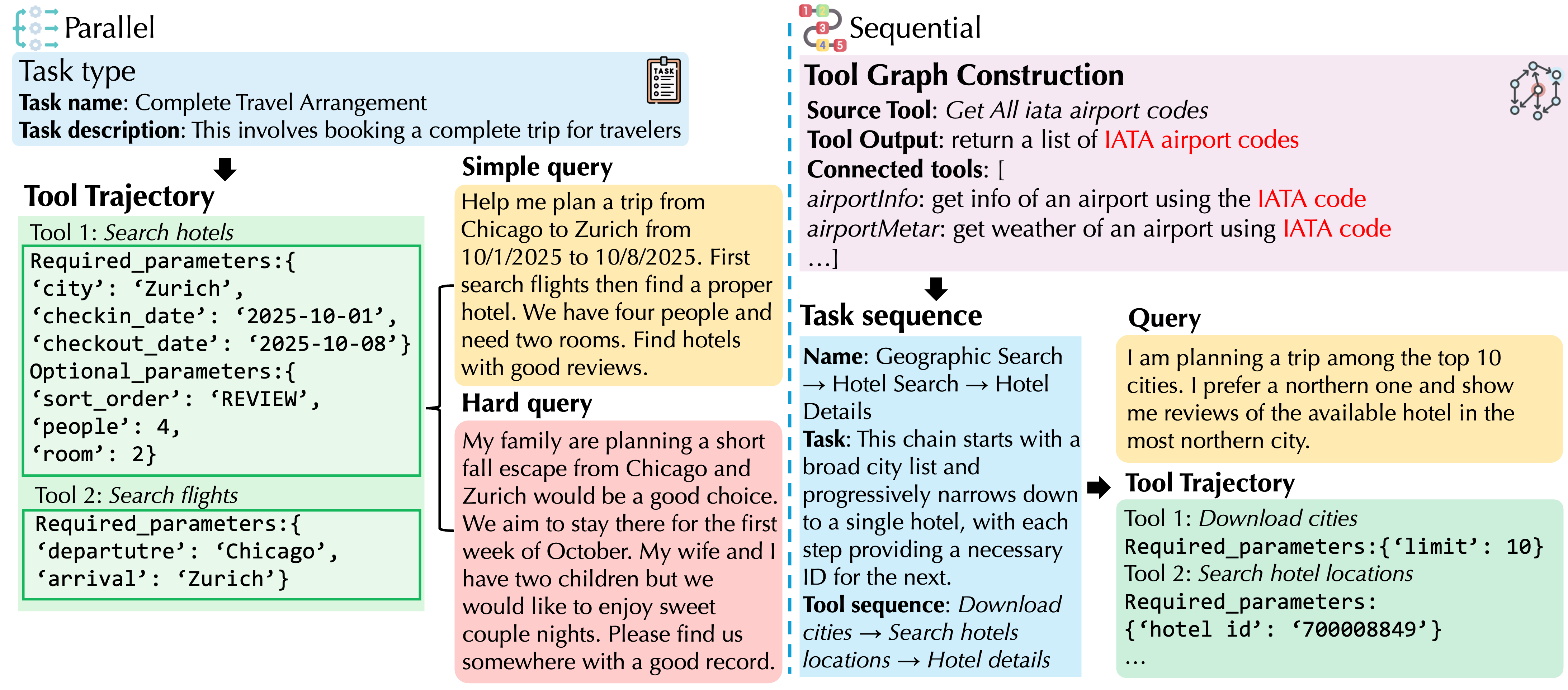
Data synthesis overview
The following figure shows the data synthesis of TRAJECT-Bench, including parallel and sequential.
🔗 Quick Links
- 📁 Public data folder:
public_data/ - 🧪 Evaluation scripts:
evaluation/tool_evaluation_model.py,evaluation/tool_evaluation_agent.py
🏗️ Benchmark Structure
🌍 Domains Covered
The benchmark covers 10 carefully selected domains that require external tools rather than internal model capabilities:
- ✈️ Travel: Hotel booking, flight information, trip planning, transportation
- 🌤️ Weather: Forecasts, meteorological data, climate information
- 💰 Finance: Market data, trading platforms, cryptocurrency, banking
- 🗺️ Mapping: Location services, routing, geographic data
- 🎵 Music: Streaming, lyrics, artist information, music metadata
- 📰 News & Media: News articles, multimedia content, current events
- 📚 Education: Learning resources, academic data, research tools
- 📧 Email: Communication, automation, folder management
- 🎮 Gaming: Game data, statistics, account management
- 🛒 eCommerce: Online shopping, inventory, product information
📁 Data Organization
public_data/
├── tools/           # Tool definitions and APIs for each domain
└── parallel/        # Parallel trajectory sets
│   ├── Education/   # Education domain
│       ├──hard_ver.json   # Hard queries
│       └──simple_ver.json # Simple queries
│   ├── Finance/     # Domain-specific test cases
│   ├── Travel/      # Multi-tool scenarios
│   └── ...          # Other domains
└── sequential/        # Sequential trajectory sets
│   ├── Education/   # Education domain
│       └──traj_query.json # Trajectory and query data
│   ├── Finance/     # Domain-specific test cases
│   ├── Travel/      # Multi-tool scenarios
│   └── ...          # Other domains
📊 Dataset at a Glance (for parallel, sequential on the way)
- 🌍 10 domains: Education, Email, Finance, Gaming, Mapping, Music, News_Media, Travel, Weather, eCommerce
- 🎯 50 practical task types: 5 representative user task types for each domain
- 🛤️ 2,000 total parallel trajectories with different depth: 5 trajectory per number of tools (from 3-10) for each task
- 📝 2,000 queries per difficulty: one simple and one hard for each trajectory
- 🔢 4,000 total parallel trajectories: simple (2,000) + hard (2,000)
- 🛠️ Tool metadata:
public_data/tools/*.json
🔄 Query/Trajectories Types
We take a trajectory->query strategy
- 🔗 Parallel tool-calling trajectory: Independent tools collaborate for one task. Test sub-task planning and tool-usage capability.
- ⏭️ Sequential tool-calling trajectory: Trajectories with strong dependency among tools, i.e. latter tools require former tools' outputs.
- 📝 Simple Queries: Straightforward and clear instructions requiring multiple tools
- 🧠 Hard Queries: Indirect and indicating queries that are challenging, but avoid vagueness and much openness.
📋 Query JSON Structure
Each entry in public_data/parallel/<Domain>/*.json follows this structure:
- query: Natural language instruction
- tool_list: Tool-calling trajectory for solving the query
- tool name:
<parent tool name>: <API name> - tool description: Brief description of the API endpoint
- required parameters: List of objects
{ "name": string, "value": string } - optional parameters: List of objects
{ "name": string, "value": string }(can be empty) - parent tool name: Name of the tool/provider
- API name: Endpoint name
- domain name: Domain category
- tool name:
- trajectory_type:
parallelorsequential - task_name: Short title of the general task type
- task_description: Extended description of the task type
Example:
{
  "query": "First, retrieve the post with ID P36288 from FluentMe. Then, get information about the university with ID 394596. Finally, show me a list of video game adaptations from the Transmedia Storytelling database.",
  "tool_list": [
    {
      "tool name": "thefluentme: Get post by id",
      "tool description": "Returns a specific post using its post_id identifier...",
      "required parameters": [{ "name": "post_id", "value": "P36288" }],
      "optional parameters": [],
      "parent tool name": "thefluentme",
      "API name": "Get post by id",
      "domain name": "Education"
    },
    ...
  ],
  "trajectory_type": "parallel",
  "task_name": "Language and Culture Homework Helper",
  "task_description": "This task assists students with language and culture assignments. It involves finding definitions, translations, character information, and contextual examples for various languages."
}
📝 Minimal sequential example (illustrative)
{
  "query": "Find a flight from NYC to SFO next Friday and then get the 3-day weather forecast for the arrival dates in SFO.",
  "tool_list": [
    {
      "tool name": "skyscanner_flights: search_flights",
      "required parameters": [{ "name": "origin", "value": "NYC" }, { "name": "destination", "value": "SFO" }, { "name": "date", "value": "<next_friday>" }],
      "optional parameters": [],
      "parent tool name": "skyscanner_flights",
      "API name": "search_flights",
      "domain name": "Travel"
    },
    {
      "tool name": "forecast_lookup: 3day",
      "required parameters": [{ "name": "location", "value": "SFO" }, { "name": "date", "value": "<arrival_date>" }],
      "optional parameters": [],
      "parent tool name": "forecast_lookup",
      "API name": "3day",
      "domain name": "Weather"
    }
  ],
  "trajectory_type": "sequential",
  "task_name": "Travel planning with weather guardrails",
  "task_description": "Plan travel and check weather constraints based on retrieved itinerary."
}
📊 Evaluation Metrics
The benchmark evaluates models on:
- 🎯 Exact Match: Exact same selected tools with/without order consideration
- 🔍 Tool includion: Fraction of ground-truth tools that appear in the predicted trajectory
- ⚙️ Tool parameterization: Proper usage of tools, including input values and formats
- 🏆 Trajectory win rate: Given the predicted vs. reference trajectories, an LLM judge picks which better satisfies the task
- ✅ Trajectory satisfication: Judge rates whether the predicted trajectory sufficiently satisfies the query (LLM judge)
- 🎯 Solution Accuracy: Compare predicted solution with the ground truth solution (executation involved)
📋 Detailed metrics in utils/metrics.py
📊 Evaluation Results
Results of individual model’s tool-use capability with domain-specific tools on parallel queries (direct query).
| Model | Simple | Hard | ||||||||
|---|---|---|---|---|---|---|---|---|---|---|
| EM | Inclusion | Usage | Traj-Satisfy | Acc | EM | Inclusion | Usage | Traj-Satisfy | Acc | |
| Claude-3.7 | 0.676 | 0.746 | 0.706 | 6.831 | 0.714 | 0.135 | 0.554 | 0.603 | 1.582 | 0.246 |
| Claude-4 | 0.846 | 0.855 | 0.839 | 8.549 | 0.905 | 0.445 | 0.668 | 0.794 | 4.882 | 0.517 |
| Gemini-2.5-flash | 0.714 | 0.759 | 0.784 | 7.215 | 0.782 | 0.216 | 0.538 | 0.666 | 2.340 | 0.263 |
| Gemini-2.5-pro | 0.851 | 0.854 | 0.835 | 8.599 | 0.911 | 0.442 | 0.652 | 0.785 | 4.849 | 0.498 |
| GPT5-mini | 0.817 | 0.825 | 0.819 | 8.236 | 0.834 | 0.155 | 0.589 | 0.626 | 1.701 | 0.380 |
| o4-mini | 0.823 | 0.830 | 0.824 | 8.316 | 0.863 | 0.376 | 0.629 | 0.726 | 3.849 | 0.472 |
| gpt-oss:120b | 0.652 | 0.667 | 0.715 | 6.588 | 0.726 | 0.174 | 0.559 | 0.671 | 1.909 | 0.387 |
| DeepSeek | 0.833 | 0.836 | 0.829 | 8.417 | 0.889 | 0.439 | 0.669 | 0.757 | 4.817 | 0.458 |
| qwen3-235b-A22B | 0.844 | 0.856 | 0.809 | 8.529 | 0.898 | 0.440 | 0.667 | 0.796 | 4.828 | 0.479 |
| Kimi-k2 | 0.815 | 0.876 | 0.872 | 8.236 | 0.902 | 0.321 | 0.666 | 0.772 | 3.522 | 0.448 |
Results of individual model’s tool-use capability with domain-specific tools on sequential queries.
| Model | EM | Inclusion | Usage | Traj-Satisfy | Acc |
|---|---|---|---|---|---|
| Claude-3.7 | 0.583 | 0.724 | 0.584 | 6.010 | 0.573 |
| Claude-4 | 0.819 | 0.832 | 0.775 | 8.243 | 0.813 |
| Gemini-2.5-flash | 0.613 | 0.695 | 0.714 | 6.219 | 0.652 |
| Gemini-2.5-pro | 0.807 | 0.821 | 0.809 | 8.119 | 0.848 |
| GPT5-mini | 0.693 | 0.715 | 0.692 | 7.042 | 0.677 |
| o4-mini | 0.789 | 0.807 | 0.748 | 8.134 | 0.761 |
| gpt-oss:120b | 0.538 | 0.619 | 0.694 | 5.546 | 0.653 |
| DeepSeek | 0.825 | 0.849 | 0.811 | 8.305 | 0.823 |
| qwen3-235b-A22B | 0.824 | 0.837 | 0.772 | 8.194 | 0.791 |
| Kimi-k2 | 0.821 | 0.827 | 0.793 | 8.363 | 0.833 |
Results of individual models combined with retrieval-based tool-selection strategy.
| Claude_v37 | Simple | Hard | |||||||||||
|---|---|---|---|---|---|---|---|---|---|---|---|---|---|
| Emb_mdel | Retrieval pool | Retrieval rate | EM | Inclusion | Usage | Traj-Satisfy | Acc | Retrieval rate | EM | Inclusion | Usage | Traj-Satisfy | Acc |
| bge-large | domain | 0.906 | 0.681 | 0.792 | 0.738 | 7.134 | 0.708 | 0.585 | 0.035 | 0.410 | 0.692 | 0.541 | 0.127 |
| all | 0.842 | 0.639 | 0.762 | 0.728 | 6.592 | 0.665 | 0.482 | 0.020 | 0.341 | 0.657 | 0.334 | 0.098 | |
| all-miniLM | domain | 0.913 | 0.685 | 0.793 | 0.749 | 7.257 | 0.717 | 0.584 | 0.029 | 0.403 | 0.683 | 0.265 | 0.109 |
| all | 0.868 | 0.645 | 0.751 | 0.745 | 6.613 | 0.680 | 0.460 | 0.012 | 0.403 | 0.641 | 0.140 | 0.082 | |
| ToolLM-IR | domain | 0.945 | 0.703 | 0.814 | 0.778 | 7.142 | 0.715 | 0.578 | 0.030 | 0.419 | 0.698 | 0.294 | 0.139 |
| all | 0.877 | 0.652 | 0.783 | 0.758 | 6.770 | 0.696 | 0.475 | 0.024 | 0.425 | 0.656 | 0.259 | 0.132 | |
| Claude_v4 | |||||||||||||
| bge-large | domain | 0.906 | 0.852 | 0.867 | 0.835 | 8.631 | 0.902 | 0.585 | 0.031 | 0.397 | 0.672 | 0.328 | 0.264 |
| all | 0.842 | 0.785 | 0.823 | 0.770 | 8.053 | 0.876 | 0.482 | 0.012 | 0.292 | 0.656 | 0.111 | 0.189 | |
| all-miniLM | domain | 0.913 | 0.833 | 0.859 | 0.786 | 8.764 | 0.870 | 0.584 | 0.033 | 0.410 | 0.663 | 0.355 | 0.277 |
| all | 0.868 | 0.817 | 0.806 | 0.773 | 8.352 | 0.832 | 0.460 | 0.015 | 0.267 | 0.620 | 0.171 | 0.168 | |
| ToolLM-IR | domain | 0.945 | 0.906 | 0.928 | 0.833 | 9.117 | 0.916 | 0.578 | 0.028 | 0.420 | 0.680 | 0.286 | 0.241 |
| all | 0.877 | 0.852 | 0.861 | 0.764 | 8.613 | 0.879 | 0.475 | 0.014 | 0.298 | 0.653 | 0.190 | 0.164 |
Evaluation of model’s inherent agentic tool-use capability.
| model | Simple | Hard | |||||||||
|---|---|---|---|---|---|---|---|---|---|---|---|
| EM | Inclusion | Usage | Traj-Satisfy | Acc | EM | Inclusion | Usage | Traj-Satisfy | Acc | ||
| Claude-4 | agentic | 0.832 | 0.868 | 0.816 | 8.407 | 0.893 | 0.440 | 0.637 | 0.751 | 4.828 | 0.486 |
| context | 0.846 | 0.855 | 0.839 | 8.549 | 0.905 | 0.445 | 0.668 | 0.794 | 4.882 | 0.517 | |
| Gemini-2.5-pro | agentic | 0.828 | 0.866 | 0.876 | 8.367 | 0.917 | 0.416 | 0.674 | 0.768 | 4.564 | 0.503 |
| context | 0.851 | 0.847 | 0.835 | 8.599 | 0.911 | 0.442 | 0.652 | 0.785 | 4.849 | 0.498 | |
| Deepseek | agentic | 0.819 | 0.857 | 0.756 | 8.256 | 0.845 | 0.416 | 0.682 | 0.783 | 4.564 | 0.481 |
| context | 0.835 | 0.833 | 0.729 | 8.417 | 0.889 | 0.439 | 0.669 | 0.757 | 4.817 | 0.458 | |
| Kimi-k2 | agentic | 0.853 | 0.977 | 0.893 | 8.620 | 0.951 | 0.315 | 0.717 | 0.765 | 3.456 | 0.437 |
| context | 0.815 | 0.876 | 0.872 | 8.236 | 0.902 | 0.321 | 0.666 | 0.772 | 3.522 | 0.448 |
🚀 Getting Started
📋 Prerequisites
- 🐍 Python 3.12+
- 📦 Required packages (see requirements.txt)
⚙️ Installation
git clone <repository-url>
cd ToolData-public
pip install -r requirements.txt
⚠️ Before running
- Setup models in utils/model_providers.py
- The execuation of tools relies on endpoints provided by ToolBench. Thanks to their contribution!
🧪 Running Evaluations (to finish soon)
# Simple query evaluation with direct prompting, CoT, etc. Support multiple tool selection modes and trajectory types.
python evaluation/tool_evaluation.py

# Agentic evaluation (ReAct) Support both static and dynamic tool retrieval.
python evaluation/tool_evaluation_react.py
📁 Data Access
The benchmark data is publicly available in the public_data/ directory:
- 🛠️ Tool Definitions: JSON files containing API specifications and parameters
- 📝 Test Queries: Curated queries with ground truth tool execution paths
📊 Data Source
Primary dataset hosting: This repo
🔮 Future update
- ⭐ (Highest priority) Complete evaluation pipeline, add detailed instructions
- ⭐ (Highest priority) Add sequential trajectory and query data
- 🌍 Add more domains and tasks
🤝 Contributing
We welcome contributions to improve the benchmark:
- 🌍 Additional domains and tools
- 📊 Enhanced evaluation metrics
- 🔄 New query types and scenarios
- ⚡ Performance optimizations
📄 License
This project is licensed under the MIT License - see the LICENSE file for details.
📞 Contact
For questions or feedback about the benchmark, please open an issue on GitHub or contact the maintainers.
This benchmark is designed to advance the field of tool-using language models by providing comprehensive evaluation scenarios that reflect real-world tool usage patterns.
Contributors

47 commits
Similar repos





Languages
Python
100.0%
README
✨ A comprehensive benchmark for evaluating tool-using language models across multiple practical domains, designed to test models' ability to effectively utilize external tools for real-world tasks. Bring new insights to LLM-based agentic tool usage!
🆕 News
📢 [2025/9/24] We release all parallel and sequential data. We will release paper and results soon.
📢 [2025/8/24] We release the tool evaluation script for ReAct (agentic method), supporting both static and dynamic tool retrieval.
📢 [2025/8/23] We release the tool evaluation script for LLMs, supporting multiple query methods and tool selection modes.
📢 [2025/8/21] We release the first version of TRAJECT-Bench, including a high-quality executable production-style tool set and a novel tool-usage query dataset. The tool-calling trajectory is driven by real-world task types and invlove multiple tools from 3 to 10, enabling a scalable evaluation of tool-using capabilities. Queries consist of simple and hard versions, enabling deeper investigation on complexity.
🚀 Quickstart (TL;DR)
git clone <repository-url>
cd ToolData-public
pip install -r requirements.txt

# Tool evaluation on LLMs (not agentic evaluation)
python evaluation/tool_evaluation_model.py -model [model name] -tool_select [tool selection mode] -method [problem solving method] -k [tool pool size] -emb_model [embedding model] -emb_model_dir [embedding model directory] -traj_type [trajectory type] -traj_file [trajectory file name] -log_dir [log directory] -chk_dir [checkpoint directory] -base_data_dir [base data directory]

## default settings (direct prompting, domain mode, parallel trajectory, simple version, default model claude_v37)
python evaluation/tool_evaluation_model.py -model claude_v37 -tool_select domain -method direct -traj_type parallel -traj_file simple_ver -log_dir ./log/model -chk_dir ./chk/model -base_data_dir ./

## CoT setting (default model claude_v37, prompts in evaluation/evaluation_prompt.json)
python evaluation/tool_evaluation_model.py -model claude_v37 -tool_select domain -method cot -traj_type parallel -traj_file simple_ver -log_dir ./log/model -chk_dir ./chk/model -base_data_dir ./

## Retrieval tool pool setting (default model claude_v37, direct prompting, embedding model all-MiniLM, embedding model directory ./retriever, tool pool size 20)
python evaluation/tool_evaluation_model.py -model claude_v37 -tool_select retrieval -method direct -k 20 -emb_model all-MiniLM -emb_model_dir ./retriever -traj_type parallel -traj_file simple_ver -log_dir ./log/model -chk_dir ./chk/model -base_data_dir ./

# Agentic evaluation (ReAct)
python evaluation/tool_evaluation_agent.py -model [model name] -tool_select [tool selection mode] -method [problem solving method] -k [tool pool size] -emb_model [embedding model] -emb_model_dir [embedding model directory] -retrieve_mode [retrieve mode] -retrieve_pool [retrieve pool] -traj_type [trajectory type] -traj_file [trajectory file name] -log_dir [log directory] -chk_dir [checkpoint directory] -base_data_dir [base data directory]

## default settings (ReAct, domain tool pool, no retrieval, parallel trajectory, simple version, default model claude_v37)
python evaluation/tool_evaluation_agent.py -model claude_v37 -tool_select domain -method react -traj_type parallel -traj_file simple_ver -log_dir ./log/react -chk_dir ./chk/react -base_data_dir ./

## Static retrieval (default model claude_v37, static retrieval from domain tool pool)
python evaluation/tool_evaluation_agent.py -model claude_v37 -tool_select retrieval -method react -retrieve_mode static -retrieve_pool domain -traj_type parallel -traj_file simple_ver -log_dir ./log/react -chk_dir ./chk/react -base_data_dir ./

## Dynamic retrieval (default model claude_v37, dynamic retrieval from domain tool pool)
python evaluation/tool_evaluation_agent.py -model claude_v37 -tool_select retrieval -method react -retrieve_mode dynamic -retrieve_pool domain -traj_type parallel -traj_file simple_ver -log_dir ./log/react -chk_dir ./chk/react -base_data_dir ./

# Claude agentic tool-use
python evaluation/claude_tool_evaluation.py -model claude_v37 -tool_select domain -traj_type parallel -traj_file simple_ver -log_dir ./log/claude -chk_dir ./chk/claude -base_data_dir ./

# Other model's agentic evaulation is the same.
🎯 Overview
🌟 Hightlights:
- 🔧 Multi-Tool Selection: Combining multiple executable, production-style tools to solve complex queries
- 🎯 Practical Task Solving: Incorporating practical tasks across diverse domains
- 🛤️ Trajectory Structure Support: First to evaluate both parallel and sequential tool-calling trajectories
- 📊 Advanced Metrics: Trajectory-aware evaluation metrics for comprehensive assessment
- 📈 Query Difficulty Control: Structured difficulty levels for progressive evaluation
- 🎲 Multiple Tool-Pool Regimes: Support for various tool pool setups, including whole toolset (mixture of tools), domain-specific tools, tool retrieval, small-scale fixed tool pool
- 🤖 Agentic Method Support: Evaluation frameworks for ReAct and other agentic approaches
| Benchmark | Practical tools | Large&diverse tool | Trajectory structure1 | Trajectory scaling2 | Trajectory-aware metrics3 | Query difficulty control | Tool-pool regimes4 | Agentic methods |
|---|---|---|---|---|---|---|---|---|
| MetaTool | ✅ | ❌ | ❌ | ❌ | ❌ | ❌ | ❌ | ❌ |
| API-Bank | ✅ | ❌ | ❌ | ❌ | ❌ | ❌ | ❌ | ❌ |
| ToolBench | ✅ | ✅ | ❌ | ❌ | ❌ | ❌ | ❌ | ✅ |
| Gorilla | ✅ | ✅ | ❌ | ❌ | ❌ | ❌ | ✅ | ❌ |
| Berkeley Function-Calling (BFCL) | ✅ | ✅ | ❌ | ❌ | ❌ | ❌ | ❌ | ❌ |
| ToolQA | ❌ | ❌ | ❌ | ❌ | ❌ | ✅ | ❌ | ✅ |
| TRAJECT-Bench (ours) | ✅ | ✅ | ✅ | ✅ | ✅ | ✅ | ✅ | ✅ |
1 Trajectory structure: Evaluates support for different tool-calling patterns, including parallel (independent tools) and sequential (dependent tool chains) execution strategies
2 Trajectory scaling: Tests model performance across varying task complexity levels, from simple 3-tool scenarios to complex 10+ tool orchestration
3 Trajectory-aware metrics: Provides comprehensive evaluation beyond final results, measuring the quality of the entire tool-calling trajectory
4 Tool-pool regimes: Supports diverse evaluation strategies including whole toolset, domain-specific pools, retrieval-based selection, and fixed small-scale tool pools
Data synthesis overview
The following figure shows the data synthesis of TRAJECT-Bench, including parallel and sequential.
🔗 Quick Links
- 📁 Public data folder:
public_data/ - 🧪 Evaluation scripts:
evaluation/tool_evaluation_model.py,evaluation/tool_evaluation_agent.py
🏗️ Benchmark Structure
🌍 Domains Covered
The benchmark covers 10 carefully selected domains that require external tools rather than internal model capabilities:
- ✈️ Travel: Hotel booking, flight information, trip planning, transportation
- 🌤️ Weather: Forecasts, meteorological data, climate information
- 💰 Finance: Market data, trading platforms, cryptocurrency, banking
- 🗺️ Mapping: Location services, routing, geographic data
- 🎵 Music: Streaming, lyrics, artist information, music metadata
- 📰 News & Media: News articles, multimedia content, current events
- 📚 Education: Learning resources, academic data, research tools
- 📧 Email: Communication, automation, folder management
- 🎮 Gaming: Game data, statistics, account management
- 🛒 eCommerce: Online shopping, inventory, product information
📁 Data Organization
public_data/
├── tools/           # Tool definitions and APIs for each domain
└── parallel/        # Parallel trajectory sets
│   ├── Education/   # Education domain
│       ├──hard_ver.json   # Hard queries
│       └──simple_ver.json # Simple queries
│   ├── Finance/     # Domain-specific test cases
│   ├── Travel/      # Multi-tool scenarios
│   └── ...          # Other domains
└── sequential/        # Sequential trajectory sets
│   ├── Education/   # Education domain
│       └──traj_query.json # Trajectory and query data
│   ├── Finance/     # Domain-specific test cases
│   ├── Travel/      # Multi-tool scenarios
│   └── ...          # Other domains
📊 Dataset at a Glance (for parallel, sequential on the way)
- 🌍 10 domains: Education, Email, Finance, Gaming, Mapping, Music, News_Media, Travel, Weather, eCommerce
- 🎯 50 practical task types: 5 representative user task types for each domain
- 🛤️ 2,000 total parallel trajectories with different depth: 5 trajectory per number of tools (from 3-10) for each task
- 📝 2,000 queries per difficulty: one simple and one hard for each trajectory
- 🔢 4,000 total parallel trajectories: simple (2,000) + hard (2,000)
- 🛠️ Tool metadata:
public_data/tools/*.json
🔄 Query/Trajectories Types
We take a trajectory->query strategy
- 🔗 Parallel tool-calling trajectory: Independent tools collaborate for one task. Test sub-task planning and tool-usage capability.
- ⏭️ Sequential tool-calling trajectory: Trajectories with strong dependency among tools, i.e. latter tools require former tools' outputs.
- 📝 Simple Queries: Straightforward and clear instructions requiring multiple tools
- 🧠 Hard Queries: Indirect and indicating queries that are challenging, but avoid vagueness and much openness.
📋 Query JSON Structure
Each entry in public_data/parallel/<Domain>/*.json follows this structure:
- query: Natural language instruction
- tool_list: Tool-calling trajectory for solving the query
- tool name:
<parent tool name>: <API name> - tool description: Brief description of the API endpoint
- required parameters: List of objects
{ "name": string, "value": string } - optional parameters: List of objects
{ "name": string, "value": string }(can be empty) - parent tool name: Name of the tool/provider
- API name: Endpoint name
- domain name: Domain category
- tool name:
- trajectory_type:
parallelorsequential - task_name: Short title of the general task type
- task_description: Extended description of the task type
Example:
{
  "query": "First, retrieve the post with ID P36288 from FluentMe. Then, get information about the university with ID 394596. Finally, show me a list of video game adaptations from the Transmedia Storytelling database.",
  "tool_list": [
    {
      "tool name": "thefluentme: Get post by id",
      "tool description": "Returns a specific post using its post_id identifier...",
      "required parameters": [{ "name": "post_id", "value": "P36288" }],
      "optional parameters": [],
      "parent tool name": "thefluentme",
      "API name": "Get post by id",
      "domain name": "Education"
    },
    ...
  ],
  "trajectory_type": "parallel",
  "task_name": "Language and Culture Homework Helper",
  "task_description": "This task assists students with language and culture assignments. It involves finding definitions, translations, character information, and contextual examples for various languages."
}
📝 Minimal sequential example (illustrative)
{
  "query": "Find a flight from NYC to SFO next Friday and then get the 3-day weather forecast for the arrival dates in SFO.",
  "tool_list": [
    {
      "tool name": "skyscanner_flights: search_flights",
      "required parameters": [{ "name": "origin", "value": "NYC" }, { "name": "destination", "value": "SFO" }, { "name": "date", "value": "<next_friday>" }],
      "optional parameters": [],
      "parent tool name": "skyscanner_flights",
      "API name": "search_flights",
      "domain name": "Travel"
    },
    {
      "tool name": "forecast_lookup: 3day",
      "required parameters": [{ "name": "location", "value": "SFO" }, { "name": "date", "value": "<arrival_date>" }],
      "optional parameters": [],
      "parent tool name": "forecast_lookup",
      "API name": "3day",
      "domain name": "Weather"
    }
  ],
  "trajectory_type": "sequential",
  "task_name": "Travel planning with weather guardrails",
  "task_description": "Plan travel and check weather constraints based on retrieved itinerary."
}
📊 Evaluation Metrics
The benchmark evaluates models on:
- 🎯 Exact Match: Exact same selected tools with/without order consideration
- 🔍 Tool includion: Fraction of ground-truth tools that appear in the predicted trajectory
- ⚙️ Tool parameterization: Proper usage of tools, including input values and formats
- 🏆 Trajectory win rate: Given the predicted vs. reference trajectories, an LLM judge picks which better satisfies the task
- ✅ Trajectory satisfication: Judge rates whether the predicted trajectory sufficiently satisfies the query (LLM judge)
- 🎯 Solution Accuracy: Compare predicted solution with the ground truth solution (executation involved)
📋 Detailed metrics in utils/metrics.py
📊 Evaluation Results
Results of individual model’s tool-use capability with domain-specific tools on parallel queries (direct query).
| Model | Simple | Hard | ||||||||
|---|---|---|---|---|---|---|---|---|---|---|
| EM | Inclusion | Usage | Traj-Satisfy | Acc | EM | Inclusion | Usage | Traj-Satisfy | Acc | |
| Claude-3.7 | 0.676 | 0.746 | 0.706 | 6.831 | 0.714 | 0.135 | 0.554 | 0.603 | 1.582 | 0.246 |
| Claude-4 | 0.846 | 0.855 | 0.839 | 8.549 | 0.905 | 0.445 | 0.668 | 0.794 | 4.882 | 0.517 |
| Gemini-2.5-flash | 0.714 | 0.759 | 0.784 | 7.215 | 0.782 | 0.216 | 0.538 | 0.666 | 2.340 | 0.263 |
| Gemini-2.5-pro | 0.851 | 0.854 | 0.835 | 8.599 | 0.911 | 0.442 | 0.652 | 0.785 | 4.849 | 0.498 |
| GPT5-mini | 0.817 | 0.825 | 0.819 | 8.236 | 0.834 | 0.155 | 0.589 | 0.626 | 1.701 | 0.380 |
| o4-mini | 0.823 | 0.830 | 0.824 | 8.316 | 0.863 | 0.376 | 0.629 | 0.726 | 3.849 | 0.472 |
| gpt-oss:120b | 0.652 | 0.667 | 0.715 | 6.588 | 0.726 | 0.174 | 0.559 | 0.671 | 1.909 | 0.387 |
| DeepSeek | 0.833 | 0.836 | 0.829 | 8.417 | 0.889 | 0.439 | 0.669 | 0.757 | 4.817 | 0.458 |
| qwen3-235b-A22B | 0.844 | 0.856 | 0.809 | 8.529 | 0.898 | 0.440 | 0.667 | 0.796 | 4.828 | 0.479 |
| Kimi-k2 | 0.815 | 0.876 | 0.872 | 8.236 | 0.902 | 0.321 | 0.666 | 0.772 | 3.522 | 0.448 |
Results of individual model’s tool-use capability with domain-specific tools on sequential queries.
| Model | EM | Inclusion | Usage | Traj-Satisfy | Acc |
|---|---|---|---|---|---|
| Claude-3.7 | 0.583 | 0.724 | 0.584 | 6.010 | 0.573 |
| Claude-4 | 0.819 | 0.832 | 0.775 | 8.243 | 0.813 |
| Gemini-2.5-flash | 0.613 | 0.695 | 0.714 | 6.219 | 0.652 |
| Gemini-2.5-pro | 0.807 | 0.821 | 0.809 | 8.119 | 0.848 |
| GPT5-mini | 0.693 | 0.715 | 0.692 | 7.042 | 0.677 |
| o4-mini | 0.789 | 0.807 | 0.748 | 8.134 | 0.761 |
| gpt-oss:120b | 0.538 | 0.619 | 0.694 | 5.546 | 0.653 |
| DeepSeek | 0.825 | 0.849 | 0.811 | 8.305 | 0.823 |
| qwen3-235b-A22B | 0.824 | 0.837 | 0.772 | 8.194 | 0.791 |
| Kimi-k2 | 0.821 | 0.827 | 0.793 | 8.363 | 0.833 |
Results of individual models combined with retrieval-based tool-selection strategy.
| Claude_v37 | Simple | Hard | |||||||||||
|---|---|---|---|---|---|---|---|---|---|---|---|---|---|
| Emb_mdel | Retrieval pool | Retrieval rate | EM | Inclusion | Usage | Traj-Satisfy | Acc | Retrieval rate | EM | Inclusion | Usage | Traj-Satisfy | Acc |
| bge-large | domain | 0.906 | 0.681 | 0.792 | 0.738 | 7.134 | 0.708 | 0.585 | 0.035 | 0.410 | 0.692 | 0.541 | 0.127 |
| all | 0.842 | 0.639 | 0.762 | 0.728 | 6.592 | 0.665 | 0.482 | 0.020 | 0.341 | 0.657 | 0.334 | 0.098 | |
| all-miniLM | domain | 0.913 | 0.685 | 0.793 | 0.749 | 7.257 | 0.717 | 0.584 | 0.029 | 0.403 | 0.683 | 0.265 | 0.109 |
| all | 0.868 | 0.645 | 0.751 | 0.745 | 6.613 | 0.680 | 0.460 | 0.012 | 0.403 | 0.641 | 0.140 | 0.082 | |
| ToolLM-IR | domain | 0.945 | 0.703 | 0.814 | 0.778 | 7.142 | 0.715 | 0.578 | 0.030 | 0.419 | 0.698 | 0.294 | 0.139 |
| all | 0.877 | 0.652 | 0.783 | 0.758 | 6.770 | 0.696 | 0.475 | 0.024 | 0.425 | 0.656 | 0.259 | 0.132 | |
| Claude_v4 | |||||||||||||
| bge-large | domain | 0.906 | 0.852 | 0.867 | 0.835 | 8.631 | 0.902 | 0.585 | 0.031 | 0.397 | 0.672 | 0.328 | 0.264 |
| all | 0.842 | 0.785 | 0.823 | 0.770 | 8.053 | 0.876 | 0.482 | 0.012 | 0.292 | 0.656 | 0.111 | 0.189 | |
| all-miniLM | domain | 0.913 | 0.833 | 0.859 | 0.786 | 8.764 | 0.870 | 0.584 | 0.033 | 0.410 | 0.663 | 0.355 | 0.277 |
| all | 0.868 | 0.817 | 0.806 | 0.773 | 8.352 | 0.832 | 0.460 | 0.015 | 0.267 | 0.620 | 0.171 | 0.168 | |
| ToolLM-IR | domain | 0.945 | 0.906 | 0.928 | 0.833 | 9.117 | 0.916 | 0.578 | 0.028 | 0.420 | 0.680 | 0.286 | 0.241 |
| all | 0.877 | 0.852 | 0.861 | 0.764 | 8.613 | 0.879 | 0.475 | 0.014 | 0.298 | 0.653 | 0.190 | 0.164 |
Evaluation of model’s inherent agentic tool-use capability.
| model | Simple | Hard | |||||||||
|---|---|---|---|---|---|---|---|---|---|---|---|
| EM | Inclusion | Usage | Traj-Satisfy | Acc | EM | Inclusion | Usage | Traj-Satisfy | Acc | ||
| Claude-4 | agentic | 0.832 | 0.868 | 0.816 | 8.407 | 0.893 | 0.440 | 0.637 | 0.751 | 4.828 | 0.486 |
| context | 0.846 | 0.855 | 0.839 | 8.549 | 0.905 | 0.445 | 0.668 | 0.794 | 4.882 | 0.517 | |
| Gemini-2.5-pro | agentic | 0.828 | 0.866 | 0.876 | 8.367 | 0.917 | 0.416 | 0.674 | 0.768 | 4.564 | 0.503 |
| context | 0.851 | 0.847 | 0.835 | 8.599 | 0.911 | 0.442 | 0.652 | 0.785 | 4.849 | 0.498 | |
| Deepseek | agentic | 0.819 | 0.857 | 0.756 | 8.256 | 0.845 | 0.416 | 0.682 | 0.783 | 4.564 | 0.481 |
| context | 0.835 | 0.833 | 0.729 | 8.417 | 0.889 | 0.439 | 0.669 | 0.757 | 4.817 | 0.458 | |
| Kimi-k2 | agentic | 0.853 | 0.977 | 0.893 | 8.620 | 0.951 | 0.315 | 0.717 | 0.765 | 3.456 | 0.437 |
| context | 0.815 | 0.876 | 0.872 | 8.236 | 0.902 | 0.321 | 0.666 | 0.772 | 3.522 | 0.448 |
🚀 Getting Started
📋 Prerequisites
- 🐍 Python 3.12+
- 📦 Required packages (see requirements.txt)
⚙️ Installation
git clone <repository-url>
cd ToolData-public
pip install -r requirements.txt
⚠️ Before running
- Setup models in utils/model_providers.py
- The execuation of tools relies on endpoints provided by ToolBench. Thanks to their contribution!
🧪 Running Evaluations (to finish soon)
# Simple query evaluation with direct prompting, CoT, etc. Support multiple tool selection modes and trajectory types.
python evaluation/tool_evaluation.py

# Agentic evaluation (ReAct) Support both static and dynamic tool retrieval.
python evaluation/tool_evaluation_react.py
📁 Data Access
The benchmark data is publicly available in the public_data/ directory:
- 🛠️ Tool Definitions: JSON files containing API specifications and parameters
- 📝 Test Queries: Curated queries with ground truth tool execution paths
📊 Data Source
Primary dataset hosting: This repo
🔮 Future update
- ⭐ (Highest priority) Complete evaluation pipeline, add detailed instructions
- ⭐ (Highest priority) Add sequential trajectory and query data
- 🌍 Add more domains and tasks
🤝 Contributing
We welcome contributions to improve the benchmark:
- 🌍 Additional domains and tools
- 📊 Enhanced evaluation metrics
- 🔄 New query types and scenarios
- ⚡ Performance optimizations
📄 License
This project is licensed under the MIT License - see the LICENSE file for details.
📞 Contact
For questions or feedback about the benchmark, please open an issue on GitHub or contact the maintainers.
This benchmark is designed to advance the field of tool-using language models by providing comprehensive evaluation scenarios that reflect real-world tool usage patterns.
Similar repos
Contributors
47 commits
Languages
Python
100.0%