
Giorgio – open, CE-oriented mobile bimanual service robot made in Italy: own AMR base, CAD, safety electrics, MuJoCo sim, RL training
See the codeSee what people are saying
README
GIORGIO
An open, mobile two-armed service robot. It sorts, carries, docks to charge itself, and makes espresso.
We couldn't build the parts. So we bought them, and made them work together.







Simulation render. Click the GIF for the full 68 s teaser. More videos ↓
[!IMPORTANT] Work in progress: design and simulation only. Giorgio has not been built. Many points are still open: type tests, CE certification, the choice of arms, real-hardware validation and more. See Known gaps & open questions. Every number in this repository comes either from a manufacturer document or is marked as an estimate or an assumption. Help is very welcome.
Giorgio is a mobile bimanual service robot assembled from open-hardware projects and certified off-the-shelf components:
- Enactic OpenArm 2.0 arms;
- our own AMR base, built from a SICK, Pilz and ez-Wheel safety chain;
- an Orbbec depth camera and an NVIDIA Jetson.
The structure, shells, power system and software are our own. All of it is public: CAD, calculations, electrical and safety design, a CE technical-file skeleton, a MuJoCo simulation of the whole robot, the robot software (GIORGIO-OS) and reinforcement-learning training. Fork it, study it, improve it.
Contents
Start here · What it does · Videos · Architecture · Repository map · Quick start · Bill of materials · Customise · Contribute · Known gaps · Roadmap · Status & honesty · Licence · Trademarks
Start here
| I want to… | Go to | Time |
|---|---|---|
| Just look | the videos, the AMR base datasheet (download it and open it in a browser), the renders in amr/renders/ and the bill of materials | 5 min |
| Run the simulation | Quick start: make setup && make sim | 5–10 min |
| Change the design | Customise your Giorgio, then CONTRIBUTING.md. Starter tasks are labelled good first issue | an evening |
Questions and ideas go to Discussions. Some file and variable names are still in Italian; the glossary translates them.
What it does
All clips are renders of the MuJoCo simulation (Blender 4.5 over recorded physics states), not footage of hardware.
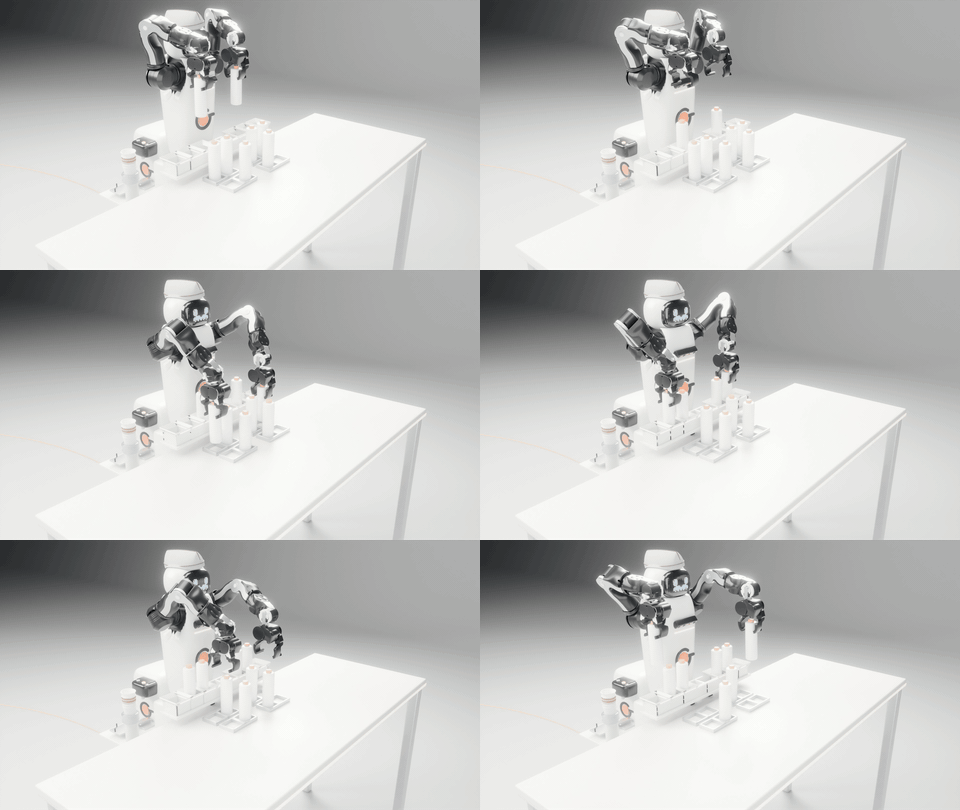 Kitting. It loads its own tray and uses vision to insert the parts into the kit. | 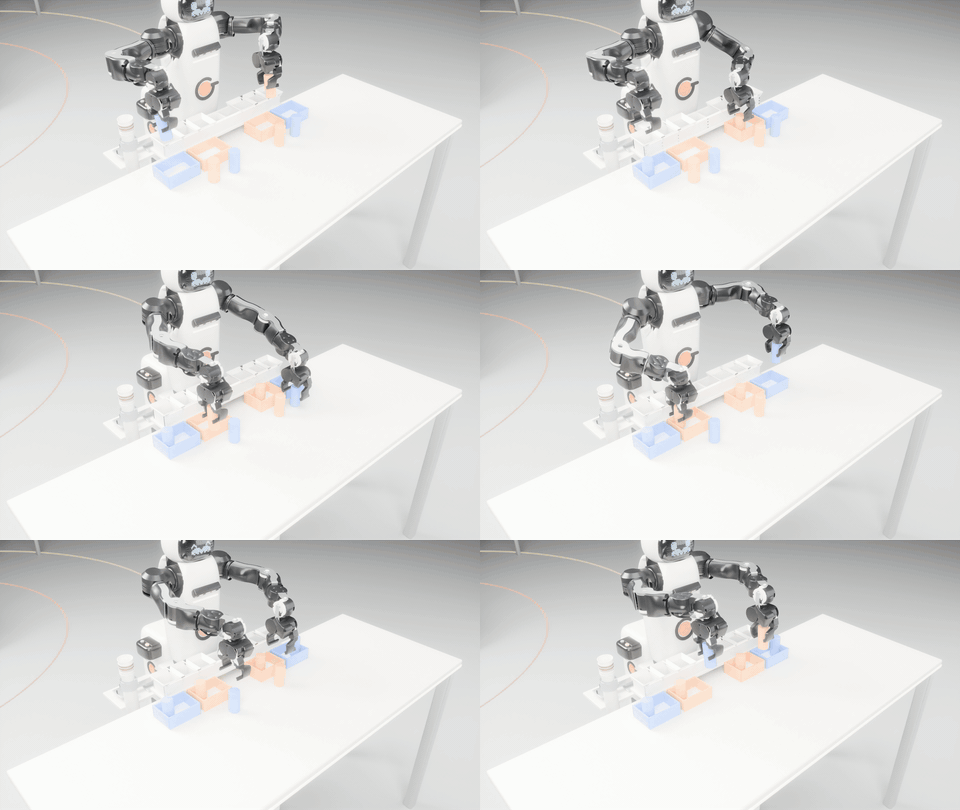 Sorting. It sorts parts by colour with a clash-aware two-arm planner. | 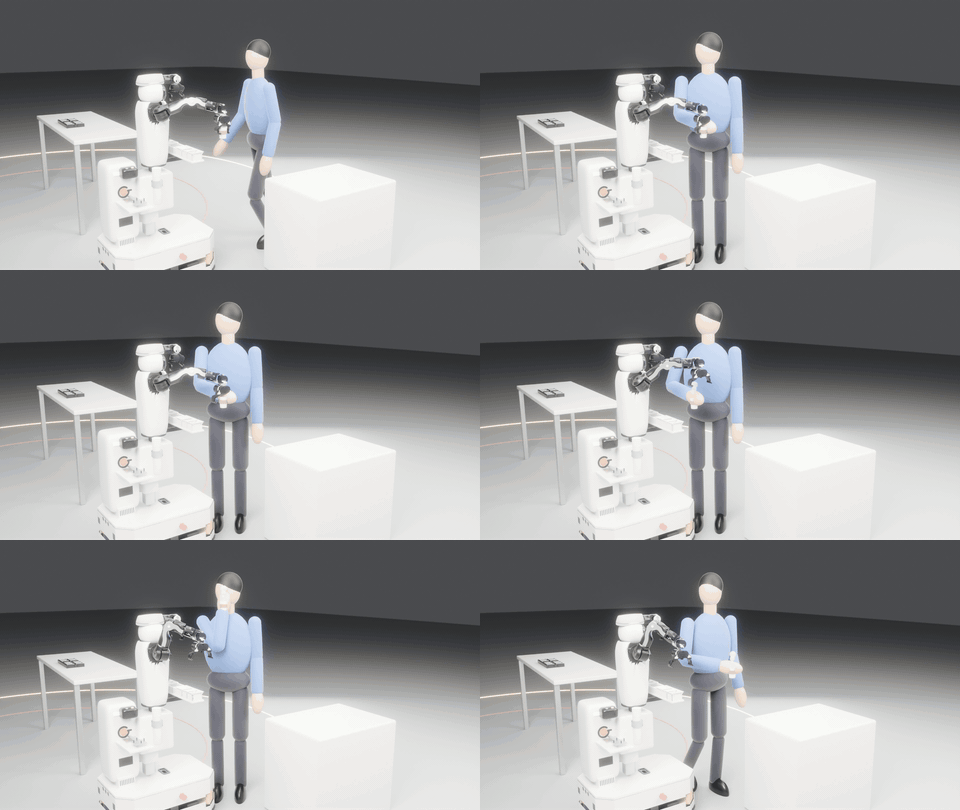 Coffee hand-over. "Make me a coffee and bring it to Marco": it brews, drives and hands over the cup. |
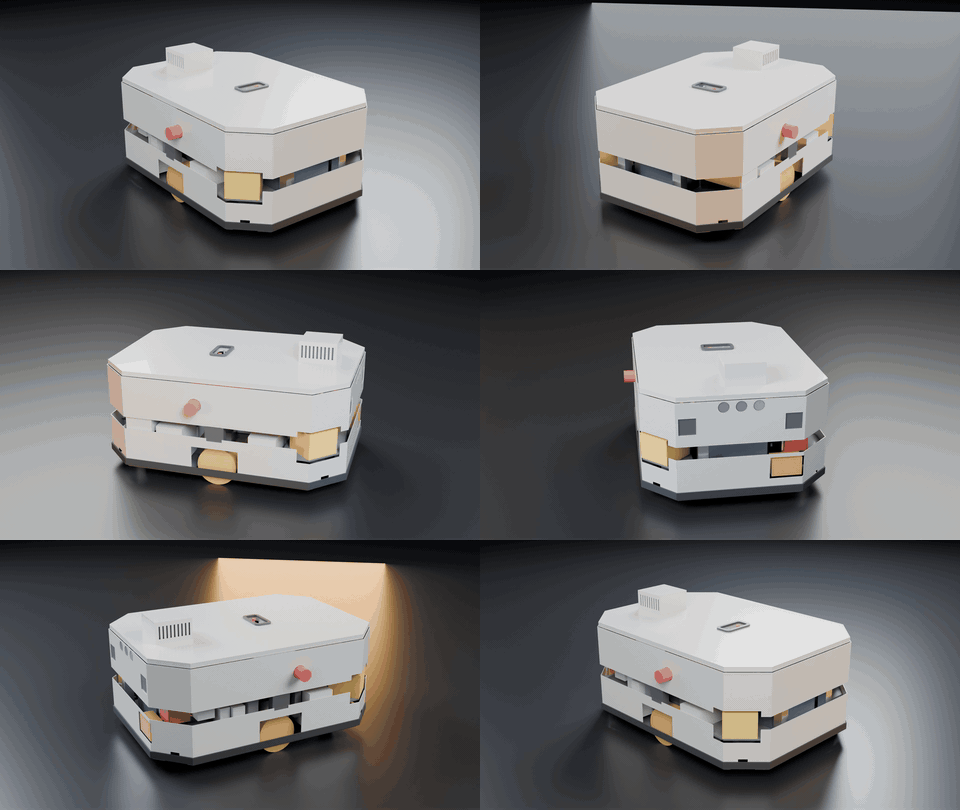 Own AMR base (rev B4). 780 × 560 mm, turns on the spot, two ez-Wheel safety drives, two SICK nanoScan3. | 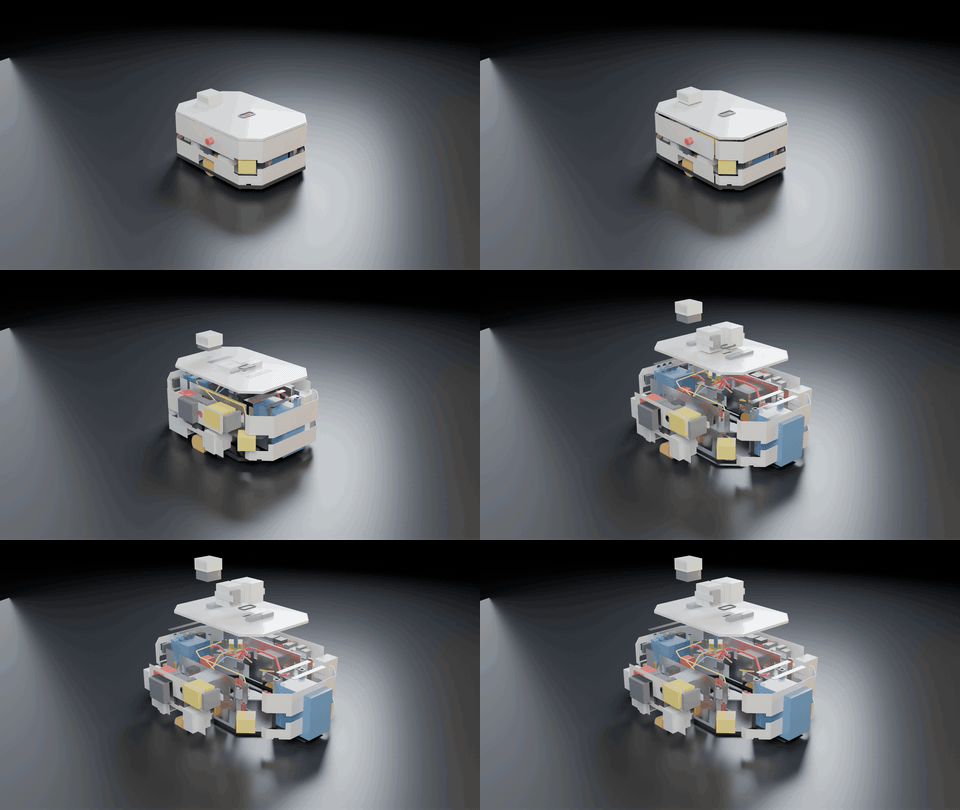 Every part, off the shelf or laser-cut. 170 CAD parts, 0 interferences, power on the left and safety on the right. | 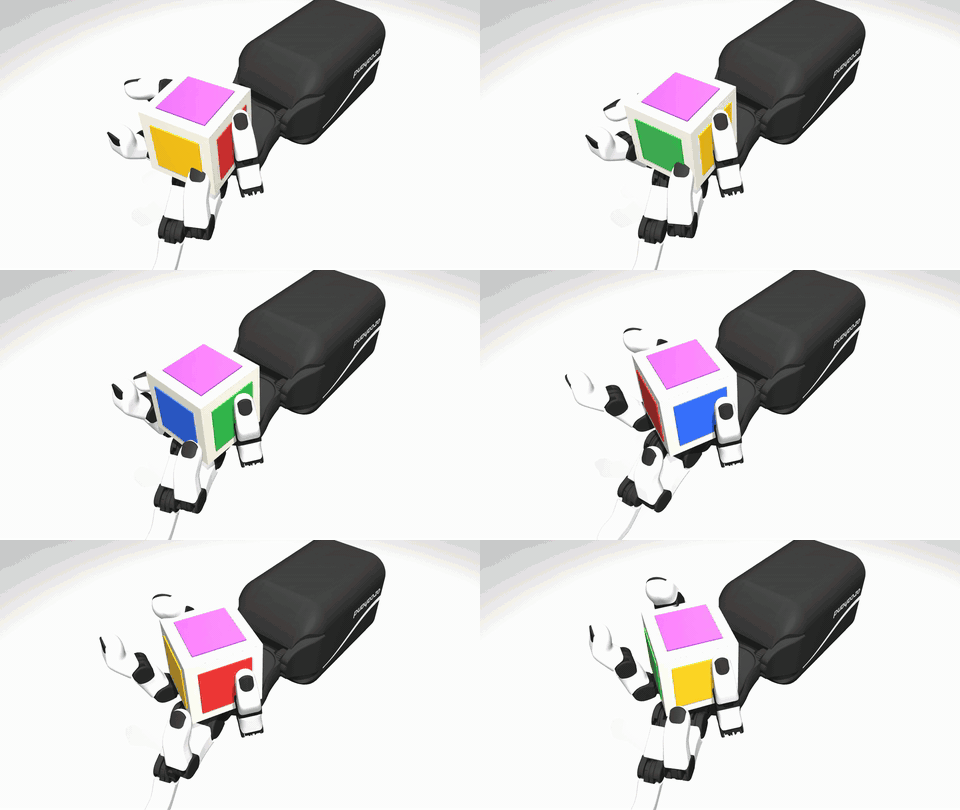 Learned skills. An ORCA hand learns in-hand cube rotation with PPO on GPU (236 M steps in 81 min). |
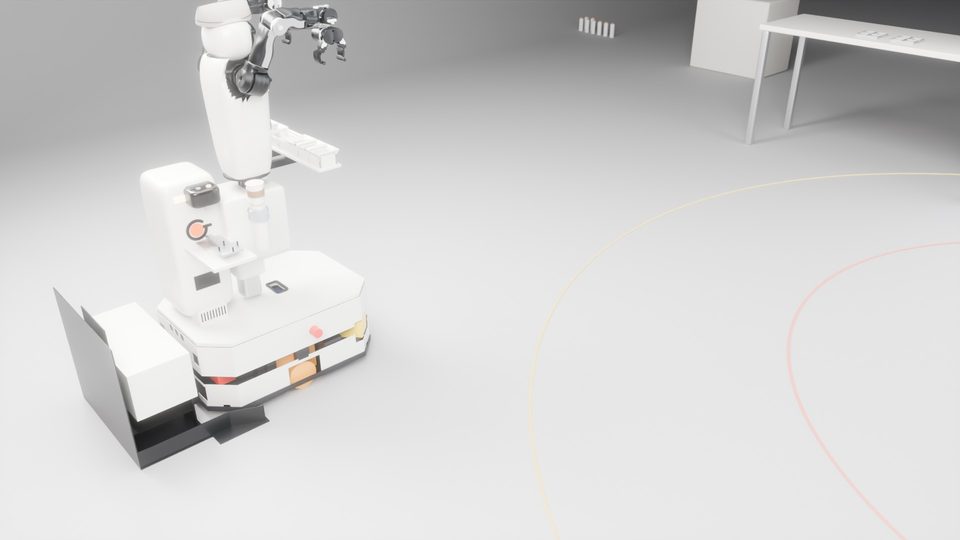 Auto-docking. It goes home to charge on its own; the contacts stay dead until it is docked. | 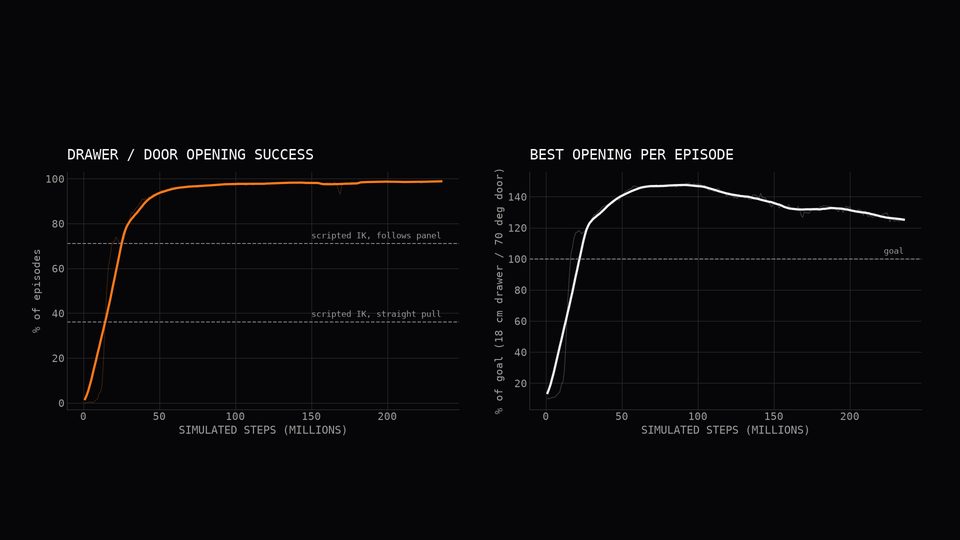 Drawers and doors. A policy trained on a plain OpenArm runs unchanged on Giorgio: 90–95 % success, against 71–76 % for scripted IK. | 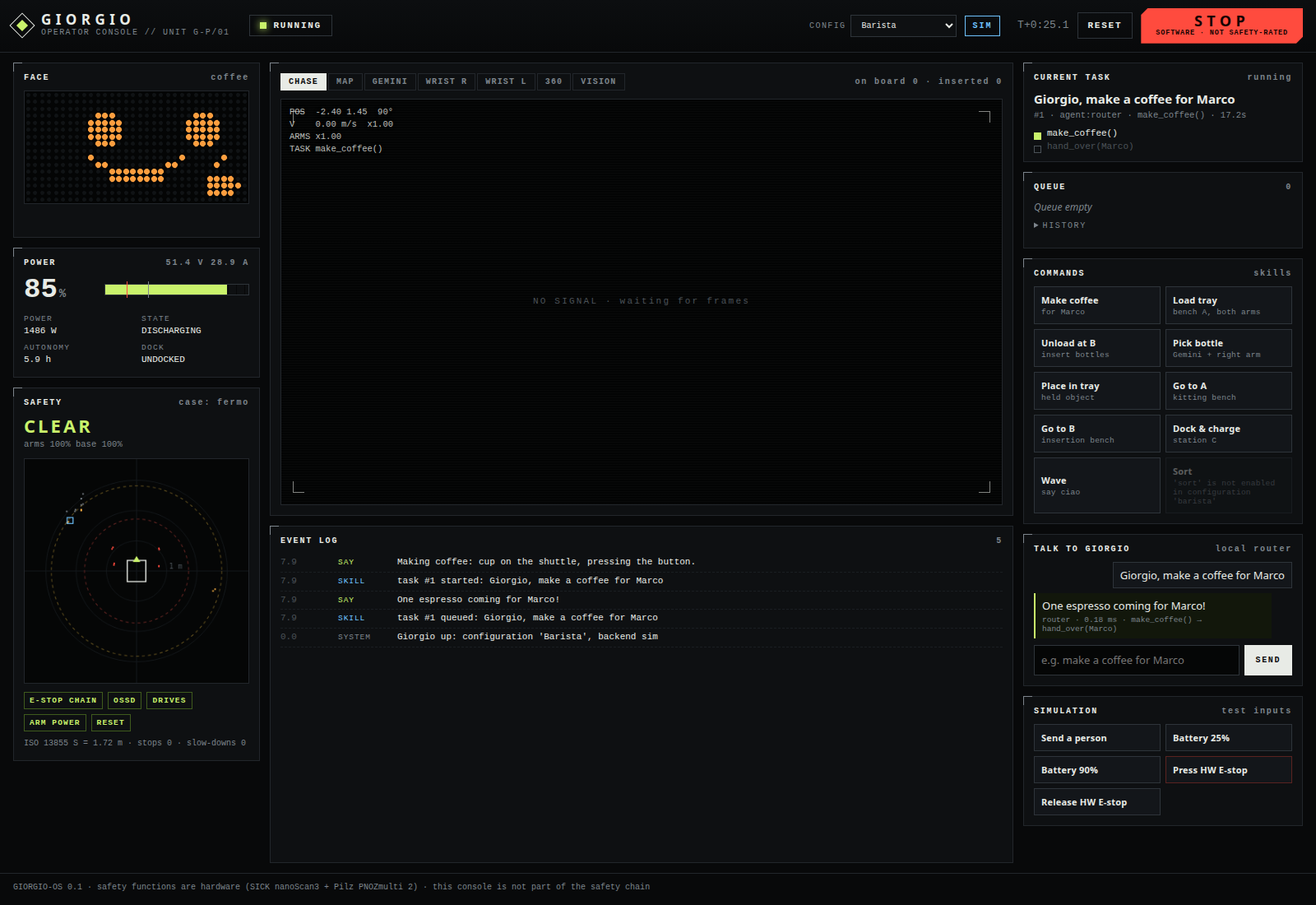 GIORGIO-OS console. Chat, skills, a live energy budget and safety state, with the same code for sim and robot. |
Videos
Full-HD (1920×1080) videos of the simulation, attached to the v0.1.0-design release (CC BY 4.0):
| Video | Length | What you see |
|---|---|---|
| Teaser | 1:08 | the whole idea in one minute |
| Components | 0:57 | the parts and the own AMR base: exploded views, batteries, power and safety, the dock |
| Activities | 0:51 | loading the tray, vision-guided insertion, slowing down for people, sorting, going home to charge |
| Training | 1:08 | an ORCA hand learns to turn a cube; an OpenArm learns drawers and doors, then runs on Giorgio |
| Customisation | 1:06 | LED faces, hats, four setups (grippers, ORCA hands, budget hands, coffee module) |
| Full film | 4:05 | everything above, in one cut |
The videos are built by render/video_series.py. Vertical 9:16 cuts are still to do (see the
issues).
Architecture
flowchart LR
  subgraph BASE["Own AMR base (amr/), rev B4"]
    BAT["2× Discover 48 V LFP<br/>3.07 kWh"] --> PWR["Power: fuses, K0 contactor,<br/>Mean Well DC-DCs"]
    DOCK["Dock: RoboPad contacts<br/>+ NPB-750 charger"] --> BAT
    PWR --> DRV["2× ez-Wheel SWD 125<br/>safety wheel drives"]
  end
  subgraph SAFE["Safety chain (deterministic, certified parts)"]
    SCN["2× SICK nanoScan3<br/>protective fields"] --> PNOZ["Pilz PNOZmulti 2<br/>safety controller"]
    ES["E-stops · key selector<br/>enabling pendant"] --> PNOZ
    PNOZ -->|"STO / SLS"| DRV
    PNOZ -->|"K1/K2 contactors"| ARMPWR["Arm 24 V bus"]
  end
  subgraph SUP["Superstructure (cad/)"]
    ARMS["2× OpenArm 2.0<br/>+ grippers / ORCA / AmazingHand"]
    VIS["Orbbec Gemini 336L<br/>+ wrist cameras"]
    COF["Coffee module + tray"]
    JET["Jetson Orin NX"]
  end
  subgraph SW["Software, sim and training"]
    OS["GIORGIO-OS (giorgio_os/)<br/>HAL · skills · energy · NL agent · console"]
    SIM["MuJoCo 3.8 simulation<br/>giorgio_v5.py, giorgio_model.py"]
    RL["RL training<br/>rl_mani/ · rl_openarm/ (mujoco_warp)"]
  end
  ARMPWR --> ARMS
  PWR --> JET
  JET --- OS
  OS <-->|"sim backend"| SIM
  OS -.->|"real backend (stubs)"| ARMS
  RL -->|"policies"| OS
  OS -.->|"status only, never in the safety path"| PNOZ
Design rule: every safety function runs on certified, deterministic hardware: scanners, a safety controller and
safety drives. No machine-learning model sits in the safety path, as the EU Machinery Regulation 2023/1230, Annex I
requires. Details: amr/electrical/ and amr/ce/.
Repository map
| Folder / file | What's there | Status | Main entry point |
|---|---|---|---|
amr/ | Own mobile base: • CAD (170 parts) and calculations • electrical + safety package • CE file skeleton • industrialisation plan and certainty audit | design rev B4, checks pass | amr/amr_cad.py, amr/amr_calc.py, amr/electrical/check_amr.py |
cad/ | Superstructure CAD (CadQuery): • parts and bolted joints • validator • STEP/STL exports | design; base-adapter parts belong to an earlier base variant | cad/validate.py → cad/VALIDATION.md |
electrical/ | Superstructure power and safety design, netlists, BOM generator | design; base variants archived | electrical/calc.py, electrical/make_bom.py |
giorgio_v5.py, giorgio_model.py, … (root) | MuJoCo simulation: • robot model (official OpenArm MJCF + own base) • missions, IK, vision • people, energy, docking | working in sim | giorgio_v5.py (make sim) |
giorgio_os/ | Robot software: • HAL (sim + real stubs), skills • safety supervisor, energy and mission managers • NL agent, web console | sim backend works; real backend stubs | python -m giorgio_os.sim_server (make console) |
rl_mani/ | RL: ORCA hand in-hand cube rotation (PPO, mujoco_warp) | trained policy included | rl_mani/train.py |
rl_openarm/ | RL: OpenArm lift and drawer/door policies, transferred unchanged to Giorgio | trained policies included | rl_openarm/train.py, rl_openarm/run_cpu.py |
verifiche/ | Simulation checks: docking, arm collisions, shells, box forces | working | verifiche/aggancio.py, verifiche/urti.py |
render/ | Blender 4.5 render pipeline, LED faces, hats, music, video editing | working (needs Blender) | render/video_series.py, render/run_v19.sh |
assets/, robots/ | Shell meshes (OBJ) and arm URDFs | data | shells.py |
docs/ | BOM overview, customising, glossary, base decision, power & certification notes, Italian summary | docs | — |
FEASIBILITY.md | SDK, driver and licence check for every component, plus the top risks | docs | — |
kickstarter/, launch/ | Campaign and launch drafts (IT/EN) | drafts | — |
scripts/ | setup.sh, fetch_third_party.sh, bom_overview.py | working | make setup |
legacy/ | One-off and superseded scripts, kept for history | unmaintained | — |
third_party/ (not committed) | OpenArm MJCF, ORCA, AmazingHand, LEAP models at pinned commits | fetched | scripts/fetch_third_party.sh |
Quick start
Tested on Ubuntu 24.04 with Python 3.12. You need git, Python ≥ 3.10 with venv, and about 1.5 GB of disk. The
optional parts need more: a GPU for training, Blender 4.5 for renders, and a separate environment for the CAD.
git clone https://github.com/VenetoStato/giorgio.git && cd giorgio
make setup        # .venv + requirements.txt (MuJoCo 3.8, ...) + third_party/ at pinned commits
make sim          # GUI simulation: the logistics mission (needs a display)
make coffee       # GUI: "Giorgio, make me a coffee and bring it to Marco"
make console      # GIORGIO-OS operator console → http://127.0.0.1:8080
make check        # fast checks, the same as CI (AMR electrical/safety + calculations, syntax)
Without make (manual steps), headless servers, CAD, renders and training
# 1. simulation environment (Debian/Ubuntu: sudo apt install python3-venv git)
python3 -m venv .venv && . .venv/bin/activate
pip install -r requirements.txt && pip install --no-deps -e giorgio_os
scripts/fetch_third_party.sh                       # ~400 MB; --minimal = OpenArm only (~30 MB)

# 2. run
MUJOCO_GL=egl PYTHONPATH=. python giorgio_v5.py                                  # GUI
MUJOCO_GL=egl PYTHONPATH=. python giorgio_v5.py --seconds 40 --video video/sim.mp4   # headless → mp4
MUJOCO_GL=egl python -m giorgio_os.sim_server                                     # console
(cd giorgio_os && MUJOCO_GL=egl python -m pytest -q)                              # tests

# 3. checks of the base (PyYAML + numpy only)
python amr/electrical/check_amr.py                 # 242 PASS / 0 FAIL / 11 OPEN
(cd amr && python amr_calc.py)                     # writes amr/CALC.md

# 4. CAD (separate env, ~2 GB): see cad/README.md
python3.11 -m venv cad/.env && cad/.env/bin/pip install -r cad/requirements.txt
make cad-validate && make amr-cad

# 5. renders (Blender 4.5 on PATH or BLENDER=/path/to/blender)
make render-amr

# 6. GPU training (separate env, Python 3.11, NVIDIA GPU): see rl_openarm/README.md, rl_mani/README_IT.md
pip install torch && pip install -r requirements-train.txt
cd rl_openarm && python train.py --task cabinet --envs 4096 --max_minutes 95 --out runs/cX
Environment variables: PYTHON (interpreter for make and setup.sh), CADPY (CAD env), BLENDER (Blender binary),
MUJOCO_GL=egl (headless rendering, the default in make).
Bill of materials
The full robot, grouped by subsystem with part numbers, sources and status, is in docs/BOM_OVERVIEW.md.
It is generated by scripts/bom_overview.py from amr/bom_amr.csv and
docs/bom.csv. Component costs only: EUR excluding VAT, prototype quantity 1, no labour.
| Subsystem | Main parts | EUR |
|---|---|---|
| Base AMR | 2× ez-Wheel SWD 125, laser-cut/bent steel and aluminium frame, sprung castors, covers | 8,317 |
| Safety | 2× SICK nanoScan3 Pro I/O, Pilz PNOZmulti 2 (B0 + 3 × EF 4DI4DOR), contactors, e-stops, pendant | 8,919 |
| Power | 2× Discover DLP-GC2-48V LFP, fuses, main contactor, Mean Well DC-DCs, harnesses | 4,855 |
| Dock | RoboPad contacts, Mean Well NPB-750-48 charger, dock controller | 2,171 |
| Arms & hands | Enactic OpenArm 2.0 bimanual kit (arms, torso, grippers, wrist cameras) + arm power | 6,959 |
| Vision & compute | Jetson Orin NX (reComputer J4012), Orbbec Gemini 336L, fisheye cameras, LED face | 2,335 |
| Structure & shells | column, brackets, tray, PA12 shells, fasteners | 1,476 |
| Coffee module | 24 V capsule machine, cup shuttle, coffee power | 1,025 |
| Total (barista configuration) | 171 rows; 67 % of the value from documented prices, the rest are estimates waiting for quotes | 36,056 |
Customise your Giorgio
Giorgio is meant to be remixed. docs/CUSTOMIZE.md explains how to:
- change the base dimensions (
amr/amr_params.py); - swap the arms or hands (gripper / ORCA / AmazingHand / LEAP);
- change the LED face, hats, tray and coffee module;
- re-run the checks and renders;
- re-train a skill.
How to contribute
- Look at the good first issues or help wanted, or open an issue/discussion with your idea.
- Fork, create a branch, change things, and run
make checkplus the checks of the area you touched. - Open a pull request. The template asks for the check results and the sources of any technical value.
Rules that matter:
- Every purchased-part value needs an official source, tagged SOURCED / SECONDARY / ESTIMATE / ASSUMED.
- Safety stays deterministic and certified.
- No manufacturer PDFs in git.
The details are in CONTRIBUTING.md. Please follow the Code of Conduct. Security or safety-design concerns go through SECURITY.md.
Known gaps & open questions
What is not done or not certain yet. Each item has its source:
- Arms decision (owner). OpenArm 2.0 is open and cheap, but it has no brakes, no STO and no safety-rated
speed/force. That makes it non-collaborative: no certified hand-to-hand hand-over and no CE as-is (gap G1 in
amr/ce/GAPS.md). The alternative is a certified cobot on 48 V DC (variant "C48": UR e-Series / Kassow), or a brake retrofit of OpenArm. - CE gaps (
amr/ce/GAPS.md):- safety requirements spec and PL calculations (SISTEMA) not written;
- coffee machine without a DoC or food-contact declaration;
- Wi-Fi module and EN 18031 not done;
- supervisory function and safety logging not implemented;
- producer registrations not done;
- the SS1-t ramp-failure residual is open.
- Type tests TP-01…TP-23 are planned but not run (
amr/ce/TEST_PLAN.md). They cover stopping distances, personnel detection, EMC, short-circuit current (TP-14) and payload. - Certainty audit (
amr/CERTAINTY.md). Of the 82 BOM rows, 32 have only a price and need a quote, and 1 is a gap. Of the calculation inputs, 2 are gaps (gripper length, coffee machine power) and 28 wait for type tests. In the netlist, the battery short-circuit current is unpublished, which leaves 11 OPEN rows. - Documents still to fetch or buy (
amr/DOWNLOAD_LIST.md): the Pilz certificate, the Discover UN 38.3 summary, EN 60204-1 / DIN VDE 0298-4, and EN ISO 3691-4. - Purchased-part interfaces in the CAD are partly datasheet envelopes or ASSUMED holes, not vendor STEP files
(
cad/VALIDATION.md). The superstructure CAD incad/still carries adapter parts of an earlier base variant. - Software:
- the ROS 2 node and launch files are not written;
- the real-hardware backend of GIORGIO-OS is stubs;
- 4 of the 29 GIORGIO-OS tests (sim skills: pick into tray, auto-dock, safety stop, chat navigation) have failed since the switch to the rev B base;
- the Claude planner is untested against the live API.
- Sim ↔ CAD drift: part of the base geometry in
giorgio_model.py(castors, wheels) is typed by hand and differs slightly fromamr/amr_params.py(see docs/CUSTOMIZE.md). - Sim-to-real: the RL policies use privileged simulator state for the object pose. Nothing has run on hardware.
- Media: vertical 9:16 cuts for social media are missing.
Roadmap
- Decide the arms (OpenArm R&D variant vs a certified 48 V cobot) and freeze the superstructure on the rev B4 base.
- Prototype: buy the long-lead parts (ez-Wheel, nanoScan3, PNOZ, batteries), build the base, and bring up the safety chain on the bench.
- CE type tests TP-01…TP-23 with an Italian lab, the SISTEMA PL calculations and the technical file.
- ROS 2 bring-up: base driver, scanners, Nav2 with the docking server, OpenArm
ros2_control, and the GIORGIO-OS real backend. - Skills on hardware: teleoperation data, then imitation / RL fine-tuning; validate the policies sim-to-real.
- Community: vertical videos, translations, a web CAD viewer, more hands and modules.
Status & honesty
| Simulated / designed | Verified on hardware | |
|---|---|---|
| Mechanics (CAD, interferences, tipping, bolt loads) | yes: CadQuery + checks | no |
| Electrical and safety design (fuses, contactors, PL targets) | yes: netlists + 242 automated checks | no |
| Robot behaviour (kitting, sorting, coffee, docking) | yes: MuJoCo 3.8 with official arm models | no |
| Learned skills (cube rotation, lift, drawers/doors) | yes: GPU PPO, evaluated on 50–100 episodes | no |
| Purchased-part data | from manufacturer documents where tagged SOURCED; otherwise marked | n/a |
| Prices | 67 % documented, the rest estimates | no quotes yet |
The renders and videos show the simulation. Where a value is an estimate, the file says so. If you find a number that is wrong or unsourced, please open an issue.
Licence
- Software: Apache-2.0.
- Hardware and CAD: CERN-OHL-S-2.0.
- Documents, renders and videos: CC BY 4.0.
Third-party models keep their own licences and are not redistributed here (see NOTICE.md):
- OpenArm: Apache-2.0;
- ORCA Hand: CC BY 4.0 (description MIT);
- AmazingHand: CC BY 4.0 / Apache-2.0;
- MuJoCo Menagerie LEAP hand: per its own licence.
Trademarks
Giorgio is an independent design concept, not affiliated with, sponsored or endorsed by any company named here. Component names are used only to identify compatible parts. OpenArm is a project of Enactic, Inc. SICK and nanoScan3 are trademarks of SICK AG. Pilz and PNOZ are trademarks of Pilz GmbH & Co. KG. NVIDIA and Jetson are trademarks of NVIDIA Corporation. Orbbec and Gemini are trademarks of Orbbec. ORCA Hand is a trademark of ORCA Dexterity, Inc. AmazingHand is a project of Pollen Robotics. Ferrari is a trademark of Ferrari S.p.A. Fiat and Panda are trademarks of FCA Italy S.p.A. (Stellantis). The teaser line "Not a Ferrari. A Fiat Panda." uses them only as a comparison. All other names are trademarks of their respective owners. See NOTICE.md.
Similar repos


Giorgio – open, CE-oriented mobile bimanual service robot made in Italy: own AMR base, CAD, safety electrics, MuJoCo sim, RL training
See the codeSee what people are saying
README
GIORGIO
An open, mobile two-armed service robot. It sorts, carries, docks to charge itself, and makes espresso.
We couldn't build the parts. So we bought them, and made them work together.
Simulation render. Click the GIF for the full 68 s teaser. More videos ↓
[!IMPORTANT] Work in progress: design and simulation only. Giorgio has not been built. Many points are still open: type tests, CE certification, the choice of arms, real-hardware validation and more. See Known gaps & open questions. Every number in this repository comes either from a manufacturer document or is marked as an estimate or an assumption. Help is very welcome.
Giorgio is a mobile bimanual service robot assembled from open-hardware projects and certified off-the-shelf components:
- Enactic OpenArm 2.0 arms;
- our own AMR base, built from a SICK, Pilz and ez-Wheel safety chain;
- an Orbbec depth camera and an NVIDIA Jetson.
The structure, shells, power system and software are our own. All of it is public: CAD, calculations, electrical and safety design, a CE technical-file skeleton, a MuJoCo simulation of the whole robot, the robot software (GIORGIO-OS) and reinforcement-learning training. Fork it, study it, improve it.
Contents
Start here · What it does · Videos · Architecture · Repository map · Quick start · Bill of materials · Customise · Contribute · Known gaps · Roadmap · Status & honesty · Licence · Trademarks
Start here
| I want to… | Go to | Time |
|---|---|---|
| Just look | the videos, the AMR base datasheet (download it and open it in a browser), the renders in amr/renders/ and the bill of materials | 5 min |
| Run the simulation | Quick start: make setup && make sim | 5–10 min |
| Change the design | Customise your Giorgio, then CONTRIBUTING.md. Starter tasks are labelled good first issue | an evening |
Questions and ideas go to Discussions. Some file and variable names are still in Italian; the glossary translates them.
What it does
All clips are renders of the MuJoCo simulation (Blender 4.5 over recorded physics states), not footage of hardware.
Kitting. It loads its own tray and uses vision to insert the parts into the kit. | Sorting. It sorts parts by colour with a clash-aware two-arm planner. | Coffee hand-over. "Make me a coffee and bring it to Marco": it brews, drives and hands over the cup. |
Own AMR base (rev B4). 780 × 560 mm, turns on the spot, two ez-Wheel safety drives, two SICK nanoScan3. | Every part, off the shelf or laser-cut. 170 CAD parts, 0 interferences, power on the left and safety on the right. | Learned skills. An ORCA hand learns in-hand cube rotation with PPO on GPU (236 M steps in 81 min). |
Auto-docking. It goes home to charge on its own; the contacts stay dead until it is docked. | Drawers and doors. A policy trained on a plain OpenArm runs unchanged on Giorgio: 90–95 % success, against 71–76 % for scripted IK. | GIORGIO-OS console. Chat, skills, a live energy budget and safety state, with the same code for sim and robot. |
Videos
Full-HD (1920×1080) videos of the simulation, attached to the v0.1.0-design release (CC BY 4.0):
| Video | Length | What you see |
|---|---|---|
| Teaser | 1:08 | the whole idea in one minute |
| Components | 0:57 | the parts and the own AMR base: exploded views, batteries, power and safety, the dock |
| Activities | 0:51 | loading the tray, vision-guided insertion, slowing down for people, sorting, going home to charge |
| Training | 1:08 | an ORCA hand learns to turn a cube; an OpenArm learns drawers and doors, then runs on Giorgio |
| Customisation | 1:06 | LED faces, hats, four setups (grippers, ORCA hands, budget hands, coffee module) |
| Full film | 4:05 | everything above, in one cut |
The videos are built by render/video_series.py. Vertical 9:16 cuts are still to do (see the
issues).
Architecture
flowchart LR
  subgraph BASE["Own AMR base (amr/), rev B4"]
    BAT["2× Discover 48 V LFP<br/>3.07 kWh"] --> PWR["Power: fuses, K0 contactor,<br/>Mean Well DC-DCs"]
    DOCK["Dock: RoboPad contacts<br/>+ NPB-750 charger"] --> BAT
    PWR --> DRV["2× ez-Wheel SWD 125<br/>safety wheel drives"]
  end
  subgraph SAFE["Safety chain (deterministic, certified parts)"]
    SCN["2× SICK nanoScan3<br/>protective fields"] --> PNOZ["Pilz PNOZmulti 2<br/>safety controller"]
    ES["E-stops · key selector<br/>enabling pendant"] --> PNOZ
    PNOZ -->|"STO / SLS"| DRV
    PNOZ -->|"K1/K2 contactors"| ARMPWR["Arm 24 V bus"]
  end
  subgraph SUP["Superstructure (cad/)"]
    ARMS["2× OpenArm 2.0<br/>+ grippers / ORCA / AmazingHand"]
    VIS["Orbbec Gemini 336L<br/>+ wrist cameras"]
    COF["Coffee module + tray"]
    JET["Jetson Orin NX"]
  end
  subgraph SW["Software, sim and training"]
    OS["GIORGIO-OS (giorgio_os/)<br/>HAL · skills · energy · NL agent · console"]
    SIM["MuJoCo 3.8 simulation<br/>giorgio_v5.py, giorgio_model.py"]
    RL["RL training<br/>rl_mani/ · rl_openarm/ (mujoco_warp)"]
  end
  ARMPWR --> ARMS
  PWR --> JET
  JET --- OS
  OS <-->|"sim backend"| SIM
  OS -.->|"real backend (stubs)"| ARMS
  RL -->|"policies"| OS
  OS -.->|"status only, never in the safety path"| PNOZ
Design rule: every safety function runs on certified, deterministic hardware: scanners, a safety controller and
safety drives. No machine-learning model sits in the safety path, as the EU Machinery Regulation 2023/1230, Annex I
requires. Details: amr/electrical/ and amr/ce/.
Repository map
| Folder / file | What's there | Status | Main entry point |
|---|---|---|---|
amr/ | Own mobile base: • CAD (170 parts) and calculations • electrical + safety package • CE file skeleton • industrialisation plan and certainty audit | design rev B4, checks pass | amr/amr_cad.py, amr/amr_calc.py, amr/electrical/check_amr.py |
cad/ | Superstructure CAD (CadQuery): • parts and bolted joints • validator • STEP/STL exports | design; base-adapter parts belong to an earlier base variant | cad/validate.py → cad/VALIDATION.md |
electrical/ | Superstructure power and safety design, netlists, BOM generator | design; base variants archived | electrical/calc.py, electrical/make_bom.py |
giorgio_v5.py, giorgio_model.py, … (root) | MuJoCo simulation: • robot model (official OpenArm MJCF + own base) • missions, IK, vision • people, energy, docking | working in sim | giorgio_v5.py (make sim) |
giorgio_os/ | Robot software: • HAL (sim + real stubs), skills • safety supervisor, energy and mission managers • NL agent, web console | sim backend works; real backend stubs | python -m giorgio_os.sim_server (make console) |
rl_mani/ | RL: ORCA hand in-hand cube rotation (PPO, mujoco_warp) | trained policy included | rl_mani/train.py |
rl_openarm/ | RL: OpenArm lift and drawer/door policies, transferred unchanged to Giorgio | trained policies included | rl_openarm/train.py, rl_openarm/run_cpu.py |
verifiche/ | Simulation checks: docking, arm collisions, shells, box forces | working | verifiche/aggancio.py, verifiche/urti.py |
render/ | Blender 4.5 render pipeline, LED faces, hats, music, video editing | working (needs Blender) | render/video_series.py, render/run_v19.sh |
assets/, robots/ | Shell meshes (OBJ) and arm URDFs | data | shells.py |
docs/ | BOM overview, customising, glossary, base decision, power & certification notes, Italian summary | docs | — |
FEASIBILITY.md | SDK, driver and licence check for every component, plus the top risks | docs | — |
kickstarter/, launch/ | Campaign and launch drafts (IT/EN) | drafts | — |
scripts/ | setup.sh, fetch_third_party.sh, bom_overview.py | working | make setup |
legacy/ | One-off and superseded scripts, kept for history | unmaintained | — |
third_party/ (not committed) | OpenArm MJCF, ORCA, AmazingHand, LEAP models at pinned commits | fetched | scripts/fetch_third_party.sh |
Quick start
Tested on Ubuntu 24.04 with Python 3.12. You need git, Python ≥ 3.10 with venv, and about 1.5 GB of disk. The
optional parts need more: a GPU for training, Blender 4.5 for renders, and a separate environment for the CAD.
git clone https://github.com/VenetoStato/giorgio.git && cd giorgio
make setup        # .venv + requirements.txt (MuJoCo 3.8, ...) + third_party/ at pinned commits
make sim          # GUI simulation: the logistics mission (needs a display)
make coffee       # GUI: "Giorgio, make me a coffee and bring it to Marco"
make console      # GIORGIO-OS operator console → http://127.0.0.1:8080
make check        # fast checks, the same as CI (AMR electrical/safety + calculations, syntax)
Without make (manual steps), headless servers, CAD, renders and training
# 1. simulation environment (Debian/Ubuntu: sudo apt install python3-venv git)
python3 -m venv .venv && . .venv/bin/activate
pip install -r requirements.txt && pip install --no-deps -e giorgio_os
scripts/fetch_third_party.sh                       # ~400 MB; --minimal = OpenArm only (~30 MB)

# 2. run
MUJOCO_GL=egl PYTHONPATH=. python giorgio_v5.py                                  # GUI
MUJOCO_GL=egl PYTHONPATH=. python giorgio_v5.py --seconds 40 --video video/sim.mp4   # headless → mp4
MUJOCO_GL=egl python -m giorgio_os.sim_server                                     # console
(cd giorgio_os && MUJOCO_GL=egl python -m pytest -q)                              # tests

# 3. checks of the base (PyYAML + numpy only)
python amr/electrical/check_amr.py                 # 242 PASS / 0 FAIL / 11 OPEN
(cd amr && python amr_calc.py)                     # writes amr/CALC.md

# 4. CAD (separate env, ~2 GB): see cad/README.md
python3.11 -m venv cad/.env && cad/.env/bin/pip install -r cad/requirements.txt
make cad-validate && make amr-cad

# 5. renders (Blender 4.5 on PATH or BLENDER=/path/to/blender)
make render-amr

# 6. GPU training (separate env, Python 3.11, NVIDIA GPU): see rl_openarm/README.md, rl_mani/README_IT.md
pip install torch && pip install -r requirements-train.txt
cd rl_openarm && python train.py --task cabinet --envs 4096 --max_minutes 95 --out runs/cX
Environment variables: PYTHON (interpreter for make and setup.sh), CADPY (CAD env), BLENDER (Blender binary),
MUJOCO_GL=egl (headless rendering, the default in make).
Bill of materials
The full robot, grouped by subsystem with part numbers, sources and status, is in docs/BOM_OVERVIEW.md.
It is generated by scripts/bom_overview.py from amr/bom_amr.csv and
docs/bom.csv. Component costs only: EUR excluding VAT, prototype quantity 1, no labour.
| Subsystem | Main parts | EUR |
|---|---|---|
| Base AMR | 2× ez-Wheel SWD 125, laser-cut/bent steel and aluminium frame, sprung castors, covers | 8,317 |
| Safety | 2× SICK nanoScan3 Pro I/O, Pilz PNOZmulti 2 (B0 + 3 × EF 4DI4DOR), contactors, e-stops, pendant | 8,919 |
| Power | 2× Discover DLP-GC2-48V LFP, fuses, main contactor, Mean Well DC-DCs, harnesses | 4,855 |
| Dock | RoboPad contacts, Mean Well NPB-750-48 charger, dock controller | 2,171 |
| Arms & hands | Enactic OpenArm 2.0 bimanual kit (arms, torso, grippers, wrist cameras) + arm power | 6,959 |
| Vision & compute | Jetson Orin NX (reComputer J4012), Orbbec Gemini 336L, fisheye cameras, LED face | 2,335 |
| Structure & shells | column, brackets, tray, PA12 shells, fasteners | 1,476 |
| Coffee module | 24 V capsule machine, cup shuttle, coffee power | 1,025 |
| Total (barista configuration) | 171 rows; 67 % of the value from documented prices, the rest are estimates waiting for quotes | 36,056 |
Customise your Giorgio
Giorgio is meant to be remixed. docs/CUSTOMIZE.md explains how to:
- change the base dimensions (
amr/amr_params.py); - swap the arms or hands (gripper / ORCA / AmazingHand / LEAP);
- change the LED face, hats, tray and coffee module;
- re-run the checks and renders;
- re-train a skill.
How to contribute
- Look at the good first issues or help wanted, or open an issue/discussion with your idea.
- Fork, create a branch, change things, and run
make checkplus the checks of the area you touched. - Open a pull request. The template asks for the check results and the sources of any technical value.
Rules that matter:
- Every purchased-part value needs an official source, tagged SOURCED / SECONDARY / ESTIMATE / ASSUMED.
- Safety stays deterministic and certified.
- No manufacturer PDFs in git.
The details are in CONTRIBUTING.md. Please follow the Code of Conduct. Security or safety-design concerns go through SECURITY.md.
Known gaps & open questions
What is not done or not certain yet. Each item has its source:
- Arms decision (owner). OpenArm 2.0 is open and cheap, but it has no brakes, no STO and no safety-rated
speed/force. That makes it non-collaborative: no certified hand-to-hand hand-over and no CE as-is (gap G1 in
amr/ce/GAPS.md). The alternative is a certified cobot on 48 V DC (variant "C48": UR e-Series / Kassow), or a brake retrofit of OpenArm. - CE gaps (
amr/ce/GAPS.md):- safety requirements spec and PL calculations (SISTEMA) not written;
- coffee machine without a DoC or food-contact declaration;
- Wi-Fi module and EN 18031 not done;
- supervisory function and safety logging not implemented;
- producer registrations not done;
- the SS1-t ramp-failure residual is open.
- Type tests TP-01…TP-23 are planned but not run (
amr/ce/TEST_PLAN.md). They cover stopping distances, personnel detection, EMC, short-circuit current (TP-14) and payload. - Certainty audit (
amr/CERTAINTY.md). Of the 82 BOM rows, 32 have only a price and need a quote, and 1 is a gap. Of the calculation inputs, 2 are gaps (gripper length, coffee machine power) and 28 wait for type tests. In the netlist, the battery short-circuit current is unpublished, which leaves 11 OPEN rows. - Documents still to fetch or buy (
amr/DOWNLOAD_LIST.md): the Pilz certificate, the Discover UN 38.3 summary, EN 60204-1 / DIN VDE 0298-4, and EN ISO 3691-4. - Purchased-part interfaces in the CAD are partly datasheet envelopes or ASSUMED holes, not vendor STEP files
(
cad/VALIDATION.md). The superstructure CAD incad/still carries adapter parts of an earlier base variant. - Software:
- the ROS 2 node and launch files are not written;
- the real-hardware backend of GIORGIO-OS is stubs;
- 4 of the 29 GIORGIO-OS tests (sim skills: pick into tray, auto-dock, safety stop, chat navigation) have failed since the switch to the rev B base;
- the Claude planner is untested against the live API.
- Sim ↔ CAD drift: part of the base geometry in
giorgio_model.py(castors, wheels) is typed by hand and differs slightly fromamr/amr_params.py(see docs/CUSTOMIZE.md). - Sim-to-real: the RL policies use privileged simulator state for the object pose. Nothing has run on hardware.
- Media: vertical 9:16 cuts for social media are missing.
Roadmap
- Decide the arms (OpenArm R&D variant vs a certified 48 V cobot) and freeze the superstructure on the rev B4 base.
- Prototype: buy the long-lead parts (ez-Wheel, nanoScan3, PNOZ, batteries), build the base, and bring up the safety chain on the bench.
- CE type tests TP-01…TP-23 with an Italian lab, the SISTEMA PL calculations and the technical file.
- ROS 2 bring-up: base driver, scanners, Nav2 with the docking server, OpenArm
ros2_control, and the GIORGIO-OS real backend. - Skills on hardware: teleoperation data, then imitation / RL fine-tuning; validate the policies sim-to-real.
- Community: vertical videos, translations, a web CAD viewer, more hands and modules.
Status & honesty
| Simulated / designed | Verified on hardware | |
|---|---|---|
| Mechanics (CAD, interferences, tipping, bolt loads) | yes: CadQuery + checks | no |
| Electrical and safety design (fuses, contactors, PL targets) | yes: netlists + 242 automated checks | no |
| Robot behaviour (kitting, sorting, coffee, docking) | yes: MuJoCo 3.8 with official arm models | no |
| Learned skills (cube rotation, lift, drawers/doors) | yes: GPU PPO, evaluated on 50–100 episodes | no |
| Purchased-part data | from manufacturer documents where tagged SOURCED; otherwise marked | n/a |
| Prices | 67 % documented, the rest estimates | no quotes yet |
The renders and videos show the simulation. Where a value is an estimate, the file says so. If you find a number that is wrong or unsourced, please open an issue.
Licence
- Software: Apache-2.0.
- Hardware and CAD: CERN-OHL-S-2.0.
- Documents, renders and videos: CC BY 4.0.
Third-party models keep their own licences and are not redistributed here (see NOTICE.md):
- OpenArm: Apache-2.0;
- ORCA Hand: CC BY 4.0 (description MIT);
- AmazingHand: CC BY 4.0 / Apache-2.0;
- MuJoCo Menagerie LEAP hand: per its own licence.
Trademarks
Giorgio is an independent design concept, not affiliated with, sponsored or endorsed by any company named here. Component names are used only to identify compatible parts. OpenArm is a project of Enactic, Inc. SICK and nanoScan3 are trademarks of SICK AG. Pilz and PNOZ are trademarks of Pilz GmbH & Co. KG. NVIDIA and Jetson are trademarks of NVIDIA Corporation. Orbbec and Gemini are trademarks of Orbbec. ORCA Hand is a trademark of ORCA Dexterity, Inc. AmazingHand is a project of Pollen Robotics. Ferrari is a trademark of Ferrari S.p.A. Fiat and Panda are trademarks of FCA Italy S.p.A. (Stellantis). The teaser line "Not a Ferrari. A Fiat Panda." uses them only as a comparison. All other names are trademarks of their respective owners. See NOTICE.md.