[NeurIPS 2025] Source codes for the paper "MindJourney: Test-Time Scaling with World Models for Spatial Reasoning"
See the code
NeurIPS 2025
Yuncong Yang, Jiageng Liu, Zheyuan Zhang, Siyuan Zhou, Reuben Tan, Jianwei Yang, Yilun Du, Chuang Gan


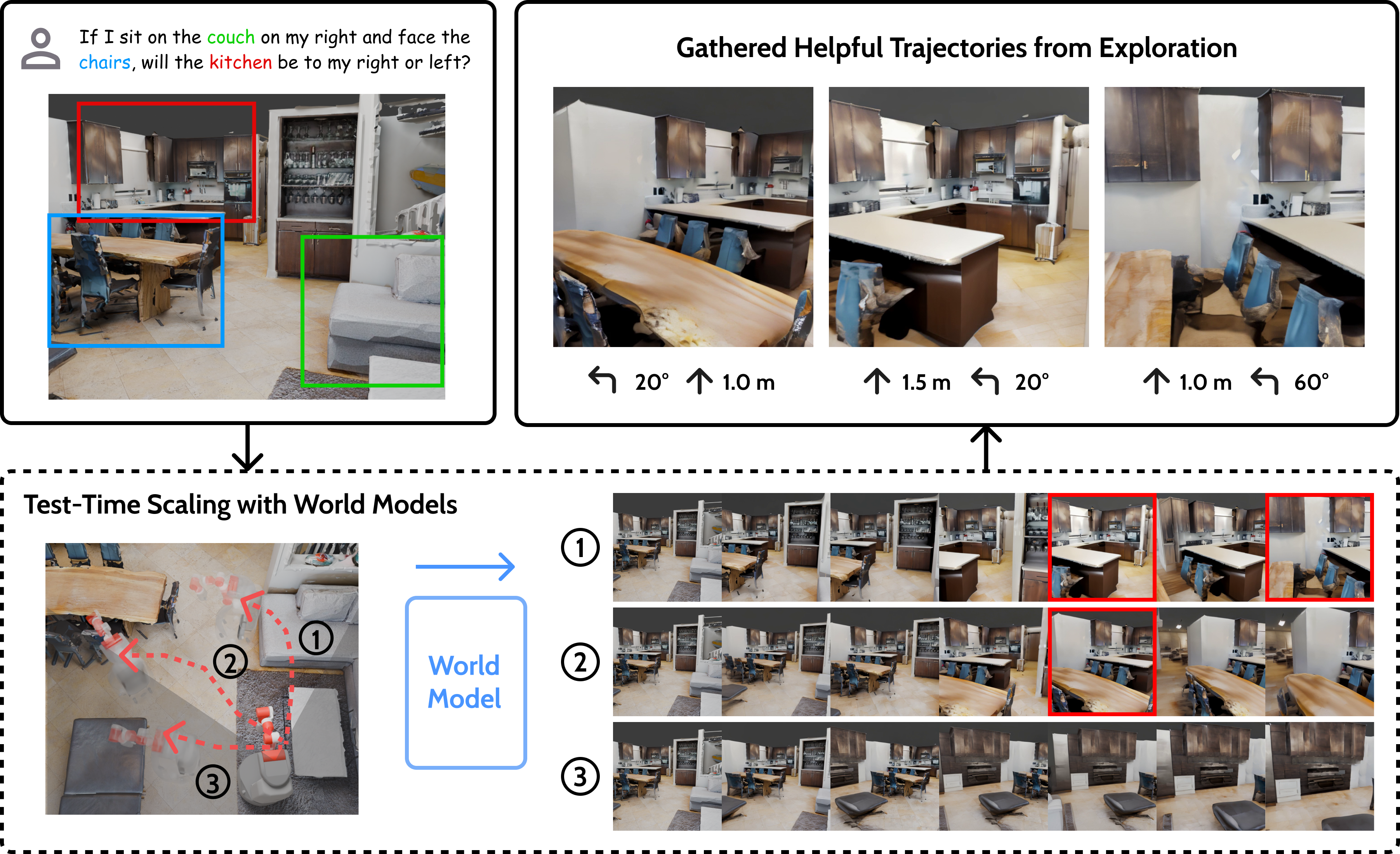
MindJourney is a test-time scaling framework that leverages the 3D imagination capability of World Models to strengthen spatial reasoning in Vision-Language Models (VLMs). We evaluate on the SAT dataset and provide a baseline pipeline, a Stable Virtual Camera (SVC) based spatial beam search pipeline, and a Search World Model (SWM) based spatial beam search pipeline.
pipelines/
pipeline_baseline.py: baseline inference without a world model.pipeline_svc_scaling_spatial_beam_search.py: SVC-based spatial beam search.pipeline_wan_scaling_beam_search_double_rank.py: SWM-based spatial beam searchscripts/
pipeline_baseline.sh: baseline example script.inference_pipeline_svc_scaling_parallel_sat_test.sh: alternative SVC inference driver.inference_pipeline_wan_scaling_parallel_sat-test.sh: example driver for WAN-based experiments.utils/
api.py: Azure OpenAI wrapper and configuration.args.py: unified CLI arguments (pipeline + SVC).vlm_wrapper.py, prompt_formatting.py: VLM wrapper and prompt construction.data_process.py: SAT dataset preprocessing (download and JSON organization).stable_virtual_camera/: SVC module (editable install; see pyproject.toml).assets/: logo and figures.wan2.2/: WAN-related experimental code.We recommend two Conda environments to isolate the main runtime and SVC.
conda create -n mindjourney python=3.11 -y
conda activate mindjourney

# CUDA 12.6 builds of PyTorch (adjust if needed)
pip install torch==2.6.0+cu126 torchvision==0.21.0+cu126 torchaudio==2.6.0+cu126 \
  --extra-index-url https://download.pytorch.org/whl/cu126

# General dependencies
pip install -r requirements.txt
conda create -n mindjourney_svc python=3.10 -y
conda activate mindjourney_svc

# Editable install of the SVC module (dependencies defined in pyproject.toml)
pip install -e stable_virtual_camera/

# Optionally reuse shared utilities if needed
pip install -r requirements_svc.txt
Hardware suggestions:
utils/api.py:MindJourney-dev-new/utils/api.pyAzureConfig.azure_endpoint = "YOUR_API_ENDPOINT"export AZURE_OPENAI_API_KEY=YOUR_API_KEY
Supported models: gpt-4o, gpt-4.1, o4-mini, o1. You can also choose OpenGVLab/InternVL3-8B or OpenGVLab/InternVL3-14B (ensure adequate VRAM and dependencies).
Download Search World Model (SWM) from checkpoint
Update checkpoint path in the bash scripts in the .scripts/ folder.
Request access to SVC weights and login:
# https://huggingface.co/stabilityai/stable-virtual-camera
huggingface-cli login
Prepare SAT from Hugging Face using the helper script:
python utils/data_process.py --split val
python utils/data_process.py --split test
Outputs under ./data/:
val.json / test.json: questions with choices, correct answers, and image pathsval_<type>.json / test_<type>.json./data/<split>/image_*.pngPer-question JSON fields: database_idx, question_type, question, answer_choices, correct_answer, img_paths.
Before running:
AZURE_OPENAI_API_KEY and set azure_endpoint in utils/api.py if using GPT modelsPYTHONPATH: export PYTHONPATH=$PYTHONPATH:./WORLD_MODEL_TYPE=svc for Stable Virtual Camerabash scripts/pipeline_baseline.sh
bash scripts/inference_pipeline_wan_scaling_parallel_sat-test.sh 0
bash scripts/inference_pipeline_svc_scaling_parallel_sat-test.sh 0
Key arguments (see utils/args.py for full list):
--vlm_model_name / --vlm_qa_model_name: scoring and answering VLMs (Azure OpenAI or InternVL3)--num_questions, --split: number of questions and split (val/test)--max_steps_per_question: max iterations per question (beam search)--num_beams, --num_top_candidates: beam width and candidate count--helpful_score_threshold, --exploration_score_threshold: filtering thresholds--max_images: max images per question (typically 1–2)You may set num_question_chunks into $\ge 2$ to split the questions into chunks and run different question chunks in parallel.
Outputs under --output_dir:
results.json: overall accuracy, per-type accuracy, skipped indices, parsing stats/<qid>/: starting image(s) and gpt.json, timing.jsonlogs per questionIf you find this repository helpful, please cite:
@misc{yang2025mindjourneytesttimescalingworld,
      title={MindJourney: Test-Time Scaling with World Models for Spatial Reasoning},
      author={Yuncong Yang and Jiageng Liu and Zheyuan Zhang and Siyuan Zhou and Reuben Tan and Jianwei Yang and Yilun Du and Chuang Gan},
      year={2025},
      eprint={2507.12508},
      archivePrefix={arXiv},
      primaryClass={cs.CV},
      url={https://arxiv.org/abs/2507.12508},
}
utils/args.py and code comments in pipelines/.[NeurIPS 2025] Source codes for the paper "MindJourney: Test-Time Scaling with World Models for Spatial Reasoning"
See the code
NeurIPS 2025
Yuncong Yang, Jiageng Liu, Zheyuan Zhang, Siyuan Zhou, Reuben Tan, Jianwei Yang, Yilun Du, Chuang Gan
MindJourney is a test-time scaling framework that leverages the 3D imagination capability of World Models to strengthen spatial reasoning in Vision-Language Models (VLMs). We evaluate on the SAT dataset and provide a baseline pipeline, a Stable Virtual Camera (SVC) based spatial beam search pipeline, and a Search World Model (SWM) based spatial beam search pipeline.
pipelines/
pipeline_baseline.py: baseline inference without a world model.pipeline_svc_scaling_spatial_beam_search.py: SVC-based spatial beam search.pipeline_wan_scaling_beam_search_double_rank.py: SWM-based spatial beam searchscripts/
pipeline_baseline.sh: baseline example script.inference_pipeline_svc_scaling_parallel_sat_test.sh: alternative SVC inference driver.inference_pipeline_wan_scaling_parallel_sat-test.sh: example driver for WAN-based experiments.utils/
api.py: Azure OpenAI wrapper and configuration.args.py: unified CLI arguments (pipeline + SVC).vlm_wrapper.py, prompt_formatting.py: VLM wrapper and prompt construction.data_process.py: SAT dataset preprocessing (download and JSON organization).stable_virtual_camera/: SVC module (editable install; see pyproject.toml).assets/: logo and figures.wan2.2/: WAN-related experimental code.We recommend two Conda environments to isolate the main runtime and SVC.
conda create -n mindjourney python=3.11 -y
conda activate mindjourney

# CUDA 12.6 builds of PyTorch (adjust if needed)
pip install torch==2.6.0+cu126 torchvision==0.21.0+cu126 torchaudio==2.6.0+cu126 \
  --extra-index-url https://download.pytorch.org/whl/cu126

# General dependencies
pip install -r requirements.txt
conda create -n mindjourney_svc python=3.10 -y
conda activate mindjourney_svc

# Editable install of the SVC module (dependencies defined in pyproject.toml)
pip install -e stable_virtual_camera/

# Optionally reuse shared utilities if needed
pip install -r requirements_svc.txt
Hardware suggestions:
utils/api.py:MindJourney-dev-new/utils/api.pyAzureConfig.azure_endpoint = "YOUR_API_ENDPOINT"export AZURE_OPENAI_API_KEY=YOUR_API_KEY
Supported models: gpt-4o, gpt-4.1, o4-mini, o1. You can also choose OpenGVLab/InternVL3-8B or OpenGVLab/InternVL3-14B (ensure adequate VRAM and dependencies).
Download Search World Model (SWM) from checkpoint
Update checkpoint path in the bash scripts in the .scripts/ folder.
Request access to SVC weights and login:
# https://huggingface.co/stabilityai/stable-virtual-camera
huggingface-cli login
Prepare SAT from Hugging Face using the helper script:
python utils/data_process.py --split val
python utils/data_process.py --split test
Outputs under ./data/:
val.json / test.json: questions with choices, correct answers, and image pathsval_<type>.json / test_<type>.json./data/<split>/image_*.pngPer-question JSON fields: database_idx, question_type, question, answer_choices, correct_answer, img_paths.
Before running:
AZURE_OPENAI_API_KEY and set azure_endpoint in utils/api.py if using GPT modelsPYTHONPATH: export PYTHONPATH=$PYTHONPATH:./WORLD_MODEL_TYPE=svc for Stable Virtual Camerabash scripts/pipeline_baseline.sh
bash scripts/inference_pipeline_wan_scaling_parallel_sat-test.sh 0
bash scripts/inference_pipeline_svc_scaling_parallel_sat-test.sh 0
Key arguments (see utils/args.py for full list):
--vlm_model_name / --vlm_qa_model_name: scoring and answering VLMs (Azure OpenAI or InternVL3)--num_questions, --split: number of questions and split (val/test)--max_steps_per_question: max iterations per question (beam search)--num_beams, --num_top_candidates: beam width and candidate count--helpful_score_threshold, --exploration_score_threshold: filtering thresholds--max_images: max images per question (typically 1–2)You may set num_question_chunks into $\ge 2$ to split the questions into chunks and run different question chunks in parallel.
Outputs under --output_dir:
results.json: overall accuracy, per-type accuracy, skipped indices, parsing stats/<qid>/: starting image(s) and gpt.json, timing.jsonlogs per questionIf you find this repository helpful, please cite:
@misc{yang2025mindjourneytesttimescalingworld,
      title={MindJourney: Test-Time Scaling with World Models for Spatial Reasoning},
      author={Yuncong Yang and Jiageng Liu and Zheyuan Zhang and Siyuan Zhou and Reuben Tan and Jianwei Yang and Yilun Du and Chuang Gan},
      year={2025},
      eprint={2507.12508},
      archivePrefix={arXiv},
      primaryClass={cs.CV},
      url={https://arxiv.org/abs/2507.12508},
}
utils/args.py and code comments in pipelines/.


