
[ECCV 2024] FlexAttention for Efficient High-Resolution Vision-Language Models
Python
51
12 commits
updated Jan 8, 2025
README
FlexAttention for Efficient High-Resolution Vision-Language Models
[Project Page] [Paper]
Overview
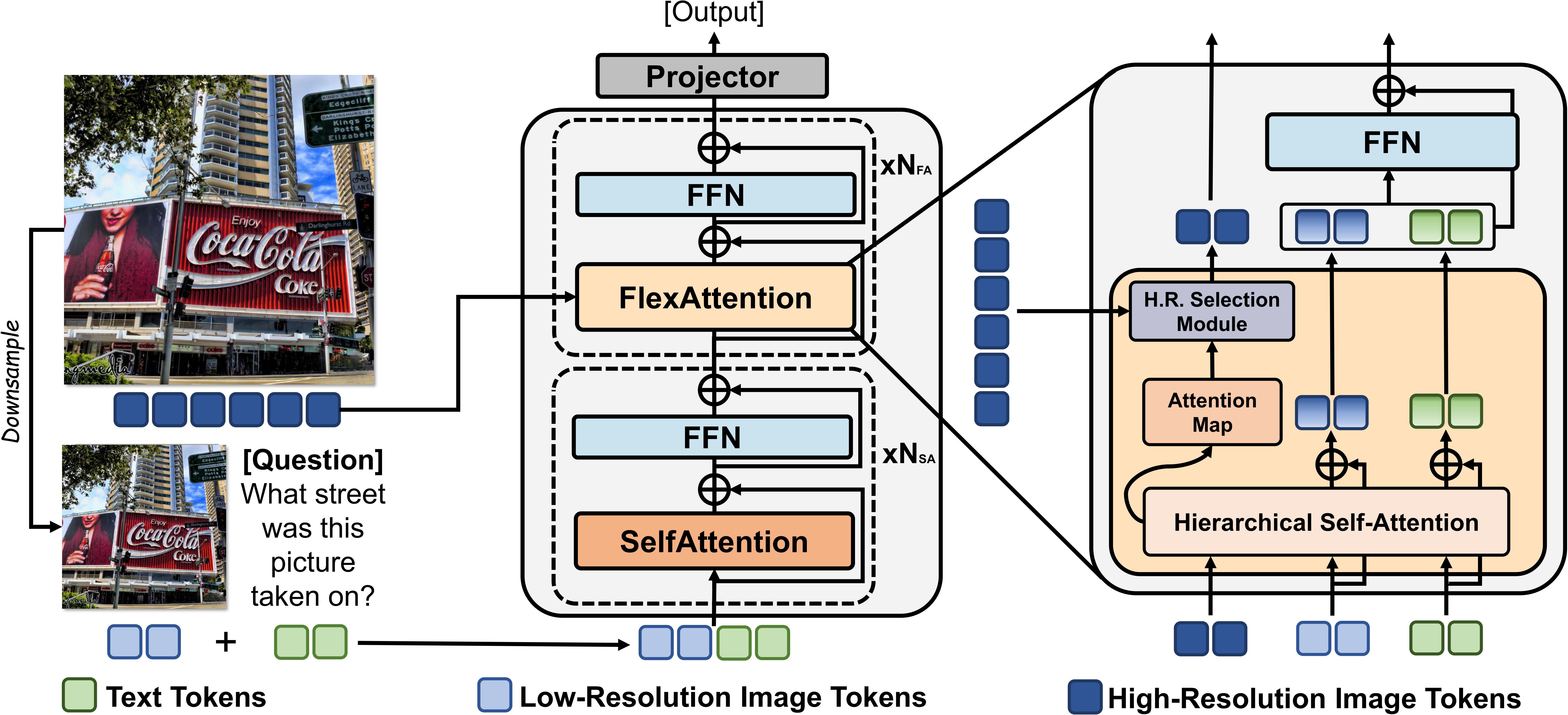
This repository contains the official code for FlexAttention for Efficient High-Resolution Vision-Language Models.
News
- Jan 2025: Training documentation released.
- July 2024: Open-source codebase and evaluation.
- July 2024: Accepted by ECCV'2024!
Installation
conda create -n flexattention python=3.9
conda activate flexattention
pip install -e .
pip install -e ".[train]"
pip install -e ./transformers
Checkpoint
You can download our 7B model checkpoint from huggingface and put it into checkpoints folder.
Evaluation
TextVQA
- Follow this instruction to download the textvqa evaluaton images and annotation, and extract to
datasets/eval/textvqa. - Run the multi-gpu inference:
torchrun --nproc_per_node 3 scripts/evaluation/eval_textvqa.py --dist --model-path checkpoints/llava-v1.5-7b-flexattn --id llava-v1.5-7b-flexattn
It will generate a file similar to answer_textvqa_llava-v1.5-7b-flexattn_xxx.jsonl on the folder root.
- Run the evaluation script:
bash scripts/evaluation/get_textvqa_score.sh ANSWER_FILE
V* Bench
- Download the dataset from huggingface.
git lfs install
git clone https://huggingface.co/datasets/craigwu/vstar_bench
- Run the multi-gpu inference:
# Attribute
torchrun --nproc_per_node 3 scripts/evaluation/eval_vbench.py --dist --model-path checkpoints/llava-v1.5-7b-flexattn --id llava-v1.5-7b-flexattn --subset direct_attributes

# Spatial
torchrun --nproc_per_node 3 scripts/evaluation/eval_vbench.py --dist --model-path checkpoints/llava-v1.5-7b-flexattn --id llava-v1.5-7b-flexattn --subset relative_position
MagnifierBench
-
Download the dataset from here, and extract it to
datasets/eval/. -
Run the multi-gpu inference:
torchrun --nproc_per_node 3 scripts/evaluation/eval_magnifier.py --dist --model-path checkpoints/llava-v1.5-7b-flexattn --id llava-v1.5-7b-flexattn
Training
Prepare Data
First, follow LLaVA's instruction to prepare the image and annotation. The overall folder structure will look like this:
playground
├── llava_v1_5_mix665k
       ├── llava_v1_5_mix665k.json
       ├── coco
       │   └── train2017
       ├── gqa
       │   └── images
       ├── ocr_vqa
       │   └── images
       ├── textvqa
       │   └── train_images
       └── vg
           ├── VG_100K
           └── VG_100K_2
Then, run the data cleaning script to clean the data.
python tools/prepare_data.py
In this script, we perform the following actions:
- Insert a placeholder
<image>tag for samples containing only text. - Correct any incorrect image file extensions found in the original data.
- Remove samples that use non-existent images.
You can directly download the prepared file here.
Start Training
Finally, run the training script:
bash scripts/train/llava-v1.5-7b-flexattn.sh
Acknowledgement
LLaVA: the codebase that our project build on. Thanks for their amazing code and model.
Citation
If our work is useful or relevant to your research, please kindly recognize our contributions by citing our paper:
@inproceedings{li2025flexattention,
  title={Flexattention for efficient high-resolution vision-language models},
  author={Li, Junyan and Chen, Delin and Cai, Tianle and Chen, Peihao and Hong, Yining and Chen, Zhenfang and Shen, Yikang and Gan, Chuang},
  booktitle={European Conference on Computer Vision},
  pages={286--302},
  year={2025},
  organization={Springer}
}
Similar repos


Languages
Python
99.4%
[ECCV 2024] FlexAttention for Efficient High-Resolution Vision-Language Models
Python
51
12 commits
updated Jan 8, 2025
README
FlexAttention for Efficient High-Resolution Vision-Language Models
[Project Page] [Paper]
Overview
This repository contains the official code for FlexAttention for Efficient High-Resolution Vision-Language Models.
News
- Jan 2025: Training documentation released.
- July 2024: Open-source codebase and evaluation.
- July 2024: Accepted by ECCV'2024!
Installation
conda create -n flexattention python=3.9
conda activate flexattention
pip install -e .
pip install -e ".[train]"
pip install -e ./transformers
Checkpoint
You can download our 7B model checkpoint from huggingface and put it into checkpoints folder.
Evaluation
TextVQA
- Follow this instruction to download the textvqa evaluaton images and annotation, and extract to
datasets/eval/textvqa. - Run the multi-gpu inference:
torchrun --nproc_per_node 3 scripts/evaluation/eval_textvqa.py --dist --model-path checkpoints/llava-v1.5-7b-flexattn --id llava-v1.5-7b-flexattn
It will generate a file similar to answer_textvqa_llava-v1.5-7b-flexattn_xxx.jsonl on the folder root.
- Run the evaluation script:
bash scripts/evaluation/get_textvqa_score.sh ANSWER_FILE
V* Bench
- Download the dataset from huggingface.
git lfs install
git clone https://huggingface.co/datasets/craigwu/vstar_bench
- Run the multi-gpu inference:
# Attribute
torchrun --nproc_per_node 3 scripts/evaluation/eval_vbench.py --dist --model-path checkpoints/llava-v1.5-7b-flexattn --id llava-v1.5-7b-flexattn --subset direct_attributes

# Spatial
torchrun --nproc_per_node 3 scripts/evaluation/eval_vbench.py --dist --model-path checkpoints/llava-v1.5-7b-flexattn --id llava-v1.5-7b-flexattn --subset relative_position
MagnifierBench
-
Download the dataset from here, and extract it to
datasets/eval/. -
Run the multi-gpu inference:
torchrun --nproc_per_node 3 scripts/evaluation/eval_magnifier.py --dist --model-path checkpoints/llava-v1.5-7b-flexattn --id llava-v1.5-7b-flexattn
Training
Prepare Data
First, follow LLaVA's instruction to prepare the image and annotation. The overall folder structure will look like this:
playground
├── llava_v1_5_mix665k
       ├── llava_v1_5_mix665k.json
       ├── coco
       │   └── train2017
       ├── gqa
       │   └── images
       ├── ocr_vqa
       │   └── images
       ├── textvqa
       │   └── train_images
       └── vg
           ├── VG_100K
           └── VG_100K_2
Then, run the data cleaning script to clean the data.
python tools/prepare_data.py
In this script, we perform the following actions:
- Insert a placeholder
<image>tag for samples containing only text. - Correct any incorrect image file extensions found in the original data.
- Remove samples that use non-existent images.
You can directly download the prepared file here.
Start Training
Finally, run the training script:
bash scripts/train/llava-v1.5-7b-flexattn.sh
Acknowledgement
LLaVA: the codebase that our project build on. Thanks for their amazing code and model.
Citation
If our work is useful or relevant to your research, please kindly recognize our contributions by citing our paper:
@inproceedings{li2025flexattention,
  title={Flexattention for efficient high-resolution vision-language models},
  author={Li, Junyan and Chen, Delin and Cai, Tianle and Chen, Peihao and Hong, Yining and Chen, Zhenfang and Shen, Yikang and Gan, Chuang},
  booktitle={European Conference on Computer Vision},
  pages={286--302},
  year={2025},
  organization={Springer}
}
Similar repos
Languages
Python
99.4%