
README
palm-infra
AI Infra projects from PalmAI Team. Currently includes mollm.
mollm
mobile-oriented LLM inference engine.
                 _ _
 _ __ ___   ___ | | |_ __ ___
| '_ ` _ \ / _ \| | | '_ ` _ \
| | | | | | (_) | | | | | | | |
|_| |_| |_|\___/|_|_|_| |_| |_|
mollm is a small C++ LLM runtime for ARM and x86 CPUs, with experimental
Apple Metal support. It converts supported Hugging Face model directories into
one .mollm file containing the graph, weights, tokenizer, and chat template,
then runs that package directly.
The current focus is fast local inference on Apple Silicon and other modern ARM
CPUs. FP16 uses NEON FP16FML kernels; quantized CPU models use weight-only int8
or int4 kernels optimized for ARM dot-product instructions. Linux x86_64 has
separately compiled scalar, AVX2/FMA/F16C, and AVX-512 providers for FP32,
FP16, W8, and packed W4G32/W4G128 matmul. Runtime CPUID dispatch selects the
widest supported tier without exposing newer instructions to older CPUs.
Set MOLLM_X86_ISA=scalar|avx2|avx512|auto to cap the selected tier for
testing or machine-specific tuning. The legacy
MOLLM_X86_DISABLE_AVX2=1 scalar override remains supported.
Large MoE models with SSD offload
mollm keeps dense weights in RAM and loads only routed experts from SSD into
a bounded shared cache. The same asynchronous offload path supports W4 models
as well as checkpoint-native FP8/MXFP4 and NVFP4 experts.
| Model | Expert cache | Prefill | Decode |
|---|---|---|---|
| Qwen3.5-122B-A10B W4 | 16 GiB | 51.06 t/s | 16.53 t/s |
| Qwen3.8-Flash-Next NVFP4 | 20 GiB | 16.2 t/s | 21.8 t/s † |
| DeepSeek-V4-Flash | 16 GiB | 9.52 t/s | 5.71 t/s |
| Hy3-295B-A21B W4G128 | 16 GiB | 10.57 t/s | 3.41 t/s |
† Best observed real-prompt run with eight CPU threads and a 20 GiB expert cache; the other rows use their documented four-thread / 16 GiB protocols.
Cache sweeps, I/O behavior, and tracing · Complete performance tables and protocols
What Works
| Model family | Status |
|---|---|
| Qwen3 dense text models | FP16, W8, W4 |
| Qwen3-30B-A3B MoE | text-only W4 path |
| Qwen3.6-35B-A3B MoE | text-only W4 path |
| Qwen3.5-122B-A10B MoE | CPU W4 with SSD expert offload |
| Qwen3.8-Flash-Next | text-only CPU inference with native NVFP4 expert SSD offload |
| Tencent Hy-MT2-30B-A3B | text-only W4 MoE; CPU and Metal |
| Tencent Hy3-295B-A21B | text-only W4 MoE with CPU SSD expert offload |
| Qwen3.5-0.8B / Qwen3.5-4B | FP16, W8, W4, mixed W4; experimental single-image vision |
| Youtu-LLM-2B | FP16, W8, W4, mixed W4 |
| RWKV7 | FP16, W8, mixed W4; recurrent CPU prefill/decode |
| DeepSeek-V4-Flash | Experimental CPU inference with native FP8/MXFP4 and SSD expert offload |
The most tested runtime path today is w4g128: it has the lowest memory use and
the fastest decode speed in mollm. All config-based converters also accept
w4g32 and w4mixg32. The smaller groups improve W4 quality at the cost of
more scales and potentially lower throughput; mixed modes reuse each model's
w4mixg128 policy for deciding which sensitive tensors remain W8.
Performance
CPU
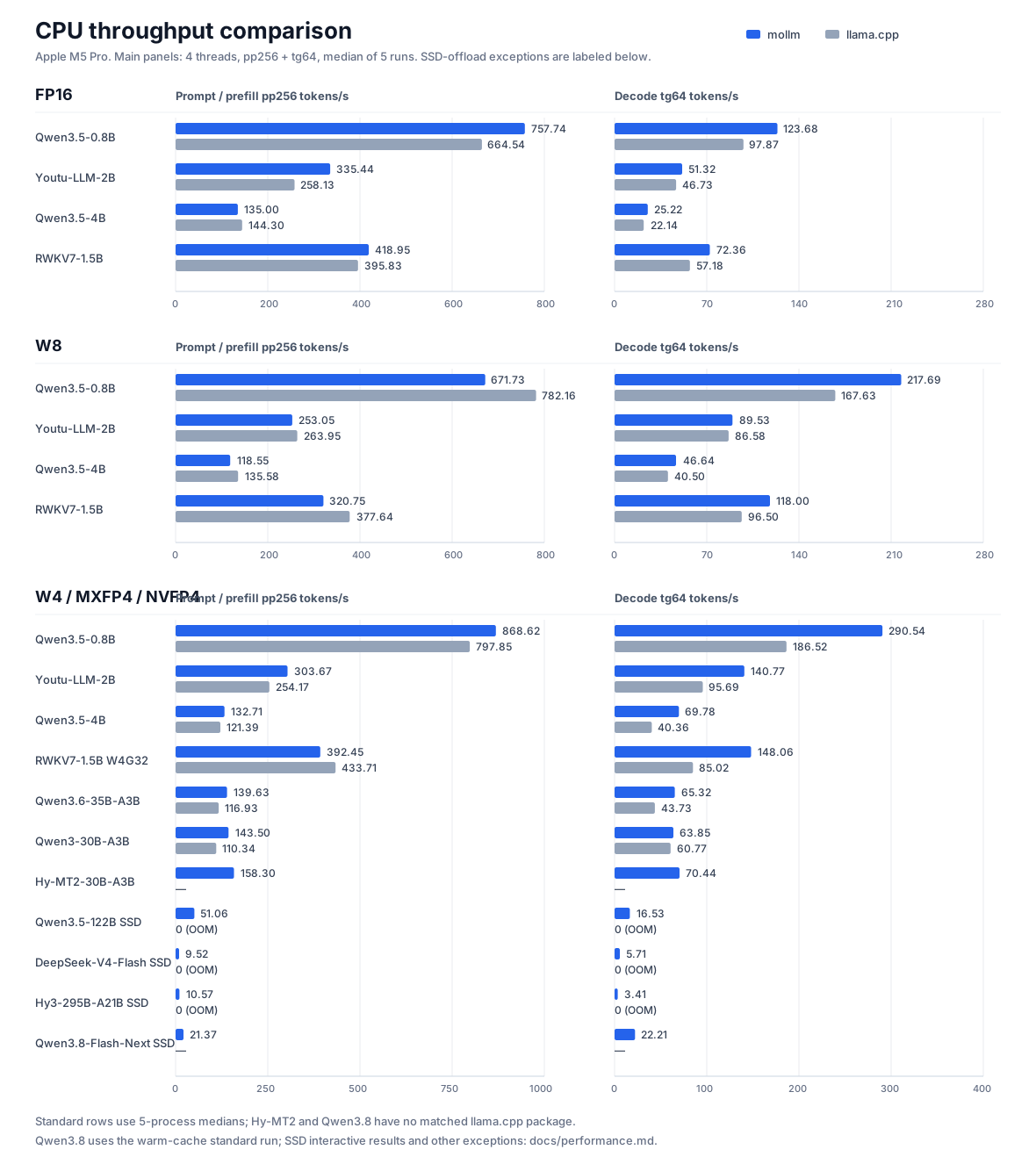
Apple M5 Pro results use four CPU threads, pp256 + tg64, warmup=3, and
independent-process medians unless noted.
Current W4 medians reach 140.77 decode tokens/s on Youtu-LLM-2B and 69.78 tokens/s on Qwen3.5-4B, respectively 1.47x and 1.73x the matched llama.cpp Q4_0 CPU results. All dense and recurrent W4 rows in the chart use current packages and binaries.
Metal (experimental)
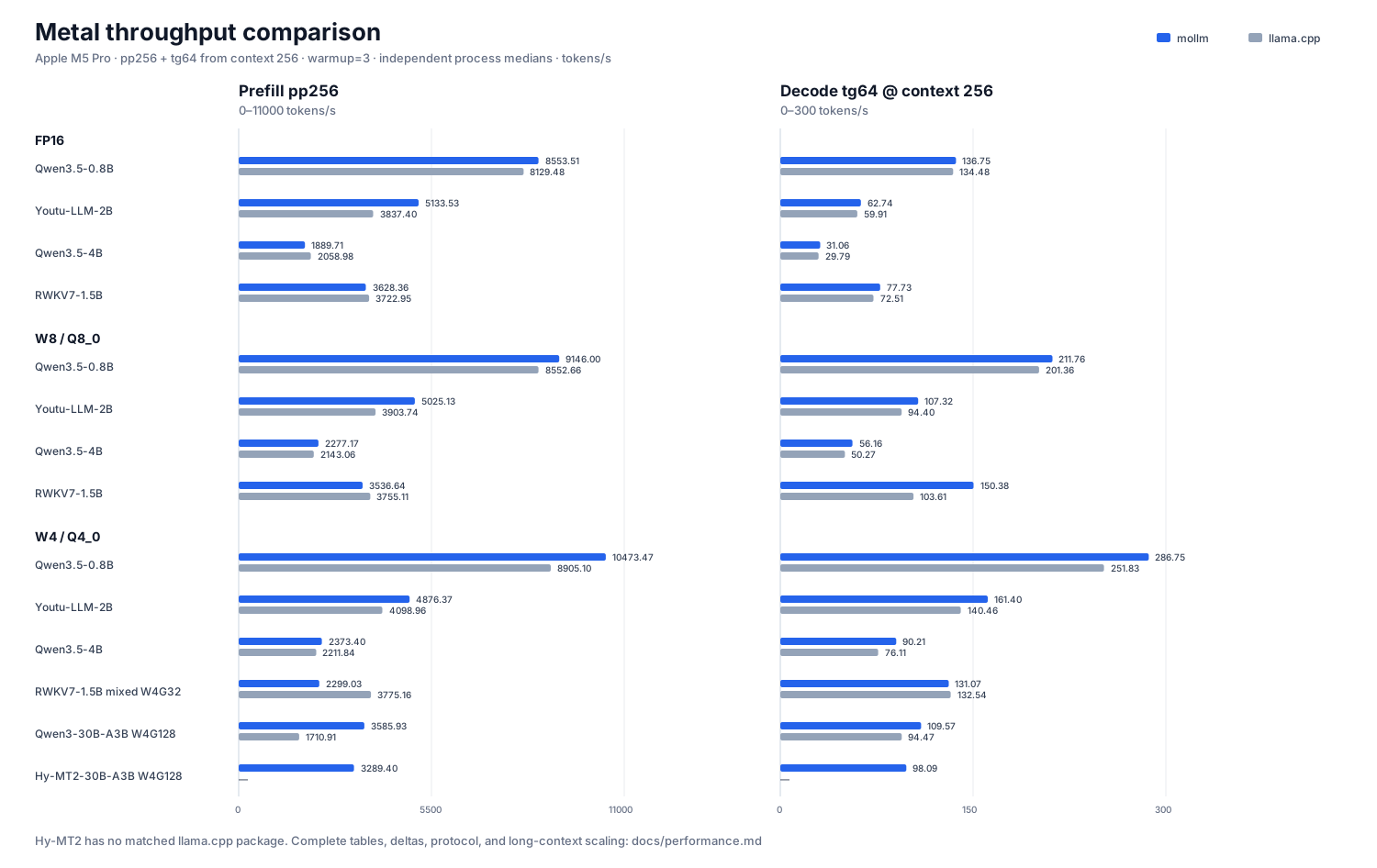
Apple M5 Pro Metal results use the same pp256 + tg64, warmup=3, and
independent-process median protocol. Decode starts with an existing 256-token
context, and both runtimes keep model weights on Metal.
Protocol, complete CPU and Metal tables, context scaling, and correctness gates
Why Decode Is Fast
- Highly optimized AArch64 GEMV kernels for FP16, W8, and W4 decode.
- Decode-friendly packed weight layouts, including direct W4G128 package layout.
- W4A8 decode aligns activation and weight groups at 128 values, accumulating four dot-product blocks in integer registers before applying their scale.
- Static reusable decode workspace to avoid per-token allocation churn.
- Prefill is still the main optimization target on dense models.
Quick Start
cmake -G Ninja -B build_i8mm -DCMAKE_BUILD_TYPE=Release
cmake --build build_i8mm -j

# Needed for W4 conversion.
cmake --build build_i8mm --target mollm-quantize

# Convert a Hugging Face model directory.
python3 models/converter.py /path/to/Qwen3.5-4B qwen35_4b_w4g128.mollm w4g128

# Chat from the single package file.
./build_i8mm/mollm_chat --package qwen35_4b_w4g128.mollm --threads 4
                 _ _
 _ __ ___   ___ | | |_ __ ___
| '_ ` _ \ / _ \| | | '_ ` _ \
| | | | | | (_) | | | | | | | |
|_| |_| |_|\___/|_|_|_| |_| |_|

 model     : Qwen3-30B-A3B
 arch      : qwen3-moe
 layers    : 48
 hidden    : 2048
 quant     : w4g128
 ctx       : 16384
 threads   : 4

 /reset   clear context
 /quit    exit


>
Interactive chat commands:
/reset   clear conversation context
/quit    exit
Build
Requirements:
- macOS/Apple Silicon, ARM Linux, or Linux x86_64
- CMake + Ninja or Make
- Python 3
- Python packages needed by conversion, especially
numpyandsafetensors
Recommended local build:
cmake -G Ninja -B build_i8mm -DCMAKE_BUILD_TYPE=Release
cmake --build build_i8mm -j
On ARM64, a compiler with i8mm support embeds the optimized kernels as separate
objects. Runtime HWCAP/sysctl probing selects them only on a compatible CPU;
the rest of the library remains on the NEON/DOTPROD baseline.
MOLLM_ARM_I8MM=OFF omits the i8mm objects, while
MOLLM_ARM_ISA=neon forces the runtime fallback for testing. A plain build/
directory also works; replace build_i8mm in the examples with your build
directory.
Convert Models
The converter auto-detects the model type from config.json.
# Default FP16 package.
python3 models/converter.py /path/to/Qwen3.5-4B qwen35_4b_fp16.mollm

# W8 int8 baseline.
python3 models/converter.py /path/to/Qwen3.5-4B qwen35_4b_w8pc.mollm w8pc

# W4 performance package.
python3 models/converter.py /path/to/Qwen3.5-4B qwen35_4b_w4g128.mollm w4g128

# Mixed W4 quality package.
python3 models/converter.py /path/to/Qwen3.5-4B qwen35_4b_w4mixg128.mollm w4mixg128

# Smaller-group W4, pure or with the same model-specific mixed policy.
python3 models/converter.py /path/to/Qwen3.5-4B qwen35_4b_w4g32.mollm w4g32
python3 models/converter.py /path/to/Qwen3.5-4B qwen35_4b_w4mixg32.mollm w4mixg32

# RWKV7
python3 models/rwkv7.py /path/to/rwkv7-g1h-1.5b.pth rwkv7_1.5b_w4mixg32.mollm --tokenizer /path/to/tokenizer.txt --quant w4mixg32
MoE example:
python3 models/converter.py \
    /path/to/Qwen3-30B-A3B \
    qwen3_30b_a3b_w4g128.mollm \
    w4g128
Experimental DeepSeek-V4-Flash conversion preserves its checkpoint-native FP8 and MXFP4 weights:
python3 models/deepseek_v4.py \
    /path/to/DeepSeek-V4-Flash \
    deepseek_v4_flash_native.mollm

./build_i8mm/mollm_chat \
    --package deepseek_v4_flash_native.mollm \
    --ssd-cache-mb 10240 --ssd-io-workers 8 --threads 6
Qwen3.8-Flash-Next conversion preserves the checkpoint's NVFP4 routed experts,
quantizes dense weights to W4G32, and stores lm_head as per-channel W8:
python3 models/converter.py \
    /path/to/Qwen3.8-Flash-Next-NVFP4 \
    qwen38_flash_next_nvfp4.mollm

./build_i8mm/mollm_chat \
    --package qwen38_flash_next_nvfp4.mollm \
    --ssd-cache-mb 16384 --ssd-io-workers 8 --threads 4
Supported config.json model types:
model_type | Supported models |
|---|---|
qwen3 | Qwen3 dense text models |
qwen3_moe | Qwen3 MoE text models |
qwen3_5 | Qwen3.5 dense text and single-image vision models |
qwen3_5_moe | Qwen3.5/3.6 MoE text models |
qwen4_exp | Qwen3.8-Flash-Next text model with native NVFP4 experts |
hy_v3 | Tencent HY-V3 / Hy-MT2 MoE text models |
youtu | Youtu-LLM MLA models |
RWKV7 .pth | Use models/rwkv7.py directly. |
deepseek_v4 | Use the experimental models/deepseek_v4.py converter directly. |
Quantization choices:
| Mode | Use when |
|---|---|
fp16 | You want the simplest baseline and have enough memory. |
w8pc | You want int8 weight-only quantization with small quality drift. |
w4g128 | You want the smallest package and fastest decode. This is the usual performance choice. |
w4mixg128 | Pure W4 quality is too low and you can spend more memory for selected W8 tensors. |
w4g32 | You want better W4 quality from smaller 32-value groups and accept extra scales and possible throughput loss. |
w4mixg32 | You want W4G32 plus the same model-specific W8 tensor promotions used by w4mixg128. |
Notes:
- DeepSeek-V4-Flash uses checkpoint-native FP8 E4M3 block-128 quantized dense/shared-expert weights and MXFP4 E2M1/E8M0 group-32 routed experts instead of the conversion modes above.
- Qwen3.8-Flash-Next uses checkpoint-native NVFP4 routed experts, offline
W4G32 dense weights, and a per-channel W8
lm_head. - W4 conversion requires the
mollm-quantizehelper built from C++. - FP16 and W8 conversion do not require that helper.
- The prefill graph is built with an internal 256-token chunk size, but CPU
runtime prefill is dynamic: short prompts are not padded to 256 unless you
explicitly pass
--static-padded. - Converted packages store a user-facing model name from the Hugging Face config
or model directory, so chat displays names such as
Qwen3-30B-A3B.
Run Chat
./build_i8mm/mollm_chat --package qwen35_4b_w4g128.mollm --threads 4
One-shot deterministic smoke test:
./build_i8mm/mollm_chat \
    --package qwen35_4b_w4g128.mollm \
    --prompt "请只输出一句话,不要解释:杭州有什么特点?" \
    --max-new-tokens 64 \
    --threads 4 \
    --temperature 0
Experimental Qwen3.5 single-image chat (macOS, CPU vision encoder):
./build_i8mm/mollm_chat \
    --package qwen35_0.8b_w4g128.mollm \
    --image photo.png \
    --prompt "Describe this image." \
    --max-new-tokens 128
The converter packages the checkpoint's FP16 vision tower alongside the
quantized text model. The first implementation supports one static image in
single-shot chat; multi-image/video input, server integration, and Metal vision
execution are not enabled yet. Images default to a 262,144-pixel resize budget
(roughly 512x512); use --image-max-pixels to trade speed for detail, up to
1,048,576 pixels. Use converter option --text-only when the vision tower is
not needed, avoiding its package and resident-memory overhead.
Sampled generation:
./build_i8mm/mollm_chat \
    --package qwen35_4b_w4g128.mollm \
    --temperature 0.8 --top-p 0.95 --top-k 40 --min-p 0.05 \
    --repeat-penalty 1.05 --repeat-last-n 128 --seed 42
OpenAI-style --presence-penalty and --frequency-penalty are also
available. Run mollm_chat --help for ranges and defaults.
MoE chat:
./build_i8mm/mollm_chat --package qwen3_30b_a3b_w4g128.mollm --threads 4
By default, mollm_chat loads package weights into resident memory. For mmap
A/B testing, pass --mmap; mmap page warmup is enabled unless you also pass
--no-load-warmup.
Benchmark
Standard mollm benchmark:
./build_i8mm/mollm_bench \
    --package qwen35_4b_w4g128.mollm \
    --prompt-tokens 256 \
    --max-new-tokens 64 \
    --warmup 3 \
    --threads 4
CUDA correctness backend
CUDA support can be built independently of the CPU provider:
cmake -S . -B build_cuda -DCMAKE_BUILD_TYPE=Release -DMOLLM_CUDA=ON
cmake --build build_cuda -j
./build_cuda/mollm_chat --device cuda --package model.mollm
Explicitly selecting CUDA now requires a working CUDA backend instead of
silently falling back to CPU. Add --require-native to reject any operator
that would use the CPU reference implementation.
The CUDA backend is still a correctness-first implementation. Graph outputs
and persistent state use device-addressable managed storage, FP16/FP32 linear
layers run through cuBLAS. W8 weights remain quantized on device: decode uses
a native GEMV kernel, while prefill dequantizes one matrix at a time into
reusable FP16 scratch before cuBLAS. Package-native W4G32/W4G128 weights use
the same policy with packed decode kernels and reusable prefill scratch.
RMSNorm and fused norm paths,
dense elementwise operations, common activations, SwiGLU, RoPE, strided layout
materialization, FP32 cached SDPA, zero-copy views, and the decode lm_head also
stay on CUDA. Operators not yet implemented natively synchronize and use the
CPU reference dispatcher over the managed buffers. Set
MOLLM_CUDA_PROFILE=1 to print native/fallback operator counts. Recurrent
Gated DeltaNet/short-convolution operators and several specialized model
families still fall back, so this is not yet a performance-complete CUDA
backend.
Local HTTP server
./build_i8mm/mollm_server \
    --package qwen35_4b_w4g128.mollm \
    --host 127.0.0.1 --port 8080 --threads 4
The initial server implements GET /v1/models and OpenAI-compatible
POST /v1/chat/completions, including SSE streaming. It also retains a
single exact token-prefix KV cache between serialized requests. Sampling
parameters can be set per request; the default remains deterministic
(temperature=0). See SERVER.md for fields, examples, and
limitations.
Project Layout
mollm/
├── kernels/    ARM kernels for matmul, attention, MoE, norm, rope
├── graph/      Graph format, executor, mmap package loading, BufferPool
├── engine/     LLMEngine, tokenizer, chat/generation lifecycle
├── models/     Python converters and graph builders
├── examples/   mollm_chat, mollm_server, mollm_bench, mollm_ppl
└── tests/      Unit, stress, and end-to-end tests
Roadmap
- Prefill performance optimization, especially for W8/W4 dense-model prompt processing.
- Improve experimental Metal performance, especially quantized prefill, MoE prefill, and CPU/GPU synchronization overhead.
- Full prefix caching for serving workloads, building on the current single-user REPL cache.
- Broader accelerator coverage while keeping the CPU runtime as the portable baseline.
- More model families beyond the current Qwen, Youtu, and Qwen-MoE coverage.
- Broader vision support beyond the current Qwen3.5 single-image path, including multi-image/video input, serving, and Metal execution.
- Speculative decoding for DeepSeek-V4, starting with native MTP and exploring DSpark-style confidence-scheduled semi-autoregressive drafting.
- Keep optimizing SSD offload.
License
Copyright 2026 Tencent. Licensed under the Apache License 2.0. See LICENSE and NOTICE. Bundled dependency notices are in THIRD_PARTY_NOTICES.md.
Acknowledgments
Significant stargazers

37 followers · starred Jul 2026
Similar repos


Languages
C++
60.6%
Python
11.6%
Metal
10.3%
Objective-C++
10.2%
Cuda
5.5%
README
palm-infra
AI Infra projects from PalmAI Team. Currently includes mollm.
mollm
mobile-oriented LLM inference engine.
                 _ _
 _ __ ___   ___ | | |_ __ ___
| '_ ` _ \ / _ \| | | '_ ` _ \
| | | | | | (_) | | | | | | | |
|_| |_| |_|\___/|_|_|_| |_| |_|
mollm is a small C++ LLM runtime for ARM and x86 CPUs, with experimental
Apple Metal support. It converts supported Hugging Face model directories into
one .mollm file containing the graph, weights, tokenizer, and chat template,
then runs that package directly.
The current focus is fast local inference on Apple Silicon and other modern ARM
CPUs. FP16 uses NEON FP16FML kernels; quantized CPU models use weight-only int8
or int4 kernels optimized for ARM dot-product instructions. Linux x86_64 has
separately compiled scalar, AVX2/FMA/F16C, and AVX-512 providers for FP32,
FP16, W8, and packed W4G32/W4G128 matmul. Runtime CPUID dispatch selects the
widest supported tier without exposing newer instructions to older CPUs.
Set MOLLM_X86_ISA=scalar|avx2|avx512|auto to cap the selected tier for
testing or machine-specific tuning. The legacy
MOLLM_X86_DISABLE_AVX2=1 scalar override remains supported.
Large MoE models with SSD offload
mollm keeps dense weights in RAM and loads only routed experts from SSD into
a bounded shared cache. The same asynchronous offload path supports W4 models
as well as checkpoint-native FP8/MXFP4 and NVFP4 experts.
| Model | Expert cache | Prefill | Decode |
|---|---|---|---|
| Qwen3.5-122B-A10B W4 | 16 GiB | 51.06 t/s | 16.53 t/s |
| Qwen3.8-Flash-Next NVFP4 | 20 GiB | 16.2 t/s | 21.8 t/s † |
| DeepSeek-V4-Flash | 16 GiB | 9.52 t/s | 5.71 t/s |
| Hy3-295B-A21B W4G128 | 16 GiB | 10.57 t/s | 3.41 t/s |
† Best observed real-prompt run with eight CPU threads and a 20 GiB expert cache; the other rows use their documented four-thread / 16 GiB protocols.
Cache sweeps, I/O behavior, and tracing · Complete performance tables and protocols
What Works
| Model family | Status |
|---|---|
| Qwen3 dense text models | FP16, W8, W4 |
| Qwen3-30B-A3B MoE | text-only W4 path |
| Qwen3.6-35B-A3B MoE | text-only W4 path |
| Qwen3.5-122B-A10B MoE | CPU W4 with SSD expert offload |
| Qwen3.8-Flash-Next | text-only CPU inference with native NVFP4 expert SSD offload |
| Tencent Hy-MT2-30B-A3B | text-only W4 MoE; CPU and Metal |
| Tencent Hy3-295B-A21B | text-only W4 MoE with CPU SSD expert offload |
| Qwen3.5-0.8B / Qwen3.5-4B | FP16, W8, W4, mixed W4; experimental single-image vision |
| Youtu-LLM-2B | FP16, W8, W4, mixed W4 |
| RWKV7 | FP16, W8, mixed W4; recurrent CPU prefill/decode |
| DeepSeek-V4-Flash | Experimental CPU inference with native FP8/MXFP4 and SSD expert offload |
The most tested runtime path today is w4g128: it has the lowest memory use and
the fastest decode speed in mollm. All config-based converters also accept
w4g32 and w4mixg32. The smaller groups improve W4 quality at the cost of
more scales and potentially lower throughput; mixed modes reuse each model's
w4mixg128 policy for deciding which sensitive tensors remain W8.
Performance
CPU
Apple M5 Pro results use four CPU threads, pp256 + tg64, warmup=3, and
independent-process medians unless noted.
Current W4 medians reach 140.77 decode tokens/s on Youtu-LLM-2B and 69.78 tokens/s on Qwen3.5-4B, respectively 1.47x and 1.73x the matched llama.cpp Q4_0 CPU results. All dense and recurrent W4 rows in the chart use current packages and binaries.
Metal (experimental)
Apple M5 Pro Metal results use the same pp256 + tg64, warmup=3, and
independent-process median protocol. Decode starts with an existing 256-token
context, and both runtimes keep model weights on Metal.
Protocol, complete CPU and Metal tables, context scaling, and correctness gates
Why Decode Is Fast
- Highly optimized AArch64 GEMV kernels for FP16, W8, and W4 decode.
- Decode-friendly packed weight layouts, including direct W4G128 package layout.
- W4A8 decode aligns activation and weight groups at 128 values, accumulating four dot-product blocks in integer registers before applying their scale.
- Static reusable decode workspace to avoid per-token allocation churn.
- Prefill is still the main optimization target on dense models.
Quick Start
cmake -G Ninja -B build_i8mm -DCMAKE_BUILD_TYPE=Release
cmake --build build_i8mm -j

# Needed for W4 conversion.
cmake --build build_i8mm --target mollm-quantize

# Convert a Hugging Face model directory.
python3 models/converter.py /path/to/Qwen3.5-4B qwen35_4b_w4g128.mollm w4g128

# Chat from the single package file.
./build_i8mm/mollm_chat --package qwen35_4b_w4g128.mollm --threads 4
                 _ _
 _ __ ___   ___ | | |_ __ ___
| '_ ` _ \ / _ \| | | '_ ` _ \
| | | | | | (_) | | | | | | | |
|_| |_| |_|\___/|_|_|_| |_| |_|

 model     : Qwen3-30B-A3B
 arch      : qwen3-moe
 layers    : 48
 hidden    : 2048
 quant     : w4g128
 ctx       : 16384
 threads   : 4

 /reset   clear context
 /quit    exit


>
Interactive chat commands:
/reset   clear conversation context
/quit    exit
Build
Requirements:
- macOS/Apple Silicon, ARM Linux, or Linux x86_64
- CMake + Ninja or Make
- Python 3
- Python packages needed by conversion, especially
numpyandsafetensors
Recommended local build:
cmake -G Ninja -B build_i8mm -DCMAKE_BUILD_TYPE=Release
cmake --build build_i8mm -j
On ARM64, a compiler with i8mm support embeds the optimized kernels as separate
objects. Runtime HWCAP/sysctl probing selects them only on a compatible CPU;
the rest of the library remains on the NEON/DOTPROD baseline.
MOLLM_ARM_I8MM=OFF omits the i8mm objects, while
MOLLM_ARM_ISA=neon forces the runtime fallback for testing. A plain build/
directory also works; replace build_i8mm in the examples with your build
directory.
Convert Models
The converter auto-detects the model type from config.json.
# Default FP16 package.
python3 models/converter.py /path/to/Qwen3.5-4B qwen35_4b_fp16.mollm

# W8 int8 baseline.
python3 models/converter.py /path/to/Qwen3.5-4B qwen35_4b_w8pc.mollm w8pc

# W4 performance package.
python3 models/converter.py /path/to/Qwen3.5-4B qwen35_4b_w4g128.mollm w4g128

# Mixed W4 quality package.
python3 models/converter.py /path/to/Qwen3.5-4B qwen35_4b_w4mixg128.mollm w4mixg128

# Smaller-group W4, pure or with the same model-specific mixed policy.
python3 models/converter.py /path/to/Qwen3.5-4B qwen35_4b_w4g32.mollm w4g32
python3 models/converter.py /path/to/Qwen3.5-4B qwen35_4b_w4mixg32.mollm w4mixg32

# RWKV7
python3 models/rwkv7.py /path/to/rwkv7-g1h-1.5b.pth rwkv7_1.5b_w4mixg32.mollm --tokenizer /path/to/tokenizer.txt --quant w4mixg32
MoE example:
python3 models/converter.py \
    /path/to/Qwen3-30B-A3B \
    qwen3_30b_a3b_w4g128.mollm \
    w4g128
Experimental DeepSeek-V4-Flash conversion preserves its checkpoint-native FP8 and MXFP4 weights:
python3 models/deepseek_v4.py \
    /path/to/DeepSeek-V4-Flash \
    deepseek_v4_flash_native.mollm

./build_i8mm/mollm_chat \
    --package deepseek_v4_flash_native.mollm \
    --ssd-cache-mb 10240 --ssd-io-workers 8 --threads 6
Qwen3.8-Flash-Next conversion preserves the checkpoint's NVFP4 routed experts,
quantizes dense weights to W4G32, and stores lm_head as per-channel W8:
python3 models/converter.py \
    /path/to/Qwen3.8-Flash-Next-NVFP4 \
    qwen38_flash_next_nvfp4.mollm

./build_i8mm/mollm_chat \
    --package qwen38_flash_next_nvfp4.mollm \
    --ssd-cache-mb 16384 --ssd-io-workers 8 --threads 4
Supported config.json model types:
model_type | Supported models |
|---|---|
qwen3 | Qwen3 dense text models |
qwen3_moe | Qwen3 MoE text models |
qwen3_5 | Qwen3.5 dense text and single-image vision models |
qwen3_5_moe | Qwen3.5/3.6 MoE text models |
qwen4_exp | Qwen3.8-Flash-Next text model with native NVFP4 experts |
hy_v3 | Tencent HY-V3 / Hy-MT2 MoE text models |
youtu | Youtu-LLM MLA models |
RWKV7 .pth | Use models/rwkv7.py directly. |
deepseek_v4 | Use the experimental models/deepseek_v4.py converter directly. |
Quantization choices:
| Mode | Use when |
|---|---|
fp16 | You want the simplest baseline and have enough memory. |
w8pc | You want int8 weight-only quantization with small quality drift. |
w4g128 | You want the smallest package and fastest decode. This is the usual performance choice. |
w4mixg128 | Pure W4 quality is too low and you can spend more memory for selected W8 tensors. |
w4g32 | You want better W4 quality from smaller 32-value groups and accept extra scales and possible throughput loss. |
w4mixg32 | You want W4G32 plus the same model-specific W8 tensor promotions used by w4mixg128. |
Notes:
- DeepSeek-V4-Flash uses checkpoint-native FP8 E4M3 block-128 quantized dense/shared-expert weights and MXFP4 E2M1/E8M0 group-32 routed experts instead of the conversion modes above.
- Qwen3.8-Flash-Next uses checkpoint-native NVFP4 routed experts, offline
W4G32 dense weights, and a per-channel W8
lm_head. - W4 conversion requires the
mollm-quantizehelper built from C++. - FP16 and W8 conversion do not require that helper.
- The prefill graph is built with an internal 256-token chunk size, but CPU
runtime prefill is dynamic: short prompts are not padded to 256 unless you
explicitly pass
--static-padded. - Converted packages store a user-facing model name from the Hugging Face config
or model directory, so chat displays names such as
Qwen3-30B-A3B.
Run Chat
./build_i8mm/mollm_chat --package qwen35_4b_w4g128.mollm --threads 4
One-shot deterministic smoke test:
./build_i8mm/mollm_chat \
    --package qwen35_4b_w4g128.mollm \
    --prompt "请只输出一句话,不要解释:杭州有什么特点?" \
    --max-new-tokens 64 \
    --threads 4 \
    --temperature 0
Experimental Qwen3.5 single-image chat (macOS, CPU vision encoder):
./build_i8mm/mollm_chat \
    --package qwen35_0.8b_w4g128.mollm \
    --image photo.png \
    --prompt "Describe this image." \
    --max-new-tokens 128
The converter packages the checkpoint's FP16 vision tower alongside the
quantized text model. The first implementation supports one static image in
single-shot chat; multi-image/video input, server integration, and Metal vision
execution are not enabled yet. Images default to a 262,144-pixel resize budget
(roughly 512x512); use --image-max-pixels to trade speed for detail, up to
1,048,576 pixels. Use converter option --text-only when the vision tower is
not needed, avoiding its package and resident-memory overhead.
Sampled generation:
./build_i8mm/mollm_chat \
    --package qwen35_4b_w4g128.mollm \
    --temperature 0.8 --top-p 0.95 --top-k 40 --min-p 0.05 \
    --repeat-penalty 1.05 --repeat-last-n 128 --seed 42
OpenAI-style --presence-penalty and --frequency-penalty are also
available. Run mollm_chat --help for ranges and defaults.
MoE chat:
./build_i8mm/mollm_chat --package qwen3_30b_a3b_w4g128.mollm --threads 4
By default, mollm_chat loads package weights into resident memory. For mmap
A/B testing, pass --mmap; mmap page warmup is enabled unless you also pass
--no-load-warmup.
Benchmark
Standard mollm benchmark:
./build_i8mm/mollm_bench \
    --package qwen35_4b_w4g128.mollm \
    --prompt-tokens 256 \
    --max-new-tokens 64 \
    --warmup 3 \
    --threads 4
CUDA correctness backend
CUDA support can be built independently of the CPU provider:
cmake -S . -B build_cuda -DCMAKE_BUILD_TYPE=Release -DMOLLM_CUDA=ON
cmake --build build_cuda -j
./build_cuda/mollm_chat --device cuda --package model.mollm
Explicitly selecting CUDA now requires a working CUDA backend instead of
silently falling back to CPU. Add --require-native to reject any operator
that would use the CPU reference implementation.
The CUDA backend is still a correctness-first implementation. Graph outputs
and persistent state use device-addressable managed storage, FP16/FP32 linear
layers run through cuBLAS. W8 weights remain quantized on device: decode uses
a native GEMV kernel, while prefill dequantizes one matrix at a time into
reusable FP16 scratch before cuBLAS. Package-native W4G32/W4G128 weights use
the same policy with packed decode kernels and reusable prefill scratch.
RMSNorm and fused norm paths,
dense elementwise operations, common activations, SwiGLU, RoPE, strided layout
materialization, FP32 cached SDPA, zero-copy views, and the decode lm_head also
stay on CUDA. Operators not yet implemented natively synchronize and use the
CPU reference dispatcher over the managed buffers. Set
MOLLM_CUDA_PROFILE=1 to print native/fallback operator counts. Recurrent
Gated DeltaNet/short-convolution operators and several specialized model
families still fall back, so this is not yet a performance-complete CUDA
backend.
Local HTTP server
./build_i8mm/mollm_server \
    --package qwen35_4b_w4g128.mollm \
    --host 127.0.0.1 --port 8080 --threads 4
The initial server implements GET /v1/models and OpenAI-compatible
POST /v1/chat/completions, including SSE streaming. It also retains a
single exact token-prefix KV cache between serialized requests. Sampling
parameters can be set per request; the default remains deterministic
(temperature=0). See SERVER.md for fields, examples, and
limitations.
Project Layout
mollm/
├── kernels/    ARM kernels for matmul, attention, MoE, norm, rope
├── graph/      Graph format, executor, mmap package loading, BufferPool
├── engine/     LLMEngine, tokenizer, chat/generation lifecycle
├── models/     Python converters and graph builders
├── examples/   mollm_chat, mollm_server, mollm_bench, mollm_ppl
└── tests/      Unit, stress, and end-to-end tests
Roadmap
- Prefill performance optimization, especially for W8/W4 dense-model prompt processing.
- Improve experimental Metal performance, especially quantized prefill, MoE prefill, and CPU/GPU synchronization overhead.
- Full prefix caching for serving workloads, building on the current single-user REPL cache.
- Broader accelerator coverage while keeping the CPU runtime as the portable baseline.
- More model families beyond the current Qwen, Youtu, and Qwen-MoE coverage.
- Broader vision support beyond the current Qwen3.5 single-image path, including multi-image/video input, serving, and Metal execution.
- Speculative decoding for DeepSeek-V4, starting with native MTP and exploring DSpark-style confidence-scheduled semi-autoregressive drafting.
- Keep optimizing SSD offload.
License
Copyright 2026 Tencent. Licensed under the Apache License 2.0. See LICENSE and NOTICE. Bundled dependency notices are in THIRD_PARTY_NOTICES.md.
Acknowledgments
Similar repos
Significant stargazers
37 followers · starred Jul 2026
Languages
C++
60.6%
Python
11.6%
Metal
10.3%
Objective-C++
10.2%
Cuda
5.5%