
⚡ Native MLX Swift LLM inference server for Apple Silicon. OpenAI-compatible API, SSD streaming for 100B+ MoE models, TurboQuant KV cache compression, MACOS + iOS iPhone app.
Swift
772
617 commits
updated Sep 23, 2026
README
⚡️ SwiftLM
A blazingly fast, native Swift inference server that serves MLX models with a strict OpenAI-compatible API.
No Python runtime, no Global Interpreter Lock (GIL), no unnecessary memory copies. Just bare-metal Apple Silicon performance compiled to a single binary.
🏁 Getting Started
Fastest: Download Pre-built Binary
Download the latest release tarball from the Releases page.
The archive is self-contained — mlx.metallib is bundled alongside the binary.
tar -xzf SwiftLM-<version>-macos-arm64.tar.gz
./SwiftLM --model mlx-community/Qwen2.5-3B-Instruct-4bit --port 5413
Build from Source
The build script handles everything: submodules, cmake, Metal kernel compilation, and the Swift build.
git clone --recursive https://github.com/SharpAI/SwiftLM
cd SwiftLM
./build.sh
This will:
- Initialize git submodules
- Install
cmakevia Homebrew (if not already installed) - Compile
mlx.metallibfrom the Metal kernel sources - Build the
SwiftLMbinary in release mode
Then start the server (models download automatically if not cached):
.build/release/SwiftLM \
  --model mlx-community/gemma-4-26b-a4b-it-4bit \
  --port 5413
(Add --stream-experts when running oversized MoE models to bypass macOS virtual memory swapping and stream expert layers directly from NVMe SSD.)
📊 Performance: MTP Speculative Decoding — Gemma 4-26B (MacBook Pro M5 Pro 64 GB)
Benchmarked with gemma-4-26b-a4b-it-4bit running three configurations across 512 / 40K / 100K token contexts.
Generation Speed (tok/s) — higher is better
| Configuration | 512 tokens | 40K tokens | 100K tokens | Avg TPS* |
|---|---|---|---|---|
| Baseline | 70.8 | 34.3 | 25.8 | 36.6 |
| MTP Speculative | 71.5 (1.01×) | 38.4 (1.12×) | 29.1 (1.13×) | 40.3 |
| MTP + TurboQuant ⭐ | 72.1 (1.02×) | 65.2 (1.90×) | 62.1 (2.41×) | 66.2 |
* Time-weighted average: total_tokens / sum(60/TPS) — correct wall-clock representation vs arithmetic mean.
Time to First Token (seconds) — lower is better
| Configuration | 512 tokens | 40K tokens | 100K tokens |
|---|---|---|---|
| Baseline | 0.64s | 22.85s | 63.11s |
| MTP Speculative | 0.34s | 20.45s | 55.17s |
| MTP + TurboQuant ⭐ | 0.33s | 13.17s | 33.95s |
GPU Memory (allocated / peak physical RAM)
| Configuration | 512 tokens | 40K tokens | 100K tokens |
|---|---|---|---|
| Baseline | 20.4 GB / 15.8 GB | 54.8 GB / 19.3 GB | 54.3 GB / 23.3 GB |
| MTP Speculative | 20.4 GB / 16.0 GB | 54.6 GB / 20.8 GB | 54.3 GB / 23.1 GB |
| MTP + TurboQuant ⭐ | 20.3 GB / 15.8 GB | 23.9 GB / 17.3 GB | 26.4 GB / 18.2 GB |
Key takeaways:
- 🚀 1.81× avg throughput — MTP + TurboQuant delivers 66.2 tok/s time-weighted vs 36.6 tok/s baseline
- 🏎️ Nearly 2× faster TTFT at 100K context — 33.95s vs 63.11s baseline (46% reduction)
- 💾 Massive memory savings at long context — GPU allocation drops from 54.8 GB → 23.9 GB at 40K tokens (TurboQuant KV compression)
- 🔬 MTP alone is free — 1.10× time-weighted TPS and lower TTFT with zero additional memory overhead
Run
python3 -u scripts/profiling/profile_runner.py --model gemma-4-26b-a4b-it-4bit --contexts "512,40000,100000"to reproduce on your device.
📊 Performance: Gemma 4-26B on Apple Silicon
Benchmark results for gemma-4-26b-a4b-it-4bit (26B MoE, ~4B active params/token, 4-bit) on M5 Pro 64 GB.
⚠️ This is a Mixture-of-Experts (MoE) model, not a dense model. Each token activates ~4B of the 26B parameters. "Vanilla" = all experts loaded into unified RAM (no SSD streaming).
Headline Numbers — gemma-4-26b-a4b-it-4bit (4-bit MoE)
Benchmarked on M5 Pro 64 GB ·
gemma-4-26b-a4b-it-4bit·./run_benchmark.shOption 13 Values shown asgeneration TPS · OS RAM used(TTFT excluded from speed measurement)
| Configuration | 512 ctx | 40K ctx | 100K ctx |
|---|---|---|---|
| Vanilla (full-RAM MoE) | 77.5 tok/s · 14.6 GB | 44.3 tok/s · 48.7 GB | 27.5 tok/s · 48.5 GB |
| Vanilla + MTP | 72.7 tok/s · 16.6 GB | 44.9 tok/s · 49.4 GB | 37.5 tok/s · 49.3 GB |
| Vanilla + TurboQuant | 77.3 tok/s · 14.7 GB | 70.1 tok/s · 18.2 GB | 66.9 tok/s · 20.7 GB |
| Vanilla + MTP + TurboQuant | 73.5 tok/s · 16.6 GB | 53.8 tok/s · 19.7 GB | 32.8 tok/s · 22.0 GB |
| SSD Stream | 10.8 tok/s · 22.2 GB | 10.4 tok/s · 24.2 GB | 9.0 tok/s · 27.6 GB |
| SSD + TurboQuant | 11.4 tok/s · 22.0 GB | 2.5 tok/s · 22.5 GB | 1.6 tok/s · 22.3 GB |
GPU Peak physical RAM (from
ioreg): Vanilla 100K peaks at 21.8 GB in-use · TurboQuant 100K stays at 17.1 GB in-use
Key takeaways (4-bit):
- 🚀 TurboQuant is the headline win: At 100K context,
Vanilla + TurboQuantdelivers 66.9 tok/s vs 27.5 tok/s Vanilla — a 2.43× speedup. - 💾 Massive memory savings: OS RAM at 40K context drops from 48.7 GB → 18.2 GB with TurboQuant (63% reduction).
- ⚡ MTP neutral on 4-bit MoE: The 4-bit model is compute-bound (MoE expert dispatch). Batch verification scales linearly with token count, so MTP provides no net throughput gain over vanilla at 4-bit.
- ⚠️ TQ + MTP undercuts TQ alone: Adding MTP to a TurboQuant server removes the bandwidth bottleneck (KV is now tiny) but not the FFN compute — MTP then adds overhead without proportional gains.
- 🖥️ SSD Stream for 24 GB Macs: Enables long-context inference with only ~22–27 GB RAM across all context depths.
Headline Numbers — gemma-4-26b-a4b-it-8bit (8-bit, bandwidth-bound)
Benchmarked on M5 Pro 64 GB ·
gemma-4-26b-a4b-it-8bit·./run_benchmark.shOption 13
| Configuration | 512 ctx | 40K ctx | 100K ctx |
|---|---|---|---|
| Vanilla | 53.7 tok/s · 26.1 GB | 32.4 tok/s · 49.4 GB | 14.9 tok/s · 49.3 GB |
| Vanilla + MTP ⭐ | 47.1 tok/s · 28.0 GB | 38.8 tok/s (+20%) · 49.6 GB | 22.5 tok/s (+51%) · 49.6 GB |
| Vanilla + TurboQuant | 53.5 tok/s · 26.1 GB | 50.1 tok/s · 29.6 GB | 48.3 tok/s · 32.0 GB |
| Vanilla + MTP + TurboQuant | 47.4 tok/s · 28.0 GB | 31.0 tok/s · 31.1 GB | 23.3 tok/s · 33.3 GB |
Key takeaways (8-bit):
- 🎯 MTP works at 8-bit: The 8-bit model is bandwidth-bound (2× heavier weights than 4-bit). The KV reads in the 3-token verification batch amortize across all 3 queries — so batch verification costs ~1.3× vanilla while producing 2+ tokens. Net: +20% at 40K, +51% at 100K.
- 🚀 TurboQuant still wins outright: At 100K, TurboQuant alone gives 48.3 tok/s vs MTP's 22.5 tok/s — TQ eliminates memory pressure and achieves 3.24× speedup over vanilla.
- ❌ Don't combine TQ + MTP on 8-bit: TurboQuant compresses the KV cache 4×, removing the bandwidth bottleneck and making MTP compute-bound again — TQ+MTP (31.0) is slower than TQ alone (50.1) at 40K.
- 💡 Precision-dependent guidance: Use
--mtpfor 8-bit models at 40K+ contexts without TurboQuant. Use--turbo-kv(without MTP) when maximum throughput or memory efficiency is the priority.
Run
./run_benchmark.sh→ Option 13 to reproduce these metrics on your own device.
Qwen3.6-35B-A3B-UD-MLX-4bit (Full-RAM) — M1 Ultra 64 GB
Benchmark results for full-RAM (no SSD streaming) MoE inference on M1 Ultra. The 3.4× vanilla improvement vs. earlier builds comes from the needsMoeFlush gate in mlx-swift-lm (see SwiftLM #84) — the per-layer GPU sync barrier required for SSD streaming was firing unconditionally on the full-RAM path and flushing MLX's kernel-batching pipeline.
| Configuration | Short (~126 tok) | Medium (~400 tok) | Long (~800 tok) |
|---|---|---|---|
| Vanilla full-GPU | 61.7 tok/s | 62.3 tok/s | 62.1 tok/s |
Hardware: Apple M1 Ultra, 64 GB unified memory, macOS 26.x. Model ~20 GB on disk, ~21.6 GB resident weight + ~2.1 GB KV at runtime. Flags:
--repeat-penalty 1.1 --max-tokens 2000,temperature: 0.6, single-stream/v1/chat/completions. Vanilla baseline beforeneedsMoeFlushgate (for reference): 19.2 / 18.1 / 18.3 tok/s — see #84.
⚠️ DFlash on this model is currently unsuitable for production. DFlash uses pure greedy (
argMax) decoding regardless oftemperature, which on Qwen3.6-35B-A3B + thez-lab/Qwen3.6-35B-A3B-DFlashdraft locks into low-entropy attractors ("and and and...","**UMA** **UMA**..."). Earlier 70 tok/s DFlash numbers were degenerate output that scored high acceptance because draft and target both committed to the same locked-in token. Repetition-penalty mitigation works on some prompts but tanks acceptance on others — the proper fix is stochastic posterior sampling with rejection-based accept (Leviathan/Chen formulation), which is a DFlash architecture change tracked at z-lab/dflash#91.
DeepSeek-V4-Flash (126 GB, Q3-mixed-gs128-affine) — M5 Pro 64 GB
Model: Thump604/DeepSeek-V4-Flash-MLX-Q3-mixed-gs128-affine
Dense/Vanilla and TurboQuant (non-SSD) configurations are skipped automatically — the 126 GB model exceeds physical RAM.
| Configuration | 512 ctx | 40K ctx |
|---|---|---|
| SSD Stream | 4.65 tok/s · 16.7 GB RAM | 0.32 tok/s · 12.5 GB RAM |
| SSD + TurboQuant | 4.78 tok/s · 16.8 GB RAM | 4.16 tok/s · 16.8 GB RAM |
| SSD + 16-Worker Prefetch | 4.43 tok/s · 16.6 GB RAM | 0.32 tok/s · 13.6 GB RAM |
Values shown as
generation speed · peak physical RAM used(sampled every 0.5s during prefill + generation). The 126 GB model streams the rest from NVMe SSD.
Key takeaways:
- 🏆 SSD + TurboQuant dominates at long context — 4.16 tok/s at 40K vs 0.32 tok/s for plain SSD Stream (13× faster). TurboQuant compresses the KV cache so far fewer layers need to stream from SSD per token.
- At 512-token context all configurations perform similarly (~4.4–4.8 tok/s); TurboQuant's advantage is KV-cache compression at long context.
- Peak physical RAM stays ≤ 17 GB across all configurations — the 126 GB model streams the rest from NVMe SSD.
🚀 Features
- 🍎 100% Native Apple Silicon: Powered natively by Metal and Swift.
- 🔌 OpenAI-compatible: Drop-in replacement for OpenAI SDKs (
/v1/chat/completions, streaming, etc). - 🧠 Smart Model Routing: Loads HuggingFace format models directly, with native Safetensors parsing.
- 👁️ Vision-Language Models (VLM): Native multimodal vision processing natively on Metal via the
--visionflag, supporting real-time base64 image parsing (e.g., Qwen2-VL, PaliGemma). - 🎧 Audio-Language Models (ALM): High-performance audio ingestion via the
--audioflag, decoding OpenAI-specinput_audiopayloads with AVFoundation WAV extraction. - ⚡️ TurboQuantization Integrated: Custom low-level MLX Metal primitives that apply extremely fast quantization for KV caching out-of-the-box.
- 💾 SSD Expert Streaming (10x): High-performance NVMe streaming that loads Mixture of Experts (MoE) layers directly from SSD to GPU — engineered by @ericjlake, achieving 10x speedup (0.58 → 5.91 tok/s) on 122B+ models with only ~10 GB resident memory. Uses cross-projection batching, concurrent pread (QD=24), asyncEval pipeline, and runtime top-k expert selection.
- 🔮 Speculative Decoding: Load a small draft model (e.g. 9B) alongside a large main model to generate candidate tokens and verify in bulk — accelerating in-RAM inference.
- 🎛️ Granular Memory Control: Integrated Layer Partitioning (
--gpu-layers) and Wisdom Auto-Calibration for squeezing massive models into RAM.
📡 Supported Models & Methodologies
SwiftLM dynamically maps Apple MLX primitives to standard HuggingFace architectures, enabling native Metal inference across the latest frontier open-weights models.
💬 Text (LLMs)
| Family | Models | Notes |
|---|---|---|
| Gemma 4 | gemma-4-e2b, gemma-4-e4b (dense) · gemma-4-26b-a4b, gemma-4-31b (MoE) | Interleaved local + global attention; KV sharing; native quantized KV cache (issue #71 fix) |
| Gemma 3 / 3n | gemma-3-*, gemma-3n-* | Google Gemma 3 and nano variants |
| Gemma / Gemma 2 | gemma-*, gemma-2-* | Original Gemma family |
| Qwen 3.5 | Qwen3.5-7B, Qwen3.5-27B, Qwen3.5-122B-A10B, Qwen3.5-397B-A22B | Dense + MoE; SSD streaming at 10× for 122B/397B |
| Qwen 3 | Qwen3-* (dense + MoE) | Sliding window + hybrid attention |
| Qwen 2.5 | Qwen2.5-7B, Qwen2.5-14B, Qwen2.5-72B | Robust RoPE scaling |
| Qwen 2 | Qwen2-* | Linear RoPE variants |
| Phi 4 / PhiMoE | phi-4-mlx, Phi-3.5-MoE | Microsoft Phi family incl. MoE |
| Phi 3 / Phi | Phi-3, Phi-3.5-mini | 128k context via chunked prefill |
| Mistral / Mixtral | Mistral-7B, Mistral-4, Mixtral-* | GQA + sliding window variants |
| Llama / Llama 3 | Llama-3.1-*, Llama-3.2-*, Llama-3.3-* | YaRN + dynamic NTK RoPE scaling |
| GLM 4 | GLM-4-* | THUDM GLM-4 dense + MoE-Lite variants |
| DeepSeek V3 | DeepSeek-V3-* | MLA attention architecture |
| Falcon H1 | Falcon-H1-* | Falcon hybrid SSM+attention |
| LFM 2 | LFM2-*, LFM2-MoE-* | Liquid AI dense + MoE |
| OLMo 2 / OLMo 3 / OLMoE | OLMo-2-*, OLMo-3-* | AllenAI open language models |
| Granite / GraniteMoE | Granite-*, GraniteMoE-Hybrid-* | IBM Granite hybrid Mamba+attention |
| SmolLM 3 | SmolLM3-* | HuggingFace compact LM |
| MiniCPM | MiniCPM-* | Lightweight efficient LM |
| InternLM 2 | InternLM2-* | Shanghai AI Lab series |
| Cohere / Command-R | Command-R-*, c4ai-* | Cohere retrieval-tuned models |
| Jamba | Jamba-v0.1 | AI21 hybrid Mamba+attention |
| Exaone 4 | EXAONE-4.0-* | LG AI Research |
| MiMo / MiMo V2 | MiMo-7B-* | Xiaomi reasoning model |
| Ernie 4.5 | ERNIE-4.5-* | Baidu ERNIE series |
| Baichuan M1 | Baichuan-M1-* | Baichuan multimodal base |
| Bailing MoE | Ling-* | Bailing/Ling MoE family |
| NemotronH | Nemotron-H-* | NVIDIA Nemotron hybrid |
| Starcoder 2 | starcoder2-* | Code generation |
| OpenELM | OpenELM-* | Apple on-device efficient LM |
| Apertus / AfMoE | Apertus-* | Sparse MoE research models |
| BitNet | bitnet-* | 1-bit weight quantization |
| MiniMax | MiniMax-Text-* | Lightning attention architecture |
| Olmo3 | Olmo3-* | AllenAI Olmo3 series |
👁️ Vision (VLMs)
Run with --vision flag.
| Family | Models | Notes |
|---|---|---|
| Gemma 4 | gemma-4-* (VLM mode) | Native image tower via MLXVLM |
| Gemma 3 | gemma-3-* (VLM mode) | PaLiGemma-style image projection |
| Qwen3-VL / Qwen3.5-VL | Qwen3-VL-*, Qwen3.5-VL-* | Dynamic resolution with native RoPE |
| Qwen2-VL / Qwen2.5-VL | Qwen2-VL-2B/7B, Qwen2.5-VL-* | Real-time positional bounding + Metal image scaling |
| LFM2-VL | LFM2-VL-1.6B | Liquid AI multimodal |
| Pixtral | pixtral-12b | Mistral vision model |
| PaliGemma | paligemma-* | Google vision-language |
| Idefics 3 | Idefics3-* | HuggingFace multimodal |
| Mistral 3 | Mistral-Small-3.1-* | Mistral vision variant |
| FastVLM | FastVLM-* | Apple on-device VLM |
| SmolVLM 2 | SmolVLM2-* | HuggingFace compact VLM |
| GLM OCR | glm-4v-* | THUDM vision+OCR |
| QwenVL | Qwen-VL-* | Original Qwen VL |
🎧 Audio (ALMs)
Run with --audio flag. Only gemma-4-e4b variants include an audio tower.
| Family | Models | Notes |
|---|---|---|
| Gemma 4 Omni | gemma-4-e4b-it-4bit, gemma-4-e4b-it-8bit | Audio-in via vDSP STFT → Mel spectrogram (16kHz, 128 bins); text-out |
📱 SwiftBuddy — iOS App
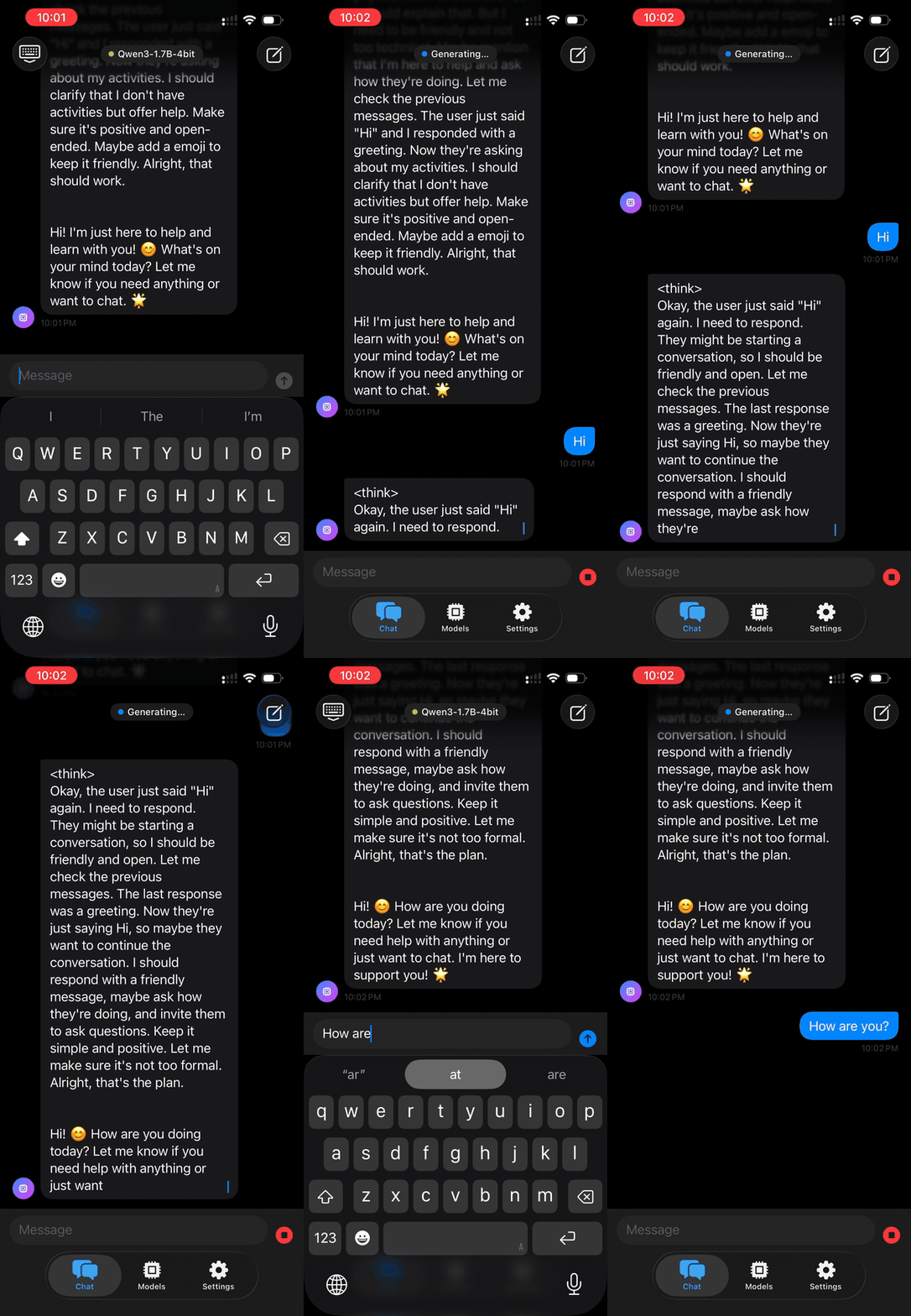
A native iPhone & iPad companion app that downloads MLX models directly from HuggingFace and runs inference on-device via MLX Swift.
Features
- Tab UI: Chat · Models · Settings
- Live download progress with speed indicator and circular progress ring
- Model catalog: Qwen3, Phi-3.5, Mistral, Llama — with on-device RAM fit indicators
- HuggingFace search — find any
mlx-communitymodel by name - Context-aware empty states — downloading ring, loading spinner, idle prompt
- iOS lifecycle hardened — model unload only fires on true background (not notification banners); 30-second grace period on app-switch
📱 Running live on iPhone 13 Pro (6 GB) — no Python, no server, no GIL. Pure on-device MLX inference via Metal GPU.
Build & Run (iOS)
cd SwiftBuddy
python3 generate_xcodeproj.py       # Generates SwiftBuddy.xcodeproj
open SwiftBuddy.xcodeproj
Then in Xcode:
- Select the SwiftBuddy target → Signing & Capabilities
- Set your Team (your Apple Developer account)
- Select your iPhone as the run destination
- ⌘R to build and run
Note for contributors: The
.xcodeprojis git-ignored (it contains your personal Team ID). Rungenerate_xcodeproj.pyafter cloning to regenerate it locally. Your Team ID is never committed.
⚡️ TurboQuantization: KV Cache Compression
SwiftLM implements a hybrid V2+V3 TurboQuant architecture for on-the-fly KV cache compression. At roughly ~3.6 bits per coordinate overall, the KV cache is compressed ~3.5× vs FP16 with near-zero accuracy loss.
By combining V2 Speed with V3 Quality:
Recent reproductions of the TurboQuant algorithm (e.g., turboquant-mlx) revealed two distinct paths:
- V2 (Hardware-Accelerated): Fast, but uses linear affine quantization which degrades quality at 3-bit.
- V3 (Paper-Correct): Excellent quality using non-linear Lloyd-Max codebooks, but painfully slow due to software dequantization.
We built the "Holy Grail" hybrid: We ported the V3 non-linear Lloyd-Max codebooks directly into the native C++ encoding path, and process the dequantization natively in fused Metal (bggml-metal) shaders. This achieves V3 quality at V2 speeds, completely detached from Python overhead.
The Algorithm:
K-Cache (3-bit PolarQuant + 1-bit QJL) = 4.25 bits/dim
- Extract L2 norm and normalize:
x̂ = x / ‖x‖ - Apply Fast Walsh-Hadamard Transform (WHT) rotation to distribute outliers evenly.
- Quantize each coordinate using 3-bit non-linear Lloyd-Max centroids.
- Compute the residual error between the original vector and the quantized approximation.
- Project the residual via a random Johnson-Lindenstrauss (QJL) matrix and store the 1-bit signs. (Why QJL? QJL acts as an additional regularizer that prevents centroid resolution loss from degrading the attention dot-product.)
V-Cache (3-bit PolarQuant) = 3.125 bits/dim Because the V-cache matrix is not used for inner-product attention scoring, the QJL error correction provides no benefit. We cleanly disable QJL for the V-cache, extracting an additional 25% memory savings without sacrificing quality.
Reference implementations: turboquant-mlx | turboquant_plus | Paper: TurboQuant, Google 2504.19874
💾 SSD Expert Streaming: 10x MoE Speedup
SwiftLM implements a rewritten SSD expert streaming pipeline (engineered by Eric Lake) that achieves 10x generation speedup for massive Mixture of Experts (MoE) models running on memory-constrained Apple Silicon. This enables running models like Qwen3.5-122B (69.6 GB) and Qwen3.5-397B (209 GB) on a 64 GB Mac by streaming expert weights from NVMe SSD.
Benchmark Results (M1 Ultra 64GB, Qwen3.5-122B-A10B-4bit)
| Configuration | tok/s | vs. Original | Notes |
|---|---|---|---|
Original --stream-experts | 0.58 | baseline | Sequential pread, 1 NVMe queue |
| This PR (top-k=8, full quality) | 4.95 | 8.5× | All 8 experts evaluated |
| This PR (top-k=6, default) | 5.20 | 9.0× | Recommended default |
| This PR (top-k=4, speed mode) | 5.91 | 10.2× | Best quality/speed tradeoff |
| This PR (top-k=2, turbo mode) | 6.52 | 11.2× | Still coherent output |
Memory stable at ~10.6 GB resident, no swap activity. Tested over 200-token generation runs.
The Approach: Small Model Helps Large Model
A novel aspect of this architecture is the dual-model speculative decoding pattern: a small draft model (e.g. Qwen3.5-9B at 73 tok/s) runs entirely in RAM while the large MoE model (e.g. 122B) streams experts from SSD. The draft model generates candidate tokens at high speed, and the main model verifies them in bulk — dramatically reducing the number of SSD-bound generation rounds needed.
Performance note: Combining
--stream-expertswith--draft-modelrequires care. The verify pass sends N+1 tokens simultaneously, each routing to different experts — SSD I/O scales with the union of all positions' expert selections. At the default--num-draft-tokens 4this creates a 5× I/O fan-out that regresses throughput below solo SSD streaming.Auto-cap strategy (Issue #72 fix): SwiftLM automatically caps
--num-draft-tokensto 1 when both flags are active. With 1 draft token the verify pass covers only 2 positions (2× fan-out). If the draft model's acceptance rate is ≥ 50% — typical for same-family models — the net throughput is still positive despite the 2× I/O overhead. A startup advisory is printed when the cap fires.For maximum throughput: use
--stream-expertsalone (no draft model).
Optimization Techniques
- Cross-Projection Batching: Collapses ~1,400 per-expert
eval()calls down to ~48 per token by orchestrating gate/up/down projections together inSwitchGLU. - Concurrent NVMe pread (QD=24): Replaces sequential pread with
DispatchQueue.concurrentPerform, saturating the NVMe controller's queue depth (8 experts × 3 projections = 24 parallel reads). - AsyncEval Pipeline with Speculative Pread: Overlaps GPU compute with SSD I/O — uses previous-token routing to speculatively pre-load experts for the next token during the GPU async window (~70% hit rate). Only missed experts (~30%) require on-demand pread after routing sync.
- Persistent Metal Buffers: Expert weight buffers are allocated once per
SwitchGLUlayer and reused across tokens, eliminating per-token allocation overhead. - Runtime Top-K Expert Selection: The
SWIFTLM_TOP_Kenvironment variable reduces the number of active experts per token at runtime without model recompilation — trading marginal quality for significant speed gains.
Key Engineering Findings
| Finding | Detail |
|---|---|
| GPU compute is the bottleneck | At steady state, GPU compute is ~190ms of ~200ms per-token time. The OS page cache serves ~90% of expert reads from RAM. |
| Don't cache experts in application memory | An LRU expert cache stole from the OS page cache and regressed performance (4.84 → 4.01 tok/s). Let the kernel manage it. |
| MambaCache requires checkpoint rollback | Unlike attention KV caches (trim = decrement offset), Mamba's recurrent state integrates all history and cannot be partially undone. We implemented checkpoint()/restore() for speculative decoding on hybrid Attention+Mamba architectures (Qwen3.5). |
Usage
# Standard SSD streaming (recommended, top-k=6):
SWIFTLM_TOP_K=6 SwiftLM --port 8002 \
  --model <path>/Qwen3.5-122B-A10B-4bit --stream-experts

# Speed mode (top-k=4):
SWIFTLM_TOP_K=4 SwiftLM --port 8002 \
  --model <path>/Qwen3.5-122B-A10B-4bit --stream-experts

# With speculative decoding (in-RAM models only — both models fit in RAM):
SwiftLM --port 8002 \
  --model <path>/Qwen3.5-27B-4bit \
  --draft-model <path>/Qwen3.5-9B-4bit \
  --num-draft-tokens 4

# With SSD streaming + draft model (auto-cap mode):
# SwiftLM automatically caps --num-draft-tokens to 1 to minimise the
# verify-pass I/O fan-out. Net positive if draft acceptance rate ≥ 50%.
SwiftLM --port 8002 \
  --model <path>/Qwen3.5-122B-A10B-4bit \
  --stream-experts \
  --draft-model <path>/Qwen3.5-9B-4bit
  # ↑ num-draft-tokens is auto-capped to 1 at startup
🔮 Speculative Decoding & Multi-Token Prediction (MTP)
SwiftLM supports two forms of Speculative Decoding to accelerate in-RAM inference:
1. Traditional Dual-Model Speculative Decoding
Load a small draft model alongside a large main model. The draft model generates candidate tokens at high speed, and the main model verifies them in bulk.
Requires passing both --model and --draft-model.
2. Multi-Token Prediction (MTP) Native Decoding
For models trained with native MTP heads (e.g., the Qwen3 family), SwiftLM automatically leverages the hidden MTP layers to draft future tokens within a single forward pass, completely eliminating the need to load a separate draft model.
Algorithmic Parity (Leviathan et al.)
SwiftLM implements mathematically rigorous probabilistic rejection sampling (as defined by Leviathan et al.) in its MTPTokenIterator. This ensures exact mathematical output parity with the target model's true distribution, even at non-zero temperatures, properly evaluating $P_{target} / P_{draft}$ and resampling the corrected distribution upon rejection.
⚠️ Hardware Limitations & SSD Streaming (Help Wanted!)
MTP is strictly a Compute-Bound optimization.
We successfully verified algorithmic parity and a 15%+ TPS speedup on the dense Qwen/Qwen3.6-27B model, which fits completely in 64GB VRAM.
However, running MTP on massive MoE models (like the Qwen3.6-35B-A3B) on a 64GB Mac requires --stream-experts to fetch MoE weights from the NVMe SSD. Because MTP evaluates multiple draft tokens in parallel, the verify pass forces a massive I/O fan-out, attempting to fetch up to 3x as many unique experts from the SSD simultaneously.
This saturates the NVMe bandwidth, causing the GPU to stall and completely neutralizing the MTP speedup. If you are running a 64GB Mac, MTP on 35B+ MoE models will be slower than the baseline.
(Community Help Wanted: We are actively looking for optimizations to batch expert pre-fetching during MTP verification to make this viable on 64GB Unified Memory limits!)
🔀 Why We Forked Apple MLX
To achieve the extreme memory efficiency and speeds seen in SSD Expert Streaming and Speculative Decoding, SwiftLM relies on custom C++ primitives that bypass standard unified memory limits.
[!NOTE] We maintain custom forks (
SharpAI/mlxandSharpAI/mlx-c) to support out-of-core memory-mapped execution, streaming tensor blocks directly from the SSD (NVMe) to the GPU via custom Metal kernels (ssd_streamer.mmandfence.air). Officialml-explorerepositories do not yet support this out-of-the-box.
For a detailed breakdown on repository architecture, upstream synchronization, our specific custom patches, and the specific indications for when we can safely revert to Apple's native upstream, read the full documentation: 👉 Upstream MLX Synchronization & SSD Streaming Maintenance
💻 Benchmarks & Testing
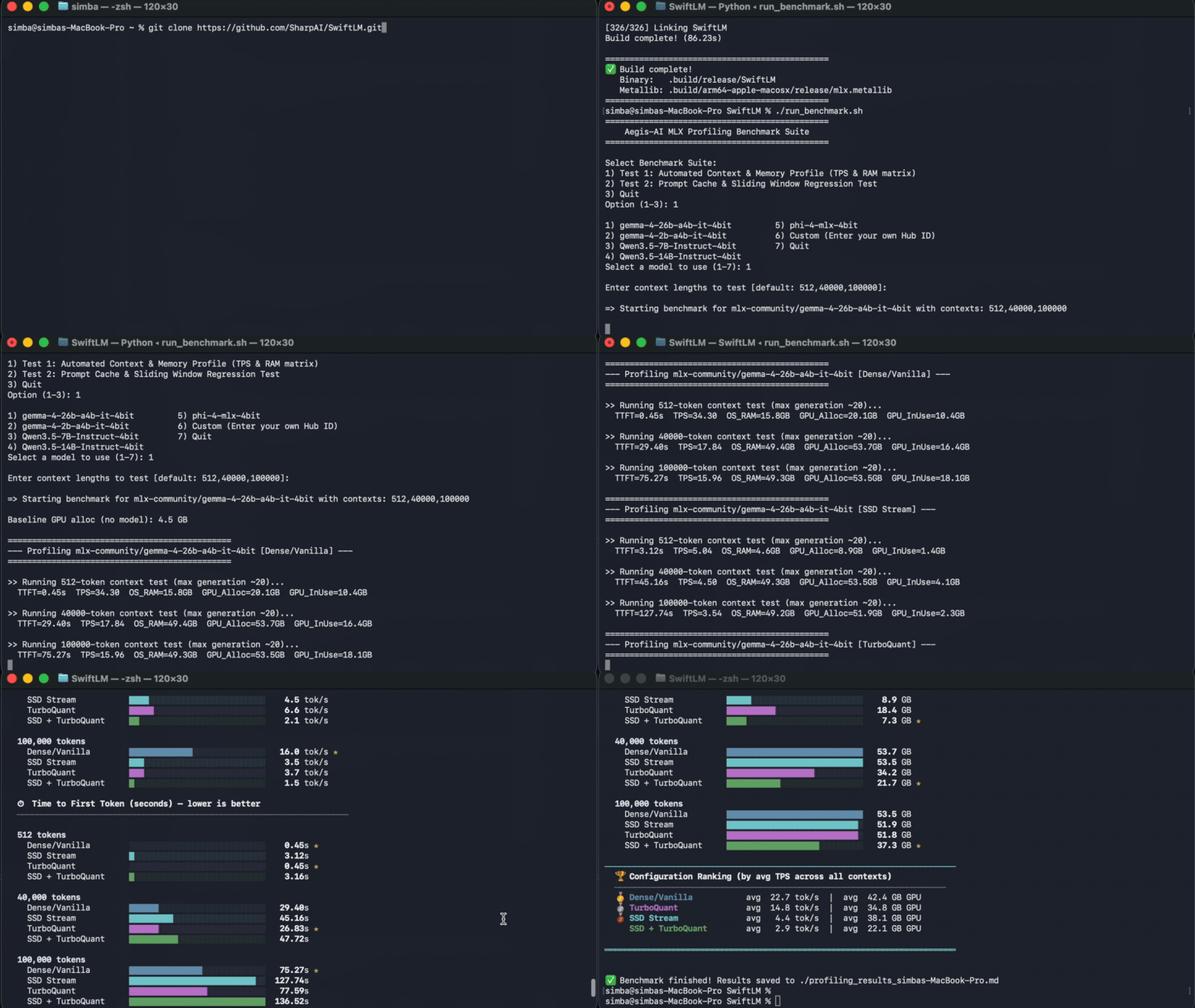
Run our automated benchmark suites via the interactive script:
./run_benchmark.sh
The script provides an interactive menu to select any model and run one of two automated testing suites:
Test 1: Automated Context & Memory Profile (TPS & RAM matrix)
Tests generation speed (TPS) and granular Apple Metal GPU memory allocation across extreme context lengths (e.g., 512, 40000, 100000 tokens).
- Iterates over 4 configurations: Vanilla, SSD Streaming, TurboQuant, and SSD + TurboQuant.
- Generates a rich ANSI console visualization with bar charts and a configuration scoreboard.
- Saves the complete results matrix to
docs/profiling/profiling_results_<hostname>.md.
Test 2: Prompt Cache & Sliding Window Regression Test
Verifies the stability of the engine's KV prompt cache when interleaving long contexts with sliding window attention bounds.
- Automatically spins up an isolated background inference server instance.
- Generates a 5,000+ token mock JSON payload.
- Fires an extreme alternating sequence of 4 concurrent requests (
5537t→18t→5537t→Big Full Cache Hit). - Confirms the memory bounds remain stable without throwing $O(N^2)$ OS memory warnings, $OOM$ exceptions, or
SIGTRAPerrors.
Throughput & Inference Memory Profile
Tested by rendering exactly 20 tokens under standard conversational evaluation (--prefill-size 512) to capture precise Token Generation (TPS) and Apple Metal memory footprint limits:
| Model | Time To First Token (s) | Generation Speed (tok/s) | Peak GPU Memory (GB) |
|---|---|---|---|
gemma-4-e2b-it-4bit | 0.08s | 116.27 tok/s | 1.37 GB |
gemma-4-e4b-it-8bit | 0.33s | 48.21 tok/s | 7.64 GB |
gemma-4-26b-a4b-it-4bit | 0.14s | 85.49 tok/s | 13.46 GB |
gemma-4-31b-it-4bit | 0.55s | 14.82 tok/s | 16.83 GB |
To run the automated suite on your machine for these models, execute:
python3 tests/run_4models_benchmark.py
🧠 How it works: SwiftLM implements Chunked Prefill (controlled via
--prefill-size, defaulting to 512). This is functionally equivalent tollama.cpp's--batch-sizeparameter and mirrors themlx-lmPython library's reference implementation approach to preventing $O(N^2)$ Unified Memory over-allocation during massive sequence parsing.
⚠️ Quantization Disclaimer: While heavier quantization shrinks the required memory footprint, 4-bit quantization remains the strict production standard for MoE models. Our metrics indicated that aggressive 2-bit quantization heavily destabilizes JSON grammars—routinely producing broken keys like
\name\instead of"name"—which systematically breaks OpenAI-compatible tool calling.
📡 API Endpoints
| Endpoint | Method | Description |
|---|---|---|
/health | GET | Server health + loaded model capabilities |
/v1/models | GET | List available models |
/v1/chat/completions | POST | Chat completions (LLM and VLM support, multi-turn, system prompts) |
💻 Usage Examples
Chat Completion (Streaming)
Drop-in compatible with standard OpenAI HTTP consumers:
curl http://localhost:5413/v1/chat/completions \
  -H "Content-Type: application/json" \
  -d '{
    "model": "gemma-4-26b-a4b-it-4bit",
    "stream": true,
    "messages": [
      {"role": "system", "content": "You are Aegis-AI, a local home security agent. Output strictly in JSON format."},
      {"role": "user", "content": "Clip 1: Delivery person drops package at 14:02. Clip 2: Delivery person walks away down driveway at 14:03. Do these clips represent the same security event? Output a JSON object with a `duplicate` boolean and a `reason` string."}
    ]
  }'
Vision-Language Models (VLM)
To run a vision model (e.g., mlx-community/Qwen2-VL-2B-Instruct-4bit), launch SwiftLM with the --vision flag:
./.build/release/SwiftLM --model mlx-community/Qwen2-VL-2B-Instruct-4bit --vision
You can then pass standard OpenAI base64 encoded images directly. SwiftLM handles hardware spatial-mapping natively via Metal:
curl http://localhost:5413/v1/chat/completions \
  -H "Content-Type: application/json" \
  -d '{
    "model": "qwen2-vl",
    "messages": [
      {
        "role": "user",
        "content": [
          {"type": "text", "text": "Describe the contents of this image."},
          {"type": "image_url", "image_url": {"url": "data:image/jpeg;base64,/9j/4AAQSkZJRgABAQ..."}}
        ]
      }
    ]
  }'
⚙️ CLI Options
| Option | Default | Description |
|---|---|---|
--model | (required) | HuggingFace model ID or local path |
--port | 5413 | Port to listen on |
--host | 127.0.0.1 | Host to bind |
--vision | false | Enable VLM (vision-language model) mode for image inputs |
--audio | false | Enable ALM (audio-language model) mode for audio inputs |
--max-tokens | 2048 | Max tokens limit per generation |
--prefill-size | 512 | Prompt prefill chunk size (micro-batching for long contexts) |
--top-p | 1.0 | Default top-p nucleus sampling (overridable per-request) |
--top-k | 50 | Default top-k sampling (0 disables, overridable per-request) |
--min-p | 0.0 | Default min-p sampling threshold relative to the highest probability token (0 disables) |
--gpu-layers | model_default | Restrict the amount of layers allocated to GPU hardware |
--stream-experts | false | Enable SSD expert streaming for MoE models (10x speedup) |
--turbo-kv | false | Enable TurboQuant 3-bit KV cache compression (activates after 2048 tokens, server-wide) |
--draft-model | (none) | Draft model path/ID for speculative decoding. When used with --stream-experts, --num-draft-tokens is auto-capped to 1 to minimise SSD I/O fan-out (see performance note above). |
--num-draft-tokens | 4 | Tokens per speculation round. Auto-capped to 1 when combined with --stream-experts. |
--dflash | false | Enable DFlash block-diffusion speculative decoding. Requires a compatible DFlash draft model |
--dflash-block-size | (auto) | Number of tokens per DFlash draft block. Defaults to draft model config |
🔧 Per-Request API Parameters
In addition to the standard OpenAI fields (temperature, top_p, max_tokens, etc.), SwiftLM accepts the following SwiftLM-specific fields on POST /v1/chat/completions:
| Field | Type | Description |
|---|---|---|
kv_bits | int (4 or 8) | Enable MLX-native quantized KV cache for this request. Uses QuantizedKVCache (standard group quantization) instead of KVCacheSimple. Separate from --turbo-kv. Reduces KV memory ~2–4× at mild quality cost. |
enable_thinking | bool | Force-enable or disable chain-of-thought thinking blocks for Gemma-4 / Qwen3. |
kv_group_size | int | Group size for kv_bits quantization (default: 64). |
top_k | int | Per-request top-k sampling override (0 = disabled). |
min_p | float | Per-request min-p sampling threshold (0 = disabled). |
repetition_penalty | float | Token repetition penalty (e.g. 1.15). |
kv_bits vs --turbo-kv — What's the difference?
kv_bits (per-request) | --turbo-kv (server flag) | |
|---|---|---|
| Scope | Per-request, sent in JSON body | Server-wide, set at startup |
| Algorithm | MLX-native group quantization (4-bit / 8-bit) | Custom 3-bit PolarQuant + QJL Walsh-Hadamard |
| Activation | From token 0 | After 2048 tokens |
| Memory savings | ~2–4× vs FP16 | ~3.5× vs FP16 |
| Use case | Targeted memory reduction per conversation | Extreme long-context (100K+) compression |
Example: Enable 4-bit KV cache per request
curl http://localhost:5413/v1/chat/completions \\
  -H "Content-Type: application/json" \\
  -d '{
    "model": "gemma-4-26b-a4b-it-4bit",
    "kv_bits": 4,
    "messages": [
      {"role": "user", "content": "Summarize the history of computing in 3 sentences."}
    ]
  }'
📦 Requirements
- macOS 14.0+
- Apple Silicon (M1/M2/M3/M4/M5)
- Xcode Command Line Tools
- Metal Toolchain (
xcodebuild -downloadComponent MetalToolchain)
📖 The "Aha!" Moment
The "2+2=4" Aha Moment: During development, we encountered a severe "silent failure" where the model would successfully load and evaluate all 32 layers at high speed, but generate nothing but infinite whitespace. The model logits showed the correct shape but the wrong magnitudes.
The breakthrough arrived when we realized the embedding scale was missing. The Gemma architecture requires scaling embedding outputs by sqrt(hidden_size). For a hidden size of 2816, missing this meant every activation in the network was ~53x too small! By adding one single math operation:
h = h * MLXArray(Float(config.hiddenSize).squareRoot())
The model instantly woke up from "whispering" whitespace and successfully responded to "What is 2+2?" with a perfect "2 + 2 equals 4." — proving that the entire massive structural pipeline from Swift to Metal was working.
🙏 Acknowledgments & Credits

SwiftLM leverages the powerful foundation of the Apple MLX community and relies heavily on the open-source ecosystem. While the custom C++ implementations, Metal optimizations, and high-performance pipeline architecture were engineered natively for this engine, we owe massive thanks to the following projects and contributors for their indispensable reference materials and underlying protocols:
Contributors
- Eric Lake — Engineered the SSD Expert Streaming 10x rewrite (PR #26), achieving 10× generation speedup on 122B+ MoE models via cross-projection batching, concurrent NVMe pread (QD=24), asyncEval pipeline with speculative pread, and runtime top-k expert selection. Also implemented the speculative decoding infrastructure with
DraftModelRef, dual-model loading, and MambaCache checkpoint/restore for hybrid Attention+Mamba architectures.
Projects & References
- mlx-swift — The core Apple MLX wrapper bringing Metal-accelerated operations into the Swift ecosystem.
- mlx-lm — The official Python language models implementation, serving as the core inspiration for our chunked-prefill architecture and attention manipulation logic.
- flash-moe — Inspired the memory-mapped out-of-core SSD Expert Streaming mechanics that we implemented natively in SwiftLM.
- Hummingbird — The incredible event-driven Swift HTTP engine powering the OpenAI-compatible REST API.
- TurboQuant Paper — "TurboQuant: Online Vector Quantization with Near-optimal Distortion Rate" (Zandieh et al., AISTATS 2026). Provided the initial algorithmic framework for the dual-stage PolarQuant + QJL engine.
- TheTom/llama-cpp-turboquant — Served as an invaluable reference architecture for the C and GPU quantization tables, guiding the development of our native
turbo-whtWalsh-Hadamard kernels and custom Metal wrapper layers. - TheTom/turboquant_plus — Essential Python validation logic used to certify the correctness of our manually constructed Lloyd-Max codebook generation math.
- amirzandieh/QJL — The original 1-bit residual correction engine backing the paper, which informed our QJL error recovery in dot-product regimes.
License: MIT
Contributors


Similar repos


Languages
Swift
77.4%
Shell
12.9%
Python
9.0%
⚡ Native MLX Swift LLM inference server for Apple Silicon. OpenAI-compatible API, SSD streaming for 100B+ MoE models, TurboQuant KV cache compression, MACOS + iOS iPhone app.
Swift
772
617 commits
updated Sep 23, 2026
README
⚡️ SwiftLM
A blazingly fast, native Swift inference server that serves MLX models with a strict OpenAI-compatible API.
No Python runtime, no Global Interpreter Lock (GIL), no unnecessary memory copies. Just bare-metal Apple Silicon performance compiled to a single binary.
🏁 Getting Started
Fastest: Download Pre-built Binary
Download the latest release tarball from the Releases page.
The archive is self-contained — mlx.metallib is bundled alongside the binary.
tar -xzf SwiftLM-<version>-macos-arm64.tar.gz
./SwiftLM --model mlx-community/Qwen2.5-3B-Instruct-4bit --port 5413
Build from Source
The build script handles everything: submodules, cmake, Metal kernel compilation, and the Swift build.
git clone --recursive https://github.com/SharpAI/SwiftLM
cd SwiftLM
./build.sh
This will:
- Initialize git submodules
- Install
cmakevia Homebrew (if not already installed) - Compile
mlx.metallibfrom the Metal kernel sources - Build the
SwiftLMbinary in release mode
Then start the server (models download automatically if not cached):
.build/release/SwiftLM \
  --model mlx-community/gemma-4-26b-a4b-it-4bit \
  --port 5413
(Add --stream-experts when running oversized MoE models to bypass macOS virtual memory swapping and stream expert layers directly from NVMe SSD.)
📊 Performance: MTP Speculative Decoding — Gemma 4-26B (MacBook Pro M5 Pro 64 GB)
Benchmarked with gemma-4-26b-a4b-it-4bit running three configurations across 512 / 40K / 100K token contexts.
Generation Speed (tok/s) — higher is better
| Configuration | 512 tokens | 40K tokens | 100K tokens | Avg TPS* |
|---|---|---|---|---|
| Baseline | 70.8 | 34.3 | 25.8 | 36.6 |
| MTP Speculative | 71.5 (1.01×) | 38.4 (1.12×) | 29.1 (1.13×) | 40.3 |
| MTP + TurboQuant ⭐ | 72.1 (1.02×) | 65.2 (1.90×) | 62.1 (2.41×) | 66.2 |
* Time-weighted average: total_tokens / sum(60/TPS) — correct wall-clock representation vs arithmetic mean.
Time to First Token (seconds) — lower is better
| Configuration | 512 tokens | 40K tokens | 100K tokens |
|---|---|---|---|
| Baseline | 0.64s | 22.85s | 63.11s |
| MTP Speculative | 0.34s | 20.45s | 55.17s |
| MTP + TurboQuant ⭐ | 0.33s | 13.17s | 33.95s |
GPU Memory (allocated / peak physical RAM)
| Configuration | 512 tokens | 40K tokens | 100K tokens |
|---|---|---|---|
| Baseline | 20.4 GB / 15.8 GB | 54.8 GB / 19.3 GB | 54.3 GB / 23.3 GB |
| MTP Speculative | 20.4 GB / 16.0 GB | 54.6 GB / 20.8 GB | 54.3 GB / 23.1 GB |
| MTP + TurboQuant ⭐ | 20.3 GB / 15.8 GB | 23.9 GB / 17.3 GB | 26.4 GB / 18.2 GB |
Key takeaways:
- 🚀 1.81× avg throughput — MTP + TurboQuant delivers 66.2 tok/s time-weighted vs 36.6 tok/s baseline
- 🏎️ Nearly 2× faster TTFT at 100K context — 33.95s vs 63.11s baseline (46% reduction)
- 💾 Massive memory savings at long context — GPU allocation drops from 54.8 GB → 23.9 GB at 40K tokens (TurboQuant KV compression)
- 🔬 MTP alone is free — 1.10× time-weighted TPS and lower TTFT with zero additional memory overhead
Run
python3 -u scripts/profiling/profile_runner.py --model gemma-4-26b-a4b-it-4bit --contexts "512,40000,100000"to reproduce on your device.
📊 Performance: Gemma 4-26B on Apple Silicon
Benchmark results for gemma-4-26b-a4b-it-4bit (26B MoE, ~4B active params/token, 4-bit) on M5 Pro 64 GB.
⚠️ This is a Mixture-of-Experts (MoE) model, not a dense model. Each token activates ~4B of the 26B parameters. "Vanilla" = all experts loaded into unified RAM (no SSD streaming).
Headline Numbers — gemma-4-26b-a4b-it-4bit (4-bit MoE)
Benchmarked on M5 Pro 64 GB ·
gemma-4-26b-a4b-it-4bit·./run_benchmark.shOption 13 Values shown asgeneration TPS · OS RAM used(TTFT excluded from speed measurement)
| Configuration | 512 ctx | 40K ctx | 100K ctx |
|---|---|---|---|
| Vanilla (full-RAM MoE) | 77.5 tok/s · 14.6 GB | 44.3 tok/s · 48.7 GB | 27.5 tok/s · 48.5 GB |
| Vanilla + MTP | 72.7 tok/s · 16.6 GB | 44.9 tok/s · 49.4 GB | 37.5 tok/s · 49.3 GB |
| Vanilla + TurboQuant | 77.3 tok/s · 14.7 GB | 70.1 tok/s · 18.2 GB | 66.9 tok/s · 20.7 GB |
| Vanilla + MTP + TurboQuant | 73.5 tok/s · 16.6 GB | 53.8 tok/s · 19.7 GB | 32.8 tok/s · 22.0 GB |
| SSD Stream | 10.8 tok/s · 22.2 GB | 10.4 tok/s · 24.2 GB | 9.0 tok/s · 27.6 GB |
| SSD + TurboQuant | 11.4 tok/s · 22.0 GB | 2.5 tok/s · 22.5 GB | 1.6 tok/s · 22.3 GB |
GPU Peak physical RAM (from
ioreg): Vanilla 100K peaks at 21.8 GB in-use · TurboQuant 100K stays at 17.1 GB in-use
Key takeaways (4-bit):
- 🚀 TurboQuant is the headline win: At 100K context,
Vanilla + TurboQuantdelivers 66.9 tok/s vs 27.5 tok/s Vanilla — a 2.43× speedup. - 💾 Massive memory savings: OS RAM at 40K context drops from 48.7 GB → 18.2 GB with TurboQuant (63% reduction).
- ⚡ MTP neutral on 4-bit MoE: The 4-bit model is compute-bound (MoE expert dispatch). Batch verification scales linearly with token count, so MTP provides no net throughput gain over vanilla at 4-bit.
- ⚠️ TQ + MTP undercuts TQ alone: Adding MTP to a TurboQuant server removes the bandwidth bottleneck (KV is now tiny) but not the FFN compute — MTP then adds overhead without proportional gains.
- 🖥️ SSD Stream for 24 GB Macs: Enables long-context inference with only ~22–27 GB RAM across all context depths.
Headline Numbers — gemma-4-26b-a4b-it-8bit (8-bit, bandwidth-bound)
Benchmarked on M5 Pro 64 GB ·
gemma-4-26b-a4b-it-8bit·./run_benchmark.shOption 13
| Configuration | 512 ctx | 40K ctx | 100K ctx |
|---|---|---|---|
| Vanilla | 53.7 tok/s · 26.1 GB | 32.4 tok/s · 49.4 GB | 14.9 tok/s · 49.3 GB |
| Vanilla + MTP ⭐ | 47.1 tok/s · 28.0 GB | 38.8 tok/s (+20%) · 49.6 GB | 22.5 tok/s (+51%) · 49.6 GB |
| Vanilla + TurboQuant | 53.5 tok/s · 26.1 GB | 50.1 tok/s · 29.6 GB | 48.3 tok/s · 32.0 GB |
| Vanilla + MTP + TurboQuant | 47.4 tok/s · 28.0 GB | 31.0 tok/s · 31.1 GB | 23.3 tok/s · 33.3 GB |
Key takeaways (8-bit):
- 🎯 MTP works at 8-bit: The 8-bit model is bandwidth-bound (2× heavier weights than 4-bit). The KV reads in the 3-token verification batch amortize across all 3 queries — so batch verification costs ~1.3× vanilla while producing 2+ tokens. Net: +20% at 40K, +51% at 100K.
- 🚀 TurboQuant still wins outright: At 100K, TurboQuant alone gives 48.3 tok/s vs MTP's 22.5 tok/s — TQ eliminates memory pressure and achieves 3.24× speedup over vanilla.
- ❌ Don't combine TQ + MTP on 8-bit: TurboQuant compresses the KV cache 4×, removing the bandwidth bottleneck and making MTP compute-bound again — TQ+MTP (31.0) is slower than TQ alone (50.1) at 40K.
- 💡 Precision-dependent guidance: Use
--mtpfor 8-bit models at 40K+ contexts without TurboQuant. Use--turbo-kv(without MTP) when maximum throughput or memory efficiency is the priority.
Run
./run_benchmark.sh→ Option 13 to reproduce these metrics on your own device.
Qwen3.6-35B-A3B-UD-MLX-4bit (Full-RAM) — M1 Ultra 64 GB
Benchmark results for full-RAM (no SSD streaming) MoE inference on M1 Ultra. The 3.4× vanilla improvement vs. earlier builds comes from the needsMoeFlush gate in mlx-swift-lm (see SwiftLM #84) — the per-layer GPU sync barrier required for SSD streaming was firing unconditionally on the full-RAM path and flushing MLX's kernel-batching pipeline.
| Configuration | Short (~126 tok) | Medium (~400 tok) | Long (~800 tok) |
|---|---|---|---|
| Vanilla full-GPU | 61.7 tok/s | 62.3 tok/s | 62.1 tok/s |
Hardware: Apple M1 Ultra, 64 GB unified memory, macOS 26.x. Model ~20 GB on disk, ~21.6 GB resident weight + ~2.1 GB KV at runtime. Flags:
--repeat-penalty 1.1 --max-tokens 2000,temperature: 0.6, single-stream/v1/chat/completions. Vanilla baseline beforeneedsMoeFlushgate (for reference): 19.2 / 18.1 / 18.3 tok/s — see #84.
⚠️ DFlash on this model is currently unsuitable for production. DFlash uses pure greedy (
argMax) decoding regardless oftemperature, which on Qwen3.6-35B-A3B + thez-lab/Qwen3.6-35B-A3B-DFlashdraft locks into low-entropy attractors ("and and and...","**UMA** **UMA**..."). Earlier 70 tok/s DFlash numbers were degenerate output that scored high acceptance because draft and target both committed to the same locked-in token. Repetition-penalty mitigation works on some prompts but tanks acceptance on others — the proper fix is stochastic posterior sampling with rejection-based accept (Leviathan/Chen formulation), which is a DFlash architecture change tracked at z-lab/dflash#91.
DeepSeek-V4-Flash (126 GB, Q3-mixed-gs128-affine) — M5 Pro 64 GB
Model: Thump604/DeepSeek-V4-Flash-MLX-Q3-mixed-gs128-affine
Dense/Vanilla and TurboQuant (non-SSD) configurations are skipped automatically — the 126 GB model exceeds physical RAM.
| Configuration | 512 ctx | 40K ctx |
|---|---|---|
| SSD Stream | 4.65 tok/s · 16.7 GB RAM | 0.32 tok/s · 12.5 GB RAM |
| SSD + TurboQuant | 4.78 tok/s · 16.8 GB RAM | 4.16 tok/s · 16.8 GB RAM |
| SSD + 16-Worker Prefetch | 4.43 tok/s · 16.6 GB RAM | 0.32 tok/s · 13.6 GB RAM |
Values shown as
generation speed · peak physical RAM used(sampled every 0.5s during prefill + generation). The 126 GB model streams the rest from NVMe SSD.
Key takeaways:
- 🏆 SSD + TurboQuant dominates at long context — 4.16 tok/s at 40K vs 0.32 tok/s for plain SSD Stream (13× faster). TurboQuant compresses the KV cache so far fewer layers need to stream from SSD per token.
- At 512-token context all configurations perform similarly (~4.4–4.8 tok/s); TurboQuant's advantage is KV-cache compression at long context.
- Peak physical RAM stays ≤ 17 GB across all configurations — the 126 GB model streams the rest from NVMe SSD.
🚀 Features
- 🍎 100% Native Apple Silicon: Powered natively by Metal and Swift.
- 🔌 OpenAI-compatible: Drop-in replacement for OpenAI SDKs (
/v1/chat/completions, streaming, etc). - 🧠 Smart Model Routing: Loads HuggingFace format models directly, with native Safetensors parsing.
- 👁️ Vision-Language Models (VLM): Native multimodal vision processing natively on Metal via the
--visionflag, supporting real-time base64 image parsing (e.g., Qwen2-VL, PaliGemma). - 🎧 Audio-Language Models (ALM): High-performance audio ingestion via the
--audioflag, decoding OpenAI-specinput_audiopayloads with AVFoundation WAV extraction. - ⚡️ TurboQuantization Integrated: Custom low-level MLX Metal primitives that apply extremely fast quantization for KV caching out-of-the-box.
- 💾 SSD Expert Streaming (10x): High-performance NVMe streaming that loads Mixture of Experts (MoE) layers directly from SSD to GPU — engineered by @ericjlake, achieving 10x speedup (0.58 → 5.91 tok/s) on 122B+ models with only ~10 GB resident memory. Uses cross-projection batching, concurrent pread (QD=24), asyncEval pipeline, and runtime top-k expert selection.
- 🔮 Speculative Decoding: Load a small draft model (e.g. 9B) alongside a large main model to generate candidate tokens and verify in bulk — accelerating in-RAM inference.
- 🎛️ Granular Memory Control: Integrated Layer Partitioning (
--gpu-layers) and Wisdom Auto-Calibration for squeezing massive models into RAM.
📡 Supported Models & Methodologies
SwiftLM dynamically maps Apple MLX primitives to standard HuggingFace architectures, enabling native Metal inference across the latest frontier open-weights models.
💬 Text (LLMs)
| Family | Models | Notes |
|---|---|---|
| Gemma 4 | gemma-4-e2b, gemma-4-e4b (dense) · gemma-4-26b-a4b, gemma-4-31b (MoE) | Interleaved local + global attention; KV sharing; native quantized KV cache (issue #71 fix) |
| Gemma 3 / 3n | gemma-3-*, gemma-3n-* | Google Gemma 3 and nano variants |
| Gemma / Gemma 2 | gemma-*, gemma-2-* | Original Gemma family |
| Qwen 3.5 | Qwen3.5-7B, Qwen3.5-27B, Qwen3.5-122B-A10B, Qwen3.5-397B-A22B | Dense + MoE; SSD streaming at 10× for 122B/397B |
| Qwen 3 | Qwen3-* (dense + MoE) | Sliding window + hybrid attention |
| Qwen 2.5 | Qwen2.5-7B, Qwen2.5-14B, Qwen2.5-72B | Robust RoPE scaling |
| Qwen 2 | Qwen2-* | Linear RoPE variants |
| Phi 4 / PhiMoE | phi-4-mlx, Phi-3.5-MoE | Microsoft Phi family incl. MoE |
| Phi 3 / Phi | Phi-3, Phi-3.5-mini | 128k context via chunked prefill |
| Mistral / Mixtral | Mistral-7B, Mistral-4, Mixtral-* | GQA + sliding window variants |
| Llama / Llama 3 | Llama-3.1-*, Llama-3.2-*, Llama-3.3-* | YaRN + dynamic NTK RoPE scaling |
| GLM 4 | GLM-4-* | THUDM GLM-4 dense + MoE-Lite variants |
| DeepSeek V3 | DeepSeek-V3-* | MLA attention architecture |
| Falcon H1 | Falcon-H1-* | Falcon hybrid SSM+attention |
| LFM 2 | LFM2-*, LFM2-MoE-* | Liquid AI dense + MoE |
| OLMo 2 / OLMo 3 / OLMoE | OLMo-2-*, OLMo-3-* | AllenAI open language models |
| Granite / GraniteMoE | Granite-*, GraniteMoE-Hybrid-* | IBM Granite hybrid Mamba+attention |
| SmolLM 3 | SmolLM3-* | HuggingFace compact LM |
| MiniCPM | MiniCPM-* | Lightweight efficient LM |
| InternLM 2 | InternLM2-* | Shanghai AI Lab series |
| Cohere / Command-R | Command-R-*, c4ai-* | Cohere retrieval-tuned models |
| Jamba | Jamba-v0.1 | AI21 hybrid Mamba+attention |
| Exaone 4 | EXAONE-4.0-* | LG AI Research |
| MiMo / MiMo V2 | MiMo-7B-* | Xiaomi reasoning model |
| Ernie 4.5 | ERNIE-4.5-* | Baidu ERNIE series |
| Baichuan M1 | Baichuan-M1-* | Baichuan multimodal base |
| Bailing MoE | Ling-* | Bailing/Ling MoE family |
| NemotronH | Nemotron-H-* | NVIDIA Nemotron hybrid |
| Starcoder 2 | starcoder2-* | Code generation |
| OpenELM | OpenELM-* | Apple on-device efficient LM |
| Apertus / AfMoE | Apertus-* | Sparse MoE research models |
| BitNet | bitnet-* | 1-bit weight quantization |
| MiniMax | MiniMax-Text-* | Lightning attention architecture |
| Olmo3 | Olmo3-* | AllenAI Olmo3 series |
👁️ Vision (VLMs)
Run with --vision flag.
| Family | Models | Notes |
|---|---|---|
| Gemma 4 | gemma-4-* (VLM mode) | Native image tower via MLXVLM |
| Gemma 3 | gemma-3-* (VLM mode) | PaLiGemma-style image projection |
| Qwen3-VL / Qwen3.5-VL | Qwen3-VL-*, Qwen3.5-VL-* | Dynamic resolution with native RoPE |
| Qwen2-VL / Qwen2.5-VL | Qwen2-VL-2B/7B, Qwen2.5-VL-* | Real-time positional bounding + Metal image scaling |
| LFM2-VL | LFM2-VL-1.6B | Liquid AI multimodal |
| Pixtral | pixtral-12b | Mistral vision model |
| PaliGemma | paligemma-* | Google vision-language |
| Idefics 3 | Idefics3-* | HuggingFace multimodal |
| Mistral 3 | Mistral-Small-3.1-* | Mistral vision variant |
| FastVLM | FastVLM-* | Apple on-device VLM |
| SmolVLM 2 | SmolVLM2-* | HuggingFace compact VLM |
| GLM OCR | glm-4v-* | THUDM vision+OCR |
| QwenVL | Qwen-VL-* | Original Qwen VL |
🎧 Audio (ALMs)
Run with --audio flag. Only gemma-4-e4b variants include an audio tower.
| Family | Models | Notes |
|---|---|---|
| Gemma 4 Omni | gemma-4-e4b-it-4bit, gemma-4-e4b-it-8bit | Audio-in via vDSP STFT → Mel spectrogram (16kHz, 128 bins); text-out |
📱 SwiftBuddy — iOS App
A native iPhone & iPad companion app that downloads MLX models directly from HuggingFace and runs inference on-device via MLX Swift.
Features
- Tab UI: Chat · Models · Settings
- Live download progress with speed indicator and circular progress ring
- Model catalog: Qwen3, Phi-3.5, Mistral, Llama — with on-device RAM fit indicators
- HuggingFace search — find any
mlx-communitymodel by name - Context-aware empty states — downloading ring, loading spinner, idle prompt
- iOS lifecycle hardened — model unload only fires on true background (not notification banners); 30-second grace period on app-switch
📱 Running live on iPhone 13 Pro (6 GB) — no Python, no server, no GIL. Pure on-device MLX inference via Metal GPU.
Build & Run (iOS)
cd SwiftBuddy
python3 generate_xcodeproj.py       # Generates SwiftBuddy.xcodeproj
open SwiftBuddy.xcodeproj
Then in Xcode:
- Select the SwiftBuddy target → Signing & Capabilities
- Set your Team (your Apple Developer account)
- Select your iPhone as the run destination
- ⌘R to build and run
Note for contributors: The
.xcodeprojis git-ignored (it contains your personal Team ID). Rungenerate_xcodeproj.pyafter cloning to regenerate it locally. Your Team ID is never committed.
⚡️ TurboQuantization: KV Cache Compression
SwiftLM implements a hybrid V2+V3 TurboQuant architecture for on-the-fly KV cache compression. At roughly ~3.6 bits per coordinate overall, the KV cache is compressed ~3.5× vs FP16 with near-zero accuracy loss.
By combining V2 Speed with V3 Quality:
Recent reproductions of the TurboQuant algorithm (e.g., turboquant-mlx) revealed two distinct paths:
- V2 (Hardware-Accelerated): Fast, but uses linear affine quantization which degrades quality at 3-bit.
- V3 (Paper-Correct): Excellent quality using non-linear Lloyd-Max codebooks, but painfully slow due to software dequantization.
We built the "Holy Grail" hybrid: We ported the V3 non-linear Lloyd-Max codebooks directly into the native C++ encoding path, and process the dequantization natively in fused Metal (bggml-metal) shaders. This achieves V3 quality at V2 speeds, completely detached from Python overhead.
The Algorithm:
K-Cache (3-bit PolarQuant + 1-bit QJL) = 4.25 bits/dim
- Extract L2 norm and normalize:
x̂ = x / ‖x‖ - Apply Fast Walsh-Hadamard Transform (WHT) rotation to distribute outliers evenly.
- Quantize each coordinate using 3-bit non-linear Lloyd-Max centroids.
- Compute the residual error between the original vector and the quantized approximation.
- Project the residual via a random Johnson-Lindenstrauss (QJL) matrix and store the 1-bit signs. (Why QJL? QJL acts as an additional regularizer that prevents centroid resolution loss from degrading the attention dot-product.)
V-Cache (3-bit PolarQuant) = 3.125 bits/dim Because the V-cache matrix is not used for inner-product attention scoring, the QJL error correction provides no benefit. We cleanly disable QJL for the V-cache, extracting an additional 25% memory savings without sacrificing quality.
Reference implementations: turboquant-mlx | turboquant_plus | Paper: TurboQuant, Google 2504.19874
💾 SSD Expert Streaming: 10x MoE Speedup
SwiftLM implements a rewritten SSD expert streaming pipeline (engineered by Eric Lake) that achieves 10x generation speedup for massive Mixture of Experts (MoE) models running on memory-constrained Apple Silicon. This enables running models like Qwen3.5-122B (69.6 GB) and Qwen3.5-397B (209 GB) on a 64 GB Mac by streaming expert weights from NVMe SSD.
Benchmark Results (M1 Ultra 64GB, Qwen3.5-122B-A10B-4bit)
| Configuration | tok/s | vs. Original | Notes |
|---|---|---|---|
Original --stream-experts | 0.58 | baseline | Sequential pread, 1 NVMe queue |
| This PR (top-k=8, full quality) | 4.95 | 8.5× | All 8 experts evaluated |
| This PR (top-k=6, default) | 5.20 | 9.0× | Recommended default |
| This PR (top-k=4, speed mode) | 5.91 | 10.2× | Best quality/speed tradeoff |
| This PR (top-k=2, turbo mode) | 6.52 | 11.2× | Still coherent output |
Memory stable at ~10.6 GB resident, no swap activity. Tested over 200-token generation runs.
The Approach: Small Model Helps Large Model
A novel aspect of this architecture is the dual-model speculative decoding pattern: a small draft model (e.g. Qwen3.5-9B at 73 tok/s) runs entirely in RAM while the large MoE model (e.g. 122B) streams experts from SSD. The draft model generates candidate tokens at high speed, and the main model verifies them in bulk — dramatically reducing the number of SSD-bound generation rounds needed.
Performance note: Combining
--stream-expertswith--draft-modelrequires care. The verify pass sends N+1 tokens simultaneously, each routing to different experts — SSD I/O scales with the union of all positions' expert selections. At the default--num-draft-tokens 4this creates a 5× I/O fan-out that regresses throughput below solo SSD streaming.Auto-cap strategy (Issue #72 fix): SwiftLM automatically caps
--num-draft-tokensto 1 when both flags are active. With 1 draft token the verify pass covers only 2 positions (2× fan-out). If the draft model's acceptance rate is ≥ 50% — typical for same-family models — the net throughput is still positive despite the 2× I/O overhead. A startup advisory is printed when the cap fires.For maximum throughput: use
--stream-expertsalone (no draft model).
Optimization Techniques
- Cross-Projection Batching: Collapses ~1,400 per-expert
eval()calls down to ~48 per token by orchestrating gate/up/down projections together inSwitchGLU. - Concurrent NVMe pread (QD=24): Replaces sequential pread with
DispatchQueue.concurrentPerform, saturating the NVMe controller's queue depth (8 experts × 3 projections = 24 parallel reads). - AsyncEval Pipeline with Speculative Pread: Overlaps GPU compute with SSD I/O — uses previous-token routing to speculatively pre-load experts for the next token during the GPU async window (~70% hit rate). Only missed experts (~30%) require on-demand pread after routing sync.
- Persistent Metal Buffers: Expert weight buffers are allocated once per
SwitchGLUlayer and reused across tokens, eliminating per-token allocation overhead. - Runtime Top-K Expert Selection: The
SWIFTLM_TOP_Kenvironment variable reduces the number of active experts per token at runtime without model recompilation — trading marginal quality for significant speed gains.
Key Engineering Findings
| Finding | Detail |
|---|---|
| GPU compute is the bottleneck | At steady state, GPU compute is ~190ms of ~200ms per-token time. The OS page cache serves ~90% of expert reads from RAM. |
| Don't cache experts in application memory | An LRU expert cache stole from the OS page cache and regressed performance (4.84 → 4.01 tok/s). Let the kernel manage it. |
| MambaCache requires checkpoint rollback | Unlike attention KV caches (trim = decrement offset), Mamba's recurrent state integrates all history and cannot be partially undone. We implemented checkpoint()/restore() for speculative decoding on hybrid Attention+Mamba architectures (Qwen3.5). |
Usage
# Standard SSD streaming (recommended, top-k=6):
SWIFTLM_TOP_K=6 SwiftLM --port 8002 \
  --model <path>/Qwen3.5-122B-A10B-4bit --stream-experts

# Speed mode (top-k=4):
SWIFTLM_TOP_K=4 SwiftLM --port 8002 \
  --model <path>/Qwen3.5-122B-A10B-4bit --stream-experts

# With speculative decoding (in-RAM models only — both models fit in RAM):
SwiftLM --port 8002 \
  --model <path>/Qwen3.5-27B-4bit \
  --draft-model <path>/Qwen3.5-9B-4bit \
  --num-draft-tokens 4

# With SSD streaming + draft model (auto-cap mode):
# SwiftLM automatically caps --num-draft-tokens to 1 to minimise the
# verify-pass I/O fan-out. Net positive if draft acceptance rate ≥ 50%.
SwiftLM --port 8002 \
  --model <path>/Qwen3.5-122B-A10B-4bit \
  --stream-experts \
  --draft-model <path>/Qwen3.5-9B-4bit
  # ↑ num-draft-tokens is auto-capped to 1 at startup
🔮 Speculative Decoding & Multi-Token Prediction (MTP)
SwiftLM supports two forms of Speculative Decoding to accelerate in-RAM inference:
1. Traditional Dual-Model Speculative Decoding
Load a small draft model alongside a large main model. The draft model generates candidate tokens at high speed, and the main model verifies them in bulk.
Requires passing both --model and --draft-model.
2. Multi-Token Prediction (MTP) Native Decoding
For models trained with native MTP heads (e.g., the Qwen3 family), SwiftLM automatically leverages the hidden MTP layers to draft future tokens within a single forward pass, completely eliminating the need to load a separate draft model.
Algorithmic Parity (Leviathan et al.)
SwiftLM implements mathematically rigorous probabilistic rejection sampling (as defined by Leviathan et al.) in its MTPTokenIterator. This ensures exact mathematical output parity with the target model's true distribution, even at non-zero temperatures, properly evaluating $P_{target} / P_{draft}$ and resampling the corrected distribution upon rejection.
⚠️ Hardware Limitations & SSD Streaming (Help Wanted!)
MTP is strictly a Compute-Bound optimization.
We successfully verified algorithmic parity and a 15%+ TPS speedup on the dense Qwen/Qwen3.6-27B model, which fits completely in 64GB VRAM.
However, running MTP on massive MoE models (like the Qwen3.6-35B-A3B) on a 64GB Mac requires --stream-experts to fetch MoE weights from the NVMe SSD. Because MTP evaluates multiple draft tokens in parallel, the verify pass forces a massive I/O fan-out, attempting to fetch up to 3x as many unique experts from the SSD simultaneously.
This saturates the NVMe bandwidth, causing the GPU to stall and completely neutralizing the MTP speedup. If you are running a 64GB Mac, MTP on 35B+ MoE models will be slower than the baseline.
(Community Help Wanted: We are actively looking for optimizations to batch expert pre-fetching during MTP verification to make this viable on 64GB Unified Memory limits!)
🔀 Why We Forked Apple MLX
To achieve the extreme memory efficiency and speeds seen in SSD Expert Streaming and Speculative Decoding, SwiftLM relies on custom C++ primitives that bypass standard unified memory limits.
[!NOTE] We maintain custom forks (
SharpAI/mlxandSharpAI/mlx-c) to support out-of-core memory-mapped execution, streaming tensor blocks directly from the SSD (NVMe) to the GPU via custom Metal kernels (ssd_streamer.mmandfence.air). Officialml-explorerepositories do not yet support this out-of-the-box.
For a detailed breakdown on repository architecture, upstream synchronization, our specific custom patches, and the specific indications for when we can safely revert to Apple's native upstream, read the full documentation: 👉 Upstream MLX Synchronization & SSD Streaming Maintenance
💻 Benchmarks & Testing
Run our automated benchmark suites via the interactive script:
./run_benchmark.sh
The script provides an interactive menu to select any model and run one of two automated testing suites:
Test 1: Automated Context & Memory Profile (TPS & RAM matrix)
Tests generation speed (TPS) and granular Apple Metal GPU memory allocation across extreme context lengths (e.g., 512, 40000, 100000 tokens).
- Iterates over 4 configurations: Vanilla, SSD Streaming, TurboQuant, and SSD + TurboQuant.
- Generates a rich ANSI console visualization with bar charts and a configuration scoreboard.
- Saves the complete results matrix to
docs/profiling/profiling_results_<hostname>.md.
Test 2: Prompt Cache & Sliding Window Regression Test
Verifies the stability of the engine's KV prompt cache when interleaving long contexts with sliding window attention bounds.
- Automatically spins up an isolated background inference server instance.
- Generates a 5,000+ token mock JSON payload.
- Fires an extreme alternating sequence of 4 concurrent requests (
5537t→18t→5537t→Big Full Cache Hit). - Confirms the memory bounds remain stable without throwing $O(N^2)$ OS memory warnings, $OOM$ exceptions, or
SIGTRAPerrors.
Throughput & Inference Memory Profile
Tested by rendering exactly 20 tokens under standard conversational evaluation (--prefill-size 512) to capture precise Token Generation (TPS) and Apple Metal memory footprint limits:
| Model | Time To First Token (s) | Generation Speed (tok/s) | Peak GPU Memory (GB) |
|---|---|---|---|
gemma-4-e2b-it-4bit | 0.08s | 116.27 tok/s | 1.37 GB |
gemma-4-e4b-it-8bit | 0.33s | 48.21 tok/s | 7.64 GB |
gemma-4-26b-a4b-it-4bit | 0.14s | 85.49 tok/s | 13.46 GB |
gemma-4-31b-it-4bit | 0.55s | 14.82 tok/s | 16.83 GB |
To run the automated suite on your machine for these models, execute:
python3 tests/run_4models_benchmark.py
🧠 How it works: SwiftLM implements Chunked Prefill (controlled via
--prefill-size, defaulting to 512). This is functionally equivalent tollama.cpp's--batch-sizeparameter and mirrors themlx-lmPython library's reference implementation approach to preventing $O(N^2)$ Unified Memory over-allocation during massive sequence parsing.
⚠️ Quantization Disclaimer: While heavier quantization shrinks the required memory footprint, 4-bit quantization remains the strict production standard for MoE models. Our metrics indicated that aggressive 2-bit quantization heavily destabilizes JSON grammars—routinely producing broken keys like
\name\instead of"name"—which systematically breaks OpenAI-compatible tool calling.
📡 API Endpoints
| Endpoint | Method | Description |
|---|---|---|
/health | GET | Server health + loaded model capabilities |
/v1/models | GET | List available models |
/v1/chat/completions | POST | Chat completions (LLM and VLM support, multi-turn, system prompts) |
💻 Usage Examples
Chat Completion (Streaming)
Drop-in compatible with standard OpenAI HTTP consumers:
curl http://localhost:5413/v1/chat/completions \
  -H "Content-Type: application/json" \
  -d '{
    "model": "gemma-4-26b-a4b-it-4bit",
    "stream": true,
    "messages": [
      {"role": "system", "content": "You are Aegis-AI, a local home security agent. Output strictly in JSON format."},
      {"role": "user", "content": "Clip 1: Delivery person drops package at 14:02. Clip 2: Delivery person walks away down driveway at 14:03. Do these clips represent the same security event? Output a JSON object with a `duplicate` boolean and a `reason` string."}
    ]
  }'
Vision-Language Models (VLM)
To run a vision model (e.g., mlx-community/Qwen2-VL-2B-Instruct-4bit), launch SwiftLM with the --vision flag:
./.build/release/SwiftLM --model mlx-community/Qwen2-VL-2B-Instruct-4bit --vision
You can then pass standard OpenAI base64 encoded images directly. SwiftLM handles hardware spatial-mapping natively via Metal:
curl http://localhost:5413/v1/chat/completions \
  -H "Content-Type: application/json" \
  -d '{
    "model": "qwen2-vl",
    "messages": [
      {
        "role": "user",
        "content": [
          {"type": "text", "text": "Describe the contents of this image."},
          {"type": "image_url", "image_url": {"url": "data:image/jpeg;base64,/9j/4AAQSkZJRgABAQ..."}}
        ]
      }
    ]
  }'
⚙️ CLI Options
| Option | Default | Description |
|---|---|---|
--model | (required) | HuggingFace model ID or local path |
--port | 5413 | Port to listen on |
--host | 127.0.0.1 | Host to bind |
--vision | false | Enable VLM (vision-language model) mode for image inputs |
--audio | false | Enable ALM (audio-language model) mode for audio inputs |
--max-tokens | 2048 | Max tokens limit per generation |
--prefill-size | 512 | Prompt prefill chunk size (micro-batching for long contexts) |
--top-p | 1.0 | Default top-p nucleus sampling (overridable per-request) |
--top-k | 50 | Default top-k sampling (0 disables, overridable per-request) |
--min-p | 0.0 | Default min-p sampling threshold relative to the highest probability token (0 disables) |
--gpu-layers | model_default | Restrict the amount of layers allocated to GPU hardware |
--stream-experts | false | Enable SSD expert streaming for MoE models (10x speedup) |
--turbo-kv | false | Enable TurboQuant 3-bit KV cache compression (activates after 2048 tokens, server-wide) |
--draft-model | (none) | Draft model path/ID for speculative decoding. When used with --stream-experts, --num-draft-tokens is auto-capped to 1 to minimise SSD I/O fan-out (see performance note above). |
--num-draft-tokens | 4 | Tokens per speculation round. Auto-capped to 1 when combined with --stream-experts. |
--dflash | false | Enable DFlash block-diffusion speculative decoding. Requires a compatible DFlash draft model |
--dflash-block-size | (auto) | Number of tokens per DFlash draft block. Defaults to draft model config |
🔧 Per-Request API Parameters
In addition to the standard OpenAI fields (temperature, top_p, max_tokens, etc.), SwiftLM accepts the following SwiftLM-specific fields on POST /v1/chat/completions:
| Field | Type | Description |
|---|---|---|
kv_bits | int (4 or 8) | Enable MLX-native quantized KV cache for this request. Uses QuantizedKVCache (standard group quantization) instead of KVCacheSimple. Separate from --turbo-kv. Reduces KV memory ~2–4× at mild quality cost. |
enable_thinking | bool | Force-enable or disable chain-of-thought thinking blocks for Gemma-4 / Qwen3. |
kv_group_size | int | Group size for kv_bits quantization (default: 64). |
top_k | int | Per-request top-k sampling override (0 = disabled). |
min_p | float | Per-request min-p sampling threshold (0 = disabled). |
repetition_penalty | float | Token repetition penalty (e.g. 1.15). |
kv_bits vs --turbo-kv — What's the difference?
kv_bits (per-request) | --turbo-kv (server flag) | |
|---|---|---|
| Scope | Per-request, sent in JSON body | Server-wide, set at startup |
| Algorithm | MLX-native group quantization (4-bit / 8-bit) | Custom 3-bit PolarQuant + QJL Walsh-Hadamard |
| Activation | From token 0 | After 2048 tokens |
| Memory savings | ~2–4× vs FP16 | ~3.5× vs FP16 |
| Use case | Targeted memory reduction per conversation | Extreme long-context (100K+) compression |
Example: Enable 4-bit KV cache per request
curl http://localhost:5413/v1/chat/completions \\
  -H "Content-Type: application/json" \\
  -d '{
    "model": "gemma-4-26b-a4b-it-4bit",
    "kv_bits": 4,
    "messages": [
      {"role": "user", "content": "Summarize the history of computing in 3 sentences."}
    ]
  }'
📦 Requirements
- macOS 14.0+
- Apple Silicon (M1/M2/M3/M4/M5)
- Xcode Command Line Tools
- Metal Toolchain (
xcodebuild -downloadComponent MetalToolchain)
📖 The "Aha!" Moment
The "2+2=4" Aha Moment: During development, we encountered a severe "silent failure" where the model would successfully load and evaluate all 32 layers at high speed, but generate nothing but infinite whitespace. The model logits showed the correct shape but the wrong magnitudes.
The breakthrough arrived when we realized the embedding scale was missing. The Gemma architecture requires scaling embedding outputs by sqrt(hidden_size). For a hidden size of 2816, missing this meant every activation in the network was ~53x too small! By adding one single math operation:
h = h * MLXArray(Float(config.hiddenSize).squareRoot())
The model instantly woke up from "whispering" whitespace and successfully responded to "What is 2+2?" with a perfect "2 + 2 equals 4." — proving that the entire massive structural pipeline from Swift to Metal was working.
🙏 Acknowledgments & Credits
SwiftLM leverages the powerful foundation of the Apple MLX community and relies heavily on the open-source ecosystem. While the custom C++ implementations, Metal optimizations, and high-performance pipeline architecture were engineered natively for this engine, we owe massive thanks to the following projects and contributors for their indispensable reference materials and underlying protocols:
Contributors
- Eric Lake — Engineered the SSD Expert Streaming 10x rewrite (PR #26), achieving 10× generation speedup on 122B+ MoE models via cross-projection batching, concurrent NVMe pread (QD=24), asyncEval pipeline with speculative pread, and runtime top-k expert selection. Also implemented the speculative decoding infrastructure with
DraftModelRef, dual-model loading, and MambaCache checkpoint/restore for hybrid Attention+Mamba architectures.
Projects & References
- mlx-swift — The core Apple MLX wrapper bringing Metal-accelerated operations into the Swift ecosystem.
- mlx-lm — The official Python language models implementation, serving as the core inspiration for our chunked-prefill architecture and attention manipulation logic.
- flash-moe — Inspired the memory-mapped out-of-core SSD Expert Streaming mechanics that we implemented natively in SwiftLM.
- Hummingbird — The incredible event-driven Swift HTTP engine powering the OpenAI-compatible REST API.
- TurboQuant Paper — "TurboQuant: Online Vector Quantization with Near-optimal Distortion Rate" (Zandieh et al., AISTATS 2026). Provided the initial algorithmic framework for the dual-stage PolarQuant + QJL engine.
- TheTom/llama-cpp-turboquant — Served as an invaluable reference architecture for the C and GPU quantization tables, guiding the development of our native
turbo-whtWalsh-Hadamard kernels and custom Metal wrapper layers. - TheTom/turboquant_plus — Essential Python validation logic used to certify the correctness of our manually constructed Lloyd-Max codebook generation math.
- amirzandieh/QJL — The original 1-bit residual correction engine backing the paper, which informed our QJL error recovery in dot-product regimes.
License: MIT
Similar repos
Contributors
Languages
Swift
77.4%
Shell
12.9%
Python
9.0%