HY-Embodied-0.5-X: An Enhanced Embodied Foundation Model for Real-World Agents
See the codeTencent Robotics X × HY Vision Team






HY-Embodied-0.5-X is an enhanced open-source embodied multimodal foundation model
jointly released by Tencent Robotics X and the HY Vision Team. Built on
top of the HY-Embodied-0.5 MoT-2B architecture (4B total parameters with
only 2B activated), it is specifically optimized for the core loop of
real-world robotics — "understand, reason, and act".
The model reaches state-of-the-art performance on 10 mainstream embodied task-planning benchmarks, ranking 1st among edge-side domain models on 7 of them. Compared with general-purpose multimodal models, HY-Embodied-0.5-X focuses more tightly on the problems that matter in real-world robot interaction, with dedicated improvements in fine-grained manipulation understanding, spatial reasoning, action prediction, risk assessment, multimodal reference grounding, and long-horizon planning — pushing the model from "seeing" to "doing".
[2026-04-24] 🚀 Released HY-Embodied-0.5-X, an embodied-focused
enhancement on top of HY-Embodied-0.5 MoT-2B, together with inference
and training code.HY-Embodied-0.5-X combines self-collected first-person robot manipulation data, robotic-arm manipulation data, and open-source embodied data into a high-quality corpus that covers manipulation understanding, first-person task reasoning, and multimodal reference grounding:
All core samples are paired with chain-of-thought (CoT) annotations and a full "generate → verify → correct → eval-regression" data-quality loop. Embodied, internet, and 3D data are further unified through a standardized reconstruction pipeline that turns heterogeneous sources into consistent, high-quality embodied reasoning data.
Training follows a staged iterative strategy:
This ensures each unit of compute is invested in the most valuable data.
Across 10 open-source benchmarks covering planning, spatial reasoning, embodied QA, visual reference, and trajectory understanding, HY-Embodied-0.5-X stays in the top tier.
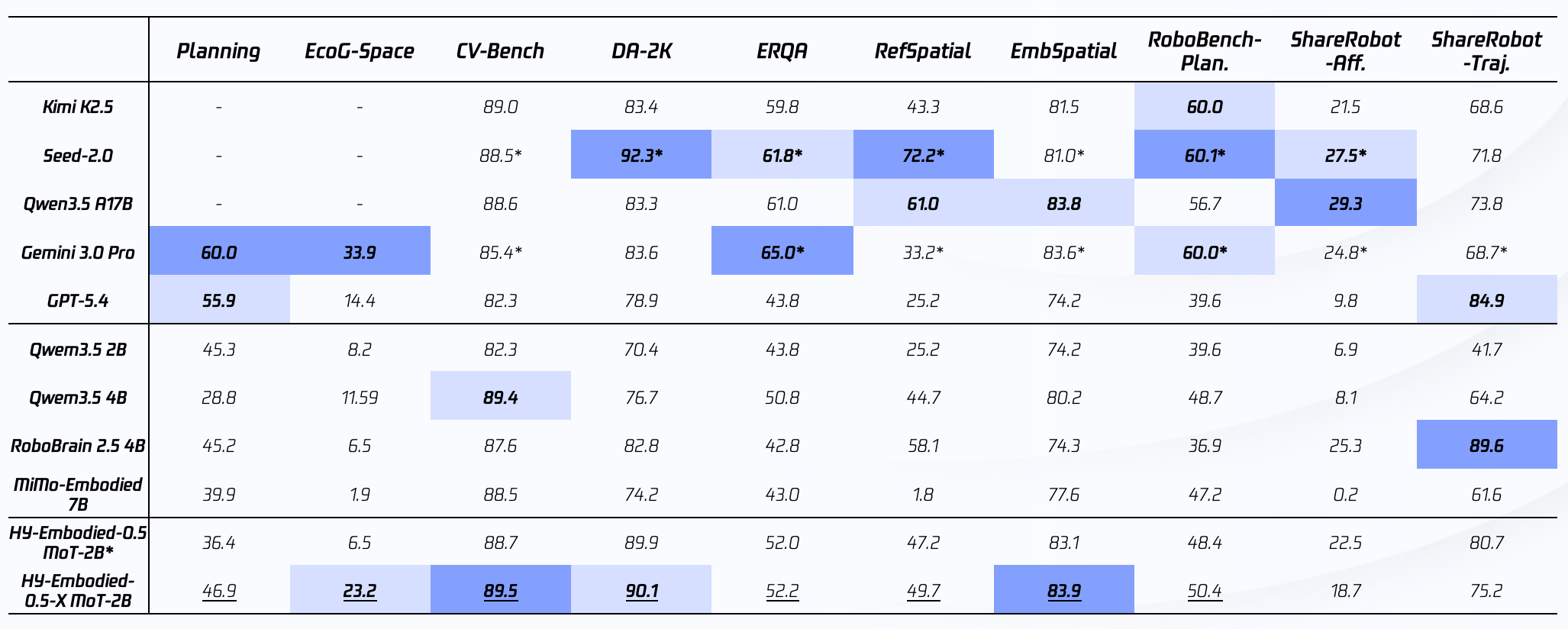
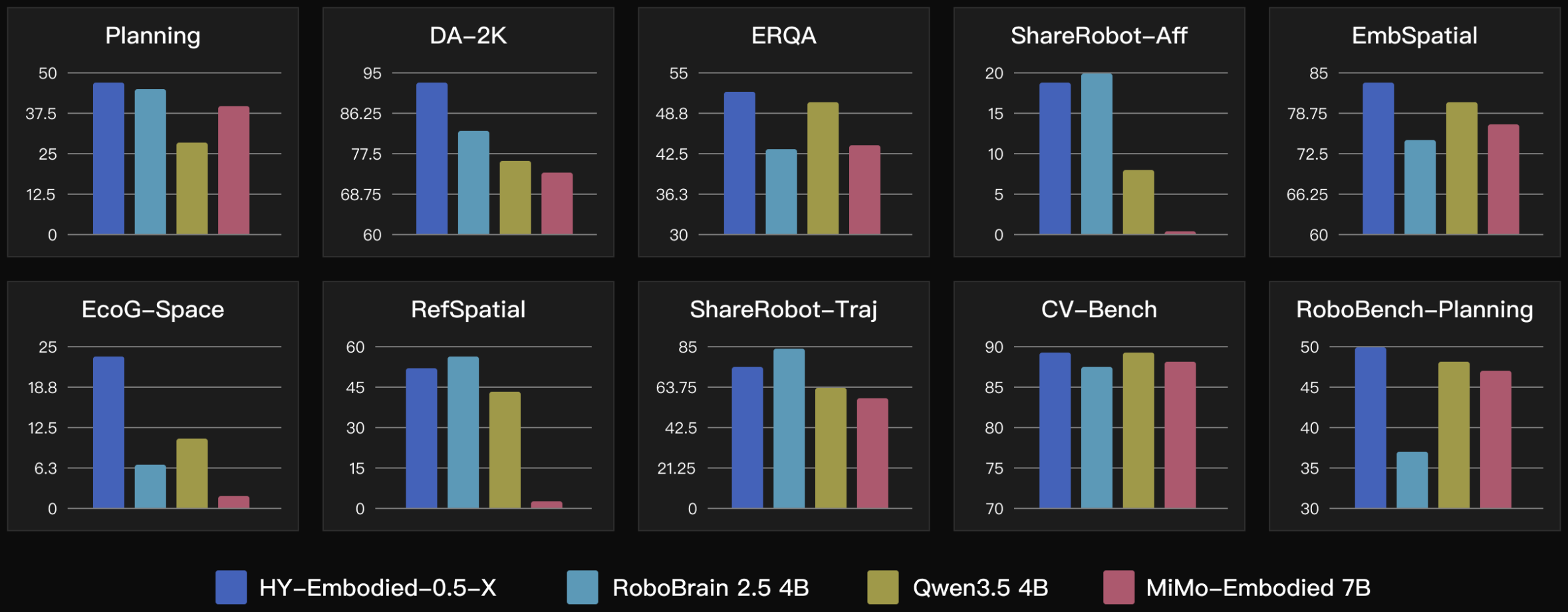
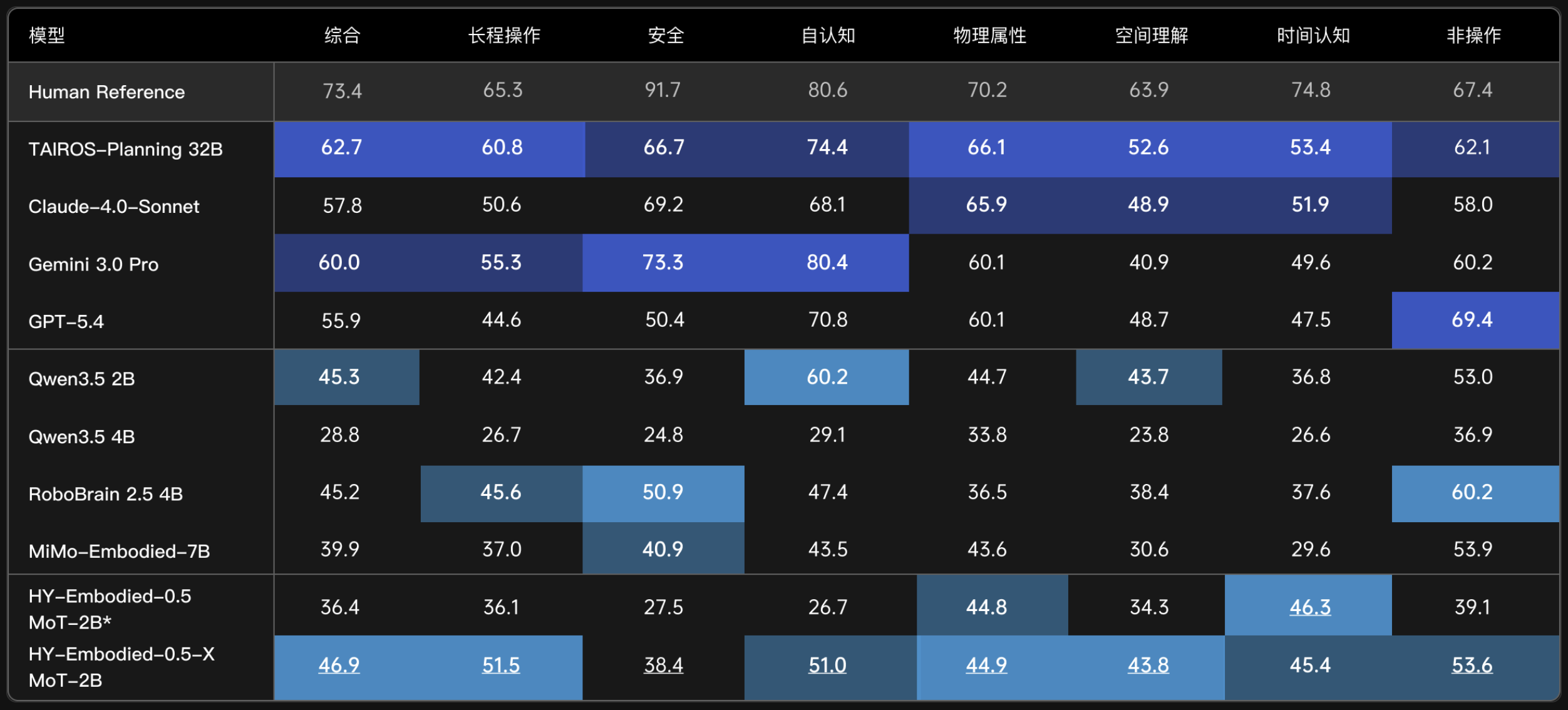
We built an internal embodied-planning benchmark on AI2Thor with 1,011 tasks across four household scenes (kitchen, bedroom, living room, bathroom), evaluating planning and execution on navigation, grasping, placement, appliance operation, and food cutting. HY-Embodied-0.5-X shows clear gains on long-horizon manipulation, self-awareness, and spatial understanding:
HY-Embodied-0.5-X is integrated with the PlaygroundX simulation framework (built on Tairos). It produces full plans for household instructions such as "throw the potato into the trash", "close the fridge door", or "put the tomato in the fridge", and adjusts execution based on environmental feedback — including on-the-fly replanning when an initial plan fails, forming a complete ReAct loop: reason → execute → detect failure → replan.
A one-click conda setup script setup_env.sh is provided. It creates the
environment, installs PyTorch / flash_attn / transformers (native
HY-Embodied support) / and all remaining dependencies. flash_attn
compiles from source and takes ~10–20 minutes:
bash setup_env.sh
conda activate hy_embodied_x

# (optional) expose the package as a console script
pip install -e .
| Item | Requirement |
|---|---|
| OS | Linux |
| Python | 3.12 |
| CUDA | 12.6 |
| PyTorch | 2.10.0 |
| GPU | NVIDIA GPU with ≥ 16 GB VRAM |
Key dependencies:
transformers(specific commit, native HY-Embodied support),flash_attn==2.8.3,accelerate,deepspeed,timm,liger-kernel. Seesetup_env.shandrequirements.txtfor the pinned list.
hf download tencent/HY-Embodied-0.5-X \
    --local-dir ckpts/HY-Embodied-0.5-X
Weights (*.safetensors) are git-ignored and expected under
ckpts/HY-Embodied-0.5-X/. The inference and training code also accepts
the Hub repo id directly, which triggers on-demand download via
transformers.
# Default: thinking mode disabled
python -m hy_embodied.cli.infer \
    --model ckpts/HY-Embodied-0.5-X \
    --image ./assets/demo.jpg \
    --prompt "Describe this image"

# Enable thinking mode (chain-of-thought reasoning)
python -m hy_embodied.cli.infer \
    --model ckpts/HY-Embodied-0.5-X \
    --image ./assets/demo.jpg \
    --prompt "Describe this image" \
    --enable-thinking
The legacy python inference.py ... invocation also works (it forwards to
the same code path).
import torch
from hy_embodied.inference import GenerationConfig, HyEmbodiedPipeline

pipe = HyEmbodiedPipeline.from_pretrained(
    "ckpts/HY-Embodied-0.5-X",
    device="cuda",
    torch_dtype=torch.bfloat16,
)

# Default: thinking disabled
print(pipe.generate(
    "Describe the image in detail.",
    image="./assets/demo.jpg",
    generation_config=GenerationConfig(max_new_tokens=32768, temperature=0.05),
))

# Enable thinking mode
print(pipe.generate(
    "Describe the image in detail.",
    image="./assets/demo.jpg",
    generation_config=GenerationConfig(
        max_new_tokens=32768,
        temperature=0.05,
        enable_thinking=True,
    ),
))
See docs/inference.md for batch inference and
multi-image / video examples.
Launch a server that exposes the standard /v1/chat/completions endpoint:
# Quick start
bash scripts/run_server.sh

# Or with custom options
python -m hy_embodied.cli.server \
    --model ckpts/HY-Embodied-0.5-X \
    --host 0.0.0.0 --port 8080

# After `pip install -e ".[serve]"`
hy-embodied-server --model ckpts/HY-Embodied-0.5-X --port 8080
Then use any OpenAI-compatible client to call the model:
from openai import OpenAI

client = OpenAI(base_url="http://localhost:8080/v1", api_key="any")

# Text-only (thinking disabled by default)
resp = client.chat.completions.create(
    model="HY-Embodied-0.5-X",
    messages=[{"role": "user", "content": "How to open a fridge?"}],
)
print(resp.choices[0].message.content)

# With image (thinking disabled by default)
resp = client.chat.completions.create(
    model="HY-Embodied-0.5-X",
    messages=[{
        "role": "user",
        "content": [
            {"type": "image_url", "image_url": {"url": "https://example.com/img.jpg"}},
            {"type": "text", "text": "Describe this image."},
        ],
    }],
)

# Enable thinking mode (chain-of-thought reasoning)
resp = client.chat.completions.create(
    model="HY-Embodied-0.5-X",
    messages=[{"role": "user", "content": "How to open a fridge?"}],
    extra_body={"enable_thinking": True},
)

# Streaming
stream = client.chat.completions.create(
    model="HY-Embodied-0.5-X",
    messages=[{"role": "user", "content": "Plan how to clean the table."}],
    stream=True,
)
for chunk in stream:
    if chunk.choices[0].delta.content:
        print(chunk.choices[0].delta.content, end="", flush=True)
Supports curl as well:
curl http://localhost:8080/v1/chat/completions \
  -H "Content-Type: application/json" \
  -d '{
    "model": "HY-Embodied-0.5-X",
    "messages": [{"role":"user","content":"Hello!"}]
  }'

# Enable thinking mode
curl http://localhost:8080/v1/chat/completions \
  -H "Content-Type: application/json" \
  -d '{
    "model": "HY-Embodied-0.5-X",
    "messages": [{"role":"user","content":"Hello!"}],
    "enable_thinking": true
  }'
See docs/inference.md for full server documentation.
# Single GPU smoke test — no torchrun / DeepSpeed required (≥ 16 GB VRAM)
CUDA_VISIBLE_DEVICES=0 python -m hy_embodied.cli.train \
    --config configs/sft/example_small_single_gpu.yaml
# or simply:
bash scripts/run_sft_single_gpu.sh

# 1 node × 8 GPUs with DeepSpeed ZeRO-2
bash scripts/run_sft_1node_8gpu.sh

# 4 nodes × 8 GPUs
bash scripts/run_sft_4node_8gpu.sh
Two reference configs are shipped:
configs/sft/example_small_single_gpu.yaml — single-GPU config with
DeepSpeed disabled. Can be launched with plain python -m (no torchrun
needed). Best for quick validation and debugging.configs/sft/example_small.yaml — multi-GPU config with DeepSpeed
ZeRO-2 enabled. Must be launched via torchrun or accelerate. Its
training/optimizer defaults match the release recipe; new users typically
only need to edit data.train_data_paths /
data.train_data_sampling_ratios to point at their own JSONL mixture.Both configs ship with data_examples/data_demo.jsonl (14 samples across
6 capabilities, images bundled in the repo) so the default commands run
end-to-end with no external data.
See docs/training.md for the config reference and
distributed strategies.
(x, y) or [(x1, y1), (x2, y2)][xmin, ymin, xmax, ymax]<think>[reasoning]</think><answer>[answer]</answer>.HY-Embodied-0.5-X/
├── README.md # this file
├── LICENSE # Apache-2.0
├── pyproject.toml # packaging + console scripts
├── requirements.txt # full pinned dependency list
├── setup_env.sh # one-click env setup
│
├── src/hy_embodied/ # Python package
│ ├── cli/ # `python -m hy_embodied.cli.train / .infer / .server`
│ ├── training/ # SFT trainer, data pipeline, chat template
│ └── inference/ # HyEmbodiedPipeline
│
├── configs/
│ ├── sft/ # training config (example_small.yaml)
│ ├── accelerate/ # accelerate launcher configs
│ ├── deepspeed/ # ZeRO configs
│ └── fsdp/ # FSDP configs
│
├── scripts/ # shell launchers (1-node / 4-node)
├── data_examples/ # per-capability sample JSONLs (+ README)
├── docs/ # data_format / training / inference / architecture
├── assets/ # images used in docs / README
├── ckpts/ # (gitignored) `hf download` target
├── outputs/ # (gitignored) training run outputs
└── inference.py # backward-compat shim for the legacy CLI
See docs/architecture.md for the architectural
rationale and dependency rules.
HY-Embodied-0.5-X targets the following embodied scenarios:
@article{tencent2026hyembodied05x,
  title   = {HY-Embodied-0.5-X: An Enhanced Embodied Foundation Model for Real-World Agents},
  author  = {Tencent Robotics X and HY Vision Team},
  year    = {2026}
}
Thanks to the Hugging Face community, and all open-source contributors. By open-sourcing HY-Embodied-0.5-X we hope to offer the embodied-AI community a more deployment-oriented foundation, and to push models from general understanding toward real-world execution.
HY-Embodied-0.5-X: An Enhanced Embodied Foundation Model for Real-World Agents
See the codeTencent Robotics X × HY Vision Team
HY-Embodied-0.5-X is an enhanced open-source embodied multimodal foundation model
jointly released by Tencent Robotics X and the HY Vision Team. Built on
top of the HY-Embodied-0.5 MoT-2B architecture (4B total parameters with
only 2B activated), it is specifically optimized for the core loop of
real-world robotics — "understand, reason, and act".
The model reaches state-of-the-art performance on 10 mainstream embodied task-planning benchmarks, ranking 1st among edge-side domain models on 7 of them. Compared with general-purpose multimodal models, HY-Embodied-0.5-X focuses more tightly on the problems that matter in real-world robot interaction, with dedicated improvements in fine-grained manipulation understanding, spatial reasoning, action prediction, risk assessment, multimodal reference grounding, and long-horizon planning — pushing the model from "seeing" to "doing".
[2026-04-24] 🚀 Released HY-Embodied-0.5-X, an embodied-focused
enhancement on top of HY-Embodied-0.5 MoT-2B, together with inference
and training code.HY-Embodied-0.5-X combines self-collected first-person robot manipulation data, robotic-arm manipulation data, and open-source embodied data into a high-quality corpus that covers manipulation understanding, first-person task reasoning, and multimodal reference grounding:
All core samples are paired with chain-of-thought (CoT) annotations and a full "generate → verify → correct → eval-regression" data-quality loop. Embodied, internet, and 3D data are further unified through a standardized reconstruction pipeline that turns heterogeneous sources into consistent, high-quality embodied reasoning data.
Training follows a staged iterative strategy:
This ensures each unit of compute is invested in the most valuable data.
Across 10 open-source benchmarks covering planning, spatial reasoning, embodied QA, visual reference, and trajectory understanding, HY-Embodied-0.5-X stays in the top tier.
We built an internal embodied-planning benchmark on AI2Thor with 1,011 tasks across four household scenes (kitchen, bedroom, living room, bathroom), evaluating planning and execution on navigation, grasping, placement, appliance operation, and food cutting. HY-Embodied-0.5-X shows clear gains on long-horizon manipulation, self-awareness, and spatial understanding:
HY-Embodied-0.5-X is integrated with the PlaygroundX simulation framework (built on Tairos). It produces full plans for household instructions such as "throw the potato into the trash", "close the fridge door", or "put the tomato in the fridge", and adjusts execution based on environmental feedback — including on-the-fly replanning when an initial plan fails, forming a complete ReAct loop: reason → execute → detect failure → replan.
A one-click conda setup script setup_env.sh is provided. It creates the
environment, installs PyTorch / flash_attn / transformers (native
HY-Embodied support) / and all remaining dependencies. flash_attn
compiles from source and takes ~10–20 minutes:
bash setup_env.sh
conda activate hy_embodied_x

# (optional) expose the package as a console script
pip install -e .
| Item | Requirement |
|---|---|
| OS | Linux |
| Python | 3.12 |
| CUDA | 12.6 |
| PyTorch | 2.10.0 |
| GPU | NVIDIA GPU with ≥ 16 GB VRAM |
Key dependencies:
transformers(specific commit, native HY-Embodied support),flash_attn==2.8.3,accelerate,deepspeed,timm,liger-kernel. Seesetup_env.shandrequirements.txtfor the pinned list.
hf download tencent/HY-Embodied-0.5-X \
    --local-dir ckpts/HY-Embodied-0.5-X
Weights (*.safetensors) are git-ignored and expected under
ckpts/HY-Embodied-0.5-X/. The inference and training code also accepts
the Hub repo id directly, which triggers on-demand download via
transformers.
# Default: thinking mode disabled
python -m hy_embodied.cli.infer \
    --model ckpts/HY-Embodied-0.5-X \
    --image ./assets/demo.jpg \
    --prompt "Describe this image"

# Enable thinking mode (chain-of-thought reasoning)
python -m hy_embodied.cli.infer \
    --model ckpts/HY-Embodied-0.5-X \
    --image ./assets/demo.jpg \
    --prompt "Describe this image" \
    --enable-thinking
The legacy python inference.py ... invocation also works (it forwards to
the same code path).
import torch
from hy_embodied.inference import GenerationConfig, HyEmbodiedPipeline

pipe = HyEmbodiedPipeline.from_pretrained(
    "ckpts/HY-Embodied-0.5-X",
    device="cuda",
    torch_dtype=torch.bfloat16,
)

# Default: thinking disabled
print(pipe.generate(
    "Describe the image in detail.",
    image="./assets/demo.jpg",
    generation_config=GenerationConfig(max_new_tokens=32768, temperature=0.05),
))

# Enable thinking mode
print(pipe.generate(
    "Describe the image in detail.",
    image="./assets/demo.jpg",
    generation_config=GenerationConfig(
        max_new_tokens=32768,
        temperature=0.05,
        enable_thinking=True,
    ),
))
See docs/inference.md for batch inference and
multi-image / video examples.
Launch a server that exposes the standard /v1/chat/completions endpoint:
# Quick start
bash scripts/run_server.sh

# Or with custom options
python -m hy_embodied.cli.server \
    --model ckpts/HY-Embodied-0.5-X \
    --host 0.0.0.0 --port 8080

# After `pip install -e ".[serve]"`
hy-embodied-server --model ckpts/HY-Embodied-0.5-X --port 8080
Then use any OpenAI-compatible client to call the model:
from openai import OpenAI

client = OpenAI(base_url="http://localhost:8080/v1", api_key="any")

# Text-only (thinking disabled by default)
resp = client.chat.completions.create(
    model="HY-Embodied-0.5-X",
    messages=[{"role": "user", "content": "How to open a fridge?"}],
)
print(resp.choices[0].message.content)

# With image (thinking disabled by default)
resp = client.chat.completions.create(
    model="HY-Embodied-0.5-X",
    messages=[{
        "role": "user",
        "content": [
            {"type": "image_url", "image_url": {"url": "https://example.com/img.jpg"}},
            {"type": "text", "text": "Describe this image."},
        ],
    }],
)

# Enable thinking mode (chain-of-thought reasoning)
resp = client.chat.completions.create(
    model="HY-Embodied-0.5-X",
    messages=[{"role": "user", "content": "How to open a fridge?"}],
    extra_body={"enable_thinking": True},
)

# Streaming
stream = client.chat.completions.create(
    model="HY-Embodied-0.5-X",
    messages=[{"role": "user", "content": "Plan how to clean the table."}],
    stream=True,
)
for chunk in stream:
    if chunk.choices[0].delta.content:
        print(chunk.choices[0].delta.content, end="", flush=True)
Supports curl as well:
curl http://localhost:8080/v1/chat/completions \
  -H "Content-Type: application/json" \
  -d '{
    "model": "HY-Embodied-0.5-X",
    "messages": [{"role":"user","content":"Hello!"}]
  }'

# Enable thinking mode
curl http://localhost:8080/v1/chat/completions \
  -H "Content-Type: application/json" \
  -d '{
    "model": "HY-Embodied-0.5-X",
    "messages": [{"role":"user","content":"Hello!"}],
    "enable_thinking": true
  }'
See docs/inference.md for full server documentation.
# Single GPU smoke test — no torchrun / DeepSpeed required (≥ 16 GB VRAM)
CUDA_VISIBLE_DEVICES=0 python -m hy_embodied.cli.train \
    --config configs/sft/example_small_single_gpu.yaml
# or simply:
bash scripts/run_sft_single_gpu.sh

# 1 node × 8 GPUs with DeepSpeed ZeRO-2
bash scripts/run_sft_1node_8gpu.sh

# 4 nodes × 8 GPUs
bash scripts/run_sft_4node_8gpu.sh
Two reference configs are shipped:
configs/sft/example_small_single_gpu.yaml — single-GPU config with
DeepSpeed disabled. Can be launched with plain python -m (no torchrun
needed). Best for quick validation and debugging.configs/sft/example_small.yaml — multi-GPU config with DeepSpeed
ZeRO-2 enabled. Must be launched via torchrun or accelerate. Its
training/optimizer defaults match the release recipe; new users typically
only need to edit data.train_data_paths /
data.train_data_sampling_ratios to point at their own JSONL mixture.Both configs ship with data_examples/data_demo.jsonl (14 samples across
6 capabilities, images bundled in the repo) so the default commands run
end-to-end with no external data.
See docs/training.md for the config reference and
distributed strategies.
(x, y) or [(x1, y1), (x2, y2)][xmin, ymin, xmax, ymax]<think>[reasoning]</think><answer>[answer]</answer>.HY-Embodied-0.5-X/
├── README.md # this file
├── LICENSE # Apache-2.0
├── pyproject.toml # packaging + console scripts
├── requirements.txt # full pinned dependency list
├── setup_env.sh # one-click env setup
│
├── src/hy_embodied/ # Python package
│ ├── cli/ # `python -m hy_embodied.cli.train / .infer / .server`
│ ├── training/ # SFT trainer, data pipeline, chat template
│ └── inference/ # HyEmbodiedPipeline
│
├── configs/
│ ├── sft/ # training config (example_small.yaml)
│ ├── accelerate/ # accelerate launcher configs
│ ├── deepspeed/ # ZeRO configs
│ └── fsdp/ # FSDP configs
│
├── scripts/ # shell launchers (1-node / 4-node)
├── data_examples/ # per-capability sample JSONLs (+ README)
├── docs/ # data_format / training / inference / architecture
├── assets/ # images used in docs / README
├── ckpts/ # (gitignored) `hf download` target
├── outputs/ # (gitignored) training run outputs
└── inference.py # backward-compat shim for the legacy CLI
See docs/architecture.md for the architectural
rationale and dependency rules.
HY-Embodied-0.5-X targets the following embodied scenarios:
@article{tencent2026hyembodied05x,
  title   = {HY-Embodied-0.5-X: An Enhanced Embodied Foundation Model for Real-World Agents},
  author  = {Tencent Robotics X and HY Vision Team},
  year    = {2026}
}
Thanks to the Hugging Face community, and all open-source contributors. By open-sourcing HY-Embodied-0.5-X we hope to offer the embodied-AI community a more deployment-oriented foundation, and to push models from general understanding toward real-world execution.






