Pi-Pocket + Batteries
See the codePi Pocket, tuned for local models.
A durable, multiplayer, mobile-first web app for Pi agents, built on Pi Durable.
Runs on your own machine or directly on your phone. No cloud VM.
A fork of TannerMidd/pi-pocket with the context batteries from oh-my-pi ported in.


Website · Quick start · Features · Remote access
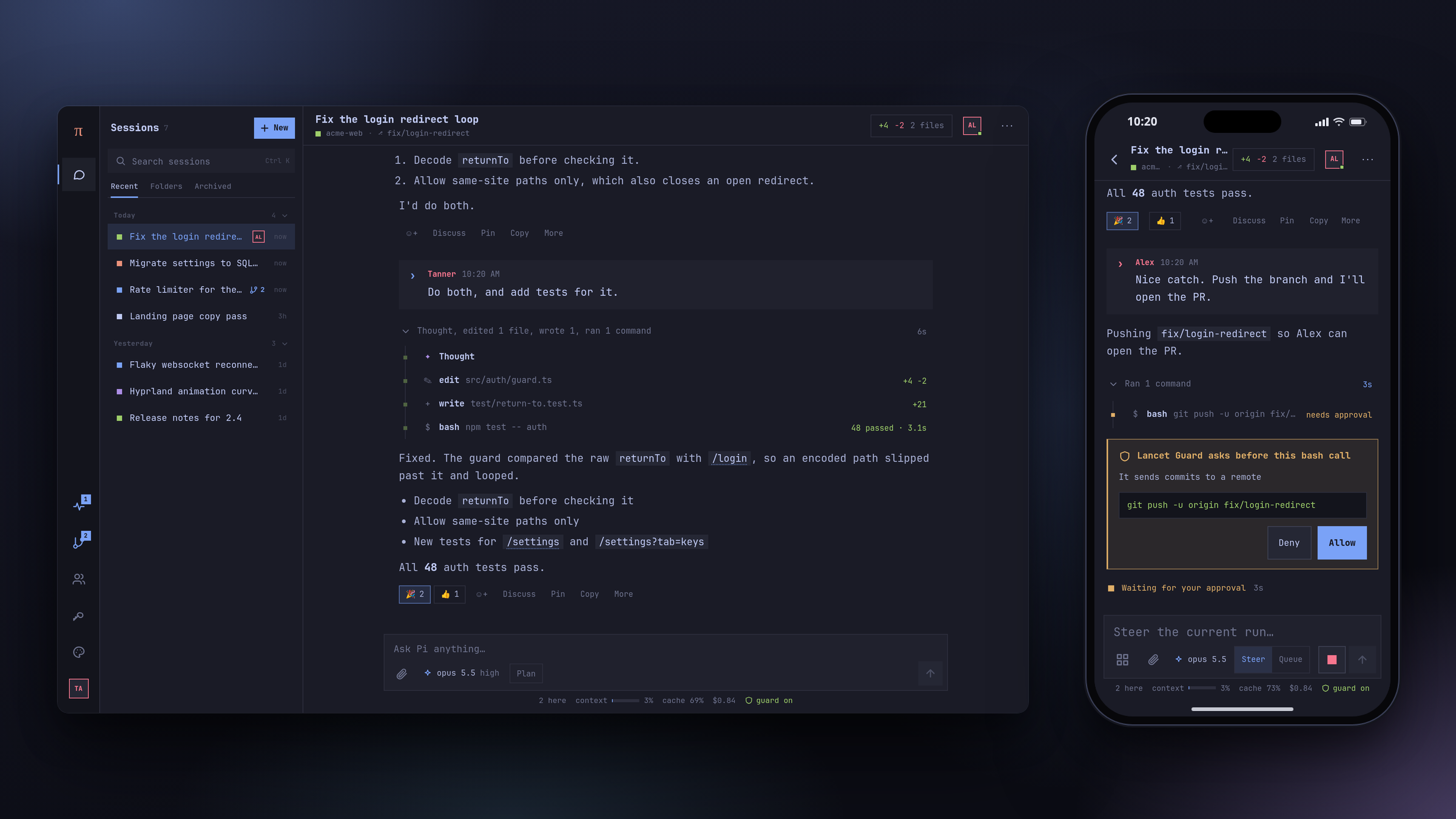
Oh-My-Pocket keeps Pi Pocket whole and adds what a self-hosted model on one GPU needs: a small, stable prompt prefix, no surprise model swaps, and a plan mode that can read the project board. Each change ships with tests, and each one that touches the prompt is measured against oh-my-pi (OMP) on the same task, model, and server.
oh-my-pocket is the default branch. main mirrors Pi Pocket: upstream changes land there first, get reviewed, and
only then merge into oh-my-pocket.
| Battery | What it does | Measured |
|---|---|---|
| Agent definitions | subagent spawn takes agent: <name> and loads ~/.pi-pocket/agents/<name>.md: role instructions, model, thinking level, and tools. Pipelines (plan, implement, review) run each stage as its own role. | 5 tests |
| Background compaction off | compaction.backgroundTokens in Pi's settings now reaches Pi Durable; 0 turns it off. A local server answers one request at a time, so a background summary only queues behind the turn it was meant to overlap. | 3 tests |
| Titles on the session's model | A session's own model writes its title, never a cheaper one picked on the side: nobody chose that one, and it may cost what nobody agreed to. It started as a free-model carve-out (on a one-GPU server, a *-mini load pushed the session's model out of VRAM for a six-word title); upstream's 0.13.1 made it the rule for every session. | no model swap before the first turn (about 40 s each way here) |
| Plan mode reads the board | Tools can mark which calls only read (host.readOnlyCalls), and plan mode lets those through: listing and reading board tickets, say. git -C <dir>, git branch -a, and output sent to /dev/null count as reads too. | 19 new test cases; the 4 calls a real plan session got blocked on now pass |
| Per-role skill catalog (recipe) | A drop-in wraps the skills section (Pi Durable's wrapSection) and renders it from the session role's own list. Pi otherwise sends its whole catalog on every request. | router start context 19,395 to 13,133 tokens |
| Context meter | /context, a tap on the status-line meter, or GET /api/c/:id/context: the context split into prompt sections, tool schemas, and history by kind, scaled to the newest measured prompt. Every A/B reads its own numbers. | within 0.1% of the measured prompt; 3 tests |
| Waiting subagents | subagent spawn and send take wait: true and return the answer as the call's result. The parent writes nothing while a stage runs, so on a one-slot server the stage keeps its cache. A stopped waiting call still gets its answer as a report. | cached share 60% to 90%; 2 tests |
| Prune before summarising | Compaction first replaces its range with a note that costs no model call: old tool output masked to one line each, the newest results kept in full, stale re-reads and loops dropped; the LLM summary runs only when the note would still leave the context over its limit. compaction.pruneToolOutput and pruneKeepLast in Pi's settings. | 9 tests; no second model call in the common case |
| Loop guard | The third identical tool call in one turn is blocked (the block says so when the earlier runs failed), and the system prompt says the same in one line; a file edit re-arms reads and shell checks, so test, fix, test is not a loop; a restart-interrupted call is not a failure, and a fresh person's message re-arms it. Call arguments a model wrote slightly wrong (a JSON string where the object belongs) are repaired before validation. | 10 tests; research measured 30K to 8.9K prompt tokens, under 20% to 100% solve |
| Read economy | A read without an explicit limit returns at most five hundred lines, and the result carries a structural map of the part it did not read: how many lines remain and where the sections sit. To see more, the model reads on with an offset and a limit. | 6 tests; keeps whole-file dumps out of a small model's context |
| KV-prefix discipline | The system prompt is byte-stable and append-friendly: the one line that changes on its own (the day) sits in the last section of each pack, behind drop-ins' sections too, so a cache hit stays a hit through the day instead of re-prefilling the tail. Pinned by test for sessions, PiP, and drop-ins. | the date's flip re-prefills one short line, not the pack |
| Context baseline | /context baseline (or a tap on the status line) takes a meter of where the context goes; the next /context lines it up against that and names the rows a change touched, before and after, biggest moves first. /context clear puts the meter back on its own. | 4 tests; names the row a prompt, tool, or skill change lands on |
Router start context, the tokens sent before the first word of every request: Pi Pocket with a router prompt 22,726;
OMP 15,900; Oh-My-Pocket 13,226 (llama-swap /api/metrics/activity, probe "Reply with just: ok", 2026-10-11).
Same T2 job (add subtract(a, b) with a pytest test: plan, implement, review, one model, one GPU), 2026-10-11:
| Harness | Wall | Requests | Prompt tokens | Cached | Prefilled | Output | Result |
|---|---|---|---|---|---|---|---|
| OMP | 213 s | 41 | 685,014 | 81% | 130K | 20,009 | 2 passed, review clean |
Oh-My-Pocket, before wait | 187 s | 34 | 468,160 | 60% | 186K | 13,880 | 2 passed, review clean |
Oh-My-Pocket, wait | 179 s | 36 | 470,091 | 90% | 47K | 14,252 | 2 passed, review ship |
| Oh-My-Pocket, batteries | 145 s | 31 | 397,605 | 75% | 99K | 13,395 | 3 passed, review clean |
The batteries row is the median of three runs on NInfer v3 (2026-10-11 evening; 136, 145 and 181 s), alternating with the build before the batteries on the same engine: 166, 184 and 256 s, median 476K prompt, 104K prefilled, 18.4K output. On a three-file repository the batteries barely fire, so the gap sits inside run-to-run noise: they cost nothing here. With a 1,007-line file to edit, read economy fires (4 maps over two runs) and the median prefill falls from 156K to 139K tokens (298 s against 307 s); two runs each, so a direction, not a result.
A router is made in the editor, and its prompt is written from its stages. Drop-ins in
~/.pi-pocket/extensions/ add to that, so Oh-My-Pocket itself stays general:
section that adds the router's instructions when the session's model is the router model,
and stays out of subagents.ome {call, args}) costs a fraction of one schema per call. The drop-in
puts its read-only calls in host.readOnlyCalls, so plan mode can read the board.wrapSection("skills", ...) that filters host.skills(cwd) to the role's list and renders it
with Pi's formatSkillsForPrompt. /skill:<name> still loads any skill.wait: true.docs/extensions.md covers the host members and hooks these use.
Run the same task in OMP and in Oh-My-Pocket against the same llama-swap server, then read
/api/metrics/activity (paged, newest first) for prompt tokens, cache hits, output, and wall time. A battery stays only
if it holds or improves those numbers without lowering the result.
Ported from OMP and DeepSeek Harness (both MIT), ranked by measured cost on local models: hash-anchored edit
(A/B only, never ported blind), LSP diagnostics after an edit, suppression of a file read a second time this turn,
and subagent handoff hygiene - the child gets file pointers and a typed result schema, nothing else.
docs/RESEARCH.md holds the full survey with its measurements.
Requires Node.js 22.19 or newer. Runs on Linux, macOS, Windows, and Android (Termux); Linux is the most tested. Sign in to a provider with Pi first (pi, then /login), or later from the app's Providers sheet.
git clone -b oh-my-pocket https://github.com/T-Crypt/oh-my-pocket.git
cd oh-my-pocket
npm install
npm start
The launcher asks how your devices should connect, then prints the address, a sign-in link, and a QR code. Open the link once per browser; the cookie lasts a year. The link is the owner's key, so keep it private. --rotate-token replaces it and signs out every device that used the old link; people you invited stay signed in until you remove them under Menu → People.
While it runs: q quit · r restart server · a change access · o open in browser · s show QR code.
/schedule every weekday 8:00 summarize CI), and /until npm test keeps Pi going until the check passes.localhost included./subagents, sets which models they may run on besides the session's own.~/.pi-pocket/routers/<id>.json, routers already on this machine show read-only under From this machine, and Use in this session or the model picker's Routers group runs a session on the router's model until a plain model is picked.~/.pi-pocket/extensions/.The full tour is in docs/features.md.
Choose a mode in the launcher, or pass --access:
| Mode | Who can connect | Notes |
|---|---|---|
local | This machine | Listens on 127.0.0.1 |
lan | Your local network | All addresses, plain http |
cloudflare | Anyone with the link | Free quick tunnel with https, no account needed (Cloudflare offers quick tunnels for testing and development). The address changes each time the launcher starts but stays the same across server restarts. |
tailscale | Your tailnet | Tailscale address only, encrypted by the tailnet |
Cloudflare mode needs cloudflared. On Linux the launcher can download the official release into ~/.pi-pocket/bin. To use another tunnel (ngrok, tailscale serve), choose local and point the tunnel at port 8787.
[!WARNING] Anyone with steering rights can make the agent run commands on this machine, as you. That reaches everything you can: your files, Pi Pocket's own settings and sign-in tokens, and its code. A single-session invite limits what someone sees in the app, not what Pi can reach, and Lancet Guard approvals can come from anyone who can steer, including the person who asked. People who can steer every session can also invite others. Invite only people you would trust at your keyboard. View-only users cannot make Pi act.
pkg update && pkg upgrade
pkg install nodejs git
npm install -g --ignore-scripts @earendil-works/pi-coding-agent
pi                      # /login, then quit
# copy or clone pi-pocket to the phone, then:
cd pi-pocket && npm install --ignore-scripts && npm start
Open the link in Chrome and choose Add to Home screen. Run termux-wake-lock so Android does not stop Termux.
Lancet Guard needs ONNX Runtime, which may not load on Android. If the guard is on but cannot load, Pi Pocket blocks bash, write, and edit calls (the status line shows "guard failed"). Turn it off in the app (Menu → Extensions), in ~/.pi/lancet-guard.json, or by starting with PI_POCKET_GUARD=off.
| Option | Default | Purpose |
|---|---|---|
--access <mode> | last choice | Skip the access menu |
-y | Reuse the last access choice | |
--port | 8787 | Port to listen on |
--cwd | current folder | Default folder for new sessions |
--data | ~/.pi-pocket | Database, settings, uploads, and push keys |
--host | Listen on a specific address instead of choosing access | |
--rotate-token | Issue a new owner link and sign out devices that used the old one |
Environment variables: PI_POCKET_ACCESS, PI_POCKET_DIR, PI_POCKET_HOST, PI_POCKET_PORT, PI_POCKET_GUARD=off, PI_POCKET_BROWSER (the browser to run, when Chromium or Chrome is not found by itself), and PI_POCKET_BROWSER_ARGS (extra flags for it, such as --no-sandbox where sandboxes are unavailable). Without a terminal (under systemd, for example), the launcher uses --access or the last choice.
| Path | Role |
|---|---|
bin/pi-pocket.js | Entry point: checks the Node version, starts the launcher |
src/launcher/ | Access menu, server supervisor, Cloudflare tunnel, keys, QR code |
src/server/app.ts | The core: the durable harness over pocket.sqlite, the coordinator every commit goes through, connected tabs, access, and the session list |
src/server/attribution.ts, workspace.ts, transcripts.ts | Who Pi works for; a conversation's folder and its stored history, as people reach them |
src/server/room.ts | One conversation's shared live view, sent to every tab watching it |
src/server/commands.ts | What people ask of Pi: messages, forks, models, plan mode, goals, schedules, worktrees |
src/server/collab.ts | The people's side: chat, activity lines, reactions, pins, notes, take turns |
src/server/http.ts, http/ | Web files, JSON API, server-sent events, uploads, artifacts, invites, the Browser panel's frames and input |
src/server/browser.ts, browser/ | The built-in browser: one headless Chromium over the DevTools protocol, a page per conversation |
src/server/projection.ts | Turns committed conversation state into compact JSON for browsers |
src/server/docs.ts | Durable documents: sessions, chat, pins, notes, artifacts, subagents, schedules, goals, spend |
src/server/schedules.ts, goals.ts, spend.ts, changes.ts, branches.ts, worktrees.ts | One feature each, with its durable tasks or git calls |
src/server/push.ts, alerts.ts | Dependency-free Web Push (RFC 8291 and RFC 8292), and who gets which notification |
src/server/extensions/ | Live-reloaded extensions: system prompt, artifacts, browser, subagents, schedules, goals, plan mode, Lancet Guard, codemode |
web/ | The app: Preact and htm as plain ES modules |
Browsers render only committed state. Each session's Pi Durable view is coalesced and sent as small updates over server-sent events, so a device that reconnects or joins late sees exactly what everyone else sees. The engineering page explains the design; docs/map.md is a short map of the code.
npm run check       # type-check
npm test            # server tests with a scripted model
npm run check:web   # type-check web/; the files marked clean must stay clean
npm run coverage    # the tests with line coverage, held at 60%
npm run format      # ESLint's layout fixes, then Prettier
npm run lint        # check the layout rules
Changes to web/ reload every open browser. Changes to src/server/extensions/ are reinstalled into the running server. Other server changes need Restart server from the menu, and running work resumes afterward. AGENTS.md covers editing Pi Pocket safely from inside itself, and node test/serve.ts runs a throwaway copy, with its own data and a scripted model, to check a change on.
Pi knows where Pi Pocket's own documentation is: docs/index.md starts it, for agents and people who change how Pi works without code (customizing), write extensions (extensions, with tested examples), or change Pi Pocket itself while it runs (self-editing).
package.json.~/.pi-pocket/extensions/. Pi's prompt templates work as slash commands.localStorage and cookies are unavailable inside them.Inspired by Mario Zechner's demo of his own Pi app. Pi Pocket is an independent project, not affiliated with Earendil. JetBrains Mono is bundled under the SIL Open Font License.
MIT. To report a security problem, see SECURITY.md.
Pi-Pocket + Batteries
See the codePi Pocket, tuned for local models.
A durable, multiplayer, mobile-first web app for Pi agents, built on Pi Durable.
Runs on your own machine or directly on your phone. No cloud VM.
A fork of TannerMidd/pi-pocket with the context batteries from oh-my-pi ported in.
Website · Quick start · Features · Remote access
Oh-My-Pocket keeps Pi Pocket whole and adds what a self-hosted model on one GPU needs: a small, stable prompt prefix, no surprise model swaps, and a plan mode that can read the project board. Each change ships with tests, and each one that touches the prompt is measured against oh-my-pi (OMP) on the same task, model, and server.
oh-my-pocket is the default branch. main mirrors Pi Pocket: upstream changes land there first, get reviewed, and
only then merge into oh-my-pocket.
| Battery | What it does | Measured |
|---|---|---|
| Agent definitions | subagent spawn takes agent: <name> and loads ~/.pi-pocket/agents/<name>.md: role instructions, model, thinking level, and tools. Pipelines (plan, implement, review) run each stage as its own role. | 5 tests |
| Background compaction off | compaction.backgroundTokens in Pi's settings now reaches Pi Durable; 0 turns it off. A local server answers one request at a time, so a background summary only queues behind the turn it was meant to overlap. | 3 tests |
| Titles on the session's model | A session's own model writes its title, never a cheaper one picked on the side: nobody chose that one, and it may cost what nobody agreed to. It started as a free-model carve-out (on a one-GPU server, a *-mini load pushed the session's model out of VRAM for a six-word title); upstream's 0.13.1 made it the rule for every session. | no model swap before the first turn (about 40 s each way here) |
| Plan mode reads the board | Tools can mark which calls only read (host.readOnlyCalls), and plan mode lets those through: listing and reading board tickets, say. git -C <dir>, git branch -a, and output sent to /dev/null count as reads too. | 19 new test cases; the 4 calls a real plan session got blocked on now pass |
| Per-role skill catalog (recipe) | A drop-in wraps the skills section (Pi Durable's wrapSection) and renders it from the session role's own list. Pi otherwise sends its whole catalog on every request. | router start context 19,395 to 13,133 tokens |
| Context meter | /context, a tap on the status-line meter, or GET /api/c/:id/context: the context split into prompt sections, tool schemas, and history by kind, scaled to the newest measured prompt. Every A/B reads its own numbers. | within 0.1% of the measured prompt; 3 tests |
| Waiting subagents | subagent spawn and send take wait: true and return the answer as the call's result. The parent writes nothing while a stage runs, so on a one-slot server the stage keeps its cache. A stopped waiting call still gets its answer as a report. | cached share 60% to 90%; 2 tests |
| Prune before summarising | Compaction first replaces its range with a note that costs no model call: old tool output masked to one line each, the newest results kept in full, stale re-reads and loops dropped; the LLM summary runs only when the note would still leave the context over its limit. compaction.pruneToolOutput and pruneKeepLast in Pi's settings. | 9 tests; no second model call in the common case |
| Loop guard | The third identical tool call in one turn is blocked (the block says so when the earlier runs failed), and the system prompt says the same in one line; a file edit re-arms reads and shell checks, so test, fix, test is not a loop; a restart-interrupted call is not a failure, and a fresh person's message re-arms it. Call arguments a model wrote slightly wrong (a JSON string where the object belongs) are repaired before validation. | 10 tests; research measured 30K to 8.9K prompt tokens, under 20% to 100% solve |
| Read economy | A read without an explicit limit returns at most five hundred lines, and the result carries a structural map of the part it did not read: how many lines remain and where the sections sit. To see more, the model reads on with an offset and a limit. | 6 tests; keeps whole-file dumps out of a small model's context |
| KV-prefix discipline | The system prompt is byte-stable and append-friendly: the one line that changes on its own (the day) sits in the last section of each pack, behind drop-ins' sections too, so a cache hit stays a hit through the day instead of re-prefilling the tail. Pinned by test for sessions, PiP, and drop-ins. | the date's flip re-prefills one short line, not the pack |
| Context baseline | /context baseline (or a tap on the status line) takes a meter of where the context goes; the next /context lines it up against that and names the rows a change touched, before and after, biggest moves first. /context clear puts the meter back on its own. | 4 tests; names the row a prompt, tool, or skill change lands on |
Router start context, the tokens sent before the first word of every request: Pi Pocket with a router prompt 22,726;
OMP 15,900; Oh-My-Pocket 13,226 (llama-swap /api/metrics/activity, probe "Reply with just: ok", 2026-10-11).
Same T2 job (add subtract(a, b) with a pytest test: plan, implement, review, one model, one GPU), 2026-10-11:
| Harness | Wall | Requests | Prompt tokens | Cached | Prefilled | Output | Result |
|---|---|---|---|---|---|---|---|
| OMP | 213 s | 41 | 685,014 | 81% | 130K | 20,009 | 2 passed, review clean |
Oh-My-Pocket, before wait | 187 s | 34 | 468,160 | 60% | 186K | 13,880 | 2 passed, review clean |
Oh-My-Pocket, wait | 179 s | 36 | 470,091 | 90% | 47K | 14,252 | 2 passed, review ship |
| Oh-My-Pocket, batteries | 145 s | 31 | 397,605 | 75% | 99K | 13,395 | 3 passed, review clean |
The batteries row is the median of three runs on NInfer v3 (2026-10-11 evening; 136, 145 and 181 s), alternating with the build before the batteries on the same engine: 166, 184 and 256 s, median 476K prompt, 104K prefilled, 18.4K output. On a three-file repository the batteries barely fire, so the gap sits inside run-to-run noise: they cost nothing here. With a 1,007-line file to edit, read economy fires (4 maps over two runs) and the median prefill falls from 156K to 139K tokens (298 s against 307 s); two runs each, so a direction, not a result.
A router is made in the editor, and its prompt is written from its stages. Drop-ins in
~/.pi-pocket/extensions/ add to that, so Oh-My-Pocket itself stays general:
section that adds the router's instructions when the session's model is the router model,
and stays out of subagents.ome {call, args}) costs a fraction of one schema per call. The drop-in
puts its read-only calls in host.readOnlyCalls, so plan mode can read the board.wrapSection("skills", ...) that filters host.skills(cwd) to the role's list and renders it
with Pi's formatSkillsForPrompt. /skill:<name> still loads any skill.wait: true.docs/extensions.md covers the host members and hooks these use.
Run the same task in OMP and in Oh-My-Pocket against the same llama-swap server, then read
/api/metrics/activity (paged, newest first) for prompt tokens, cache hits, output, and wall time. A battery stays only
if it holds or improves those numbers without lowering the result.
Ported from OMP and DeepSeek Harness (both MIT), ranked by measured cost on local models: hash-anchored edit
(A/B only, never ported blind), LSP diagnostics after an edit, suppression of a file read a second time this turn,
and subagent handoff hygiene - the child gets file pointers and a typed result schema, nothing else.
docs/RESEARCH.md holds the full survey with its measurements.
Requires Node.js 22.19 or newer. Runs on Linux, macOS, Windows, and Android (Termux); Linux is the most tested. Sign in to a provider with Pi first (pi, then /login), or later from the app's Providers sheet.
git clone -b oh-my-pocket https://github.com/T-Crypt/oh-my-pocket.git
cd oh-my-pocket
npm install
npm start
The launcher asks how your devices should connect, then prints the address, a sign-in link, and a QR code. Open the link once per browser; the cookie lasts a year. The link is the owner's key, so keep it private. --rotate-token replaces it and signs out every device that used the old link; people you invited stay signed in until you remove them under Menu → People.
While it runs: q quit · r restart server · a change access · o open in browser · s show QR code.
/schedule every weekday 8:00 summarize CI), and /until npm test keeps Pi going until the check passes.localhost included./subagents, sets which models they may run on besides the session's own.~/.pi-pocket/routers/<id>.json, routers already on this machine show read-only under From this machine, and Use in this session or the model picker's Routers group runs a session on the router's model until a plain model is picked.~/.pi-pocket/extensions/.The full tour is in docs/features.md.
Choose a mode in the launcher, or pass --access:
| Mode | Who can connect | Notes |
|---|---|---|
local | This machine | Listens on 127.0.0.1 |
lan | Your local network | All addresses, plain http |
cloudflare | Anyone with the link | Free quick tunnel with https, no account needed (Cloudflare offers quick tunnels for testing and development). The address changes each time the launcher starts but stays the same across server restarts. |
tailscale | Your tailnet | Tailscale address only, encrypted by the tailnet |
Cloudflare mode needs cloudflared. On Linux the launcher can download the official release into ~/.pi-pocket/bin. To use another tunnel (ngrok, tailscale serve), choose local and point the tunnel at port 8787.
[!WARNING] Anyone with steering rights can make the agent run commands on this machine, as you. That reaches everything you can: your files, Pi Pocket's own settings and sign-in tokens, and its code. A single-session invite limits what someone sees in the app, not what Pi can reach, and Lancet Guard approvals can come from anyone who can steer, including the person who asked. People who can steer every session can also invite others. Invite only people you would trust at your keyboard. View-only users cannot make Pi act.
pkg update && pkg upgrade
pkg install nodejs git
npm install -g --ignore-scripts @earendil-works/pi-coding-agent
pi                      # /login, then quit
# copy or clone pi-pocket to the phone, then:
cd pi-pocket && npm install --ignore-scripts && npm start
Open the link in Chrome and choose Add to Home screen. Run termux-wake-lock so Android does not stop Termux.
Lancet Guard needs ONNX Runtime, which may not load on Android. If the guard is on but cannot load, Pi Pocket blocks bash, write, and edit calls (the status line shows "guard failed"). Turn it off in the app (Menu → Extensions), in ~/.pi/lancet-guard.json, or by starting with PI_POCKET_GUARD=off.
| Option | Default | Purpose |
|---|---|---|
--access <mode> | last choice | Skip the access menu |
-y | Reuse the last access choice | |
--port | 8787 | Port to listen on |
--cwd | current folder | Default folder for new sessions |
--data | ~/.pi-pocket | Database, settings, uploads, and push keys |
--host | Listen on a specific address instead of choosing access | |
--rotate-token | Issue a new owner link and sign out devices that used the old one |
Environment variables: PI_POCKET_ACCESS, PI_POCKET_DIR, PI_POCKET_HOST, PI_POCKET_PORT, PI_POCKET_GUARD=off, PI_POCKET_BROWSER (the browser to run, when Chromium or Chrome is not found by itself), and PI_POCKET_BROWSER_ARGS (extra flags for it, such as --no-sandbox where sandboxes are unavailable). Without a terminal (under systemd, for example), the launcher uses --access or the last choice.
| Path | Role |
|---|---|
bin/pi-pocket.js | Entry point: checks the Node version, starts the launcher |
src/launcher/ | Access menu, server supervisor, Cloudflare tunnel, keys, QR code |
src/server/app.ts | The core: the durable harness over pocket.sqlite, the coordinator every commit goes through, connected tabs, access, and the session list |
src/server/attribution.ts, workspace.ts, transcripts.ts | Who Pi works for; a conversation's folder and its stored history, as people reach them |
src/server/room.ts | One conversation's shared live view, sent to every tab watching it |
src/server/commands.ts | What people ask of Pi: messages, forks, models, plan mode, goals, schedules, worktrees |
src/server/collab.ts | The people's side: chat, activity lines, reactions, pins, notes, take turns |
src/server/http.ts, http/ | Web files, JSON API, server-sent events, uploads, artifacts, invites, the Browser panel's frames and input |
src/server/browser.ts, browser/ | The built-in browser: one headless Chromium over the DevTools protocol, a page per conversation |
src/server/projection.ts | Turns committed conversation state into compact JSON for browsers |
src/server/docs.ts | Durable documents: sessions, chat, pins, notes, artifacts, subagents, schedules, goals, spend |
src/server/schedules.ts, goals.ts, spend.ts, changes.ts, branches.ts, worktrees.ts | One feature each, with its durable tasks or git calls |
src/server/push.ts, alerts.ts | Dependency-free Web Push (RFC 8291 and RFC 8292), and who gets which notification |
src/server/extensions/ | Live-reloaded extensions: system prompt, artifacts, browser, subagents, schedules, goals, plan mode, Lancet Guard, codemode |
web/ | The app: Preact and htm as plain ES modules |
Browsers render only committed state. Each session's Pi Durable view is coalesced and sent as small updates over server-sent events, so a device that reconnects or joins late sees exactly what everyone else sees. The engineering page explains the design; docs/map.md is a short map of the code.
npm run check       # type-check
npm test            # server tests with a scripted model
npm run check:web   # type-check web/; the files marked clean must stay clean
npm run coverage    # the tests with line coverage, held at 60%
npm run format      # ESLint's layout fixes, then Prettier
npm run lint        # check the layout rules
Changes to web/ reload every open browser. Changes to src/server/extensions/ are reinstalled into the running server. Other server changes need Restart server from the menu, and running work resumes afterward. AGENTS.md covers editing Pi Pocket safely from inside itself, and node test/serve.ts runs a throwaway copy, with its own data and a scripted model, to check a change on.
Pi knows where Pi Pocket's own documentation is: docs/index.md starts it, for agents and people who change how Pi works without code (customizing), write extensions (extensions, with tested examples), or change Pi Pocket itself while it runs (self-editing).
package.json.~/.pi-pocket/extensions/. Pi's prompt templates work as slash commands.localStorage and cookies are unavailable inside them.Inspired by Mario Zechner's demo of his own Pi app. Pi Pocket is an independent project, not affiliated with Earendil. JetBrains Mono is bundled under the SIL Open Font License.
MIT. To report a security problem, see SECURITY.md.



