
See what people are saying (1)
README
jev-chess
Play chess in the browser against Jev, a System One model that answers typed questions instead of generating text.
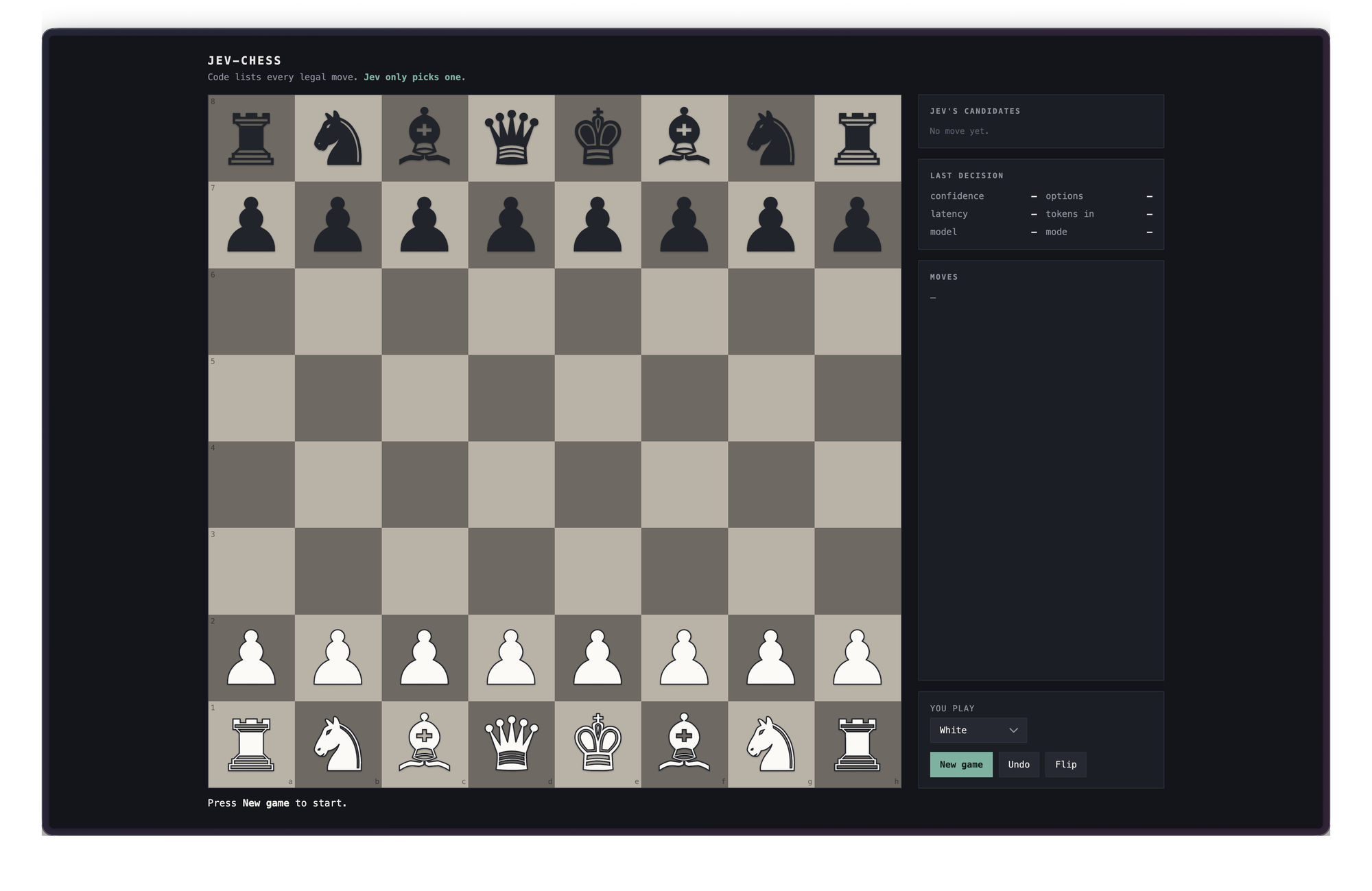
Jev never writes a move. python-chess enumerates every legal move in the position and
hands them over as the options of a single Choice question; Jev returns one option plus
a probability over all of them. An illegal move is not something the model can express.
The sidebar shows what that looks like from the inside: the top candidates with their probabilities, the confidence in the move it took, how many options it was choosing between, latency, and input tokens.
Run it
python -m venv .venv && source .venv/bin/activate
pip install -r requirements.txt
cp .env.example .env        # add your TYPESAFE_API_KEY
python server.py            # http://127.0.0.1:8111
The key is read once at startup and stays in the server process. The browser talks only to localhost.
Layout
server.py         stdlib HTTP server: /api/new, /api/move, /api/undo, and the page itself
jevchess/ask.py   builds the Choice question from a board, one option per legal move
web/index.html    the board, drag and drop, and the decision panel. No build step, no deps.
Games live in memory, keyed by an id the client holds. Restart the server and they are gone.
Notes
Undo takes back two plies, so it is your turn again. Move labels are plain SAN, which does
leak a little: Qxh5# announces the mate before Jev has judged anything. jevchess/ask.py
also carries a stripped mode that removes the +/# suffixes, and a glossed mode that
adds a description of each move, if you want to see how much the notation is doing.
Contributors

5 commits
Similar repos


Languages
HTML
70.3%
Python
29.7%
See what people are saying (1)
README
jev-chess
Play chess in the browser against Jev, a System One model that answers typed questions instead of generating text.
Jev never writes a move. python-chess enumerates every legal move in the position and
hands them over as the options of a single Choice question; Jev returns one option plus
a probability over all of them. An illegal move is not something the model can express.
The sidebar shows what that looks like from the inside: the top candidates with their probabilities, the confidence in the move it took, how many options it was choosing between, latency, and input tokens.
Run it
python -m venv .venv && source .venv/bin/activate
pip install -r requirements.txt
cp .env.example .env        # add your TYPESAFE_API_KEY
python server.py            # http://127.0.0.1:8111
The key is read once at startup and stays in the server process. The browser talks only to localhost.
Layout
server.py         stdlib HTTP server: /api/new, /api/move, /api/undo, and the page itself
jevchess/ask.py   builds the Choice question from a board, one option per legal move
web/index.html    the board, drag and drop, and the decision panel. No build step, no deps.
Games live in memory, keyed by an id the client holds. Restart the server and they are gone.
Notes
Undo takes back two plies, so it is your turn again. Move labels are plain SAN, which does
leak a little: Qxh5# announces the mate before Jev has judged anything. jevchess/ask.py
also carries a stripped mode that removes the +/# suffixes, and a glossed mode that
adds a description of each move, if you want to see how much the notation is doing.
Similar repos
Contributors
5 commits
Languages
HTML
70.3%
Python
29.7%