
Low level toy functional programming language with linear types, first class inline functions, levity polymorphism and regions.
Haskell
80
244 commits
updated Feb 19, 2026
README
Aith my toy programming language that experiments with type systems for perfomant systems programming. As of now, Aith development is dead. I plan to eventually integrate all of it's ideas into Hazy, my Haskell compiler.
 |
|---|
| visualization of compiler internals |
 |
|---|
| visualization of type system |
 |
|---|
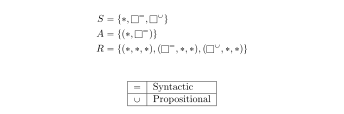
| pure type system subset |
Features
(todo: expand on all of these)
Levity Polymorphic System-F
In languages like in C++ or Rust, generics perform monomorphization. When a generic is used in these languages they will generate code for each instante of type they use.
Rather then do this, Aith uses levity polymorphism, which can be seen as a generalization of Java's type erasure generics. In Aith, a type's kind, which is the type of a type, determines how (and if) it will be represented at runtime.
First Class Inline Functions (staging)
Aith has first class inline functions, a unique (as far as I can tell) take on staging. In Aith, inline functions can take inline functions as argument and return inline functions, all of which is completely erased at runtime.
Inline functions that type check always generate valid code and inline functions are prevented from appearing at runtime though kind checking.
Linear / Unique Types
Aith supports linear types and unique types. These are types that limit how copying of variables. Linear types promise that a variable of a linear type will be used exactly once. Unique types promise that a variable of a unique type will has not been aliased.
Aith has linear types at the inline level with multiplicity in the arrow like Linear Haskell. Aith has necessarily unique types at the runtime level with multiplicity via kinds.
Effectful Regions
Aith has support for effectful regions, similar to Rust's lifetimes. Regions allow programs to reason about borrowing and scoping resources (like memory). Conceptually, an executing program has a stack of regions that it accessing at any given time (think stack frames). If a region is alive, then that region and all it's parent regions are valid.
In Aith, regions are effectful, meaning that all runtime expressions are attached to a region that they live in. These expressions can only access memory in their region or regions proven to be parents of said region.
Type Inference
Aith is built on top of Hindley Milner type inference, similiar to Haskell and OCaml. Hindley Milner is a rather fancy type inference scheme that allows the majority of a program to be without type annotations but still statically typed.
First Class Polymorpism (System-F)
Aith implements first class polymorphism at the meta level. This allows treating generic (inline) functions (or more specifically any generic term) as if they where first class. Generic inline functions can be passed to other inline functions and returned from them. As of now, first class polymorphism is only implmented at the meta level for inline functions and not for runtime functions.
As type inference for first class polymorphism is undeciable, some compromises must be made. Aith implements it's own variant of PolyML, which requires explicit boxing and unboxing and requires annotations for variables who's types are instancited.
Boolean Unification
Aith extends Hindley Milner with boolean unification. This allows certain types to contain boolean expressions (and only boolean expressions). Boolean unification is used by Aith to type check both regions and linear types.
Hindley Milner extended with boolean unification preserves it's nice properties such as principle types. This means that types that use booleans infer as nicely as types that don't. The main trade off is that now type checking now involves what is effectively a generalization of SAT solving.
Building and Running Tests
Install ghc, cabal and make.
Run make to build aith, make tests to run the tests and make test.c to generate the test c source file.
Todo List
- Proper Documentation
- Algebraic data types
- Newtypes
- Add higher kinded types (System-F A)
- Runtime level higher rank polymorphism
- Simplify boolean types to DNF rather then ANF
- Refactoring and syntax changes as usual
Syntax
Files are lists of declarations, where these declarations could be a plain variable declaration or a path declaration. For example f(x) { x } is a plain declaration and example/f(x) { x } is a path declaration.
Folders concatenates all it's contents where the folder name is prepend to all the declarations. A folder named abc prepends abc/ to all it's contents.
Declarations(code)
| Description | Syntax |
|---|---|
| Inline Term | inline x = e; |
| Inline Term Ascribe | inline x : σ = e; |
| Function | x(pm, pm', ...) { e } |
| Function Ascribe | x(pm, pm', ...) : σ in π { e } |
| Function Ascribe | x(pm, pm', ...) :: σ { e } |
| Synonym | type x = σ; |
| New Type Declaration | newtype x : κ; |
Terms(e)
| Description | Syntax |
|---|---|
| Variable | x |
| Variable | x @_ |
| Variable | x @<σ, σ', ...> |
| Global Variable | /x/x'/... |
| Inline Abstraction | \pm -> e |
| Inline Application | e {e'} |
| Inline Binding | inline pm = e; e' |
| Extern | extern [arity] "sym" |
| Function Application | e (e', e'', ...) |
| Runtime Binding | let pm = e; e' |
| Tuple Construction | (e, e', ...) |
| Read Pointer | *e |
| Write Pointer | *e = (e') |
| Array Increment | &e[e'] |
| Array to Pointer | &*e |
| Number Literal | n |
| Addition | e + e' |
| Subtraction | e - e' |
| Multiplication | e * e' |
| Divsion | e / e' |
| Modulus | e % e' |
| Equality | e == e' |
| Inequality | e != e' |
| Less | e < e' |
| Less or Equal | e <= e' |
| Greater | e > e' |
| Greater or Equal | e >= e' |
| Integer Resize | resize e |
| True | true |
| False | false |
| Switch | switch e { pm -> e; pm' -> e'; ... } |
| Poly Introduction | ς e |
| Poly Elimination | e @_ |
| Poly Elimination | e @<σ, σ', ...> |
| Type Annotation | e : σ |
| Pretype Annotation | e :: σ |
| Continue | continue e |
| Break | break e |
| Loop | loop (let pm = e) { e' } |
| Unsafe Cast | cast e |
Terms (Syntax Sugar) (e)
| Description | Syntax | Meaning |
|---|---|---|
| Not | !e | if e { false } else { true } |
| And | e & e' | if e { e' } else { false } |
| Or | e | e' | if e { true } else { e' } |
| Do | e; e' | let () = e; e' |
| If | if e { e' } else { e''} | switch (e) { true -> e; false -> e'; } |
Meta Patterns(pm)
| Description | Syntax |
|---|---|
| Linear Variable | x |
| Linear Variable Abscribe | x : σ |
| Unrestricted Variable Abscribe | x :* σ |
| Polymorphic Variable Abscribe | x :^τ σ |
Runtime Patterns(pm)
| Description | Syntax |
|---|---|
| Variable | x |
| Variable Abscribe | x : σ |
| Tuple Destruction | (pm, pm', ...) |
| True | true |
| False | false |
Scheme(ς)
| Description | Syntax |
|---|---|
| TypeScheme | <pmσ, pmσ', ...> |
Types(σ, τ, π, κ, ρ)
| Description | Syntax |
|---|---|
| Hole | _ |
| Variable | x |
| Linear Inline Function | σ -> τ |
| Unrestricted Inline Function | σ -* τ |
| Polymorphic Inline Function | σ -π τ |
| Poly | ς σ |
| Function Pointer | function(σ, σ', ...) -> τ uses π |
| Tuple | (σ, σ', ...) |
| Effect | σ in π |
| Unique | unique σ |
| Shared | σ @ π |
| Pointer | σ* |
| Array | σ[] |
| Number | ρ integer(ρ') |
| Boolean | boolean |
| IO Region | io |
| Step | step<σ, τ> |
| Meta Type | metatype |
| Type | type<σ, τ> |
| Boxed | boxed |
| Capacity | capacity |
| Region | region |
| Pointer Representation | pointer |
| Struct Representation | struct (ρ, ρ', ...) |
| Union Representation | union (ρ, ρ', ...) |
| Word Representation | ρ word |
| Signed | signed |
| Unsigned | unsigned |
| Byte Size | 8bit |
| Short Size | 16bit |
| Int Size | 32bit |
| Long Size | 64bit |
| Native Size | native |
| Representation | representation |
| Signedness | signedness |
| Size | size |
| Type True | true |
| Type False | false |
| Type And | σ & τ |
| Type Or | σ | τ |
| Type Not | !σ |
| Type Xor | σ (+) τ |
Types (Internal) (σ, τ, π, κ, ρ)
| Description | Syntax |
|---|---|
| Unification | unification |
| Kind | kind<σ> |
| Syntactic | syntactic |
| Propositional | propositional |
| Top | /|\ |
| Function Literal Type | function literal(σ) -> τ uses π |
| Label | label |
| Ambiguous Label | ambiguous |
Types (Syntax Sugar) (σ, τ, π, κ, ρ)
| Description | Syntax | Meaning |
|---|---|---|
| Byte | byte | signed integer(8bit) |
| Short | short | signed integer(16bit) |
| Int | int | signed integer(32bit) |
| Long | long | signed integer(64bit) |
| PtrDiff | ptrdiff | signed integer(native) |
| UByte | ubyte | unsigned integer(8bit) |
| UShort | ushort | unsigned integer(16bit) |
| UInt | uint | unsigned integer(32bit) |
| ULong | ulong | unsigned integer(64bit) |
| Integer | integer(σ) | signed integer(σ) |
| Natural | natural(σ) | unsigned integer(σ) |
| Native Integer | integer | signed integer(native) |
| Native Natural | natural | unsigned integer(native) |
Type Pattern(pmσ)
| Description | Syntax |
|---|---|
| Variable | x : κ |
| Concrete Variable | x :* κ |
C Compiler Requirements
This list may be incomplete.
- All pointers must have the same representation (including function pointers).
- Signed integers must have 2's complement wrapping. (
-fwrapvon gcc)
Papers
Useful / Inspirational papers:
Implemented
Linear / Unique Types
- Linear Haskell (video)
- Implemented for inline functions
Levity polymorphism
- Levity Polymorphism (video)
- Implemented with more restrictive representation lambda.
Compiler Design
- Invertible Syntax Descriptions: Unifying Parsing and Pretty Printing
- Implemented with prisms instead of partial isomorphisms.
Reduction
- Demonstrating Lambda Calculus Reduction
- Applicative order reduction used for inline function reduction.
Unification
- Unification Theory
- Reference for unification and E-unification
- Embedding Boolean Expressions into Logic Programming
Type Inference (First Class Polymorphism)
PolyML is implemented, but with scope type variables are used rather then schematic ones.
Compiler Design
- How OCaml type checker works -- or what polymorphism and garbage collection have in common
- Only implemented for checking escaping skolem variables. Still need to implement let generalization.
Regions
Inspirational, and / or Formerly Used
General Introductions
Pure Type Systems
Linear / Unique Types
- A taste of linear logic
- Linearity and Uniqueness: An Entente Cordiale
- The Best of Both Worlds: Linear Functional Programming without Compromise (video)
Effect Tracking
Type Inference (First Class Polymorphism)
- FreezeML : Complete and Easy Type Inference for First-Class Polymorphism (video)
- A Quick Look at Impredicativity (video)
- QML : Explicit First-Class Polymorphism for ML
Type Inference (Subtyping)
Unification
Internals
Copyright
Copyright © Freddy A Cubas, "Superstar64"
Licensed under GPL3 only. See LICENSE for more info.
Contributors

244 commits
Similar repos


Languages
Haskell
90.7%
TeX
8.1%
Makefile
1.0%
Low level toy functional programming language with linear types, first class inline functions, levity polymorphism and regions.
Haskell
80
244 commits
updated Feb 19, 2026
README
Aith my toy programming language that experiments with type systems for perfomant systems programming. As of now, Aith development is dead. I plan to eventually integrate all of it's ideas into Hazy, my Haskell compiler.
|
|---|
| visualization of compiler internals |
|
|---|
| visualization of type system |
|
|---|
| pure type system subset |
Features
(todo: expand on all of these)
Levity Polymorphic System-F
In languages like in C++ or Rust, generics perform monomorphization. When a generic is used in these languages they will generate code for each instante of type they use.
Rather then do this, Aith uses levity polymorphism, which can be seen as a generalization of Java's type erasure generics. In Aith, a type's kind, which is the type of a type, determines how (and if) it will be represented at runtime.
First Class Inline Functions (staging)
Aith has first class inline functions, a unique (as far as I can tell) take on staging. In Aith, inline functions can take inline functions as argument and return inline functions, all of which is completely erased at runtime.
Inline functions that type check always generate valid code and inline functions are prevented from appearing at runtime though kind checking.
Linear / Unique Types
Aith supports linear types and unique types. These are types that limit how copying of variables. Linear types promise that a variable of a linear type will be used exactly once. Unique types promise that a variable of a unique type will has not been aliased.
Aith has linear types at the inline level with multiplicity in the arrow like Linear Haskell. Aith has necessarily unique types at the runtime level with multiplicity via kinds.
Effectful Regions
Aith has support for effectful regions, similar to Rust's lifetimes. Regions allow programs to reason about borrowing and scoping resources (like memory). Conceptually, an executing program has a stack of regions that it accessing at any given time (think stack frames). If a region is alive, then that region and all it's parent regions are valid.
In Aith, regions are effectful, meaning that all runtime expressions are attached to a region that they live in. These expressions can only access memory in their region or regions proven to be parents of said region.
Type Inference
Aith is built on top of Hindley Milner type inference, similiar to Haskell and OCaml. Hindley Milner is a rather fancy type inference scheme that allows the majority of a program to be without type annotations but still statically typed.
First Class Polymorpism (System-F)
Aith implements first class polymorphism at the meta level. This allows treating generic (inline) functions (or more specifically any generic term) as if they where first class. Generic inline functions can be passed to other inline functions and returned from them. As of now, first class polymorphism is only implmented at the meta level for inline functions and not for runtime functions.
As type inference for first class polymorphism is undeciable, some compromises must be made. Aith implements it's own variant of PolyML, which requires explicit boxing and unboxing and requires annotations for variables who's types are instancited.
Boolean Unification
Aith extends Hindley Milner with boolean unification. This allows certain types to contain boolean expressions (and only boolean expressions). Boolean unification is used by Aith to type check both regions and linear types.
Hindley Milner extended with boolean unification preserves it's nice properties such as principle types. This means that types that use booleans infer as nicely as types that don't. The main trade off is that now type checking now involves what is effectively a generalization of SAT solving.
Building and Running Tests
Install ghc, cabal and make.
Run make to build aith, make tests to run the tests and make test.c to generate the test c source file.
Todo List
- Proper Documentation
- Algebraic data types
- Newtypes
- Add higher kinded types (System-F A)
- Runtime level higher rank polymorphism
- Simplify boolean types to DNF rather then ANF
- Refactoring and syntax changes as usual
Syntax
Files are lists of declarations, where these declarations could be a plain variable declaration or a path declaration. For example f(x) { x } is a plain declaration and example/f(x) { x } is a path declaration.
Folders concatenates all it's contents where the folder name is prepend to all the declarations. A folder named abc prepends abc/ to all it's contents.
Declarations(code)
| Description | Syntax |
|---|---|
| Inline Term | inline x = e; |
| Inline Term Ascribe | inline x : σ = e; |
| Function | x(pm, pm', ...) { e } |
| Function Ascribe | x(pm, pm', ...) : σ in π { e } |
| Function Ascribe | x(pm, pm', ...) :: σ { e } |
| Synonym | type x = σ; |
| New Type Declaration | newtype x : κ; |
Terms(e)
| Description | Syntax |
|---|---|
| Variable | x |
| Variable | x @_ |
| Variable | x @<σ, σ', ...> |
| Global Variable | /x/x'/... |
| Inline Abstraction | \pm -> e |
| Inline Application | e {e'} |
| Inline Binding | inline pm = e; e' |
| Extern | extern [arity] "sym" |
| Function Application | e (e', e'', ...) |
| Runtime Binding | let pm = e; e' |
| Tuple Construction | (e, e', ...) |
| Read Pointer | *e |
| Write Pointer | *e = (e') |
| Array Increment | &e[e'] |
| Array to Pointer | &*e |
| Number Literal | n |
| Addition | e + e' |
| Subtraction | e - e' |
| Multiplication | e * e' |
| Divsion | e / e' |
| Modulus | e % e' |
| Equality | e == e' |
| Inequality | e != e' |
| Less | e < e' |
| Less or Equal | e <= e' |
| Greater | e > e' |
| Greater or Equal | e >= e' |
| Integer Resize | resize e |
| True | true |
| False | false |
| Switch | switch e { pm -> e; pm' -> e'; ... } |
| Poly Introduction | ς e |
| Poly Elimination | e @_ |
| Poly Elimination | e @<σ, σ', ...> |
| Type Annotation | e : σ |
| Pretype Annotation | e :: σ |
| Continue | continue e |
| Break | break e |
| Loop | loop (let pm = e) { e' } |
| Unsafe Cast | cast e |
Terms (Syntax Sugar) (e)
| Description | Syntax | Meaning |
|---|---|---|
| Not | !e | if e { false } else { true } |
| And | e & e' | if e { e' } else { false } |
| Or | e | e' | if e { true } else { e' } |
| Do | e; e' | let () = e; e' |
| If | if e { e' } else { e''} | switch (e) { true -> e; false -> e'; } |
Meta Patterns(pm)
| Description | Syntax |
|---|---|
| Linear Variable | x |
| Linear Variable Abscribe | x : σ |
| Unrestricted Variable Abscribe | x :* σ |
| Polymorphic Variable Abscribe | x :^τ σ |
Runtime Patterns(pm)
| Description | Syntax |
|---|---|
| Variable | x |
| Variable Abscribe | x : σ |
| Tuple Destruction | (pm, pm', ...) |
| True | true |
| False | false |
Scheme(ς)
| Description | Syntax |
|---|---|
| TypeScheme | <pmσ, pmσ', ...> |
Types(σ, τ, π, κ, ρ)
| Description | Syntax |
|---|---|
| Hole | _ |
| Variable | x |
| Linear Inline Function | σ -> τ |
| Unrestricted Inline Function | σ -* τ |
| Polymorphic Inline Function | σ -π τ |
| Poly | ς σ |
| Function Pointer | function(σ, σ', ...) -> τ uses π |
| Tuple | (σ, σ', ...) |
| Effect | σ in π |
| Unique | unique σ |
| Shared | σ @ π |
| Pointer | σ* |
| Array | σ[] |
| Number | ρ integer(ρ') |
| Boolean | boolean |
| IO Region | io |
| Step | step<σ, τ> |
| Meta Type | metatype |
| Type | type<σ, τ> |
| Boxed | boxed |
| Capacity | capacity |
| Region | region |
| Pointer Representation | pointer |
| Struct Representation | struct (ρ, ρ', ...) |
| Union Representation | union (ρ, ρ', ...) |
| Word Representation | ρ word |
| Signed | signed |
| Unsigned | unsigned |
| Byte Size | 8bit |
| Short Size | 16bit |
| Int Size | 32bit |
| Long Size | 64bit |
| Native Size | native |
| Representation | representation |
| Signedness | signedness |
| Size | size |
| Type True | true |
| Type False | false |
| Type And | σ & τ |
| Type Or | σ | τ |
| Type Not | !σ |
| Type Xor | σ (+) τ |
Types (Internal) (σ, τ, π, κ, ρ)
| Description | Syntax |
|---|---|
| Unification | unification |
| Kind | kind<σ> |
| Syntactic | syntactic |
| Propositional | propositional |
| Top | /|\ |
| Function Literal Type | function literal(σ) -> τ uses π |
| Label | label |
| Ambiguous Label | ambiguous |
Types (Syntax Sugar) (σ, τ, π, κ, ρ)
| Description | Syntax | Meaning |
|---|---|---|
| Byte | byte | signed integer(8bit) |
| Short | short | signed integer(16bit) |
| Int | int | signed integer(32bit) |
| Long | long | signed integer(64bit) |
| PtrDiff | ptrdiff | signed integer(native) |
| UByte | ubyte | unsigned integer(8bit) |
| UShort | ushort | unsigned integer(16bit) |
| UInt | uint | unsigned integer(32bit) |
| ULong | ulong | unsigned integer(64bit) |
| Integer | integer(σ) | signed integer(σ) |
| Natural | natural(σ) | unsigned integer(σ) |
| Native Integer | integer | signed integer(native) |
| Native Natural | natural | unsigned integer(native) |
Type Pattern(pmσ)
| Description | Syntax |
|---|---|
| Variable | x : κ |
| Concrete Variable | x :* κ |
C Compiler Requirements
This list may be incomplete.
- All pointers must have the same representation (including function pointers).
- Signed integers must have 2's complement wrapping. (
-fwrapvon gcc)
Papers
Useful / Inspirational papers:
Implemented
Linear / Unique Types
- Linear Haskell (video)
- Implemented for inline functions
Levity polymorphism
- Levity Polymorphism (video)
- Implemented with more restrictive representation lambda.
Compiler Design
- Invertible Syntax Descriptions: Unifying Parsing and Pretty Printing
- Implemented with prisms instead of partial isomorphisms.
Reduction
- Demonstrating Lambda Calculus Reduction
- Applicative order reduction used for inline function reduction.
Unification
- Unification Theory
- Reference for unification and E-unification
- Embedding Boolean Expressions into Logic Programming
Type Inference (First Class Polymorphism)
PolyML is implemented, but with scope type variables are used rather then schematic ones.
Compiler Design
- How OCaml type checker works -- or what polymorphism and garbage collection have in common
- Only implemented for checking escaping skolem variables. Still need to implement let generalization.
Regions
Inspirational, and / or Formerly Used
General Introductions
Pure Type Systems
Linear / Unique Types
- A taste of linear logic
- Linearity and Uniqueness: An Entente Cordiale
- The Best of Both Worlds: Linear Functional Programming without Compromise (video)
Effect Tracking
Type Inference (First Class Polymorphism)
- FreezeML : Complete and Easy Type Inference for First-Class Polymorphism (video)
- A Quick Look at Impredicativity (video)
- QML : Explicit First-Class Polymorphism for ML
Type Inference (Subtyping)
Unification
Internals
Copyright
Copyright © Freddy A Cubas, "Superstar64"
Licensed under GPL3 only. See LICENSE for more info.
Similar repos
Contributors
244 commits
Languages
Haskell
90.7%
TeX
8.1%
Makefile
1.0%