
A garden of small programming language implementations 🪴
OCaml
340
1,870 commits
updated Sep 13, 2026
README
Language garden 🌱
Some toy programming language implementations, mostly implemented in OCaml.
These projects are mostly my attempt to understand different techniques for implementing programming languages, and as a way to share these techniques with others. Perhaps from these seedlings something new and interesting might germinate?
This is part of my ongoing work at YesLogic1, but is also deeply rooted in my long-term interest in programming languages as tools for thought, and as works of computational world building.
The garden path
Elaboration
Elaboration is an approach to implementing language front-ends where a complicated, user friendly surface language is type checked and lowered to a simpler, typed core language. This approach to type checking is particularly popular and useful for implementing dependently typed programming languages, but is more widely applicable as well.
Simply typed:
- elab-stlc-bidirectional: An elaborator for a simply typed lambda calculus that uses bidirectional typing to allow some type annotations to be omitted.
- elab-stlc-error-recovery: An elaborator for a simply typed lambda calculus with support for reporting multiple errors during type checking.
- elab-stlc-bidirectional-stratify: An elaborator that partially stratifies a combined type and term language into a simply typed core language.
- elab-stlc-abstract: An LCF-style elaborator that moves the construction of well-typed terms behind a trusted interface.
- elab-stlc-unification: An elaborator for a simply typed lambda calculus where type annotations can be omitted.
- elab-stlc-letrec-unification: Extends the simply typed lambda calculus with recursive let bindings.
- elab-stlc-row-unification: Extends the simply typed lambda calculus with structural record and variant types, inferring types eagerly using constraint based unification.
Polymorphically typed:
- elab-generics: An elaborator for a simple, polymorphic functional language.
- elab-generics-lettype: An implementation of generics that supports local type definitions.
- elab-system-f-bidirectional: An elaborator for a higher-rank polymorphic lambda calculus.
- elab-system-f-unification: An elaborator for a higher-rank polymorphic lambda calculus where explicit type applications and type annotations can be omitted.
Dependently typed:
- elab-dependent: An elaborator for a small dependently typed lambda calculus.
- elab-dependent-sugar: An elaborator for a small dependently typed lambda calculus with syntactic sugar.
- elab-record-patching: An elaborator of a dependently typed lambda calculus with singletons and record patching.
Compilation
These are related to compilation. Mainly to stack-machines, but I’m interested in exploring more approaches in the future, and other compilation passes related to compiling functional programming languages.
- compile-arith: Compiling arithmetic expressions to stack machine instructions and A-Normal Form.
- compile-arithcond: Compiling arithmetic and conditional expressions to stack machine instructions and A-Normal Form.
- compile-items: Compiling a language with top-level, mutually recursive definitions to Wasm and LLVM IR.
- compile-items-funrefs: Compiling a language with top-level definitions and function references to Wasm and LLVM IR.
Languages
Miscellaneous programming language experiments.
- lang-datalog: A simple Datalog interpreter.
- lang-declarative-graphics: Declarative DSL for 2-dimensional graphics.
- lang-doc-templates: A programmable document template language that elaborates to a typed lambda calculus.
- lang-fractal-growth: Experiments with using grammars and rewriting systems to model fractal growth.
- lang-fractal-tree-rewriting: Plant growth modelled as tree rewriting systems.
- lang-lc-interpreters: A comparison of lambda calculus interpreters using different approaches to name binding.
- lang-shader-graphics: An embedded DSL for describing procedural graphics, based on signed distance functions. These can be rendered on the CPU or compiled to GLSL shaders.
Scraps
Many other smaller examples and unfinished projects can be found in the scraps directory.
Project dependency graph
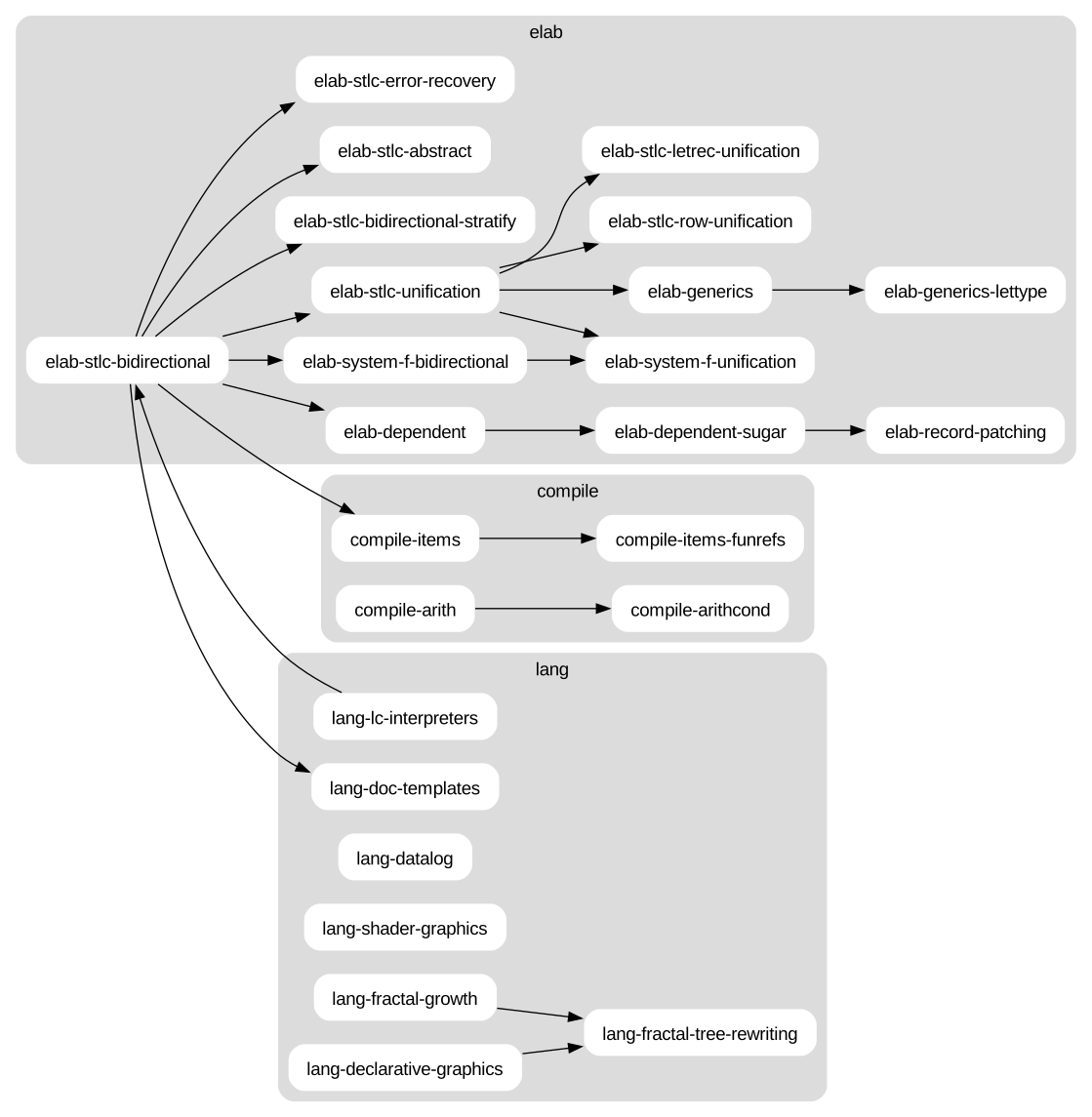
This diagram shows the flow of ideas and techniques between the various projects listed above. If you are struggling to understand concepts in a later project, it might be worth going back to an earlier one to see a simpler version.
Background
As I’ve been working in the area of programming languages I’ve often found myself in the position of:
- Explaining the same idea or technique over and over, but not having a minimal example I can point to.
- Re-implementing an existing technique (either from a paper, or based on some other existing code I’ve seen) in my own way, as a way of learning and understanding it more deeply.
- Wanting a place to experiment with an approach before committing to using it in a larger project, which can take time and may amount to nothing.
- Trying to recall a technique I’d spent time learning a long ago.
- Having an idea for a small language experiment that does not need to be part of a standalone project, but may require some build system setup.
My hope is that by collecting some of these projects and experiments together into a single repository they might be useful to others and my future self.
I’m also trying to get better at interleaved breadth-first/depth-first search as part of my learning process - somewhat like the search strategy employed by miniKanren. My goal is not to become an expert of one thing, but to be able to be good at combining ideas from different places and perspective.
Related work
The metaphor of a “garden” as related to knowledge work was inspired by the rising popularity of “digital gardening” (which apparently originates from Hypertext Gardens). While this project is less directly interconnected than other digital gardens, I still like the idea of each project being a “seedling” that can be nurtured and tended to over an extended period of time, with the learning from one project being transferred to the others. Perhaps a “language nursery” would have been a more fitting name.
I’ve also been particularly inspired by Mark Barbone’s small, self-contained gists implementing small type systems and solvers, and Andras Kovacs’ excellent elaboration-zoo (which was instrumental in helping me get my head around how to implement elaborators).
If you like this repository, you might find these interesting as well:
- github:andrejbauer/plzoo: Andrej Bauer’s minimal programming language demonstrations
- github:AndrasKovacs/elaboration-zoo: Minimal implementations for dependent type checking and elaboration by Andras Kovacs
- github:gallais/potpourri: G. Allais’ research code
- github:mspertus/TAPL: Updated type system implementations from Benjamin Pierce's “Types and Programming Languages”
- github:pigworker/Samizdat: Conor McBride’s programming scrapbook
- github:tomprimozic/type-systems: Implementations of various type systems in OCaml
Other project gardens:
- github:jake-87/project-garden: A garden for small projects
- github:jakob-schuster/language-scrapyard: Scrappy implementations of programming language ideas
- github:qexat/PLAGE: Programming Language Adjacent General Experiments
- github:RiscInside/LanguageEtudes: Single-file typechecker/interpreter/compiler implementations
- github:yeslogic/fathom-experiments: Fathom related experiments
- sourcehut:icefox/determination: Type checkers for System F and System Fω
Conventions and style choices
Provide lots of type annotations
The predominant style in OCaml of leaving off type annotations makes understanding and porting code far more difficult. Instead I try to add type annotations to most top-level type signatures.
Avoid opening modules
When open is used I find it hard to figure out where identifiers are coming from without an editor.
Instead I prefer using an explicitly qualified path where possible.
Group related variants with a common prefix
In the past I’ve often found it hard to find related nodes in an AST when trying to understand other people’s code. For example, the following variants might all refer to different parts of a dependent pair type:
type tm =
  ...
  | Sig of string * tm * tm
  | Pair of tm * tm
  | Fst of tm
  | Snd of tm
Instead I prefer to use the following constructors:
type tm =
  ...
  | Pair_type of string * tm * tm
  | Pair_lit of tm * tm
  | Pair_fst of tm
  | Pair_snd of tm
Use types to disambiguate variant names
OCaml’s variant constructors aren’t namespaced under the type like in Rust or Lean, so reusing the same variant name will result in ambiguities if you are relying on global type inference. Generally OCaml programmers will either:
- Wrap every type in a module
- Come up with an ad-hoc prefix for to prevent the conflict
I find the former convention often results in duplicated datatype definitions (mutually dependent modules require explicit module signatures), and the latter is a little arbitrary and ugly.
Instead I’ve decided to just disambiguate variants using the type. I realise this might make the code a more difficult to understand and if I come up with a better compromise I might revisit this in the future.
Development setup
With Nix
Using Lix (recommended) or Nix is not required, but can be useful for setting up a development shell with the packages and tools used in this project. With Nix flakes enabled:
nix run .#arith -- compile --target=anf <<< "1 + 2 * 27"
nix-direnv can be used to load development tools into your shell automatically. Once it’s installed, run the following commands to enable it in the project directory:
echo "use flake" > .envrc
direnv allow
You’ll want to locally exclude the .envrc, or add it to your global gitignore.
After that, dune can be used to build, test, and run the projects:
dune build
dune test
dune exec arith -- compile --target=anf <<< "1 + 2 * 27"
With opam
Alternatively, opam package definitions are provided in the ./opam
directory. They drive the Nix flake, so should be up to date. I don’t use opam
however, so I’m not sure what the workflow is.
Footnotes
-
yeslogic/fathom: A declarative data definition language for formally specifying binary data formats. ↩
Contributors

1,870 commits
Similar repos


Languages
OCaml
93.5%
WebAssembly
2.0%
LLVM
1.6%
A garden of small programming language implementations 🪴
OCaml
340
1,870 commits
updated Sep 13, 2026
README
Language garden 🌱
Some toy programming language implementations, mostly implemented in OCaml.
These projects are mostly my attempt to understand different techniques for implementing programming languages, and as a way to share these techniques with others. Perhaps from these seedlings something new and interesting might germinate?
This is part of my ongoing work at YesLogic1, but is also deeply rooted in my long-term interest in programming languages as tools for thought, and as works of computational world building.
The garden path
Elaboration
Elaboration is an approach to implementing language front-ends where a complicated, user friendly surface language is type checked and lowered to a simpler, typed core language. This approach to type checking is particularly popular and useful for implementing dependently typed programming languages, but is more widely applicable as well.
Simply typed:
- elab-stlc-bidirectional: An elaborator for a simply typed lambda calculus that uses bidirectional typing to allow some type annotations to be omitted.
- elab-stlc-error-recovery: An elaborator for a simply typed lambda calculus with support for reporting multiple errors during type checking.
- elab-stlc-bidirectional-stratify: An elaborator that partially stratifies a combined type and term language into a simply typed core language.
- elab-stlc-abstract: An LCF-style elaborator that moves the construction of well-typed terms behind a trusted interface.
- elab-stlc-unification: An elaborator for a simply typed lambda calculus where type annotations can be omitted.
- elab-stlc-letrec-unification: Extends the simply typed lambda calculus with recursive let bindings.
- elab-stlc-row-unification: Extends the simply typed lambda calculus with structural record and variant types, inferring types eagerly using constraint based unification.
Polymorphically typed:
- elab-generics: An elaborator for a simple, polymorphic functional language.
- elab-generics-lettype: An implementation of generics that supports local type definitions.
- elab-system-f-bidirectional: An elaborator for a higher-rank polymorphic lambda calculus.
- elab-system-f-unification: An elaborator for a higher-rank polymorphic lambda calculus where explicit type applications and type annotations can be omitted.
Dependently typed:
- elab-dependent: An elaborator for a small dependently typed lambda calculus.
- elab-dependent-sugar: An elaborator for a small dependently typed lambda calculus with syntactic sugar.
- elab-record-patching: An elaborator of a dependently typed lambda calculus with singletons and record patching.
Compilation
These are related to compilation. Mainly to stack-machines, but I’m interested in exploring more approaches in the future, and other compilation passes related to compiling functional programming languages.
- compile-arith: Compiling arithmetic expressions to stack machine instructions and A-Normal Form.
- compile-arithcond: Compiling arithmetic and conditional expressions to stack machine instructions and A-Normal Form.
- compile-items: Compiling a language with top-level, mutually recursive definitions to Wasm and LLVM IR.
- compile-items-funrefs: Compiling a language with top-level definitions and function references to Wasm and LLVM IR.
Languages
Miscellaneous programming language experiments.
- lang-datalog: A simple Datalog interpreter.
- lang-declarative-graphics: Declarative DSL for 2-dimensional graphics.
- lang-doc-templates: A programmable document template language that elaborates to a typed lambda calculus.
- lang-fractal-growth: Experiments with using grammars and rewriting systems to model fractal growth.
- lang-fractal-tree-rewriting: Plant growth modelled as tree rewriting systems.
- lang-lc-interpreters: A comparison of lambda calculus interpreters using different approaches to name binding.
- lang-shader-graphics: An embedded DSL for describing procedural graphics, based on signed distance functions. These can be rendered on the CPU or compiled to GLSL shaders.
Scraps
Many other smaller examples and unfinished projects can be found in the scraps directory.
Project dependency graph
This diagram shows the flow of ideas and techniques between the various projects listed above. If you are struggling to understand concepts in a later project, it might be worth going back to an earlier one to see a simpler version.
Background
As I’ve been working in the area of programming languages I’ve often found myself in the position of:
- Explaining the same idea or technique over and over, but not having a minimal example I can point to.
- Re-implementing an existing technique (either from a paper, or based on some other existing code I’ve seen) in my own way, as a way of learning and understanding it more deeply.
- Wanting a place to experiment with an approach before committing to using it in a larger project, which can take time and may amount to nothing.
- Trying to recall a technique I’d spent time learning a long ago.
- Having an idea for a small language experiment that does not need to be part of a standalone project, but may require some build system setup.
My hope is that by collecting some of these projects and experiments together into a single repository they might be useful to others and my future self.
I’m also trying to get better at interleaved breadth-first/depth-first search as part of my learning process - somewhat like the search strategy employed by miniKanren. My goal is not to become an expert of one thing, but to be able to be good at combining ideas from different places and perspective.
Related work
The metaphor of a “garden” as related to knowledge work was inspired by the rising popularity of “digital gardening” (which apparently originates from Hypertext Gardens). While this project is less directly interconnected than other digital gardens, I still like the idea of each project being a “seedling” that can be nurtured and tended to over an extended period of time, with the learning from one project being transferred to the others. Perhaps a “language nursery” would have been a more fitting name.
I’ve also been particularly inspired by Mark Barbone’s small, self-contained gists implementing small type systems and solvers, and Andras Kovacs’ excellent elaboration-zoo (which was instrumental in helping me get my head around how to implement elaborators).
If you like this repository, you might find these interesting as well:
- github:andrejbauer/plzoo: Andrej Bauer’s minimal programming language demonstrations
- github:AndrasKovacs/elaboration-zoo: Minimal implementations for dependent type checking and elaboration by Andras Kovacs
- github:gallais/potpourri: G. Allais’ research code
- github:mspertus/TAPL: Updated type system implementations from Benjamin Pierce's “Types and Programming Languages”
- github:pigworker/Samizdat: Conor McBride’s programming scrapbook
- github:tomprimozic/type-systems: Implementations of various type systems in OCaml
Other project gardens:
- github:jake-87/project-garden: A garden for small projects
- github:jakob-schuster/language-scrapyard: Scrappy implementations of programming language ideas
- github:qexat/PLAGE: Programming Language Adjacent General Experiments
- github:RiscInside/LanguageEtudes: Single-file typechecker/interpreter/compiler implementations
- github:yeslogic/fathom-experiments: Fathom related experiments
- sourcehut:icefox/determination: Type checkers for System F and System Fω
Conventions and style choices
Provide lots of type annotations
The predominant style in OCaml of leaving off type annotations makes understanding and porting code far more difficult. Instead I try to add type annotations to most top-level type signatures.
Avoid opening modules
When open is used I find it hard to figure out where identifiers are coming from without an editor.
Instead I prefer using an explicitly qualified path where possible.
Group related variants with a common prefix
In the past I’ve often found it hard to find related nodes in an AST when trying to understand other people’s code. For example, the following variants might all refer to different parts of a dependent pair type:
type tm =
  ...
  | Sig of string * tm * tm
  | Pair of tm * tm
  | Fst of tm
  | Snd of tm
Instead I prefer to use the following constructors:
type tm =
  ...
  | Pair_type of string * tm * tm
  | Pair_lit of tm * tm
  | Pair_fst of tm
  | Pair_snd of tm
Use types to disambiguate variant names
OCaml’s variant constructors aren’t namespaced under the type like in Rust or Lean, so reusing the same variant name will result in ambiguities if you are relying on global type inference. Generally OCaml programmers will either:
- Wrap every type in a module
- Come up with an ad-hoc prefix for to prevent the conflict
I find the former convention often results in duplicated datatype definitions (mutually dependent modules require explicit module signatures), and the latter is a little arbitrary and ugly.
Instead I’ve decided to just disambiguate variants using the type. I realise this might make the code a more difficult to understand and if I come up with a better compromise I might revisit this in the future.
Development setup
With Nix
Using Lix (recommended) or Nix is not required, but can be useful for setting up a development shell with the packages and tools used in this project. With Nix flakes enabled:
nix run .#arith -- compile --target=anf <<< "1 + 2 * 27"
nix-direnv can be used to load development tools into your shell automatically. Once it’s installed, run the following commands to enable it in the project directory:
echo "use flake" > .envrc
direnv allow
You’ll want to locally exclude the .envrc, or add it to your global gitignore.
After that, dune can be used to build, test, and run the projects:
dune build
dune test
dune exec arith -- compile --target=anf <<< "1 + 2 * 27"
With opam
Alternatively, opam package definitions are provided in the ./opam
directory. They drive the Nix flake, so should be up to date. I don’t use opam
however, so I’m not sure what the workflow is.
Footnotes
-
yeslogic/fathom: A declarative data definition language for formally specifying binary data formats. ↩
Similar repos
Contributors
1,870 commits
Languages
OCaml
93.5%
WebAssembly
2.0%
LLVM
1.6%