A fully functional AI Agent desktop client that supports Webui access and can be creatively customized and expanded!
TypeScript
2,228
1,536 commits
updated Oct 14, 2026
Your Local-First AI Agent Desktop
Multi-model access · Local tool execution · MCP & Skills ecosystem · Remote Gateway
English | 简体中文




Core Features • Download & Deployment • FAQ • Docs

For all things AI, head to LINUX DO! Wishing the community ever greater success~
 | PackyCode is a reliable, efficient, and professional API relay service provider, offering relay services for Claude Code, Codex, Gemini, Chinese domestic models, and more — a long-established, top-tier relay. The vast majority of the model resources used to develop this software were provided by PackyCode — thank you, Laonong! Register here to get started! |
 | Right Code provides stable relay services for Claude Code, Codex, Gemini, Chinese domestic models, and more. Invoices are available upon top-up, and enterprise and team users receive dedicated one-on-one support. The remaining model resources used to develop this software were provided by RightCode — thanks to the RC site owner and the support team! Register here to get started! |
 | Cubence is a reliable and efficient API relay service provider, offering relay services for Claude Code, Codex, Gemini, and more, with pay-as-you-go billing. Thanks to Cubence for supporting this project! Register here to get started! |
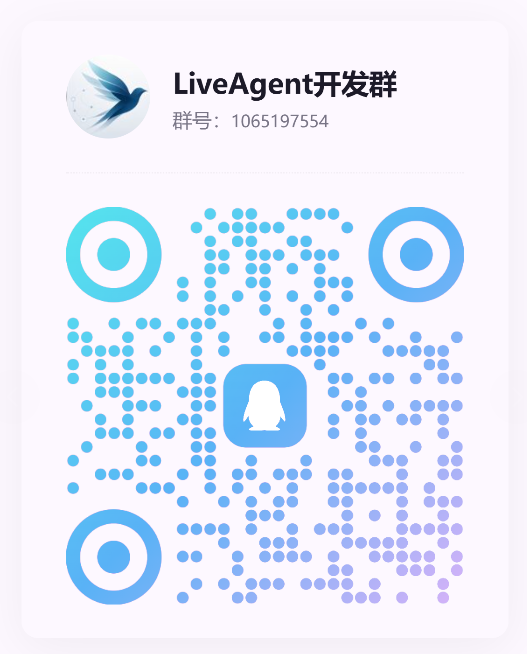
Scan the QR code to join our QQ group and help drive LiveAgent development!
(Why a QQ group? It just packs a few more features than a WeChat group~)
LiveAgent is a local-first AI agent desktop client. It deeply integrates large language model reasoning with local system tools, so the AI can genuinely operate your file system, run commands, and manage scheduled tasks — while the Gateway enables remote access and collaboration.
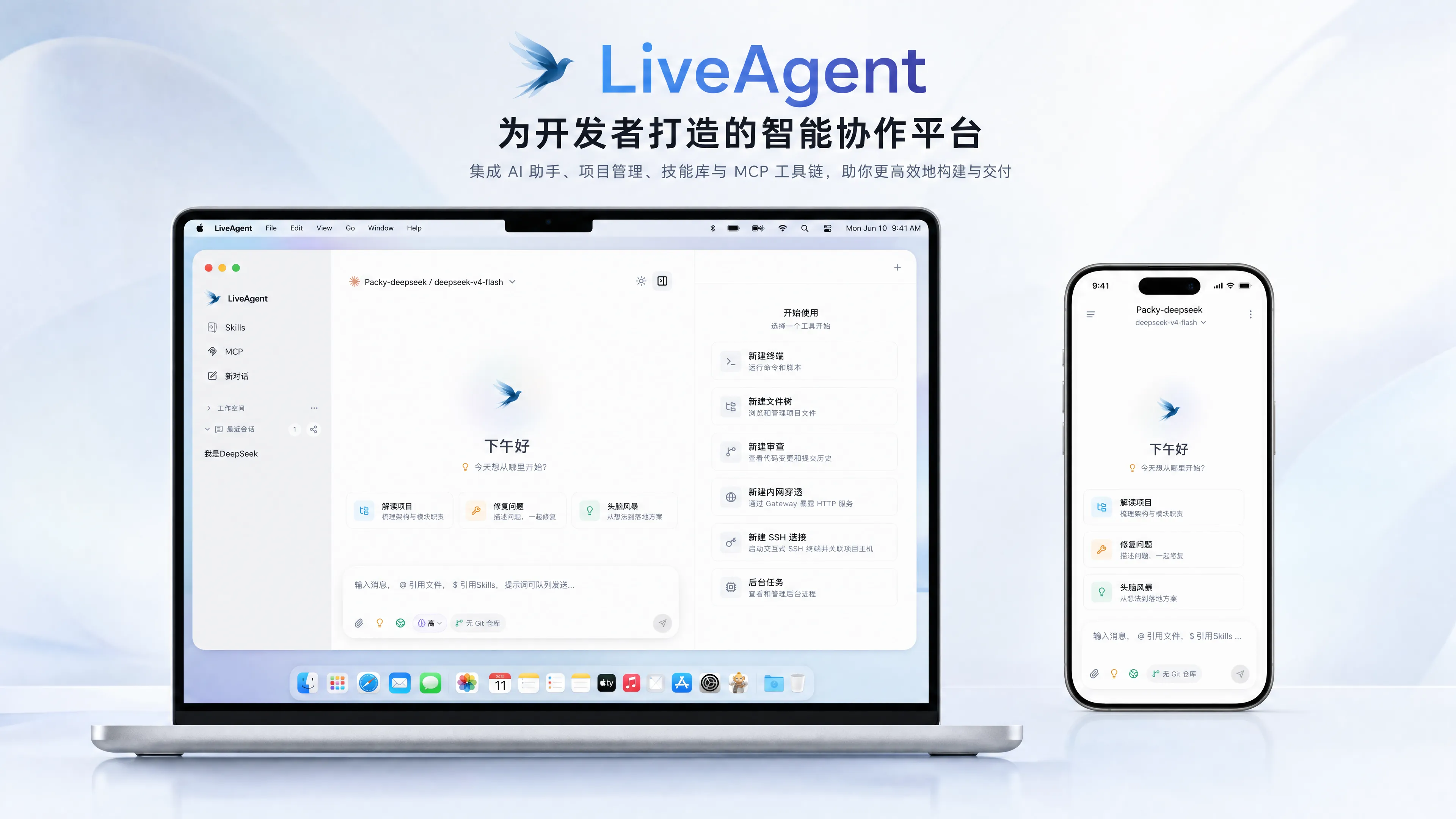
Read / Write / Edit / Delete, plus Glob / Grep pattern and regex searchManagedProcess supervising dev servers and other resident tasksTunnelManager exposes local services to the public internet in one clickInstallers are automatically built, signed, and published by GitHub Actions — grab the latest version from GitHub Releases.
| Platform | Requirements |
|---|---|
| macOS | Both Intel (x64) and Apple Silicon (aarch64) architectures |
| Windows | x64; requires the WebView2 runtime (bundled with Windows 11) |
| Linux | x86_64; requires WebKitGTK 4.1 (Ubuntu 22.04+ / Debian 12+, etc.) |
Download the DMG matching your chip from Releases, open it, and drag LiveAgent into Applications:
LiveAgent-<version>-macOS-aarch64.dmgLiveAgent-<version>-macOS-x64.dmgThe installer is signed and notarized by Apple — no manual security override is needed on first launch.
Pick an installation method from Releases:
| Method | File | Best for |
|---|---|---|
| Setup wizard | LiveAgent-<version>-Windows-x64-Setup.exe | Most users |
| MSI package | LiveAgent-<version>-Windows-x64.msi | Enterprise distribution / silent install |
| Portable | LiveAgent-<version>-Windows-x64-portable.zip | No install — unzip and run |
Choose by distribution from Releases:
| Format | Distributions | Install |
|---|---|---|
| AppImage | Any distribution | chmod +x, then run directly |
| DEB | Debian / Ubuntu family | sudo dpkg -i LiveAgent-<version>-Linux-x86_64.deb |
| RPM | Fedora / openSUSE family | sudo rpm -i LiveAgent-<version>-Linux-x86_64.rpm |
The desktop app works out of the box and depends on no server. Deploy the Gateway only if you want to control your local agent from a browser.
Note: when deployed behind an Nginx reverse proxy, set the Gateway address on the Settings → Remote page to the HTTPS URL and use port 443.
# Pull the image (built by GitHub Actions, multi-arch: amd64 / arm64)
docker pull ghcr.io/stack-cairn/liveagent-gateway:latest

# Run in the background (HTTP/WebSocket → host 3000)
docker run -d \
  --name liveagent-gateway \
  --restart unless-stopped \
  -p 3000:8080 \
  -v liveagent-gateway-data:/var/lib/liveagent \
  -e LIVEAGENT_GATEWAY_TOKEN=your-token \
  ghcr.io/stack-cairn/liveagent-gateway:latest
The named volume persists the Gateway database and independently issued Agent tokens across container upgrades.
One-command upgrade to the latest version — pull the new image → remove the old container → recreate it with the same arguments (if you changed the port mappings or token, adjust the arguments below accordingly):
docker pull ghcr.io/stack-cairn/liveagent-gateway:latest \
  && docker rm -f liveagent-gateway \
  && docker run -d \
    --name liveagent-gateway \
    --restart unless-stopped \
    -p 3000:8080 \
    -v liveagent-gateway-data:/var/lib/liveagent \
    -e LIVEAGENT_GATEWAY_TOKEN=your-token \
    ghcr.io/stack-cairn/liveagent-gateway:latest \
  && docker image prune -f
Since protocol v2, all traffic — the WebUI, the HTTP API, and the WebSocket links of both the browser and the desktop app — goes through the single HTTP port (default 3000).
WebSocket upgrades happen on several paths (
/ws/v2,/ws/v2/agent,/ws/v2/terminal, and tunnels under/t/), so the simplest correct setup enables the upgrade on the whole vhost:
# WebUI SPA/static/API + every WebSocket link (browser and desktop)
location / {
    proxy_pass http://127.0.0.1:3000;
    proxy_http_version 1.1;

    # WebSocket upgrade
    proxy_set_header Upgrade $http_upgrade;
    proxy_set_header Connection "upgrade";

    # Required: the Gateway's same-origin check compares the browser's
    # Origin header against X-Forwarded-Proto + Host
    proxy_set_header Host $host;
    proxy_set_header Authorization $http_authorization;
    proxy_set_header X-Forwarded-For $proxy_add_x_forwarded_for;
    proxy_set_header X-Forwarded-Proto $scheme;

    # The Gateway pings every WebSocket connection every 15s,
    # so a generous-but-finite timeout is enough
    proxy_read_timeout 300s;
    proxy_send_timeout 300s;
    proxy_buffering off;
}
The upstream port maps to the host port from the
docker runabove: HTTP/WebSocket 3000 (inside the container, HTTP actually listens onPORT=8080). The server block needslisten 443 ssl;and aclient_max_body_sizelarge enough for attachment uploads (e.g.100m).
Expand the Development Guide below for the full set of Make commands.
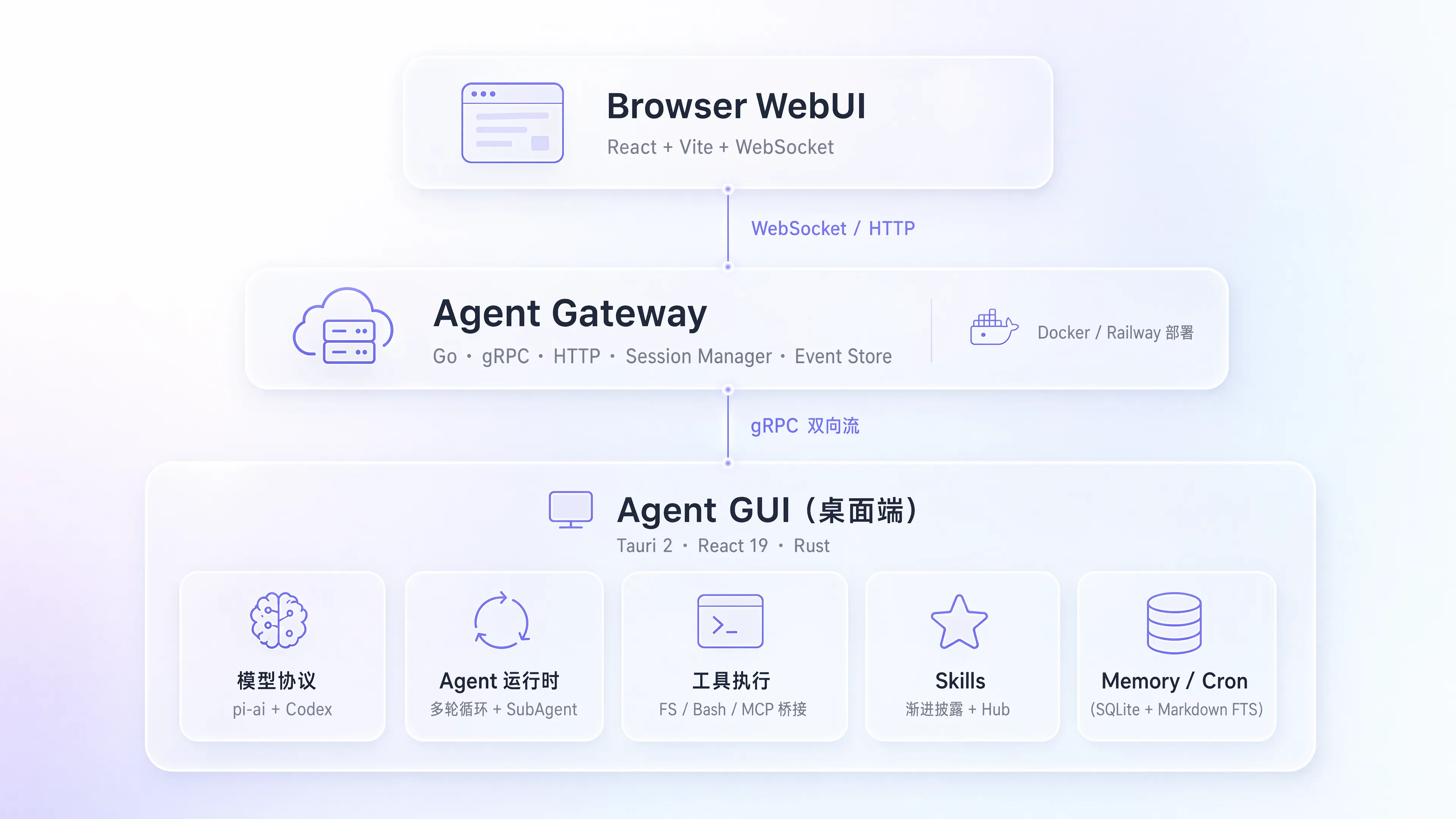
┌──────────────────────────────────────────────────────────────┐
│                        Browser WebUI                          │
│              React + Vite + WebSocket + Gateway API           │
└────────────────────────────┬─────────────────────────────────┘
                             │ WebSocket / HTTP
┌────────────────────────────▼─────────────────────────────────┐
│                       Agent Gateway                           │
│    Go · WebSocket · HTTP · Session Manager · Event Store     │
│               (Railway / Docker / self-hosted)                │
└────────────────────────────┬─────────────────────────────────┘
                             │ WebSocket v2 (bidirectional stream)
┌────────────────────────────▼─────────────────────────────────┐
│                        Agent GUI                              │
│                   Tauri 2 · React 19 · Rust                  │
├──────────┬────────────┬───────────┬────────────┬─────────────┤
│ Models   │ Runtime    │ Tools     │ Skills     │ Memory/Cron │
│ pi-ai    │ multi-turn │ FS/Bash/  │ progressive│ SQLite+MD   │
│ + Codex  │ + SubAgent │ MCP bridge│ + Hub      │ FTS index   │
└──────────┴────────────┴───────────┴────────────┴─────────────┘
Tech Stack
| Component | Technology |
|---|---|
| Agent GUI · Framework | Tauri 2 + React 19 + TypeScript 6 |
| Agent GUI · Build | Vite 8 + pnpm |
| Agent GUI · Styling | Tailwind CSS 4 + Radix UI |
| Agent GUI · Rendering | streamdown + KaTeX + Mermaid + Monaco Editor |
| Agent GUI · Backend | Rust + Tokio + SQLite (rusqlite) + WebSocket (tokio-tungstenite) |
| Agent GUI · LLM | @earendil-works/pi-ai · @earendil-works/pi-agent-core |
| Gateway · Language | Go 1.25 |
| Gateway · Protocols | WebSocket + Protobuf + HTTP |
| Gateway · Web UI | React + Vite + Tailwind CSS (embedded) |
| Gateway · Deployment | Docker multi-stage · Railway CI/CD |
make help for the full list)| Command | Description |
|---|---|
make dev | Start Tauri development with Session Workbench enabled (DEV_SESSION_WORKBENCH=0 restores the legacy single-conversation layout) |
make build | Build the desktop app |
make dev-gateway | Start the Gateway dev server |
make dev-webui | Start the WebUI dev server |
make gateway-build | Build the Gateway binary |
make gateway-docker-build | Build the Docker image |
make gateway-docker-smoke | Build + health check |
make desktop-build-macos-release | macOS signed release build |
make build-linux | Linux amd64 gateway |
make build-linux-arm | Linux arm64 gateway |
make proto | Regenerate Protobuf code |
make clean | Clean build artifacts |
LiveAgent/
├── package.json                  # pnpm workspace commands
├── pnpm-lock.yaml                # Unified frontend dependency lock
├── crates/
│   ├── agent-ui/                 # Shared GUI/WebUI React source
│   │   └── src/                  #   Components, domain models, settings shell
│   │
│   ├── agent-gui/                # Desktop client
│   │   ├── src/                  # React frontend
│   │   │   ├── components/       #   UI components
│   │   │   ├── lib/              #   Core logic (chat, tools, skills, memory)
│   │   │   ├── pages/            #   Pages (Chat, Settings)
│   │   │   ├── i18n/             #   Internationalization
│   │   │   └── prompt/           #   System prompt templates
│   │   └── src-tauri/            # Rust backend (Tauri)
│   │
│   └── agent-gateway/            # Go gateway service
│       ├── cmd/gateway/          #   Entry point
│       ├── internal/             #   Core implementation
│       ├── proto/v2/             #   Protobuf definitions
│       └── web/                  #   Embedded WebUI
│
├── docs/                         # Project docs
│   ├── architecture/             #   Architecture design
│   ├── features/                 #   Feature guides
│   └── operations/               #   Operations & deployment
│
├── scripts/release/              # Release automation
├── .github/workflows/            # CI/CD (CI + Desktop Release + Gateway Docker)
├── Dockerfile                    # Gateway container image
├── Makefile                      # Build commands
└── Cargo.toml                    # Rust workspace
No. Keys are stored locally on the desktop side only. The Gateway is a pure protocol relay — it never accesses the file system and never stores any credentials.
No. The desktop client works standalone with all local capabilities; deploy the Gateway only when you need browser-based remote access to your local agent.
Claude (Anthropic), Codex (OpenAI), and Gemini protocols are built in, plus custom Base URL support for any compatible third-party service.
No. The desktop app persists the full history with Segment + Summary Checkpoints; the Gateway replays short disconnects through a bounded seq window and converges automatically after reconnecting.
Issues and pull requests are welcome! See the Development Guide for setting up a dev environment.
Before submitting a PR, make sure all of the following checks pass (they match the CI gates):
Install frontend dependencies once from the repository root with pnpm install --frozen-lockfile.
Desktop client
pnpm build:guipnpm lint:ui && pnpm lint:guipnpm test:gui (also run pnpm --filter liveagent test:release when touching release scripts)cargo check --manifest-path crates/agent-gui/src-tauri/Cargo.toml --tests (run from the repo root)Gateway · crates/agent-gateway (if changed)
go test ./...pnpm build:webui && pnpm lint:webui && pnpm test:webuimake protoShared UI boundaries
pnpm check:ui-boundariesgit diff --checkThanks to everyone who has contributed to LiveAgent!

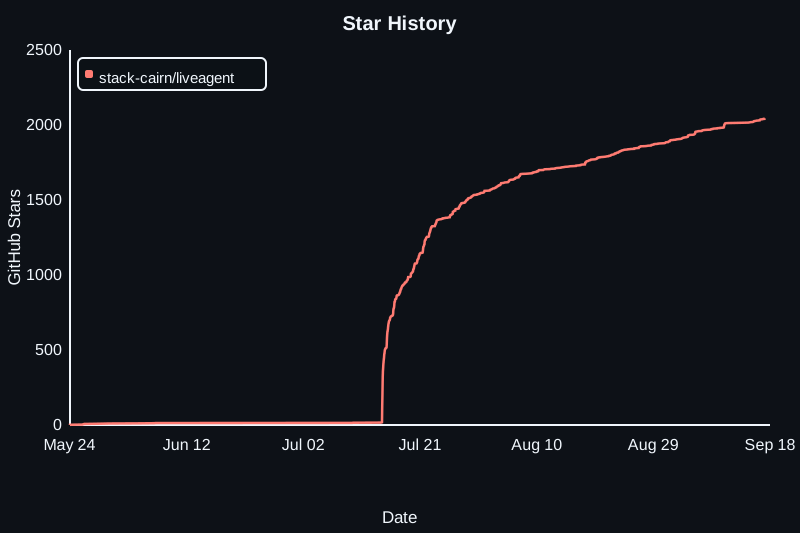
MIT © StackCairn
A fully functional AI Agent desktop client that supports Webui access and can be creatively customized and expanded!
TypeScript
2,228
1,536 commits
updated Oct 14, 2026
Your Local-First AI Agent Desktop
Multi-model access · Local tool execution · MCP & Skills ecosystem · Remote Gateway
English | 简体中文
Core Features • Download & Deployment • FAQ • Docs
For all things AI, head to LINUX DO! Wishing the community ever greater success~
| PackyCode is a reliable, efficient, and professional API relay service provider, offering relay services for Claude Code, Codex, Gemini, Chinese domestic models, and more — a long-established, top-tier relay. The vast majority of the model resources used to develop this software were provided by PackyCode — thank you, Laonong! Register here to get started! |
| Right Code provides stable relay services for Claude Code, Codex, Gemini, Chinese domestic models, and more. Invoices are available upon top-up, and enterprise and team users receive dedicated one-on-one support. The remaining model resources used to develop this software were provided by RightCode — thanks to the RC site owner and the support team! Register here to get started! |
| Cubence is a reliable and efficient API relay service provider, offering relay services for Claude Code, Codex, Gemini, and more, with pay-as-you-go billing. Thanks to Cubence for supporting this project! Register here to get started! |
Scan the QR code to join our QQ group and help drive LiveAgent development!
(Why a QQ group? It just packs a few more features than a WeChat group~)
LiveAgent is a local-first AI agent desktop client. It deeply integrates large language model reasoning with local system tools, so the AI can genuinely operate your file system, run commands, and manage scheduled tasks — while the Gateway enables remote access and collaboration.
Read / Write / Edit / Delete, plus Glob / Grep pattern and regex searchManagedProcess supervising dev servers and other resident tasksTunnelManager exposes local services to the public internet in one clickInstallers are automatically built, signed, and published by GitHub Actions — grab the latest version from GitHub Releases.
| Platform | Requirements |
|---|---|
| macOS | Both Intel (x64) and Apple Silicon (aarch64) architectures |
| Windows | x64; requires the WebView2 runtime (bundled with Windows 11) |
| Linux | x86_64; requires WebKitGTK 4.1 (Ubuntu 22.04+ / Debian 12+, etc.) |
Download the DMG matching your chip from Releases, open it, and drag LiveAgent into Applications:
LiveAgent-<version>-macOS-aarch64.dmgLiveAgent-<version>-macOS-x64.dmgThe installer is signed and notarized by Apple — no manual security override is needed on first launch.
Pick an installation method from Releases:
| Method | File | Best for |
|---|---|---|
| Setup wizard | LiveAgent-<version>-Windows-x64-Setup.exe | Most users |
| MSI package | LiveAgent-<version>-Windows-x64.msi | Enterprise distribution / silent install |
| Portable | LiveAgent-<version>-Windows-x64-portable.zip | No install — unzip and run |
Choose by distribution from Releases:
| Format | Distributions | Install |
|---|---|---|
| AppImage | Any distribution | chmod +x, then run directly |
| DEB | Debian / Ubuntu family | sudo dpkg -i LiveAgent-<version>-Linux-x86_64.deb |
| RPM | Fedora / openSUSE family | sudo rpm -i LiveAgent-<version>-Linux-x86_64.rpm |
The desktop app works out of the box and depends on no server. Deploy the Gateway only if you want to control your local agent from a browser.
Note: when deployed behind an Nginx reverse proxy, set the Gateway address on the Settings → Remote page to the HTTPS URL and use port 443.
# Pull the image (built by GitHub Actions, multi-arch: amd64 / arm64)
docker pull ghcr.io/stack-cairn/liveagent-gateway:latest

# Run in the background (HTTP/WebSocket → host 3000)
docker run -d \
  --name liveagent-gateway \
  --restart unless-stopped \
  -p 3000:8080 \
  -v liveagent-gateway-data:/var/lib/liveagent \
  -e LIVEAGENT_GATEWAY_TOKEN=your-token \
  ghcr.io/stack-cairn/liveagent-gateway:latest
The named volume persists the Gateway database and independently issued Agent tokens across container upgrades.
One-command upgrade to the latest version — pull the new image → remove the old container → recreate it with the same arguments (if you changed the port mappings or token, adjust the arguments below accordingly):
docker pull ghcr.io/stack-cairn/liveagent-gateway:latest \
  && docker rm -f liveagent-gateway \
  && docker run -d \
    --name liveagent-gateway \
    --restart unless-stopped \
    -p 3000:8080 \
    -v liveagent-gateway-data:/var/lib/liveagent \
    -e LIVEAGENT_GATEWAY_TOKEN=your-token \
    ghcr.io/stack-cairn/liveagent-gateway:latest \
  && docker image prune -f
Since protocol v2, all traffic — the WebUI, the HTTP API, and the WebSocket links of both the browser and the desktop app — goes through the single HTTP port (default 3000).
WebSocket upgrades happen on several paths (
/ws/v2,/ws/v2/agent,/ws/v2/terminal, and tunnels under/t/), so the simplest correct setup enables the upgrade on the whole vhost:
# WebUI SPA/static/API + every WebSocket link (browser and desktop)
location / {
    proxy_pass http://127.0.0.1:3000;
    proxy_http_version 1.1;

    # WebSocket upgrade
    proxy_set_header Upgrade $http_upgrade;
    proxy_set_header Connection "upgrade";

    # Required: the Gateway's same-origin check compares the browser's
    # Origin header against X-Forwarded-Proto + Host
    proxy_set_header Host $host;
    proxy_set_header Authorization $http_authorization;
    proxy_set_header X-Forwarded-For $proxy_add_x_forwarded_for;
    proxy_set_header X-Forwarded-Proto $scheme;

    # The Gateway pings every WebSocket connection every 15s,
    # so a generous-but-finite timeout is enough
    proxy_read_timeout 300s;
    proxy_send_timeout 300s;
    proxy_buffering off;
}
The upstream port maps to the host port from the
docker runabove: HTTP/WebSocket 3000 (inside the container, HTTP actually listens onPORT=8080). The server block needslisten 443 ssl;and aclient_max_body_sizelarge enough for attachment uploads (e.g.100m).
Expand the Development Guide below for the full set of Make commands.
┌──────────────────────────────────────────────────────────────┐
│                        Browser WebUI                          │
│              React + Vite + WebSocket + Gateway API           │
└────────────────────────────┬─────────────────────────────────┘
                             │ WebSocket / HTTP
┌────────────────────────────▼─────────────────────────────────┐
│                       Agent Gateway                           │
│    Go · WebSocket · HTTP · Session Manager · Event Store     │
│               (Railway / Docker / self-hosted)                │
└────────────────────────────┬─────────────────────────────────┘
                             │ WebSocket v2 (bidirectional stream)
┌────────────────────────────▼─────────────────────────────────┐
│                        Agent GUI                              │
│                   Tauri 2 · React 19 · Rust                  │
├──────────┬────────────┬───────────┬────────────┬─────────────┤
│ Models   │ Runtime    │ Tools     │ Skills     │ Memory/Cron │
│ pi-ai    │ multi-turn │ FS/Bash/  │ progressive│ SQLite+MD   │
│ + Codex  │ + SubAgent │ MCP bridge│ + Hub      │ FTS index   │
└──────────┴────────────┴───────────┴────────────┴─────────────┘
Tech Stack
| Component | Technology |
|---|---|
| Agent GUI · Framework | Tauri 2 + React 19 + TypeScript 6 |
| Agent GUI · Build | Vite 8 + pnpm |
| Agent GUI · Styling | Tailwind CSS 4 + Radix UI |
| Agent GUI · Rendering | streamdown + KaTeX + Mermaid + Monaco Editor |
| Agent GUI · Backend | Rust + Tokio + SQLite (rusqlite) + WebSocket (tokio-tungstenite) |
| Agent GUI · LLM | @earendil-works/pi-ai · @earendil-works/pi-agent-core |
| Gateway · Language | Go 1.25 |
| Gateway · Protocols | WebSocket + Protobuf + HTTP |
| Gateway · Web UI | React + Vite + Tailwind CSS (embedded) |
| Gateway · Deployment | Docker multi-stage · Railway CI/CD |
make help for the full list)| Command | Description |
|---|---|
make dev | Start Tauri development with Session Workbench enabled (DEV_SESSION_WORKBENCH=0 restores the legacy single-conversation layout) |
make build | Build the desktop app |
make dev-gateway | Start the Gateway dev server |
make dev-webui | Start the WebUI dev server |
make gateway-build | Build the Gateway binary |
make gateway-docker-build | Build the Docker image |
make gateway-docker-smoke | Build + health check |
make desktop-build-macos-release | macOS signed release build |
make build-linux | Linux amd64 gateway |
make build-linux-arm | Linux arm64 gateway |
make proto | Regenerate Protobuf code |
make clean | Clean build artifacts |
LiveAgent/
├── package.json                  # pnpm workspace commands
├── pnpm-lock.yaml                # Unified frontend dependency lock
├── crates/
│   ├── agent-ui/                 # Shared GUI/WebUI React source
│   │   └── src/                  #   Components, domain models, settings shell
│   │
│   ├── agent-gui/                # Desktop client
│   │   ├── src/                  # React frontend
│   │   │   ├── components/       #   UI components
│   │   │   ├── lib/              #   Core logic (chat, tools, skills, memory)
│   │   │   ├── pages/            #   Pages (Chat, Settings)
│   │   │   ├── i18n/             #   Internationalization
│   │   │   └── prompt/           #   System prompt templates
│   │   └── src-tauri/            # Rust backend (Tauri)
│   │
│   └── agent-gateway/            # Go gateway service
│       ├── cmd/gateway/          #   Entry point
│       ├── internal/             #   Core implementation
│       ├── proto/v2/             #   Protobuf definitions
│       └── web/                  #   Embedded WebUI
│
├── docs/                         # Project docs
│   ├── architecture/             #   Architecture design
│   ├── features/                 #   Feature guides
│   └── operations/               #   Operations & deployment
│
├── scripts/release/              # Release automation
├── .github/workflows/            # CI/CD (CI + Desktop Release + Gateway Docker)
├── Dockerfile                    # Gateway container image
├── Makefile                      # Build commands
└── Cargo.toml                    # Rust workspace
No. Keys are stored locally on the desktop side only. The Gateway is a pure protocol relay — it never accesses the file system and never stores any credentials.
No. The desktop client works standalone with all local capabilities; deploy the Gateway only when you need browser-based remote access to your local agent.
Claude (Anthropic), Codex (OpenAI), and Gemini protocols are built in, plus custom Base URL support for any compatible third-party service.
No. The desktop app persists the full history with Segment + Summary Checkpoints; the Gateway replays short disconnects through a bounded seq window and converges automatically after reconnecting.
Issues and pull requests are welcome! See the Development Guide for setting up a dev environment.
Before submitting a PR, make sure all of the following checks pass (they match the CI gates):
Install frontend dependencies once from the repository root with pnpm install --frozen-lockfile.
Desktop client
pnpm build:guipnpm lint:ui && pnpm lint:guipnpm test:gui (also run pnpm --filter liveagent test:release when touching release scripts)cargo check --manifest-path crates/agent-gui/src-tauri/Cargo.toml --tests (run from the repo root)Gateway · crates/agent-gateway (if changed)
go test ./...pnpm build:webui && pnpm lint:webui && pnpm test:webuimake protoShared UI boundaries
pnpm check:ui-boundariesgit diff --checkThanks to everyone who has contributed to LiveAgent!
MIT © StackCairn



