
Family portfolio software with Clarity and Comfort views. Runnable synthetic demo, current source and help wanted on usability and local setup.
Python
0
10 commits
updated Sep 28, 2026
See what people are saying
README
MoneyMoney

I'm building this for my family. Our investments sit across Indian and US accounts, statements arrive in different formats, and the person helping manage them isn't always the person who needs to understand them.
I want one place to answer fairly ordinary questions: what do we own, what is it worth, where did that number come from, and what have we missed? I also want my dad to be able to use it without learning another complicated finance app.
There isn't a business plan behind this. I don't currently expect to monetise it. I'd like it to become useful enough that other people with the same problem can use it, change it and help improve it.
The current Clarity source is now in clarity/. It runs
with a connected local Python backend and invented portfolio data. No account or
API key is needed. This is a developer alpha: useful to run, inspect and improve;
real-family self-hosting still needs a reviewed authentication and storage setup.
The original prototype remains at the repository root.
The name stuck before I noticed the connection: my dad's favourite song is ABBA's “Money, Money, Money.”
Try the current demo
Python 3.11 and Node 22.18+ on macOS/Linux:
git clone https://github.com/St-Gonne/moneymoney.git
cd moneymoney
python3.11 clarity/scripts/demo.py --install
One terminal starts both parts and opens the interface. The first run downloads
pinned packages; later runs can omit --install. Ctrl-C stops both servers.
Use Show amounts, open Holdings, then open a holding. Everything is invented.
Full setup and limits.
First contribution: try the three-minute walkthrough and tell me what was confusing or broken. You don't need to write code. If you find this useful, a star helps people find it. Fork it when you want to change it.
What it looks like now
The first image is the public Clarity source running locally on 25 September 2026. The detail/mobile captures below are from the accepted local Clarity review on 23 September. All accounts and values shown are invented. These are working screens, not renders or evidence of real returns.
Clarity — the regular view
White and Dark versions, a holdings table, account filters and a detail view. The intention is a calm place to check the portfolio, with dates and source information close to the numbers.
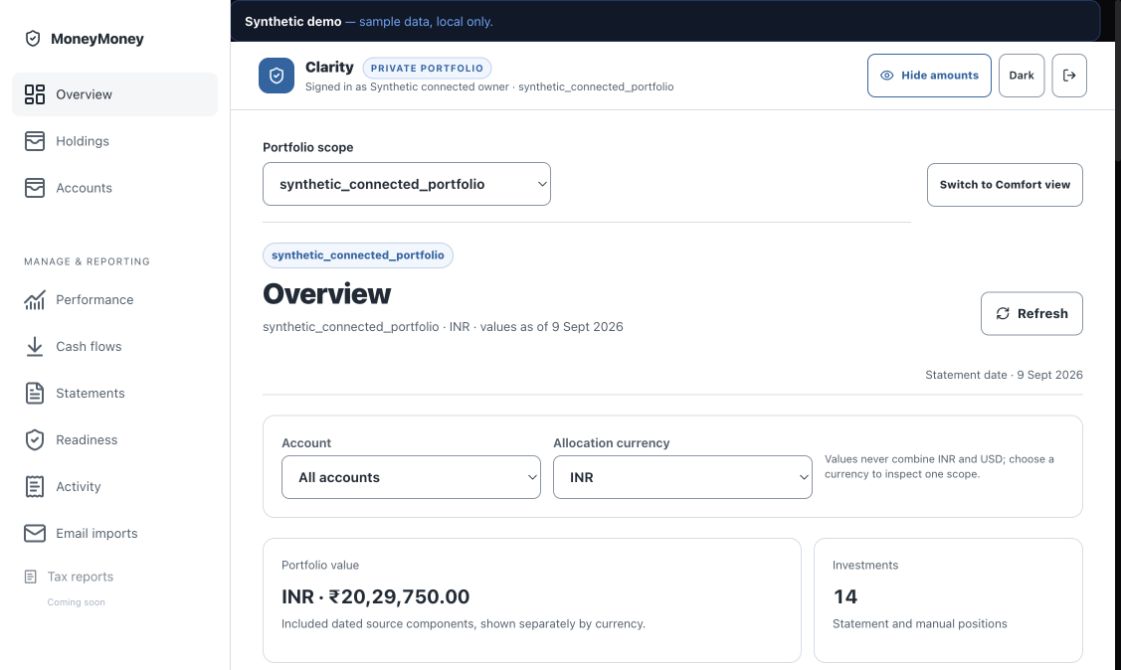
The chart deliberately says that a change in value is not a return. Adding money can make the line go up without the investments having performed better.
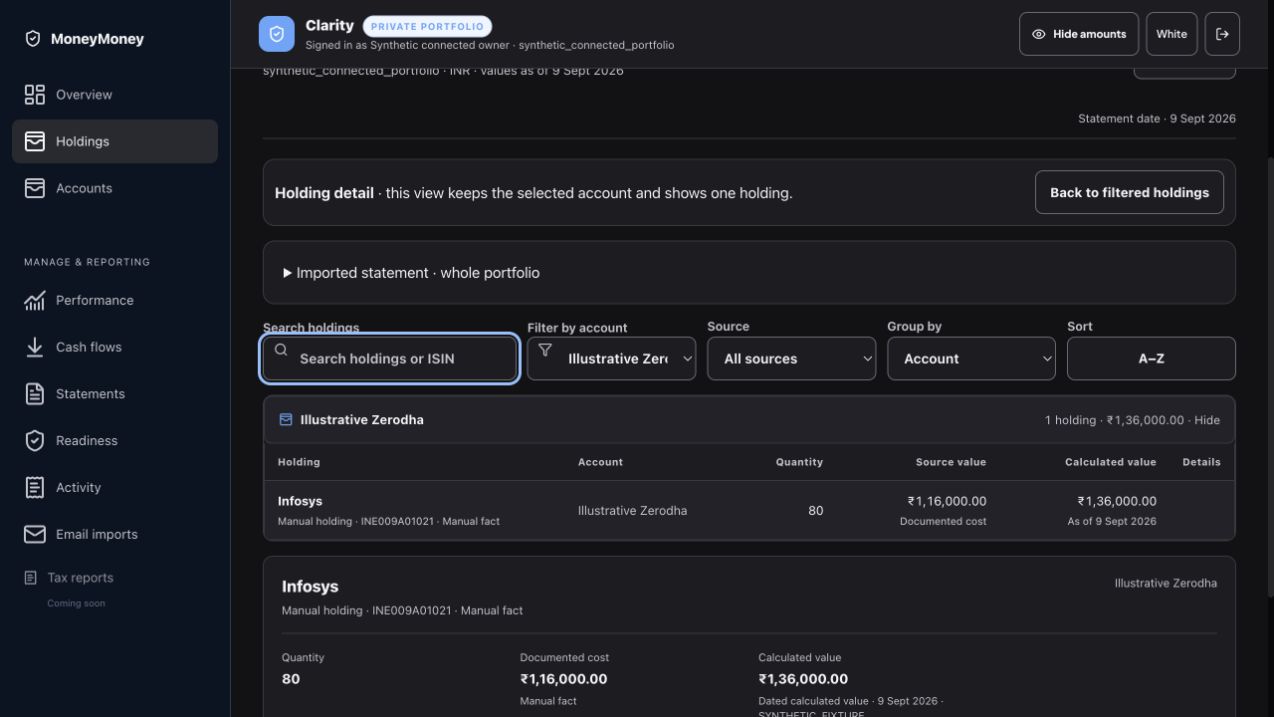
The detail view separates documented cost from calculated value and keeps the selected account in view.
Mobile working screen
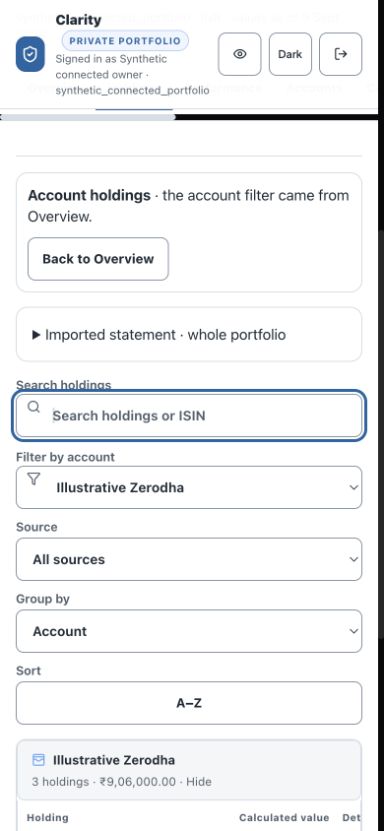
This is a scrolled acceptance capture. Mobile still needs less filtering before useful information comes into view; it is not a finished marketing screenshot.
What works, and where
| Area | Current position |
|---|---|
| Public code | Current Clarity source in clarity/, with local persistent account facts, valuation, synthetic setup and tests. Earlier prototype remains at the root. |
| Newer Clarity interface | Overview → holdings → detail accepted locally; dates, account scope and masking exercised with synthetic data. Included in the new clarity/ source release. |
| Statement-led portfolio work | The private version has NSDL review and portfolio flows. A statement covers named accounts and dates, not everything the family owns. |
| Schwab | Local review-only preview. Currency, ownership and the durable import contract still need resolution before saved holdings. |
| Zerodha cash statements | Narrow local reader; no portfolio-import bridge yet. |
| Return calculations | Complete dated cash-flow history is needed. A statement balance alone is not enough. Missing history stays unavailable. |
| Comfort view | An existing simpler card-based view. The next design pass is deferred; it has not received the new Clarity redesign. |
| Voice | Work in progress. Normal private Comfort Talk is unavailable. The newer local harness tests session controls with a mock, not a live financial conversation. |
Two views for two different jobs
Clarity is for whoever is checking accounts, holdings and source details. It uses a restrained blue accent, system fonts, familiar tables and White/Dark choices. The aim is readability and enough detail to investigate a number.
Comfort is for someone who wants a simpler answer and fewer controls. It started with my dad in mind: larger text, larger targets, a small number of sections and a more direct route to the information. Making the dashboard larger isn't enough. We still need to simplify the language, reduce decisions, make the selected account and displayed totals unambiguous, and test it with the person it's meant for. High contrast alone does not establish accessibility.
Why voice is taking longer
The useful version would let someone ask about their own holdings without navigating tables. Getting a model to speak is the easy part.
It must use the right person's accounts, know the date and source of a number, and say when the answer is unavailable. Changing accounts, signing out or hiding amounts must stop the old session from continuing with the old context. It also needs a clear choice about which provider receives portfolio information.
The current local work tests cancellation, retries, stale callbacks and privacy state with a mock. Live provider integration, microphone use, grounded financial answers and an ordinary-user trial remain ahead. Older Gemini experiments in the public code are not evidence that the newer Comfort voice flow is ready.
Who this could suit
People helping manage family finances who want to inspect and adapt the software, keep account ownership and source evidence visible, and make it easier for a parent to understand the result. Cross-border holdings are part of the problem I'm working on, not a claim of complete international broker support.
Why build this when other apps exist?
The first question for me is who holds the financial picture, and what they want to do with it. A convenient dashboard is useful. So is being able to inspect the software, choose where it runs and keep it out of a business built around selling financial products.
INDmoney has broad tracking and investment features. Its privacy policy, checked on 25 September 2026, permits personal information to be used for marketing and promotional communications, and describes sharing with service providers, group companies and business partners. That is a provider-managed commercial service, not the same arrangement as running a family tool under your own control. This policy review does not establish that INDmoney sells personal data.
MoneyMoney's direction is a tool for understanding what the family owns, without turning that understanding into a sales opportunity. I don't currently plan to monetise it. I want people to be able to inspect it, adapt it and run the current synthetic version for themselves. The parent-facing view and visible source gaps are part of the same idea: make the information useful to the family.
That makes privacy, control and a simpler family experience the reasons to choose it. A longer integration list or an AI chat button isn't the point of difference. Someone who shares those priorities and is comfortable with self-hosting could be a better fit than someone looking for a ready-made investing platform.
Where that promise stands today: the private version uses hosted authentication and storage. It is not wholly offline, and real-data self-hosting is not yet packaged. The public Clarity demo runs locally with invented data and a public demo token. Future voice may send selected information to a model provider; that needs an explicit choice. Publishing inspectable code helps, but it does not by itself prove privacy. The Clarity setup guide explains the local data flows and what remains before real-data self-hosting.
Help improve it
The most useful help is specific:
- Comfort design: a simpler route from “what do I own?” to an understandable answer, with attention to low vision, language and account scope.
- Portability: try the new synthetic setup on another machine and report reproducible installation failures; real-data self-hosting is a separate step.
- Statement formats: one named format and version, an invented fixture and an expected result. No real statements in issues or PRs.
- Financial edge cases: a small reproducible calculation case with the expected answer and reasoning.
- Voice: session and privacy design first; no keys or private audio needed.
Code and design PRs can target the current clarity/ source. Start with the local
synthetic setup so someone else can reproduce your change.
Please describe the proposed change in an issue before a large patch.
Contribution guide · next release scope.
Run the current version
Start with the Clarity setup and test commands. You can try the interface, change invented manual records and restart the backend to check persistence. No real statements or credentials are needed.
Inspect the earlier prototype
Use a Node version supported by the pinned Vite dependency:
npm ci
npm run dev
Use invented data. The commands describe the earlier public snapshot; this
publication updates its story and release plan, not its deployment certification.
The repository also includes npm run test:xirr, npm run test:tax,
npm run test:ui and python3 backend/tests/run_all_tests.py.
I make the product decisions and review the results. AI coding tools write the implementation under my direction. MIT license.
Similar repos


Languages
Python
56.6%
TypeScript
33.0%
CSS
7.3%
JavaScript
2.8%
Family portfolio software with Clarity and Comfort views. Runnable synthetic demo, current source and help wanted on usability and local setup.
Python
0
10 commits
updated Sep 28, 2026
See what people are saying
README
MoneyMoney
I'm building this for my family. Our investments sit across Indian and US accounts, statements arrive in different formats, and the person helping manage them isn't always the person who needs to understand them.
I want one place to answer fairly ordinary questions: what do we own, what is it worth, where did that number come from, and what have we missed? I also want my dad to be able to use it without learning another complicated finance app.
There isn't a business plan behind this. I don't currently expect to monetise it. I'd like it to become useful enough that other people with the same problem can use it, change it and help improve it.
The current Clarity source is now in clarity/. It runs
with a connected local Python backend and invented portfolio data. No account or
API key is needed. This is a developer alpha: useful to run, inspect and improve;
real-family self-hosting still needs a reviewed authentication and storage setup.
The original prototype remains at the repository root.
The name stuck before I noticed the connection: my dad's favourite song is ABBA's “Money, Money, Money.”
Try the current demo
Python 3.11 and Node 22.18+ on macOS/Linux:
git clone https://github.com/St-Gonne/moneymoney.git
cd moneymoney
python3.11 clarity/scripts/demo.py --install
One terminal starts both parts and opens the interface. The first run downloads
pinned packages; later runs can omit --install. Ctrl-C stops both servers.
Use Show amounts, open Holdings, then open a holding. Everything is invented.
Full setup and limits.
First contribution: try the three-minute walkthrough and tell me what was confusing or broken. You don't need to write code. If you find this useful, a star helps people find it. Fork it when you want to change it.
What it looks like now
The first image is the public Clarity source running locally on 25 September 2026. The detail/mobile captures below are from the accepted local Clarity review on 23 September. All accounts and values shown are invented. These are working screens, not renders or evidence of real returns.
Clarity — the regular view
White and Dark versions, a holdings table, account filters and a detail view. The intention is a calm place to check the portfolio, with dates and source information close to the numbers.
The chart deliberately says that a change in value is not a return. Adding money can make the line go up without the investments having performed better.
The detail view separates documented cost from calculated value and keeps the selected account in view.
Mobile working screen
This is a scrolled acceptance capture. Mobile still needs less filtering before useful information comes into view; it is not a finished marketing screenshot.
What works, and where
| Area | Current position |
|---|---|
| Public code | Current Clarity source in clarity/, with local persistent account facts, valuation, synthetic setup and tests. Earlier prototype remains at the root. |
| Newer Clarity interface | Overview → holdings → detail accepted locally; dates, account scope and masking exercised with synthetic data. Included in the new clarity/ source release. |
| Statement-led portfolio work | The private version has NSDL review and portfolio flows. A statement covers named accounts and dates, not everything the family owns. |
| Schwab | Local review-only preview. Currency, ownership and the durable import contract still need resolution before saved holdings. |
| Zerodha cash statements | Narrow local reader; no portfolio-import bridge yet. |
| Return calculations | Complete dated cash-flow history is needed. A statement balance alone is not enough. Missing history stays unavailable. |
| Comfort view | An existing simpler card-based view. The next design pass is deferred; it has not received the new Clarity redesign. |
| Voice | Work in progress. Normal private Comfort Talk is unavailable. The newer local harness tests session controls with a mock, not a live financial conversation. |
Two views for two different jobs
Clarity is for whoever is checking accounts, holdings and source details. It uses a restrained blue accent, system fonts, familiar tables and White/Dark choices. The aim is readability and enough detail to investigate a number.
Comfort is for someone who wants a simpler answer and fewer controls. It started with my dad in mind: larger text, larger targets, a small number of sections and a more direct route to the information. Making the dashboard larger isn't enough. We still need to simplify the language, reduce decisions, make the selected account and displayed totals unambiguous, and test it with the person it's meant for. High contrast alone does not establish accessibility.
Why voice is taking longer
The useful version would let someone ask about their own holdings without navigating tables. Getting a model to speak is the easy part.
It must use the right person's accounts, know the date and source of a number, and say when the answer is unavailable. Changing accounts, signing out or hiding amounts must stop the old session from continuing with the old context. It also needs a clear choice about which provider receives portfolio information.
The current local work tests cancellation, retries, stale callbacks and privacy state with a mock. Live provider integration, microphone use, grounded financial answers and an ordinary-user trial remain ahead. Older Gemini experiments in the public code are not evidence that the newer Comfort voice flow is ready.
Who this could suit
People helping manage family finances who want to inspect and adapt the software, keep account ownership and source evidence visible, and make it easier for a parent to understand the result. Cross-border holdings are part of the problem I'm working on, not a claim of complete international broker support.
Why build this when other apps exist?
The first question for me is who holds the financial picture, and what they want to do with it. A convenient dashboard is useful. So is being able to inspect the software, choose where it runs and keep it out of a business built around selling financial products.
INDmoney has broad tracking and investment features. Its privacy policy, checked on 25 September 2026, permits personal information to be used for marketing and promotional communications, and describes sharing with service providers, group companies and business partners. That is a provider-managed commercial service, not the same arrangement as running a family tool under your own control. This policy review does not establish that INDmoney sells personal data.
MoneyMoney's direction is a tool for understanding what the family owns, without turning that understanding into a sales opportunity. I don't currently plan to monetise it. I want people to be able to inspect it, adapt it and run the current synthetic version for themselves. The parent-facing view and visible source gaps are part of the same idea: make the information useful to the family.
That makes privacy, control and a simpler family experience the reasons to choose it. A longer integration list or an AI chat button isn't the point of difference. Someone who shares those priorities and is comfortable with self-hosting could be a better fit than someone looking for a ready-made investing platform.
Where that promise stands today: the private version uses hosted authentication and storage. It is not wholly offline, and real-data self-hosting is not yet packaged. The public Clarity demo runs locally with invented data and a public demo token. Future voice may send selected information to a model provider; that needs an explicit choice. Publishing inspectable code helps, but it does not by itself prove privacy. The Clarity setup guide explains the local data flows and what remains before real-data self-hosting.
Help improve it
The most useful help is specific:
- Comfort design: a simpler route from “what do I own?” to an understandable answer, with attention to low vision, language and account scope.
- Portability: try the new synthetic setup on another machine and report reproducible installation failures; real-data self-hosting is a separate step.
- Statement formats: one named format and version, an invented fixture and an expected result. No real statements in issues or PRs.
- Financial edge cases: a small reproducible calculation case with the expected answer and reasoning.
- Voice: session and privacy design first; no keys or private audio needed.
Code and design PRs can target the current clarity/ source. Start with the local
synthetic setup so someone else can reproduce your change.
Please describe the proposed change in an issue before a large patch.
Contribution guide · next release scope.
Run the current version
Start with the Clarity setup and test commands. You can try the interface, change invented manual records and restart the backend to check persistence. No real statements or credentials are needed.
Inspect the earlier prototype
Use a Node version supported by the pinned Vite dependency:
npm ci
npm run dev
Use invented data. The commands describe the earlier public snapshot; this
publication updates its story and release plan, not its deployment certification.
The repository also includes npm run test:xirr, npm run test:tax,
npm run test:ui and python3 backend/tests/run_all_tests.py.
I make the product decisions and review the results. AI coding tools write the implementation under my direction. MIT license.
Similar repos
Languages
Python
56.6%
TypeScript
33.0%
CSS
7.3%
JavaScript
2.8%