Visible multi-agent CLI workspace for mixing Codex, Claude, Gemini, Kimi, Qwen, Cursor, Copilot, Pi, OpenCode, and other AI coding agents
Python
3,576
1,142 commits
updated Oct 13, 2026
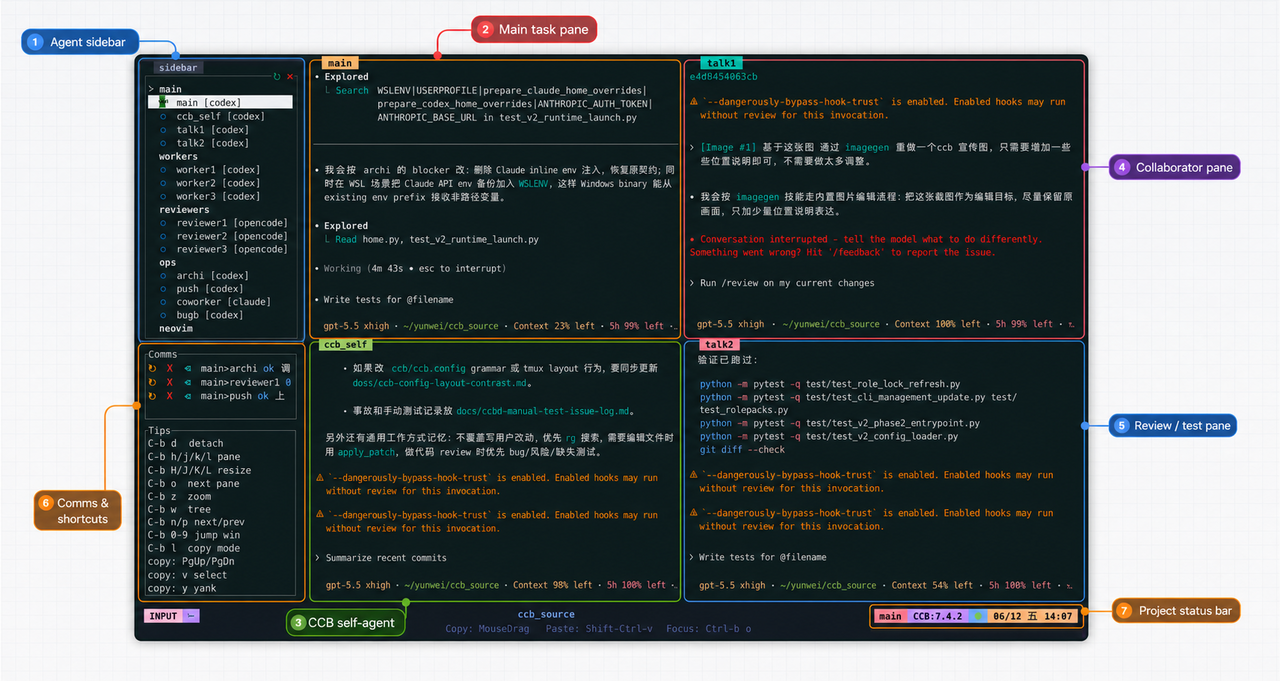
A lightweight multi-agent TUI with a stable cross-provider collaboration layer
Coordinate Codex, Claude, Gemini, and other CLI agents in visible, controllable workflows you can take over





中文 | English | 日本語 | Français | Deutsch | العربية | Español | Português | 한국어 | Русский
Quick Start · Message Queues · Mobile App · Rich Mode · Configure Agents · User Guide · Developer Guide
A -> B -> C, A,B -> C, and A -> B,C.Reuse verified plugin snapshots, share resolved dependencies, recover interrupted builds and honor startup timeout overrides. Verified with real Pi plugin loading and two-agent cold/warm startup. Notes.
Fix accepted jobs waiting behind native Codex fullscreen status/shortcut rows and ordinary replies mentioning esc to interrupt, while preserving human drafts, busy/menu guards and FIFO. Notes.
Recognize native Claude pasted envelopes and empty Codex composers with newer status bars; preserve draft protection. Notes.
Opening /model or another control-only selector no longer supersedes an
active OMP/Pi ask. CCB now waits for a real provider turn boundary before
classifying different user input as replacement work. See the
verification and upgrade guidance.
Claude and Codex preserve usable local history across account/key/gateway changes. Pi follows manual session switches; OMP accepts its newer history header format. See verified scope and upgrade guidance.
Codex composer detection no longer matches model names. Claude suggestion, accepted-draft and ordered return-delivery regressions accompany real continuous communication verification. Experimental Claude native plugins remain disabled. Install/update onboarding no longer recommends the six V3 preview roles; explicit installation and updates for installed roles remain available. See upgrade guidance and layout limitations.
Fix Codex recovery commands with duplicate resume arguments, abandoned OMP editor sockets, and padded Codex empty-input detection. Queue details now show input-guard waiting reasons. See upgrade guidance and remaining limitations.
Click a file or press Enter to open it with the system default application;
folders stay inside the file browser. Both safe and rich profiles use the same
behavior. macOS uses open; Linux prefers gio open, then xdg-open when GIO
is absent; WSL uses wslview from wslu to open with the Windows default app.
WSL requires enabled Windows interop and reports a missing bridge explicitly.
After upgrading CCB, run ccb update rich and reopen the file-browser pane.
See the 8.7.1 notes for validation and limitations.
Incoming agent messages wait while you compose a draft, avoiding interruption or accidental submission of your text together with a returned result. CCB first waits for the target agent's current turn to end, then checks the input box for the message at the front of the queue.
Requests (ask) and returned results (back) share one chronological FIFO
queue per target agent. Each message waits until the target finishes processing
the previous one, including returned results. Later replies cannot interrupt
an earlier reply's processing turn; different agents can still work in parallel.
We recommend testing these queue modes with Claude, Codex and OMP in managed tmux panes. Input protection for other providers will follow; their existing delivery behavior is unchanged and should not be assumed to protect drafts. OMP currently requires its default Status Band input layout and the new managed extension. After upgrading, restart the project when idle to load the new daemon and provider extensions.
This is a first version for testing. Codex/Claude deadline clearing uses Ctrl-C;
a simultaneous user action can still cause interruption. The final screen-check,
paste and Enter sequence is not atomic against typing at that exact instant.
See the 8.7.0 notes for tested
scope, upgrade guidance and the Codex remote-session recovery limitation.
Install or update an npm-managed CCB with npm:
npm install -g @seemseam/ccb@latest
For GitHub release-package or source installs, use CCB's transactional updater:
ccb update
On an npm-managed install, ccb update prints the equivalent npm command and
does not modify npm's vendored payload in place.
The Windows beta artifact is attached to the matching stable CCB GitHub
release. Download ccb-windows-x86_64.zip and its .sha256 sidecar, verify
the digest, extract the ZIP, then run:
.\install.ps1 install -Yes
ccb --print-version
It requires native Windows x64, Python 3.10+, WezTerm, Git Bash, and Herdr
0.8.0 or newer. The installer creates an install-local managed Python runtime.
The binaries are unsigned, and ccb update remains diagnostic-only for this
beta support tier; install a later Windows build by rerunning its validated
install.ps1.
CCB-managed provider panes suppress known provider-native startup update prompts.
After updating CCB—or immediately when CCB is already current—ccb update
checks installed provider CLIs and offers supported updates once. Use
--providers check, --providers all, or --providers none for explicit
report-only, non-interactive update, or skip behavior. Declining prompts again
on the next ccb update; skipping a version hides only that exact version.
CCB never restarts active provider panes during this flow, so an accepted
provider update applies when that pane next starts or is explicitly restarted.
After a release change, the newly installed CCB also retires old
project-scoped Claude/Gemini caches. Manifest-valid caches for deleted projects
are removed immediately. A stopped current project is cleaned immediately;
active or other existing projects are preserved and cleaned after their next
successful ccb kill. Unknown providers, malformed manifests, foreign
symlinks, sessions/auth, and the user-scoped Gemini cache are never removed by
this migration. Use ccb update --no-cache-cleanup to skip it for one update.
To roll back, use the same transactional updater with an older released version,
for example ccb update 8.1.3. CCB rejects a same-version artifact whose build
identity differs from the installed build, and restores the prior local prefix
if the update transaction fails. If restoration itself cannot complete, CCB
retains and reports the external recovery backup path.
If npm is not convenient in your environment, download the matching package from Releases, unpack it, and install:
tar -xzf ccb-*.tar.gz
cd ccb-*
./install.sh install
Source install is intended only for development or temporary fallback:
git clone https://github.com/SeemSeam/claude_codex_bridge.git
cd claude_codex_bridge
./install.sh install
Source install links global ccb / ask back to the checkout. Regular users should prefer the npm package.
Run this from your working directory:
ccb
If startup reports that .ccb cannot be created automatically or that the project anchor is missing, create .ccb manually:
mkdir -p .ccb
A blank project starts light: CCB opens one main window with a single agent named demo, selecting the first supported CLI available on the machine (Codex, Claude, Gemini, then other providers). It no longer mounts a multi-agent team by default.
Click the ⚙ Settings icon at the top-left of the CCB sidebar to open the local configuration control panel. You can also run ccb config ui from the project directory.
The Config UI always binds to loopback. To use a stable local port and token, configure a token source in .ccb/ccb.config; never put a literal token in that file:
[config_ui]
port = 43123
token_env = "CCB_CONFIG_UI_TOKEN"
# Or use this instead of token_env:
# token_file = ".ccb/config-ui.token"
--port remains a one-run override. token_file must be project-relative, non-symlinked, and owner-only (chmod 600 .ccb/config-ui.token on POSIX). Without a token source, CCB keeps the existing random token and ephemeral-port behavior. The CLI prints only the loopback URL and token source, never the token value.
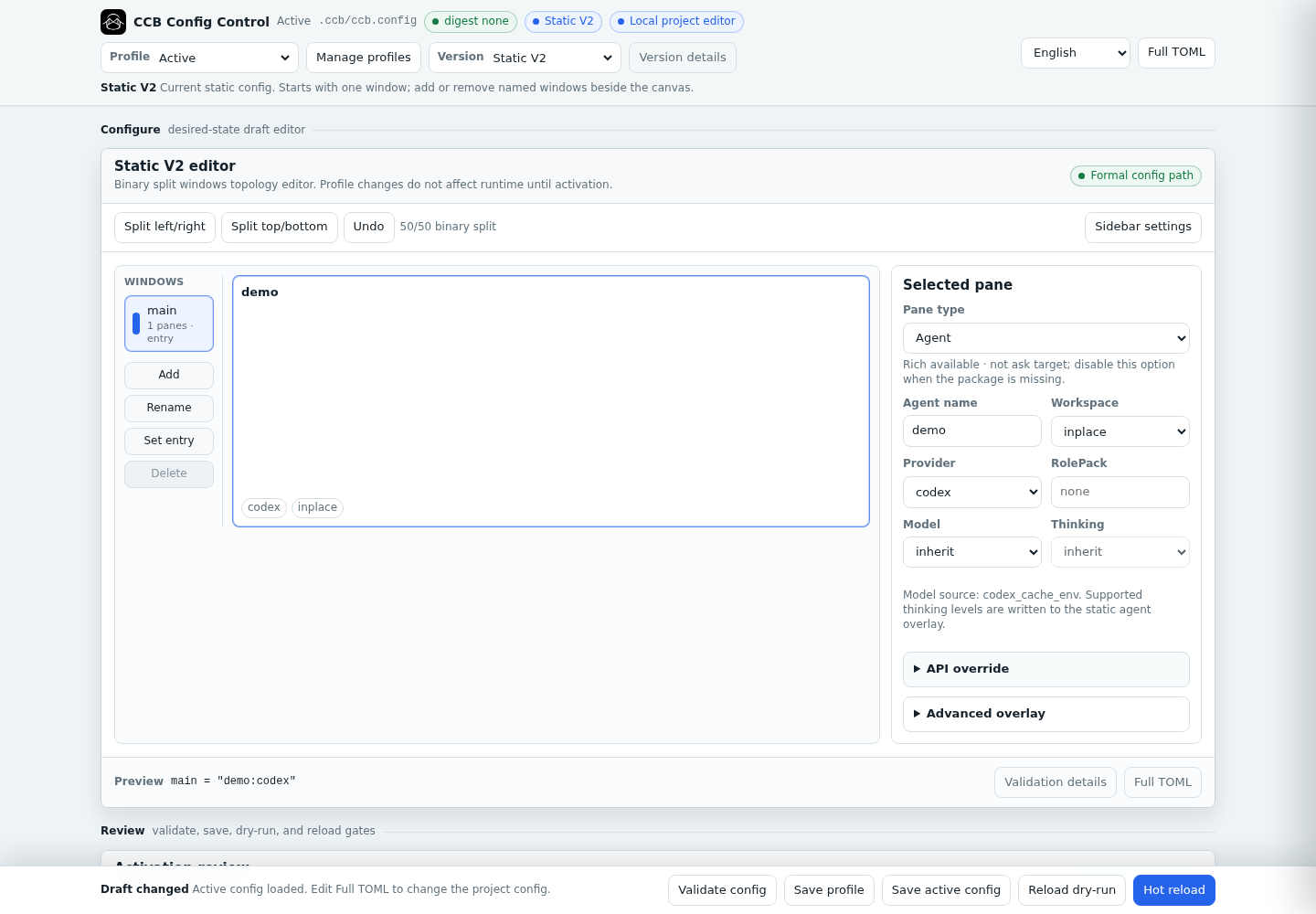
The panel edits windows, pane splits, providers, models, thinking levels, API overrides, workspaces, Rich mode, and sidebar settings. It validates changes before saving and supports reload dry-runs and guarded hot reload. Saving creates .ccb/ccb.config and pins the selected provider and topology for this project.
For an advanced multi-agent topology, edit it visually or create .ccb/ccb.config manually. In v2 [windows], , and ; control vertical stacking and horizontal splits inside each window, so A,B;C,D is close to a four-pane layout.
version = 2

[windows]
main = "main:codex"
work = "worker1:codex(worktree), worker2:claude(worktree)"
review = "reviewer:claude, qa:gemini"

[ui.sidebar]
mode = "every_window"
width = "15%"
bottom_height = 20
agents_height = "50%"
comms_height = "15%"
tips_height = "35%"
comms_limit = 3
Validate the config and start the workspace:
ccb config validate
ccb
You can type directly in any agent pane, or let agents collaborate:
/ask reviewer review the latest parser changes and list blocking issues.
Agents can also call /ask during workflow orchestration to delegate and hand off work. Use agent memory or the project-wide shared memory file .ccb/ccb_memory.md for durable coordination.
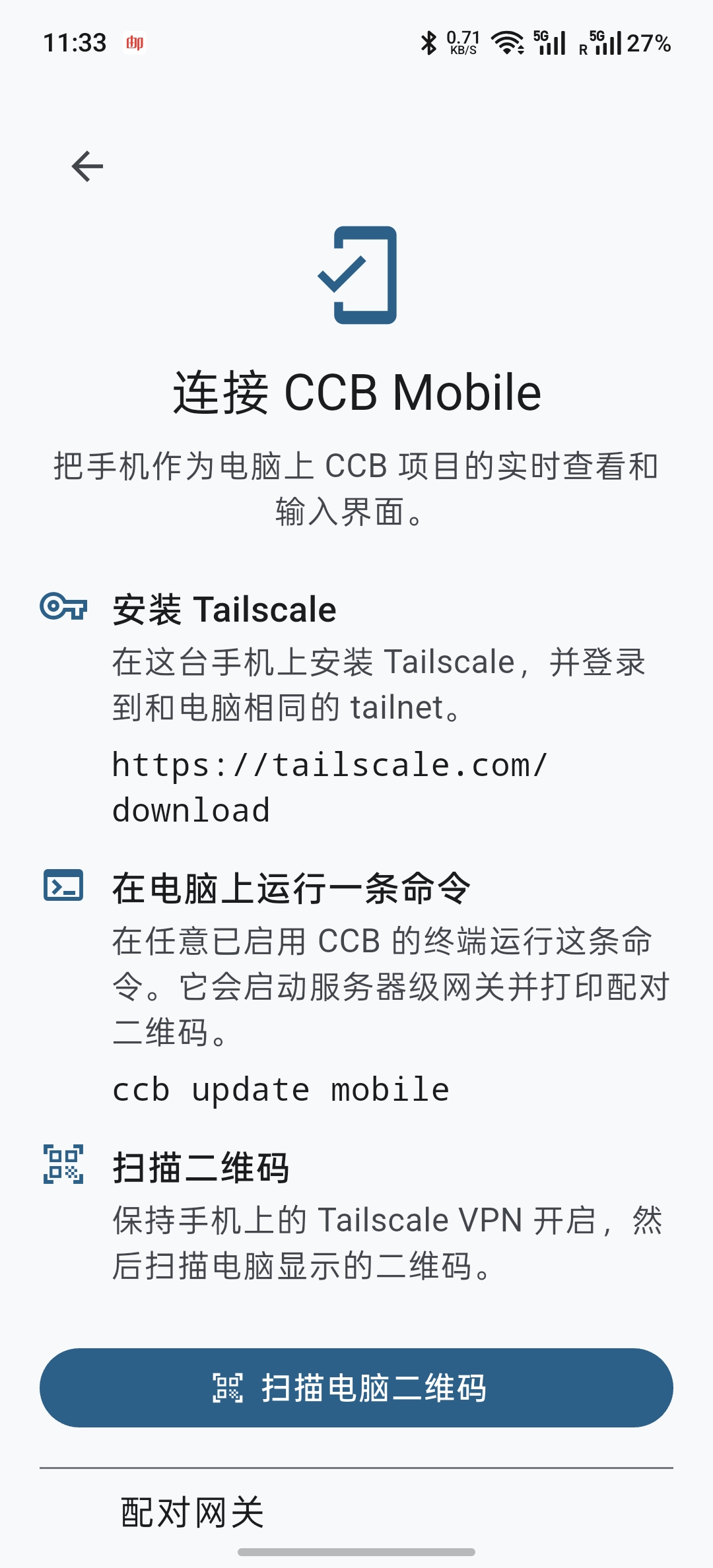
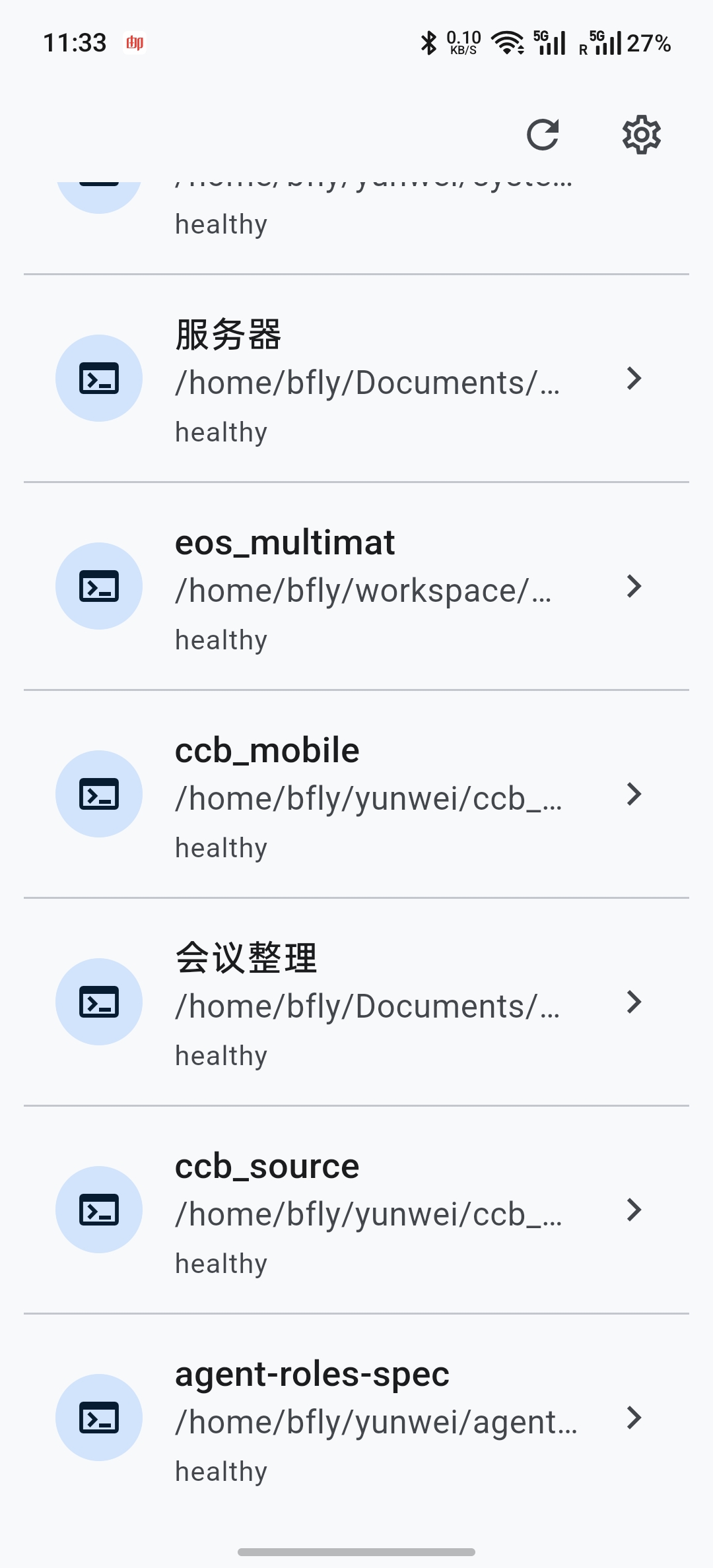
The recommended way to control CCB from a phone can connect to all CCB projects, control each agent, accept voice input, and transfer files.
ccb update mobile
This command guides installation and configuration.
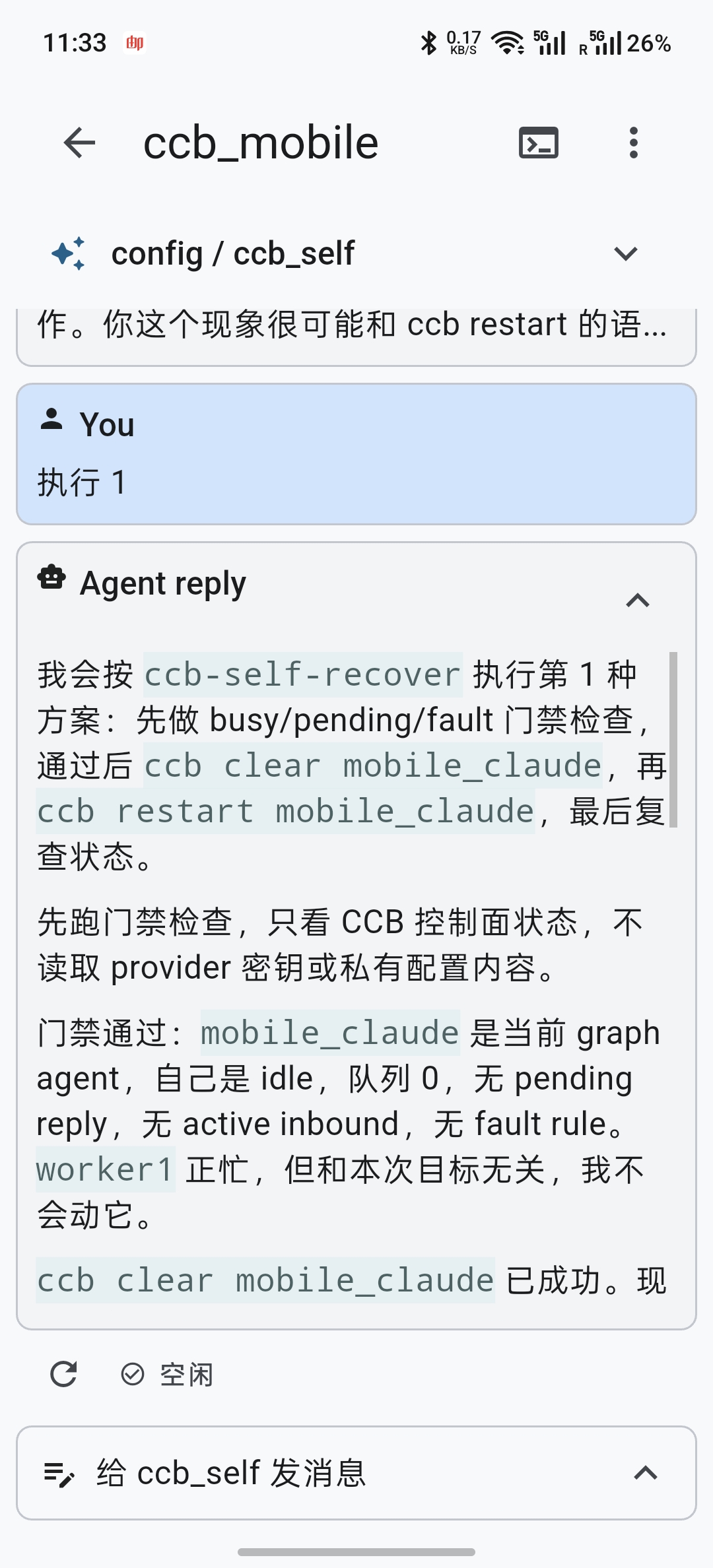
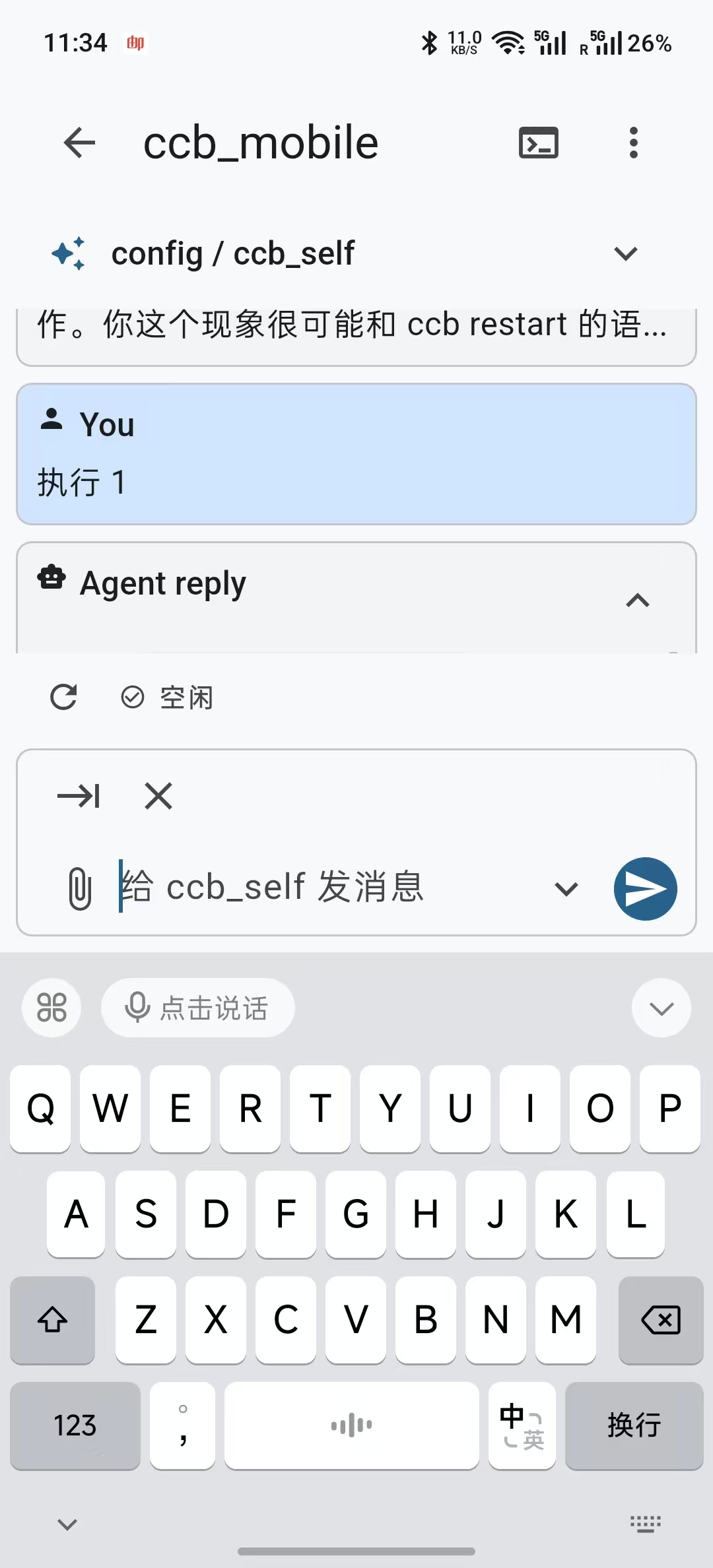
CCB 8.7.10 includes the Flutter CCB Mobile source in mobile/ and publishes the Android APK through GitHub Releases:
mobile/applib/mobile_gatewayThe phone app is a remote controller for real CCB projects running on a server. It can discover mounted projects from the server-wide mobile gateway, switch windows and agents, render agent conversation context, send text through pane-native input, open a terminal view, and upload/download images and documents through the authenticated gateway.
Safety boundary:
127.0.0.1:8787.ccb install mobile --route-provider lan --listen 192.168.31.155:8787. The pairing URL is inferred from --listen; no forwarding process or --public-url is needed.Browse file trees, open files, edit documents, and preview media inside the terminal.
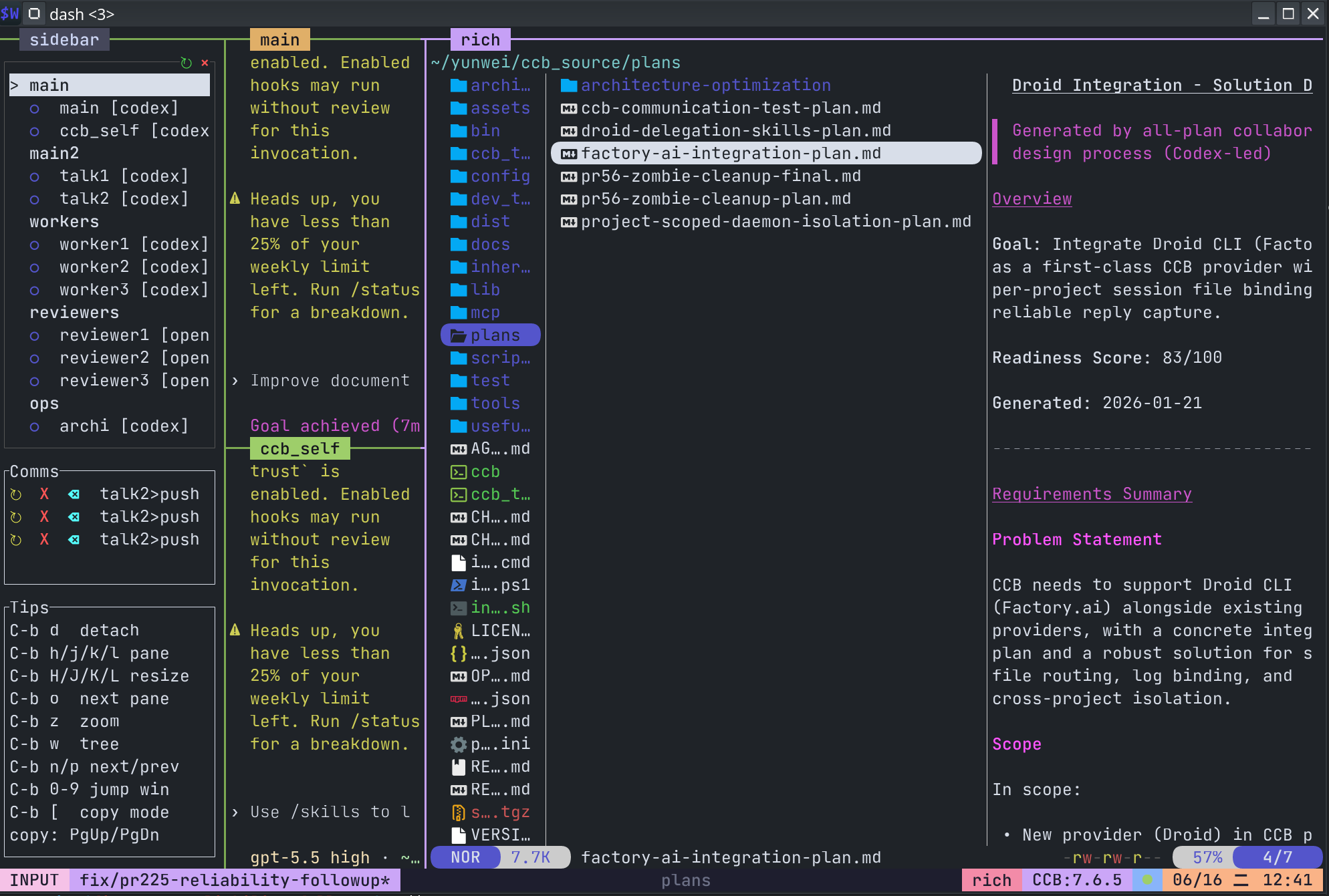
ccb update rich
After rich mode is enabled, plain ccb opens the rich WezTerm launcher automatically unless it is already running inside a CCB-managed rich WezTerm session. Run ccb uninstall rich to return to normal terminal startup.
CCB supports Agent Roles Spec, a host-neutral specification for packaging specialist agents. It can bundle skills, memory, and tool dependencies into installable, mountable, and removable Role Packs. That repository also serves as the public role catalog.
| Role | Purpose |
|---|---|
agentroles.ccb_self | CCB self-maintenance, config help, runtime diagnosis, protected recovery, and workflow orchestration. |
agentroles.archi | Architecture review, boundary checks, coupling analysis, maintainability risks, and follow-up gate advice. |
agentroles.frontend_engineer | Frontend design and implementation, design systems, accessibility, browser QA, and reviewed AGY delegation. |
agentroles.mobile_app_engineer | Mobile design and implementation for iOS, Android, React Native, Expo, Flutter, SwiftUI, Jetpack Compose, and more. |
agentroles.mother | Role creation, role source audit, role research, blueprint design, and Agent Roles spec compliance checks. |
agentroles.su_ccb | SU-CCB workflow operations for requirement analysis, planning, dispatch, review gates, archiving, and recovery. |
Use the ⚙ Settings control panel for normal project configuration. If you want agent-assisted configuration and runtime diagnosis, ccb_self remains available as an optional Role Pack and can be added with ccb roles add agentroles.ccb_self:codex.
Supported managed Agents receive the built-in ask, ccb-clear, ccb-compact, and ccb-diagnose control skills even when optional skill inheritance is disabled. Use $ccb_diagnose <agentname> to inspect one Agent's authoritative runtime/job state and live pane evidence, apply bounded recovery when safe, and review a redacted issue draft before explicitly authorizing GitHub submission. Managed Codex also keeps reconnect.
.ccb/ccb_memory.md is the project-wide shared memory document. Use it for team collaboration rules, project constraints, long-lived context, and agent handoff conventions. Stable cross-agent information belongs there instead of being copied into several provider-private memory files.
bfly123@126.comseemseam-com

WeChat group QR codes are valid for seven days. If this one has expired, add
seemseam-comto request the latest invitation.
Thanks to the Linux.do community for testing, feedback, and discussion.
Thanks to tmux-agent-sidebar for sidebar ideas and inspiration.
Reuse verified snapshots, deduplicate shared dependencies, recover interrupted staging and forward startup timeout settings.
Preserve Codex caller identity in native tool shells so bare ask results return to the correct Agent. Verified with actual Codex/OMP and Claude Sonnet 4.6 roundtrips.
Complete the Codex fullscreen delivery update and repair installed native ccb.exe/ccb.cmd entrypoints. Supersedes the interrupted v8.7.7 publication.
Fix accepted jobs waiting behind native Codex fullscreen status/shortcut rows and ordinary replies mentioning esc to interrupt, while preserving human drafts, busy/menu guards and FIFO.
Recognize native Claude pasted envelopes and empty Codex composers with newer status bars; preserve draft protection.
agentroles.ccb_self; workflow-specific ccb_* roles remain available to V3 rather than appearing in earlier schemas.0.149.0 custom providers while keeping route-only local gateways unauthenticated.dsh, using its loopback HTTP/WebSocket service and exact native turn evidence..ccb/workspaces/<agent>/... tree into authenticated Mobile download attachments..ccb runtime state remain unavailable.ccb config approve-commands for intentional values.ccb-compact Skill and ccb compact command with outstanding-work checks and fail-closed Provider command selection.ccb-clear in every supported managed Agent and add the required ccb-diagnose Skill. Run $ccb_diagnose <agentname> to combine daemon, lineage, queue, inbox, trace, provider-log, and live Pane evidence for one Agent.KIRO_HOME, forward Provider no-terminal timeout settings, and keep old Claude busy-turn records fenced from newly queued requests.codex-reconnect for managed Codex panes; terminal network and selected-model capacity failures receive one bounded continue recovery when the exact pane and thread are proven safe.resume.--chain as a real dependency only: independent asks, communication tests, batches, notifications, and reply-delivery acknowledgements no longer create false callback chains.agents.<name>.env into managed Claude launches while preserving CCB's API credential and endpoint precedence (PR #284).agent_settled message.CCB_PI_EXECUTION_MODE=headless rollback path.agent_settled event and OMP completion to agent_end.isTerminal=true, while waiting for process exit and output closure before terminalizing.yield remains a supported successful result.ask and ccb-clear controls for supported managed Agents even when optional skill inheritance is disabled; managed Codex also keeps reconnect.ccb update mobile: choose Tailscale, a validated private LAN address, CCB Relay, or a self-hosted Relay while the phone only scans a QR code or enters a pairing code.ccb update, with exact version checks, explicit decline/skip choices, and no automatic restart of active panes.--print / --config-dir execution.spawn_agent regression proving that callers receive only the parent final reply.ask and ccb-clear skills to each managed Grok home; normal starts use Grok's native bypassPermissions mode while safe starts keep approval enabled.watchdog installation through a configurable mirror after TLS or network failures.ccb config ui, with validation, diff review, save, reload dry-run, and guarded hot reload.demo, selecting the first locally available supported CLI; explicit project and user configs still support any single- or multi-agent topology.README/, added the real config-control screenshot, and synchronized package, Mobile, workflow, and release metadata for 8.1.0.ccb update mobile now uses more tolerant per-request and overall startup timeouts for the server-wide loopback /v1/health endpoint, avoiding false failures when many projects are mounted.auth.json, config.toml, company API sidecars, and safe auth/key/token sidecar filenames referenced by config.toml..ccb-auth-projection.json evidence manifests that record source and target presence, size, and SHA256 without storing secret values.ccb watch no longer defaults to a 10-second timeout./tmp/ccb-sock-* path, avoiding AF_UNIX path too long failures on macOS CI.ccb update mobile, README links, package metadata, and the mobile release manifest now point to the 8.0.12 APK.README/, with Chinese at README/zh.md.ccb update mobile into the unified Tailscale Tailnet onboarding entrypoint while keeping the gateway loopback-only, avoiding Funnel, not storing tokens, and not automatically modifying ACLs/grants.ccb-runtime-accelerator; installed Codex agents no longer silently fall back to the Python hot path when the sidecar is expected.ask calls now continue waiting for real provider/completion results instead of terminalizing as incomplete/heartbeat_timeout only because of heartbeat diagnostics.result_message, without heartbeat_timeout or incomplete evidence.See the full history in CHANGELOG.md.
46 followers · starred Feb 2026
214 followers · starred Dec 2025
167 followers · starred Feb 2026
59 followers · starred Jan 2026
Visible multi-agent CLI workspace for mixing Codex, Claude, Gemini, Kimi, Qwen, Cursor, Copilot, Pi, OpenCode, and other AI coding agents
Python
3,576
1,142 commits
updated Oct 13, 2026
A lightweight multi-agent TUI with a stable cross-provider collaboration layer
Coordinate Codex, Claude, Gemini, and other CLI agents in visible, controllable workflows you can take over
中文 | English | 日本語 | Français | Deutsch | العربية | Español | Português | 한국어 | Русский
Quick Start · Message Queues · Mobile App · Rich Mode · Configure Agents · User Guide · Developer Guide
A -> B -> C, A,B -> C, and A -> B,C.Reuse verified plugin snapshots, share resolved dependencies, recover interrupted builds and honor startup timeout overrides. Verified with real Pi plugin loading and two-agent cold/warm startup. Notes.
Fix accepted jobs waiting behind native Codex fullscreen status/shortcut rows and ordinary replies mentioning esc to interrupt, while preserving human drafts, busy/menu guards and FIFO. Notes.
Recognize native Claude pasted envelopes and empty Codex composers with newer status bars; preserve draft protection. Notes.
Opening /model or another control-only selector no longer supersedes an
active OMP/Pi ask. CCB now waits for a real provider turn boundary before
classifying different user input as replacement work. See the
verification and upgrade guidance.
Claude and Codex preserve usable local history across account/key/gateway changes. Pi follows manual session switches; OMP accepts its newer history header format. See verified scope and upgrade guidance.
Codex composer detection no longer matches model names. Claude suggestion, accepted-draft and ordered return-delivery regressions accompany real continuous communication verification. Experimental Claude native plugins remain disabled. Install/update onboarding no longer recommends the six V3 preview roles; explicit installation and updates for installed roles remain available. See upgrade guidance and layout limitations.
Fix Codex recovery commands with duplicate resume arguments, abandoned OMP editor sockets, and padded Codex empty-input detection. Queue details now show input-guard waiting reasons. See upgrade guidance and remaining limitations.
Click a file or press Enter to open it with the system default application;
folders stay inside the file browser. Both safe and rich profiles use the same
behavior. macOS uses open; Linux prefers gio open, then xdg-open when GIO
is absent; WSL uses wslview from wslu to open with the Windows default app.
WSL requires enabled Windows interop and reports a missing bridge explicitly.
After upgrading CCB, run ccb update rich and reopen the file-browser pane.
See the 8.7.1 notes for validation and limitations.
Incoming agent messages wait while you compose a draft, avoiding interruption or accidental submission of your text together with a returned result. CCB first waits for the target agent's current turn to end, then checks the input box for the message at the front of the queue.
Requests (ask) and returned results (back) share one chronological FIFO
queue per target agent. Each message waits until the target finishes processing
the previous one, including returned results. Later replies cannot interrupt
an earlier reply's processing turn; different agents can still work in parallel.
We recommend testing these queue modes with Claude, Codex and OMP in managed tmux panes. Input protection for other providers will follow; their existing delivery behavior is unchanged and should not be assumed to protect drafts. OMP currently requires its default Status Band input layout and the new managed extension. After upgrading, restart the project when idle to load the new daemon and provider extensions.
This is a first version for testing. Codex/Claude deadline clearing uses Ctrl-C;
a simultaneous user action can still cause interruption. The final screen-check,
paste and Enter sequence is not atomic against typing at that exact instant.
See the 8.7.0 notes for tested
scope, upgrade guidance and the Codex remote-session recovery limitation.
Install or update an npm-managed CCB with npm:
npm install -g @seemseam/ccb@latest
For GitHub release-package or source installs, use CCB's transactional updater:
ccb update
On an npm-managed install, ccb update prints the equivalent npm command and
does not modify npm's vendored payload in place.
The Windows beta artifact is attached to the matching stable CCB GitHub
release. Download ccb-windows-x86_64.zip and its .sha256 sidecar, verify
the digest, extract the ZIP, then run:
.\install.ps1 install -Yes
ccb --print-version
It requires native Windows x64, Python 3.10+, WezTerm, Git Bash, and Herdr
0.8.0 or newer. The installer creates an install-local managed Python runtime.
The binaries are unsigned, and ccb update remains diagnostic-only for this
beta support tier; install a later Windows build by rerunning its validated
install.ps1.
CCB-managed provider panes suppress known provider-native startup update prompts.
After updating CCB—or immediately when CCB is already current—ccb update
checks installed provider CLIs and offers supported updates once. Use
--providers check, --providers all, or --providers none for explicit
report-only, non-interactive update, or skip behavior. Declining prompts again
on the next ccb update; skipping a version hides only that exact version.
CCB never restarts active provider panes during this flow, so an accepted
provider update applies when that pane next starts or is explicitly restarted.
After a release change, the newly installed CCB also retires old
project-scoped Claude/Gemini caches. Manifest-valid caches for deleted projects
are removed immediately. A stopped current project is cleaned immediately;
active or other existing projects are preserved and cleaned after their next
successful ccb kill. Unknown providers, malformed manifests, foreign
symlinks, sessions/auth, and the user-scoped Gemini cache are never removed by
this migration. Use ccb update --no-cache-cleanup to skip it for one update.
To roll back, use the same transactional updater with an older released version,
for example ccb update 8.1.3. CCB rejects a same-version artifact whose build
identity differs from the installed build, and restores the prior local prefix
if the update transaction fails. If restoration itself cannot complete, CCB
retains and reports the external recovery backup path.
If npm is not convenient in your environment, download the matching package from Releases, unpack it, and install:
tar -xzf ccb-*.tar.gz
cd ccb-*
./install.sh install
Source install is intended only for development or temporary fallback:
git clone https://github.com/SeemSeam/claude_codex_bridge.git
cd claude_codex_bridge
./install.sh install
Source install links global ccb / ask back to the checkout. Regular users should prefer the npm package.
Run this from your working directory:
ccb
If startup reports that .ccb cannot be created automatically or that the project anchor is missing, create .ccb manually:
mkdir -p .ccb
A blank project starts light: CCB opens one main window with a single agent named demo, selecting the first supported CLI available on the machine (Codex, Claude, Gemini, then other providers). It no longer mounts a multi-agent team by default.
Click the ⚙ Settings icon at the top-left of the CCB sidebar to open the local configuration control panel. You can also run ccb config ui from the project directory.
The Config UI always binds to loopback. To use a stable local port and token, configure a token source in .ccb/ccb.config; never put a literal token in that file:
[config_ui]
port = 43123
token_env = "CCB_CONFIG_UI_TOKEN"
# Or use this instead of token_env:
# token_file = ".ccb/config-ui.token"
--port remains a one-run override. token_file must be project-relative, non-symlinked, and owner-only (chmod 600 .ccb/config-ui.token on POSIX). Without a token source, CCB keeps the existing random token and ephemeral-port behavior. The CLI prints only the loopback URL and token source, never the token value.
The panel edits windows, pane splits, providers, models, thinking levels, API overrides, workspaces, Rich mode, and sidebar settings. It validates changes before saving and supports reload dry-runs and guarded hot reload. Saving creates .ccb/ccb.config and pins the selected provider and topology for this project.
For an advanced multi-agent topology, edit it visually or create .ccb/ccb.config manually. In v2 [windows], , and ; control vertical stacking and horizontal splits inside each window, so A,B;C,D is close to a four-pane layout.
version = 2

[windows]
main = "main:codex"
work = "worker1:codex(worktree), worker2:claude(worktree)"
review = "reviewer:claude, qa:gemini"

[ui.sidebar]
mode = "every_window"
width = "15%"
bottom_height = 20
agents_height = "50%"
comms_height = "15%"
tips_height = "35%"
comms_limit = 3
Validate the config and start the workspace:
ccb config validate
ccb
You can type directly in any agent pane, or let agents collaborate:
/ask reviewer review the latest parser changes and list blocking issues.
Agents can also call /ask during workflow orchestration to delegate and hand off work. Use agent memory or the project-wide shared memory file .ccb/ccb_memory.md for durable coordination.
The recommended way to control CCB from a phone can connect to all CCB projects, control each agent, accept voice input, and transfer files.
ccb update mobile
This command guides installation and configuration.
CCB 8.7.10 includes the Flutter CCB Mobile source in mobile/ and publishes the Android APK through GitHub Releases:
mobile/applib/mobile_gatewayThe phone app is a remote controller for real CCB projects running on a server. It can discover mounted projects from the server-wide mobile gateway, switch windows and agents, render agent conversation context, send text through pane-native input, open a terminal view, and upload/download images and documents through the authenticated gateway.
Safety boundary:
127.0.0.1:8787.ccb install mobile --route-provider lan --listen 192.168.31.155:8787. The pairing URL is inferred from --listen; no forwarding process or --public-url is needed.Browse file trees, open files, edit documents, and preview media inside the terminal.
ccb update rich
After rich mode is enabled, plain ccb opens the rich WezTerm launcher automatically unless it is already running inside a CCB-managed rich WezTerm session. Run ccb uninstall rich to return to normal terminal startup.
CCB supports Agent Roles Spec, a host-neutral specification for packaging specialist agents. It can bundle skills, memory, and tool dependencies into installable, mountable, and removable Role Packs. That repository also serves as the public role catalog.
| Role | Purpose |
|---|---|
agentroles.ccb_self | CCB self-maintenance, config help, runtime diagnosis, protected recovery, and workflow orchestration. |
agentroles.archi | Architecture review, boundary checks, coupling analysis, maintainability risks, and follow-up gate advice. |
agentroles.frontend_engineer | Frontend design and implementation, design systems, accessibility, browser QA, and reviewed AGY delegation. |
agentroles.mobile_app_engineer | Mobile design and implementation for iOS, Android, React Native, Expo, Flutter, SwiftUI, Jetpack Compose, and more. |
agentroles.mother | Role creation, role source audit, role research, blueprint design, and Agent Roles spec compliance checks. |
agentroles.su_ccb | SU-CCB workflow operations for requirement analysis, planning, dispatch, review gates, archiving, and recovery. |
Use the ⚙ Settings control panel for normal project configuration. If you want agent-assisted configuration and runtime diagnosis, ccb_self remains available as an optional Role Pack and can be added with ccb roles add agentroles.ccb_self:codex.
Supported managed Agents receive the built-in ask, ccb-clear, ccb-compact, and ccb-diagnose control skills even when optional skill inheritance is disabled. Use $ccb_diagnose <agentname> to inspect one Agent's authoritative runtime/job state and live pane evidence, apply bounded recovery when safe, and review a redacted issue draft before explicitly authorizing GitHub submission. Managed Codex also keeps reconnect.
.ccb/ccb_memory.md is the project-wide shared memory document. Use it for team collaboration rules, project constraints, long-lived context, and agent handoff conventions. Stable cross-agent information belongs there instead of being copied into several provider-private memory files.
bfly123@126.comseemseam-com
WeChat group QR codes are valid for seven days. If this one has expired, add
seemseam-comto request the latest invitation.
Thanks to the Linux.do community for testing, feedback, and discussion.
Thanks to tmux-agent-sidebar for sidebar ideas and inspiration.
Reuse verified snapshots, deduplicate shared dependencies, recover interrupted staging and forward startup timeout settings.
Preserve Codex caller identity in native tool shells so bare ask results return to the correct Agent. Verified with actual Codex/OMP and Claude Sonnet 4.6 roundtrips.
Complete the Codex fullscreen delivery update and repair installed native ccb.exe/ccb.cmd entrypoints. Supersedes the interrupted v8.7.7 publication.
Fix accepted jobs waiting behind native Codex fullscreen status/shortcut rows and ordinary replies mentioning esc to interrupt, while preserving human drafts, busy/menu guards and FIFO.
Recognize native Claude pasted envelopes and empty Codex composers with newer status bars; preserve draft protection.
agentroles.ccb_self; workflow-specific ccb_* roles remain available to V3 rather than appearing in earlier schemas.0.149.0 custom providers while keeping route-only local gateways unauthenticated.dsh, using its loopback HTTP/WebSocket service and exact native turn evidence..ccb/workspaces/<agent>/... tree into authenticated Mobile download attachments..ccb runtime state remain unavailable.ccb config approve-commands for intentional values.ccb-compact Skill and ccb compact command with outstanding-work checks and fail-closed Provider command selection.ccb-clear in every supported managed Agent and add the required ccb-diagnose Skill. Run $ccb_diagnose <agentname> to combine daemon, lineage, queue, inbox, trace, provider-log, and live Pane evidence for one Agent.KIRO_HOME, forward Provider no-terminal timeout settings, and keep old Claude busy-turn records fenced from newly queued requests.codex-reconnect for managed Codex panes; terminal network and selected-model capacity failures receive one bounded continue recovery when the exact pane and thread are proven safe.resume.--chain as a real dependency only: independent asks, communication tests, batches, notifications, and reply-delivery acknowledgements no longer create false callback chains.agents.<name>.env into managed Claude launches while preserving CCB's API credential and endpoint precedence (PR #284).agent_settled message.CCB_PI_EXECUTION_MODE=headless rollback path.agent_settled event and OMP completion to agent_end.isTerminal=true, while waiting for process exit and output closure before terminalizing.yield remains a supported successful result.ask and ccb-clear controls for supported managed Agents even when optional skill inheritance is disabled; managed Codex also keeps reconnect.ccb update mobile: choose Tailscale, a validated private LAN address, CCB Relay, or a self-hosted Relay while the phone only scans a QR code or enters a pairing code.ccb update, with exact version checks, explicit decline/skip choices, and no automatic restart of active panes.--print / --config-dir execution.spawn_agent regression proving that callers receive only the parent final reply.ask and ccb-clear skills to each managed Grok home; normal starts use Grok's native bypassPermissions mode while safe starts keep approval enabled.watchdog installation through a configurable mirror after TLS or network failures.ccb config ui, with validation, diff review, save, reload dry-run, and guarded hot reload.demo, selecting the first locally available supported CLI; explicit project and user configs still support any single- or multi-agent topology.README/, added the real config-control screenshot, and synchronized package, Mobile, workflow, and release metadata for 8.1.0.ccb update mobile now uses more tolerant per-request and overall startup timeouts for the server-wide loopback /v1/health endpoint, avoiding false failures when many projects are mounted.auth.json, config.toml, company API sidecars, and safe auth/key/token sidecar filenames referenced by config.toml..ccb-auth-projection.json evidence manifests that record source and target presence, size, and SHA256 without storing secret values.ccb watch no longer defaults to a 10-second timeout./tmp/ccb-sock-* path, avoiding AF_UNIX path too long failures on macOS CI.ccb update mobile, README links, package metadata, and the mobile release manifest now point to the 8.0.12 APK.README/, with Chinese at README/zh.md.ccb update mobile into the unified Tailscale Tailnet onboarding entrypoint while keeping the gateway loopback-only, avoiding Funnel, not storing tokens, and not automatically modifying ACLs/grants.ccb-runtime-accelerator; installed Codex agents no longer silently fall back to the Python hot path when the sidecar is expected.ask calls now continue waiting for real provider/completion results instead of terminalizing as incomplete/heartbeat_timeout only because of heartbeat diagnostics.result_message, without heartbeat_timeout or incomplete evidence.See the full history in CHANGELOG.md.
46 followers · starred Feb 2026
214 followers · starred Dec 2025
167 followers · starred Feb 2026
59 followers · starred Jan 2026