
See what people are saying
README
SledTrace


A local debugger for RAG pipelines. When your app gives a wrong answer, SledTrace shows you why: what the retriever returned, what the model was given, what it said, and where those disagree.
Everything runs on your machine. No account, no API key, nothing uploaded.
Quickstart
pip install sledtrace
sledtrace serve
Your browser opens the dashboard at http://127.0.0.1:4319. Now send it a
trace. Save this as first_trace.py and run it in another terminal:
from sledtrace import trace

question = "How many days do customers have to return items after delivery?"

with trace(name="refund-question", query=question) as t:
    t.retrieval(
        query=question,
        chunks=[
            {"id": "policy-2024", "text": "Customers can return items within 30 days of delivery.",
             "score": 0.82, "metadata": {"source": "refund_policy.md"}},
            {"id": "policy-2021", "text": "Customers can return items within 14 days of delivery.",
             "score": 0.79, "metadata": {"source": "legacy_refund_policy.md"}},
        ],
    )
    t.llm(model="demo-model", prompt=question,
          response="Customers have 45 days to return items after delivery.")

print(t.flush())
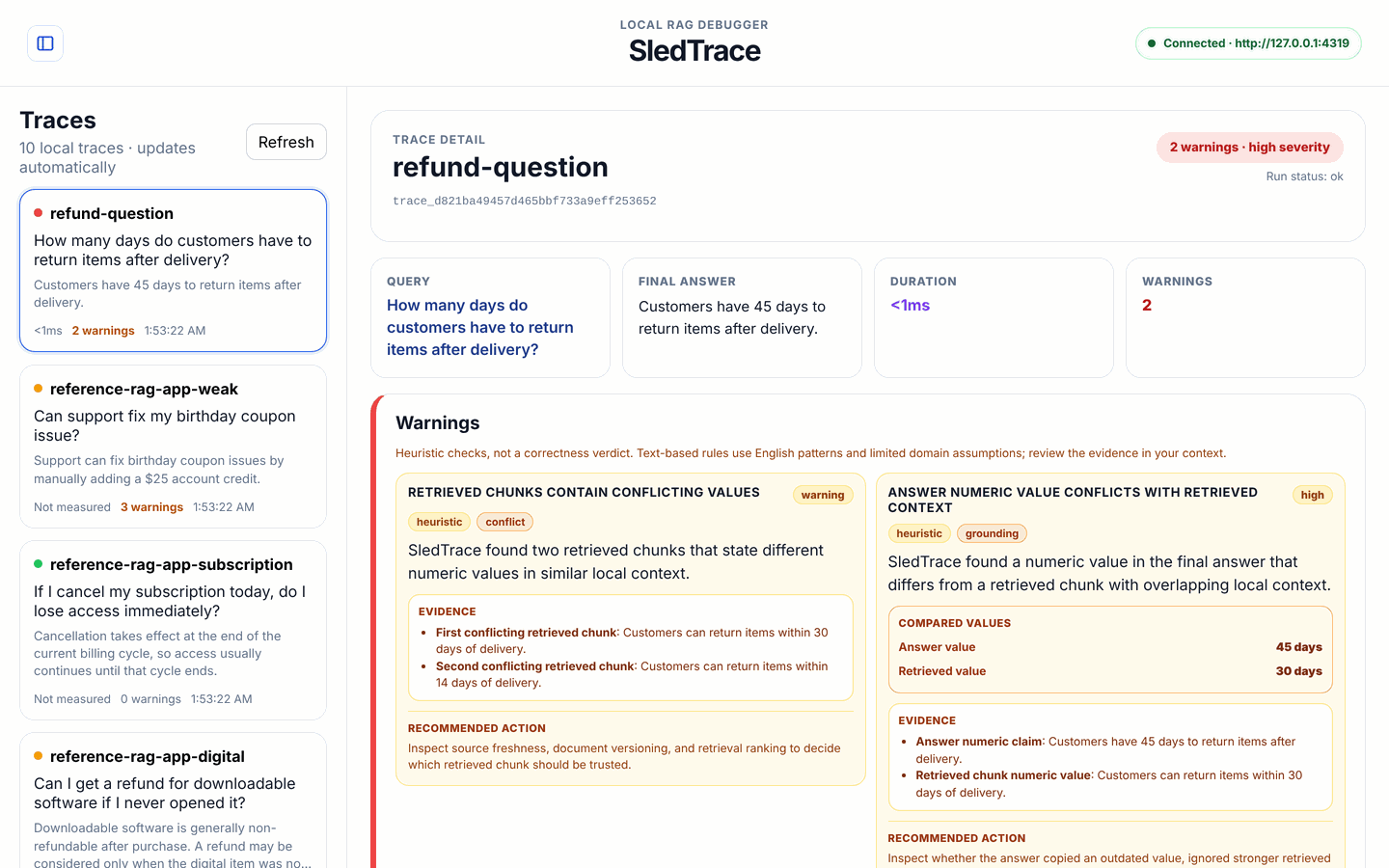
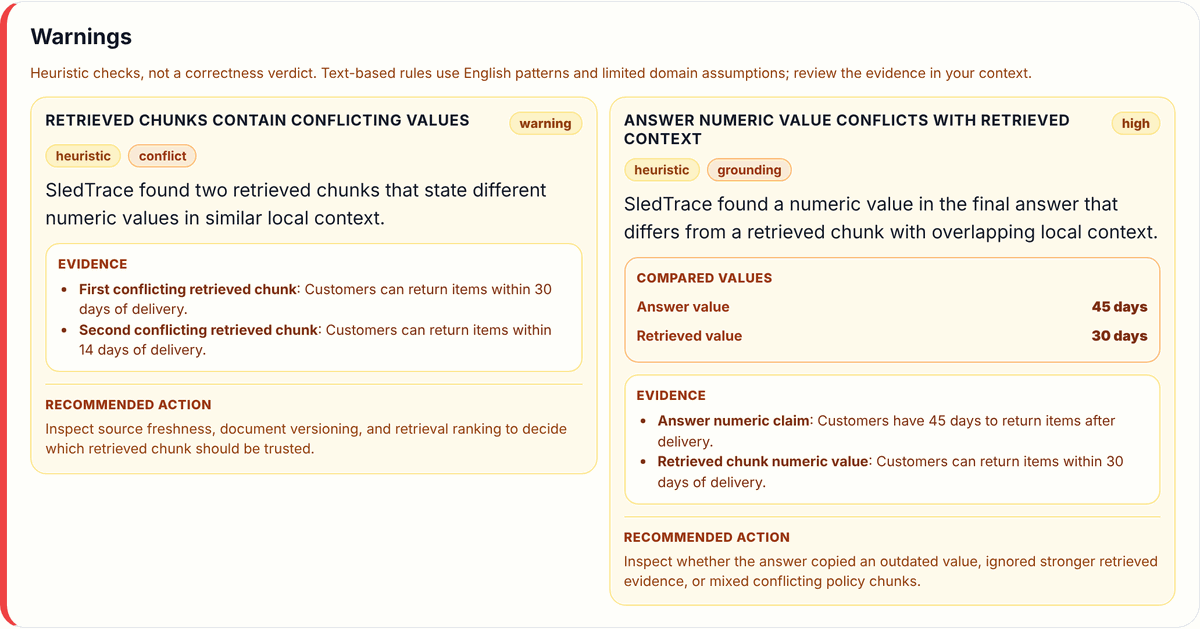
Refresh the dashboard and open refund-question. SledTrace points out that the two retrieved policies contradict each other, and that the answer's "45 days" isn't supported by either of them:
Ready to trace your own app? Follow the 5-minute quickstart.
What it catches
| Warning | Meaning |
|---|---|
no_retrieved_chunks | The retriever returned nothing usable |
low_retrieval_score | Even the best chunk scored low |
duplicate_chunks | The same text was retrieved more than once |
weak_query_chunk_overlap | Top chunks barely mention the question's key terms |
conflicting_chunks | Retrieved chunks disagree with each other |
numeric_mismatch | A number in the answer contradicts the retrieved context |
answer_not_grounded | A claim in the answer is weakly supported by the context |
Every warning shows the evidence behind it and what to check next. The rules are deterministic heuristics that run locally; no LLM judges your data. See warning rules for how each one works and where it falls short.
SledTrace also records tool calls, the final task result, timing, and LLM token usage. Values it doesn't know are shown as unknown, never as zero.
How it works
your Python app ──(sledtrace SDK)──▶ local collector ──▶ SQLite
                                        │
                                        └──▶ dashboard in your browser
You add a few calls to your request path (trace, retrieval, llm). The SDK
sends each finished trace to the collector that sledtrace serve starts; the
collector runs the warning rules and stores everything in
~/.sledtrace/sledtrace.db.
Limits
- Python only, with explicit calls: there are no automatic LangChain or LlamaIndex integrations yet.
- Warnings are heuristics built on English text patterns, not a correctness verdict.
- Token usage is recorded only when you pass it (for example with
sledtrace.openai.record_response); cost estimates are indicative. - Local, single-user tool: no hosting, authentication or team features.
- Prebuilt
sledtrace servefor Windows, macOS and Linux (x86-64 and ARM64). On other platforms, run from source.
Documentation
- Quickstart: instrument your own RAG app.
- Python SDK guide: full API reference.
- Warning rules: what each warning checks.
- Development setup: run from source, Docker, demos, configuration.
- Contributing and release notes.
- Renaming from RAGLens:
raglensimports still work.
Why "SledTrace"?
Named after my husky. A RAG pipeline is like a sled team: retrievers, rerankers and LLMs all pulling together. When the sled goes off course, you read the tracks in the snow to find out which dog stumbled. SledTrace shows you the tracks.
License
Similar repos


Languages
Python
49.5%
Go
30.5%
TypeScript
11.1%
CSS
4.3%
JavaScript
3.4%
See what people are saying
README
SledTrace
A local debugger for RAG pipelines. When your app gives a wrong answer, SledTrace shows you why: what the retriever returned, what the model was given, what it said, and where those disagree.
Everything runs on your machine. No account, no API key, nothing uploaded.
Quickstart
pip install sledtrace
sledtrace serve
Your browser opens the dashboard at http://127.0.0.1:4319. Now send it a
trace. Save this as first_trace.py and run it in another terminal:
from sledtrace import trace

question = "How many days do customers have to return items after delivery?"

with trace(name="refund-question", query=question) as t:
    t.retrieval(
        query=question,
        chunks=[
            {"id": "policy-2024", "text": "Customers can return items within 30 days of delivery.",
             "score": 0.82, "metadata": {"source": "refund_policy.md"}},
            {"id": "policy-2021", "text": "Customers can return items within 14 days of delivery.",
             "score": 0.79, "metadata": {"source": "legacy_refund_policy.md"}},
        ],
    )
    t.llm(model="demo-model", prompt=question,
          response="Customers have 45 days to return items after delivery.")

print(t.flush())
Refresh the dashboard and open refund-question. SledTrace points out that the two retrieved policies contradict each other, and that the answer's "45 days" isn't supported by either of them:
Ready to trace your own app? Follow the 5-minute quickstart.
What it catches
| Warning | Meaning |
|---|---|
no_retrieved_chunks | The retriever returned nothing usable |
low_retrieval_score | Even the best chunk scored low |
duplicate_chunks | The same text was retrieved more than once |
weak_query_chunk_overlap | Top chunks barely mention the question's key terms |
conflicting_chunks | Retrieved chunks disagree with each other |
numeric_mismatch | A number in the answer contradicts the retrieved context |
answer_not_grounded | A claim in the answer is weakly supported by the context |
Every warning shows the evidence behind it and what to check next. The rules are deterministic heuristics that run locally; no LLM judges your data. See warning rules for how each one works and where it falls short.
SledTrace also records tool calls, the final task result, timing, and LLM token usage. Values it doesn't know are shown as unknown, never as zero.
How it works
your Python app ──(sledtrace SDK)──▶ local collector ──▶ SQLite
                                        │
                                        └──▶ dashboard in your browser
You add a few calls to your request path (trace, retrieval, llm). The SDK
sends each finished trace to the collector that sledtrace serve starts; the
collector runs the warning rules and stores everything in
~/.sledtrace/sledtrace.db.
Limits
- Python only, with explicit calls: there are no automatic LangChain or LlamaIndex integrations yet.
- Warnings are heuristics built on English text patterns, not a correctness verdict.
- Token usage is recorded only when you pass it (for example with
sledtrace.openai.record_response); cost estimates are indicative. - Local, single-user tool: no hosting, authentication or team features.
- Prebuilt
sledtrace servefor Windows, macOS and Linux (x86-64 and ARM64). On other platforms, run from source.
Documentation
- Quickstart: instrument your own RAG app.
- Python SDK guide: full API reference.
- Warning rules: what each warning checks.
- Development setup: run from source, Docker, demos, configuration.
- Contributing and release notes.
- Renaming from RAGLens:
raglensimports still work.
Why "SledTrace"?
Named after my husky. A RAG pipeline is like a sled team: retrievers, rerankers and LLMs all pulling together. When the sled goes off course, you read the tracks in the snow to find out which dog stumbled. SledTrace shows you the tracks.
License
Similar repos
Languages
Python
49.5%
Go
30.5%
TypeScript
11.1%
CSS
4.3%
JavaScript
3.4%