Python
12
15 commits
updated Mar 5, 2025
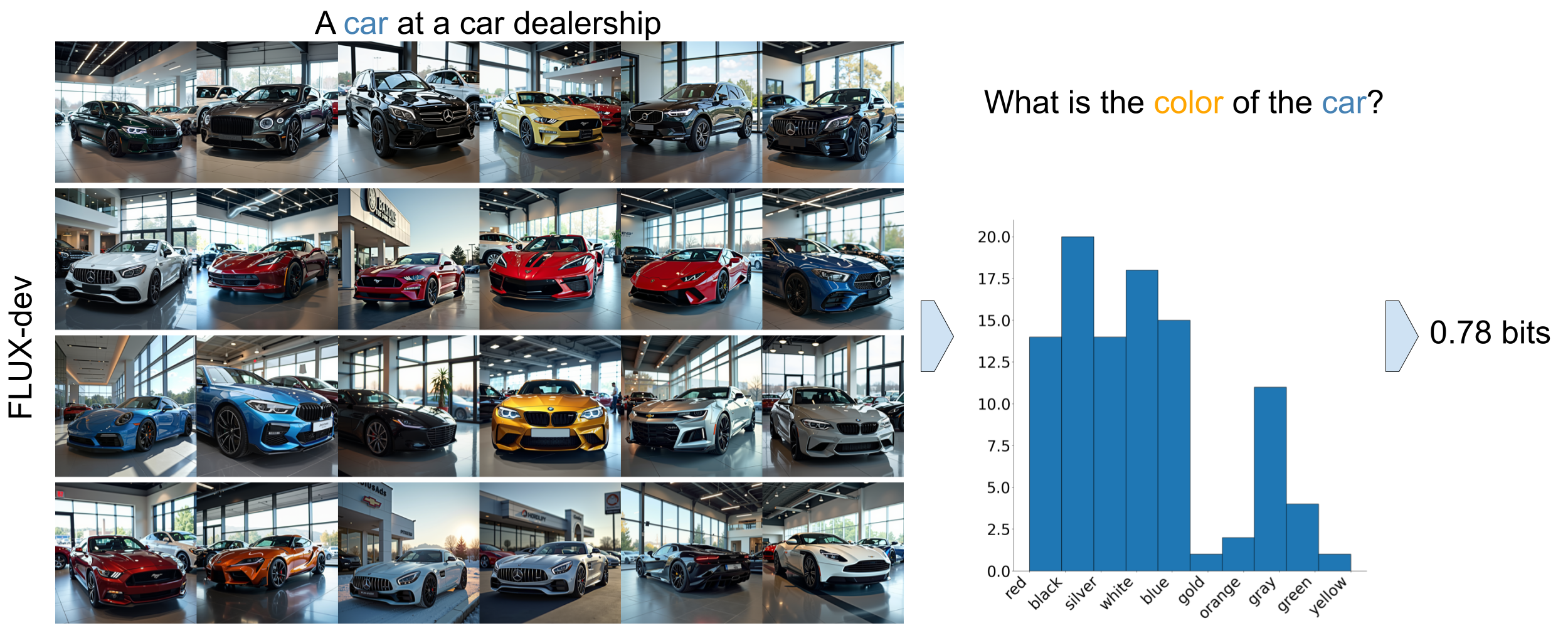
We introduce GRADE, a method for assessing the output diversity of images generated by text-to-image (T2I) models. Leveraging Large Language Models (LLMs) and Visual Question Answering (Visual-QA) systems, GRADE quantifies diversity across concept-specific attributes by estimating attribute distributions and calculating normalized entropy.
In the paper, our findings reveal substantial homogeneity in T2I outputs, with low diversity observed across all 12 models tested. Surprisingly, larger and more prompt-adherent models exhibit reduced diversity. We hypothesize that this low diversity stems from reporting bias in the training data. Additionally, we demonstrate that the diversity in the LAION dataset closely corresponds to the diversity of Stable Diffusion 1 and 2 models, which were trained on it.
To use GRADE for assessing the diversity of your text-to-image model outputs, follow these steps:
Install Dependencies:
pip install -r requirements.txt
Set Up OpenAI API Key
Since GRADE utilizes OpenAI's GPT models, you need an OpenAI API key to use it.
oai_key.txt in the base directory of the project.You can either provide a list of concepts or use an existing dataset.
Option A: Provide Concepts
Create a text file containing the concepts you wish to evaluate. Each concept should be on a new line.
Example (concepts.txt):
a cookie
an ice cream
a helmet
a tree
Option B: Use an Existing Dataset
If you already have a dataset of prompts, attributes (questions), and attribute values, place it in the datasets/ directory and ensure it's in CSV format (your_dataset_name.csv).
Use the grade.py script to process your concepts or dataset.
python grade.py [arguments]
Arguments
--model_name: (Required) The name of the text-to-image model to assess. Default choices are:
'sdxl', 'sdxl-turbo', 'sd-1.4', 'sd-2.1', 'lcm-sdxl', 'deepfloyd-xl', 'deepfloyd-l', 'deepfloyd-m', 'sd-3', 'sd-1.1', 'flux-schnell', 'flux-dev'.--concepts_path: Path to your concepts file (use if you chose Option A).--dataset_name: Name of your dataset (use if you chose Option B).--num_images_per_prompt: Number of images to generate per concept (default: 100).--gpu_id: GPU ID to use for image generation (default: 0).--batch_size: Batch size for image generation (default: 1).--vqa_model: VQA model to use (default: 'gpt-4o').--compute_for_single_prompt_distributions: Type of distributions to estimate and compute diversity (default: 'False').--report_default_behaviors: Report default behaviors or not (default: 'False').Example Usage
To quickly test GRADE with your own concepts, you can run the following command:
python grade.py --model_name 'flux-schnell' --concepts_path 'concepts.txt' --num_images_per_prompt 25
This command will:
concepts.txt using the FLUX-schnell model.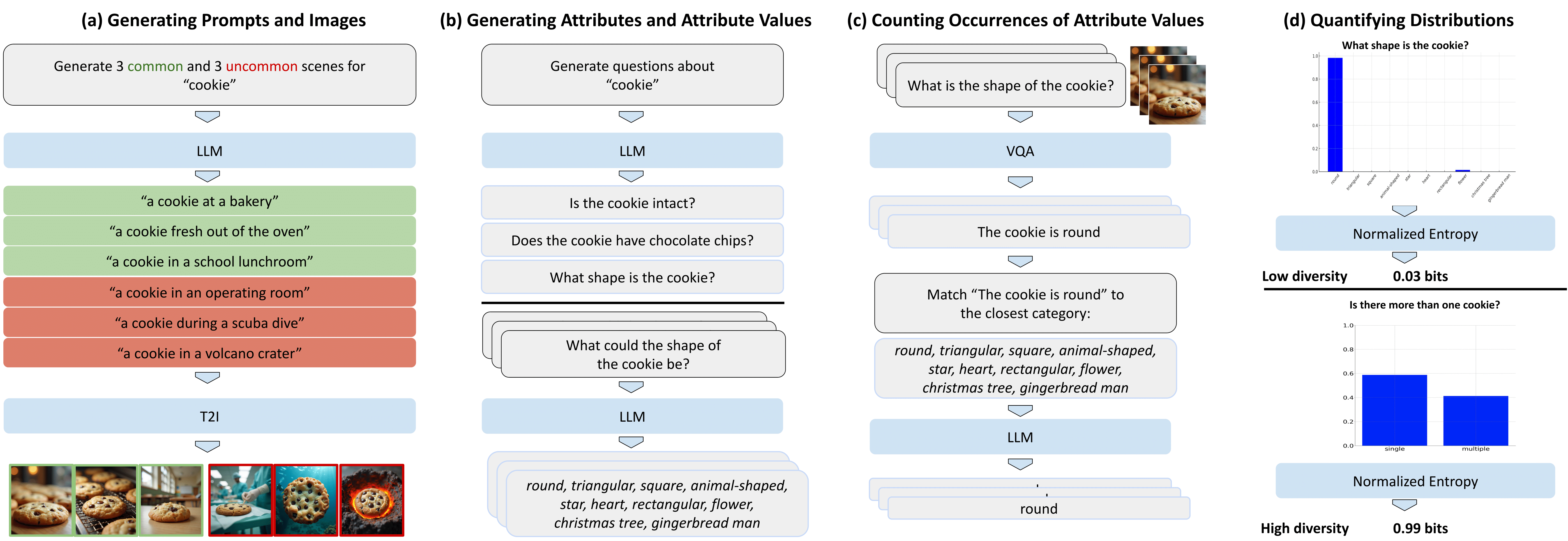
The grade.py script performs the following stages:
Data Generation
Image Generation
generated_images/model_name/dataset_name/.Attribute Extraction
results/model_name/dataset_name/extracted_attribute_values.csv.Diversity Computation
The extracted attribute values and the default behaviors are stored in the results/ directory:
results/model_name/dataset_name/extracted_attribute_values.csvresults/model_name/dataset_name/default_behaviors/multi_prompt_default_behaviors.csvYou can open these CSV files to review the detailed results. The total diversity score is printed to the console.
Custom Models
If you have a custom text-to-image model, you can integrate it into the load_model and generate_images methods in the image_generation.py script.
GRADE is Modular
GRADE is modular in essence and supports different Language Models and Visual Question Answering (VQA) models. While the default is OpenAI's GPT-4 (denoted as 'gpt-4o'), we are working on an opensource variant.
If you use this code or our results in your research, please cite as:
@misc{rassin2024gradequantifyingsamplediversity,
  title={GRADE: Quantifying Sample Diversity in Text-to-Image Models},
  author={Royi Rassin and Aviv Slobodkin and Shauli Ravfogel and Yanai Elazar and Yoav Goldberg},
  year={2024},
  eprint={2410.22592},
  archivePrefix={arXiv},
  primaryClass={cs.CV},
  url={https://arxiv.org/abs/2410.22592},
}
Python
12
15 commits
updated Mar 5, 2025
We introduce GRADE, a method for assessing the output diversity of images generated by text-to-image (T2I) models. Leveraging Large Language Models (LLMs) and Visual Question Answering (Visual-QA) systems, GRADE quantifies diversity across concept-specific attributes by estimating attribute distributions and calculating normalized entropy.
In the paper, our findings reveal substantial homogeneity in T2I outputs, with low diversity observed across all 12 models tested. Surprisingly, larger and more prompt-adherent models exhibit reduced diversity. We hypothesize that this low diversity stems from reporting bias in the training data. Additionally, we demonstrate that the diversity in the LAION dataset closely corresponds to the diversity of Stable Diffusion 1 and 2 models, which were trained on it.
To use GRADE for assessing the diversity of your text-to-image model outputs, follow these steps:
Install Dependencies:
pip install -r requirements.txt
Set Up OpenAI API Key
Since GRADE utilizes OpenAI's GPT models, you need an OpenAI API key to use it.
oai_key.txt in the base directory of the project.You can either provide a list of concepts or use an existing dataset.
Option A: Provide Concepts
Create a text file containing the concepts you wish to evaluate. Each concept should be on a new line.
Example (concepts.txt):
a cookie
an ice cream
a helmet
a tree
Option B: Use an Existing Dataset
If you already have a dataset of prompts, attributes (questions), and attribute values, place it in the datasets/ directory and ensure it's in CSV format (your_dataset_name.csv).
Use the grade.py script to process your concepts or dataset.
python grade.py [arguments]
Arguments
--model_name: (Required) The name of the text-to-image model to assess. Default choices are:
'sdxl', 'sdxl-turbo', 'sd-1.4', 'sd-2.1', 'lcm-sdxl', 'deepfloyd-xl', 'deepfloyd-l', 'deepfloyd-m', 'sd-3', 'sd-1.1', 'flux-schnell', 'flux-dev'.--concepts_path: Path to your concepts file (use if you chose Option A).--dataset_name: Name of your dataset (use if you chose Option B).--num_images_per_prompt: Number of images to generate per concept (default: 100).--gpu_id: GPU ID to use for image generation (default: 0).--batch_size: Batch size for image generation (default: 1).--vqa_model: VQA model to use (default: 'gpt-4o').--compute_for_single_prompt_distributions: Type of distributions to estimate and compute diversity (default: 'False').--report_default_behaviors: Report default behaviors or not (default: 'False').Example Usage
To quickly test GRADE with your own concepts, you can run the following command:
python grade.py --model_name 'flux-schnell' --concepts_path 'concepts.txt' --num_images_per_prompt 25
This command will:
concepts.txt using the FLUX-schnell model.
The grade.py script performs the following stages:
Data Generation
Image Generation
generated_images/model_name/dataset_name/.Attribute Extraction
results/model_name/dataset_name/extracted_attribute_values.csv.Diversity Computation
The extracted attribute values and the default behaviors are stored in the results/ directory:
results/model_name/dataset_name/extracted_attribute_values.csvresults/model_name/dataset_name/default_behaviors/multi_prompt_default_behaviors.csvYou can open these CSV files to review the detailed results. The total diversity score is printed to the console.
Custom Models
If you have a custom text-to-image model, you can integrate it into the load_model and generate_images methods in the image_generation.py script.
GRADE is Modular
GRADE is modular in essence and supports different Language Models and Visual Question Answering (VQA) models. While the default is OpenAI's GPT-4 (denoted as 'gpt-4o'), we are working on an opensource variant.
If you use this code or our results in your research, please cite as:
@misc{rassin2024gradequantifyingsamplediversity,
  title={GRADE: Quantifying Sample Diversity in Text-to-Image Models},
  author={Royi Rassin and Aviv Slobodkin and Shauli Ravfogel and Yanai Elazar and Yoav Goldberg},
  year={2024},
  eprint={2410.22592},
  archivePrefix={arXiv},
  primaryClass={cs.CV},
  url={https://arxiv.org/abs/2410.22592},
}



